boot PEUGEOT 5008 2015 User Guide
[x] Cancel search | Manufacturer: PEUGEOT, Model Year: 2015, Model line: 5008, Model: PEUGEOT 5008 2015Pages: 364, PDF Size: 12.82 MB
Page 53 of 364
51
Alarm
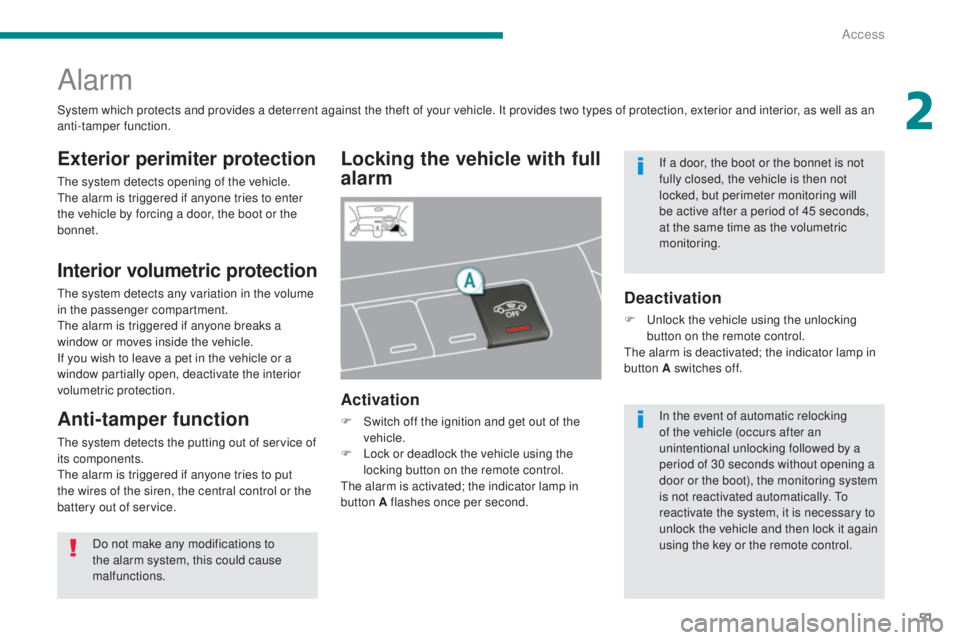
Locking the vehicle with full
alarm
Exterior perimiter protection
The system detects opening of the vehicle.
The alarm is triggered if anyone tries to enter
the vehicle by forcing a door, the boot or the
bonnet.
Interior volumetric protection
The system detects any variation in the volume
in the passenger compartment.
The alarm is triggered if anyone breaks a
window or moves inside the vehicle.
If you wish to leave a pet in the vehicle or a
window partially open, deactivate the interior
volumetric protection.
Anti-tamper function
The system detects the putting out of service of
its components.
The alarm is triggered if anyone tries to put
the wires of the siren, the central control or the
battery out of service.
Activation
F Switch off the ignition and get out of the
vehicle.
F
L
ock or deadlock the vehicle using the
locking button on the remote control.
The alarm is activated; the indicator lamp in
button A flashes once per second.
System which protects and provides a deterrent against the theft of your vehicle. It provides two types of protection, exterior and interior, as well as an
anti-tamper function.
Do not make any modifications to
the alarm system, this could cause
malfunctions. If a door, the boot or the bonnet is not
fully closed, the vehicle is then not
locked, but perimeter monitoring will
be active after a period of 45 seconds,
at the same time as the volumetric
monitoring.
In the event of automatic relocking
of the vehicle (occurs after an
unintentional unlocking followed by a
period of 30 seconds without opening a
door or the boot), the monitoring system
is not reactivated automatically. To
reactivate the system, it is necessary to
unlock the vehicle and then lock it again
using the key or the remote control.
Deactivation
F Unlock the vehicle using the unlocking
button on the remote control.
The alarm is deactivated; the indicator lamp in
button A switches off.
2
Access
Page 54 of 364
52
Reactivation of the interior
volumetric protection
F Unlock the vehicle using the unlocking button on the remote control.
F
R
elock the vehicle using the remote control.
The alarm is activated again with both types
of protection; the indicator lamp in button A
switches off.
Locking the vehicle with
exterior protection alarm only
Deactivation of the interior
volumetric protection
F Switch off the ignition.
F W ithin ten seconds, press button A until
the indicator lamp is on continuously.
F
G
et out of the vehicle.
F
L
ock or deadlock the vehicle using the
locking button on the remote control.
The exterior protection alarm alone remains
activated; the indicator lamp in button A flashes
once per second.
Triggering
This is indicated by sounding of the siren
and flashing of the direction indicators for
approximately thirty seconds.
After it has been triggered, the alarm is again
operational.
Failure of the remote control
F Unlock the vehicle using the key in the driver's door lock.
F
O
pen the door; the alarm is triggered.
F
S
witch on the ignition; the alarm stops.
Malfunction
When the ignition is switched on, illumination
the indicator lamp in button A for ten seconds
indicates a siren fault.
Have it checked by a PEUGEOT dealer or a
qualified workshop.
Locking the vehicle without
activating the alarm
F Lock or deadlock the vehicle using the key in the driver's door lock.
The direction indicators do not come on.
Automatic operation*
Depending on the legislation in force in your
country, one of these cases may occur:
-
4
5 seconds after the vehicle is locked
using the remote control, the alarm is
activated, regardless of the status of the
doors and boot.
-
2 m
inutes after the last door or the boot is
closed, the alarm is activated.
F
T
o avoid triggering the alarm on entering
the vehicle, first press the unlocking
button on the remote control.
To be effective, this deactivation must
be carried out each time the ignition is
switched off.
If the alarm is triggered ten times in
succession, the eleventh time will result
in it becoming inactive.
If the indicator lamp in button A flashes
rapidly, this indicates that the alarm was
triggered during your absence. When
the ignition is switched on, this flashing
stops immediately.
To avoid triggering the alarm when
washing your vehicle, lock it using the
key in the driver's door lock.
Do not activate the alarm before
disconnecting the battery, otherwise the
siren will sound.
* Depending on the country of sale.
Access
Page 57 of 364
55
Doors
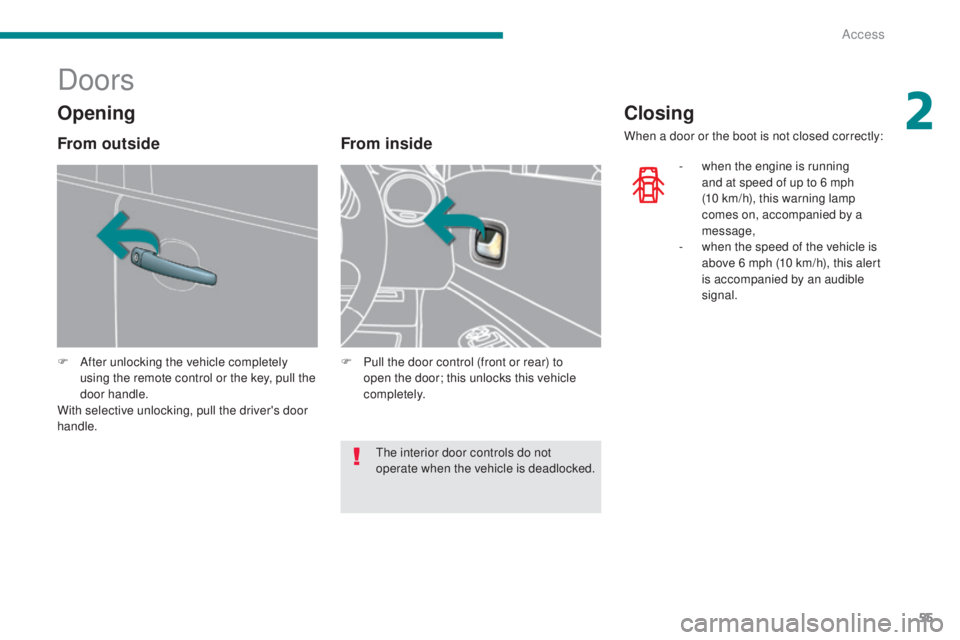
F After unlocking the vehicle completely using the remote control or the key, pull the
door handle.
With selective unlocking, pull the driver's door
handle.
From inside
F Pull the door control (front or rear) to open the door; this unlocks this vehicle
completely.
Closing
When a door or the boot is not closed correctly:
-
w
hen the engine is running
and at speed of up to 6 mph
(10
km/h), this warning lamp
comes on, accompanied by a
message,
-
w
hen the speed of the vehicle is
above 6 mph (10 km/h), this alert
is accompanied by an audible
signal.
Opening
From outside
The interior door controls do not
operate when the vehicle is deadlocked.
2
Access
Page 58 of 364
56
A confirmation message is displayed,
accompanied by an audible signal.
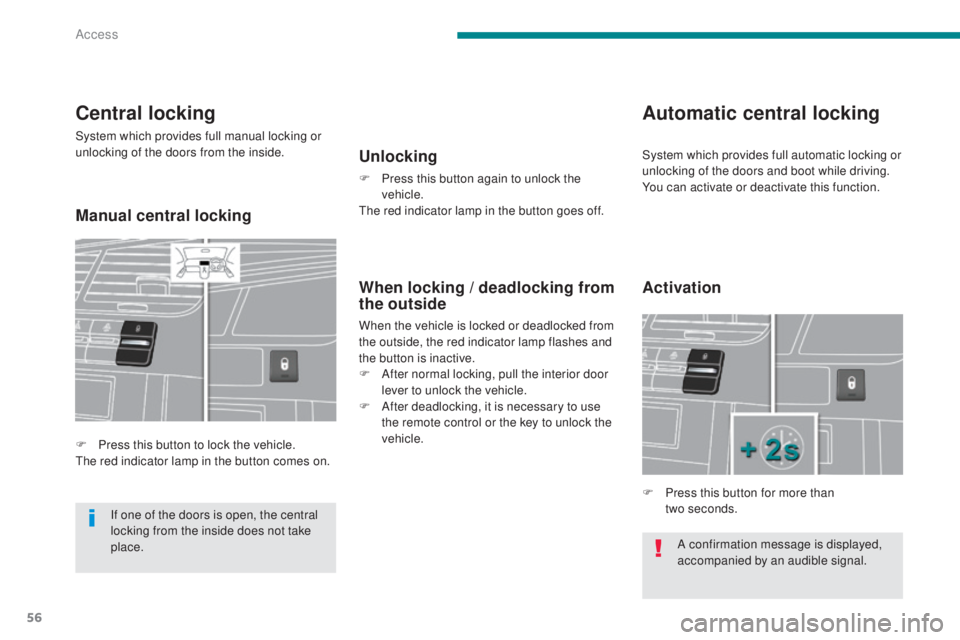
Central locking
System which provides full manual locking or
unlocking of the doors from the inside.
F
P
ress this button to lock the vehicle.
The red indicator lamp in the button comes on.
Automatic central locking
Unlocking
F Press this button again to unlock the vehicle.
The red indicator lamp in the button goes off.
When locking / deadlocking from
the outside
When the vehicle is locked or deadlocked from
the outside, the red indicator lamp flashes and
the button is inactive.
F
A
fter normal locking, pull the interior door
lever to unlock the vehicle.
F
A
fter deadlocking, it is necessary to use
the remote control or the key to unlock the
vehicle.
If one of the doors is open, the central
locking from the inside does not take
place. F
P
ress this button for more than
two
seconds.
Activation
System which provides full automatic locking or
unlocking of the doors and boot while driving.
You can activate or deactivate this function.
Manual central locking
Access
Page 59 of 364
57
Emergency control
System allowing the doors to be locked and
unlocked manually in the event of a malfunction
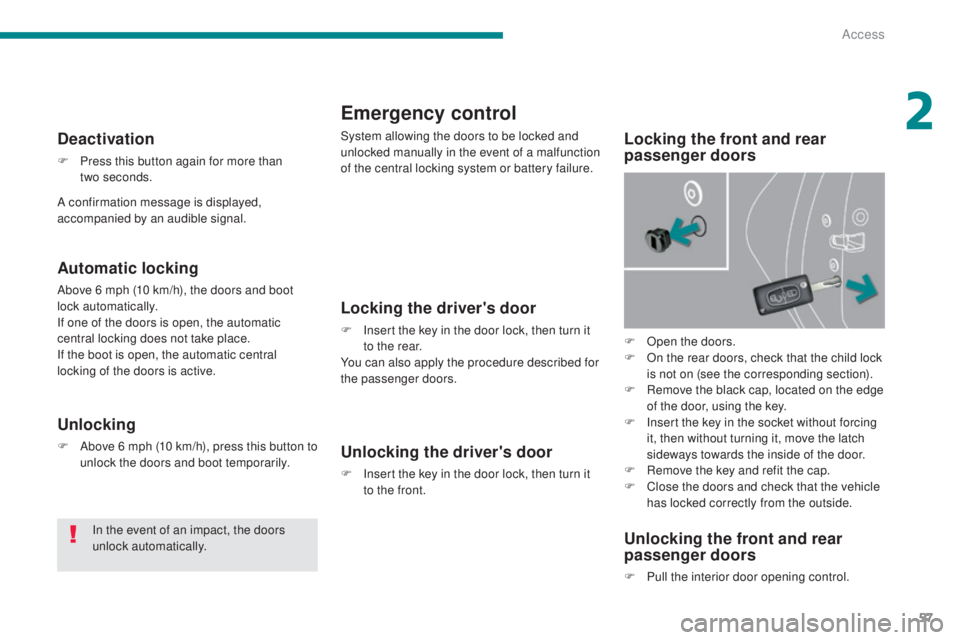
of the central locking system or battery failure.Locking the front and rear
passenger doors
Locking the driver's door
F Insert the key in the door lock, then turn it to the rear.
You can also apply the procedure described for
the passenger doors.
Unlocking the driver's door
F Insert the key in the door lock, then turn it to the front.
Unlocking the front and rear
passenger doors
F Pull the interior door opening control.
Automatic locking
Above 6 mph (10 km/h), the doors and boot
lock automatically.
If one of the doors is open, the automatic
central locking does not take place.
If the boot is open, the automatic central
locking of the doors is active.
Deactivation
F Press this button again for more than two seconds.
Unlocking
F Above 6 mph (10 km/h), press this button to unlock the doors and boot temporarily.
In the event of an impact, the doors
unlock automatically. F
O
pen the doors.
F
O
n the rear doors, check that the child lock
is not on (see the corresponding section).
F
R
emove the black cap, located on the edge
of the door, using the key.
F
I
nsert the key in the socket without forcing
it, then without turning it, move the latch
sideways towards the inside of the door.
F
R
emove the key and refit the cap.
F
C
lose the doors and check that the vehicle
has locked correctly from the outside.
A confirmation message is displayed,
accompanied by an audible signal.
2
Access
Page 60 of 364
58
Boot
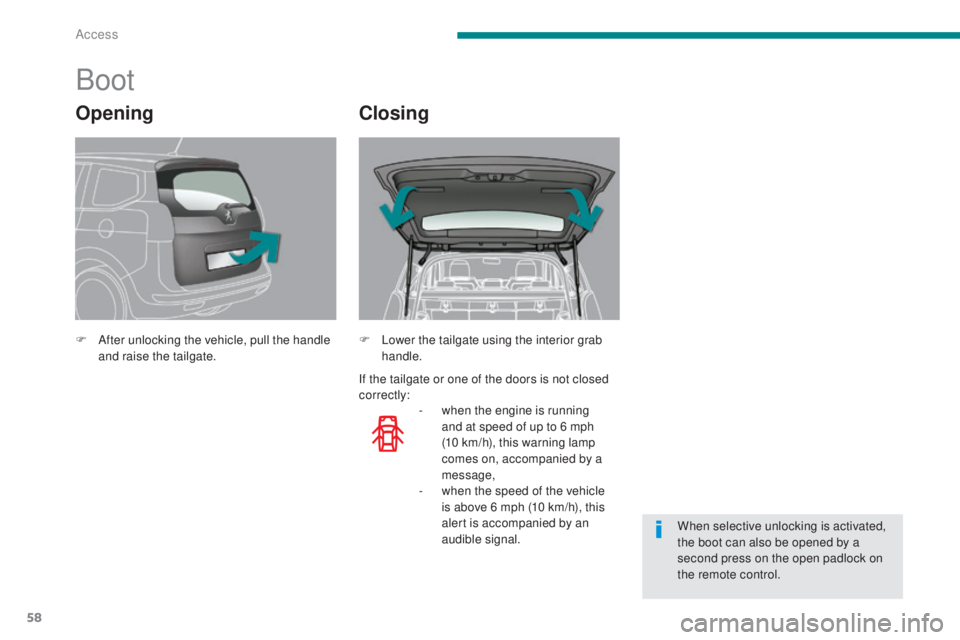
F After unlocking the vehicle, pull the handle and raise the tailgate.
-
w
hen the engine is running
and at speed of up to 6 mph
(10
km/h), this warning lamp
comes on, accompanied by a
message,
-
w
hen the speed of the vehicle
is above 6 mph (10 km/h), this
alert is accompanied by an
audible signal.
F
L ower the tailgate using the interior grab
handle.
When selective unlocking is activated,
the boot can also be opened by a
second press on the open padlock on
the remote control.
OpeningClosing
If the tailgate or one of the doors is not closed
correctly:
Access
Page 61 of 364
59
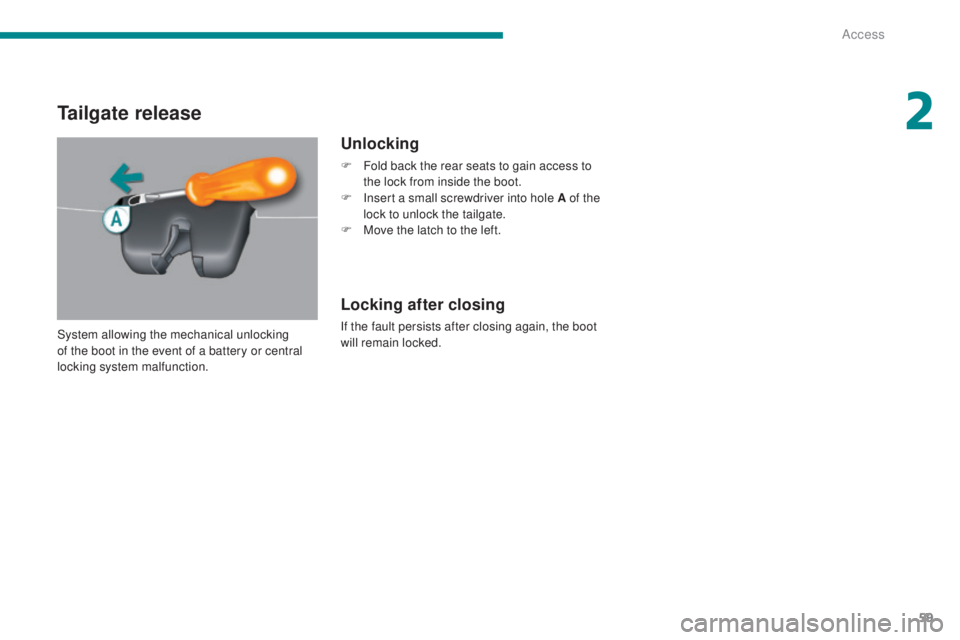
Tailgate release
Unlocking
F Fold back the rear seats to gain access to the lock from inside the boot.
F
I
nsert a small screwdriver into hole A of the
lock to unlock the tailgate.
F
M
ove the latch to the left.
Locking after closing
If the fault persists after closing again, the boot
will remain locked.
System allowing the mechanical unlocking
of the boot in the event of a battery or central
locking system malfunction.
2
Access
Page 63 of 364
61
The air conditioning system does not
contain chlorine and does not present
any danger to the ozone layer.Recommendations for ventilation and air conditioning
In order for these systems to be fully effective, follow the operation and maintenance
guidelines below:
F
I
f the interior temperature remains very high after the vehicle has been parked in the sun
for a considerable time, first ventilate the passenger compartment for a few minutes.
P
lace the air flow control at a sufficient level to provide an adequate renewal of air in the
passenger compartment.
F
T
o obtain an even air distribution, take care not to obstruct the exterior air intake grilles
located at the base of the windscreen, the nozzles, the vents and the air outlets, as well
as the air extractor located in the boot.
F
I
n normal conditions, use the intake of exterior air as prolonged use of the air
recirculation may cause misting of the windows and side windows.
F
D
o not cover the sunshine sensor, located on the dashboard; this is used for regulation
of the automatic air conditioning system.
F
O
perate the air conditioning system for 5 to 10 minutes, once or twice a month to keep it
in good working order.
F
E
nsure that the passenger compartment filter is in good condition and have the filter
elements replaced regularly (refer to the "Checks" section).
W
e recommend the use of a combined passenger compartment filter. Thanks to its
second special active filter, it contributes to the purification of the air breathed by the
occupants and the cleanliness of the passenger compartment (reduction of allergic
symptoms, bad odours and greasy deposits).
F
T
he air conditioning uses power from the engine while operating. This results in an
increase in the vehicle's fuel consumption.
W
hen towing at or near maximum capacity or on steep slopes in high ambient
temperatures, switching off the air conditioning saves engine power and so improves
towing capacity.
C
ondensation created by the air conditioning results in a discharge of water under the
vehicle when stationary, which is per fectly normal.
F
T
o ensure correct operation of the air conditioning system, you are also advised to have
it checked regularly.
F
I
f the system does not produce cold air, do not use it and contact a PEUGEOT dealer or
a qualified workshop.
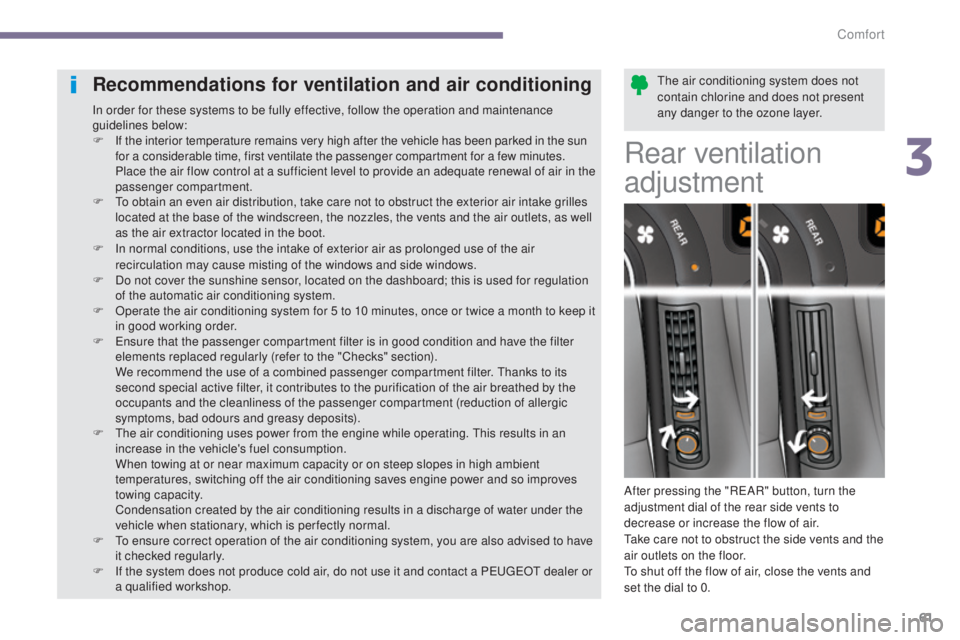
Rear ventilation
adjustment
After pressing the "REAR" button, turn the
adjustment dial of the rear side vents to
decrease or increase the flow of air.
Take care not to obstruct the side vents and the
air outlets on the floor.
To shut off the flow of air, close the vents and
set the dial to 0.
3
Comfort
Page 76 of 364
74
Flat floor
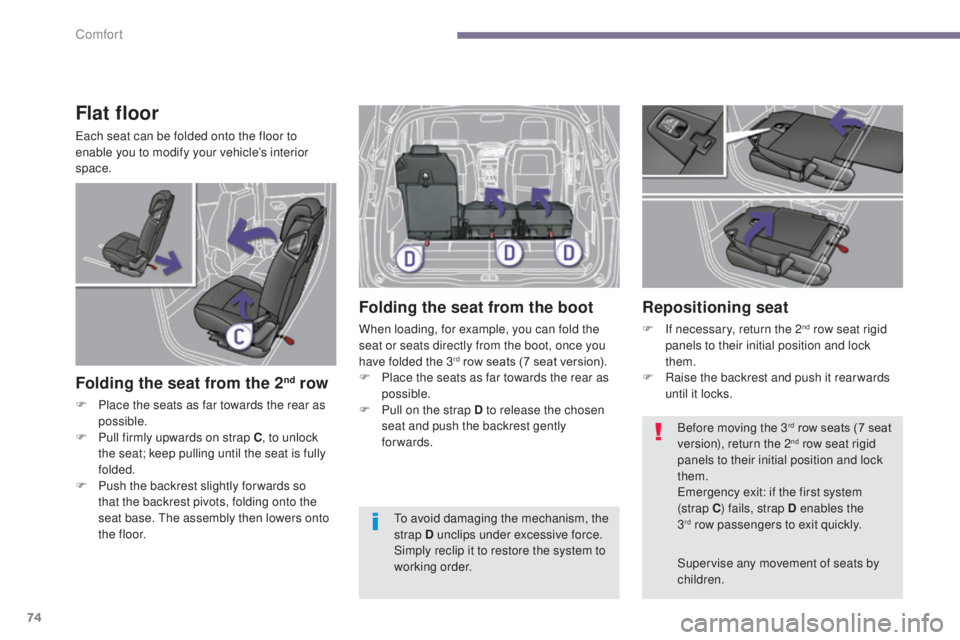
Each seat can be folded onto the floor to
enable you to modify your vehicle’s interior
space.
Folding the seat from the 2nd row
F Place the seats as far towards the rear as possible.
F
P
ull firmly upwards on strap C , to unlock
the seat; keep pulling until the seat is fully
folded.
F
P
ush the backrest slightly for wards so
that the backrest pivots, folding onto the
seat base. The assembly then lowers onto
t h e
f l o o r.
Folding the seat from the boot
When loading, for example, you can fold the
seat or seats directly from the boot, once you
have folded the 3
rd row seats (7 seat version).
F
P
lace the seats as far towards the rear as
possible.
F
P
ull on the strap D to release the chosen
seat and push the backrest gently
forwards.
Repositioning seat
F If necessary, return the 2nd row seat rigid
panels to their initial position and lock
them.
F
R
aise the backrest and push it rear wards
until it locks.
Supervise any movement of seats by
children. Before moving the 3
rd row seats (7 seat
version), return the 2nd row seat rigid
panels to their initial position and lock
them.
Emergency exit: if the first system
(strap C ) fails, strap D enables the
3
rd row passengers to exit quickly.
T
o avoid damaging the mechanism, the
strap D unclips under excessive force.
Simply reclip it to restore the system to
working order.
Comfort
Page 77 of 364
75
Rigid panel
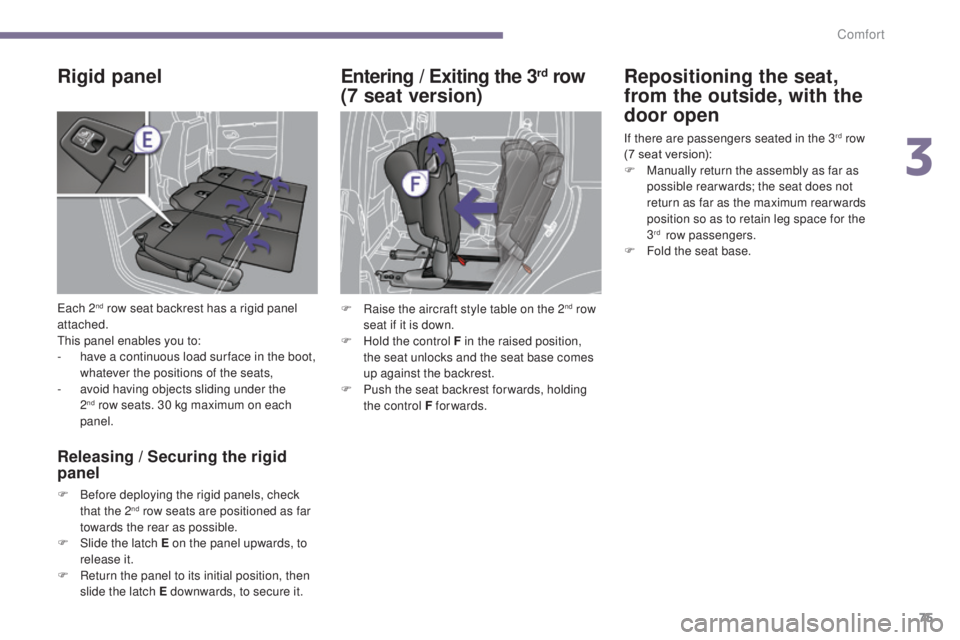
Each 2nd row seat backrest has a rigid panel
attached.
This panel enables you to:
-
h
ave a continuous load sur face in the boot,
whatever the positions of the seats,
-
a
void having objects sliding under the
2
nd row seats. 30 kg maximum on each
panel.
Releasing / Securing the rigid
panel
F Before deploying the rigid panels, check that the 2nd row seats are positioned as far
towards the rear as possible.
F
S
lide the latch E on the panel upwards, to
release it.
F
R
eturn the panel to its initial position, then
slide the latch E downwards, to secure it.
Entering / Exiting the 3rd row
(7 seat version) Repositioning the seat,
from the outside, with the
door open
If there are passengers seated in the 3rd row
(7 seat version):
F
M
anually return the assembly as far as
possible rear wards; the seat does not
return as far as the maximum rear wards
position so as to retain leg space for the
3
rd row passengers.
F
F
old the seat base.
F
R
aise the aircraft style table on the 2
nd row
seat if it is down.
F
H
old the control F in the raised position,
the seat unlocks and the seat base comes
up against the backrest.
F
P
ush the seat backrest for wards, holding
the control F forwards.
3
Comfort