stop start PEUGEOT 5008 2015 User Guide
[x] Cancel search | Manufacturer: PEUGEOT, Model Year: 2015, Model line: 5008, Model: PEUGEOT 5008 2015Pages: 364, PDF Size: 12.82 MB
Page 65 of 364
63
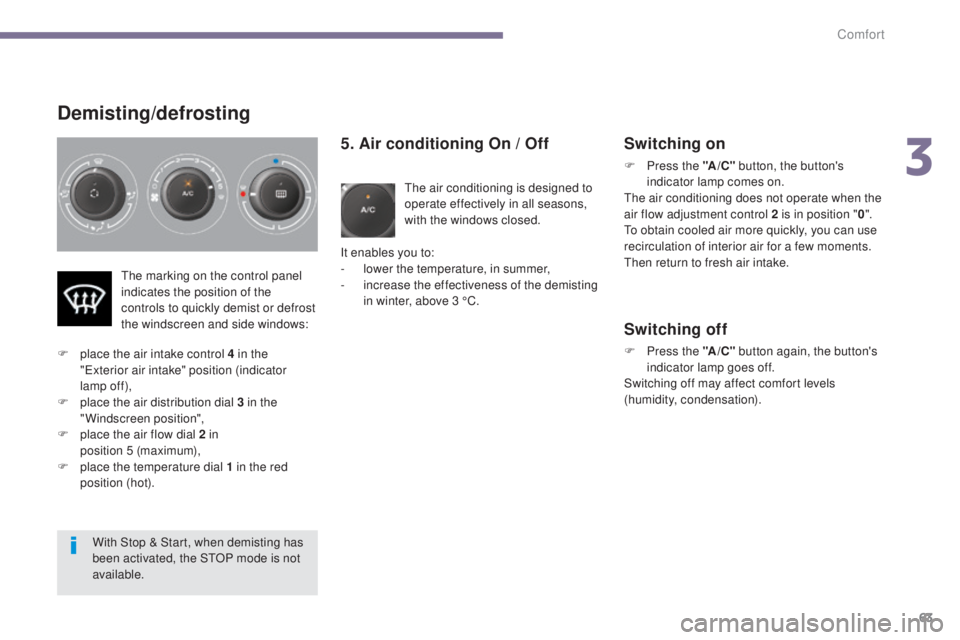
Demisting/defrosting
5. Air conditioning On / Off
The air conditioning is designed to
operate effectively in all seasons,
with the windows closed.
It enables you to:
-
l
ower the temperature, in summer,
-
i
ncrease the effectiveness of the demisting
in winter, above 3 °C.
Switching on
F Press the "A /C " button, the button's
indicator lamp comes on.
The air conditioning does not operate when the
air flow adjustment control 2 is in position " 0".
To obtain cooled air more quickly, you can use
recirculation of interior air for a few moments.
Then return to fresh air intake.
The marking on the control panel
indicates the position of the
controls to quickly demist or defrost
the windscreen and side windows:
F
p
lace the air intake control 4 in the
"Exterior air intake" position (indicator
lamp
off),
F
p
lace the air distribution dial 3 in the
"Windscreen position",
F
p
lace the air flow dial 2 in
position 5 (maximum),
F
p
lace the temperature dial 1 in the red
position (hot).
Switching off
F Press the "A /C " button again, the button's
indicator lamp goes off.
Switching off may affect comfort levels
(humidity, condensation).
With Stop & Start, when demisting has
been activated, the STOP mode is not
available.
3
Comfort
Page 69 of 364
67
Switching the system off/on
F Turn the air flow control to the left until all of the indicator lamps go off.
This action switches off all of the functions of
the system.
Temperature related comfort is no longer
guaranteed but a slight flow of air, due to the
movement of the vehicle, can still be felt.
F
T
urn the air flow dial to the right or press
the "AUTO" button to reactivate the
system with the values set before it was
switched
off.
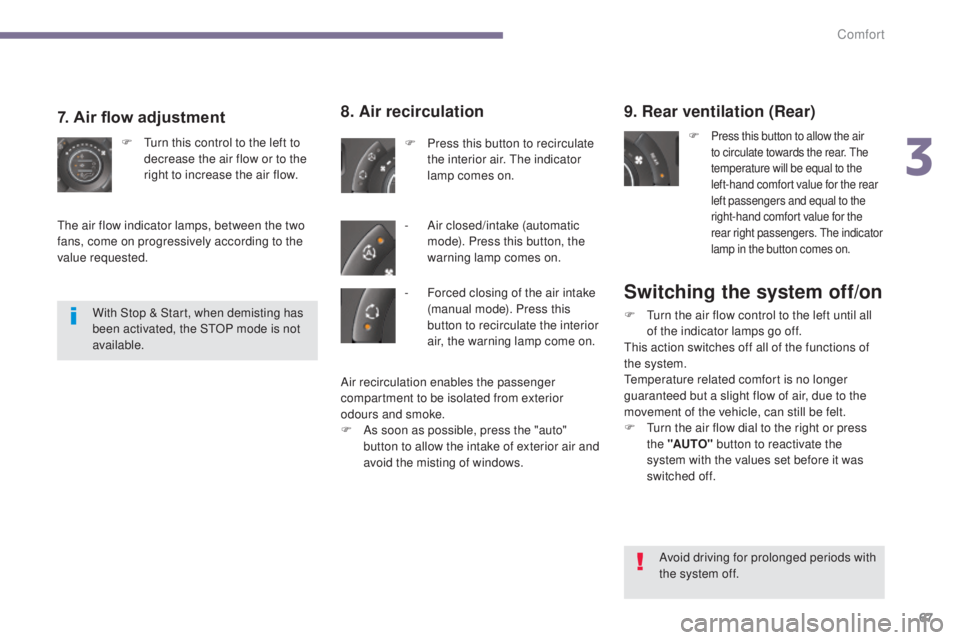
9. Rear ventilation (Rear)
F Press this button to allow the air
to circulate towards the rear. The
temperature will be equal to the
left-hand comfort value for the rear
left passengers and equal to the
right-hand comfort value for the
rear right passengers. The indicator
lamp in the button comes on.
8. Air recirculation
F Press this button to recirculate the interior air. The indicator
lamp comes on.
-
A
ir closed/intake (automatic
mode). Press this button, the
warning lamp comes on.
7. Air flow adjustment
F Turn this control to the left to decrease the air flow or to the
right to increase the air flow.
The air flow indicator lamps, between the two
fans, come on progressively according to the
value requested.
With Stop & Start, when demisting has
been activated, the STOP mode is not
available.
Avoid driving for prolonged periods with
the system off.
-
F
orced closing of the air intake
(manual mode). Press this
button to recirculate the interior
air, the warning lamp come on.
Air recirculation enables the passenger
compartment to be isolated from exterior
odours and smoke.
F
A
s soon as possible, press the "auto"
button to allow the intake of exterior air and
avoid the misting of windows.
3
Comfort
Page 139 of 364
137
Operation
When this warning lamp comes on,
accompanied by an audible signal
and a message, it indicates that
there is a fault with the ABS, which could cause
loss of control of the vehicle when braking.
When this warning lamp comes on,
coupled with the STOP warning
lamp, accompanied by an audible
signal and a message, it indicates
that there is a fault with the electronic brake
force distribution (EBFD), which could cause
loss of control of the vehicle when braking.
You must stop as soon as it is safe to do so.
In both cases, contact a PEUGEOT dealer or a
qualified workshop.
Anti-lock braking system (ABS)
and electronic brake force
distribution (EBFD)
In emergency braking, press
very firmly without releasing the
pressure.
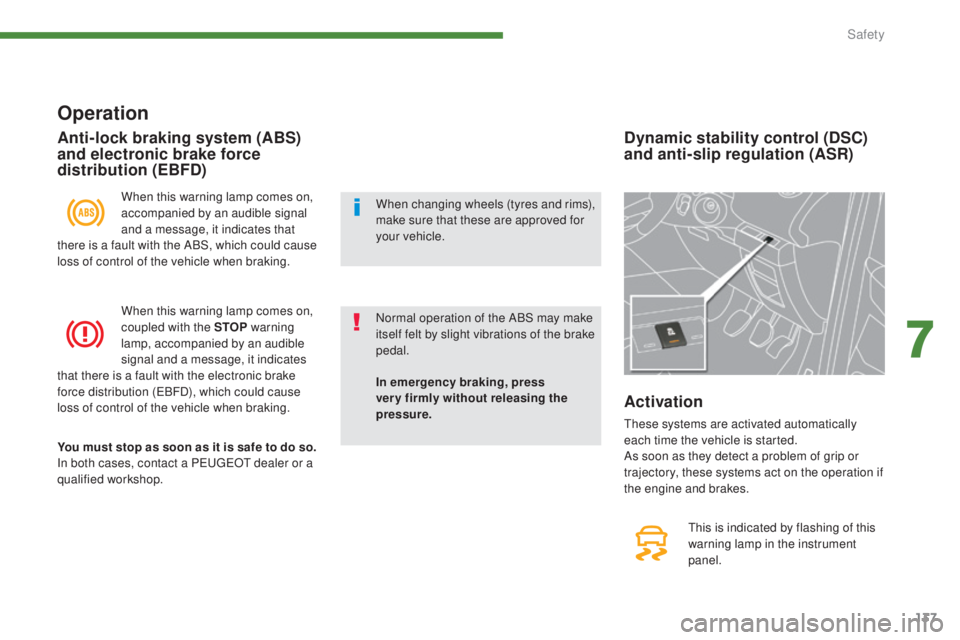
Dynamic stability control (DSC)
and anti-slip regulation (ASR)
This is indicated by flashing of this
warning lamp in the instrument
panel.
Activation
These systems are activated automatically
each time the vehicle is started.
As soon as they detect a problem of grip or
trajectory, these systems act on the operation if
the engine and brakes.
Normal operation of the ABS may make
itself felt by slight vibrations of the brake
pedal. When changing wheels (tyres and rims),
make sure that these are approved for
your vehicle.
7
Safety
Page 149 of 364
147
Driving recommendations
Observe the driving regulations and remain
vigilant whatever the traffic conditions.
Pay close attention to the traffic and keep your
hands on the wheel so that you are ready to
react at any time to any eventuality.
On a long journey, a break every two hours is
strongly recommended.
In difficult weather, drive smoothly, anticipate
the need to brake and increase the distance
from other vehicles.
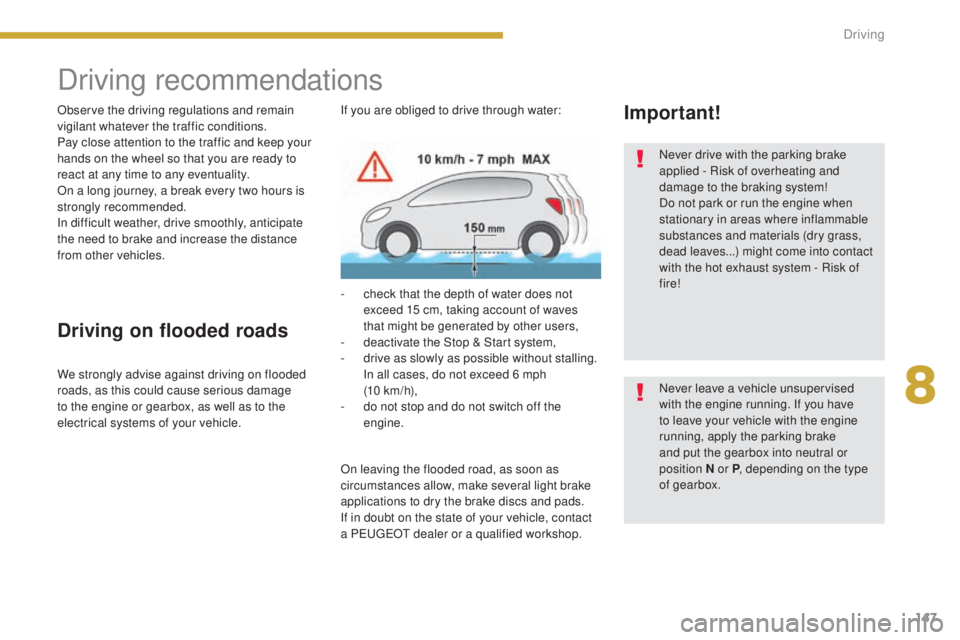
Driving on flooded roads
We strongly advise against driving on flooded
roads, as this could cause serious damage
to the engine or gearbox, as well as to the
electrical systems of your vehicle.If you are obliged to drive through water:
-
c
heck that the depth of water does not
exceed 15 cm, taking account of waves
that might be generated by other users,
-
d
eactivate the Stop & Start system,
- d rive as slowly as possible without stalling.
In all cases, do not exceed 6 mph
(10 km/h),
-
d
o not stop and do not switch off the
engine.
On leaving the flooded road, as soon as
circumstances allow, make several light brake
applications to dry the brake discs and pads.
If in doubt on the state of your vehicle, contact
a PEUGEOT dealer or a qualified workshop. Never drive with the parking brake
applied - Risk of overheating and
damage to the braking system!
Do not park or run the engine when
stationary in areas where inflammable
substances and materials (dry grass,
dead leaves...) might come into contact
with the hot exhaust system - Risk of
fire!
Never leave a vehicle unsupervised
with the engine running. If you have
to leave your vehicle with the engine
running, apply the parking brake
and put the gearbox into neutral or
position
N or P, depending on the type
of gearbox.
Important!
8
Driving
Page 150 of 364
148
Electronic engine immobiliserIgnition switch
Starting-switching off the engine
Anti-theft protection
In the event of a fault, you are informed
by illumination of this warning lamp, an
audible signal and/or the display of a
message, depending on version.
In this case, your vehicle will not start;
contact a PEUGEOT dealer as soon as
possible.
Keep safely, away from your vehicle,
the label attached to the keys given to
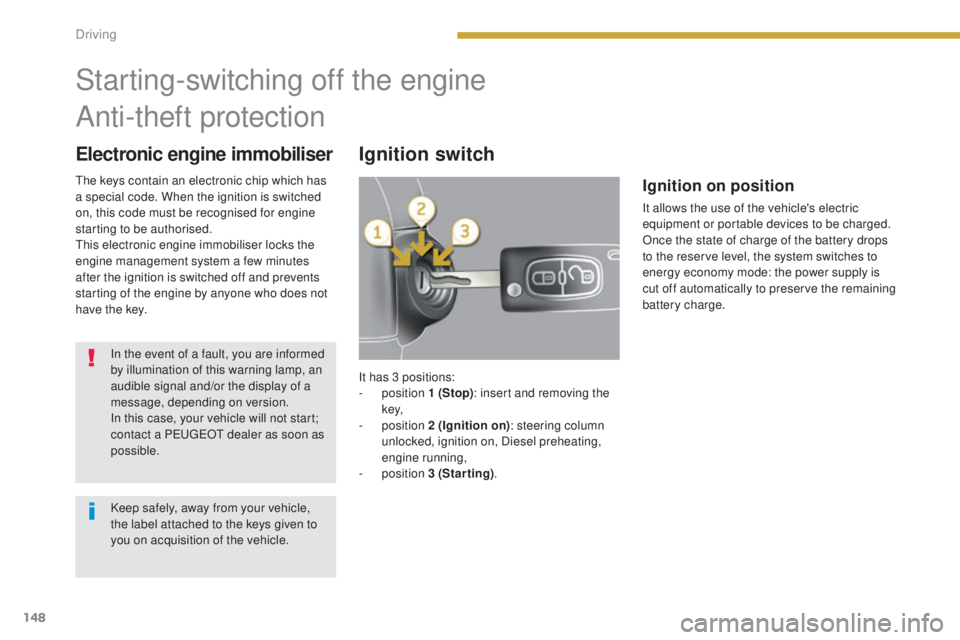
you on acquisition of the vehicle. It has 3 positions:
-
position 1 (Stop): insert and removing the
key,
-
position 2 (Ignition on) : steering column
unlocked, ignition on, Diesel preheating,
engine running,
-
position 3 (Starting) .
Ignition on position
It allows the use of the vehicle's electric
equipment or portable devices to be charged.
Once the state of charge of the battery drops
to the reserve level, the system switches to
energy economy mode: the power supply is
cut off automatically to preserve the remaining
battery charge.
The keys contain an electronic chip which has
a special code. When the ignition is switched
on, this code must be recognised for engine
starting to be authorised.
This electronic engine immobiliser locks the
engine management system a few minutes
after the ignition is switched off and prevents
starting of the engine by anyone who does not
have the key.
Driving
Page 156 of 364
154
Emergency braking
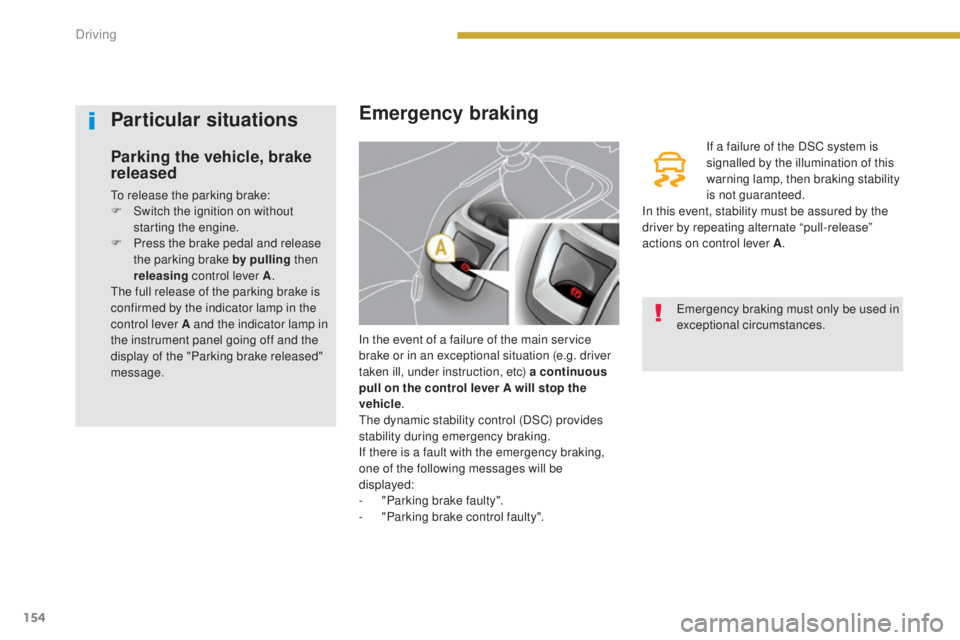
In the event of a failure of the main service
brake or in an exceptional situation (e.g. driver
taken ill, under instruction, etc) a continuous
pull on the control lever A will stop the
vehicle .
The dynamic stability control (DSC) provides
stability during emergency braking.
If there is a fault with the emergency braking,
one of the following messages will be
displayed:
-
"
Parking brake faulty".
-
"
Parking brake control faulty". If a failure of the DSC system is
signalled by the illumination of this
warning lamp, then braking stability
is not guaranteed.
In this event, stability must be assured by the
driver by repeating alternate “pull-release”
actions on control lever A .
Particular situations
Parking the vehicle, brake
released
To release the parking brake:
F
S witch the ignition on without
starting the engine.
F
P
ress the brake pedal and release
the parking brake by pulling then
releasing control lever A .
The full release of the parking brake is
confirmed by the indicator lamp in the
control lever A and the indicator lamp in
the instrument panel going off and the
display of the "Parking brake released"
message. Emergency braking must only be used in
exceptional circumstances.
Driving
Page 176 of 364
174
Stopping the vehicleOperating fault
With the ignition on, if this warning
lamp comes on and AUTO flashes,
accompanied by an audible signal
and a message in the screen, this
indicates a fault with the gearbox.
Have it checked by a PEUGEOT dealer or a
qualified workshop.
Before switching off the engine, you can
choose to:
-
m
ove to position N to engage neutral,
-
l
eave the gear engaged; in this case, it will
not be possible to move the vehicle.
In both cases, it is essential that you apply the
parking brake to immobilise the vehicle, unless
it is programmed in automatic mode.
When immobilising the vehicle, with the
engine running, it is essential to place
the gear lever in neutral N .
Before carrying out any work in the
engine compartment, check that the
gear lever is in neutral N and that the
parking brake is applied. It is essential to press the brake pedal
when starting the engine.
When parking, is it essential to apply
the parking brake to immobilise the
vehicle, whatever the circumstances.
When driving on flooded roads or when
crossing a ford, drive at walking speed.
Driving
Page 181 of 364
179
Gear efficiency indicator*
Operation
Depending on the driving situation and your
vehicle's equipment, the system may advise
you to skip one (or more) gear(s). You can
follow this instruction without engaging the
intermediate gears.
The gear engagement recommendations must
not be considered compulsory. In fact, the
configuration of the road, the amount of traffic
and safety remain determining factors when
choosing the best gear. Therefore, the driver
remains responsible for deciding whether or not
to follow the advice given by the system.
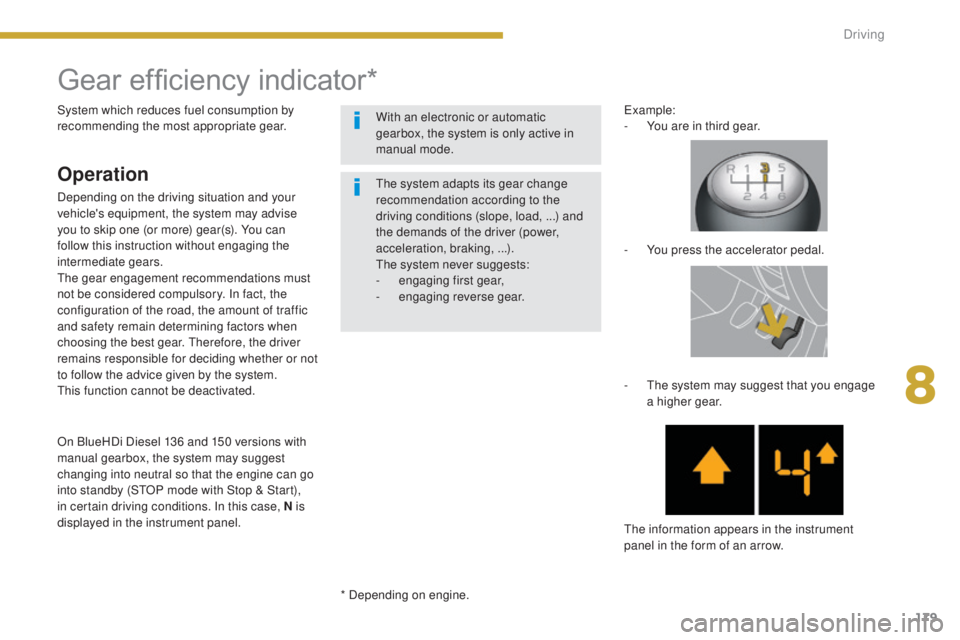
This function cannot be deactivated.Example:
-
Y
ou are in third gear.
-
Y
ou press the accelerator pedal.
-
T
he system may suggest that you engage
a higher gear.
The information appears in the instrument
panel in the form of an arrow.
System which reduces fuel consumption by
recommending the most appropriate gear.
* Depending on engine.The system adapts its gear change
recommendation according to the
driving conditions (slope, load,
...) and
the demands of the driver (power,
acceleration, braking,
...).
The system never suggests:
-
e
ngaging first gear,
-
enga
ging reverse gear.
With an electronic or automatic
gearbox, the system is only active in
manual mode.
On BlueHDi Diesel 136 and 150 versions with
manual gearbox, the system may suggest
changing into neutral so that the engine can go
into standby (STOP mode with Stop & Start),
in certain driving conditions. In this case, N is
displayed in the instrument panel.
8
Driving
Page 182 of 364
180
Stop & Start
Operation
Going into engine STOP mode
The "ECO" indicator lamp comes
on in the instrument panel and the
engine goes into standby:
-
w
ith a manual gearbox, at speeds below
12 mph (20 km/h), or vehicle stationary
with PureTech 130 and BlueHDi 115 and
120 versions, when you put the gear lever
into neutral and release the clutch pedal,
-
w
ith an electronic gearbox , at speeds
below 5 mph (8 km/h), when you press the
brake pedal or you put the gear selector in
position N ,
Special cases: STOP mode not
available
STOP mode is not invoked when:
- t
he driver's door is open,
-
t
he driver's seat belt is not fastened,
-
t
he vehicle has not exceeded 6 mph
(10 km/h) since the last engine start using
t h e key,
-
t
he vehicle is stopped on a steep slope (up
o r d ow n),
-
t
he electric parking brake is applied or
being applied,
-
t
he engine is needed to maintain a
comfortable temperature in the passenger
compartment,
-
d
emisting is active,
-
s
ome special conditions (battery charge,
engine temperature, braking assistance,
ambient temperature...) where the engine is
needed to assure control of a system.
In this case, the "ECO" indicator
lamp flashes for a few seconds then
goes off.
This operation is perfectly normal.
Never refuel with the engine in STOP
mode; you must switch off the ignition
with the key. For your comfort, during parking
maoeuvres, STOP mode is not
available for a few seconds after
coming out of reverse gear.
STOP mode does not affect the
functionality of the vehicle, such as for
example, braking, power steering...
The Stop & Start
system puts the engine
temporarily into standby - STOP mode -
during stops in the traffic (red lights, traffic
jams, or other...). The engine restarts
automatically
-
START mode - as soon as
you want to move off. The restart takes place
instantly, quickly and silently.
Per fect for urban use, the Stop & Start system
reduces fuel consumption and exhaust
emissions as well as the noise level when
stationary. -
w
ith an automatic gearbox, vehicle
stationary, when you press the brake pedal
or you put the gear selector in position N .
If your vehicle is fitted with the system,
a time counter calculates the sum of the
periods in STOP mode during a journey.
It rests itself to zero every time the
ignition is switched on with the key.
Driving
Page 183 of 364
181
Going into engine START mode
The "ECO" indicator lamp goes off
and the engine starts automatically:
-
w
ith a manual gearbox , when you fully
depress the clutch pedal,
-
w
ith an electronic gearbox :
●
g
ear selector in position A or M , when
you release the brake pedal,
●
o
r gear selector in position N and brake
pedal released, when you put the gear
selector in position A or M ,
●
o
r when you engage reverse gear.
-
w
ith an automatic gearbox :
●
g
ear selector in position D or M , when
you release the brake pedal,
●
o
r gear selector in position N and brake
pedal released, when you put the gear
selector in position D or M ,
●
o
r when you engage reverse gear. In this case the "ECO" indicator lamp
flashes for a few seconds, then goes
of f.
Special cases: START invoked
automatically
This operation is perfectly normal.
Deactivation
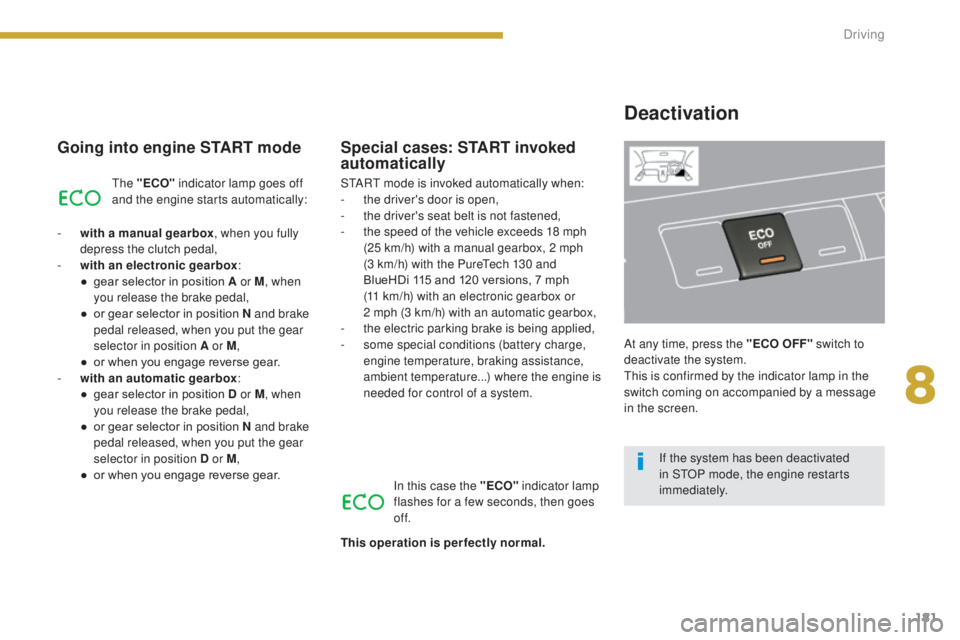
At any time, press the "ECO OFF" switch to
d eactivate the system.
This is confirmed by the indicator lamp in the
switch coming on accompanied by a message
in the screen.
START mode is invoked automatically when:
-
t
he driver's door is open,
-
t
he driver's seat belt is not fastened,
-
t
he speed of the vehicle exceeds 18 mph
(25 km/h) with a manual gearbox, 2
mph
(3
km/h) with the PureTech 130 and
BlueHDi 115 and 120 versions, 7 mph
(11
km/h) with an electronic gearbox or
2
mph (3 km/h) with an automatic gearbox,
-
t
he electric parking brake is being applied,
- s
ome special conditions (battery charge,
engine temperature, braking assistance,
ambient temperature...) where the engine is
needed for control of a system.
If the system has been deactivated
in STOP mode, the engine restarts
immediately.
8
Driving