check oil PEUGEOT 5008 2015 Owners Manual
[x] Cancel search | Manufacturer: PEUGEOT, Model Year: 2015, Model line: 5008, Model: PEUGEOT 5008 2015Pages: 364, PDF Size: 12.82 MB
Page 13 of 364
11
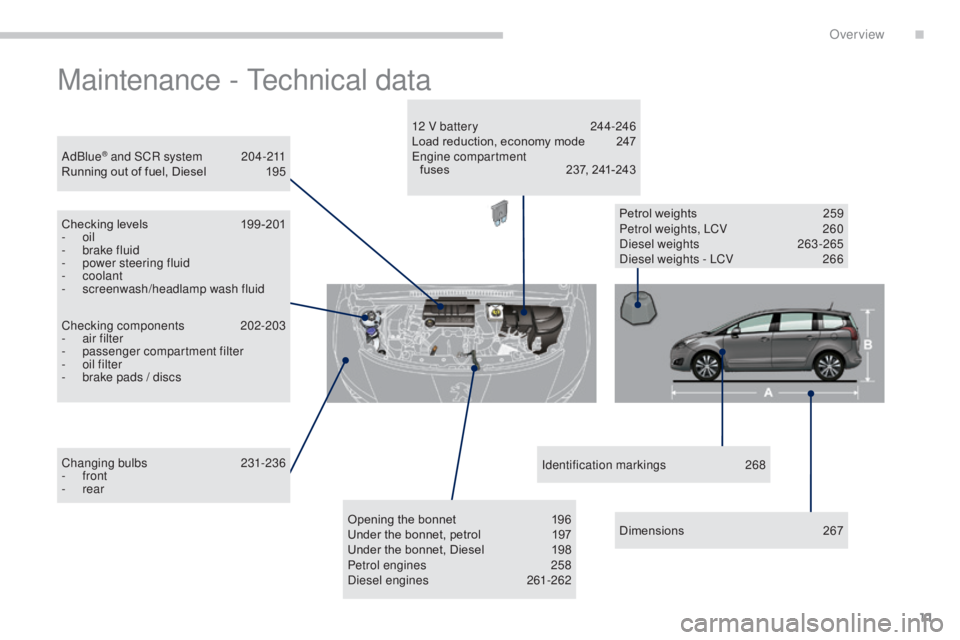
Maintenance - Technical data
Checking components 202-203
- a ir filter
-
p
assenger compartment filter
-
o
il filter
-
b
rake pads / discs
AdBlue
® and SCR system 2
04-211
Running out of fuel, Diesel 1 95
Checking levels
1
99 -201
-
oil
-
b
rake fluid
-
p
ower steering fluid
-
coolant
-
s
creenwash/headlamp wash fluid
Changing bulbs
2
31-236
-
front
-
rear Petrol weights
2
59
Petrol weights, LCV
2
60
Diesel weights
26
3-265
Diesel weights - LCV
2
66
12 V battery
2
44-246
Load reduction, economy mode 2 47
Engine compartment fuses
2 37, 241-243
Opening the bonnet
1
96
Under the bonnet, petrol
1
97
Under the bonnet, Diesel
1
98
Petrol engines
2
58
Diesel engines
2
61-262Identification markings
2
68
Dimensions
2
67
.
Over view
Page 15 of 364
13
Limit the causes of excess consumption
Spread loads throughout the vehicle; place the heaviest items in the
bottom of the boot, as close as possible to the rear seats.
Limit the loads carried in the vehicle and reduce wind resistance (roof
bars, roof rack, bicycle carrier, trailer...). Use a roof box in preference.
Remove roof bars and roof racks after use.
At the end of winter, remove snow tyres and refit your summer tyres.
Observe the recommendations on
maintenance
Check the tyre pressures regularly, when cold, referring to the label in
the door aperture, driver's side.
Carry out this check in particular:
-
b
efore a long journey,
-
a
t each change of season,
-
a
fter a long period out of use.
Don't forget the spare wheel and the tyres on any trailer or caravan.
Have your vehicle serviced regularly (engine oil, oil filter, air filter,
passenger compartment filter...) and observe the schedule of
operations recommended in the manufacturer's service schedule.
With a BlueHDi Diesel engine, if the SCR system is faulty your vehicle
becomes polluting; go to a PEUGEOT dealer or a qualified workshop
without delay to have the emissions of nitrous oxides brought back to
the legal level.
When refuelling, do not continue after the third cut-off of the nozzle to
avoid any over flow.
At the wheel of your new vehicle, it is only after the first 1 800 miles
(3
000 kilometres) that you will see the fuel consumption settle down to
a consistent average.
.
Eco-driving
Page 32 of 364
30
Engine oil level indicator*
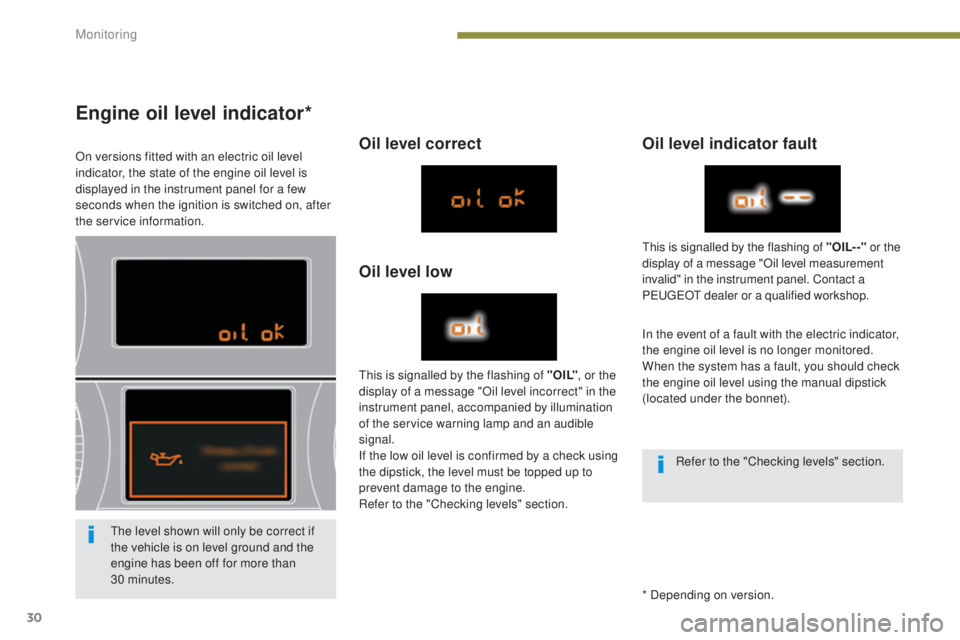
On versions fitted with an electric oil level
indicator, the state of the engine oil level is
displayed in the instrument panel for a few
seconds when the ignition is switched on, after
the service information.Oil level correct
Oil level lowOil level indicator fault
In the event of a fault with the electric indicator,
the engine oil level is no longer monitored.
When the system has a fault, you should check
the engine oil level using the manual dipstick
(located under the bonnet).
This is signalled by the flashing of " O I L"
, or the
display of a message "Oil level incorrect" in the
instrument panel, accompanied by illumination
of the service warning lamp and an audible
signal.
If the low oil level is confirmed by a check using
the dipstick, the level must be topped up to
prevent damage to the engine.
Refer to the "Checking levels" section. This is signalled by the flashing of "OIL- -"
or the
display of a message "Oil level measurement
invalid" in the instrument panel. Contact a
PEUGEOT dealer or a qualified workshop.
The level shown will only be correct if
the vehicle is on level ground and the
engine has been off for more than
30 minutes. * Depending on version.Refer to the "Checking levels" section.
Monitoring
Page 195 of 364
DIESEL
193
Fuel used for petrol
engines
The petrol engines are compatible with
E10 type petrol biofuels (containing
10 % ethanol), conforming to European
standards EN 228 and EN 15376.
E85 type fuels (containing up to 85 % ethanol)
are reserved exclusively for vehicles marketed
for the use of this type of fuel (BioFlex
vehicles). The quality of the ethanol must
comply with European standard EN 15293.
Fuel used for Diesel
engines
The Diesel engines are compatible with
biofuels which conform to current and future
European standards (Diesel fuel which
complies with standard EN 590 mixed with a
biofuel which complies with standard
EN 14214) available at the pumps (containing
up to 7 % Fatty Acid Methyl Ester).
B30 biofuel can be used in certain Diesel
engines. However, this use, even occasional,
requires strict application of the special
servicing conditions. Contact a PEUGEOT
dealer or a qualified workshop.
The use of any other type of (bio)fuel
(vegetable or animal oils, pure or diluted,
domestic fuel...) is strictly prohibited (risk of
damage to the engine and fuel system).
9
Checks
Page 199 of 364
197
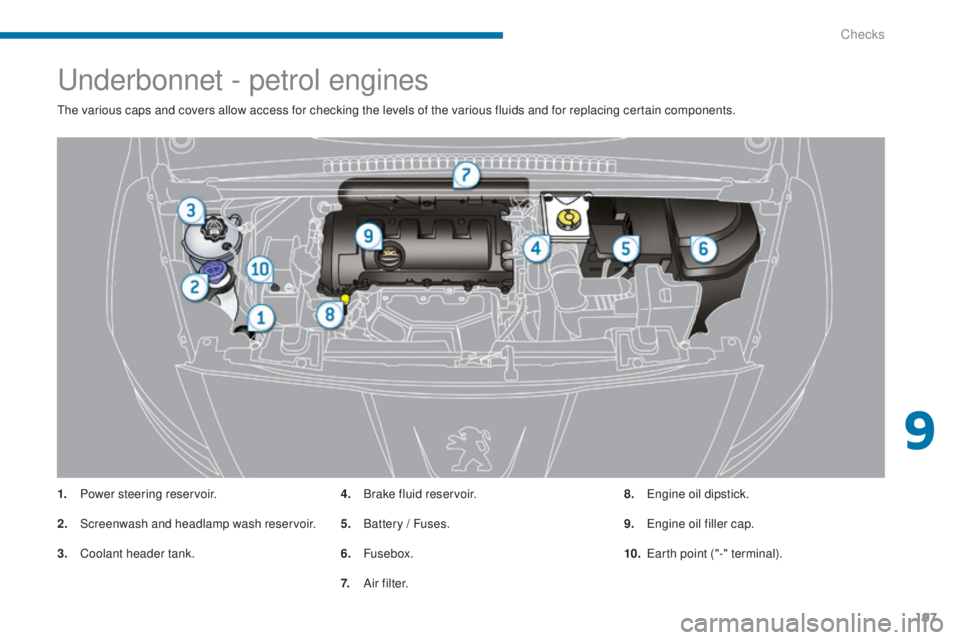
Underbonnet - petrol engines
The various caps and covers allow access for checking the levels of the various fluids and for replacing certain components.
1.
P
ower steering reservoir.
2.
S
creenwash and headlamp wash reservoir.
3.
C
oolant header tank. 4.
B
rake fluid reservoir.
5.
B
attery / Fuses.
6.
Fusebox.
7.
A
i r f i l t e r.8.
E
ngine oil dipstick.
9.
E
ngine oil filler cap.
10.
E
arth point ("-" terminal).
9
Checks
Page 200 of 364
198
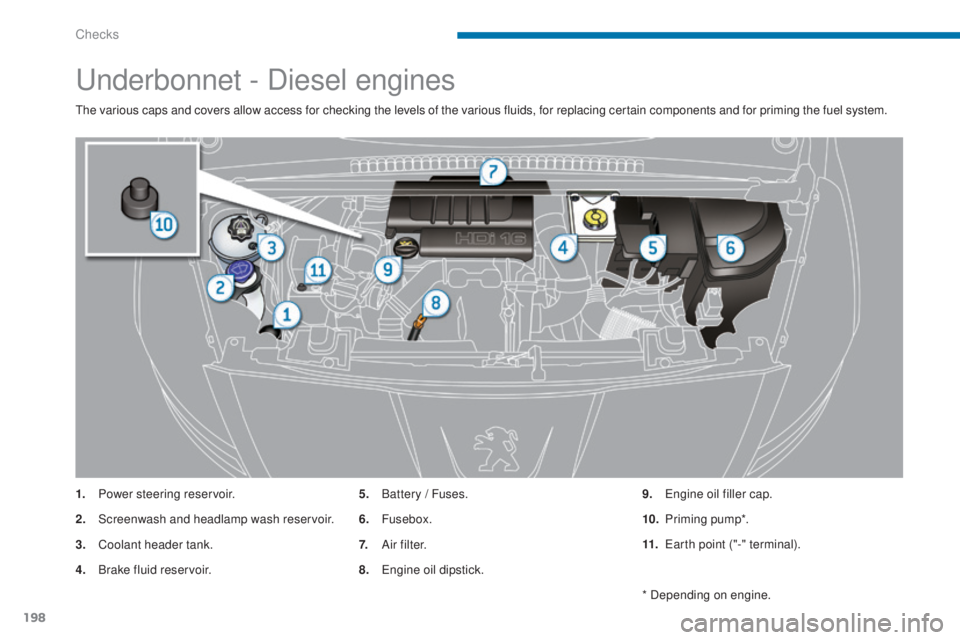
Underbonnet - Diesel engines
The various caps and covers allow access for checking the levels of the various fluids, for replacing certain components and for priming the fuel system.
1.
P
ower steering reservoir.
2.
S
creenwash and headlamp wash reservoir.
3.
C
oolant header tank.
4.
B
rake fluid reservoir. 5.
B
attery / Fuses.
6.
Fusebox.
7.
A
i r f i l t e r.
8.
E
ngine oil dipstick.9.
E
ngine oil filler cap.
10.
P
riming pump*.
11.
E
arth point ("-" terminal).
* Depending on engine.
Checks
Page 201 of 364
199
Checking levels
Engine oil level
The check is carried out either when
the ignition is switched on using the
oil level indicator in the instrument
panel for vehicles so equipped, or
using the dipstick.
Check all of these levels regularly, in line with the manufacturer's service schedule. Top them up if necessary, unless other wise indicated.
If a level drops significantly, have the corresponding system checked by a PEUGEOT dealer or a qualified workshop.
It is normal to top up the oil level between
two services (or oil changes). PEUGEOT
recommends that you check the level, and top
up if necessary, every 3 000 miles (5 000 kms). Take care when working under the bonnet, as certain areas of the engine may be extremely hot (risk of burns) and the cooling fan could start at
any time (even with the ignition off).
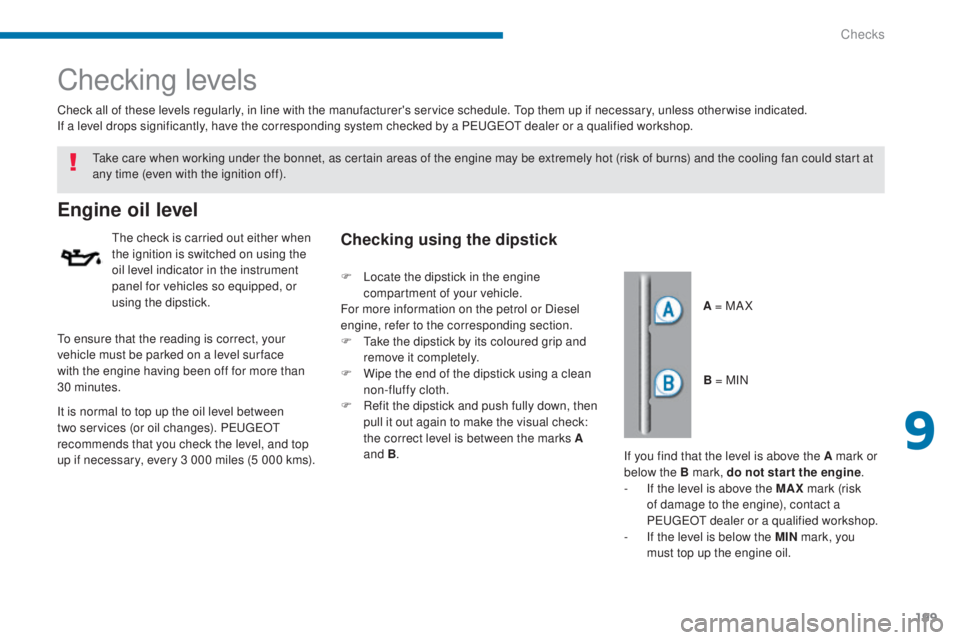
If you find that the level is above the A mark or
below the B mark, do not star t the engine.
-
I
f the level is above the MAX mark (risk
of damage to the engine), contact a
PEUGEOT dealer or a qualified workshop.
-
I
f the level is below the MIN mark, you
must top up the engine oil. A = MA X
To ensure that the reading is correct, your
vehicle must be parked on a level sur face
with the engine having been off for more than
30
minutes.Checking using the dipstick
B = MIN
F
L
ocate the dipstick in the engine
compartment of your vehicle.
For more information on the petrol or Diesel
engine, refer to the corresponding section.
F
T
ake the dipstick by its coloured grip and
remove it completely.
F
W
ipe the end of the dipstick using a clean
non-fluffy cloth.
F
R
efit the dipstick and push fully down, then
pull it out again to make the visual check:
the correct level is between the marks A
and B .
9
Checks
Page 202 of 364
200
Power steering fluid
level
The power steering fluid level should
be close to the "MA X" mark. With
the engine cold, unscrew the cap to
check the level.
Fluid specification
The brake fluid must conform to the
manufacturer's recommendations.
Changing the fluid
Refer to the manufacturer's service schedule
for details of the interval for this operation.
Brake fluid level
The brake fluid level should be close
to the "MA X" mark. If it is not, check
the brake pad wear.
After topping-up the oil, the check when
switching on the ignition with the oil
level indicator in the instrument panel
is not valid during the 30 minutes after
topping up.Oil grade
Before topping-up the oil or changing the oil,
check that the oil is the correct grade for your
engine and conforms to the manufacturer's
recommendations.
Topping-up the engine oil level
F Locate the oil filler cap in the engine
compartment of your vehicle.
For more information on the petrol or Diesel
engine, refer to the corresponding section.
F
U
nscrew the oil filler cap to reveal the filler
aperture.
F
A
dd oil in small quantities, avoiding any
spills on engine components (risk of fire).
F
W
ait a few minutes before checking the
level again using the dipstick.
F
A
dd more oil if necessary.
F
A
fter checking the level, carefully refit the
oil filler cap and the dipstick in its tube.
Engine oil change
Refer to the manufacturer's service schedule
for details of the interval for this operation.
In order to maintain the reliability of the engine
and emission control system, never use
additives in the engine oil.
Checks
Page 203 of 364
201
Diesel additive level
(Diesel engine with particle
filter)
Used products
To p p i n g u p
This additive must be topped up by a
PEUGEOT dealer or a qualified workshop
without delay. A low additive level is indicated by
illumination of this warning lamp,
accompanied by an audible warning
and a message in the instrument panel screen.Fluid specification
For optimum cleaning and to avoid freezing,
this fluid must not be topped up with or
replaced with plain water. In the case of vehicles fitted with
headlamp washers, the low fluid level
is indicated by an audible signal and
a message in the instrument panel
screen.
Top up the reservoir when you next stop the
vehicle.
Screenwash and headlamp
wash fluid
Avoid prolonged contact of used oil or
fluids with the skin.
Most of these fluids are harmful to
health or indeed very corrosive.
Do not discard used oil or fluids into
sewers or onto the ground.
Take used oil to a PEUGEOT dealer or
a qualified workshop (France) or to an
authorised waste disposal site.
The cooling fan may star t after switching
off the engine: take care with ar ticles and
clothing that might become caught by the
fan blades.
Fluid specification
The coolant must conform to the
manufacturer's recommendations.
Coolant level
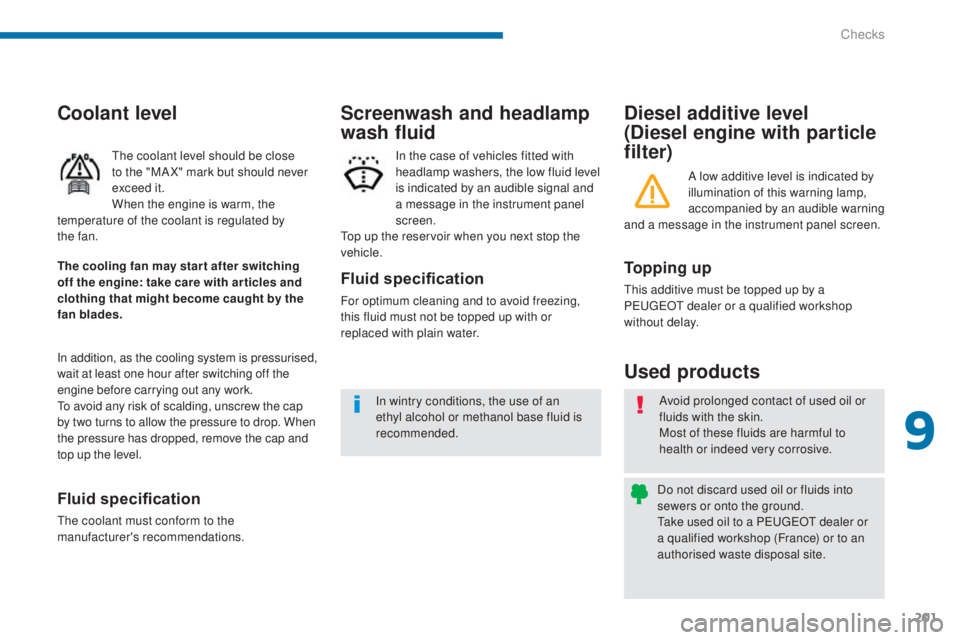
The coolant level should be close
to the "MA X" mark but should never
exceed it.
When the engine is warm, the
temperature of the coolant is regulated by
the fan.
In addition, as the cooling system is pressurised,
wait at least one hour after switching off the
engine before carrying out any work.
To avoid any risk of scalding, unscrew the cap
by two turns to allow the pressure to drop. When
the pressure has dropped, remove the cap and
top up the level. In wintry conditions, the use of an
ethyl alcohol or methanol base fluid is
recommended.
9
Checks
Page 204 of 364
202
Particle filter (Diesel)
Checks
Unless otherwise indicated, check these
components in accordance with the
manufacturer's service schedule and according
to your engine.
Other wise, have them checked by a PEUGEOT
dealer or a qualified workshop.
12 V batteryThe battery does not require any maintenance.
However, check that the terminals are clean
and correctly tightened, particularly in summer
and winter.
When carrying out work on the battery, refer
to the "12 V battery" section for details of the precautions to
be taken before disconnecting the battery and following its
reconnection.
Air filter and passenger compartment filter
Refer to the manufacturer's service
schedule for details of the replacement
intervals for these components.
Depending on the environment
(e.g. dusty atmosphere) and the use of the vehicle
(e.g. city driving), replace them twice as often if
necessary .
A clogged passenger compartment filter may have
an adverse effect on the per formance of the air
conditioning system and generate undesirable
odours.
Oil filter
Replace the oil filter each time the
engine oil is changed.
Refer to the manufacturer's
service schedule for details of
the replacement interval for this
component. On a new vehicle, the first particle
filter regeneration operations may be
accompanied by a "burning" smell,
which is per fectly normal.
Following prolonged operation of the
vehicle at very low speed or at idle,
you may, in exceptional circumstances,
notice the emission of water vapour at
the exhaust on acceleration. This does
not affect the behaviour of the vehicle
or the environment.
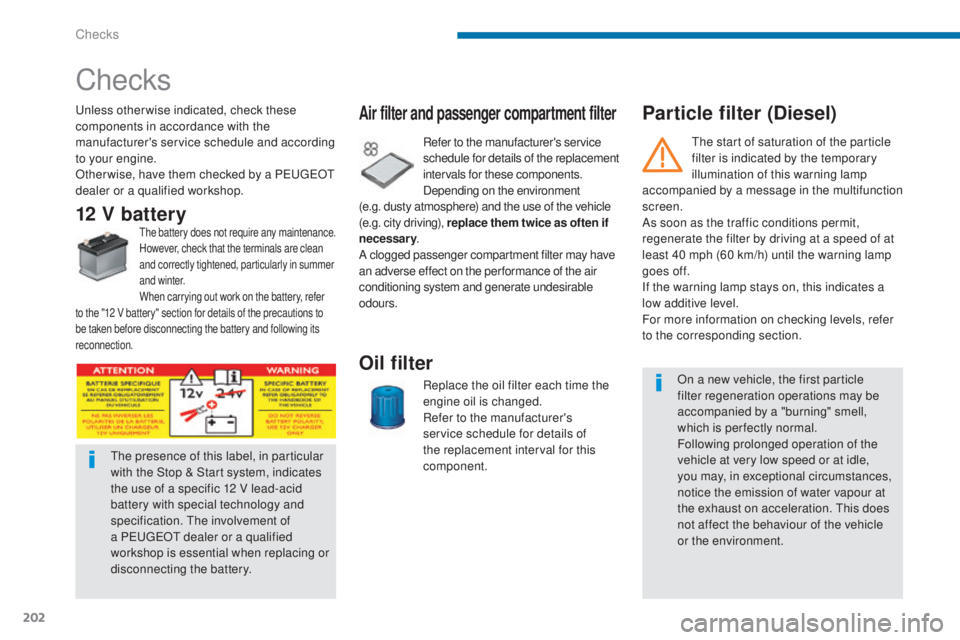
The presence of this label, in particular
with the Stop & Start system, indicates
the use of a specific 12 V lead-acid
battery with special technology and
specification. The involvement of
a PEUGEOT dealer or a qualified
workshop is essential when replacing or
disconnecting the battery. The start of saturation of the particle
filter is indicated by the temporary
illumination of this warning lamp
accompanied by a message in the multifunction
screen.
As soon as the traffic conditions permit,
regenerate the filter by driving at a speed of at
least 40 mph (60 km/h) until the warning lamp
goes off.
If the warning lamp stays on, this indicates a
low additive level.
For more information on checking levels, refer
to the corresponding section.
Checks