wheel PEUGEOT 5008 2016 Owner's Manual
[x] Cancel search | Manufacturer: PEUGEOT, Model Year: 2016, Model line: 5008, Model: PEUGEOT 5008 2016Pages: 364, PDF Size: 12.98 MB
Page 173 of 364
171
5008_en_Chap08_conduite_ed01-2015
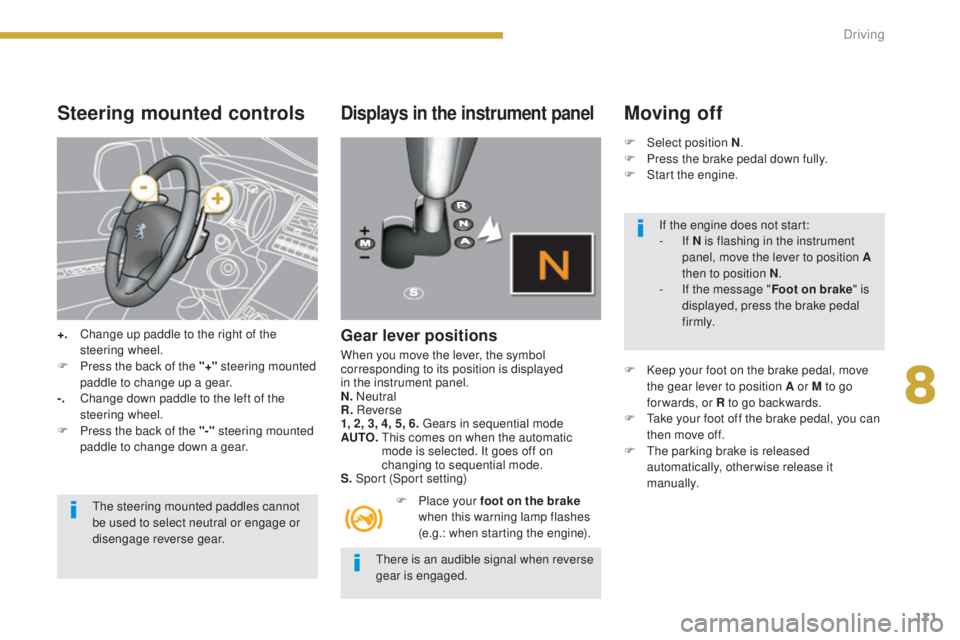
Steering mounted controls
+. Change up paddle to the right of the steering wheel.
F
P
ress the back of the "+" steering mounted
paddle to change up a gear.
-.
C
hange down paddle to the left of the
steering wheel.
F
P
ress the back of the "-" steering mounted
paddle to change down a gear.
The steering mounted paddles cannot
be used to select neutral or engage or
disengage reverse gear.
Displays in the instrument panel
Gear lever positions
When you move the lever, the symbol
corresponding to its position is displayed
in the instrument panel.
N. Neutral
R. Reverse
1, 2, 3, 4, 5, 6. Gears in sequential mode
AUTO.
T
his comes on when the automatic
mode is selected. It goes off on
changing to sequential mode.
S. Sport (Sport setting)
F
P
lace your foot on the brake
when this warning lamp flashes
(e.g.: when starting the engine).
Moving off
F Select position N .
F P ress the brake pedal down fully.
F
S
tart the engine.
F
K
eep your foot on the brake pedal, move
the gear lever to position A or M to go
for wards, or R to go backwards.
F
T
ake your foot off the brake pedal, you can
then move off.
F
T
he parking brake is released
automatically, otherwise release it
manually.
There is an audible signal when reverse
gear is engaged. If the engine does not start:
-
If N is flashing in the instrument
panel, move the lever to position A
then to position N .
-
I
f the message " Foot on brake" is
displayed, press the brake pedal
f i r m l y.
8
Driving
Page 185 of 364
183
5008_en_Chap08_conduite_ed01-2015
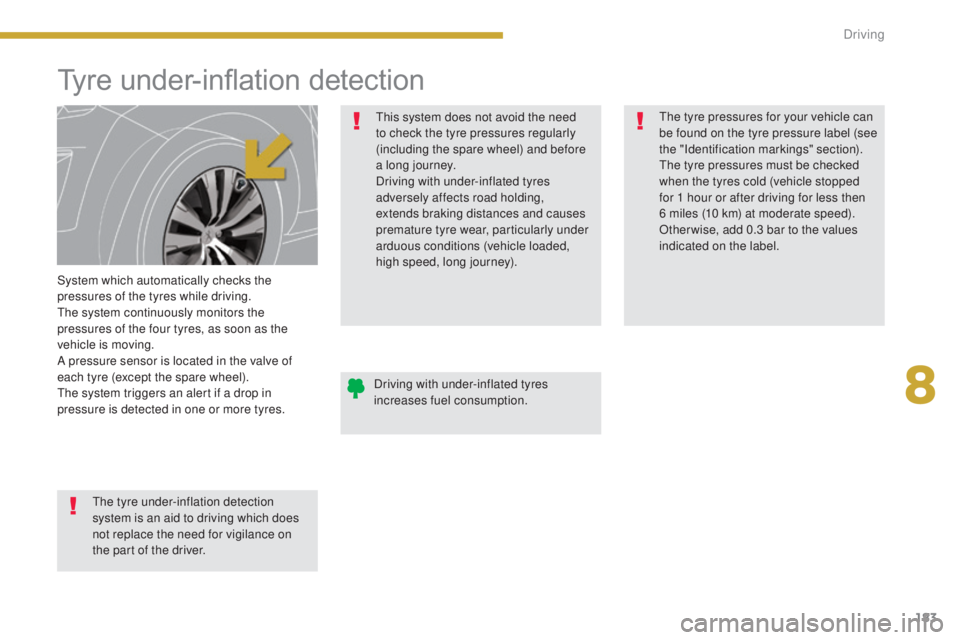
Tyre under-inflation detection
System which automatically checks the
pressures of the tyres while driving.
The system continuously monitors the
pressures of the four tyres, as soon as the
vehicle is moving.
A pressure sensor is located in the valve of
each tyre (except the spare wheel).
The system triggers an alert if a drop in
pressure is detected in one or more tyres.This system does not avoid the need
to check the tyre pressures regularly
(including the spare wheel) and before
a long journey.
Driving with under-inflated tyres
adversely affects road holding,
extends braking distances and causes
premature tyre wear, particularly under
arduous conditions (vehicle loaded,
high speed, long journey).
The tyre pressures for your vehicle can
be found on the tyre pressure label (see
the "Identification markings" section).
The tyre pressures must be checked
when the tyres cold (vehicle stopped
for 1 hour or after driving for less then
6 miles (10 km) at moderate speed).
Other wise, add 0.3 bar to the values
indicated on the label.
Driving with under-inflated tyres
increases fuel consumption.
The tyre under-inflation detection
system is an aid to driving which does
not replace the need for vigilance on
the part of the driver.
8
Driving
Page 186 of 364
184
5008_en_Chap08_conduite_ed01-2015
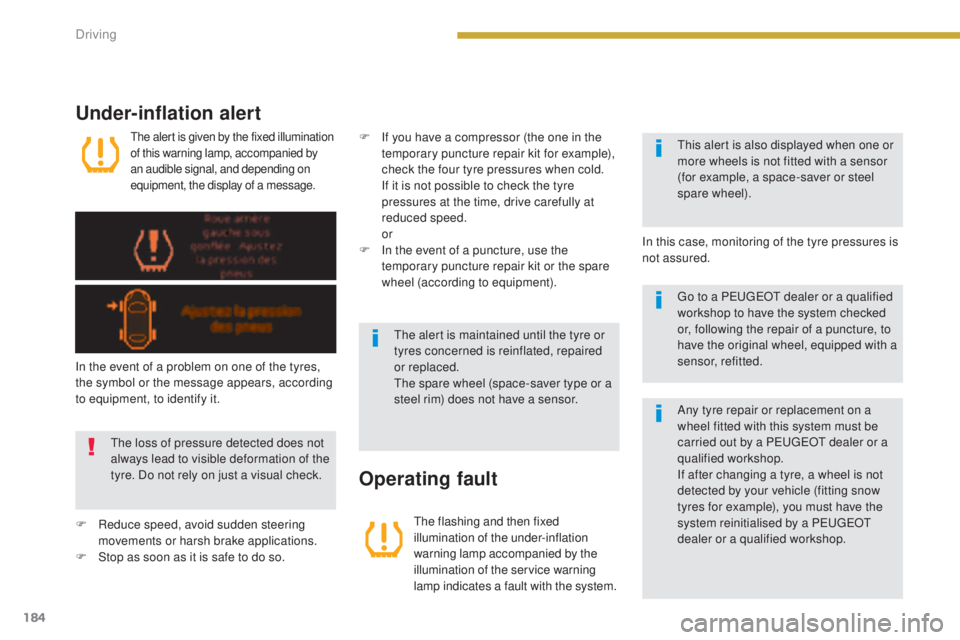
The alert is given by the fixed illumination
of this warning lamp, accompanied by
an audible signal, and depending on
equipment, the display of a message.
Under-inflation alert
The flashing and then fixed
illumination of the under-inflation
warning lamp accompanied by the
illumination of the service warning
lamp indicates a fault with the system.
Operating fault
In the event of a problem on one of the tyres,
the symbol or the message appears, according
to equipment, to identify it.
F
R
educe speed, avoid sudden steering
movements or harsh brake applications.
F
S
top as soon as it is safe to do so.The loss of pressure detected does not
always lead to visible deformation of the
tyre. Do not rely on just a visual check. The alert is maintained until the tyre or
tyres concerned is reinflated, repaired
or replaced.
The spare wheel (space-saver type or a
steel rim) does not have a sensor.This alert is also displayed when one or
more wheels is not fitted with a sensor
(for example, a space-saver or steel
spare wheel).
In this case, monitoring of the tyre pressures is
not assured. Go to a PEUGEOT dealer or a qualified
workshop to have the system checked
or, following the repair of a puncture, to
have the original wheel, equipped with a
sensor, refitted.
F
I
f you have a compressor (the one in the
temporary puncture repair kit for example),
check the four tyre pressures when cold.
I
f it is not possible to check the tyre
pressures at the time, drive carefully at
reduced speed.
or
F
I
n the event of a puncture, use the
temporary puncture repair kit or the spare
wheel (according to equipment).
Any tyre repair or replacement on a
wheel fitted with this system must be
carried out by a PEUGEOT dealer or a
qualified workshop.
If after changing a tyre, a wheel is not
detected by your vehicle (fitting snow
tyres for example), you must have the
system reinitialised by a PEUGEOT
dealer or a qualified workshop.
Driving
Page 214 of 364
212
5008_en_Chap10_infos-pratiques_ed01-2015
Tool kit
This is a set of tools provided with your vehicle. The content depends on your vehicle's equipment
(temporary puncture repair kit or spare wheel)
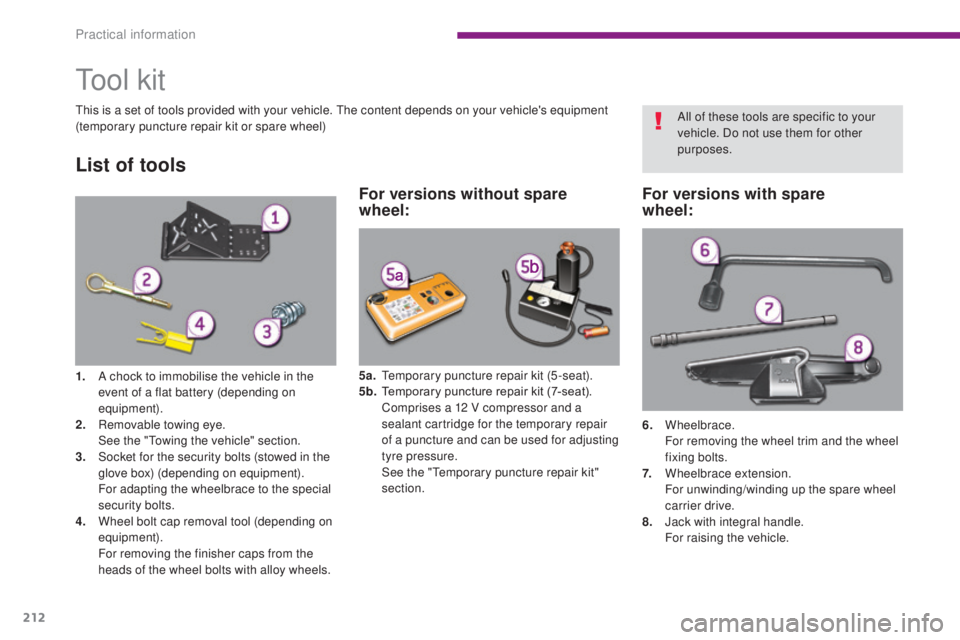
List of tools
5a. Temporary puncture repair kit (5-seat).
5b. T emporary puncture repair kit (7-seat).
C
omprises a 12 V compressor and a
sealant cartridge for the temporary repair
of a puncture and can be used for adjusting
tyre pressure.
S
ee the "Temporary puncture repair kit"
section. 6.
Wheelbrace.
F
or removing the wheel trim and the wheel
fixing bolts.
7.
W
heelbrace extension.
F
or unwinding/winding up the spare wheel
carrier drive.
8.
J
ack with integral handle.
F
or raising the vehicle.
1. A c
hock to immobilise the vehicle in the
event of a flat battery (depending on
equipment).
2.
R
emovable towing eye.
S
ee the "Towing the vehicle" section.
3.
S
ocket for the security bolts (stowed in the
glove box) (depending on equipment).
F
or adapting the wheelbrace to the special
security bolts.
4.
W
heel bolt cap removal tool (depending on
equipment).
F
or removing the finisher caps from the
heads of the wheel bolts with alloy wheels. All of these tools are specific to your
vehicle. Do not use them for other
purposes.
For versions without spare
wheel:
For versions with spare
wheel:
Practical information
Page 215 of 364
213
5008_en_Chap10_infos-pratiques_ed01-2015
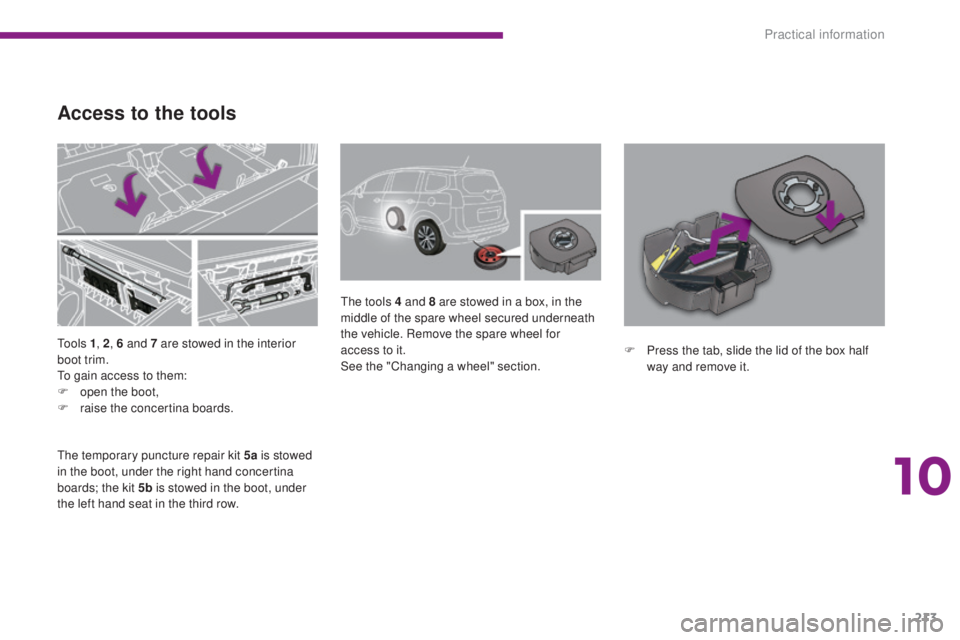
To o l s 1, 2, 6 and 7 are stowed in the interior
boot trim.
To gain access to them:
F
o
pen the boot,
F
r
aise the concertina boards. The tools 4 and 8 are stowed in a box, in the
middle of the spare wheel secured underneath
the vehicle. Remove the spare wheel for
access to it.
See the "Changing a wheel" section.
Access to the tools
The temporary puncture repair kit 5a
is stowed
in the boot, under the right hand concertina
boards; the kit 5b is stowed in the boot, under
the left hand seat in the third row. F
P
ress the tab, slide the lid of the box half
way and remove it.
10
Practical information
Page 217 of 364
215
5008_en_Chap10_infos-pratiques_ed01-2015
Description of the kit
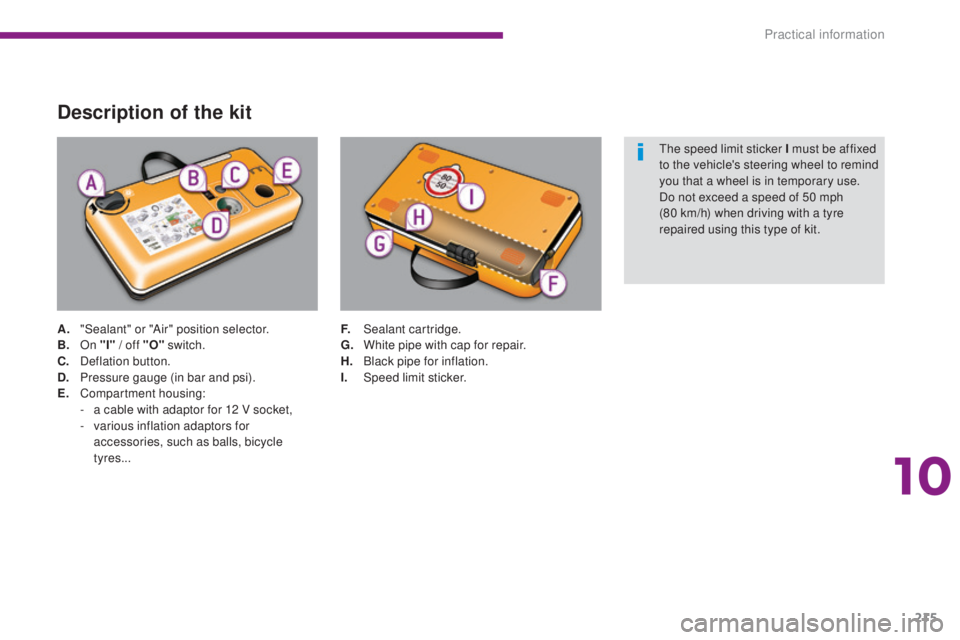
A. "Sealant" or "Air" position selector.
B. On "I" / off "O" switch.
C.
D
eflation button.
D.
P
ressure gauge (in bar and psi).
E.
C
ompartment housing:
-
a c
able with adaptor for 12 V socket,
-
v
arious inflation adaptors for
accessories, such as balls, bicycle
tyres... F. S
ealant cartridge.
G. W hite pipe with cap for repair.
H.
B
lack pipe for inflation.
I.
Spe
ed limit sticker.The speed limit sticker I must be affixed
to the vehicle's steering wheel to remind
you that a wheel is in temporary use.
Do not exceed a speed of 50 mph
(80
km/h) when driving with a tyre
repaired using this type of kit.
10
Practical information
Page 219 of 364
217
5008_en_Chap10_infos-pratiques_ed01-2015
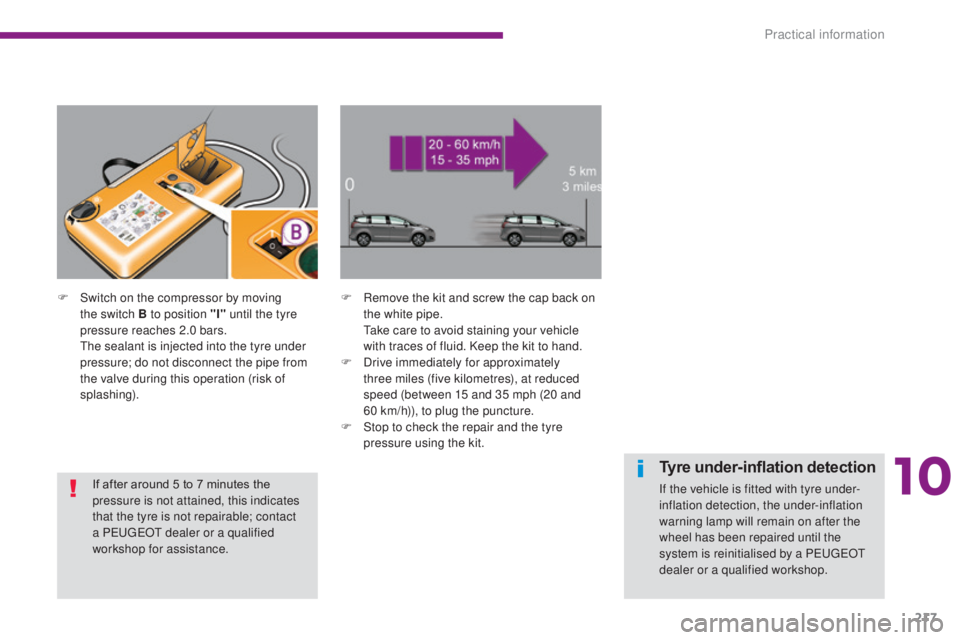
F Switch on the compressor by moving the switch B to position "I" until the tyre
pressure reaches 2.0 bars.
T
he sealant is injected into the tyre under
pressure; do not disconnect the pipe from
the valve during this operation (risk of
splashing). F
R emove the kit and screw the cap back on
the white pipe.
T
ake care to avoid staining your vehicle
with traces of fluid. Keep the kit to hand.
F
D
rive immediately for approximately
three miles (five kilometres), at reduced
speed (between 15 and 35 mph (20 and
60
km/h)), to plug the puncture.
F
S
top to check the repair and the tyre
pressure using the kit.
Tyre under-inflation detection
If the vehicle is fitted with tyre under-
inflation detection, the under-inflation
warning lamp will remain on after the
wheel has been repaired until the
system is reinitialised by a PEUGEOT
dealer or a qualified workshop.
If after around 5 to 7 minutes the
pressure is not attained, this indicates
that the tyre is not repairable; contact
a PEUGEOT dealer or a qualified
workshop for assistance.
10
Practical information
Page 220 of 364
218
5008_en_Chap10_infos-pratiques_ed01-2015
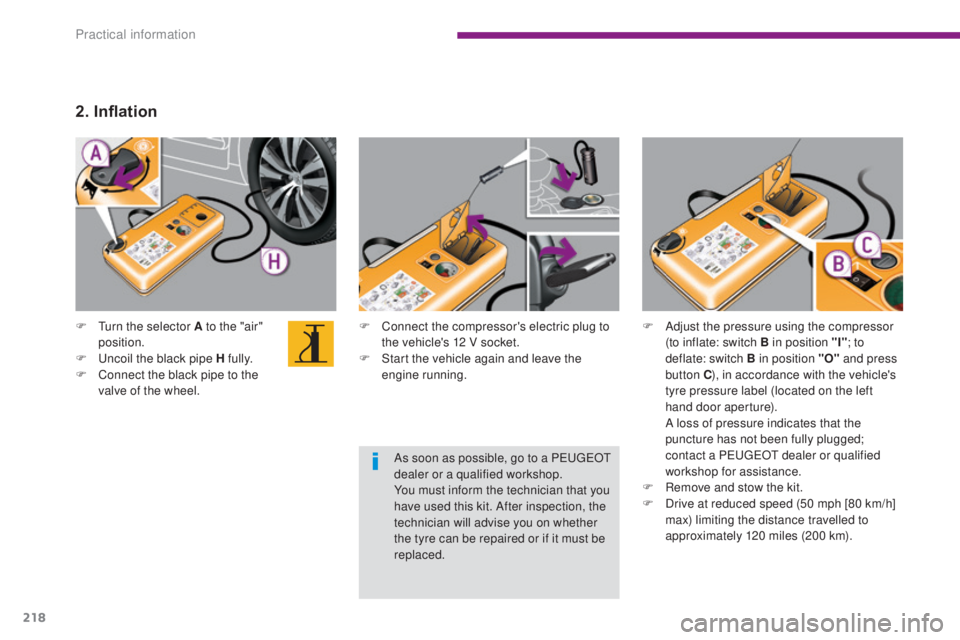
F Connect the compressor's electric plug to the vehicle's 12 V socket.
F
S
tart the vehicle again and leave the
engine running.
F
T
urn the selector A to the "air"
position.
F
U
ncoil the black pipe H fully.
F
C
onnect the black pipe to the
valve of the wheel.
2. Inflation
F Adjust the pressure using the compressor (to inflate: switch B in position "I" ; to
deflate: switch B
in position "O" and press
button C ), in accordance with the vehicle's
tyre pressure label (located on the left
hand door aperture).
A l
oss of pressure indicates that the
puncture has not been fully plugged;
contact a PEUGEOT dealer or qualified
workshop for assistance.
F
R
emove and stow the kit.
F
D
rive at reduced speed (50 mph [80 km/h]
max) limiting the distance travelled to
approximately 120 miles (200 km).
As soon as possible, go to a PEUGEOT
dealer or a qualified workshop.
You must inform the technician that you
have used this kit. After inspection, the
technician will advise you on whether
the tyre can be repaired or if it must be
replaced.
Practical information
Page 221 of 364
219
5008_en_Chap10_infos-pratiques_ed01-2015
Removing the cartridge
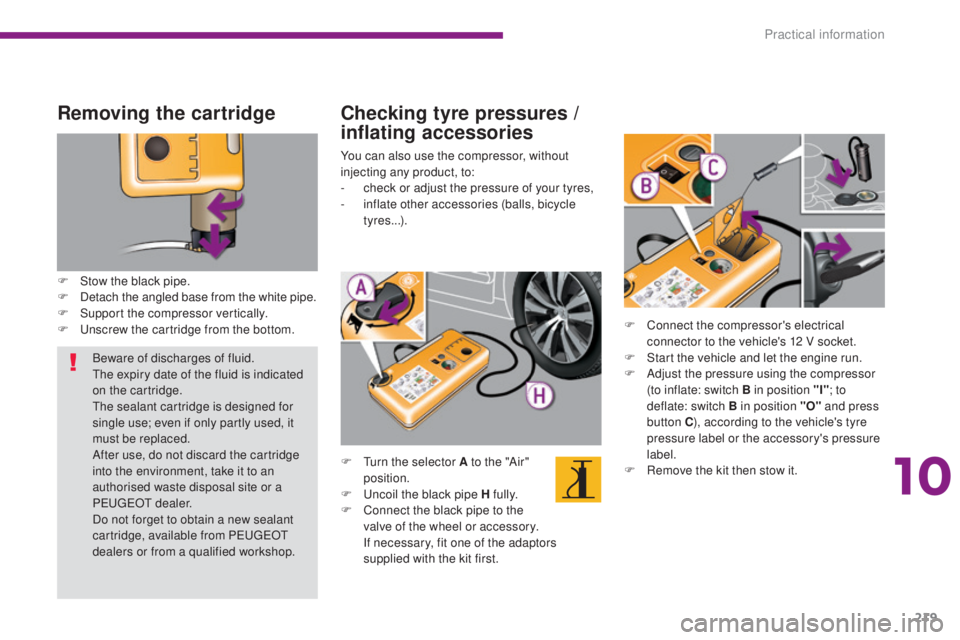
F Stow the black pipe.
F D etach the angled base from the white pipe.
F
S
upport the compressor vertically.
F
U
nscrew the cartridge from the bottom.
Checking tyre pressures /
inflating accessories
You can also use the compressor, without
injecting any product, to:
-
c
heck or adjust the pressure of your tyres,
-
i
nflate other accessories (balls, bicycle
tyres...).
F
T
urn the selector A to the "Air"
position.
F
U
ncoil the black pipe H fully.
F
C
onnect the black pipe to the
valve of the wheel or accessory.
I
f necessary, fit one of the adaptors
supplied with the kit first. F
C
onnect the compressor's electrical
connector to the vehicle's 12 V socket.
F
S
tart the vehicle and let the engine run.
F
A
djust the pressure using the compressor
(to inflate: switch B in position "I" ; to
deflate: switch B in position "O" and press
button C ), according to the vehicle's tyre
pressure label or the accessory's pressure
label.
F
R
emove the kit then stow it.
Beware of discharges of fluid.
The expiry date of the fluid is indicated
on the cartridge.
The sealant cartridge is designed for
single use; even if only partly used, it
must be replaced.
After use, do not discard the cartridge
into the environment, take it to an
authorised waste disposal site or a
PEUGEOT dealer.
Do not forget to obtain a new sealant
cartridge, available from PEUGEOT
dealers or from a qualified workshop.
10
Practical information
Page 222 of 364
220
5008_en_Chap10_infos-pratiques_ed01-2015
Temporary puncture repair kit
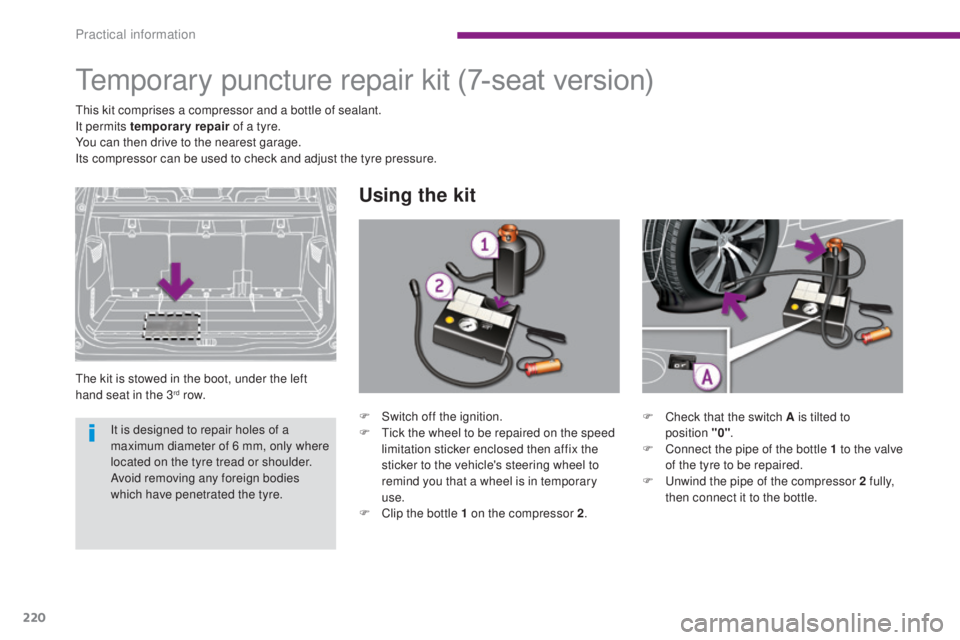
The kit is stowed in the boot, under the left
hand seat in the 3rd row.
Using the kit
(7-seat version)
This kit comprises a compressor and a bottle of sealant.
It permits temporary repair of a tyre.
You can then drive to the nearest garage.
Its compressor can be used to check and adjust the tyre pressure.
F
C
heck that the switch A is tilted to
position
"0".
F
C
onnect the pipe of the bottle 1 to the valve
of the tyre to be repaired.
F
U
nwind the pipe of the compressor 2 fully,
then connect it to the bottle.
F
S
witch off the ignition.
F
T
ick the wheel to be repaired on the speed
limitation sticker enclosed then affix the
sticker to the vehicle's steering wheel to
remind you that a wheel is in temporary
use.
F
C
lip the bottle 1 on the compressor 2.
It is designed to repair holes of a
maximum diameter of 6 mm, only where
located on the tyre tread or shoulder.
Avoid removing any foreign bodies
which have penetrated the tyre.
Practical information