seats PEUGEOT 5008 2016 Owner's Guide
[x] Cancel search | Manufacturer: PEUGEOT, Model Year: 2016, Model line: 5008, Model: PEUGEOT 5008 2016Pages: 364, PDF Size: 12.98 MB
Page 135 of 364
133
5008_en_Chap06_securite-enfants_ed01-2015
Recommendations
Child seats
The incorrect installation of a child seat in a
vehicle compromises the child's protection in
the event of an accident.
Check that there is no seat belt or seat belt
buckle under the child seat as this could
destabilise it.
Remember to fasten the seat belts or the
child seat harnesses keeping the slack in
relation to the child's body to a minimum,
even for short journeys.
For the installation of a child seat using a seat
belt, ensure that this is well tensioned on the
child seat and that it is holding the child seat
firmly against the seat of your vehicle. If your
front passenger seat is adjustable, move it
forward if necessary.
At the rear seats, always leave sufficient
space between the front seat and:
-
a r
ear ward facing child seat,
-
t
he feet of a child seated in a for ward
facing child seat.
For this, move the front seat for ward and if
necessary straighten its backrest.
Children at the front
For optimum installation of the "forward facing"
child seat, ensure that the back of the child seat
is as close as possible to the backrest of the
vehicle's seat, or in contact if possible
The head restraint must be removed before
installing a child seat with a backrest on the
passenger seat.
Ensure that the head restraint is stowed or
attached securely so that it is not thrown around
the vehicle in the event of sharp braking.
Refit the head restraint as soon as the child
seat is removed.
The legislation on carrying a child on the front
passenger seat is specific to each country.
Refer to the legislation in force in the country
in which you are driving.
Deactivate the passenger's front airbag when
a "rear ward facing" child seat is installed on
the front passenger seat. Otherwise, the child
would risk being seriously injured or killed if
the airbag were deployed.
Installing a booster
cushion
The chest part of the seat belt must be
positioned on the child's shoulder without
touching the neck.
Ensure that the lap part of the seat belt
passes correctly over the child's thighs.
PEUGEOT recommends the use of a booster
seat which has a back, fitted with a seat belt
guide at shoulder level.
As a safety precaution, do not leave:
-
o
ne or more children alone and
unsupervised in a vehicle,
-
a c
hild or an animal in a vehicle which
is exposed to the sun, with the windows
closed,
-
t
he keys within reach of children inside
the vehicle.
To prevent accidental opening of the doors,
use the "Child lock".
Take care not to open the rear windows by
more than one third.
To protect young children from the rays of the
sun, fit side blinds on the rear windows.
6
Child safety
Page 141 of 364
139
5008_en_Chap07_securite_ed01-2015
Front seat belts not fastened /
u nfastened warning lamp
Fastening
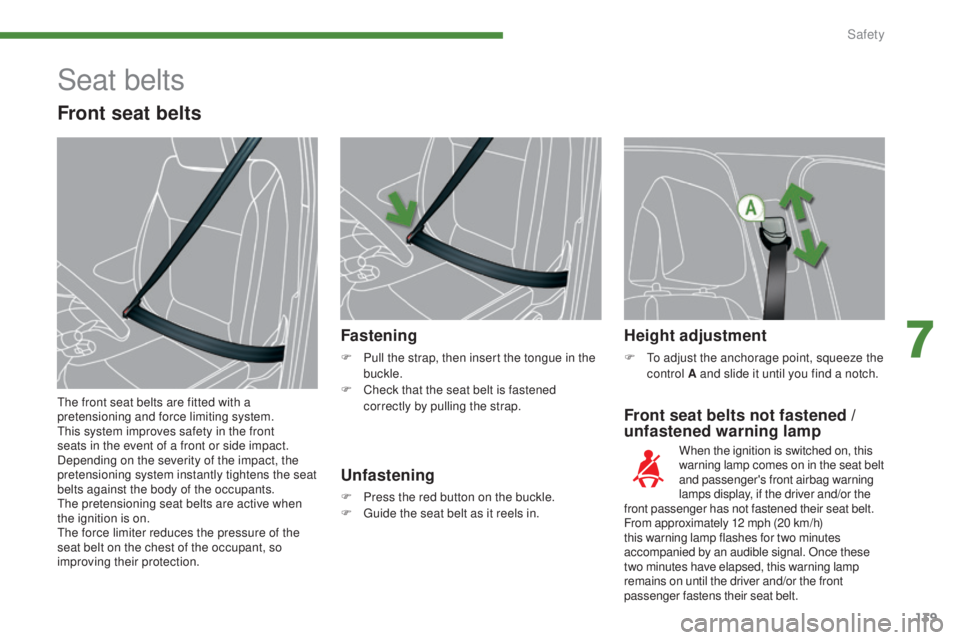
F Pull the strap, then insert the tongue in the
buckle.
F
C
heck that the seat belt is fastened
correctly by pulling the strap.
Height adjustment
F To adjust the anchorage point, squeeze the control A and slide it until you find a notch.
When the ignition is switched on, this
warning lamp comes on in the seat belt
and passenger's front airbag warning
lamps display, if the driver and/or the
front passenger has not fastened their seat belt.
From approximately 12 mph (20 km/h)
this warning lamp flashes for two minutes
accompanied by an audible signal. Once these
two minutes have elapsed, this warning lamp
remains on until the driver and/or the front
passenger fastens their seat belt.
Unfastening
F Press the red button on the buckle.
F
G uide the seat belt as it reels in.
Seat belts
Front seat belts
The front seat belts are fitted with a
pretensioning and force limiting system.
This system improves safety in the front
seats in the event of a front or side impact.
Depending on the severity of the impact, the
pretensioning system instantly tightens the seat
belts against the body of the occupants.
The pretensioning seat belts are active when
the ignition is on.
The force limiter reduces the pressure of the
seat belt on the chest of the occupant, so
improving their protection.
7
Safety
Page 142 of 364
140
5008_en_Chap07_securite_ed01-2015
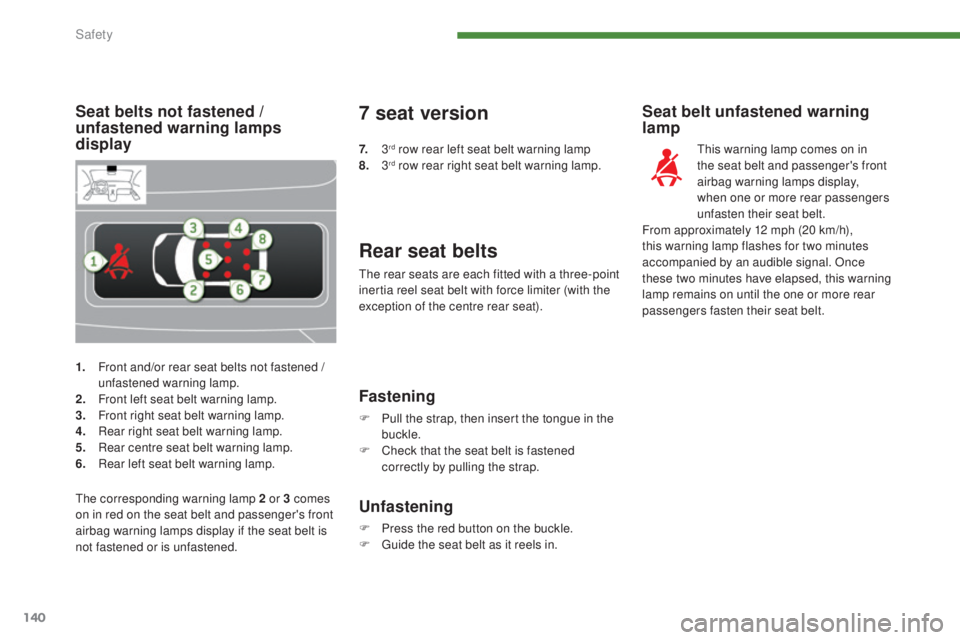
1. Front and/or rear seat belts not fastened /
unfastened warning lamp.
2.
F
ront left seat belt warning lamp.
3.
F
ront right seat belt warning lamp.
4.
R
ear right seat belt warning lamp.
5.
R
ear centre seat belt warning lamp.
6.
R
ear left seat belt warning lamp.
Seat belts not fastened /
u nfastened warning lamps
display
Rear seat belts
The rear seats are each fitted with a three-point
inertia reel seat belt with force limiter (with the
exception of the centre rear seat).
Seat belt unfastened warning
lamp
This warning lamp comes on in
the seat belt and passenger's front
airbag warning lamps display,
when one or more rear passengers
unfasten their seat belt.
From approximately 12 mph (20 km/h),
this warning lamp flashes for two minutes
accompanied by an audible signal. Once
these two minutes have elapsed, this warning
lamp remains on until the one or more rear
passengers fasten their seat belt.
Fastening
F Pull the strap, then insert the tongue in the buckle.
F
C
heck that the seat belt is fastened
correctly by pulling the strap.
Unfastening
F Press the red button on the buckle.
F G uide the seat belt as it reels in.
The corresponding warning lamp 2 or 3 comes
on in red on the seat belt and passenger's front
airbag warning lamps display if the seat belt is
not fastened or is unfastened.
7 seat version
7.
3rd row rear left seat belt warning lamp
8.
3rd row rear right seat belt warning lamp.
Safety
Page 143 of 364
141
5008_en_Chap07_securite_ed01-2015
Seat belt unfastened warning
lamps display
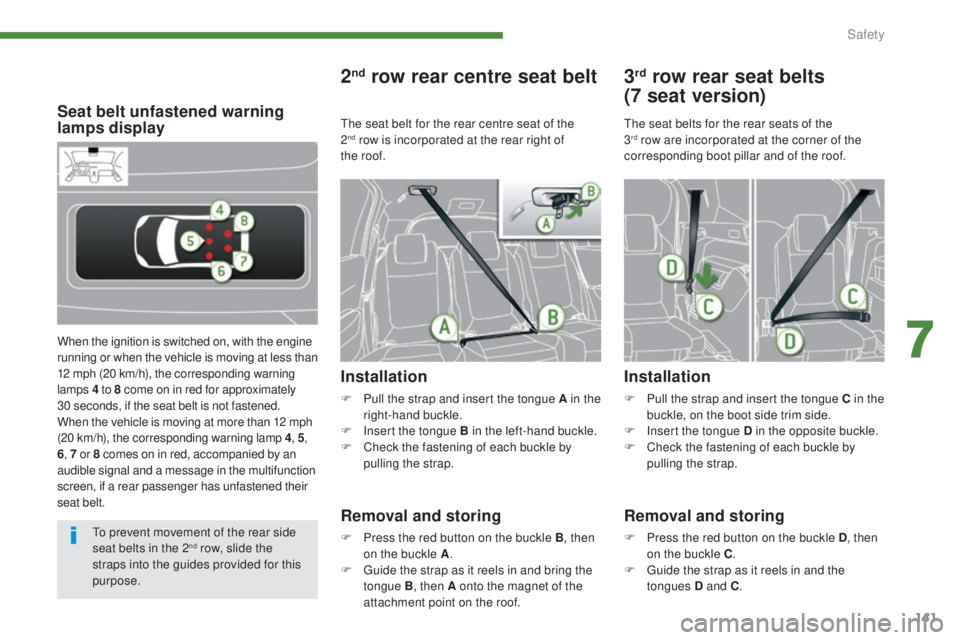
When the ignition is switched on, with the engine
running or when the vehicle is moving at less than
12 mph (20 km/h), the corresponding warning
lamps 4 to 8 come on in red for approximately
30
seconds, if the seat belt is not fastened.
When the vehicle is moving at more than 12 mph
(20 km/h), the corresponding warning lamp 4 , 5 ,
6 , 7 or 8 comes on in red, accompanied by an
audible signal and a message in the multifunction
screen, if a rear passenger has unfastened their
seat belt.
2nd row rear centre seat belt
Installation
F Pull the strap and insert the tongue A in the right-hand buckle.
F
I
nsert the tongue B in the left-hand buckle.
F
C
heck the fastening of each buckle by
pulling the strap.
Removal and storing
F Press the red button on the buckle B, then on the buckle A .
F
G
uide the strap as it reels in and bring the
tongue B , then A
onto the magnet of the
attachment point on the roof.
3rd row rear seat belts
(7
seat version)
Installation
F Pull the strap and insert the tongue C in the
buckle, on the boot side trim side.
F
I
nsert the tongue D in the opposite buckle.
F
C
heck the fastening of each buckle by
pulling the strap.
The seat belts for the rear seats of the
3
rd row are incorporated at the corner of the
c
orresponding boot pillar and of the roof.
Removal and storing
F Press the red button on the buckle D , then
on the buckle C .
F
G
uide the strap as it reels in and the
tongues D and C .
The seat belt for the rear centre seat of the
2
nd row is incorporated at the rear right of
t
he roof.
To prevent movement of the rear side
seat belts in the 2
nd row, slide the
straps into the guides provided for this
purpose.
7
Safety
Page 144 of 364
142
5008_en_Chap07_securite_ed01-2015
Advice
In order to be effective, a seat belt must:
- b e tightened as close to the body as
possible,
-
b
e pulled in front of you with a smooth
movement, checking that it does not
twist,
-
b
e used to restrain only one person,
-
n
ot bear any trace of cuts or fraying,
-
n
ot be converted or modified to avoid
affecting its performance.
The driver must ensure that passengers use
the seat belts correctly and that they are all
fastened before setting off.
Wherever you are seated in the vehicle,
always fasten your seat belt, even for short
journeys.
Do not interchange the seat belt buckles as
they will not fulfil their role fully.
The seat belts are fitted with an inertia reel
permitting automatic adjustment of the length
of the strap to your size. The seat belt is
stowed automatically when not in use.
Before and after use, ensure that the seat belt
is reeled in correctly.
The lower part of the strap must be positioned
as low as possible on the pelvis.
The upper part must be positioned in the
hollow of the shoulder.
The inertia reels are fitted with an automatic
locking device which comes into operation in
the event of a collision, emergency braking
or if the vehicle rolls over. You can release
the device by pulling the strap firmly and then
releasing it so that it reels in slightly.
In the event of an impact
Depending on the nature and seriousness
of the impact
, the pretensioning device may
be deployed before and independently of the
airbags. Deployment of the pretensioners
is accompanied by a slight discharge of
harmless smoke and a noise, due to the
activation of the pyrotechnic cartridge
incorporated in the system.
In all cases, the airbag warning lamp
comes
on.
Following an impact, have the seat belts
system checked, and if necessary replaced,
by a PEUGEOT dealer or a qualified
workshop.
Recommendations for children
Use a suitable child seat if the passenger is
less than 12 years old or shorter than one and
a half metres.
Never use the same seat belt to secure more
than one person.
Never allow a child to travel on your lap.
For more information on child seats, refer to
the corresponding section.
In accordance with current safety regulations,
for all repairs on your vehicle's seat belts, go
to a qualified workshop with the skills and
equipment needed, which a PEUGEOT dealer
is able to provide.
Have your seat belts checked regularly by a
PEUGEOT dealer or a qualified workshop,
particularly if the straps show signs of
damage.
Clean the seat belt straps with soapy water or
a textile cleaning product, sold by PEUGEOT
dealers.
After folding or moving a seat or rear bench
seat, ensure that the seat belt is positioned
and reeled in correctly.
Safety
Page 148 of 364
146
5008_en_Chap07_securite_ed01-2015
Guidelines to follow:
Sit in a normal upright position.
Wear a correctly adjusted seat belt.
Do not allow anything to come between
the occupants and the airbags (a child, pet,
object...), do not attach or fix anything near to
the airbags or their trajectories when inflating
as this could cause injuries when the airbags
are deployed.
Never modify the original definition of your
vehicle, particularly in the area directly
around the airbags.
After an accident or if the vehicle has been
stolen or broken into, have the airbag systems
checked.
All work on the airbag system must be carried
out by a PEUGEOT dealer or a qualified
workshop.
Even if all of the precautions mentioned
are observed, a risk of injury or of minor
burns to the head, chest or arms when an
airbag is deployed cannot be ruled out. The
bag inflates almost instantly (within a few
milliseconds) then deflates within the same
time discharging the hot gas via openings
provided for this purpose.
Lateral airbags
Use only approved covers on the seats,
compatible with the deployment the lateral
airbags. For information on the range of seat
covers suitable for your vehicle, you can
contact a PEUGEOT dealer.
Refer to the "Accessories" section.
Do not fix or attach anything to the seat backs
(clothing...). This could cause injury to the
chest or arms if the lateral airbag is deployed.
Do not sit with the upper part of the body any
nearer to the door than necessary.
Front airbags
Do not drive holding the steering wheel by its
spokes or resting your hands on the centre
part of the wheel.
Passengers must not place their feet on the
dashboard.
Do not smoke as deployment of the airbags
can cause burns or the risk of injury from a
cigarette or pipe.
Never remove or pierce the steering wheel or
hit it violently.
Do not fit or attach anything to the steering
wheel or dashboard, this could cause injuries
with deployment of the airbags.
Curtain airbags
Do not fix or attach anything to the roof. This
could cause injury to the head if the curtain
airbag is deployed.
If fitted on your vehicle, do not remove the
grab handles installed on the roof, they play a
part in securing the curtain airbags.
Safety
Page 258 of 364
256
5008_en_Chap10_infos-pratiques_ed01-2015
"Protection"
Mats*, boot liner, luggage net, style mud
flaps**, seat covers, pet range, boot sill
protector...
"Safety and security"
Anti-theft alarm, window etching, wheel
security bolts, child seats and booster
cushions, first aid kit, breathalyzer, warning
triangle, high visibility vest, stolen vehicle
tracking system, dog guard, winter equipment
(snow chains, non-slip covers...)...
Accessories
"Style"
Alloy wheels, door sill trims, chrome-plated
door handle shells, spoiler, gear lever knob...
"Transport solutions"
Roof bars, towbars, bicycle carrier on towbar,
bicycle carrier on roof bars, ski carrier, rigid
and flexible roof boxes...
Trailer towbar, which must be fitted by a
PEUGEOT dealer.
"Comfort"
Door deflectors, parking sensors, side window
blinds, coat-hanger, insulated module... A wide range of accessories and genuine parts is available from the PEUGEOT dealer network.
These accessories and parts are all adapted to your vehicle and benefit from PEUGEOT's recommendation and warranty.*
T
o avoid any risk of jamming of the pedals:
-
e
nsure that the mat is positioned and
secured correctly,
-
n
ever fit one mat on top of another.
**
T
he configuration of the vehicle requires
that it be fitted with mud flaps at the rear.
Practical information
Page 261 of 364
259
5008_en_Chap11_caracteristiques_ed01-2015
* The kerb weight is equal to the unladen weight + driver (75 kg).
** T he weight of the braked trailer can be increased, within the GTW limit, if the GV W of the towing vehicle is reduced by an equal amount; warning,
towing using a lightly loaded towing vehicle may have an adverse effect on its road holding.
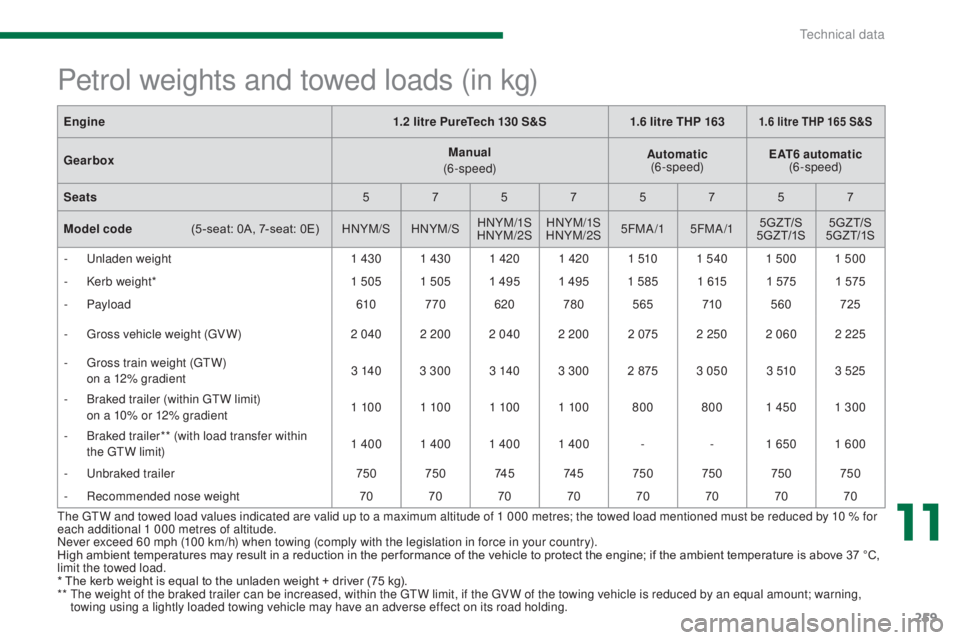
Engine
1.2 litre PureTech 130 S&S1.6 litre THP 163
1.6 litre THP 165 S&S
Gearbox Manual
(6-speed) Automatic
(6-speed) EAT6 automatic
(6-speed)
Seats 57575757
Model code
(
5 -seat: 0A, 7-seat: 0E) HNYM/S HNYM/SHNYM/1S
HNYM/2S HNYM/1S
HNYM/2S 5FMA /1 5FMA /1 5G Z T/S
5G Z T/1S 5G Z T/S
5G Z T/1S
-
U
nladen weight 1 430 1 4301 420 1 420 1 5101 540 1 500 1 500
-
K
erb weight* 1 505 1 5051 495 1 4951 5851 6151 575 1 575
-
Payload 610770 620 780565 710560 725
-
G
ross vehicle weight (GV W) 2 040 2 200 2 040 2 200 2 0752 250 2 060 2 225
-
G
ross train weight (GTW)
o
n a 12% gradient 3 140
3 300 3 1403 300 2 8753 050 3 5103 525
-
B
raked trailer (within GTW limit)
o
n a 10% or 12% gradient 1 10 0 1 10 0 1 10 0 1 10 0
800 8001 450 1 300
-
B
raked trailer** (with load transfer within
the GTW limit) 1 400 1 400 1 400 1 400 -
- 1 650 1 600
-
U
nbraked trailer 750 75074 5 74 5750 750 750 750
-
R
ecommended nose weight 70 70 70 70 70 70 70 70
The GTW and towed load values indicated are valid up to a maximum altitude of 1 000 metres; the towed load mentioned must be reduced by 10 % for
each additional 1 000 metres of altitude.
Never exceed 60 mph (100 km/h) when towing (comply with the legislation in force in your country).
High ambient temperatures may result in a reduction in the per formance of the vehicle to protect the engine; if the ambient temperature is above 37 °C,
limit the towed load.
Petrol weights and towed loads (in kg)
11
Technical data
Page 262 of 364
260
5008_en_Chap11_caracteristiques_ed01-2015
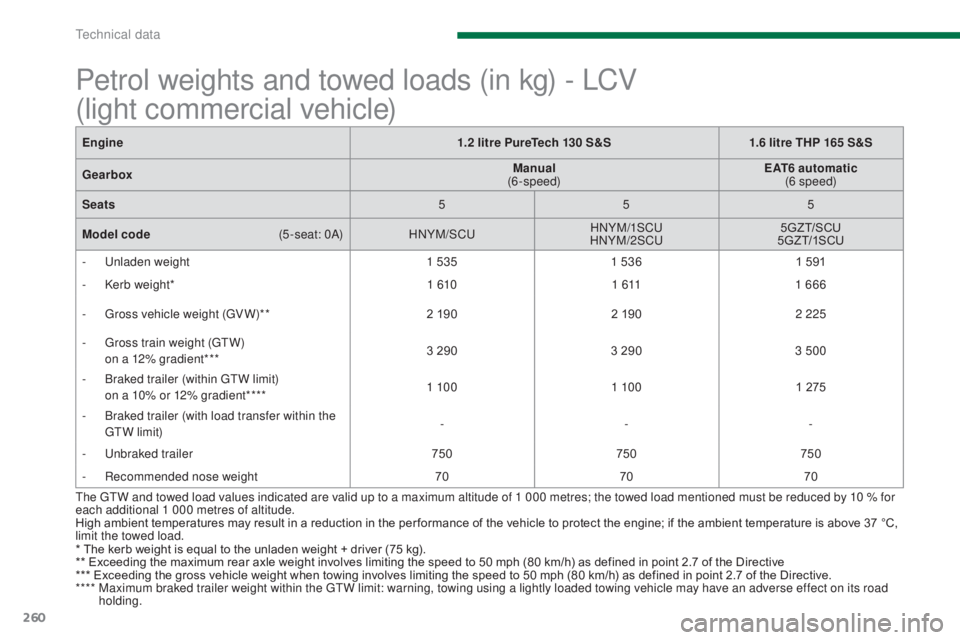
Petrol weights and towed loads (in kg) - LCV
(light commercial vehicle)
* The kerb weight is equal to the unladen weight + driver (75 kg).
** Exceeding the maximum rear axle weight involves limiting the speed to 50 mph (80 km/h) as defined in point 2.7 of the Directive
*** Exceeding the gross vehicle weight when towing involves limiting the speed to 50 mph (80 km/h) as defined in point 2.7 of the Directive.
****
M
aximum braked trailer weight within the GTW limit: warning, towing using a lightly loaded towing vehicle may have an adverse effect on its road
holding.
The GTW and towed load values indicated are valid up to a maximum altitude of 1 000 metres; the towed load mentioned must be reduced by 10 % for
each additional 1 000 metres of altitude.
High ambient temperatures may result in a reduction in the per formance of the vehicle to protect the engine; if the ambient temperature is above 37 °C,
limit the towed load. Engine
1.2 litre PureTech 130 S&S1.6 litre THP 165 S&S
Gearbox Manual
(6-speed) EAT6 automatic
(6 speed)
Seats 555
Model code
(
5-seat: 0A)
HNYM/SCU HNYM/1SCU
HNYM/2SCU 5GZT/SCU
5G Z T/1SCU
-
U
nladen weight
1 5351 536 1 591
-
K
erb weight*
1 6101 6 111 666
-
G
ross vehicle weight (GV W)**
2 1902 1902 225
-
G
ross train weight (GTW)
o
n a 12% gradient***
3 290
3 2903 500
-
B
raked trailer (within GTW limit)
o
n a 10% or 12% gradient****
1 10 0
1 10 0 1 275
-
B
raked trailer (with load transfer within the
GTW limit) -
--
-
U
nbraked trailer
750750750
-
R
ecommended nose weight
707070
Technical data
Page 265 of 364
263
5008_en_Chap11_caracteristiques_ed01-2015
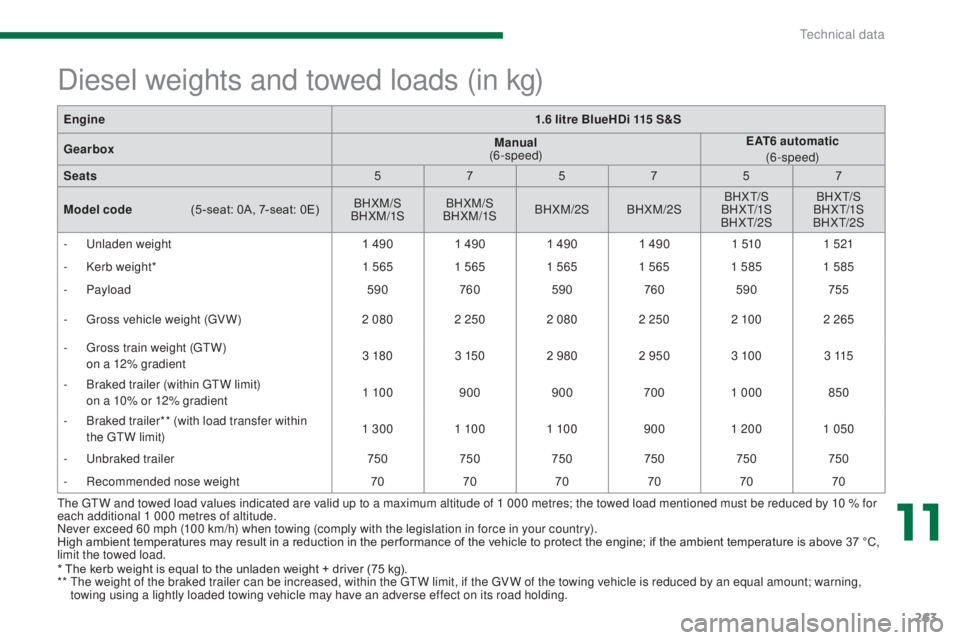
* The kerb weight is equal to the unladen weight + driver (75 kg).
** T he weight of the braked trailer can be increased, within the GTW limit, if the GV W of the towing vehicle is reduced by an equal amount; warning,
towing using a lightly loaded towing vehicle may have an adverse effect on its road holding.
The GTW and towed load values indicated are valid up to a maximum altitude of 1 000 metres; the towed load mentioned must be reduced by 10 % for
each additional 1 000 metres of altitude.
Never exceed 60 mph (100 km/h) when towing (comply with the legislation in force in your country).
High ambient temperatures may result in a reduction in the per formance of the vehicle to protect the engine; if the ambient temperature is above 37 °C,
limit the towed load.
Diesel weights and towed loads (in kg)
Engine
1.6 litre BlueHDi 115 S&S
Gearbox Manual
(6-speed) E AT 6
automatic
(6-speed)
Seats 575757
Model code
(
5 -seat: 0A, 7-seat: 0E) BHXM/S
BHXM/1S BHXM/S
BHXM/1S BHXM/2S BHXM/2S BH X T/S
BH X T/1S
BH X T/2S BH X T/S
BH X T/1S
BH X T/2S
-
U
nladen weight 1 4901 4901 4901 490 1 5101 521
-
K
erb weight* 1 5651 5651 5651 5651 5851 585
-
Payload 590760590 760590 755
-
G
ross vehicle weight (GV W) 2 0802 2502 080 2 2502 10 02 265
-
G
ross train weight (GTW)
o
n a 12% gradient 3 180
3 1502 980 2 950 3 10 0 3 115
-
B
raked trailer (within GTW limit)
o
n a 10% or 12% gradient 1 10 0
900900 7001 000 850
-
B
raked trailer** (with load transfer within
the GTW limit) 1 300
1 10 01 10 0 9001 200 1 050
-
U
nbraked trailer 750750750750750750
-
R
ecommended nose weight 707070707070
11
Technical data