ABS PEUGEOT 5008 2016 Owners Manual
[x] Cancel search | Manufacturer: PEUGEOT, Model Year: 2016, Model line: 5008, Model: PEUGEOT 5008 2016Pages: 364, PDF Size: 12.98 MB
Page 6 of 364
4
5008_en_Chap00b_vue-ensemble_ed01-2015
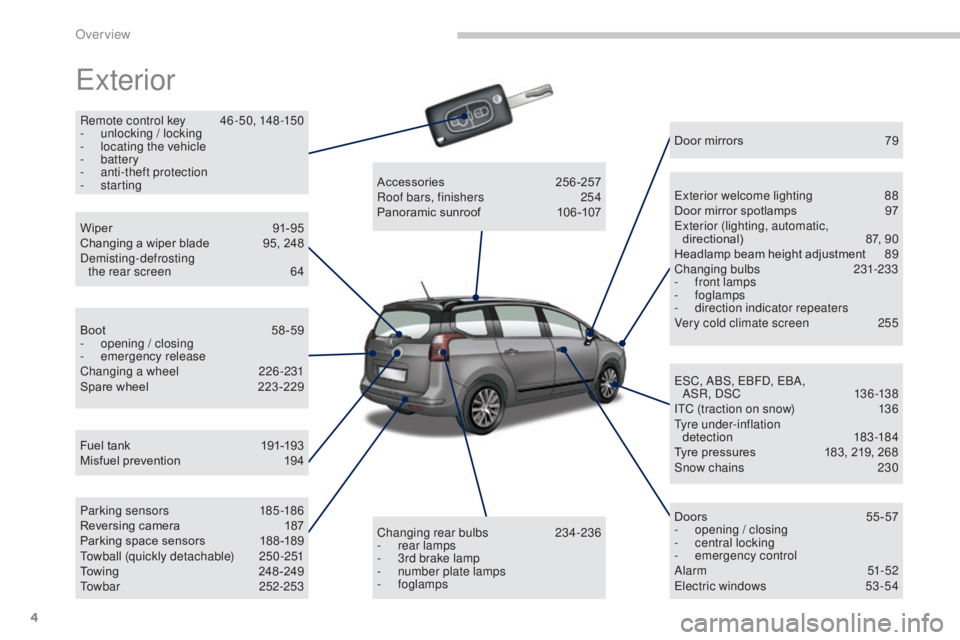
Exterior
Remote control key 46 -50, 148 -150
- u nlocking / locking
-
l
ocating the vehicle
-
battery
-
a
nti-theft protection
-
starting
Fuel tank
1
91-193
Misfuel prevention
1
94
Wiper
91
-95
Changing a wiper blade
9
5, 248
Demisting-defrosting the rear screen
6
4
Boot
5
8-59
-
ope
ning / closing
-
em
ergency release
Changing a wheel
2
26-231
Spare wheel
2
23 -229
Parking sensors
1
85-186
Reversing camera
1
87
Parking space sensors
1
88 -189
Towball (quickly detachable)
2
50 -251
Towing
24
8-249
Towbar
252-253Accessories
2
56-257
Roof bars, finishers
2
54
Panoramic sunroof
1
06 -107Door mirrors
7
9
Exterior welcome lighting
8
8
Door mirror spotlamps
9
7
Exterior (lighting, automatic, directional)
87
, 90
Headlamp beam height adjustment
8
9
Changing bulbs
2
31-233
-
f
ront lamps
-
foglamps
-
d
irection indicator repeaters
Very cold climate screen
2
55
Doors
5
5 -57
-
ope
ning / closing
-
c
entral locking
-
em
ergency control
Alarm
51-52
Electric windows
5
3 -54
ESC, ABS, EBFD, EBA,
AS R , DSC
13
6 -13 8
ITC (traction on snow)
1
36
Tyre under-inflation detection
18
3 -18 4
Tyre pressures
1
83, 219, 268
Snow chains
2
30
Changing rear bulbs
2
34-236
-
r
ear lamps
-
3
rd brake lamp
-
n
umber plate lamps
-
foglamps
Over view
Page 23 of 364
21
5008_en_Chap01_controle-marche_ed01-2015
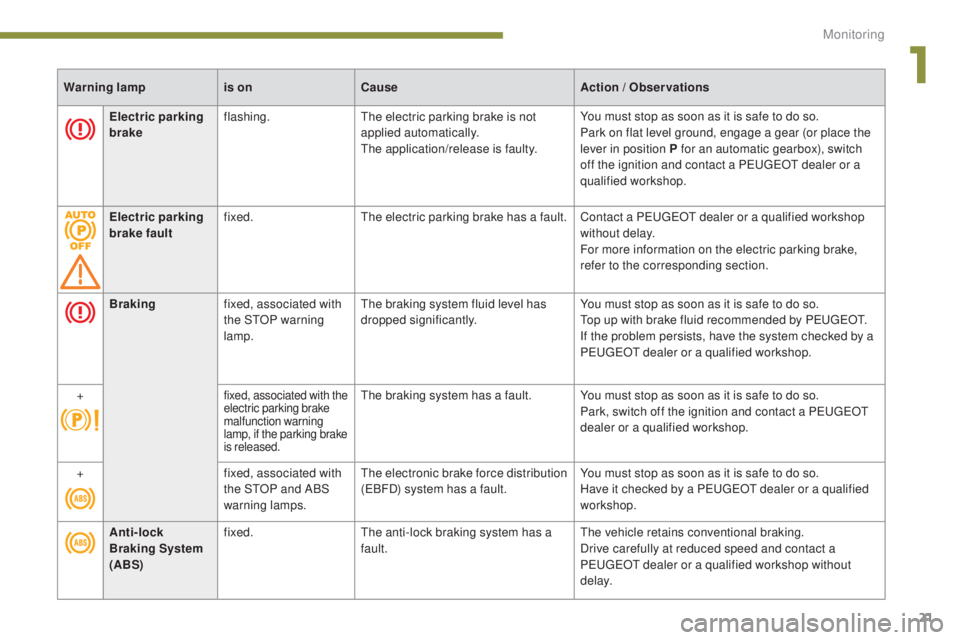
Electric parking
brakeflashing.
The electric parking brake is not
applied automatically.
The application/release is faulty. You must stop as soon as it is safe to do so.
Park on flat level ground, engage a gear (or place the
lever in position P for an automatic gearbox), switch
off the ignition and contact a PEUGEOT dealer or a
qualified workshop.
Electric parking
brake fault fixed.
The electric parking brake has a fault. Contact a PEUGEOT dealer or a qualified workshop
without delay.
For more information on the electric parking brake,
refer to the corresponding section.
Warning lamp
is onCause Action / Observations
Braking fixed, associated with
the STOP warning
lamp. The braking system fluid level has
dropped significantly.
You must stop as soon as it is safe to do so.
Top up with brake fluid recommended by PEUGEOT.
If the problem persists, have the system checked by a
PEUGEOT dealer or a qualified workshop.
+
fixed, associated with the
electric parking brake
malfunction warning
lamp, if the parking brake
is released.The braking system has a fault. You must stop as soon as it is safe to do so. Park, switch off the ignition and contact a PEUGEOT
dealer or a qualified workshop.
+ fixed, associated with
the STOP and ABS
warning lamps.The electronic brake force distribution
(EBFD) system has a fault.
You must stop as soon as it is safe to do so.
Have it checked by a PEUGEOT dealer or a qualified
workshop.
Anti-lock
Braking System
(ABS) fixed.
The anti-lock braking system has a
fault. The vehicle retains conventional braking.
Drive carefully at reduced speed and contact a
PEUGEOT dealer or a qualified workshop without
d e l ay.
1
Monitoring
Page 46 of 364
44
5008_en_Chap01_controle-marche_ed01-2015
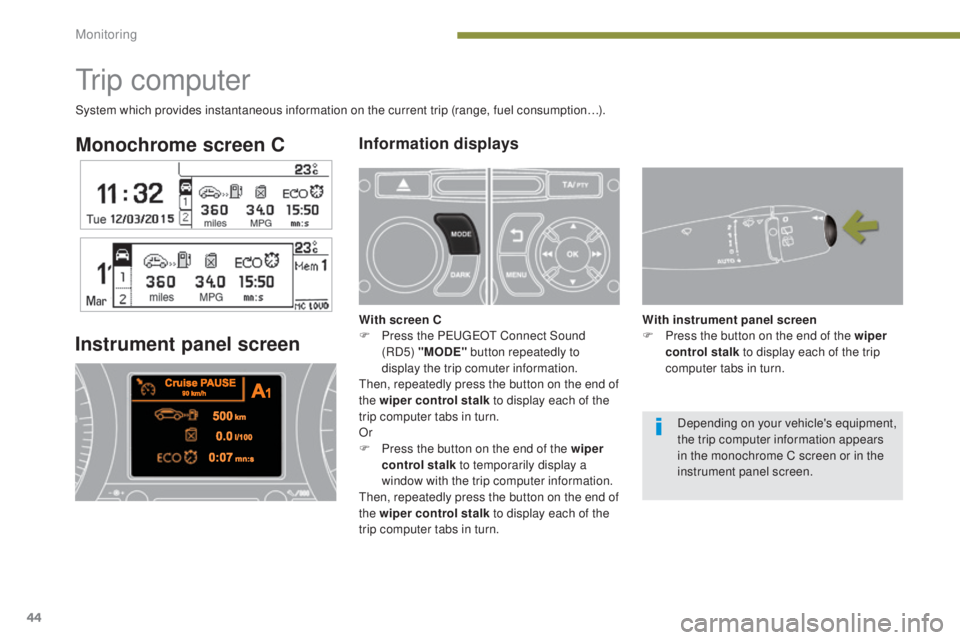
Monochrome screen CInformation displays
Instrument panel screen
Tr i p c o m p u t e r
With screen C
F P ress the PE UGEOT C onnect Sound
(RD5) "MODE" button repeatedly to
display the trip comuter information.
Then, repeatedly press the button on the end of
the wiper control stalk to display each of the
trip computer tabs in turn.
Or
F
P
ress the button on the end of the wiper
control stalk to temporarily display a
window with the trip computer information.
Then, repeatedly press the button on the end of
the wiper control stalk to display each of the
trip computer tabs in turn. With instrument panel screen
F
P ress the button on the end of the wiper
control stalk to display each of the trip
computer tabs in turn.
System which provides instantaneous information on the current trip (range, fuel consumption…).
Depending on your vehicle's equipment,
the trip computer information appears
in the monochrome C screen or in the
instrument panel screen.
Monitoring
Page 54 of 364
52
5008_en_Chap02_ouvertures_ed01-2015
Reactivation of the interior
volumetric protection
F Unlock the vehicle using the unlocking button on the remote control.
F
R
elock the vehicle using the remote control.
The alarm is activated again with both types
of protection; the indicator lamp in button A
switches off.
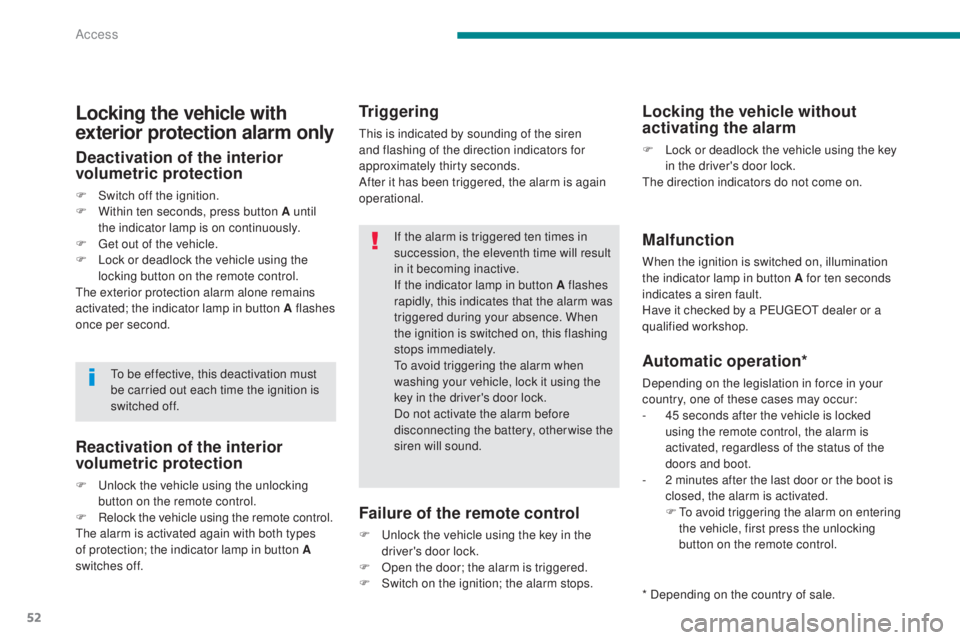
Locking the vehicle with
exterior protection alarm only
Deactivation of the interior
volumetric protection
F Switch off the ignition.
F W ithin ten seconds, press button A until
the indicator lamp is on continuously.
F
G
et out of the vehicle.
F
L
ock or deadlock the vehicle using the
locking button on the remote control.
The exterior protection alarm alone remains
activated; the indicator lamp in button A flashes
once per second.
Triggering
This is indicated by sounding of the siren
and flashing of the direction indicators for
approximately thirty seconds.
After it has been triggered, the alarm is again
operational.
Failure of the remote control
F Unlock the vehicle using the key in the driver's door lock.
F
O
pen the door; the alarm is triggered.
F
S
witch on the ignition; the alarm stops.
Malfunction
When the ignition is switched on, illumination
the indicator lamp in button A for ten seconds
indicates a siren fault.
Have it checked by a PEUGEOT dealer or a
qualified workshop.
Locking the vehicle without
activating the alarm
F Lock or deadlock the vehicle using the key in the driver's door lock.
The direction indicators do not come on.
Automatic operation*
Depending on the legislation in force in your
country, one of these cases may occur:
-
4
5 seconds after the vehicle is locked
using the remote control, the alarm is
activated, regardless of the status of the
doors and boot.
-
2 m
inutes after the last door or the boot is
closed, the alarm is activated.
F
T
o avoid triggering the alarm on entering
the vehicle, first press the unlocking
button on the remote control.
To be effective, this deactivation must
be carried out each time the ignition is
switched off.
If the alarm is triggered ten times in
succession, the eleventh time will result
in it becoming inactive.
If the indicator lamp in button A flashes
rapidly, this indicates that the alarm was
triggered during your absence. When
the ignition is switched on, this flashing
stops immediately.
To avoid triggering the alarm when
washing your vehicle, lock it using the
key in the driver's door lock.
Do not activate the alarm before
disconnecting the battery, otherwise the
siren will sound.
* Depending on the country of sale.
Access
Page 136 of 364
134
5008_en_Chap06_securite-enfants_ed01-2015
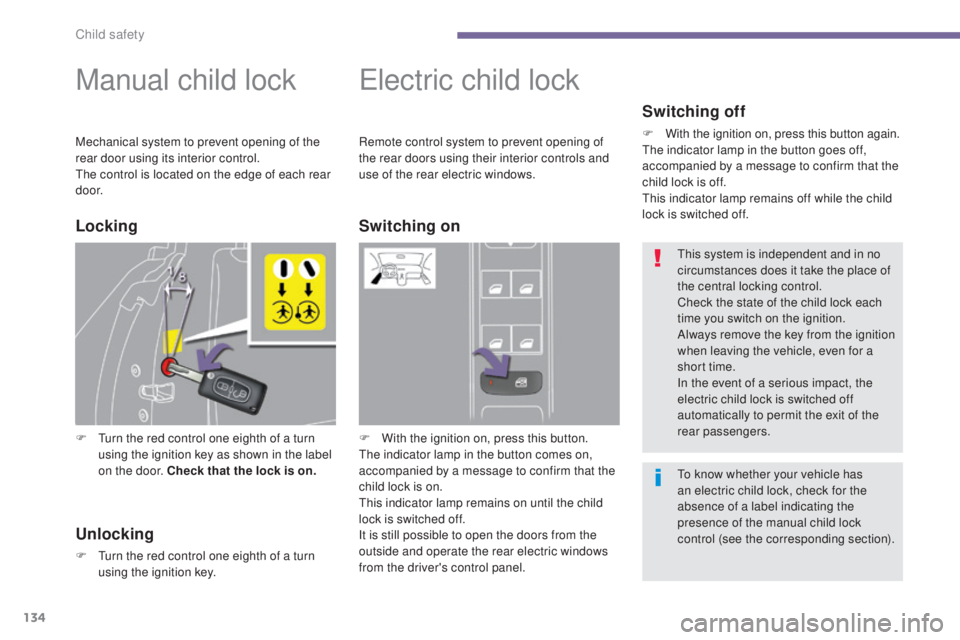
Manual child lock
F Turn the red control one eighth of a turn using the ignition key as shown in the label
on the door. Check that the lock is on.
Electric child lock
F With the ignition on, press this button.
The indicator lamp in the button comes on,
accompanied by a message to confirm that the
child lock is on.
This indicator lamp remains on until the child
lock is switched off.
It is still possible to open the doors from the
outside and operate the rear electric windows
from the driver's control panel.
Locking
Unlocking
F Turn the red control one eighth of a turn using the ignition key.
Switching on Switching off
F With the ignition on, press this button again.
The indicator lamp in the button goes off,
accompanied by a message to confirm that the
child lock is off.
This indicator lamp remains off while the child
lock is switched off.
This system is independent and in no
circumstances does it take the place of
the central locking control.
Check the state of the child lock each
time you switch on the ignition.
Always remove the key from the ignition
when leaving the vehicle, even for a
short time.
In the event of a serious impact, the
electric child lock is switched off
automatically to permit the exit of the
rear passengers.
Remote control system to prevent opening of
the rear doors using their interior controls and
use of the rear electric windows.
Mechanical system to prevent opening of the
rear door using its interior control.
The control is located on the edge of each rear
d o o r.
To know whether your vehicle has
an electric child lock, check for the
absence of a label indicating the
presence of the manual child lock
control (see the corresponding section).
Child safety
Page 138 of 364
136
5008_en_Chap07_securite_ed01-2015
Electronic stability control (ESC)
DefinitionsAnti-slip regulation (ASR)
The ASR system (also known as Traction
Control) optimises traction in order to limit
wheel slip by acting on the brakes of the driving
wheels and on the engine. It also improves
the directional stability of the vehicle on
acceleration.
Dynamic stability control (DSC)
If there is a difference between the path
followed by the vehicle and that required by
the driver, the DSC monitors each wheel and
automatically acts on the brake of one or more
wheels and on the engine to return the vehicle
to the required path, within the limits of the laws
of physics.
Emergency braking assistance
(EBA)
In an emergency, this system enables you to
reach the optimum braking pressure more
quickly and therefore reduce the stopping
distance.
It is triggered according to the speed at which
the brake pedal is pressed. This is felt by a
reduction in the resistance of the pedal and an
increase in the effectiveness of the braking.
Anti-lock braking system (ABS)
and electronic brake force
distribution (EBFD)
This system improves the stability and
manoeuvrability of your vehicle when braking
and contributes towards improved control in
corners, in particular on poor or slippery road
surfaces.
The ABS prevents wheel lock in the event of
emergency braking.
The electronic brake force distribution system
manages the braking pressure wheel by wheel.
Snow driving assistance
(Intelligent Traction Control)
Your vehicle has a system to help driving on
snow: Intelligent Traction Control.
This automatic system continuously checks
for situations of difficult sur face adhesion that
could make it difficult to move off or make
progress on deep fresh snow or compacted
snow.
In these situations, Intelligent Traction
Control limits the amount of wheel slip to
provide the best traction and trajectory control.
In extremely severe conditions (deep snow,
mud…), it can be useful to temporarily
deactivate the dynamic stability control and
wheel anti-slip systems to allow a degree of
wheel spin and so recover grip.
It is recommended that the system be
reactivated as soon as possible.
Snow tyres are strongly recommended on
sur faces offering low levels of adhesion.
Electronic Stability Control (ESC) incorporating
the following systems:
-
a
nti-lock braking system (ABS) and the
electronic brake force distribution (EBFD),
-
em
ergency braking assistance (EBA),
-
w
heel anti-slip regulation (ASR) or traction
control,
-
d
ynamic stability control (DSC).
Safety
Page 139 of 364
137
5008_en_Chap07_securite_ed01-2015
Operation
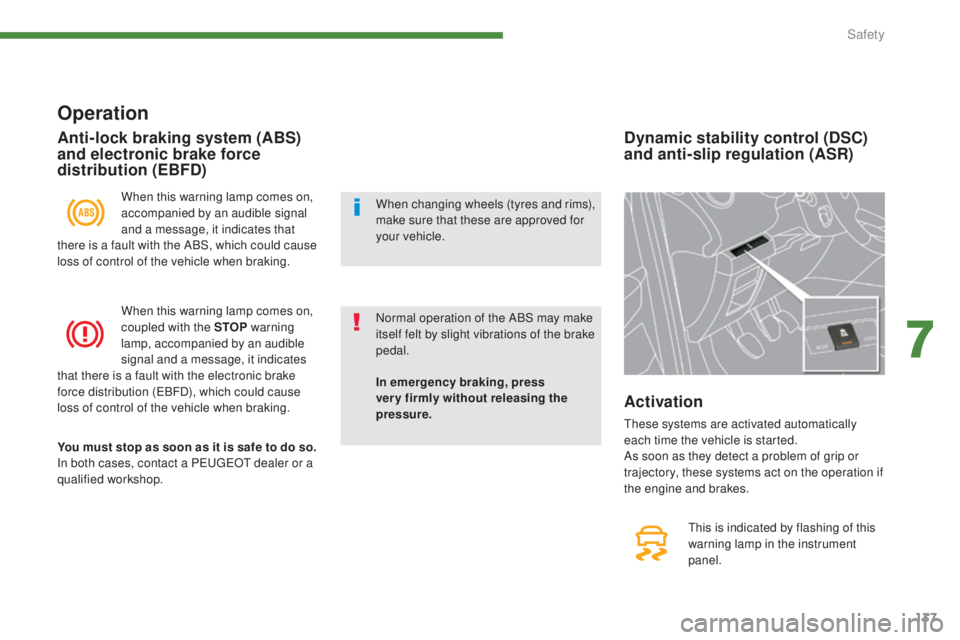
When this warning lamp comes on,
accompanied by an audible signal
and a message, it indicates that
there is a fault with the ABS, which could cause
loss of control of the vehicle when braking.
When this warning lamp comes on,
coupled with the STOP warning
lamp, accompanied by an audible
signal and a message, it indicates
that there is a fault with the electronic brake
force distribution (EBFD), which could cause
loss of control of the vehicle when braking.
You must stop as soon as it is safe to do so.
In both cases, contact a PEUGEOT dealer or a
qualified workshop.
Anti-lock braking system (ABS)
and electronic brake force
distribution (EBFD)
In emergency braking, press
very firmly without releasing the
pressure.
Dynamic stability control (DSC)
and anti-slip regulation (ASR)
This is indicated by flashing of this
warning lamp in the instrument
panel.
Activation
These systems are activated automatically
each time the vehicle is started.
As soon as they detect a problem of grip or
trajectory, these systems act on the operation if
the engine and brakes.
Normal operation of the ABS may make
itself felt by slight vibrations of the brake
pedal. When changing wheels (tyres and rims),
make sure that these are approved for
your vehicle.
7
Safety
Page 236 of 364
234
5008_en_Chap10_infos-pratiques_ed01-2015
Rear lamps
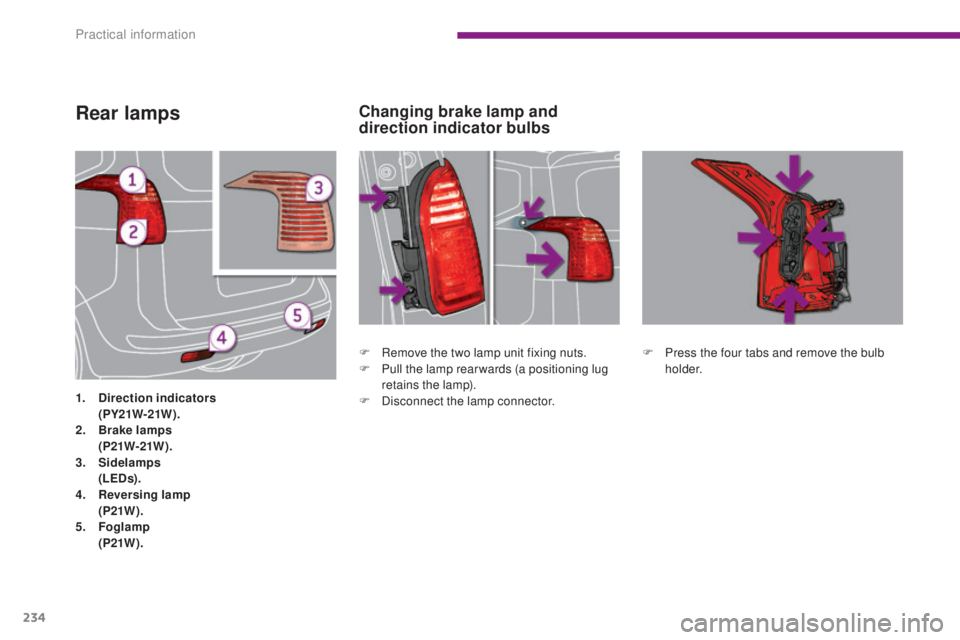
1. Direction indicators (
PY21W-21W ).
2.
Br
ake lamps
(
P21W-21W ).
3.
Si
delamps
(
LEDs).
4.
R
eversing lamp
(
P21W ).
5.
Fo
glamp
(
P21W ). F
R
emove the two lamp unit fixing nuts.
F
P
ull the lamp rear wards (a positioning lug
retains the lamp).
F D isconnect the lamp connector.F
P
ress the four tabs and remove the bulb
h o l d e r.
Changing brake lamp and
direction indicator bulbs
Practical information
Page 245 of 364
243
5008_en_Chap10_infos-pratiques_ed01-2015
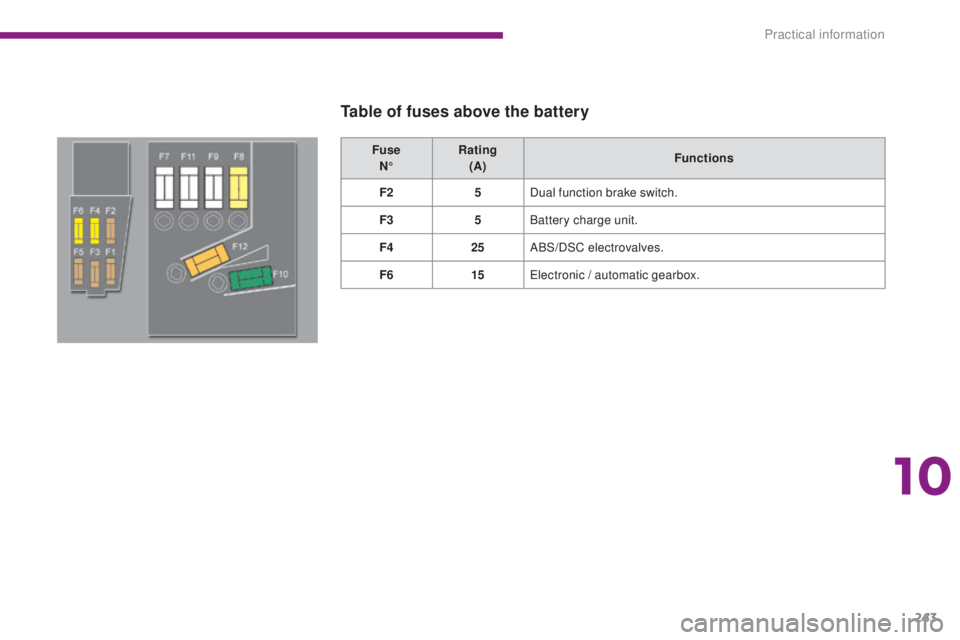
Fuse N° Rating
(A) Functions
F2 5Dual function brake switch.
F3 5Battery charge unit.
F4 25ABS/DSC electrovalves.
F6 15Electronic / automatic gearbox.
Table of fuses above the battery
10
Practical information
Page 251 of 364
249
5008_en_Chap10_infos-pratiques_ed01-2015
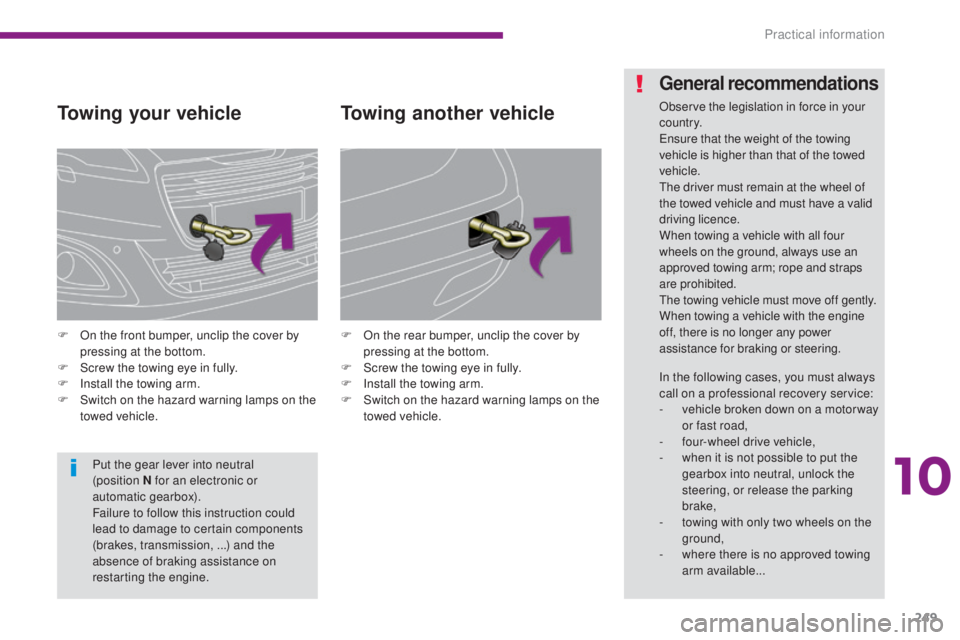
Towing your vehicle
F On the front bumper, unclip the cover by pressing at the bottom.
F
S
crew the towing eye in fully.
F
I
nstall the towing arm.
F
S
witch on the hazard warning lamps on the
towed vehicle. F
O n the rear bumper, unclip the cover by
pressing at the bottom.
F
S
crew the towing eye in fully.
F
I
nstall the towing arm.
F
S
witch on the hazard warning lamps on the
towed vehicle.
Towing another vehicle
Put the gear lever into neutral
(position N for an electronic or
automatic gearbox).
Failure to follow this instruction could
lead to damage to certain components
(brakes, transmission,
...) and the
absence of braking assistance on
restarting the engine.
General recommendations
Observe the legislation in force in your
c o unt r y.
Ensure that the weight of the towing
vehicle is higher than that of the towed
vehicle.
The driver must remain at the wheel of
the towed vehicle and must have a valid
driving licence.
When towing a vehicle with all four
wheels on the ground, always use an
approved towing arm; rope and straps
are prohibited.
The towing vehicle must move off gently.
When towing a vehicle with the engine
off, there is no longer any power
assistance for braking or steering.
In the following cases, you must always
call on a professional recovery service:
-
v
ehicle broken down on a motor way
or fast road,
-
f
our-wheel drive vehicle,
-
w
hen it is not possible to put the
gearbox into neutral, unlock the
steering, or release the parking
brake,
-
t
owing with only two wheels on the
ground,
-
w
here there is no approved towing
arm available...
10
Practical information