weight PEUGEOT 5008 2018 Owners Manual
[x] Cancel search | Manufacturer: PEUGEOT, Model Year: 2018, Model line: 5008, Model: PEUGEOT 5008 2018Pages: 364, PDF Size: 13.03 MB
Page 81 of 364
79
These continuity panels are not designed
to support a weight greater than 30 kg.
Before deploying the continuity panels,
check that the 2
nd row seats are pulled as
far back as possible.
Access to third row seats
Third row seats are accessed via the second
row outer seats. From the outside or from the 3
rd row seats:
F
C
heck that the "aircraft" type tables of the
front seats are properly folded.
F
P
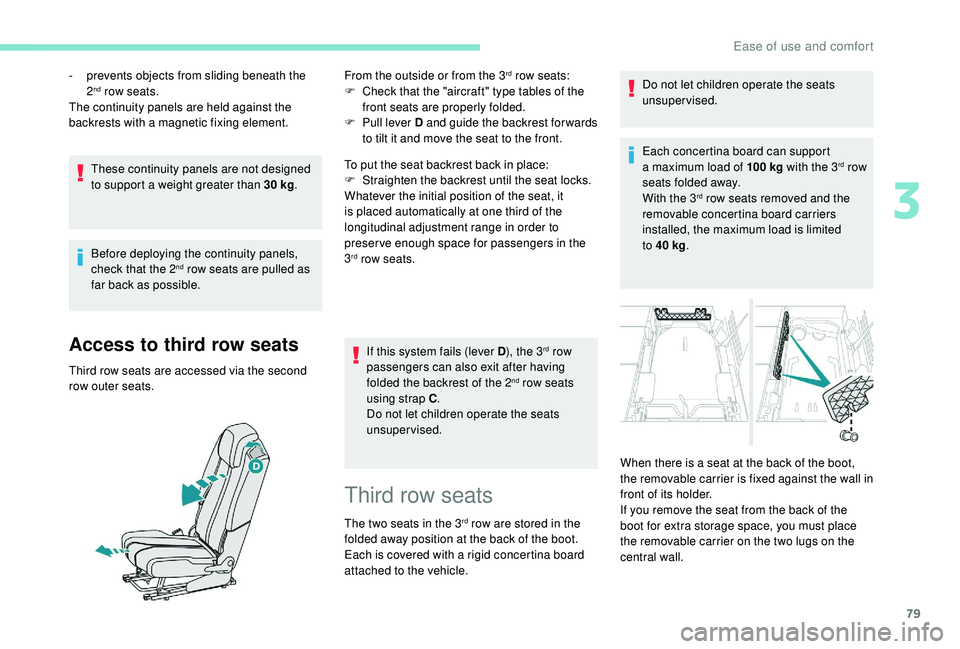
ull lever D and guide the backrest for wards
to tilt it and move the seat to the front.
To put the seat backrest back in place:
F
S
traighten the backrest until the seat locks.
Whatever the initial position of the seat, it
is placed automatically at one third of the
longitudinal adjustment range in order to
preserve enough space for passengers in the
3
rd row seats.
If this system fails (lever D ), the 3
rd row
passengers can also exit after having
folded the backrest of the 2
nd row seats
using strap C .
Do not let children operate the seats
unsupervised.
-
p
revents objects from sliding beneath the
2
nd row seats.
The continuity panels are held against the
backrests with a
magnetic fixing element.
Third row seats
The two seats in the 3rd row are stored in the
folded away position at the back of the boot.
Each is covered with a
rigid concertina board
attached to the vehicle. Do not let children operate the seats
unsupervised.
Each concertina board can support
a
maximum load of 100
kg
with the 3
rd row
seats folded away.
With the 3
rd row seats removed and the
removable concertina board carriers
installed, the maximum load is limited
to 40
kg .
When there is a
seat at the back of the boot,
the removable carrier is fixed against the wall in
front of its holder.
If you remove the seat from the back of the
boot for extra storage space, you must place
the removable carrier on the two lugs on the
central wall.
3
Ease of use and comfort
Page 84 of 364
82
Replacing the seats
These operations must be performed from the
boot sill.As long as the seat is not correctly in
position, it must be held with both hands
by the sides, keeping it folded.
F
C
heck in advance that the seat storage well
is empty and that the movable carrier is
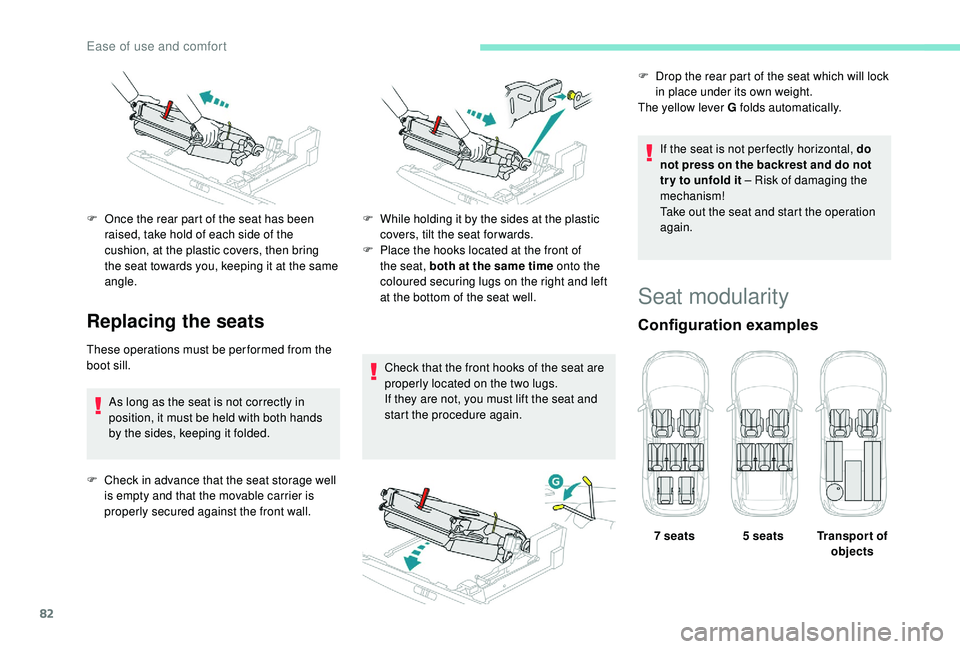
properly secured against the front wall. Check that the front hooks of the seat are
properly located on the two lugs.
If they are not, you must lift the seat and
start the procedure again.If the seat is not per fectly horizontal, do
not press on the backrest and do not
tr y to unfold it – Risk of damaging the
mechanism!
Take out the seat and start the operation
again.
Seat modularity
Configuration examples
F Once the rear part of the seat has been
raised, take hold of each side of the
cushion, at the plastic covers, then bring
the seat towards you, keeping it at the same
angle. F
W hile holding it by the sides at the plastic
covers, tilt the seat for wards.
F
P
lace the hooks located at the front of
the seat, both at the same time onto the
coloured securing lugs on the right and left
at the bottom of the seat well. F
D
rop the rear part of the seat which will lock
in place under its own weight.
The yellow lever G folds automatically.
7 seats 5 seats Transpor t of objects
Ease of use and comfort
Page 129 of 364
127
ASR/DSC
These systems offer increased safety
in normal driving, but they should not
encourage the driver to take extra risks or
drive at high speed.
It is in conditions of reduced grip (rain,
snow, ice) that the risk of loss of grip
increases. It is therefore important for your
safety to keep these systems activated in
all conditions, and particularly in difficult
conditions.
The correct operation of these
systems depends on obser vation of
the manufacturer's recommendations
regarding as much the wheels (tyres and
rims), braking and electronic components
as the assembly and repair procedures
used by PEUGEOT dealers.
The use of snow tyres is recommended,
in order to be able to benefit from the
efficiency of these systems in winter
conditions.
In this case, it is essential to equip the
four wheels with tyres approved for your
vehicle.Trailer stability assist
When towing, this system reduces the risk of
the vehicle or trailer swaying.
Operation
The system is activated automatically when the
ignition is switched on.
The electronic stability control (ESC) must not
have any faults.
Between 37 and 99 mph (60 and 160 km/h), if
the system detects oscillations (snaking) in the
movement of the trailer, it acts on the brakes to
stabilise the trailer and, if necessary, reduces
engine power to slow down the vehicle.
The correction is signalled by the
flashing of this indicator lamp in the
instrument panel and illumination of
the brake lamps.
For information on the weights and towed
loads, refer to the "Technical data" section or
the registration certificate for your vehicle.
For advice on driving safely when To w i n g
a
trailer , refer to the corresponding section.
Malfunction
Should a fault occur with the system,
t his warning lamp comes on in the
instrument panel, accompanied by
the display of a
message and an
audible signal.
The trailer stability assist system offers
increased safety in normal driving,
provided that the recommendations on
towing a
trailer are obser ved. It should not
encourage the driver to take risks, such
as towing a
trailer in adverse operating
conditions (overloading, failure to obser ve
the trailer nose weight, worn or under-
inflated tyres, faulty braking system, etc.)
or drive at too high a
speed.
In certain cases, oscillation of the trailer
may not be detected by the ESC system,
particularly with a
light trailer.
When driving on slippery or poor sur faces,
the system may not be able to prevent
sudden snaking of the trailer.
If you continue to tow a
trailer, reduce your
speed and drive carefully!
Contact a
PEUGEOT dealer or a qualified
workshop to have the system checked.
5
Safety
Page 140 of 364
138
General points relating to
child seats
The regulations on carrying children are
specific to each country. Refer to the
legislation in force in your country.
For maximum safety, please obser ve the
following recommendations:
-
I
n accordance with European regulations,
all children under the age of 12
or less
than one and a
half metres tall must
travel in approved child seats suited to
their weight , on seats fitted with a
seat belt
or ISOFIX mountings.
-
S
tatistically, the safest seats in your
vehicle for carr ying children are the rear
seats.
-
A c
hild weighing less than 9 kg must
travel in the rear ward facing position
both in the front and in the rear.
It is recommended that children travel on
the rear seats of your vehicle:
-
"rearward facing " up to the age of 3,
-
"forward facing " over the age of 3. Ensure that the seat belt is positioned and
tightened correctly.
For child seats with a
support leg, ensure
that the latter is in firm and steady contact
with the floor.
In the front: if necessary, adjust the
passenger seat.
At the rear: if necessary, adjust the
relevant front seat.
Remove and stow the head restraint
before installing a
child seat with backrest
on a
passenger seat.
Refit the head restraint once the child seat
has been removed.
Child seat at the front
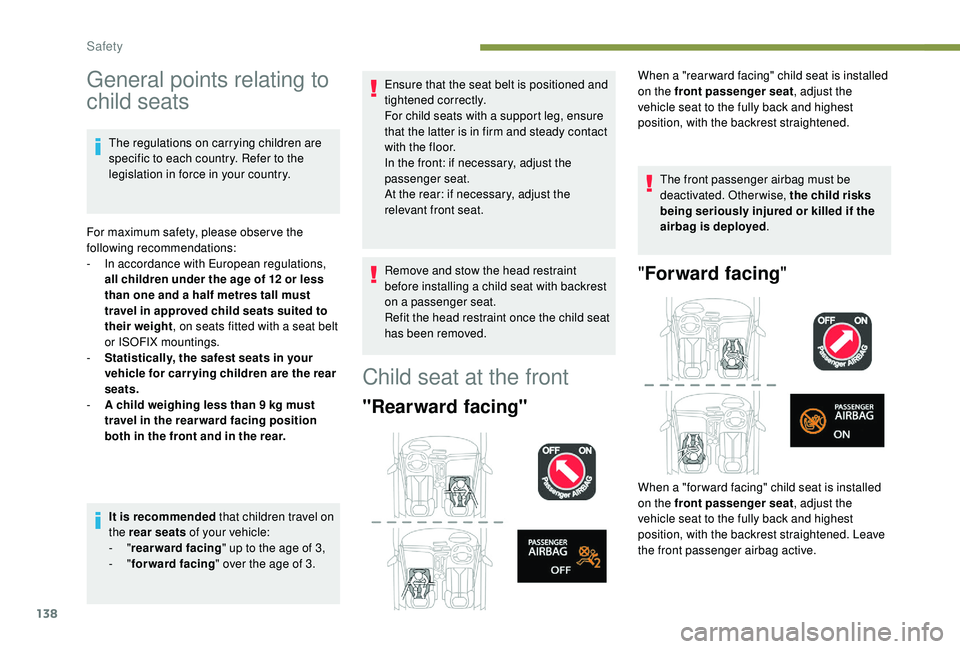
"Rearward facing"
When a "rear ward facing" child seat is installed
o n the front passenger seat , adjust the
vehicle seat to the fully back and highest
position, with the backrest straightened.
The front passenger airbag must be
deactivated. Otherwise, the child risks
being seriously injured or killed if the
airbag is deployed .
"Forward facing "
When a "for ward facing" child seat is installed
on the front passenger seat , adjust the
vehicle seat to the fully back and highest
position, with the backrest straightened. Leave
the front passenger airbag active.
Safety
Page 146 of 364
144
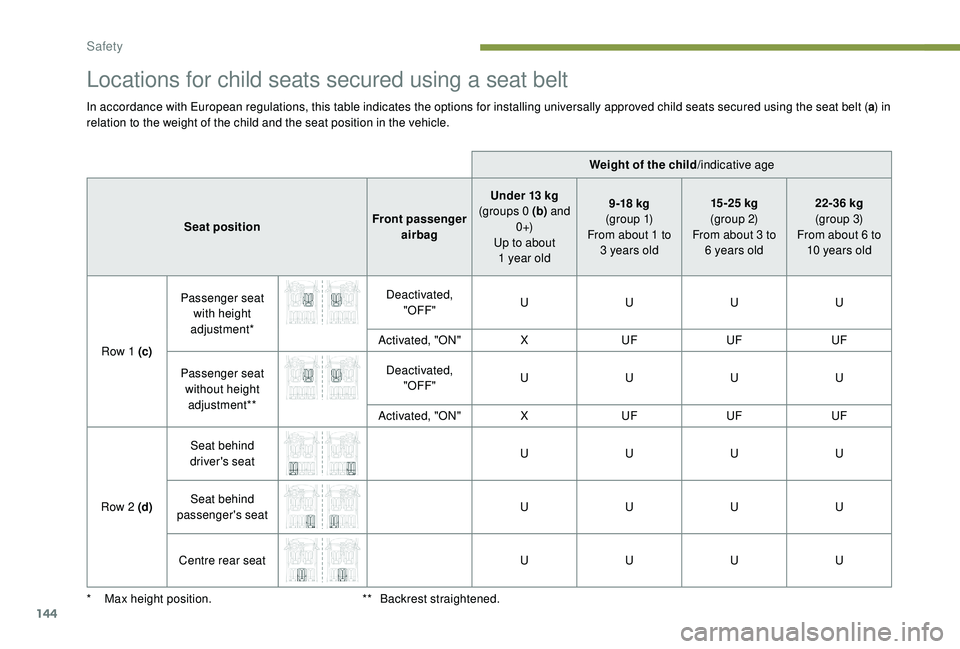
Locations for child seats secured using a seat belt
In accordance with European regulations, this table indicates the options for installing universally approved child seats secured using the seat belt (a) in
relation to the weight of the child and the seat position in the vehicle.
Weight of the child/indicative age
Seat position Front passenger
airbag Under 13
kg
(groups 0 (b) and
0 +)
Up to about 1
year old9 -18
kg
(g r o u p 1)
From about 1
to
3
years old15 -25
kg
(group 2)
From about 3
to
6
years old22-36
kg
(group 3)
From about 6
to
10
years old
Row 1 (c) Passenger seat
with height
adjustment* Deactivated,
"OFF" U
UUU
Activated, "ON" XUF UFUF
Passenger seat without height adjustment** Deactivated,
"OFF" U
UUU
Activated, "ON" XUF UFUF
Row 2 (d) Seat behind
driver's seat U
UUU
Seat behind
passenger's seat U
UUU
Centre rear seat UUUU
*
M
ax height position. **
B
ackrest straightened.
Safety
Page 147 of 364
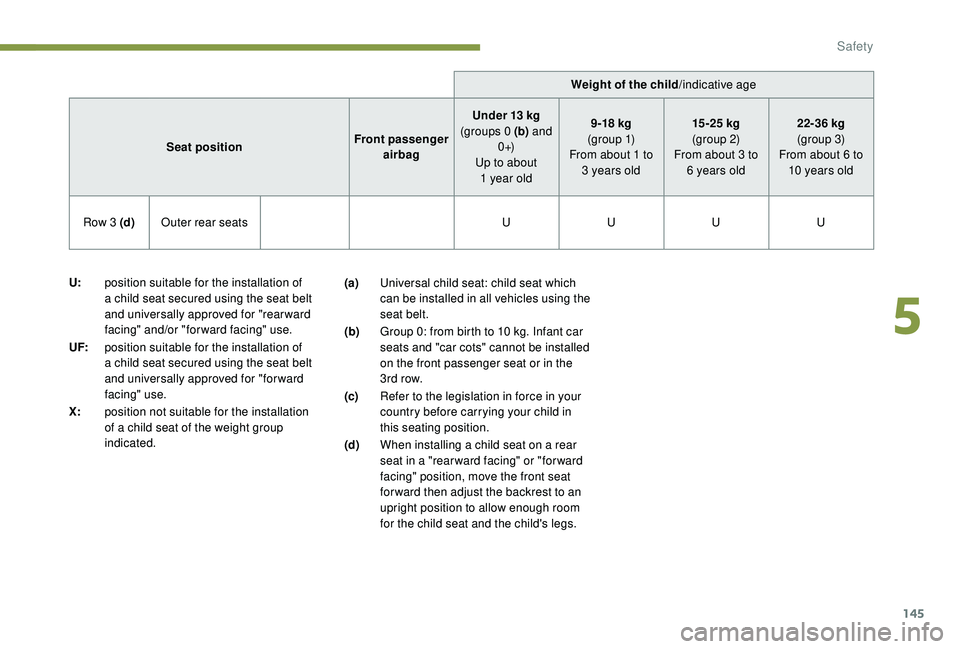
145
(a)Universal child seat: child seat which
can be installed in all vehicles using the
seat belt.
(b) Group 0: from birth to 10
kg. Infant car
seats and "car cots" cannot be installed
on the front passenger seat or in the
3rd row.
(c) Refer to the legislation in force in your
country before carrying your child in
this seating position.
(d) When installing a
child seat on a rear
seat in a
"rear ward facing" or "for ward
facing" position, move the front seat
for ward then adjust the backrest to an
upright position to allow enough room
for the child seat and the child's legs.
U:
position suitable for the installation of
a
child seat secured using the seat belt
and universally approved for "rearward
facing" and/or "forward facing" use.
UF: position suitable for the installation of
a
child seat secured using the seat belt
and universally approved for "forward
facing" use.
X: position not suitable for the installation
of a
child seat of the weight group
indicated. Weight of the child
/indicative age
Seat position Front passenger
airbag Under 13 kg
(groups 0 (b) and
0 +)
Up to about 1 year old
9 -18
kg
(g r o u p 1)
From about 1 to
3 years old
15 -25
kg
(group 2)
From about 3 to
6 years old
22-36 kg
(group 3)
From about 6 to
10 years old
Row 3 (d) Outer rear seats UUUU
5
Safety
Page 150 of 364
148
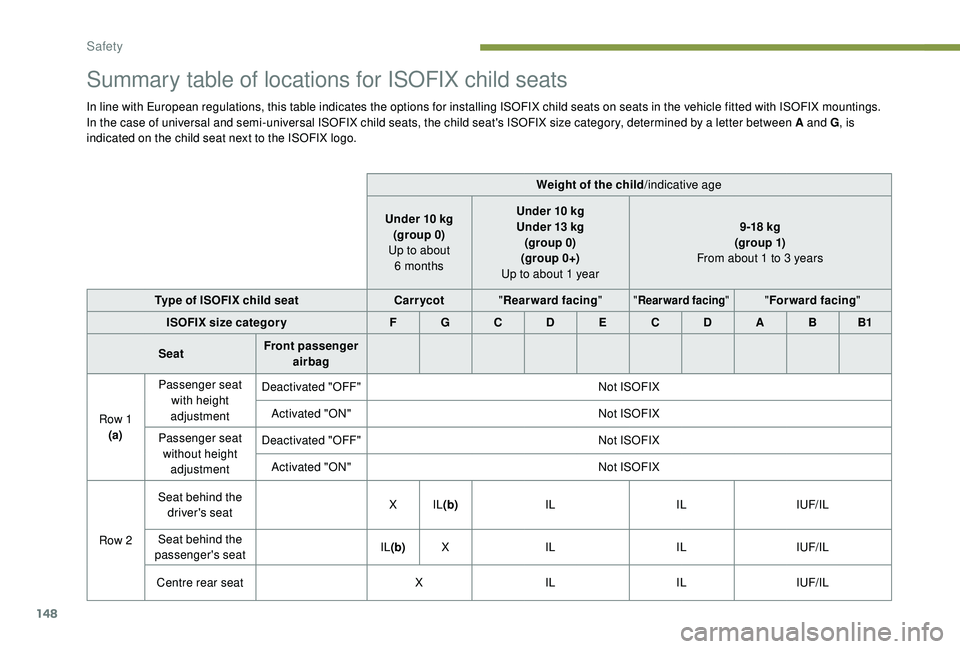
Summary table of locations for ISOFIX child seats
In line with European regulations, this table indicates the options for installing ISOFIX child seats on seats in the vehicle fitted with ISOFIX mountings.
In the case of universal and semi-universal ISOFIX child seats, the child seat's ISOFIX size category, determined by a letter between A and G, is
indicated on the child seat next to the ISOFIX logo.
Weight of the child/indicative age
Under 10
kg
(group 0)
Up to about 6
monthsUnder 10
kg
Under 13
kg
(group 0)
(group 0+)
Up to about 1
year9 -18
kg
(g ro up 1)
From about 1
to 3 years
Type of ISOFIX child seat Carr ycot"Rearward facing "
"Rearward facing ""Forward facing "
ISOFIX size categor y F G C D E C D A B B1
Seat Front passenger
airbag
Row 1 (a) Passenger seat
with height
adjustment Deactivated "OFF"
Not ISOFIX
Activated "ON" Not ISOFIX
Passenger seat without height adjustment Deactivated "OFF"
Not ISOFIX
Activated "ON" Not ISOFIX
Row 2 Seat behind the
driver's seat X
IL(b) IL ILIUF/IL
Seat behind the
passenger's seat IL
(b) X IL ILIUF/IL
Centre rear seat XIL ILIUF/IL
Safety
Page 151 of 364
149
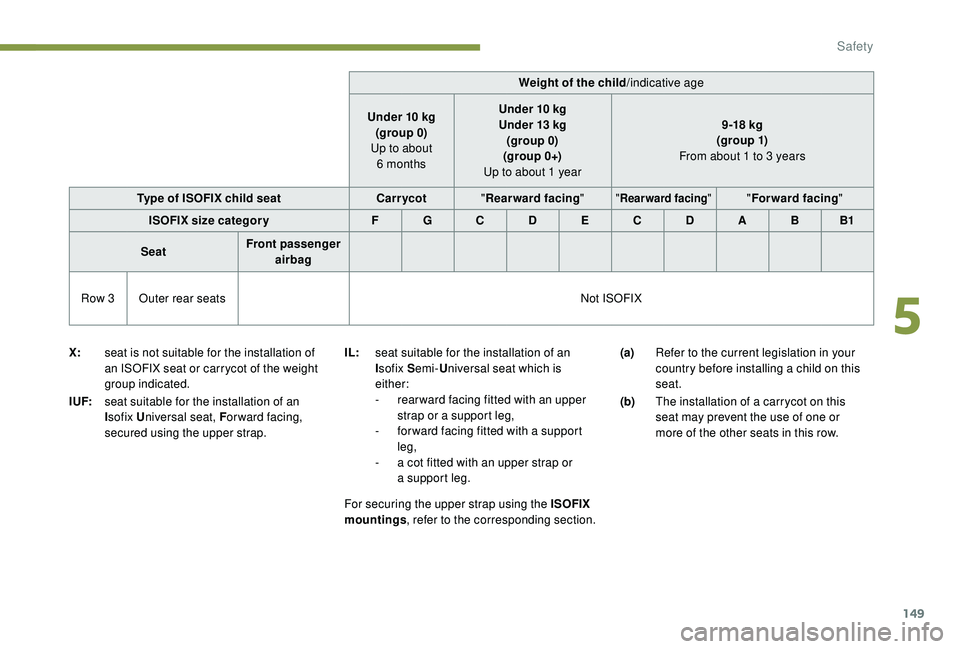
X:seat is not suitable for the installation of
an ISOFIX seat or carrycot of the weight
group indicated.
I UF: seat suitable for the installation of an
Isofix U niversal seat, F or ward facing,
secured using the upper strap. IL:
seat suitable for the installation of an
Isofix S emi-Universal seat which is
either:
-
r
ear ward facing fitted with an upper
strap or a
support leg,
-
f
or ward facing fitted with a support
leg,
-
a c
ot fitted with an upper strap or
a
support leg.(a)
Refer to the current legislation in your
country before installing a
child on this
seat.
(b) The installation of a
carrycot on this
seat may prevent the use of one or
more of the other seats in this row.
Weight of the child
/indicative age
Under 10 kg
(group 0)
Up to about 6 months
Under 10 kg
Under 13 kg
(group 0)
(group 0+)
Up to about 1 year
9 -18
kg
(g ro up 1)
From about 1 to 3 years
Type of ISOFIX child seat Carr ycot"Rearward facing "
"Rearward facing ""Forward facing "
ISOFIX size categor y F G C D E C D A B B1
Seat Front passenger
airbag
Row 3 Outer rear seats Not ISOFIX
For securing the upper strap using the ISOFIX
mountings , refer to the corresponding section.
5
Safety
Page 225 of 364
223
Travelling abroad
Cer tain fuels could damage the engine of
your vehicle.
In cer tain countries, the use of a par ticular
fuel may be required (specific octane
rating, specific trade name, etc.) to ensure
correct operation of the engine.
For any additional information, contact a
dealer.
Towing device
Load distribution
F D istribute the load in the trailer so that the
heaviest items are as close as possible to
the axle and the nose weight approaches
the maximum permitted without exceeding
it.
Air density decreases with altitude, thus
reducing engine performance. The maximum
towed load must be reduced by 10% for every
1,000
metres of altitude. Use towing devices and their genuine
harnesses approved by PEUGEOT. It
is recommended that the installation
be per formed by a
PEUGEOT dealer or
a
qualified workshop.
If the towbar is not fitted by a PEUGEOT
dealer, it must still be fitted in accordance
with the vehicle manufacturer's
instructions.
Important: for versions equipped with
the motorised tailgate with Hands-Free
Tailgate Access function, if a towing
device other than a genuine PEUGEOT
one is installed, it is imperative to visit
a
PEUGEOT dealer or a qualified
workshop to recalibrate the detection
system: risk of Hands-Free Tailgate
Access function failure.
Certain driving assistance or manoeuvring
assistance functions are automatically
disabled if an approved towbar is used. Obser ve the maximum authorised towable
weight, indicated on your vehicle's
registration certificate, the manufacturer's
label as well as in the Technical data
section of this guide.
Complying with the maximum
authorised nose weight (ball joint)
also includes the use of accessories
(bicycle carriers, tow boxes, etc.).
Obser ve the legislation in force in the
country in which you are driving.
Vehicle equipped with motorised tailgate
with "Hands-Free Tailgate Access "
function
To avoid unwanted opening of the tailgate
when using the towing device:
-
d
eactivate the Hands-Free Tailgate
Access function in advance in your
vehicle's configuration menu,
-
o
r remove the electronic key from the
recognition zone, with the tailgate closed.
7
Practical information
Page 226 of 364
224
Towbar with quickly
detachable towball
No tools are required to install or remove the
towball on this genuine towbar system.
Presentation
Trailers with LED lamps are not
compatible with the wiring harness of this
device.
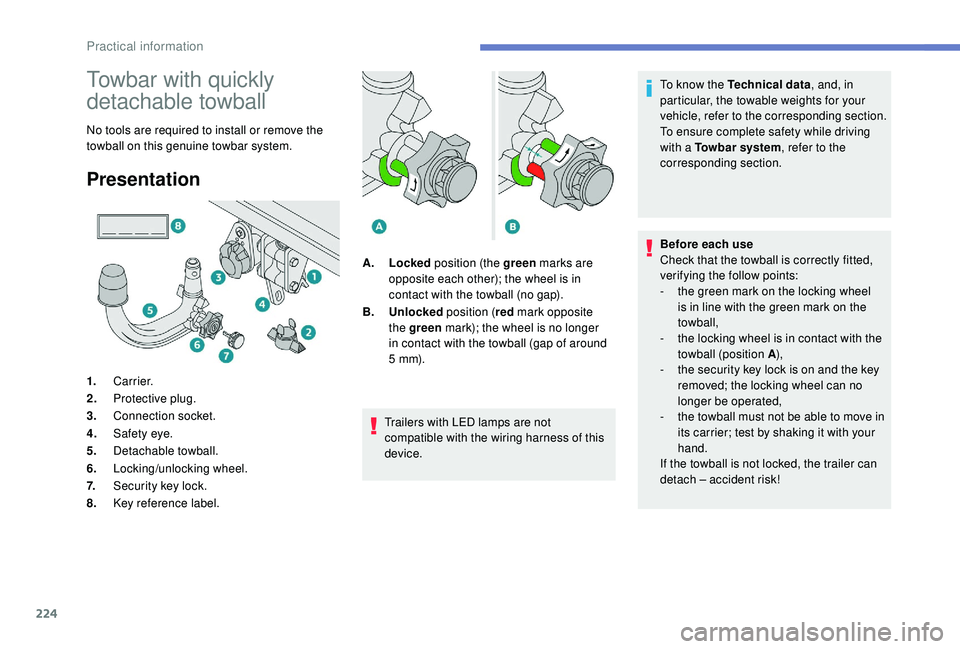
1.
Carrier.
2. Protective plug.
3. Connection socket.
4. Safety eye.
5. Detachable towball.
6. Locking/unlocking wheel.
7. Security key lock.
8. Key reference label. A.
Locked position (the green marks are
opposite each other); the wheel is in
contact with the towball (no gap).
B. Unlocked position (red mark opposite
the green mark); the wheel is no longer
in contact with the towball (gap of around
5
m m). To know the Technical data
, and, in
particular, the towable weights for your
vehicle, refer to the corresponding section.
To ensure complete safety while driving
with a Towbar system
, refer to the
corresponding section.
Before each use
Check that the towball is correctly fitted,
verifying the follow points:
-
t
he green mark on the locking wheel
is in line with the green mark on the
towball,
-
t
he locking wheel is in contact with the
towball (position A ),
-
t
he security key lock is on and the key
removed; the locking wheel can no
longer be operated,
- t he towball must not be able to move in
its carrier; test by shaking it with your
hand.
If the towball is not locked, the trailer can
detach – accident risk!
Practical information