brake light Peugeot 508 2011 Owner's Manual
[x] Cancel search | Manufacturer: PEUGEOT, Model Year: 2011, Model line: 508, Model: Peugeot 508 2011Pages: 340, PDF Size: 25.72 MB
Page 4 of 340
.
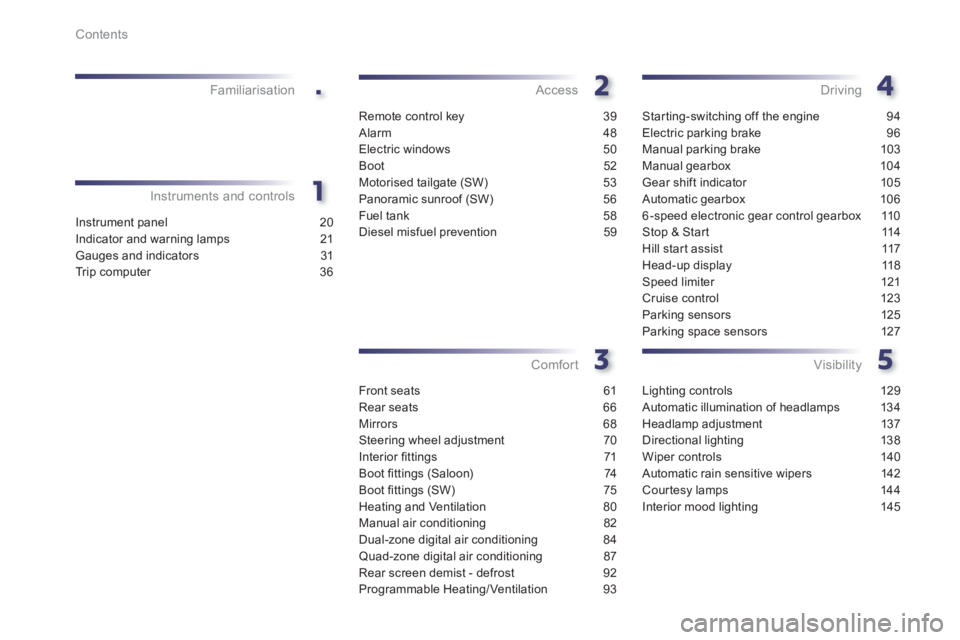
Contents
Instrument panel 20
Indicator and warning lamps 21
Gauges and indicators 31
Tr i p c o m p u t e r 3 6
Instruments and controlsFamiliarisation
Remote control key 39
Alarm 48
Electric windows 50
Boot 52
Motorised tailgate (SW) 53
Panoramic sunroof (SW) 56
Fuel tank 58
Diesel misfuel prevention 59
Access
Front seats 61
Rear seats 66
Mirrors 68
Steering wheel adjustment 70
Interior fi ttings 71
Boot fi ttings (Saloon) 74
Boot fi ttings (SW) 75
Heating and Ventilation 80
Manual air conditioning 82
Dual-zone digital air conditioning 84
Quad-zone digital air conditioning 87
Rear screen demist - defrost 92
Programmable Heating/ Ventilation 93
Comfort
Star ting-switching off the engine 94
Electric parking brake 96
Manual parking brake 103
Manual gearbox 104
Gear shift indicator 105
Automatic gearbox 106
6 -speed electronic gear control gearbox 110
Stop & Start 114
Hill start assist 117
Head-up display 118
Speed limiter 121
Cruise control 123
Parking sensors 125
Parking space sensors 127
Driving
Lighting controls 129
Automatic illumination of headlamps 134
Headlamp adjustment 137
Directional lighting 138
Wiper controls 140
Automatic rain sensitive wipers 142
Cour tesy lamps 144
Interior mood lighting 145
Visibility
Page 10 of 340
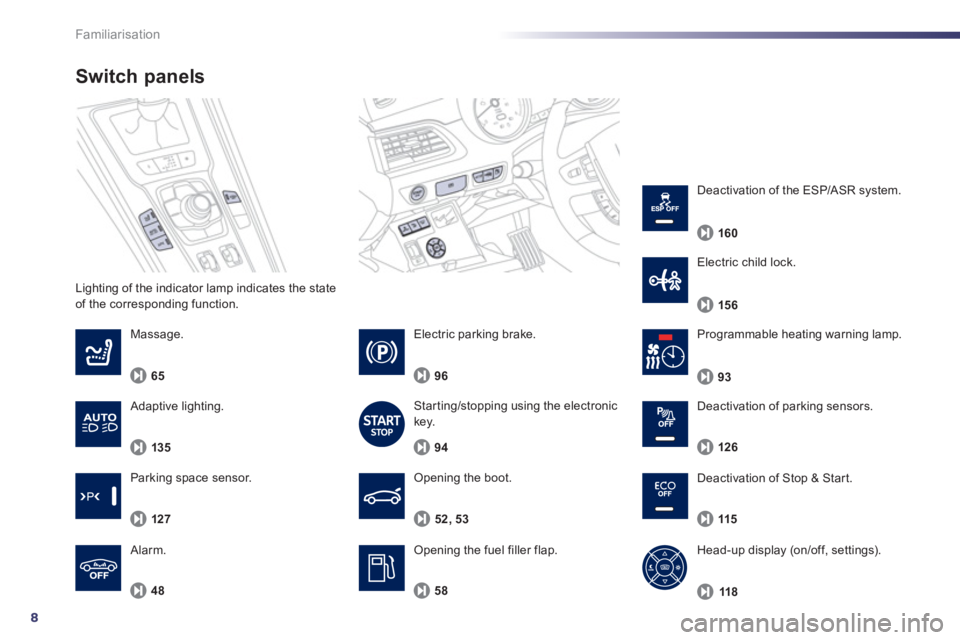
8
Familiarisation
Lighting of the indicator lamp indicates the state
of the corresponding function.
Switch panels
Opening the boot.
Opening the fuel filler flap.
52, 53
Massage.
65
48
Alarm.
Programmable heating warning lamp.
58
93
Electric parking brake.
96
Star ting/stopping using the electronic
key.
94
Deactivation of Stop & Start.
115
Head-up display (on/off, settings).
118
Deactivation of parking sensors.
126
Parking space sensor.
127
Electric child lock.
15 6
Deactivation of the ESP/ASR system.
160
Adaptive lighting.
135
Page 12 of 340
10
Familiarisation
9.
Fusebox.
10.
Front door window demisting/defrosting
vent.
11.
Windscreen demisting/defrosting vent.
12 .
Steering lock and star ting with the key.
13.
Star ting using the electronic key.
14 .
Audio equipment steering wheel controls.
15.
Wiper/screenwash/trip computer stalk.
16.
Central locking and hazard warning
buttons.
17.
Multifunction screen.
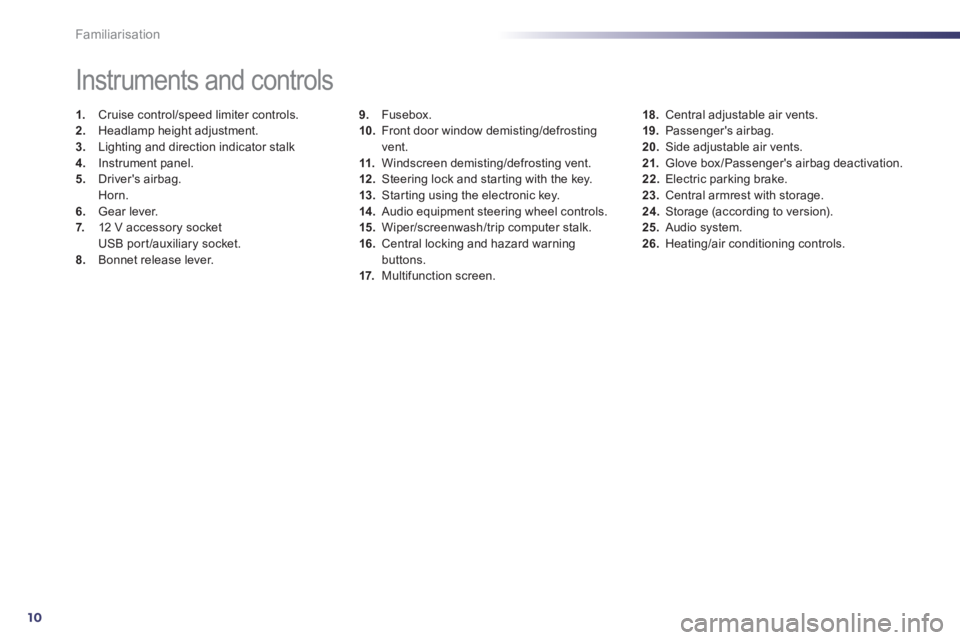
Instruments and controls
1.
Cruise control/speed limiter controls.
2.
Headlamp height adjustment.
3.
Lighting and direction indicator stalk
4.
Instrument panel.
5.
Driver's airbag.
Horn.
6.
Gear lever.
7.
12 V accessory socket
USB port /auxiliary socket.
8.
Bonnet release lever.
18.
Central adjustable air vents.
19.
Passenger's airbag.
20.
Side adjustable air vents.
21.
Glove box /Passenger's airbag deactivation.
22.
Electric parking brake.
23.
Central armrest with storage.
24.
Storage (according to version).
25.
Audio system.
26.
Heating/air conditioning controls.
Page 23 of 340
1
21
!
Instruments and controls
Indicator and warning
lamps
Visual indicators informing the driver that a
system is in operation, switched off or has a
fault.
When the ignition is switched on
Cer tain warning lamps come on for a few
seconds in the instrument panel and/or
instrument panel screen when the vehicle's
ignition is switched on.
When the engine is started, these same
warning lamps should switch off.
If they remain on, before moving off, refer to the
information on the warning lamp concerned.
Associated warnings
The switching on of cer tain warning lamps may
be accompanied by an audible signal and a
message in the instrument panel screen.
The warning lamps may come on continuously
(fixed) or flash.
Cer tain warning lamps may come on in
one of two modes. Only by relating the
type of lighting to the operating status
of the vehicle can it be ascer tained
whether the situation is normal or
whether a fault has occurred.
1
2
2
2
3
3
3
2
3
3
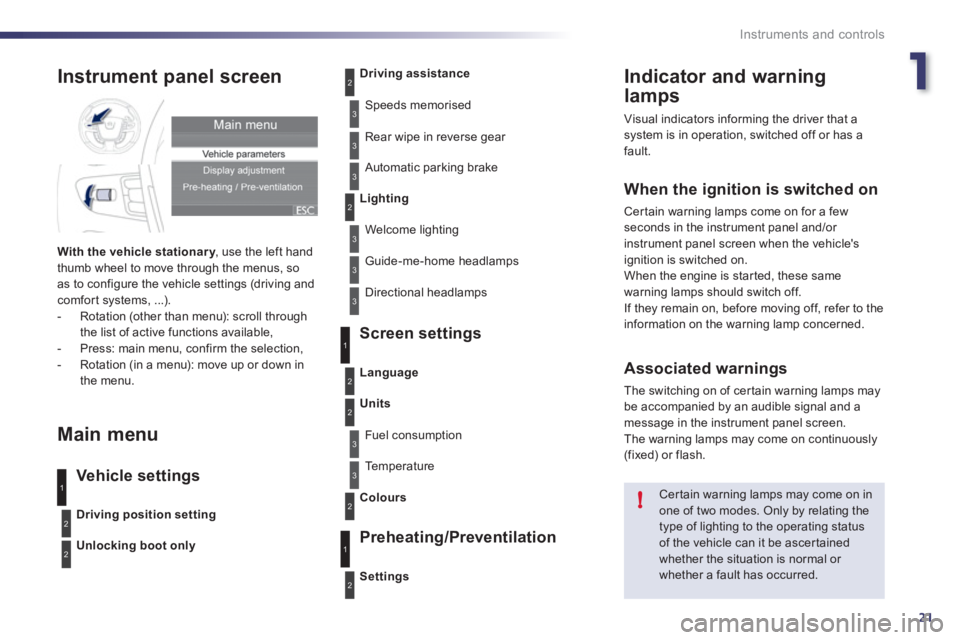
Instrument panel screen
With the vehicle stationar y
, use the left hand
thumb wheel to move through the menus, so
as to configure the vehicle settings (driving and
comfort systems, ...).
- Rotation (other than menu): scroll through
the list of active functions available,
- Press: main menu, confirm the selection,
- Rotation (in a menu): move up or down in
the menu.
Main menu
Vehicle settings
Screen settings
Preheating/Preventilation
Driving position setting
Unlocking boot only
Driving assistance
Speeds memorised
Rear wipe in reverse gear
Automatic parking brake
Lighting
Welcome lighting
Guide-me-home headlamps
Directional headlamps
Settings
Language
Units
Fuel consumption
Te m p e r a t u r e
Colours
3
1
2
2
3
2
3
1
2
Page 96 of 340
94
i
!
i
i
Driving
Starting-switching off the engine
With a manual gearbox
, put the gear lever in neutral.
With an electronic gear control gearbox
, put the gear lever in N
.
With an automatic gearbox
, put the gear lever in P
or N
.
)
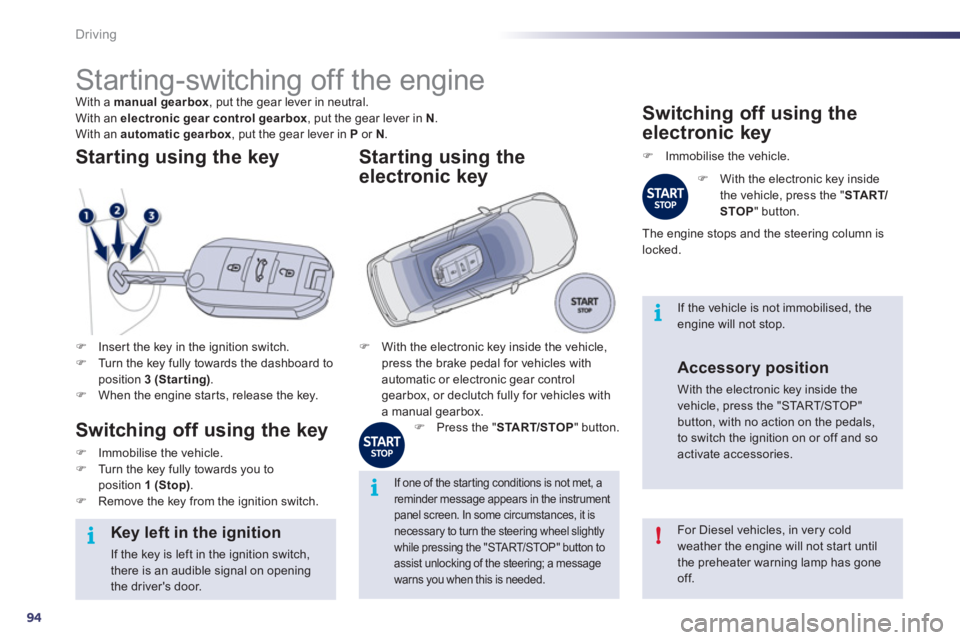
Inser t the key in the ignition switch.
)
Turn the key fully towards the dashboard to
position 3 (Star ting)
.
)
When the engine star ts, release the key.
Starting using the key
Switching off using the key
)
Immobilise the vehicle.
)
Turn the key fully towards you to
position 1 (Stop)
.
)
Remove the key from the ignition switch.
For Diesel vehicles, in very cold
weather the engine will not start until
the preheater warning lamp has gone
off.
Key left in the ignition
If the key is left in the ignition switch,
there is an audible signal on opening
the driver's door.
If one of the star ting conditions is not met, a
reminder message appears in the instrument
panel screen. In some circumstances, it is
necessary to turn the steering wheel slightly
while pressing the "START/STOP" button to
assist unlocking of the steering; a message
warns you when this is needed.
If the vehicle is not immobilised, the
engine will not stop.
)
With the electronic key inside the vehicle,
press the brake pedal for vehicles with
automatic or electronic gear control
gearbox, or declutch fully for vehicles with
a manual gearbox.
Starting using the
electronic key
)
Press the " START/STOP
" button.
Switching off using the
electronic key
)
Immobilise the vehicle.
)
With the electronic key inside
the vehicle, press the " START/
STOP
" button.
The engine stops and the steering column is
locked.
Accessory position
With the electronic key inside the
vehicle, press the "START/STOP"
button, with no action on the pedals,
to switch the ignition on or off and so
activate accessories.
Page 98 of 340
96
!
!
Driving
It is recommended that you do not
apply the parking brake in very cold
conditions (ice) and during towing
(breakdown, caravan...). Deactivate the
automatic functions and release the
parking brake manually.
Before leaving the vehicle, check that
parking brake warning lamps in the
instrument panel and the control lever A
are on, not flashing.
The electric parking brake combines
2 operating modes:
- Automatic Application/Release
Application is automatic when the engine
stops, release is automatic on use of the
accelerator (this mode is activated by
default),
- Manual Application/Release
Manual application of the parking brake is
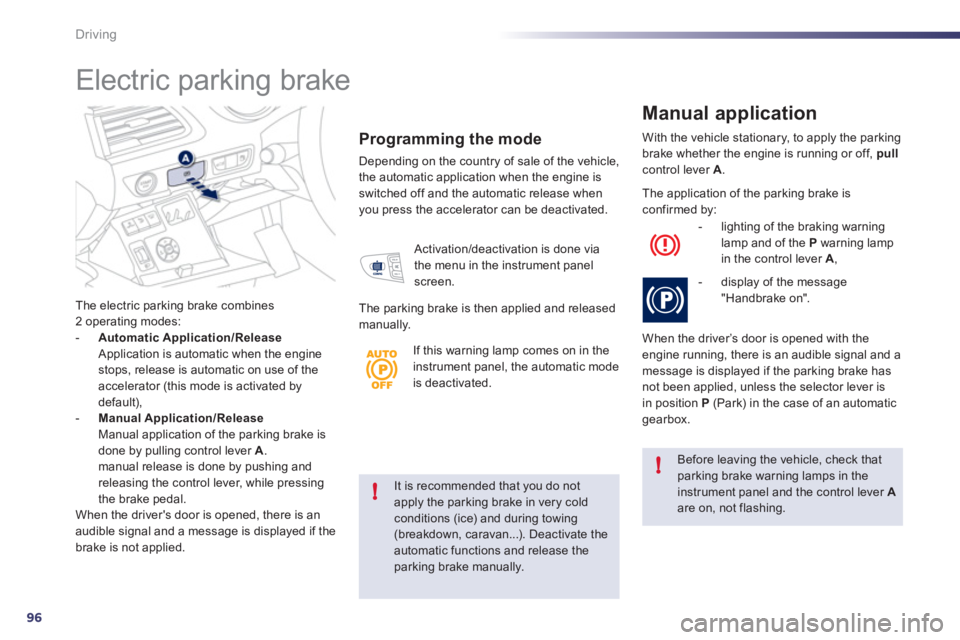
done by pulling control lever A.
manual release is done by pushing and
releasing the control lever, while pressing
the brake pedal.
When the driver's door is opened, there is an
audible signal and a message is displayed if the
brake is not applied.
Programming the mode
Depending on the country of sale of the vehicle,
the automatic application when the engine is
switched off and the automatic release when
you press the accelerator can be deactivated. With the vehicle stationary, to apply the parking
brake whether the engine is running or off, pull
control lever A
.
Manual application
Activation/deactivation is done via
the menu in the instrument panel
screen.
The parking brake is then applied and released
manually. The application of the parking brake is
confirmed by:
- lighting of the braking warning
lamp and of the P
warning lamp
in the control lever A
,
- display of the message
"Handbrake on".
When the driver’s door is opened with the
engine running, there is an audible signal and a
message is displayed if the parking brake has
not been applied, unless the selector lever is
in position P
(Park) in the case of an automatic
gearbox.
Electric parking brake
If this warning lamp comes on in the
instrument panel, the automatic mode
is deactivated.
Page 101 of 340
4
99
!
Driving
Emergency braking
In the event of a failure of the main ser vice
brake or in an exceptional situation (e.g. driver
taken ill, under instruction, etc) a continuous
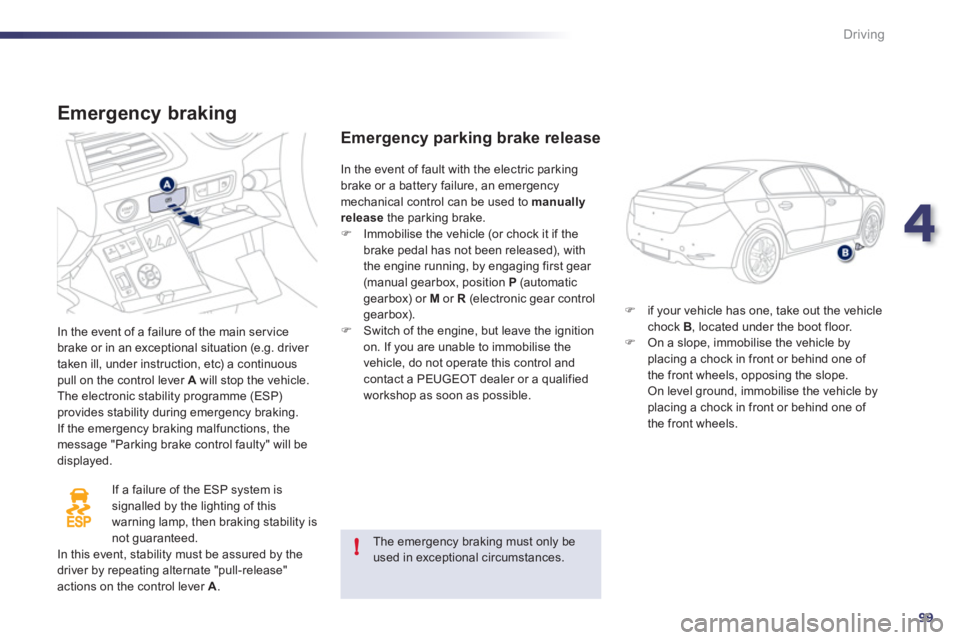
pull on the control lever A
will stop the vehicle.
The electronic stability programme (ESP)
provides stability during emergency braking.
If the emergency braking malfunctions, the
message "Parking brake control faulty" will be
displayed.
If a failure of the ESP system is
signalled by the lighting of this
warning lamp, then braking stability is
not guaranteed.
In this event, stability must be assured by the
driver by repeating alternate "pull-release"
actions on the control lever A
.
Emergency parking brake release
)
if your vehicle has one, take out the vehicle
chock B
, located under the boot floor.
)
On a slope, immobilise the vehicle by
placing a chock in front or behind one of
the front wheels, opposing the slope.
On level ground, immobilise the vehicle by
placing a chock in front or behind one of
the front wheels. In the event of fault with the electric parking
brake or a battery failure, an emergency
mechanical control can be used to manually
release
the parking brake.
)
Immobilise the vehicle (or chock it if the
brake pedal has not been released), with
the engine running, by engaging first gear
(manual gearbox, position P
(automatic
gearbox) or M
or R
(electronic gear control
gearbox).
)
Switch of the engine, but leave the ignition
on. If you are unable to immobilise the
vehicle, do not operate this control and
contact a PEUGEOT dealer or a qualified
workshop as soon as possible.
The emergency braking must only be
used in exceptional circumstances.
Page 116 of 340
114
i
!
Driving
Stop & Start
The Stop & Start system puts the engine temporarily into standby - STOP mode - during stops in the traffic (red lights, traffic jams, or other...).
The engine restarts automatically - START mode - as soon as you want to move off. The restart takes place instantly, quickly and silently.
Per fect for urban use, the Stop & Start system reduces fuel consumption and exhaust emissions as well as the noise level when stationary.
Operation
Going into engine STOP mode
The "ECO"
warning lamp comes
on in the instrument panel and the
engine goes into standby:
- with the electronic gear control
gearbox,
at speeds below 4 mph (6 km/h),
press the brake pedal or put the selector
lever in position N
.
If your vehicle is fitted with the system, a time
counter calculates the sum of the periods in
STOP mode during a journey. It rests itself to zero
every time the ignition is switched on with the key.
Never refuel with the engine in STOP
mode; you must switch off the ignition
with the key.
For your comfor t, during parking
maoeuvres, STOP mode is not available
for a few seconds after coming out of
reverse gear.
STOP mode does not affect the
functionality of the vehicle, such as for
example, braking, power steering...
Special cases: STOP mode not
available
STOP mode is not invoked when:
- the driver's door is open,
- the driver's seat belt is not fastened,
- the vehicle has not exceeded 6 mph
(10 km/h) since the last engine star t using
the key,
- the electric parking brake is applied or
being applied,
- the engine is needed to maintain a
comfor table temperature in the passenger
compartment,
- demisting is active,
- some special conditions (battery charge,
engine temperature, braking assistance,
ambient temperature...) where the engine is
needed to assure control of a system.
In this case, the "ECO"
warning lamp
flashes for a few seconds then goes
off.
This operation is per fectly normal.
Page 163 of 340
7
161
i
!
Safety
Snow driving assistance
(Intelligent Traction Control)
Your vehicle has a system to help driving on
snow: Intelligent Traction Control
.
This automatic system continuously checks
for situations of difficult sur face adhesion that
could make it difficult to move off or make
progress on deep fresh snow or compacted
snow.
In these situations, Intelligent Traction
Control
takes over from the ASR
system,
limiting the amount of wheel slip to provide
the best traction and trajectory control, even
without snow tyres and with or without chains.
In extremely severe conditions (snow on top
of ice, sand, deep mud…), it can be useful to
deactivate the ESP/ASR
systems to allow a
degree of wheel spin and so recover grip.
Operation
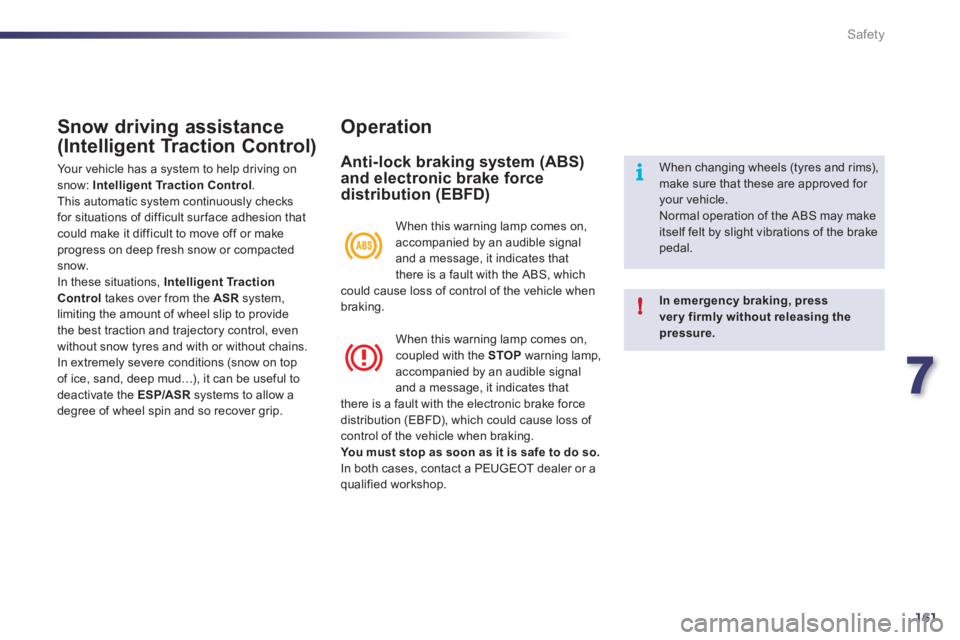
Anti-lock braking system (ABS)
and electronic brake force
distribution (EBFD)
In emergency braking, press
ver y firmly without releasing the
pressure.
When changing wheels (tyres and rims),
make sure that these are approved for
your vehicle.
Normal operation of the ABS may make
itself felt by slight vibrations of the brake
pedal. When this warning lamp comes on,
accompanied by an audible signal
and a message, it indicates that
there is a fault with the ABS, which
could cause loss of control of the vehicle when
braking.
When this warning lamp comes on,
coupled with the STOP
warning lamp,
accompanied by an audible signal
and a message, it indicates that
there is a fault with the electronic brake force
distribution (EBFD), which could cause loss of
control of the vehicle when braking.
You must stop as soon as it is safe to do so.
In both cases, contact a PEUGEOT dealer or a
qualified workshop.
Page 190 of 340
188
i
Practical information
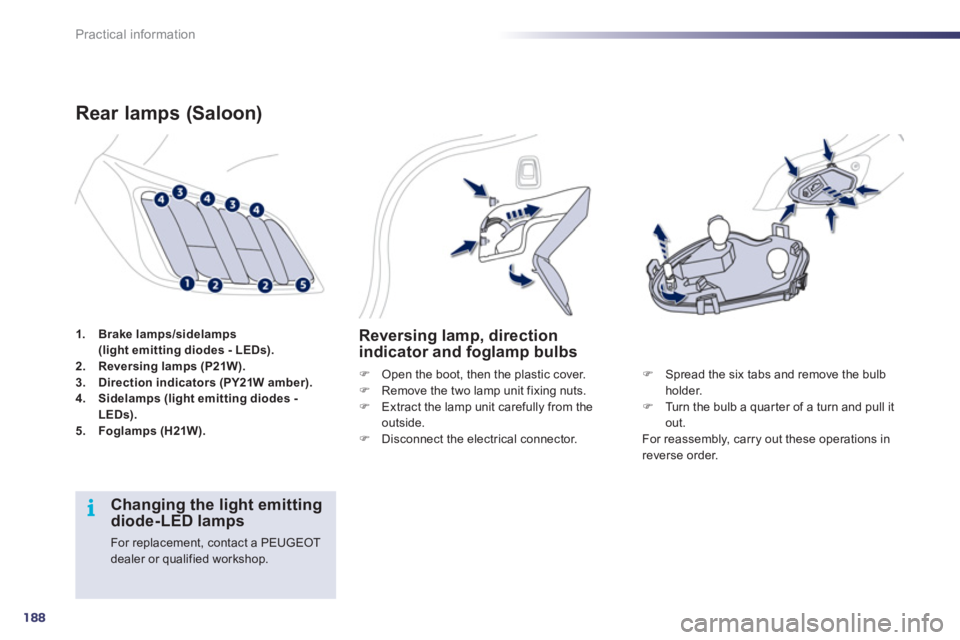
1.
Brake lamps/sidelamps
(light emitting diodes - LEDs).
2.
Reversing lamps (P21W).
3.
Direction indicators (PY21W amber).
4.
Sidelamps (light emitting diodes -
LEDs).
5.
Foglamps (H21W).
Rear lamps (Saloon)
Reversing lamp, direction
indicator and foglamp bulbs
)
Open the boot, then the plastic cover.
)
Remove the two lamp unit fixing nuts.
)
Extract the lamp unit carefully from the
outside.
)
Disconnect the electrical connector.
)
Spread the six tabs and remove the bulb
holder.
)
Turn the bulb a quar ter of a turn and pull it
out.
For reassembly, carry out these operations in
reverse order.
Changing the light emitting
diode-LED lamps
For replacement, contact a PEUGEOT
dealer or qualified workshop.