electric Peugeot 508 2011 Owner's Manual
[x] Cancel search | Manufacturer: PEUGEOT, Model Year: 2011, Model line: 508, Model: Peugeot 508 2011Pages: 340, PDF Size: 25.72 MB
Page 2 of 340
!
Please note the following point:
The fitting of electrical equipment or accessories which are not recommended by PEUGEOT may result in a failure of your vehicle's
electronic system. Please note this specific warning. It is advisable to contact a PEUGEOT dealer to be shown the recommended
equipment and accessories.
PEUGEOT's SERVICE BOX Internet site permits easy and free
consultation of your vehicle documentation on line.
Your vehicle lives on the Internet!
Access the latest information available.
Connect to http://public.ser vicebox.peugeot.com:
Simple and user friendly, SERVICE BOX allows you access:
●
to your Handbook,
●
to previous Vehicle documentation.
select your language,
click on the link in the "Private customer access" zone to
consult the Vehicle documentation,
A window opens giving access to all of the handbooks...
select your vehicle,
choose its body type then the date of publication of the handbook,
finally, click on the item which is of interest to you.
Page 4 of 340
.
Contents
Instrument panel 20
Indicator and warning lamps 21
Gauges and indicators 31
Tr i p c o m p u t e r 3 6
Instruments and controlsFamiliarisation
Remote control key 39
Alarm 48
Electric windows 50
Boot 52
Motorised tailgate (SW) 53
Panoramic sunroof (SW) 56
Fuel tank 58
Diesel misfuel prevention 59
Access
Front seats 61
Rear seats 66
Mirrors 68
Steering wheel adjustment 70
Interior fi ttings 71
Boot fi ttings (Saloon) 74
Boot fi ttings (SW) 75
Heating and Ventilation 80
Manual air conditioning 82
Dual-zone digital air conditioning 84
Quad-zone digital air conditioning 87
Rear screen demist - defrost 92
Programmable Heating/ Ventilation 93
Comfort
Star ting-switching off the engine 94
Electric parking brake 96
Manual parking brake 103
Manual gearbox 104
Gear shift indicator 105
Automatic gearbox 106
6 -speed electronic gear control gearbox 110
Stop & Start 114
Hill start assist 117
Head-up display 118
Speed limiter 121
Cruise control 123
Parking sensors 125
Parking space sensors 127
Driving
Lighting controls 129
Automatic illumination of headlamps 134
Headlamp adjustment 137
Directional lighting 138
Wiper controls 140
Automatic rain sensitive wipers 142
Cour tesy lamps 144
Interior mood lighting 145
Visibility
Page 10 of 340
8
Familiarisation
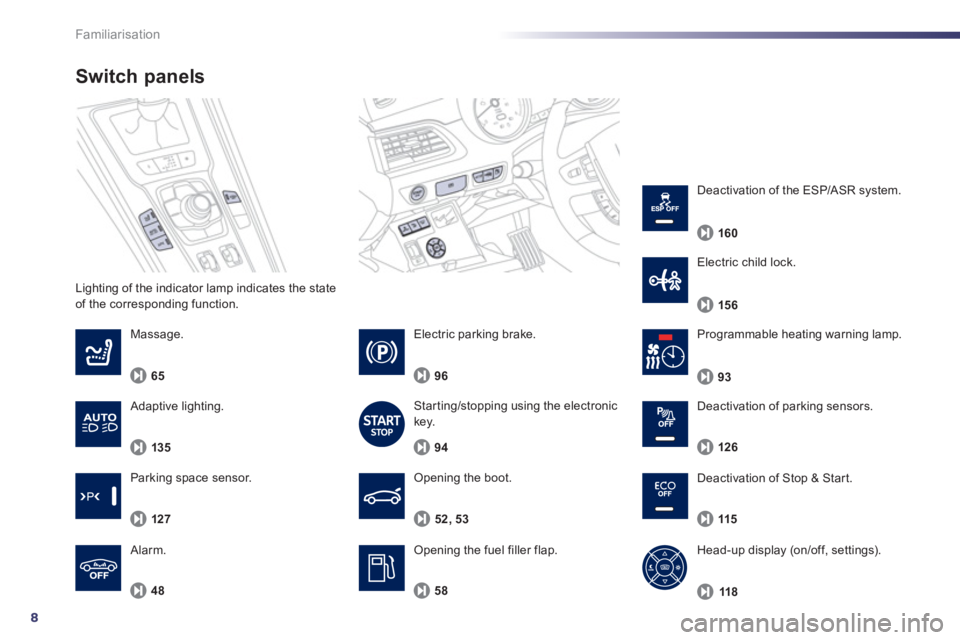
Lighting of the indicator lamp indicates the state
of the corresponding function.
Switch panels
Opening the boot.
Opening the fuel filler flap.
52, 53
Massage.
65
48
Alarm.
Programmable heating warning lamp.
58
93
Electric parking brake.
96
Star ting/stopping using the electronic
key.
94
Deactivation of Stop & Start.
115
Head-up display (on/off, settings).
118
Deactivation of parking sensors.
126
Parking space sensor.
127
Electric child lock.
15 6
Deactivation of the ESP/ASR system.
160
Adaptive lighting.
135
Page 11 of 340
.
9
Familiarisation
Sitting comfortably
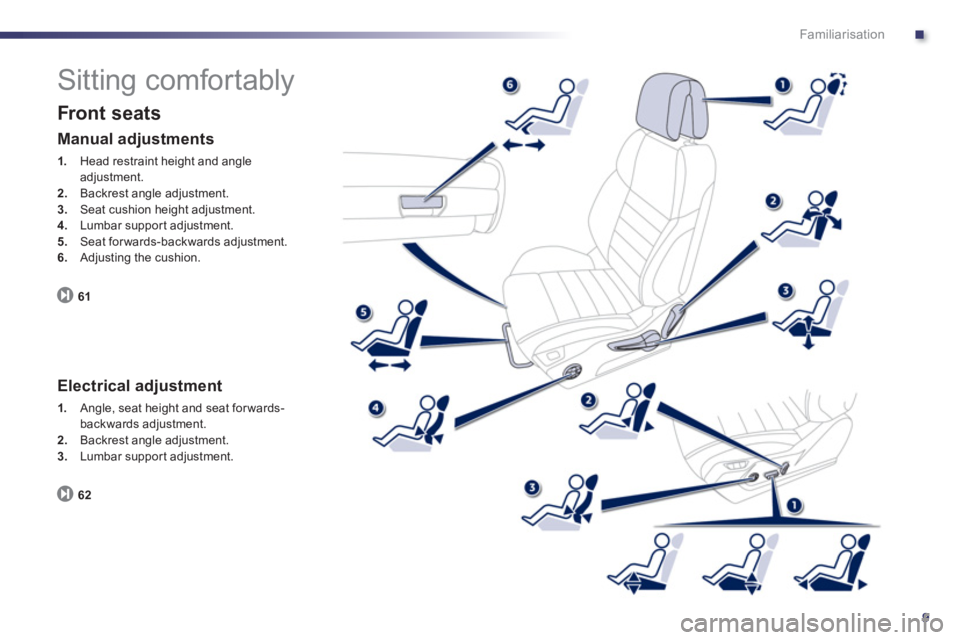
Front seats
61
Manual adjustments
1.
Head restraint height and angle
adjustment.
2.
Backrest angle adjustment.
3.
Seat cushion height adjustment.
4.
Lumbar support adjustment.
5.
Seat forwards-backwards adjustment.
Electrical adjustment
1.
Angle, seat height and seat for wards-
backwards adjustment.
2.
Backrest angle adjustment.
3.
Lumbar support adjustment.
62
6.
Adjusting the cushion.
Page 12 of 340
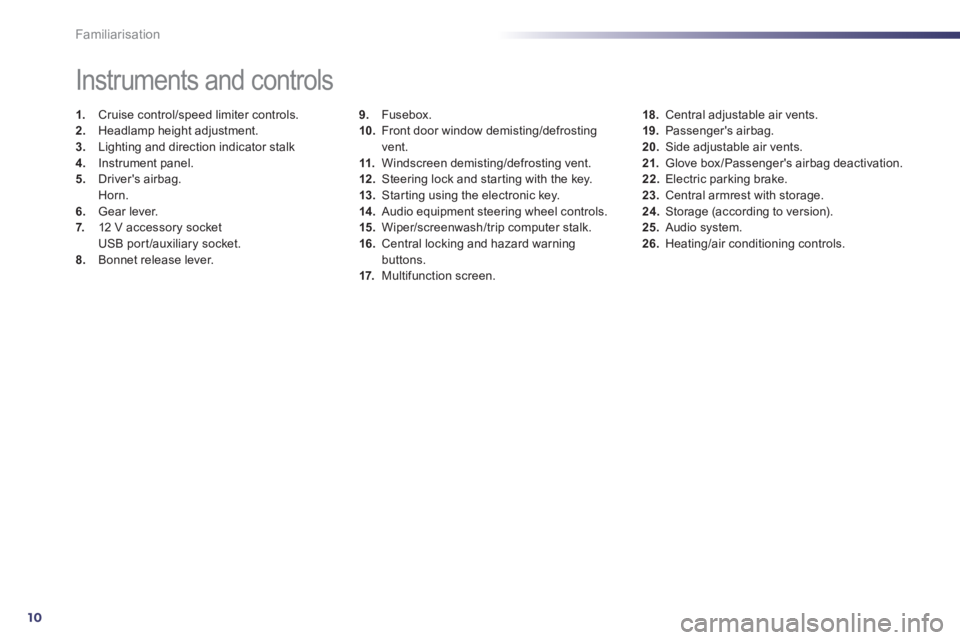
10
Familiarisation
9.
Fusebox.
10.
Front door window demisting/defrosting
vent.
11.
Windscreen demisting/defrosting vent.
12 .
Steering lock and star ting with the key.
13.
Star ting using the electronic key.
14 .
Audio equipment steering wheel controls.
15.
Wiper/screenwash/trip computer stalk.
16.
Central locking and hazard warning
buttons.
17.
Multifunction screen.
Instruments and controls
1.
Cruise control/speed limiter controls.
2.
Headlamp height adjustment.
3.
Lighting and direction indicator stalk
4.
Instrument panel.
5.
Driver's airbag.
Horn.
6.
Gear lever.
7.
12 V accessory socket
USB port /auxiliary socket.
8.
Bonnet release lever.
18.
Central adjustable air vents.
19.
Passenger's airbag.
20.
Side adjustable air vents.
21.
Glove box /Passenger's airbag deactivation.
22.
Electric parking brake.
23.
Central armrest with storage.
24.
Storage (according to version).
25.
Audio system.
26.
Heating/air conditioning controls.
Page 25 of 340
1
23
Instruments and controls
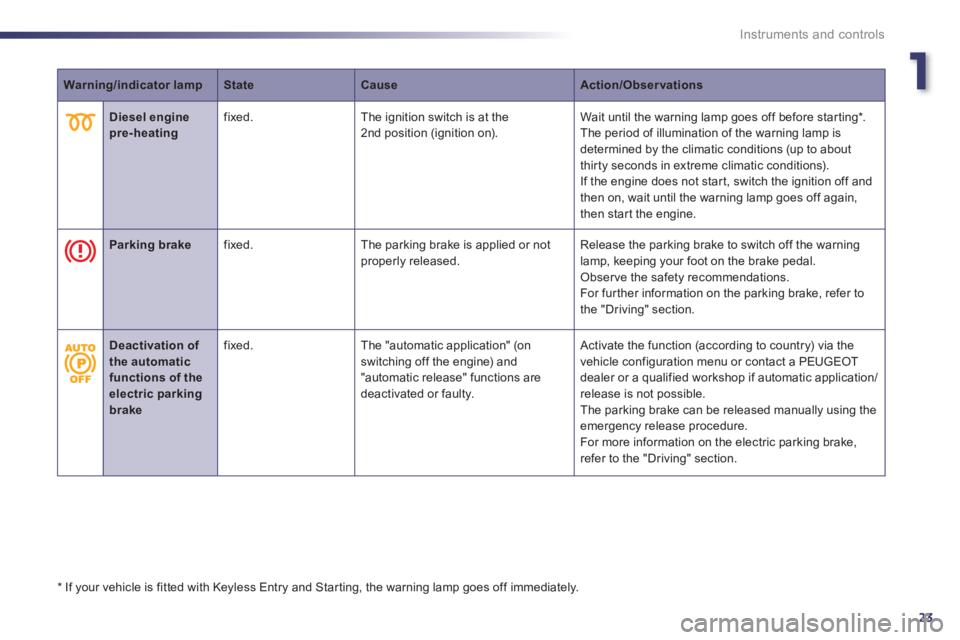
Warning/indicator lamp
State
Cause
Action/Observations
Diesel engine
pre-heating
fixed. The ignition switch is at the
2nd position (ignition on). Wait until the warning lamp goes off before star ting * .
The period of illumination of the warning lamp is
determined by the climatic conditions (up to about
thirty seconds in extreme climatic conditions).
If the engine does not star t, switch the ignition off and
then on, wait until the warning lamp goes off again,
then start the engine.
Parking brake
fixed. The parking brake is applied or not
properly released. Release the parking brake to switch off the warning
lamp, keeping your foot on the brake pedal.
Obser ve the safety recommendations.
For fur ther information on the parking brake, refer to
the "Driving" section.
Deactivation of
the automatic
functions of the
electric parking
brake
fixed. The "automatic application" (on
switching off the engine) and
"automatic release" functions are
deactivated or faulty. Activate the function (according to country) via the
vehicle configuration menu or contact a PEUGEOT
dealer or a qualified workshop if automatic application/
release is not possible.
The parking brake can be released manually using the
emergency release procedure.
For more information on the electric parking brake,
refer to the "Driving" section.
*
If your vehicle is fitted with Keyless Entry and Star ting, the warning lamp goes off immediately.
Page 28 of 340
26
Instruments and controls
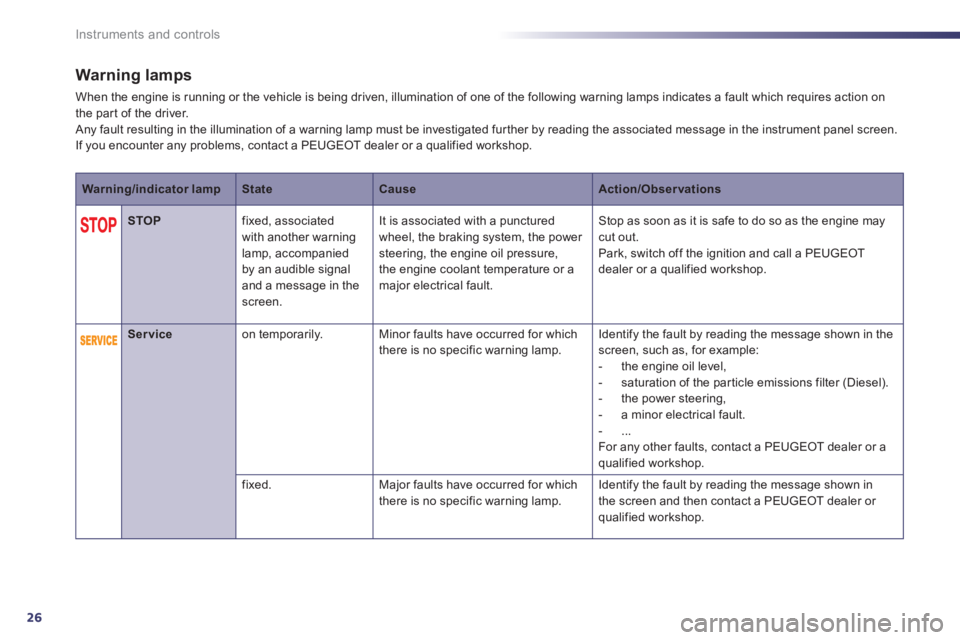
Warning lamps
When the engine is running or the vehicle is being driven, illumination of one of the following warning lamps indicates a fault which requires action on
the par t of the driver.
Any fault resulting in the illumination of a warning lamp must be investigated fur ther by reading the associated message in the instrument panel screen.
If you encounter any problems, contact a PEUGEOT dealer or a qualified workshop.
Warning/indicator lamp
State
Cause
Action/Observations
STOP
fixed, associated
with another warning
lamp, accompanied
by an audible signal
and a message in the
screen. It is associated with a punctured
wheel, the braking system, the power
steering, the engine oil pressure,
the engine coolant temperature or a
major electrical fault. Stop as soon as it is safe to do so as the engine may
cut out.
Park, switch off the ignition and call a PEUGEOT
dealer or a qualified workshop.
Service
on temporarily. Minor faults have occurred for which
there is no specific warning lamp. Identify the fault by reading the message shown in the
screen, such as, for example:
- the engine oil level,
- saturation of the par ticle emissions filter (Diesel).
- the power steering,
- a minor electrical fault.
- ...
For any other faults, contact a PEUGEOT dealer or a
qualified workshop.
fixed. Major faults have occurred for which
there is no specific warning lamp. Identify the fault by reading the message shown in
the screen and then contact a PEUGEOT dealer or
qualified workshop.
Page 29 of 340
1
27
Instruments and controls
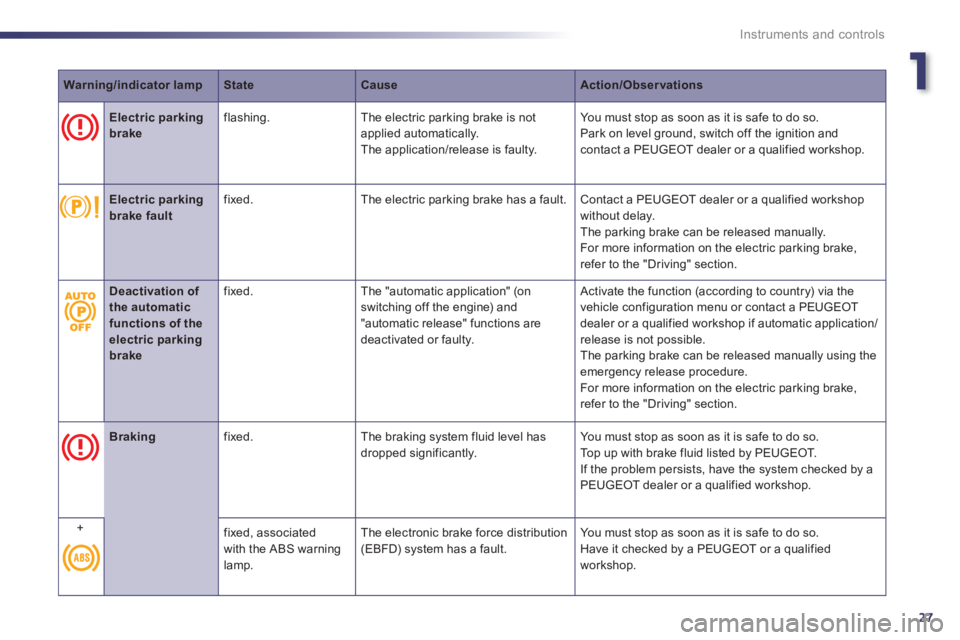
Warning/indicator lamp
State
Cause
Action/Observations
Electric parking
brake
flashing. The electric parking brake is not
applied automatically.
The application/release is faulty. You must stop as soon as it is safe to do so.
Park on level ground, switch off the ignition and
contact a PEUGEOT dealer or a qualified workshop.
Electric parking
brake fault
fixed. The electric parking brake has a fault. Contact a PEUGEOT dealer or a qualified workshop
without delay.
The parking brake can be released manually.
For more information on the electric parking brake,
refer to the "Driving" section.
Braking
fixed. The braking system fluid level has
dropped significantly. You must stop as soon as it is safe to do so.
Top up with brake fluid listed by PEUGEOT.
If the problem persists, have the system checked by a
PEUGEOT dealer or a qualified workshop.
+
fixed, associated
with the ABS warning
lamp. The electronic brake force distribution
(EBFD) system has a fault. You must stop as soon as it is safe to do so.
Have it checked by a PEUGEOT or a qualified
workshop.
Deactivation of
the automatic
functions of the
electric parking
brake
fixed. The "automatic application" (on
switching off the engine) and
"automatic release" functions are
deactivated or faulty. Activate the function (according to country) via the
vehicle configuration menu or contact a PEUGEOT
dealer or a qualified workshop if automatic application/
release is not possible.
The parking brake can be released manually using the
emergency release procedure.
For more information on the electric parking brake,
refer to the "Driving" section.
Page 49 of 340
2
47
!
Access
Lost keys, remote control, electronic key
Visit a PEUGEOT dealer with the vehicle's V5 registration document and your personal identification documents.
The PEUGEOT dealer will be able to retrieve the key code and the transponder code required to order a replacement.
Remote control
The high frequency remote control is a sensitive system; do not operate it while it is in your pocket as there is a possibility that it may unlock the
vehicle, without you being aware of it.
Do not repeatedly press the buttons of your remote control out of range and out of sight of your vehicle. You run the risk of stopping it from
working and the remote control would have to be reinitialised.
The remote control does not operate when the key is in the ignition, even when the ignition is switched off.
Locking the vehicle
Driving with the doors locked may make access to the passenger compar tment by the emergency ser vices more difficult in an emergency.
As a safety precaution (with children on board), remove the key from the ignition or take the electronic key when you leave the vehicle, even for
a shor t time.
Electrical interference
The Keyless Entry and Star ting electronic key may not operate if close to cer tain electronic devices: telephone, laptop computer, s t r o n g
magnetic fields, ...
Anti-theft protection
Do not make any modifications to the electronic engine immobiliser system; this could cause malfunctions.
Don't forget to turn the steering to engage the steering lock.
When purchasing a second-hand vehicle
Have the key codes memorised by a PEUGEOT dealer, to ensure that the keys in your possession are the only ones which can star t the vehicle.
Page 52 of 340
50
Access
Electric windows
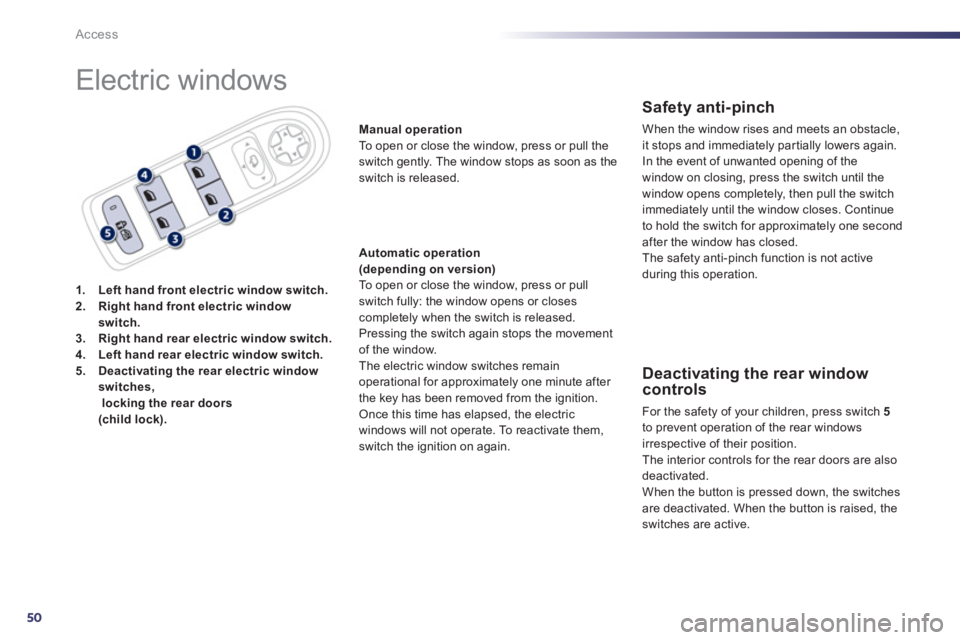
1.
Left hand front electric window switch.
2.
Right hand front electric window
switch.
3.
Right hand rear electric window switch.
4.
Left hand rear electric window switch.
5.
Deactivating the rear electric window
switches,
locking the rear doors
(child lock).
Manual operation
To open or close the window, press or pull the
switch gently. The window stops as soon as the
switch is released.
Automatic operation
(depending on version)
To open or close the window, press or pull
switch fully: the window opens or closes
completely when the switch is released.
Pressing the switch again stops the movement
of the window.
The electric window switches remain
operational for approximately one minute after
the key has been removed from the ignition.
Once this time has elapsed, the electric
windows will not operate. To reactivate them,
switch the ignition on again.
Safety anti-pinch
When the window rises and meets an obstacle,
it stops and immediately partially lowers again.
In the event of unwanted opening of the
window on closing, press the switch until the
window opens completely, then pull the switch
immediately until the window closes. Continue
to hold the switch for approximately one second
after the window has closed.
The safety anti-pinch function is not active
during this operation.
Deactivating the rear window
controls
For the safety of your children, press switch 5
to prevent operation of the rear windows
irrespective of their position.
The interior controls for the rear doors are also
deactivated.
When the button is pressed down, the switches
are deactivated. When the button is raised, the
switches are active.