steering Peugeot 508 2012 Owner's Guide
[x] Cancel search | Manufacturer: PEUGEOT, Model Year: 2012, Model line: 508, Model: Peugeot 508 2012Pages: 340, PDF Size: 11.11 MB
Page 165 of 340
7
163
i!
i
i
Safety
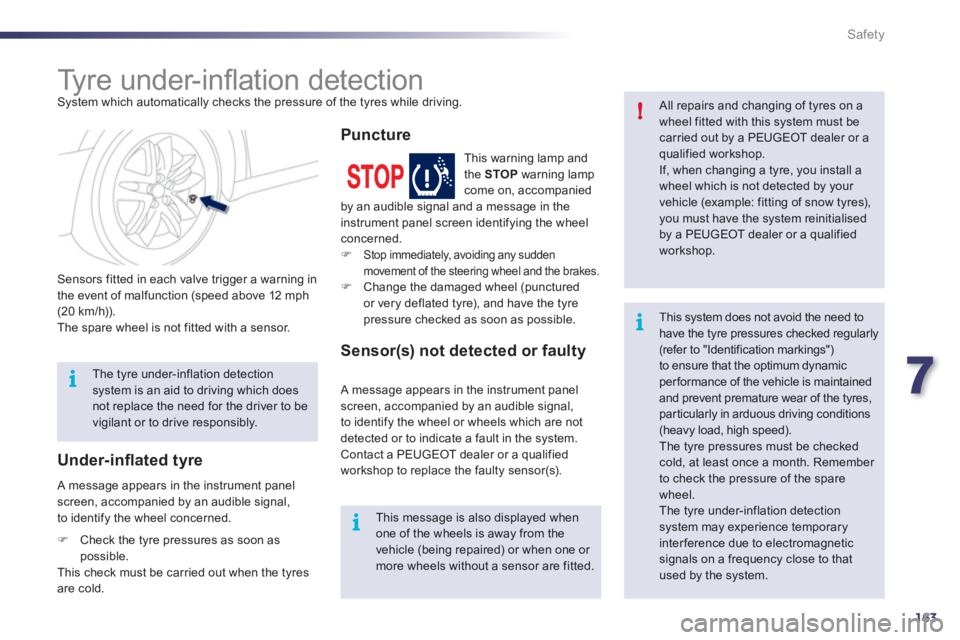
Ty r e u n d e r - i nfl ation detection System which automatically checks the pressure of the tyres while driving.
Sensors fitted in each valve trigger a warning in
the event of malfunction (speed above 12 mph (20 km/h)).
The spare wheel is not fitted with a sensor.
All repairs and changing of tyres on awheel fitted with this system must becarried out by a PEUGEOT dealer or a qualified workshop.
If, when changing a tyre, you install awheel which is not detected by your vehicle (example: fitting of snow tyres), you must have the system reinitialised
by a PEUGEOT dealer or a qualifiedworkshop.
This message is also displayed whenone of the wheels is away from thevehicle (being repaired) or when one or more wheels without a sensor are fitted.
The tyre under-inflation detectionsystem is an aid to driving which doesnot replace the need for the driver to bevigilant or to drive responsibly.
This system does not avoid the need to have the tyre pressures checked regularly(refer to "Identification markings") to ensure that the optimum dynamicperformance of the vehicle is maintainedand prevent premature wear of the tyres,particularly in arduous driving conditions (heavy load, high speed).
The tyre pressures must be checked cold, at least once a month. Remember to check the pressure of the spare wheel.
The tyre under-inflation detection system may experience temporary inter ference due to electromagnetic signals on a frequency close to that used by the system.
A message appears in the instrument panelscreen, accompanied by an audible signal,
to identify the wheel concerned.
Under-infl ated tyre
This warning lamp and
the STOPwarning lamp come on, accompanied by an audible signal and a message in theinstrument panel screen identifying the wheelconcerned. )Stop immediately, avoiding any sudden
movement of the steering wheel and the brakes.) Change the damaged wheel (punctured
or very deflated tyre), and have the tyre
pressure checked as soon as possible.
Puncture
A message appears in the instrument panel
screen, accompanied by an audible signal,
to identify the wheel or wheels which are not
detected or to indicate a fault in the system.Contact a PEUGEOT dealer or a qualifiedworkshop to replace the faulty sensor(s).
Sensor(s) not detected or faulty
)Check the tyre pressures as soon aspossible.
This check must be carried out when the tyres are cold.
Page 172 of 340
170
i
!
Safety
Airbags
System designed to maximise the safety of the
occupants (with the exception of the rear centrepassenger) in the event of violent collisions.
It supplements the action of the force-limiting seat belts (with the exception of the rear centrepassenger).
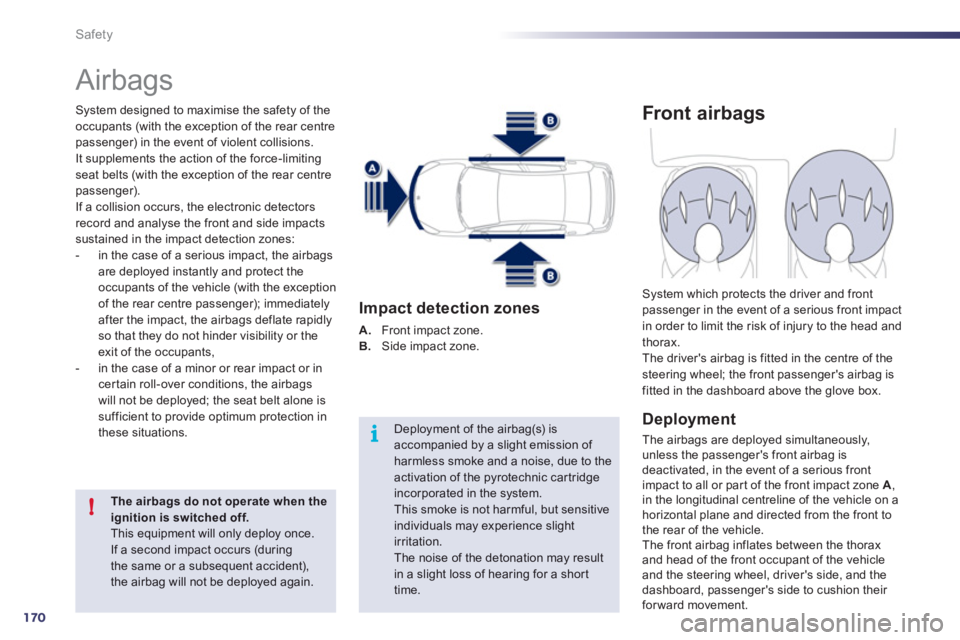
If a collision occurs, the electronic detectors record and analyse the front and side impacts sustained in the impact detection zones:
- in the case of a serious impact, the airbagsare deployed instantly and protect the
occupants of the vehicle (with the exception
of the rear centre passenger); immediately after the impact, the airbags deflate rapidlyso that they do not hinder visibility or the
exit of the occupants,
- in the case of a minor or rear impact or incer tain roll-over conditions, the airbags
will not be deployed; the seat belt alone is
sufficient to provide optimum protection in
th
ese situations.
The airbags do not operate when the ignition is switched off. This equipment will only deploy once.If a second impact occurs (during the same or a subsequent accident),the airbag will not be deployed again.
Deployment of the airbag(s) is accompanied by a slight emission of harmless smoke and a noise, due to theactivation of the pyrotechnic cartridgeincorporated in the system.This smoke is not harmful, but sensitiveindividuals may experience slight irritation. The noise of the detonation may result in a slight loss of hearing for a shorttime.
Impact detection zones
A.
Front impact zone. B.
Side impact zone.
Front airbags
Deployment
The airbags are deployed simultaneously,
unless the passenger's front airbag is
deactivated, in the event of a serious front
impact to all or part of the front impact zone A,
in the longitudinal centreline of the vehicle on a horizontal plane and directed from the front to
the rear of the vehicle.
The front airbag inflates between the thorax
and head of the front occupant of the vehicle
an
d the steering wheel, driver's side, and the
dashboard, passenger's side to cushion their
forward movement.
System which protects the driver and frontpassenger in the event of a serious front impact
in order to limit the risk of injury to the head and
thorax.
The driver's airbag is fitted in the centre of the steering wheel; the front passenger's airbag isfitted in the dashboard above the glove box.
Page 175 of 340
7
173
!
Safety
Sit in a normal upright position.
Wear a correctly adjusted seat belt.
Do not leave anything between theoccupants and the airbags (a child, pet, object...). This could hamper the operation of the airbags or injure the occupants. After an accident or if the vehicle has beenstolen or broken into, have the airbagsystems checked. All work on the airbag system must be carried out by a PEUGEOT dealer or a qualified workshop.
Even if all of the precautions mentioned are obser ved, a risk of injury or of minor burns to the head, chest or arms when an airbag is deployed cannot be ruled out. The bag inflates almost instantly (within a few milliseconds) then deflates within the same time discharging
the hot gas via openings provided for thispurpose.
Lateral airbags
Use only approved covers on the seats, compatible with the deployment the lateralairbags. For information on the range of seatcovers suitable for your vehicle, you can contact a PEUGEOT dealer (see "Practical information - § Accessories"). Do not fix or attach anything to the seatbacks (clothing...). This could cause injuryto the chest or arms if the lateral airbag isdeployed.Do not sit with the upper par t of the body anynearer to the door than necessary.
Front airbags
Do not drive holding the steering wheel by itsspokes or resting your hands on the centre part of the wheel.
Passengers must not place their feet on thedashboard.
If possible, do not smoke as deployment of the airbags can cause burns or the risk of injury from a cigarette or pipe.
Never remove or pierce the steering wheel or hit it violently.
Curtain airbags
Do not fix or attach anything to the roof.
This could cause injury to the head if the cur tain airbag is deployed. If fitted on your vehicle, do not remove thegrab handles installed on the roof, they play a part in securing the cur tain airbags.
For the airbags to be fully effective, observe the following safety rules:
Page 177 of 340
8
175
i
Practical information
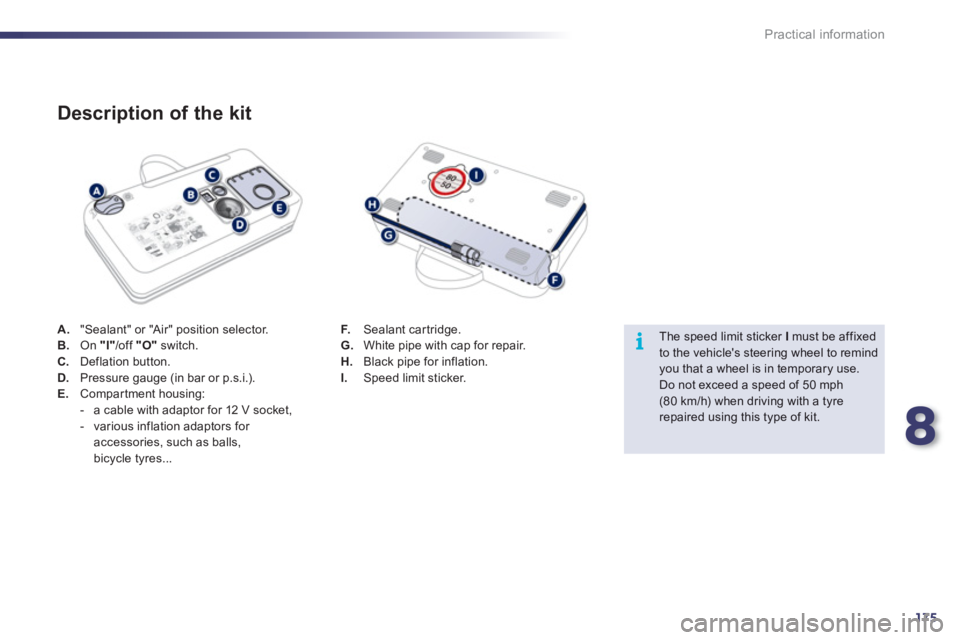
A."Sealant" or "Air" position selector.
B.On "I" /off "O"switch.C.Deflation button.D.Pressure gauge (in bar or p.s.i.). E.
Compartment housing:
- a cable with adaptor for 12 V socket,
- various inflation adaptors for accessories, such as balls,bicycle tyres...
Description of the kit
F.
Sealant car tridge.G.
White pipe with cap for repair. H.Black pipe for inflation.I.Speed limit sticker.
The speed limit sticker I
must be affixedto the vehicle's steering wheel to remind you that a wheel is in temporary use.
Do not exceed a speed of 50 mph(80 km/h) when driving with a tyre repaired using this type of kit.
Page 208 of 340
206
!
Practical information
General
recommendations
Observe the legislation in force in your country.Ensure that the weight of the towing vehicle is higher than that of the towedvehicle.The driver must stay at the wheel of thetowed vehicle. Driving on motor ways and fast roads is prohibited when towing.When towing a vehicle with all four wheels on the ground, always use an approved towing bar; rope and straps are prohibited. When towing a vehicle with the engine off, there is no longer any power assistance for braking or steering.In the following cases, you must always call on a professional recovery service:- vehicle broken down on a motor way
or fast road,- when it is not possible to put the gearbox into neutral, unlock thesteering, or release the parkingbrake, - towing with only two wheels on theground, - where there is no approved towing bar available...
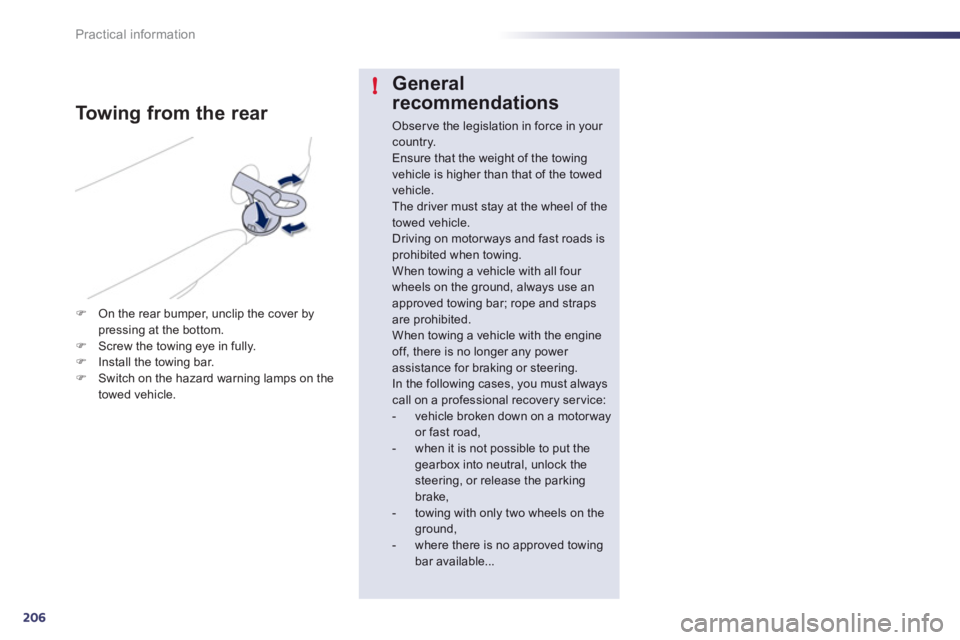
To w i ng from the rear
)On the rear bumper, unclip the cover by pressing at the bottom. )Screw the towing eye in fully. )Install the towing bar.)Switch on the hazard warning lamps on the
towed vehicle.
Page 217 of 340
9
215
Checks
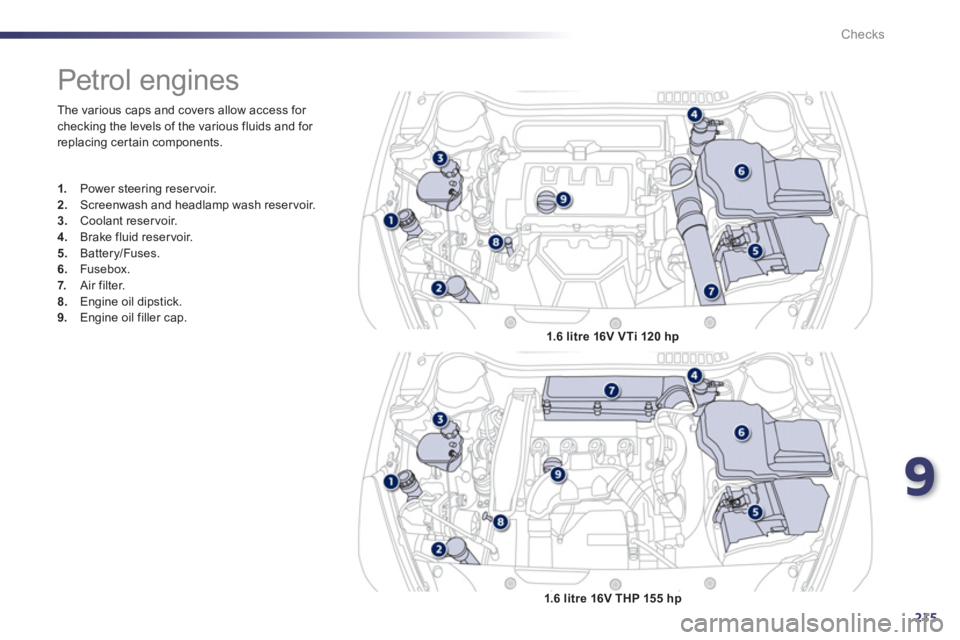
The various caps and covers allow access for checking the levels of the various fluids and for
replacing cer tain components.
Petrol engines
1.
Power steering reservoir.2.Screenwash and headlamp wash reservoir.3.Coolant reservoir.4.
Brake fluid reservoir.
5. Battery/Fuses.
6.Fusebox.
7. Air filter.8.Engine oil dipstick.9.
Engine oil filler cap.
1.6 litre 16V VTi 120 hp
1.6 litre 16V THP 155 hp
Page 218 of 340
216
Checks
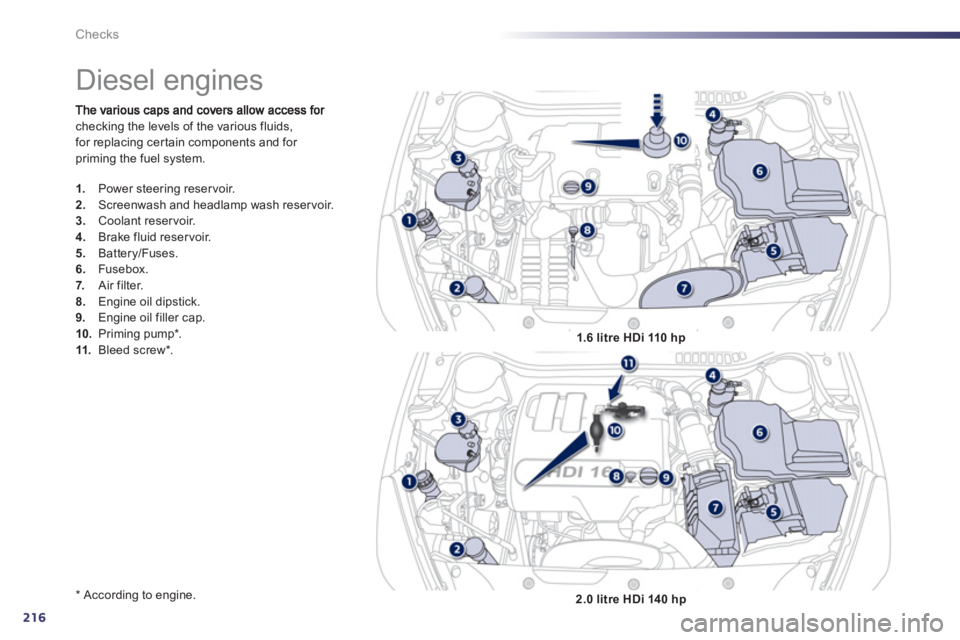
checking the levels of the various fluids,
for replacing cer tain components and for priming the fuel system.
*
Accordin
g to engine.
Diesel engines
1.
Power steering reservoir.2.
Screenwash and headlamp wash reservoir.3.
Coolant reservoir. 4.
Brake fluid reservoir.5.
Battery/Fuses.
6.Fusebox.
7. Air filter.8.Engine oil dipstick. 9.
Engine oil filler cap.10.Priming pump * . 11.
Bleed screw *
. 1.6 litre HDi 110 hp
2.0 litre HDi 140 hp
Page 219 of 340
9
217
Checks
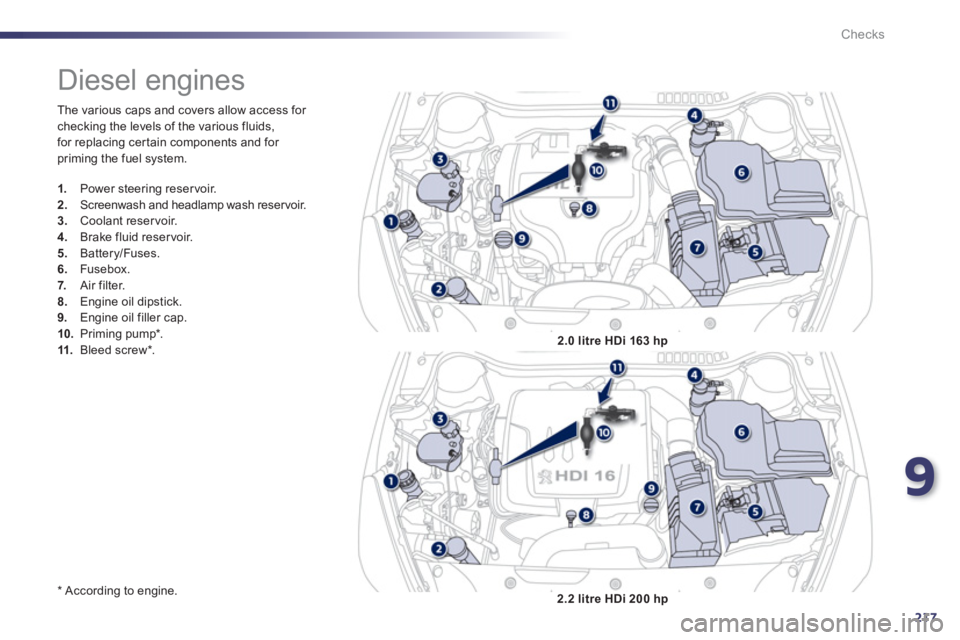
The various caps and covers allow access for checking the levels of the various fluids,
for replacing cer tain components and for priming the fuel system.
*
According to engine.
Diesel engines
1.
Power steering reservoir.2.Screenwash and headlamp wash reservoir.3.Coolant reservoir.4.
Brake fluid reservoir.
5. Battery/Fuses.
6.Fusebox.
7. Air filter.8.Engine oil dipstick.9.
Engine oil filler cap.10.Priming pump * . 11.
Bleed screw *
. 2.0 litre HDi 163 hp
2.2 litre HDi 200 hp
Page 220 of 340
218
!
Checks
Checking levels
Ta k e c a r e w h e n w o r k i ng under the
bonnet, as certain areas of the enginemay be extremely hot (risk of burns).
Oil level
The check is carried out either when
the ignition is switched on using the oil level indicator on the instrument panel, or using the dipstick.
This manual check will only be correct if the
vehicle is on level ground and the engine has
been o
ff for more than 30 minutes.
It is normal to top up the oil level between
two ser vices
(or oil changes). PEUGEOTrecommends that you check the level, and top
up if necessary, every 3 000 miles (5 000 kms).
After topping up the oil, the check whenswitching on the ignition with the oil levelindicator in the instrument panel is not validduring the 30 minutes after topping up.
Engine oil change
Refer to the ser vicing booklet for details of the
interval for this operation.
In order to maintain the reliability of the engine
and emission control system, the use of
additives in the engine oil is prohibited.
Oil specifi cation
The oil must be the correct grade for your engine and conform to the manufacturer'srecommendations.
Th
e brake fluid level should be close
to the "MA X" mark. If it is not, check
the brake pad wear.
Brake fl uid level
Chan
ging the fl uid
Refer to the ser vicing booklet for details of
the inter val for this operation.
Fluid specifi cation
The brake fluid must conform to themanufacturer's recommendations and meet
the DOT4 standard.
Power steering fl uid level
The power steering fluid level shouldbe close to the "MAX" mark. With
the engine cold, unscrew the cap to
check the level. I
f a level drops significantly, have the corresponding system checked by a PEUGEOT dealer or a qualified workshop. Check all of these levels regularly and top them up if necessary, unless other wise indicated.
Page 241 of 340
239
The system is protected in such a way that it will onlyoperate in your vehicle.
PEUGEOT CONNECT NAVIGATION (RT6)
01 First steps - Control panel
For safety reasons, the driver must carry out operations
which require prolonged attention while the vehicle is stationary.
When the en
gine is switched off and to prevent
discharging of the battery, the system switches off following the activation of the energy economy mode.
CONTENTS
02 Steering mounted controls
03 General operation
04 Navigation - Guidance
05 Traffic information
06 Using the telephone
07 Contacts - ADDR BOOK
08 Radio
09 Music media players
10 Audio settings
11 Configuration
12 Screen menu map p.
p.
p.
p.
p.
p.
p.
p.
p.
p.
p.
p.
240
2
42
243
245
2
59
262
270
27
3
276
282
283
284
Frequently asked questions p. 287
SATELLITE NAVIGATION SYSTEM
MULTIMEDIA BLUETOOTH TELEPHONE AUDIO
SYSTEM