Boot Peugeot 508 2013 - RHD (UK, Australia) Owner's Guide
[x] Cancel search | Manufacturer: PEUGEOT, Model Year: 2013, Model line: 508, Model: Peugeot 508 2013Pages: 340, PDF Size: 14.59 MB
Page 89 of 340
3
87
Comfort
In order for these systems to be fully effective, follow the operation and maintenance guidelines below: F
If the interior temperature remains very high after the vehicle has been parked in the sun for a considerable time, first ventilate the passenger compar tment for a few minutes. Place the air flow control at a sufficient level to provide an adequate renewal of air in the passenger compartment.F
To obtain an even air distribution, take care not to obstruct the exterior air intake grilles located at the base of the windscreen, the nozzles, the vents and the air outlets, as wellas the air extractor located in the boot. F
Use in preference the intake of exterior air as prolonged use of the air recirculation maycause misting of the windows and side windows.F
Do not cover the sunshine sensor, located on the dashboard; this is used for regulation of the automatic air conditioning system.F
Operate the air conditioning system for 5 to 10 minutes, once or twice a month to keep itin good working order. F
Ensure that the passenger compar tment filter is in good condition and have the filter elements replaced regularly (refer to the "Checks" section). We recommend the use of a combined passenger compartment filter. Thanks to its second special active filter, it contributes to the purification of the air breathed by the occupants and the cleanliness of the passenger compartment (reduction of allergic symptoms, bad odours and greasy deposits).F
The air conditioning uses power from the engine while operating. This results in anincrease in the vehicle's fuel consumption. When towing at or near maximum capacity or on steep slopes in high ambient temperatures, switching off the air conditioning saves engine power and so improvestowing capacity. Condensation created by the air conditioning results in a discharge of water under thevehicle when stationary, which is per fectly normal.F
To ensure correct operation of the air conditioning system, you are also advised to haveit checked regularly.F
If the system does not produce cold air, do not use it and contact a PEUGEOT dealer or a qualified workshop.
Recommendations for ventilation and air conditioning
The air conditioning system does notcontain chlorine and does not present any danger to the ozone layer.
Page 108 of 340
106
Driving
Emergency braking
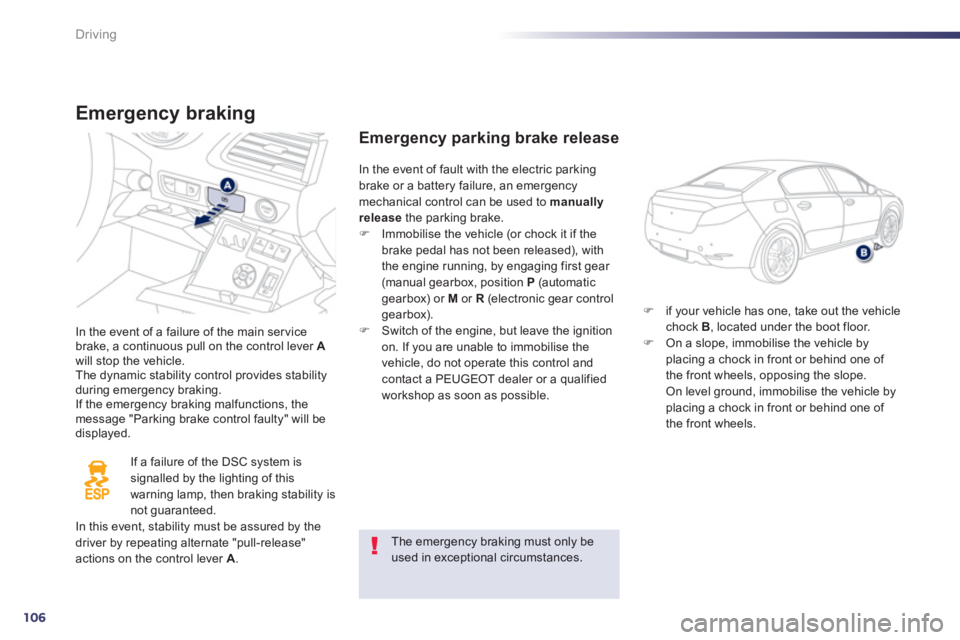
In the event of a failure of the main servicebrake, a continuous pull on the control lever Awill stop the vehicle.The dynamic stability control provides stability during emergency braking.
If the emergency braking malfunctions, themessage "Parking brake control faulty" will be displayed.
If a failure of the DSC s
ystem is
signalled by the lighting of this
warning lamp, then braking stability is
not guaranteed.In this event, stability must be assured by thedriver by repeating alternate "pull-release" actions on the control lever A.
Emergency parking brake release
Fif your vehicle has one, take out the vehicle chock B , located under the boot floor. FOn a slope, immobilise the vehicle byplacing a chock in front or behind one of
the front wheels, opposing the slope. On level ground, immobilise the vehicle byplacing a chock in front or behind one of
the front wheels.
In the event o
f fault with the electric parkingbrake or a battery failure, an emergencymechanical control can be used to manually
releasethe parking brake.F Immobilise the vehicle (or chock it if the
brake pedal has not been released), with
the engine running, by engaging first gear (manual gearbox, position P(automatic gearbox) or M or R(electronic gear control
gearbox). F Switch of the engine, but leave the ignition on. If you are unable to immobilise the
vehicle, do not operate this control and
contact a PEUGEOT dealer or a qualified
workshop as soon as possible.
The emergency braking must only be used in exceptional circumstances.
Page 146 of 340
144
Visibility
Manual adjustment
of halogen
headlamps
Automatic adjustment of xenon
headlamps
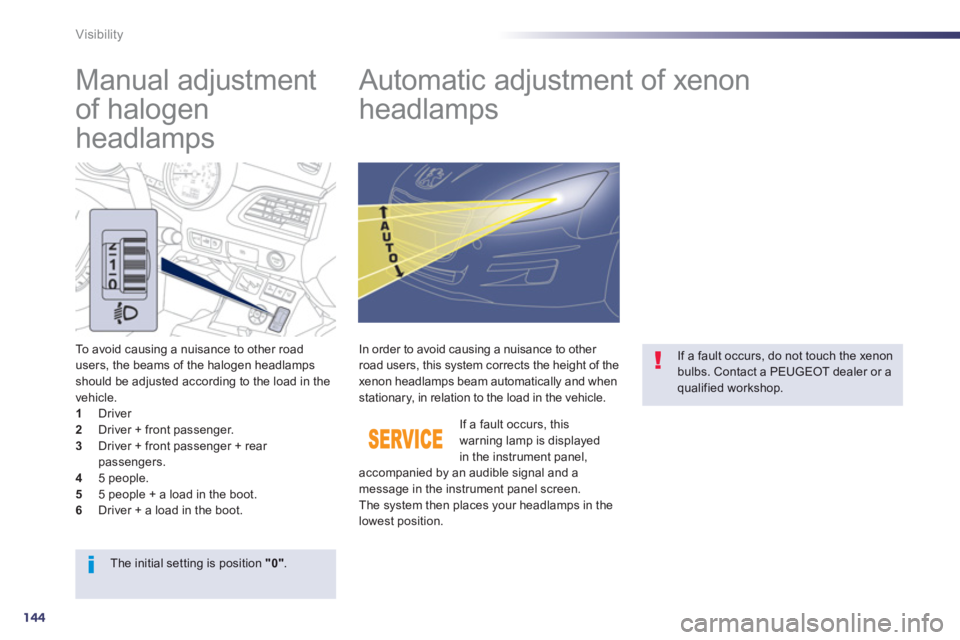
To avoid causing a nuisance to other road
users, the beams of the halogen headlamps should be adjusted according to the load in the
vehicle.1 Driver 2
Driver + front passenger.3
Driver + front passenger + rear passengers.4
5 people.5
5 people + a load in the boot. 6
Driver + a load in the boot. If a fault occurs
, this warning lamp is displayedin the instrument panel,
accompanied by an audible signal and a
message in the instrument panel screen.
The s
ystem then places your headlamps in the lowest position.
In order to avoid causing a nuisance to other road users, this system corrects the height of the
xenon headlamps beam automatically and when
stationary, in relation to the load in the vehicle.
If a fault occurs, do not touch the xenonbulbs. Contact a PEUGEOT dealer or a qualified workshop.
The initial setting is position "0".
Page 150 of 340
148
Visibility
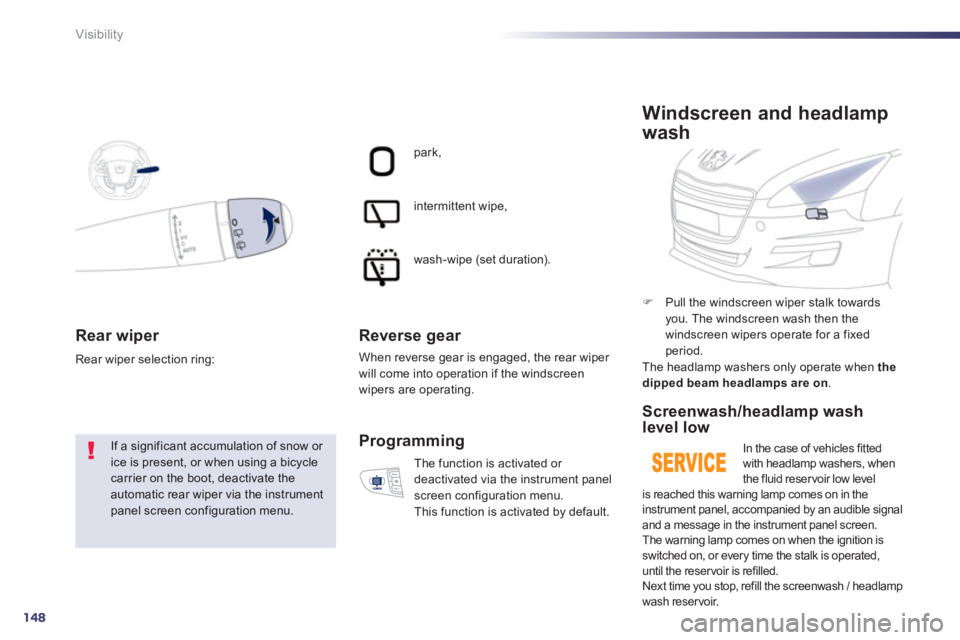
Rear wiper
If a significant accumulation of snow or ice is present, or when using a bicyclecarrier on the boot, deactivate theautomatic rear wiper via the instrument panel screen configuration menu. Rear wiper selection rin
g:
park,
intermittent wipe,
wash-wipe
(set duration).
Reverse gear
When reverse gear is engaged, the rear wiper
will come into operation if the windscreen
wipers are operating.
Th
e function is activated or
deactivated via the instrument panel
screen confi
guration menu.
This function is activated by default.
Programming
F
Pull the windscreen wiper stalk towards you. The windscreen wash then the
windscreen wipers operate for a fixed period.
The headlamp washers only operate when the
dipped beam headlamps are on .
Windscreen and headlamp
wash
Screenwash/headlamp washlevel low
In the case of vehicles fittedwith headlamp washers, when
the fluid reservoir low level
is reached this warning lamp comes on in the
instrument panel, accompanied b
y an audible signaland a message in the instrument panel screen.
The warning lamp comes on when the ignition isswitched on, or every time the stalk is operated,until the reservoir is refilled.
Next time you stop, refill the screenwash / headlamp
wash reservoir.
Page 180 of 340
178
Practical information
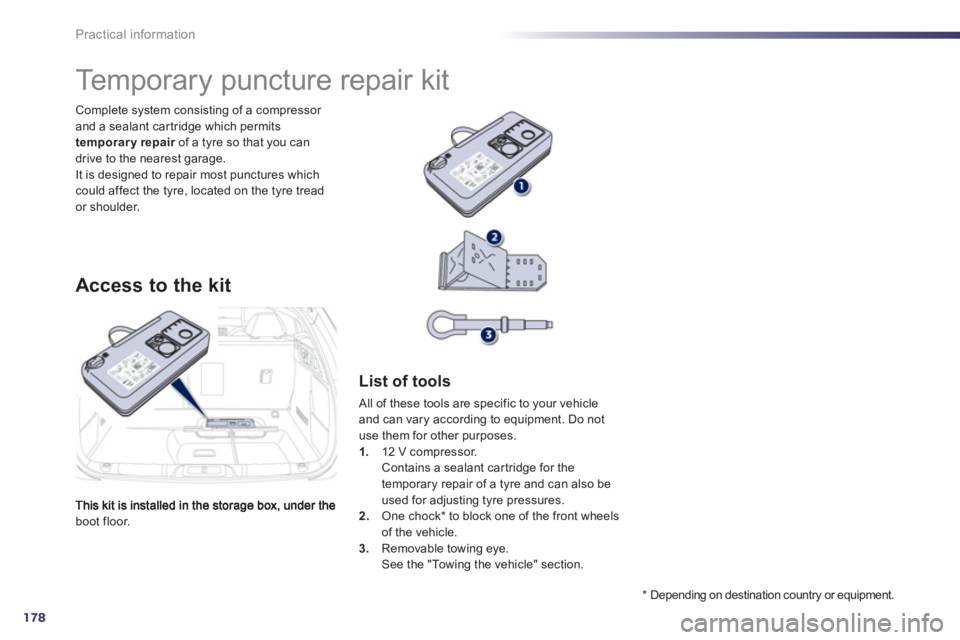
boot floor. Complete s
ystem consisting of a compressor and a sealant car tridge which permits
temporary repair of a tyre so that you can rdrive to the nearest garage.It is designed to repair most punctures which could affect the tyre, located on the tyre tread or shoulder.
Temporary puncture repair kit
Access to the kit
List of tools
All of these tools are specific to your vehicle
and can vary according to equipment. Do not
use them for other purposes. 1.12 V compressor.
Contains a sealant car tridge for the
temporary repair of a tyre and can also be used for adjusting tyre pressures.
2. One chock *
to block one of the front wheels of the vehicle.3.
Removable towing eye.
See the "Towing the vehicle" section.
*
Dependin
g on destination country or equipment.
Page 186 of 340
184
Practical information
Changing a wheel Procedure for changing a faulty wheel for the spare wheel using the tools provided with the vehicle.
Th
e tools are installed in the boot under the
floor.
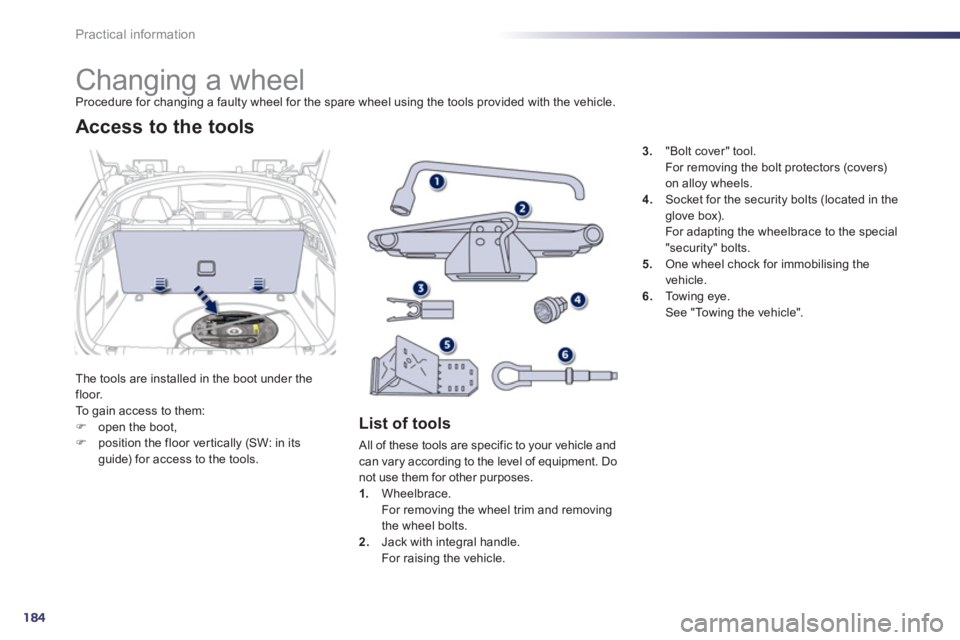
To gain access to them: Fopen the boot, Fposition the floor ver tically (SW: in itsguide) for access to the tools.
Access to the tools
List of tools
All of these tools are specific to your vehicle andcan vary according to the level of equipment. Do
not use them for other purposes.
1.Wheelbrace.
For removing the wheel trim and removing
the wheel bolts.
2. Jack with integral handle.
For raising the vehicle.
3."Bolt cover" tool.
For removing the bolt protectors
(covers)
on alloy wheels.4. Socket for the security bolts (located in the glove box).
For adapting the wheelbrace to the special
"security" bolts.
5. One wheel chock for immobilising the
vehicle.
6.Towing eye.
See "Towing the vehicle".
Page 187 of 340
8
185
Practical information
Wheel with trim
When refitting the wheel
, refit the trim starting by placing its notch facing the valve and press around its edge withthe palm of your hand.
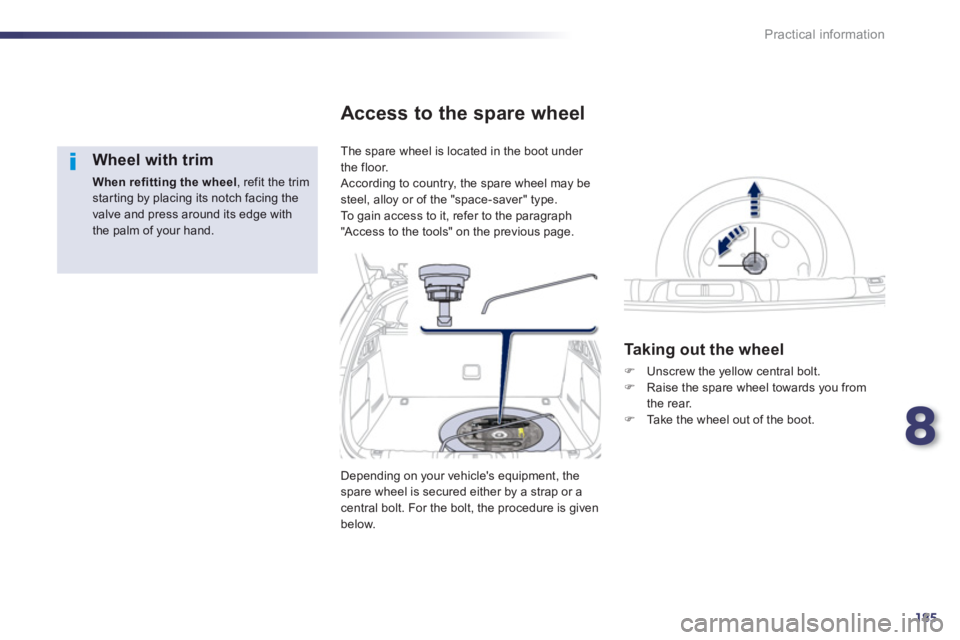
The spare wheel is located in the boot under
th
e floor.
According to country, the spare wheel may be
steel, alloy or of the "space-saver" type.
To gain access to it, refer to the paragraph"Access to the tools" on the previous page.
Access to the spare wheel
Ta k i ng out the wheel
F
Unscrew the yellow central bolt. F
Raise the spare wheel towards you from
the rear. F Take the wheel out of the boot.
Dependin
g on your vehicle's equipment, the
spare wheel is secured either by a strap or a central bolt. For the bolt, the procedure is givenbelow.
Page 191 of 340
8
189
Practical information
Fitting a wheel
Fitting the "space-saver"spare wheel
If your vehicle is fitted with alloy wheels, when tightening the bolts on fitting, it is normal to notice that the washers
do not come into contact with the "space-saver" spare wheel. The wheel is secured by the conical surface of each bolt.
After changing a wheel
To store the punctured wheel in the boot correctly, first remove the central cover. When using the "space-saver" typespare wheel, do not exceed 50 mph(80 km/h). Have the tightening of the bolts and thepressure of the spare wheel checkedby a PEUGEOT dealer or a qualified workshop without delay. Have the punctured wheel repaired and refitted to the vehicle as soon as possible.
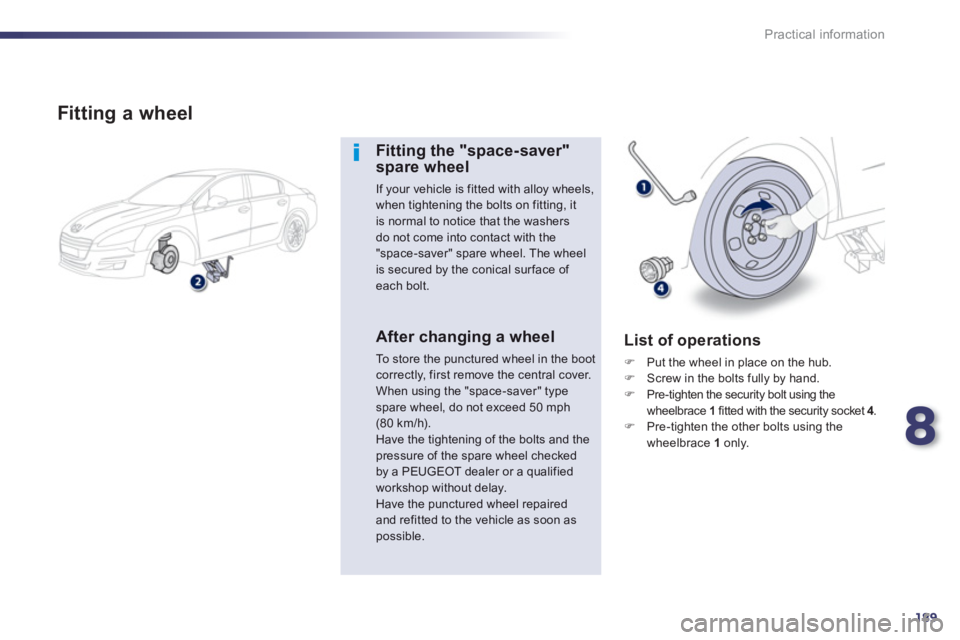
List of operations
F
Put the wheel in place on the hub. F
Screw in the bolts fully by hand.F
Pre-tighten the security bolt using the
wheelbrace 1fitted with the security socket 4.4F Pre-tighten the other bolts using the
wheelbrace 1only.
Page 198 of 340
196
Practical information
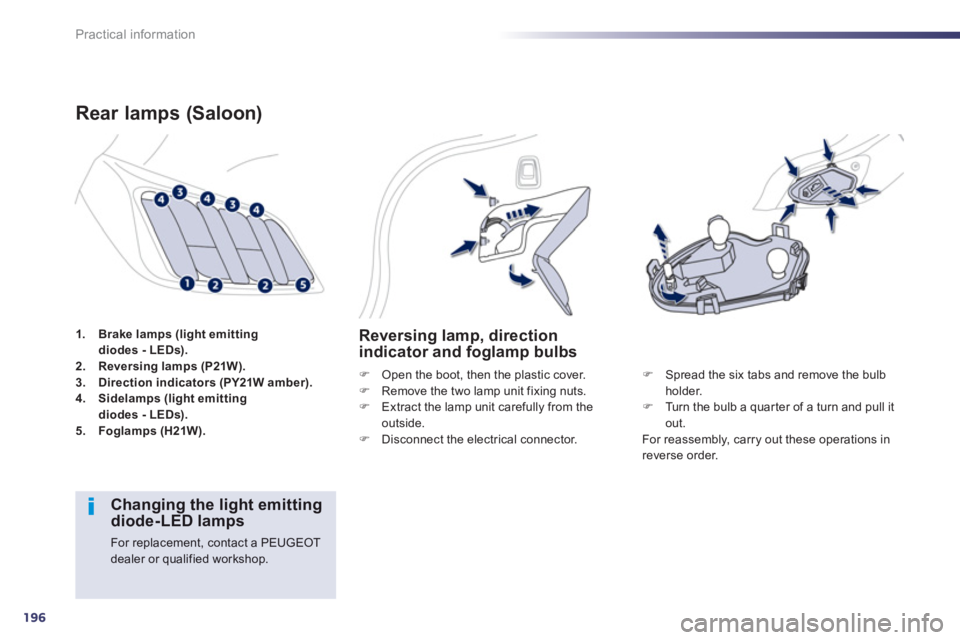
1.Brake lamps (light emittingdiodes - LEDs).2. Reversing lamps (P21W).3.Direction indicators (PY21W amber).4.Sidelamps (light emittingdiodes - LEDs).5.Foglamps (H21W).
Rear lamps (Saloon)
Reversing lamp, direction
indicator and foglamp bulbs
F Open the boot, then the plastic cover. F
Remove the two lamp unit fixing nuts. F
Extract the lamp unit carefully from the outside.F
Disconnect the electrical connector.
F
Spread the six tabs and remove the bulb holder. F
Turn the bulb a quar ter of a turn and pull it out.
For reassembly, carry out these operations in
reverse order.
Changing the light emittingdiode-LED lamps
For replacement, contact a PEUGEOT dealer or qualified workshop.
Page 199 of 340
8
197
Practical information
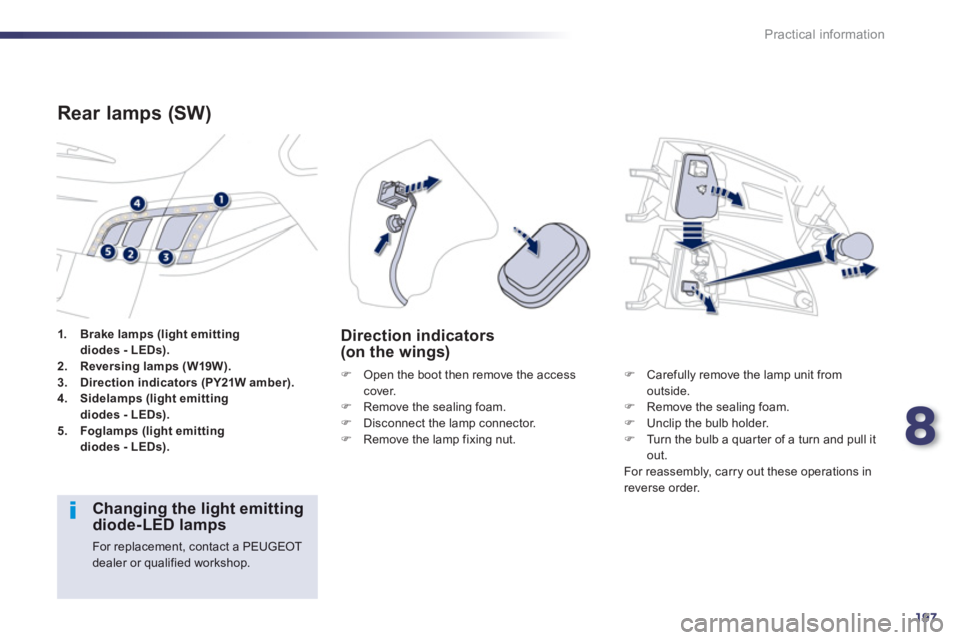
1.Brake lamps (light emittingdiodes - LEDs).2.Reversing lamps (W19W).3.Direction indicators (PY21W amber).4.Sidelamps (light emittingdiodes - LEDs).5.Foglamps (light emittingdiodes - LEDs).
Rear lamps (SW)
FOpen the boot then remove the accesscover.
FRemove the sealing foam.FDisconnect the lamp connector. FRemove the lamp fixing nut.
Direction indicators(on the wings)
F
Carefully remove the lamp unit from outside.F
Remove the sealing foam. F
Unclip the bulb holder. F
Turn the bulb a quar ter of a turn and pull itout.
For reassembly, carry out these operations in
reverse order.
Changing the light emitting diode-LED lamps
For replacement, contact a PEUGEOT dealer or qualified workshop.