warning light Peugeot 508 2018 User Guide
[x] Cancel search | Manufacturer: PEUGEOT, Model Year: 2018, Model line: 508, Model: Peugeot 508 2018Pages: 320, PDF Size: 10.09 MB
Page 101 of 320
99
Automatic operation of
hazard warning lamps
When braking in an emergency, depending on
the force of deceleration, the hazard warning
lamps come on automatically. They switch off
automatically when you next accelerate.
It is also possible to switch them off by pressing
the button.
Horn
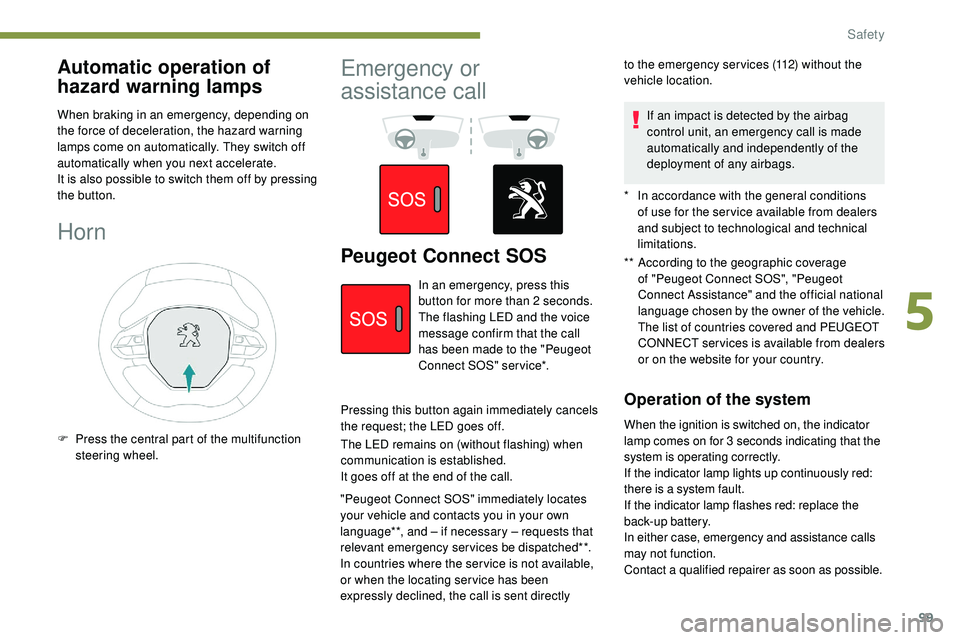
F Press the central part of the multifunction steering wheel.
Emergency or
assistance
call
Peugeot Connect SOS** According to the geographic coverage
of "Peugeot Connect SOS", "Peugeot
Connect Assistance" and the official national
language chosen by the owner of the vehicle.
The list of countries covered and PEUGEOT
CONNECT services is available from dealers
or on the website for your country.
In an emergency, press this
button for more than 2 seconds.
The flashing LED and the voice
message confirm that the call
has been made to the "Peugeot
Connect SOS" ser vice*.
Pressing this button again immediately cancels
the request; the LED goes off.
The LED remains on (without flashing) when
communication is established.
It goes off at the end of the call. *
I
n accordance with the general conditions
of use for the ser vice available from dealers
and subject to technological and technical
limitations.
"Peugeot Connect SOS" immediately locates
your vehicle and contacts you in your own
language**, and – if necessary – requests that
relevant emergency services be dispatched**.
In countries where the ser vice is not available,
or when the locating ser vice has been
expressly declined, the call is sent directly If an impact is detected by the airbag
control unit, an emergency call is made
automatically and independently of the
deployment of any airbags.
Operation of the system
When the ignition is switched on, the indicator
lamp comes on for 3 seconds indicating that the
system is operating correctly.
If the indicator lamp lights up continuously red:
there is a system fault.
If the indicator lamp flashes red: replace the
back-up battery.
In either case, emergency and assistance calls
may not function.
Contact a qualified repairer as soon as possible. to the emergency services (112) without the
vehicle location.
5
Safety
Page 103 of 320
101
Anti-lock braking system
(ABS) and electronic brake
force distribution (EBFD)
The fixed illumination of this warning
lamp signals that there is a fault with
the ABS.
Emergency braking assistance
(EBA)
In an emergency, this system enables you to
reach the optimum braking pressure more
quickly and therefore reduce the stopping
distance.
It is triggered in relation to the speed at which
the brake pedal is pressed. This is felt by a
reduction in the resistance of the pedal and an
increase in braking efficiency.
Anti-slip regulation (ASR)
This system optimises traction in order to
avoid wheel slip by acting on the brakes of
the driving wheels and on the engine. It also
improves the directional stability of the vehicle
on acceleration.
Dynamic stability control (DSC)
If there is a difference between the path
followed by the vehicle and that required by the
driver, this system monitors each wheel and
automatically acts on the brake of one or more
wheels and on the engine to return the vehicle
to the required path, within the limits of the laws
of physics.
Trailer stability assist (TSA)
This system allows control of the vehicle to be
retained when towing a trailer, so as to avoid
the risk of snaking.The vehicle retains conventional braking. Drive
carefully at moderate speed.
Contact a PEUGEOT dealer or a qualified
workshop as soon as possible.
Illumination of this warning lamp,
linked with the STOP and ABS
warning lamps, accompanied by
the display of a message and an
audible signal, signals that there is a
fault with the electronic brake force
distribution (EBFD).
You must stop as soon as it is safe to do so.
Call on a PEUGEOT dealer or a qualified
workshop.
Normal operation of the ABS may make
itself felt by slight vibrations of the brake
pedal.
When braking in an emergency, press
very firmly and maintain this pressure. When changing wheels (tyres and rims),
ensure that these are approved for your
vehicle.
After an impact, have these systems
checked by a PEUGEOT dealer or a
qualified workshop.
Anti-slip regulation (ASR)/
Dynamic stability control
(DSC)
Operation
These systems are activated automatically
every time the vehicle is started.
They come into operation in the event of a
problem with grip or trajectory.
This is indicated by flashing of this
warning lamp in the instrument panel.
Deactivation
In exceptional conditions (starting a vehicle
which is bogged down, stuck in snow, on soft
ground, etc.), it may be advisable to deactivate
the ASR system, so that the wheels can turn
freely and regain grip.
Reactivate the system when grip conditions
allow.
5
Safety
Page 105 of 320
103
Operating fault
Should a fault occur with the system,
this warning lamp comes on in the
instrument panel, accompanied by
the display of a message and an
audible signal.
If you continue to tow a trailer, reduce your
speed and drive carefully!
Contact a PEUGEOT dealer or a qualified
workshop to have the system checked.
The trailer stability assist system offers
increased safety in normal driving,
provided that the recommendations on
towing a trailer are obser ved. It should not
encourage the driver to take risks, such
as towing a trailer in adverse operating
conditions (overloading, failure to obser ve
the trailer nose weight, worn or under-
inflated tyres, faulty braking system, etc.)
or drive at too high a speed.
In certain cases, snaking of the trailer
may not be detected by the ESC system,
particularly with a light trailer.
When driving on slippery or poor sur faces,
the system may not be able to prevent
sudden snaking of the trailer.
Seat belts
Front seat belts
The front seat belts are fitted with a pyrotechnic
pretensioning and force limiting system.
This system improves safety in the front
seats in the event of a front or side impact.
Depending on the severity of the impact,
the
pretensioning system instantly tightens the
seat belts against the body of the occupants.
The pretensioning seat belts are active when
the ignition is on.
The force limiter reduces the pressure of the
seat belt on the chest of the occupant, thus
improving their protection.
Fastening
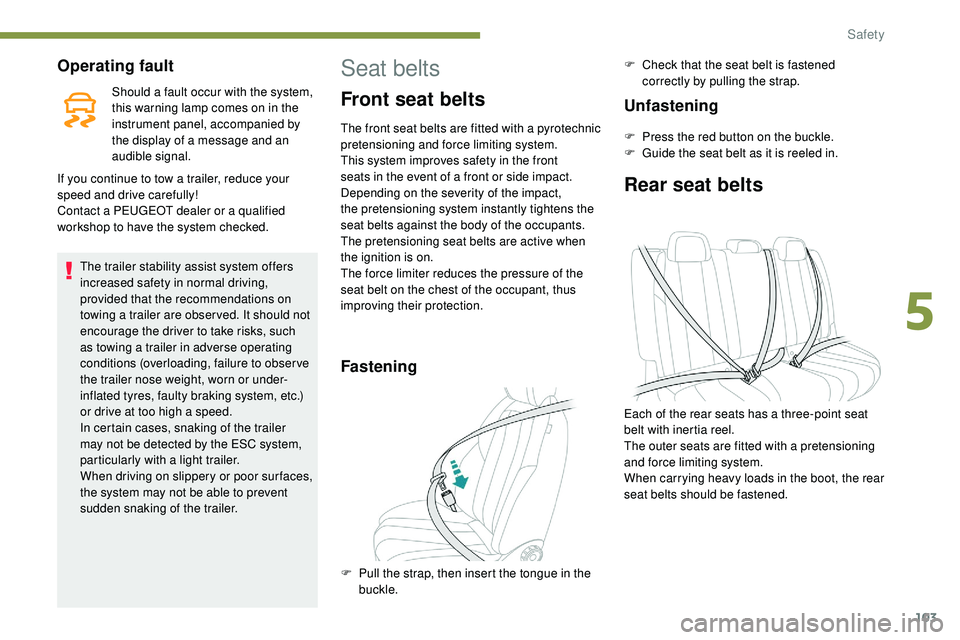
F Pull the strap, then insert the tongue in the buckle.
Unfastening
F Press the red button on the buckle.
F G uide the seat belt as it is reeled in.
Rear seat belts
F Check that the seat belt is fastened correctly by pulling the strap.
Each of the rear seats has a three-point seat
belt with inertia reel.
The outer seats are fitted with a pretensioning
and force limiting system.
When carrying heavy loads in the boot, the rear
seat belts should be fastened.
5
Safety
Page 106 of 320
104
Fastening
F Pull the strap, then insert the tongue in the buckle.
F
C
heck that the seat belt is fastened
correctly by pulling the strap.
Unfastening
F Press the red button on the buckle.
F G uide the seat belt as it is reeled in.
Seat belt not fastened/
unfastened warning lamp(s)
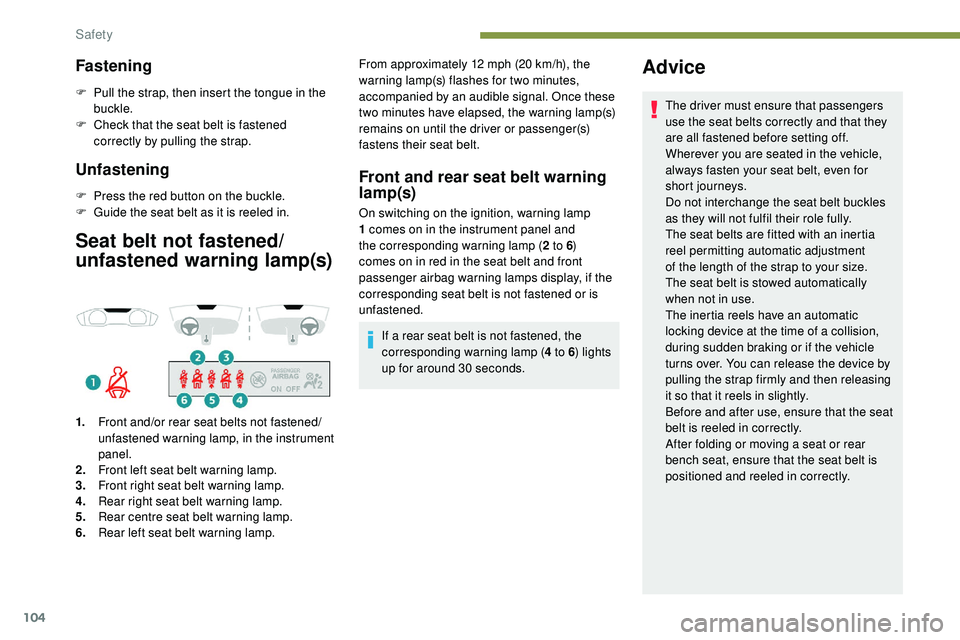
1.Front and/or rear seat belts not fastened/
unfastened warning lamp, in the instrument
panel.
2. Front left seat belt warning lamp.
3. Front right seat belt warning lamp.
4. Rear right seat belt warning lamp.
5. Rear centre seat belt warning lamp.
6. Rear left seat belt warning lamp. From approximately 12 mph (20
km/h), the
warning lamp(s) flashes for two minutes,
accompanied by an audible signal. Once these
two minutes have elapsed, the warning lamp(s)
remains on until the driver or passenger(s)
fastens their seat belt.
Front and rear seat belt warning
lamp(s)
On switching on the ignition, warning lamp
1 comes on in the instrument panel and
the corresponding warning lamp ( 2 to 6)
comes on in red in the seat belt and front
passenger airbag warning lamps display, if the
corresponding seat belt is not fastened or is
unfastened.
If a rear seat belt is not fastened, the
corresponding warning lamp ( 4 to 6) lights
up for around 30 seconds.
Advice
The driver must ensure that passengers
use the seat belts correctly and that they
are all fastened before setting off.
Wherever you are seated in the vehicle,
always fasten your seat belt, even for
short journeys.
Do not interchange the seat belt buckles
as they will not fulfil their role fully.
The seat belts are fitted with an inertia
reel permitting automatic adjustment
of the length of the strap to your size.
The
seat belt is stowed automatically
when not in use.
The inertia reels have an automatic
locking device at the time of a collision,
during sudden braking or if the vehicle
turns over. You can release the device by
pulling the strap firmly and then releasing
it so that it reels in slightly.
Before and after use, ensure that the seat
belt is reeled in correctly.
After folding or moving a seat or rear
bench seat, ensure that the seat belt is
positioned and reeled in correctly.
Safety
Page 107 of 320
105
Installation
The lower part of the strap must be
positioned as low as possible on the
pelvis.
The upper part must be positioned in the
hollow of the shoulder.
In order to be effective, a seat belt must:
-
b
e tightened as close to the body as
possible,
-
b
e pulled in front of you with a smooth
movement, checking that it does not
twist,
-
b
e used to restrain only one person,
-
n
ot show any signs of cuts or fraying,
-
n
ot be converted or modified to avoid
affecting its performance.
Recommendations for children
Use a suitable child seat if the passenger
is less than 12 years old or shorter than
one and a half metres.
Never use the same seat belt to secure
more than one child.
Never allow a child to travel on your lap.
For more information on Child seats , refer
to the corresponding section. Maintenance
In accordance with current safety
regulations, for all repairs on your
vehicle's seat belts, go to a qualified
workshop with the skills and equipment
needed, which a PEUGEOT dealer is able
to provide.
Have your seat belts checked regularly
by a PEUGEOT dealer or a qualified
workshop, particularly if the straps show
signs of damage.
Clean the seat belt straps with soapy
water or a textile cleaning product, sold
by
PEUGEOT dealers.
In the event of an impact
Depending on the nature and
seriousness of the impact, the pyrotechnic
pretensioner may be deployed before and
independently of the airbags. Deployment of
the pretensioners is accompanied by a slight
discharge of harmless smoke and a noise,
due to the activation of the pyrotechnic
cartridge incorporated in the system.
In all cases, the airbag warning lamp
comes
on.
Following an impact, have the seat belts
system checked and, if necessary, replaced,
by a PEUGEOT dealer or a qualified
workshop.
Airbags
General information
System designed to contribute towards
improving the safety of the occupants of the
front seats and the rear side seats in the event
of serious collisions. The airbags supplement
the action of the seat belts fitted with force
limiters for the front seats and the rear side
seats.
If a collision occurs, the electronic detectors
record and analyse the front and side impacts
sustained in the impact detection zones:
-
i
n the event of violent impact, the airbags
deploy instantly and help better protect
the occupants of the vehicle; immediately
after the impact, the airbags deflate rapidly
in order not to hinder the visibility or the
possible exit of the occupants,
-
i
n the case of a minor or rear impact or
in certain rollover conditions, the airbags
may not be deployed; the seat belt
alone contributes towards ensuring your
protection in these situations.
The airbags do not operate when the
ignition is switched off.
This equipment will only deploy once. If a
second impact occurs (during the same or
a subsequent accident), the airbag will not
be deployed again.
5
Safety
Page 108 of 320
106
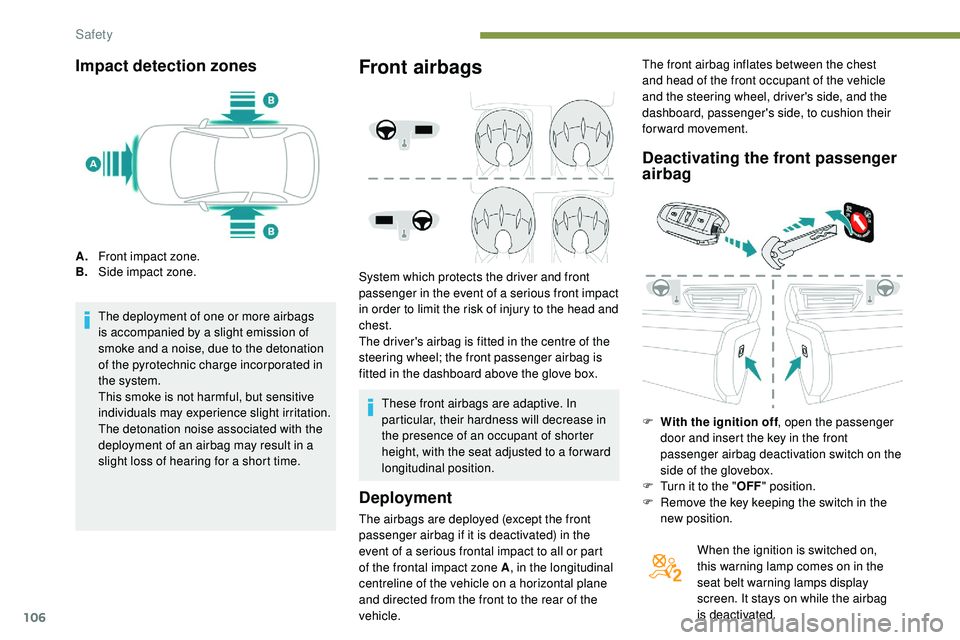
Impact detection zones
A.Front impact zone.
B. Side impact zone.
The deployment of one or more airbags
is accompanied by a slight emission of
smoke and a noise, due to the detonation
of the pyrotechnic charge incorporated in
the system.
This smoke is not harmful, but sensitive
individuals may experience slight irritation.
The detonation noise associated with the
deployment of an airbag may result in a
slight loss of hearing for a short time.
Front airbags
System which protects the driver and front
passenger in the event of a serious front impact
in order to limit the risk of injury to the head and
chest.
The driver's airbag is fitted in the centre of the
steering wheel; the front passenger airbag is
fitted in the dashboard above the glove box.
Deployment
The airbags are deployed (except the front
passenger airbag if it is deactivated) in the
event of a serious frontal impact to all or part
of the frontal impact zone A , in the longitudinal
centreline of the vehicle on a horizontal plane
and directed from the front to the rear of the
vehicle.
Deactivating the front passenger
airbag
F With the ignition off , open the passenger
door and insert the key in the front
passenger airbag deactivation switch on the
side of the glovebox.
F
T
urn it to the " OFF" position.
F
R
emove the key keeping the switch in the
new position.
When the ignition is switched on,
this warning lamp comes on in the
seat belt warning lamps display
screen. It stays on while the airbag
is deactivated.
These front airbags are adaptive. In
particular, their hardness will decrease in
the presence of an occupant of shorter
height, with the seat adjusted to a for ward
longitudinal position. The front airbag inflates between the chest
and head of the front occupant of the vehicle
and the steering wheel, driver's side, and the
dashboard, passenger's side, to cushion their
for ward movement.
Safety
Page 111 of 320
109
Lateral airbags
Use only approved covers on the seats,
compatible with the deployment of the
lateral airbags. For information on the
product range of seat covers suitable for
your vehicle, contact a PEUGEOT dealer.
Do not fix or attach anything to the seat
backrests (clothes, etc.) as this could
cause injuries to the thorax or arm when
the lateral airbag is deployed.
Do not sit with the upper part of the body
any nearer to the door than necessary.
The vehicle's front door panels include
side impact sensors.
A damaged door or any unauthorised or
incorrectly executed work (modification or
repair) on the front doors or their interior
trim could compromise the operation of
these sensors – risk of malfunction of the
lateral airbags!
Such work must only be done by a
PEUGEOT dealer or a qualified workshop.Active bonnet
Deployment of the active bonnet is
accompanied by a slight discharge of
harmless smoke and a noise, due to the
activation of the pyrotechnic cartridge
incorporated in the system. The airbag
warning lamp comes on.
Following deployment of the system, do
not try to open or close the bonnet. Call
a towing company or go to the nearest
PEUGEOT dealer or qualified workshop,
driving below 19 mph (30 km/h).
Make sure that you adjust the height of
the driver's seat – risk of hindrance to
visibility! This equipment will only deploy once. If a
second impact occurs (during the same or
a subsequent accident), the active bonnet
will not be deployed again.
After an accident or if the vehicle has
been stolen, have the system checked.
Do not tamper with the pyrotechnic
systems under the bonnet, close to the
struts – risk of explosion!
All work on this system must be carried
out only by a PEUGEOT dealer or a
qualified workshop.Malfunction
If this warning lamp comes on in the
instrument panel, accompanied by
an audible warning and the display
of a message, you must contact
a PEUGEOT dealer or a qualified
workshop to have the system
checked.
The active bonnet may no longer be
deployed in the event of an impact.
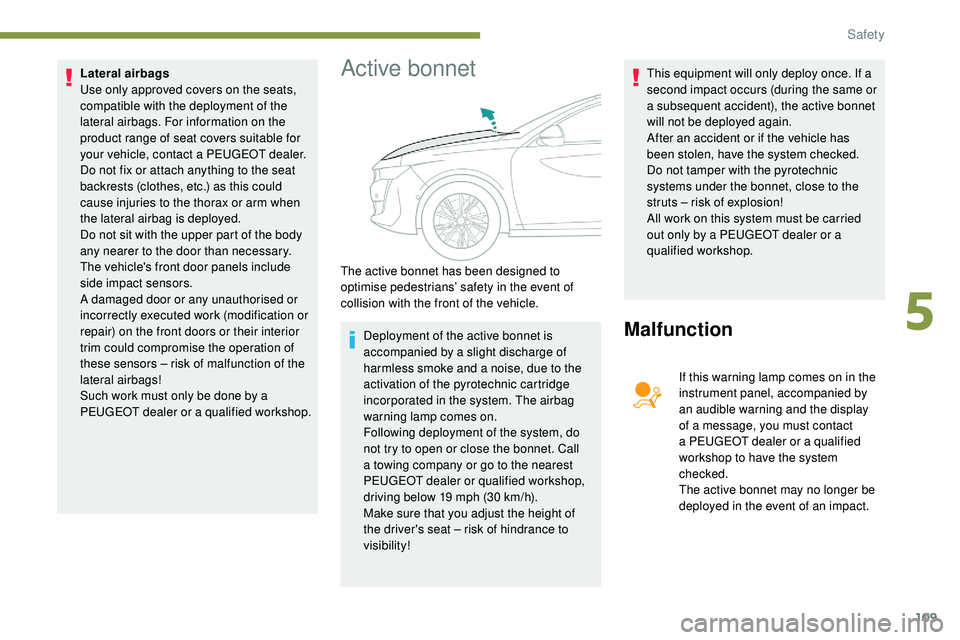
The active bonnet has been designed to
optimise pedestrians’ safety in the event of
collision with the front of the vehicle.
5
Safety
Page 127 of 320
125
In case of towing
Driving with a trailer places greater
demands on the towing vehicle and
requires extra care from the driver.
Side wind
F Take into account the increased sensitivity to wind.
Cooling
Towing a trailer on a slope increases the
temperature of the coolant.
As the fan is electrically controlled, its cooling
capacity is not dependent on the engine speed.
F
T
o lower the engine speed, reduce your
speed.
The maximum towable load on an incline
depends on the gradient and the exterior
temperature.
In all cases, keep a check on the coolant
temperature.
F
I
f this warning lamp and the STOP
warning lamp come on, stop the
vehicle and switch off the engine
as soon as possible.
New vehicle
Do not pull a trailer before having driven at least
approximately 620 miles (1,000 kilometres).
Braking
Towing a trailer increases the braking distance.
To avoid overheating of the brakes, the use of
engine braking is recommended.
Ty r e s
F Check the tyre pressures of the towing vehicle and of the trailer, observing the
recommended pressures.
Lighting
F Check the electrical lighting and signalling on the trailer and the headlamp beam height
of your vehicle.
For more information on Headlamp
adjustment , refer to the corresponding
section.
Certain driving or manoeuvring aid
functions are automatically disabled
if
an approved towbar is used.
Anti-theft protection
Electronic immobiliser
The keys contain an electronic chip which has
a secret code. When the ignition is switched
on, this code must be recognised in order for
starting to be possible.
A few seconds after switching off the ignition,
this system locks the engine control system,
therefore preventing the engine from being
started in the event of a break-in.
If the system fails, as reported by a message,
the engine will not start.
Contact the PEUGEOT dealer.
Starting/Switching off the
engine
Starting the engine
F With a manual gearbox , put the gear lever
into neutral.
6
Driving
Page 128 of 320
126
The Keyless Entry and Starting electronic
key must be inside the vehicle.
If the electronic key is not detected in this
zone, a message is displayed.
Move the electronic key into this zone so
that the engine can be started.
If there is still a problem, refer to the "Key
not detected – Back-up starting" section.
F
P
ress the " START/STOP " button while
maintaining pressure on the pedal until the
engine starts.
The steering column unlocks and the engine
starts.
On certain versions with the automatic gearbox
(EAT6/EAT8), the steering column does not
lock.
For Diesel engines , in sub-zero temperatures
and/or when the engine is cold, the start will
only take place once the preheater warning
lamp is off. F
W
ith a manual gearbox
, you should keep
the clutch pedal fully depressed and not
press the " START/STOP " button again until
the engine is running.
F
W
ith an automatic gearbox
, you should
keep the brake pedal fully depressed and
not press the " START/STOP" button again
until the engine is running.
If one of the starting conditions is not met,
a reminder message is displayed in the
instrument panel.
In some circumstances, it is necessary to turn
the steering wheel slightly while pressing the
" START/STOP " button to assist unlocking of
the steering column.
F
W
ith the electronic key inside the vehicle,
fully depress the clutch pedal.
or
F
W
ith an automatic gearbox
, select mode P
or N .
F
W
ith the electronic key inside the vehicle,
press the brake pedal. If this warning lamp comes on after
pressing the "
START/STOP " button:
With petrol engines , after a cold start,
preheating the catalytic converter can
cause noticeable engine vibrations for
up to 2 minutes while stationary with the
engine running (accelerated idle speed).
If the engine stalls, release the clutch
pedal and push it all the way down again,
the engine will restart automatically. As a safety measure, never leave the
vehicle while the engine is running.
Switching off the engine
F Immobilise the vehicle, engine at idle.
F
W ith a manual gearbox , preferably put the
gear lever into neutral.
F
W
ith an automatic gearbox , preferably
select mode P or N .
F
W
ith the electronic key inside the vehicle,
press the " START/STOP " button.
The engine stops and the steering column
locks.
In some circumstances, it is necessary to turn
the steering wheel to lock the steering column.
On certain versions with the automatic gearbox
(EAT6/EAT8), the steering column does not
lock, but the gearbox locks in mode P .
If the vehicle is not immobilised, the
engine will not stop.
Never leave your vehicle with the
electronic key still inside.
Switching off the engine leads to a loss of
braking assistance.
Driving
Page 137 of 320
135
Then, from D or R:
F R elease the brake pedal.
F
A
ccelerate progressively to automatically
release the electric parking brake.
F
W
ith the parking brake released, the vehicle
then moves off.
In severe wintry conditions (temperature
below -23°C), it is recommended that the
engine be allowed to run for a few minutes
before moving off, to ensure the correct
operation and durability of the engine and
gearbox.
Stopping the vehicle
Whatever the state of the gearbox when the
ignition is switched off, mode P is engaged
automatically and immediately.
However, in mode N , mode P will be engaged
after a duration of 5 seconds (allowing for the
process of putting the vehicle to free-wheeling).
Check that mode P has been engaged and that
the electric parking brake has been applied
automatically; if not, apply it manually.
Gearbox operating fault
The corresponding indicator lamps in
the selector and the electric parking
brake control lever must be on, as well
as those in the instrument panel.
Hill start assist
System which keeps your vehicle immobilised
temporarily (approximately 2 seconds) when
starting on a gradient, the time it takes to
move your foot from the brake pedal to the
accelerator pedal.
This system only operates when:
-
t
he vehicle has been brought to a complete
stop, with your foot on the brake pedal,
-
c
ertain slope conditions are met,
-
w
ith the driver’s door closed.
This is signalled by the illumination
of this warning lamp, accompanied
by the display of a message and an
audible signal, when the ignition is
switched on.
Go to a PEUGEOT dealer or a qualified
workshop.
Do not drive faster than 62 mph (100
km/h),
keeping to the speed limit.
The gearbox switches to back-up mode: mode
D is locked in third gear, the steering-mounted
control paddles are inoperative, mode M is no
longer available. You may feel a pronounced
jolt when engaging reverse. This does not
present any risk for the gearbox.
Selector operating fault
Minor malfunction
You are alerted by this warning lamp
lighting up, accompanied by the
display of a message and an audible
signal.
Drive cautiously and go to a PEUGEOT or a
qualified workshop.
Major malfunction
You are alerted by the illumination of
this warning lamp.
Stop as soon as it is safe to do so, away
from the traffic, and call a PEUGEOT
dealer or a qualified workshop.
When the ignition is switched off, the
gearbox goes into mode P automatically.
In certain cases, the selector lamps may not
come on, but the state of the gearbox is still
displayed in the instrument panel.
6
Driving