Remote Peugeot 508 2020 Owner's Guide
[x] Cancel search | Manufacturer: PEUGEOT, Model Year: 2020, Model line: 508, Model: Peugeot 508 2020Pages: 276, PDF Size: 8.43 MB
Page 158 of 276
156
Practical information
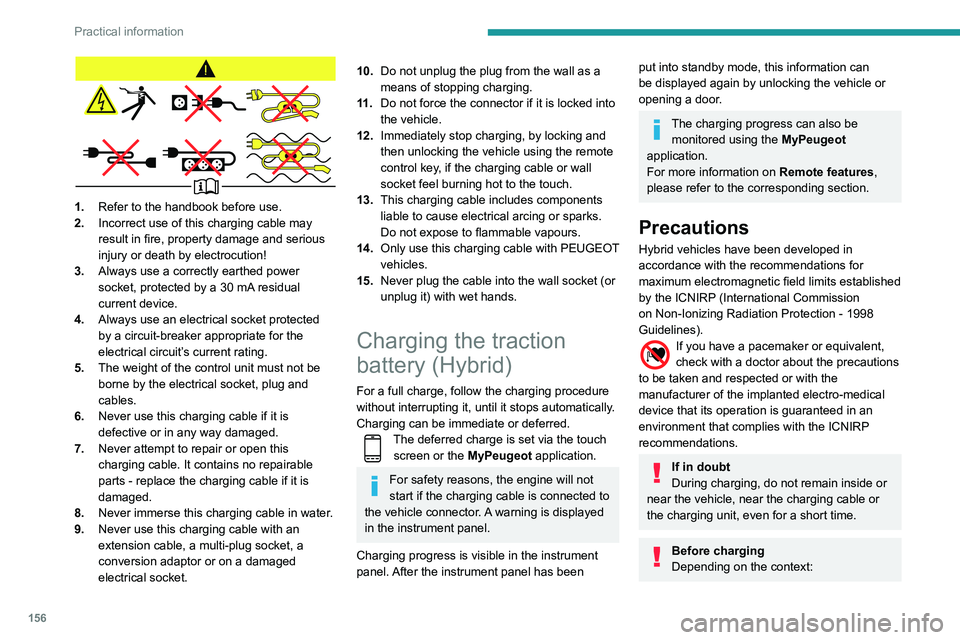
1.Refer to the handbook before use.
2. Incorrect use of this charging cable may
result in fire, property damage and serious
injury or death by electrocution!
3. Always use a correctly earthed power
socket, protected by a 30
mA residual
current device.
4. Always use an electrical socket protected
by a circuit-breaker appropriate for the
electrical circuit’s current rating.
5. The weight of the control unit must not be
borne by the electrical socket, plug and
cables.
6. Never use this charging cable if it is
defective or in any way damaged.
7. Never attempt to repair or open this
charging cable. It contains no repairable
parts - replace the charging cable if it is
damaged.
8. Never immerse this charging cable in water.
9. Never use this charging cable with an
extension cable, a multi-plug socket, a
conversion adaptor or on a damaged
electrical socket.
10.Do not unplug the plug from the wall as a
means of stopping charging.
11 . Do not force the connector if it is locked into
the vehicle.
12. Immediately stop charging, by locking and
then unlocking the vehicle using the remote
control key, if the charging cable or wall
socket feel burning hot to the touch.
13. This charging cable includes components
liable to cause electrical arcing or sparks.
Do not expose to flammable vapours.
14. Only use this charging cable with PEUGEOT
vehicles.
15. Never plug the cable into the wall socket (or
unplug it) with wet hands.
Charging the traction
battery (Hybrid)
For a full charge, follow the charging procedure
without interrupting it, until it stops automatically.
Charging can be immediate or deferred.
The deferred charge is set via the touch
screen or the MyPeugeot application.
For safety reasons, the engine will not
start if the charging cable is connected to
the vehicle connector. A warning is displayed
in the instrument panel.
Charging progress is visible in the instrument
panel. After the instrument panel has been
put into standby mode, this information can
be displayed again by unlocking the vehicle or
opening a door.
The charging progress can also be monitored using the MyPeugeot
application.
For more information on Remote features,
please refer to the corresponding section.
Precautions
Hybrid vehicles have been developed in
accordance with the recommendations for
maximum electromagnetic field limits established
by the ICNIRP (International Commission
on Non-Ionizing Radiation Protection - 1998
Guidelines).
If you have a pacemaker or equivalent,
check with a doctor about the precautions
to be taken and respected or with the
manufacturer of the implanted electro-medical
device that its operation is guaranteed in an
environment that complies with the ICNIRP
recommendations.
If in doubt
During charging, do not remain inside or
near the vehicle, near the charging cable or
the charging unit, even for a short time.
Before charging
Depending on the context:
► Have a professional check that the
electrical system to be used complies with
applicable standards and is compatible with
the vehicle.
► Have a professional electrician install
a dedicated domestic power socket or
accelerated charging unit (Wallbox)
compatible with the vehicle.
Use the charging cable supplied with the
vehicle.
(During charging)
Never work under the bonnet:
– Some areas remain very hot, even an hour
after charging ends - risk of burns!
– The fan may start at any time - risk of cuts
or strangulation!
After charging
Check that the charging flap is closed.
Do not leave the cable connected to the
domestic power socket - risk of short-circuit
or electrocution in the event of contact with or
immersion in water!
Charging procedure
Connection
► Before charging, check that the gear selector
is in mode P and the ignition is off, otherwise
charging is impossible.
Page 160 of 276
158
Practical information
Before disconnecting the nozzle from the
charging connector:
►
If the vehicle is unlocked, lock it and then
unlock it .
►
If the vehicle is locked, unlock it.
The red indicator lamp in the flap goes out to
confirm that the charging nozzle is unlocked.
►
Within
30 seconds, remove the charging
nozzle.
Domestic charging (mode 2)
The end of charging is confirmed by the fixed
lighting of the green CHARGE indicator lamp on
the control unit and by the fixed lighting of the
green light guides in the flap.
►
After disconnection, remove the protective
cover from the nozzle and close the charging
flap.
►
Disconnect the control unit's charging cable
from the domestic socket.
Accelerated charging (mode 3)
The end of charging is confirmed by the
accelerated charging unit (Wallbox) and by the
fixed lighting of the green light guides in the flap.
►
After disconnection, replace the nozzle on the
charging unit and close the charging flap.
Deferred charging
By default, charging begins when the nozzle
is connected. Deferred charging can be
programmed.
Settings
► In the Hybrid touch screen menu,
select the Charge tab.
►
Set the charging start time.
►
Press
OK.
The setting is saved in the system.
You can also programme the deferred charging function using a smartphone, via
the MyPeugeot
application.
For more information on Remotely operable
features , refer to the corresponding section.
Activation
► Connect the vehicle to the desired charging
equipment.
► Press this button in the flap within one
minute to activate the system (confirmed
by the light guides coming on in blue).
Towing device
Load distribution
► Distribute the load in the trailer so that the
heaviest items are as close as possible to the
axle, and the nose weight approaches the
maximum permitted without exceeding it.
Air density decreases with altitude, thus reducing
engine performance.
The maximum towable load
must be reduced by 10% per 1,000
metres of
altitude.
Use genuine towing devices and their
wiring harnesses approved by
PEUGEOT. We recommend having them
fitted by a PEUGEOT dealer or a qualified
workshop.
If not fitted by a PEUGEOT dealer, they must
still be fitted in accordance with the vehicle
manufacturer's instructions.
Important: with a hands-free tailgate, if a
towing device is fitted outside the PEUGEOT
dealer network, it is essential to visit a
PEUGEOT dealer or a qualified workshop
to recalibrate the detection system. Risk of
malfunction of the hands-free function!
Certain driving or manoeuvring aid functions
are automatically deactivated while an
approved towing system is in use.
Comply with the maximum authorised
towable weight, as indicated on your
vehicle's registration certificate, on the
manufacturer's label and in the Technical
data section of this guide.
Complying with the maximum authorised
nose weight (towball weight) also includes
the use of accessories (bicycle carriers,
tow boxes, etc.).
Observe the legislation in force in the
country where you are driving.
Vehicle equipped with motorised
tailgate with hands-free function
To avoid unintentionally opening the tailgate
while operating the towing device:
– Deactivate this function in advance in your
vehicle's configuration menu.
– Or remove the electronic key from the
recognition zone, with the tailgate closed.
Towing device with retractable ball joint
When this towing device is not in use, it is folded
away underneath the rear bumper.
No tools are required to install or stow it.
Before any operation, the vehicle must
be stationary with the parking brake
applied.
The area close to the exhaust pipe may reach
a high temperature: risk of burns!
Vehicle equipped with motorised
tailgate with hands-free function
To avoid unintentional opening of the tailgate,
follow the recommendations on the Towing
device by referring to the corresponding
section.
Unlocking handle
The towball is locked in either the storage
position or the usage position.
The unlocking handle is behind the rear bumper,
protected by a storage case.
To reach the handle:
Page 166 of 276
164
Practical information
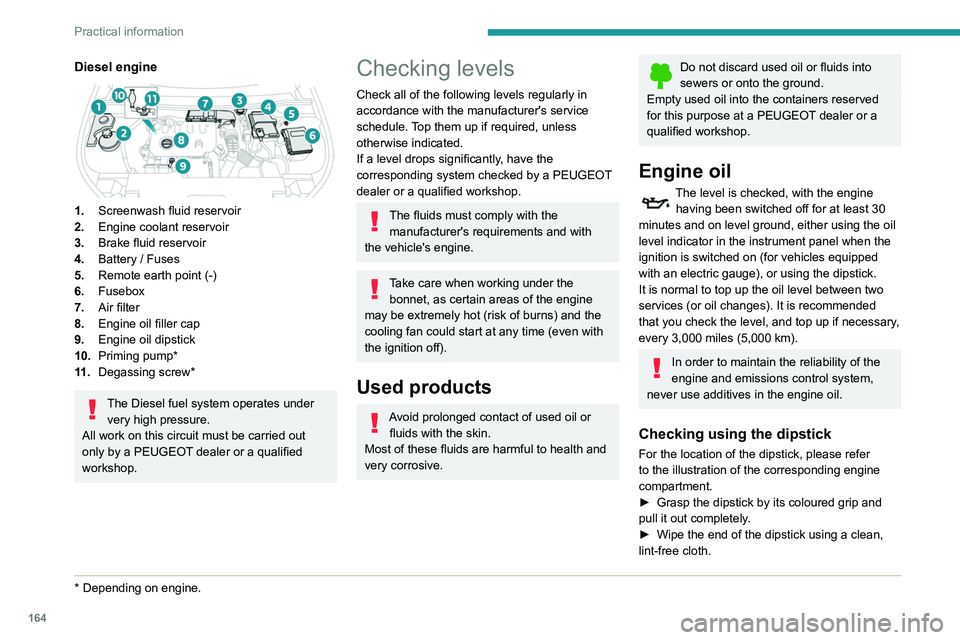
Diesel engine
1.Screenwash fluid reservoir
2. Engine coolant reservoir
3. Brake fluid reservoir
4. Battery / Fuses
5. Remote earth point (-)
6. Fusebox
7. Air filter
8. Engine oil filler cap
9. Engine oil dipstick
10. Priming pump*
11 . Degassing screw*
The Diesel fuel system operates under
very high pressure.
All work on this circuit must be carried out
only by a PEUGEOT dealer or a qualified
workshop.
* Depending on engine.
Checking levels
Check all of the following levels regularly in
accordance with the manufacturer's service
schedule. Top them up if required, unless
otherwise indicated.
If a level drops significantly, have the
corresponding system checked by a PEUGEOT
dealer or a qualified workshop.
The fluids must comply with the manufacturer's requirements and with
the vehicle's engine.
Take care when working under the bonnet, as certain areas of the engine
may be extremely hot (risk of burns) and the
cooling fan could start at any time (even with
the ignition off).
Used products
Avoid prolonged contact of used oil or fluids with the skin.
Most of these fluids are harmful to health and
very corrosive.
Do not discard used oil or fluids into
sewers or onto the ground.
Empty used oil into the containers reserved
for this purpose at a PEUGEOT dealer or a
qualified workshop.
Engine oil
The level is checked, with the engine having been switched off for at least 30
minutes and on level ground, either using the oil
level indicator in the instrument panel when the
ignition is switched on (for vehicles equipped
with an electric gauge), or using the dipstick.
It is normal to top up the oil level between two
services (or oil changes). It is recommended
that you check the level, and top up if necessary,
every 3,000 miles (5,000 km).
In order to maintain the reliability of the
engine and emissions control system,
never use additives in the engine oil.
Checking using the dipstick
For the location of the dipstick, please refer
to the illustration of the corresponding engine
compartment.
►
Grasp the dipstick by its coloured grip and
pull it out completely
.
►
Wipe the end of the dipstick using a clean,
lint-free cloth.
► Reinsert the dipstick and push fully down,
then pull it out again to visually check the oil
level: the correct level is between marks A (max)
and B (min).
Do not start the engine if the level is:
– above mark A: contact a PEUGEOT dealer or
a qualified workshop.
– below mark B: top up the engine oil
immediately.
Oil grade
Before topping up or changing the engine
oil, check that the oil is suitable for the engine
and complies with the recommendations in
the service schedule supplied with the vehicle
(or available from your PEUGEOT dealer and
qualified workshops).
Use of non-recommended oil may invalidate
the contractual warranty in the event of
engine failure.
Topping up the engine oil level
For the location of the engine oil filler cap, please
refer to the corresponding under-bonnet engine
compartment illustration.
Page 191 of 276
189
In the event of a breakdown
8Fuse N°Rating (A)Functions
F19 10 ALeft-hand main beam headlamp.
F24 40 ATrailer interface unit.
F27 25 ARight-hand dipped beam headlamp - Right-hand reversing lamps - Left-hand\
foglamps -
Rear left-hand sidelamps - Third brake lamp.
F29 40 AWindscreen wipers.
F32 80 ALeft-hand dipped beam headlamp - Static cornering lamps - Direction indi\
cator side
repeaters - Left-hand direction indicators - Front left-hand and rear ri\
ght-hand sidelamps -
Left-hand brake lamps - Number plate lamps.
12 V battery
Procedure for starting the engine using another
battery or charging a discharged battery.
Lead-acid starter batteries
These batteries contain harmful
substances (sulphuric acid and lead).
They must be disposed of in accordance
with regulations and must never under any
circumstances be discarded with household
waste.
Take used remote control batteries and
vehicle batteries to a special collection point.
Protect your eyes and face before
handling the battery.
All operations on the battery must be carried
out in a well ventilated area and away from
naked flames and sources of sparks, to avoid
any risk of explosion or fire.
Wash your hands afterwards.
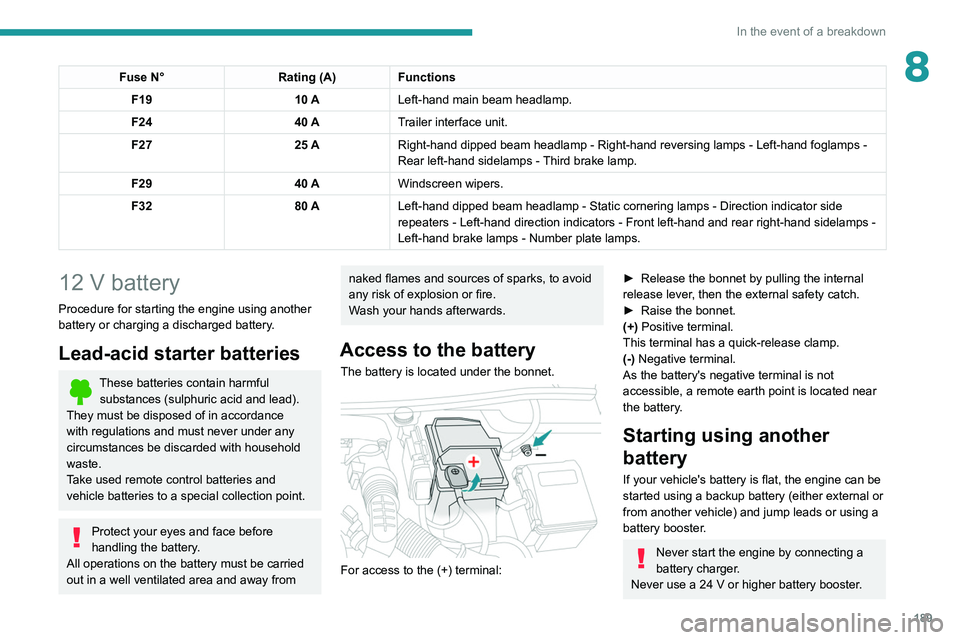
Access to the battery
The battery is located under the bonnet.
For access to the (+) terminal:
► Release the bonnet by pulling the internal
release lever , then the external safety catch.
►
Raise the bonnet.
(+)
Positive terminal.
This terminal has a quick-release clamp.
(-) Negative terminal.
As the battery's negative terminal is not
accessible, a remote earth point is located near
the battery.
Starting using another
battery
If your vehicle's battery is flat, the engine can be
started using a backup battery (either external or
from another vehicle) and jump leads or using a
battery booster.
Never start the engine by connecting a
battery charger.
Never use a 24
V or higher battery booster.
Page 194 of 276
192
In the event of a breakdown
► Push clamp B fully down.
► Lower lever A to lock clamp B.
►
Depending on equipment, lower the plastic
cover on the
(+) terminal.
Do not force the lever as locking will be
impossible if the clamp is not positioned
correctly; start the procedure again.
After reconnection
After reconnecting the battery, turn on the
ignition and wait 1 minute before starting the
engine, to enable the electronic systems to
initialise.
If minor problems nevertheless persist following
this operation, contact a PEUGEOT dealer or a
qualified workshop.
Referring to the relevant section, reset certain
equipment:
–
Electronic key
.
–
Sunroof and electric sun blind.
–
Electric windows.
–
Date and time.
–
Preset radio stations.
After reconnection of the battery, the “Collision risk detection system fault”
message is displayed on the instrument panel
when the ignition is switched on. This
operation is perfectly normal. The message
will disappear while driving.
The Stop & Start system may not be operational during the trip following the
first engine start.
In this case, the system will only be available
again after a continuous period with the
vehicle immobilised, the duration of which
depends on the exterior temperature and the
state of charge of the battery (up to about 8
hours).
Accessories batteries (Hybrid)
The hybrid system has two accessory batteries:
one at the front and one at the rear of the
vehicle.
The batteries contain harmful substances (sulphuric acid and lead).
They must be disposed of in accordance
with regulations and must not, in any
circumstances, be discarded with household
waste.
Take used remote control batteries and
vehicle batteries to a special collection point.
Protect your eyes and face before
handling batteries.
All operations on the batteries must be carried
out in a well ventilated area and away from
naked flames and sources of sparks, so as to
avoid the risk of explosion or fire.
Wash your hands afterwards.
For the replacement of batteries, contact a
PEUGEOT dealer or a qualified workshop.
Accessing the batteries
Front
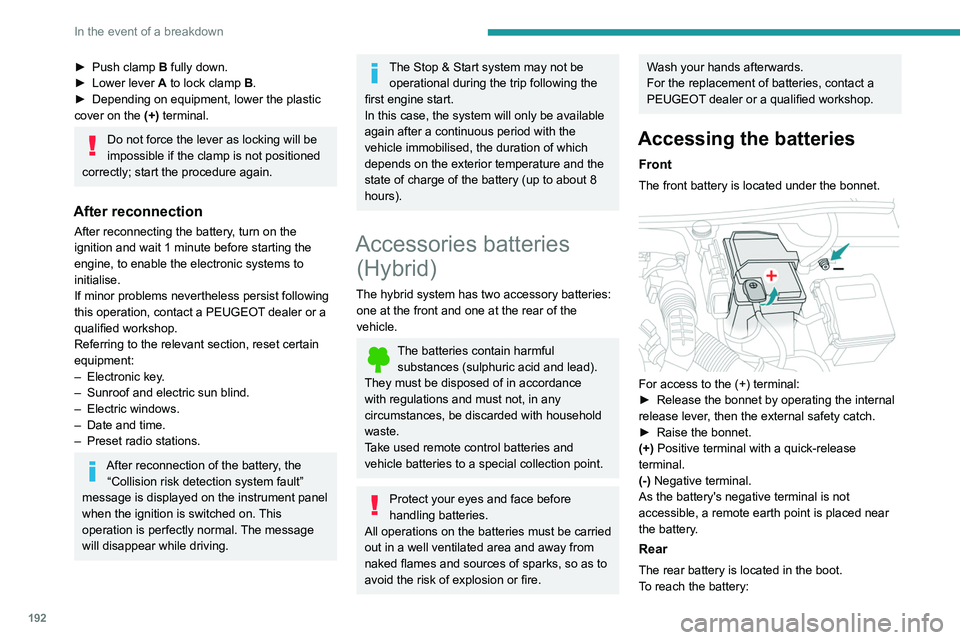
The front battery is located under the bonnet.
For access to the (+) terminal:
► Release the bonnet by operating the internal
release lever
, then the external safety catch.
►
Raise the bonnet.
(+)
Positive terminal with a quick-release
terminal.
(-) Negative terminal.
As the battery's negative terminal is not
accessible, a remote earth point is placed near
the battery.
Rear
The rear battery is located in the boot.
To reach the battery:
Page 246 of 276
244
Alphabetical index
180° rear vision 141
A
ABS 78
Accelerated charging unit (Wallbox)
154
Accessories
75, 161
Active Safety Brake
128–130
Active suspension
107
Active Suspension Control
107
Adaptive LED Technology
28, 65
Adaptive rear lighting
65
AdBlue®
18, 168
AdBlue® tank
169
Additive, Diesel
166
Adjusting headlamps
67
Adjusting head restraints
42
Adjusting seat
42–43
Adjusting the air distribution
50–51
Adjusting the air flow
50–51
Adjusting the date
216, 240
Adjusting the height and reach of the
steering wheel
45
Adjusting the lumbar support
42–43
Adjusting the seat angle
42
Adjusting the temperature
50
Adjusting the time
216, 240
Advice on care and maintenance
153, 170
Advice on driving
7, 96
Airbags
81–84, 86
Airbags, curtain
83–84
Airbags, front 82, 84, 87
Airbags, lateral
83–84
Air conditioning
48, 51
Air conditioning, automatic
52
Air conditioning, digital
49
Air conditioning, dual-zone automatic
49
Air intake
50–51
Air vents
48
Alarm
31–32
Amplifier, audio
56
Android Auto connection
231
Anti-lock braking system (ABS)
78
Antitheft / Immobiliser
26
Apple CarPlay connection
212, 230
Applications
231
Armrest, front
58
Armrest, rear
59
Assistance call
76
Assistance, emergency braking
78, 130
Audible warning
76
Audio streaming (Bluetooth)
211, 235
B
Battery 162
Battery, 12 V
166, 189–193
Battery, ancillaries
192
Battery, charging
152, 156, 190, 193
Battery (Hybrid)
153, 156
Battery, remote control
30, 54
Bicycle carrier
161
Blind 39–40
Blind spot monitoring system, active
135
Blind spot sensors
135
BlueHDi
18, 166, 172
Bluetooth (hands-free)
213–214, 236–237
Bluetooth (telephone)
213–214, 236–237
Bodywork
171
Bonnet
162–163
Bonnet, active
84
Boot
34, 37, 64
Brake discs
167
Brake lamps
182–183
Brakes
167
Braking
106
Braking assistance system
78
Braking, automatic emergency
128–130
Braking, dynamic emergency
100–101
Brightness
215
Bulbs
182
Bulbs (changing)
180–183
C
Cable, audio 235
Cable, Jack
235
Capacity, fuel tank
151
Care of the bodywork
171
CD
2 11
CD, MP3
2 11
Central locking
28, 30
Changing a bulb
180–183
Page 247 of 276
245
Alphabetical index
Changing a fuse 183–184, 187–188
Changing a wheel
173, 177
Changing a wiper blade
72–73
Changing the remote control battery
30
Charge level indicator
20
Charger, induction
57
Charger, wireless
57
Charging cable
154–155, 157
Charging connector
153, 156–157
CHECK
20
Checking the engine oil level
17
Checking the levels
164–165
Checking tyre pressures
(using the kit)
174, 176
Checks
164–165, 166–168
Checks, routine
166–167
Child lock
94
Children
81, 88–91, 93
Children (safety)
94
Child seats
81, 85–88
Child seats, conventional
87–88
Child seats, i-Size
93
Child seats, ISOFIX
89–91
Cigar lighter
55
Cleaning (advice)
153, 170–171
Closing the boot
27–28, 34
Closing the doors
27–28, 33
Collision Risk Alert
128–129
Comfort mode
108
Configuration, vehicle
22, 24
Connected applications
231–232
Connection, Bluetooth
213–214, 232, 236–237Connection, MirrorLink 212–213, 231
Connection, Wi-Fi network
232–233
Connectivity
230
Consumption figures
23
Container, AdBlue®
169
Control, emergency boot release
34
Control, emergency door
29
Control, heated seats
44
Controls, steering mounted
102–105
Control stalk, lighting
65–66
Control stalk, wipers
71–74
Control unit
154–155, 157
Courtesy lamp, front
59
Courtesy lamps
59–60
Cover, load space
61
Cruise control
115–116, 118–121
Cruise control, adaptive
121
Cruise control by speed limit
recognition
115–116
Cruise control, dynamic with Stop
function
115–116
Cup holder
55
D
DAB (Digital Audio Broadcasting) -
Digital radio
210, 234
Date (setting)
216, 240
Daytime running lamps
66, 181
Deactivating the passenger airbag
82, 86–87
Deadlocking
26, 28
Deferred charging 24, 153, 156, 158
Defrosting
52
Defrosting, front
52
Demisting
52
Demisting, front
52
Demisting, rear
52
Demisting, rear screen
52
Dials and gauges
9
Digital instrument panel
9–10
Dimensions
203
Dipstick
17, 164
Direction indicators
66, 181–183
Domestic charging
155, 158
Door pockets
55
Doors
33
Drive Assist Plus
121
Driver’s attention warning
131
Driving
41, 96
Driving aids camera (warnings)
11 2
Driving aids (recommendations)
11 2
Driving economically
7
Driving modes
107
Driving positions (storing)
44
Dynamic stability control (DSC)
78–79
E
EBFD 78
Eco-driving (advice)
7
ECO mode
107
Economy mode
162
Page 249 of 276
247
Alphabetical index
I
i-Cockpit® amplify function 44
Ignition
98, 238
Ignition on
98
Immobiliser, electronic
97
Indicator, AdBlue® range
18
Indicator, coolant temperature
18
Indicator, engine oil level
17
Indicators, direction
66, 182
Inflating tyres
167, 204
Inflating tyres and accessories
(using the kit)
174, 176
Infrared camera
69, 112
Instrument panel
9, 20–21, 113
Instrument panel (Hybrid)
9
Internet browser
228, 232
ISOFIX mountings
89
J
Jack 173–174, 177, 235
Jump starting
189
K
Key 25–26, 29
Key, electronic
27–28
Keyless Entry and Starting
27–29, 97–98
Key not recognised
99
Key with remote control 25, 97
Kit, hands-free
213–214, 236–237
Kit, puncture repair
173–174
Kit, temporary puncture repair
173–176
L
Labels, identification 204
Lamp, boot
64
Lamps, parking
66
Lamps, rear
182–183
Lams with “Full LED" technology
67, 69, 181
Lane assist
121, 125–126, 128
Lane departure warning active
131, 135
Leather (care)
171
LEDs - Light-emitting diodes
66, 181–183
Level, AdBlue®
166
Level, brake fluid
165
Level, Diesel additive
166
Level, engine coolant
18, 165
Level, engine oil
17, 164
Levels and checks
164–166
Level, screenwash fluid
72, 165
Light-emitting diodes - LEDs
66, 181–183
Lighting, cornering
69
Lighting dimmer
20
Lighting, exterior
65
Lighting, guide-me home
26, 67–68
Lighting, interior
58–59
Lighting, mood
59
Lighting, welcome
67–68
Loading 160–161
Load reduction mode
162
Locating your vehicle
26
Locking
26–27
Locking from the inside
30
Locking the doors
30–31
Long objects, transporting
60
Low fuel level
151
Lumbar
42–43
M
Mains socket (domestic network) 154, 158
Maintenance (advice)
153, 170
Maintenance, routine
113, 166
Manoeuvring aids (recommendations)
11 2
Map reading lamps
59–60
Markings, identification
204
Massage function
44
Massage, multi-point
44
Mat
58, 113
Memorising a speed
120–121
Menu
212
Menu, main
23
Menus (audio)
207–208, 220–221
Menu short cuts
23
Messages
238
Messages, quick
238
Mirror, rear view
46
Mirrors, door
45–46, 52, 135
Mirror, vanity
55
Page 250 of 276
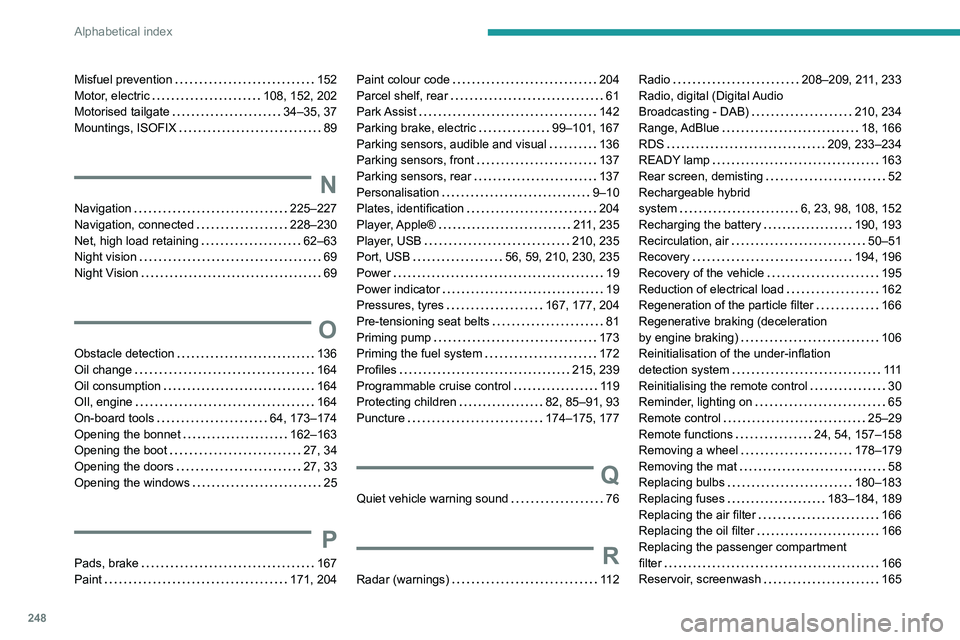
248
Alphabetical index
Misfuel prevention 152
Motor, electric
108, 152, 202
Motorised tailgate
34–35, 37
Mountings, ISOFIX
89
N
Navigation 225–227
Navigation, connected
228–230
Net, high load retaining
62–63
Night vision
69
Night Vision
69
O
Obstacle detection 136
Oil change
164
Oil consumption
164
OIl, engine
164
On-board tools
64, 173–174
Opening the bonnet
162–163
Opening the boot
27, 34
Opening the doors
27, 33
Opening the windows
25
P
Pads, brake 167
Paint
171, 204
Paint colour code 204
Parcel shelf, rear
61
Park Assist
142
Parking brake, electric
99–101, 167
Parking sensors, audible and visual
136
Parking sensors, front
137
Parking sensors, rear
137
Personalisation
9–10
Plates, identification
204
Player, Apple®
211, 235
Player, USB
210, 235
Port, USB
56, 59, 210, 230, 235
Power
19
Power indicator
19
Pressures, tyres
167, 177, 204
Pre-tensioning seat belts
81
Priming pump
173
Priming the fuel system
172
Profiles
215, 239
Programmable cruise control
119
Protecting children
82, 85–91, 93
Puncture
174–175, 177
Q
Quiet vehicle warning sound 76
R
Radar (warnings) 11 2
Radio 208–209, 211, 233
Radio, digital (Digital Audio
Broadcasting - DAB)
210, 234
Range, AdBlue
18, 166
RDS
209, 233–234
READY lamp
163
Rear screen, demisting
52
Rechargeable hybrid
system
6, 23, 98, 108, 152
Recharging the battery
190, 193
Recirculation, air
50–51
Recovery
194, 196
Recovery of the vehicle
195
Reduction of electrical load
162
Regeneration of the particle filter
166
Regenerative braking (deceleration
by engine braking)
106
Reinitialisation of the under-inflation
detection system
111
Reinitialising the remote control
30
Reminder, lighting on
65
Remote control
25–29
Remote functions
24, 54, 157–158
Removing a wheel
178–179
Removing the mat
58
Replacing bulbs
180–183
Replacing fuses
183–184, 189
Replacing the air filter
166
Replacing the oil filter
166
Replacing the passenger compartment
filter
166
Reservoir, screenwash
165
Page 251 of 276
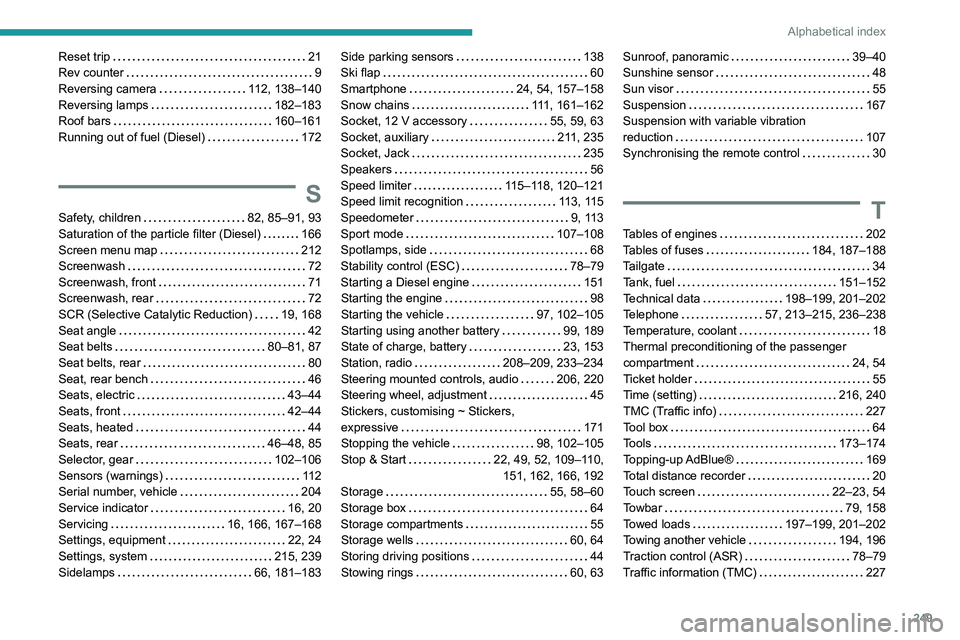
249
Alphabetical index
Reset trip 21
Rev counter
9
Reversing camera
112, 138–140
Reversing lamps
182–183
Roof bars
160–161
Running out of fuel (Diesel)
172
S
Safety, children 82, 85–91, 93
Saturation of the particle filter (Diesel)
166
Screen menu map
212
Screenwash
72
Screenwash, front
71
Screenwash, rear
72
SCR (Selective Catalytic Reduction)
19, 168
Seat angle
42
Seat belts
80–81, 87
Seat belts, rear
80
Seat, rear bench
46
Seats, electric
43–44
Seats, front
42–44
Seats, heated
44
Seats, rear
46–48, 85
Selector, gear
102–106
Sensors (warnings)
11 2
Serial number, vehicle
204
Service indicator
16, 20
Servicing
16, 166, 167–168
Settings, equipment
22, 24
Settings, system
215, 239
Sidelamps
66, 181–183
Side parking sensors 138
Ski flap
60
Smartphone
24, 54, 157–158
Snow chains
111, 161–162
Socket, 12 V accessory
55, 59, 63
Socket, auxiliary
211, 235
Socket, Jack
235
Speakers
56
Speed limiter
115–118, 120–121
Speed limit recognition
113, 115
Speedometer
9, 113
Sport mode
107–108
Spotlamps, side
68
Stability control (ESC)
78–79
Starting a Diesel engine
151
Starting the engine
98
Starting the vehicle
97, 102–105
Starting using another battery
99, 189
State of charge, battery
23, 153
Station, radio
208–209, 233–234
Steering mounted controls, audio
206, 220
Steering wheel, adjustment
45
Stickers, customising ~ Stickers,
expressive
171
Stopping the vehicle
98, 102–105
Stop & Start
22, 49, 52, 109–110,
151, 162, 166, 192
Storage
55, 58–60
Storage box
64
Storage compartments
55
Storage wells
60, 64
Storing driving positions
44
Stowing rings
60, 63Sunroof, panoramic 39–40
Sunshine sensor
48
Sun visor
55
Suspension
167
Suspension with variable vibration
reduction
107
Synchronising the remote control
30
T
Tables of engines 202
Tables of fuses
184, 187–188
Tailgate
34
Tank, fuel
151–152
Technical data
198–199, 201–202
Telephone
57, 213–215, 236–238
Temperature, coolant
18
Thermal preconditioning of the passenger
compartment
24, 54
Ticket holder
55
Time (setting)
216, 240
TMC (Traffic info)
227
Tool box
64
Tools
173–174
Topping-up AdBlue®
169
Total distance recorder
20
Touch screen
22–23, 54
Towbar
79, 158
Towed loads
197–199, 201–202
Towing another vehicle
194, 196
Traction control (ASR)
78–79
Traffic information (TMC)
227