warning light Peugeot 508 2020 Owner's Guide
[x] Cancel search | Manufacturer: PEUGEOT, Model Year: 2020, Model line: 508, Model: Peugeot 508 2020Pages: 276, PDF Size: 8.43 MB
Page 132 of 276
130
Driving
the "Close" trigger threshold has been
selected.
Intelligent emergency
braking assistance
If the driver brakes, but not sufficiently to avoid a
collision, this system will supplement the braking,
within the limits of the laws of physics.
This assistance will only be provided if the driver
presses the brake pedal.
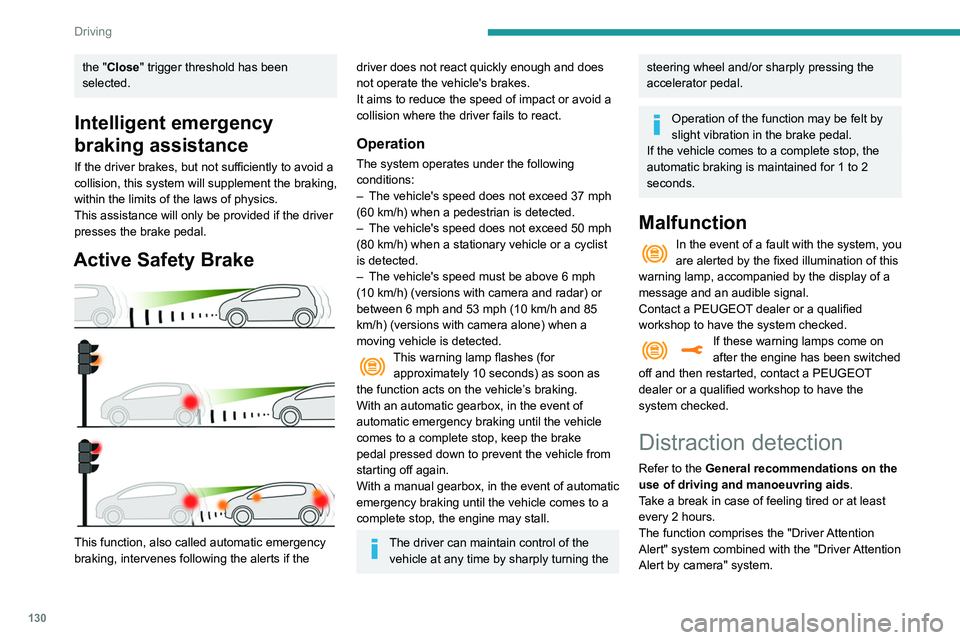
Active Safety Brake
This function, also called automatic emergency
braking, intervenes following the alerts if the
driver does not react quickly enough and does
not operate the vehicle's brakes.
It aims to reduce the speed of impact or avoid a
collision where the driver fails to react.
Operation
The system operates under the following
conditions:
–
The vehicle's speed does not exceed 37 mph
(60 km/h) when a pedestrian is detected.
–
The vehicle's speed does not exceed 50 mph
(80 km/h) when a stationary vehicle or a cyclist
is detected.
–
The vehicle's speed must be above 6 mph
(10
km/h) (versions with camera and radar) or
between 6 mph and 53 mph (10
km/h and 85
km/h) (versions with camera alone) when a
moving vehicle is detected.
This warning lamp flashes (for approximately 10 seconds) as soon as
the function acts on the vehicle’s braking.
With an automatic gearbox, in the event of
automatic emergency braking until the vehicle
comes to a complete stop, keep the brake
pedal pressed down to prevent the vehicle from
starting off again.
With a manual gearbox, in the event of automatic
emergency braking until the vehicle comes to a
complete stop, the engine may stall.
The driver can maintain control of the vehicle at any time by sharply turning the
steering wheel and/or sharply pressing the
accelerator pedal.
Operation of the function may be felt by
slight vibration in the brake pedal.
If the vehicle comes to a complete stop, the
automatic braking is maintained for 1 to 2
seconds.
Malfunction
In the event of a fault with the system, you
are alerted by the fixed illumination of this
warning lamp, accompanied by the display of a
message and an audible signal.
Contact a PEUGEOT dealer or a qualified
workshop to have the system checked.
If these warning lamps come on
after the engine has been switched
off and then restarted, contact a PEUGEOT
dealer or a qualified workshop to have the
system checked.
Distraction detection
Refer to the General recommendations on the
use of driving and manoeuvring aids .
Take a break in case of feeling tired or at least
every 2 hours.
The function comprises the "Driver Attention
Alert" system combined with the "Driver Attention
Alert by camera" system.
These systems are in no way designed to keep the driver awake or to prevent
the driver from falling asleep at the wheel.
It is the driver’s responsibility to stop if feeling
tired.
Activation / Deactivation
It is set via the Driving / Vehicle touch
screen menu.
The state of the system stays in the memory
when the ignition is switched off.
Driver Attention Alert
The system triggers an alert as soon as it detects that the driver has not taken a
break after two hours of driving at a speed above
40 mph (65 km/h).
This alert is issued via the display of a message
encouraging the driver to take a break,
accompanied by an audible signal.
If the driver does not follow this advice, the alert
is repeated hourly until the vehicle is stopped.
The system resets itself if one of the following
conditions is met:
– With the engine running, the vehicle has been
stationary for more than 15 minutes.
– The ignition has been switched off for a few
minutes.
– The driver's seat belt is unfastened and their
door is opened.
Page 136 of 276
134
Driving
Function statusIndicator lamp Display and/or associated
messageComments
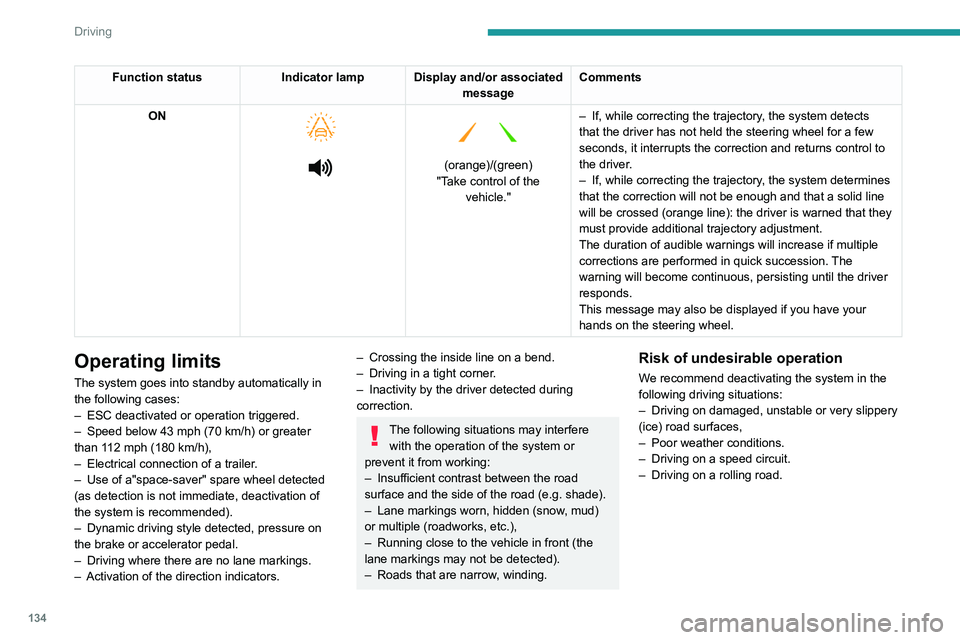
ON
(orange)/(green)
"Take control of the vehicle." –
If, while correcting the trajectory
, the system detects
that the driver has not held the steering wheel for a few
seconds, it interrupts the correction and returns control to
the driver.
– If, while correcting the trajectory , the system determines
that the correction will not be enough and that a solid line
will be crossed (orange line): the driver is warned that they
must provide additional trajectory adjustment.
The duration of audible warnings will increase if multiple
corrections are performed in quick succession. The
warning will become continuous, persisting until the driver
responds.
This message may also be displayed if you have your
hands on the steering wheel.
Operating limits
The system goes into standby automatically in
the following cases:
–
ESC deactivated or operation triggered.
–
Speed below 43 mph (70
km/h) or greater
than 112 mph (180
km/h),
–
Electrical connection of a trailer
.
–
Use of a"space-saver" spare wheel detected
(as detection is not immediate, deactivation of
the system is recommended).
–
Dynamic driving style detected, pressure on
the brake or accelerator pedal.
–
Driving where there are no lane markings.
–
Activation of the direction indicators.
– Crossing the inside line on a bend.
– Driving in a tight corner .
–
Inactivity by the driver detected during
correction.
The following situations may interfere with the operation of the system or
prevent it from working:
–
Insufficient contrast between the road
surface and the side of the road (e.g. shade).
–
Lane markings worn, hidden (snow
, mud)
or multiple (roadworks, etc.),
–
Running close to the vehicle in front (the
lane markings may not be detected).
–
Roads that are narrow
, winding.
Risk of undesirable operation
We recommend deactivating the system in the
following driving situations:
–
Driving on damaged, unstable or very slippery
(ice) road surfaces,
–
Poor weather conditions.
–
Driving on a speed circuit.
–
Driving on a rolling road.
Deactivation / Activation
► Press this button to deactivate / reactivate the
system at any time.
Deactivation is signalled by the lighting of
the indicator lamp in the button and this
warning lamp in the instrument panel.
The system is automatically reactivated every
time the ignition is switched on.
Malfunction
In the event of a system
malfunction, these warning lamps
come on on the instrument panel, accompanied
by an onscreen message and an audible signal.
Have the system checked by a PEUGEOT
dealer or a qualified workshop.
Active Blind Spot Monitoring System
Refer to the General recommendations on the
use of driving and manoeuvring aids .
Page 137 of 276
135
Driving
6Deactivation / Activation
► Press this button to deactivate / reactivate the
system at any time.
Deactivation is signalled by the lighting of
the indicator lamp in the button and this
warning lamp in the instrument panel.
The system is automatically reactivated every
time the ignition is switched on.
Malfunction
In the event of a system
malfunction, these warning lamps
come on on the instrument panel, accompanied
by an onscreen message and an audible signal.
Have the system checked by a PEUGEOT
dealer or a qualified workshop.
Active Blind Spot Monitoring System
Refer to the General recommendations on the
use of driving and manoeuvring aids .
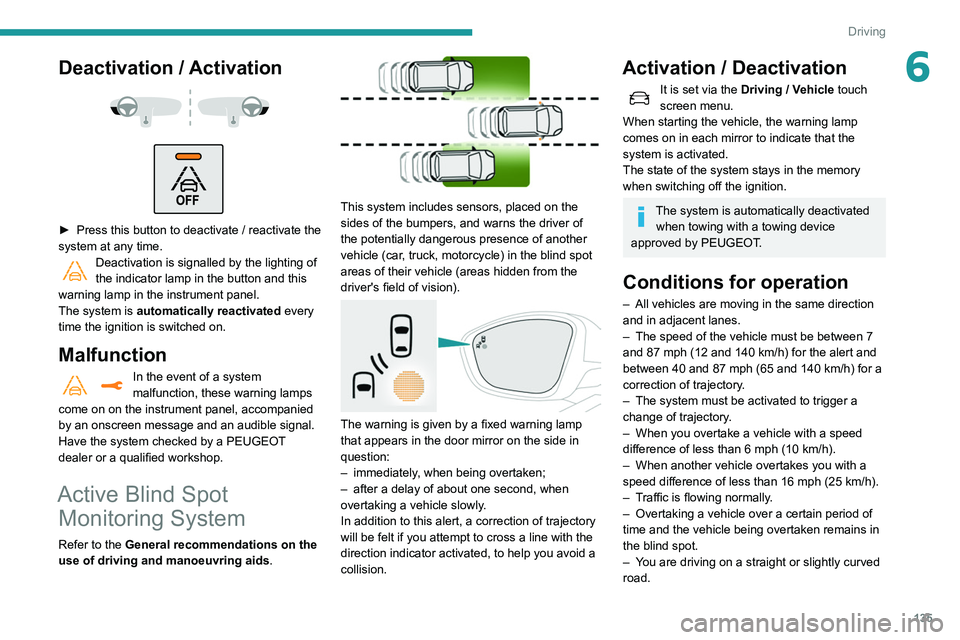
This system includes sensors, placed on the
sides of the bumpers, and warns the driver of
the potentially dangerous presence of another
vehicle (car, truck, motorcycle) in the blind spot
areas of their vehicle (areas hidden
from the
driver's field of vision).
The warning is given by a fixed warning lamp
that appears in the door mirror on the side in
question:
–
immediately
, when being overtaken;
–
after a delay of about one second, when
overtaking a vehicle slowly
.
In addition to this alert, a correction of trajectory
will be felt if you attempt to cross a line with the
direction indicator activated, to help you avoid a
collision.
Activation / Deactivation
It is set via the Driving / Vehicle touch
screen menu.
When starting the vehicle, the warning lamp
comes on in each mirror to indicate that the
system is activated.
The state of the system stays in the memory
when switching off the ignition.
The system is automatically deactivated when towing with a towing device
approved by PEUGEOT.
Conditions for operation
– All vehicles are moving in the same direction
and in adjacent lanes.
–
The speed of the vehicle must be between 7
and 87 mph (12
and 140 km/h) for the alert and
between 40 and 87 mph (65 and 140 km/h) for a
correction of trajectory.
–
The system must be activated to trigger a
change of trajectory
.
–
When you overtake a vehicle with a speed
difference of less than 6
mph (10 km/h).
–
When another vehicle overtakes you with a
speed difference of less than 16
mph (25 km/h).
–
T
raffic is flowing normally.
–
Overtaking a vehicle over a certain period of
time and the vehicle being overtaken remains in
the blind spot.
–
Y
ou are driving on a straight or slightly curved
road.
Page 146 of 276
144
Driving
Preparing for the
manoeuvre
► Move very slowly until the request to stop
the vehicle is displayed: " Stop the vehicle“,
accompanied by the “ ST
OP” sign and an audible
signal.
Once the vehicle has stopped, an instructions
page is displayed on the screen.
►
T
o prepare for the manoeuvre, follow the
instructions.
The start of the manoeuvre is indicated by the
"Manoeuvre under way" onscreen message
and an accompanying audible signal.
Reversing is indicated by this message:
“Release the steering wheel, reverse ”.
The Visiopark 1 or Visiopark 2 and the parking
sensors are automatically activated to help you
monitor the area immediately surrounding your
vehicle during the manoeuvre.
During the manoeuvre
The system controls the vehicle’s steering. It
gives instructions on the manoeuvring direction
when starting "parallel" entry and exit parking
manoeuvres, and for all "bay" entry manoeuvres.
There instructions are displayed as a symbol
accompanied by a message:
"Reverse".
“Go forwards".
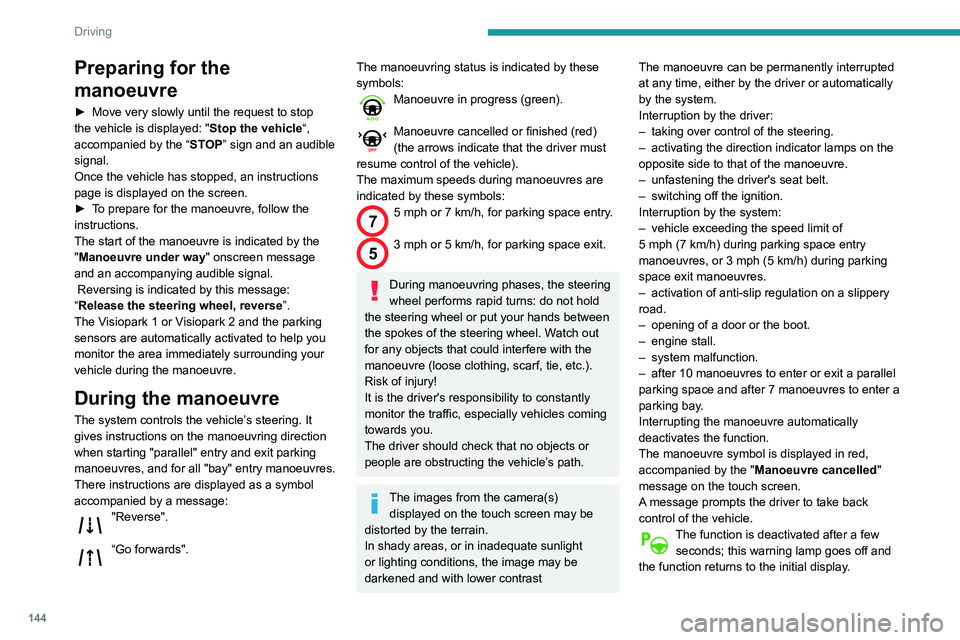
The manoeuvring status is indicated by these
symbols:
Manoeuvre in progress (green).
Manoeuvre cancelled or finished (red)
(the arrows indicate that the driver must
resume control of the vehicle).
The maximum speeds during manoeuvres are
indicated by these symbols:
75 mph or 7 km/h, for parking space entry.
53 mph or 5 km/h, for parking space exit.
During manoeuvring phases, the steering
wheel performs rapid turns: do not hold
the steering wheel or put your hands between
the spokes of the steering wheel. Watch out
for any objects that could interfere with the
manoeuvre (loose clothing, scarf, tie, etc.).
Risk of injury!
It is the driver's responsibility to constantly
monitor the traffic, especially vehicles coming
towards you.
The driver should check that no objects or
people are obstructing the vehicle’s path.
The images from the camera(s) displayed on the touch screen may be
distorted by the terrain.
In shady areas, or in inadequate sunlight
or lighting conditions, the image may be
darkened and with lower contrast The manoeuvre can be permanently interrupted
at any time, either by the driver or automatically
by the system.
Interruption by the driver:
–
taking over control of the steering.
–
activating the direction indicator lamps on the
opposite side to that of the manoeuvre.
–
unfastening the driver's seat belt.
–
switching off the ignition.
Interruption by the system:
–
vehicle exceeding the speed limit of
5
mph (7 km/h) during parking space entry
manoeuvres, or 3 mph (5 km/h) during parking
space exit manoeuvres.
–
activation of anti-slip regulation on a slippery
road.
–
opening of a door or the boot.
–
engine stall.
–
system malfunction.
–
after 10 manoeuvres to enter or exit a parallel
parking space and after 7 manoeuvres to enter a
parking bay
.
Interrupting the manoeuvre automatically
deactivates the function.
The manoeuvre symbol is displayed in red,
accompanied by the " Manoeuvre cancelled"
message on the touch screen.
A message prompts the driver to take back
control of the vehicle.
The function is deactivated after a few seconds; this warning lamp goes off and
the function returns to the initial display.
End of the parking space
entry or exit manoeuvre
The vehicle stops as soon as the manoeuvre is
completed.
The manoeuvring symbol is displayed in red
accompanied by the message “ Manoeuvre
completed” on the touch screen.
Deactivation of the function is confirmed
by this indicator lamp going off,
accompanied by an audible signal.
If entering a parking space, the driver may be
required to complete the manoeuvre.
Operating limits
– The system may suggest an inappropriate
parking space (parking prohibited, work in
progress with damaged road surface, location
alongside a ditch, etc.).
– The system may indicate that a space has
been found but will not offer it because of a fixed
obstacle on the opposite side of the manoeuvre,
which would not allow the vehicle to follow a
trajectory required for parking.
– The system may indicate that a space has
been found but the manoeuvre will not be
triggered, because the width of the lane is
insufficient.
– The system is not designed for performing the
parking manoeuvre on a sharp bend.
– The system does not detect spaces that
are much larger than the vehicle itself or that
are delimited by obstacles that are too low
Page 170 of 276
168
Practical information
For your safety and driving comfort, it is
important to have them regularly checked by a
PEUGEOT dealer or a qualified workshop.
Timing and accessory kits
Timing and accessory kits are used from
the time the engine is started until it is
switched off. It is normal for them to wear over
time.
A
faulty timing or accessory kit can damage
the engine, rendering it unusable. Observe the
recommended replacement frequency, stated in
distance travelled or time elapsed, whichever is
reached first.
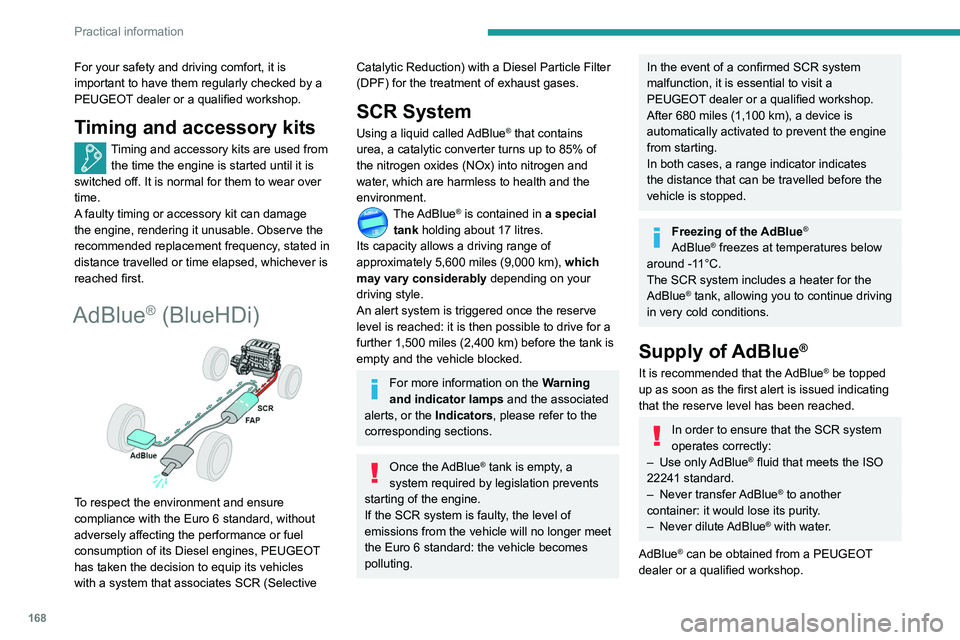
AdBlue® (BlueHDi)
To respect the environment and ensure
compliance with the Euro 6 standard, without
adversely affecting the performance or fuel
consumption of its Diesel engines, PEUGEOT
has taken the decision to equip its vehicles
with a system that associates SCR (Selective
Catalytic Reduction) with a Diesel Particle Filter
(DPF) for the treatment of exhaust gases.
SCR System
Using a liquid called AdBlue® that contains
urea, a catalytic converter turns up to 85% of
the nitrogen oxides (NOx) into nitrogen and
water, which are harmless to health and the
environment.
The AdBlue® is contained in a special
tank holding about 17 litres.
Its capacity allows a driving range of
approximately 5,600
miles (9,000 km), which
may vary considerably depending on your
driving style.
An alert system is triggered once the reserve
level is reached: it is then possible to drive for a
further 1,500 miles (2,400
km) before the tank is
empty and the vehicle blocked.
For more information on the Warning
and indicator lamps and the associated
alerts, or the Indicators, please refer to the
corresponding sections.
Once the AdBlue® tank is empty, a
system required by legislation prevents
starting of the engine.
If the SCR system is faulty, the level of
emissions from the vehicle will no longer meet
the Euro 6 standard: the vehicle becomes
polluting.
In the event of a confirmed SCR system
malfunction, it is essential to visit a
PEUGEOT dealer or a qualified workshop.
After 680 miles (1,100 km), a device is
automatically activated to prevent the engine
from starting.
In both cases, a range indicator indicates
the distance that can be travelled before the
vehicle is stopped.
Freezing of the AdBlue®
AdBlue® freezes at temperatures below
around -11°C.
The SCR system includes a heater for the
AdBlue
® tank, allowing you to continue driving
in very cold conditions.
Supply of AdBlue®
It is recommended that the AdBlue® be topped
up as soon as the first alert is issued indicating
that the reserve level has been reached.
In order to ensure that the SCR system
operates correctly:
–
Use
only AdBlue
® fluid that meets the ISO
22241 standard.
–
Never
transfer AdBlue
® to another
container: it would lose its purity.
–
Never
dilute AdBlue
® with water.
AdBlue
® can be obtained from a PEUGEOT
dealer or a qualified workshop.
You can also visit a service station equipped with AdBlue® pumps specially
designed for passenger vehicles.
Storage recommendations
AdBlue® freezes at about -11°C and deteriorates
above +25°C. Containers should be stored in a
cool area and protected from direct sunlight.
Under these conditions, the fluid can be kept for
at least a year.
If the fluid has frozen, it can be used once it has
completely thawed out in the ambient air.
Never store AdBlue® containers in your
vehicle.
Precautions for use
AdBlue® is a urea-based solution. This fluid is
non-flammable, colourless and odourless (when
kept in a cool place).
In the event of contact with the skin, wash the
affected area with soap and running water. In the
event of contact with the eyes, immediately rinse
the eyes with large amounts of water or with an
eye wash solution for at least 15 minutes. Seek
medical attention if you feel a persistent burning
sensation or irritation.
If swallowed, immediately wash out the mouth
with clean water and then drink plenty of water.
In certain conditions (high temperature, for
example), the risk of release of ammonia cannot
be excluded: do not inhale the fluid. Ammonia
Page 246 of 276
244
Alphabetical index
180° rear vision 141
A
ABS 78
Accelerated charging unit (Wallbox)
154
Accessories
75, 161
Active Safety Brake
128–130
Active suspension
107
Active Suspension Control
107
Adaptive LED Technology
28, 65
Adaptive rear lighting
65
AdBlue®
18, 168
AdBlue® tank
169
Additive, Diesel
166
Adjusting headlamps
67
Adjusting head restraints
42
Adjusting seat
42–43
Adjusting the air distribution
50–51
Adjusting the air flow
50–51
Adjusting the date
216, 240
Adjusting the height and reach of the
steering wheel
45
Adjusting the lumbar support
42–43
Adjusting the seat angle
42
Adjusting the temperature
50
Adjusting the time
216, 240
Advice on care and maintenance
153, 170
Advice on driving
7, 96
Airbags
81–84, 86
Airbags, curtain
83–84
Airbags, front 82, 84, 87
Airbags, lateral
83–84
Air conditioning
48, 51
Air conditioning, automatic
52
Air conditioning, digital
49
Air conditioning, dual-zone automatic
49
Air intake
50–51
Air vents
48
Alarm
31–32
Amplifier, audio
56
Android Auto connection
231
Anti-lock braking system (ABS)
78
Antitheft / Immobiliser
26
Apple CarPlay connection
212, 230
Applications
231
Armrest, front
58
Armrest, rear
59
Assistance call
76
Assistance, emergency braking
78, 130
Audible warning
76
Audio streaming (Bluetooth)
211, 235
B
Battery 162
Battery, 12 V
166, 189–193
Battery, ancillaries
192
Battery, charging
152, 156, 190, 193
Battery (Hybrid)
153, 156
Battery, remote control
30, 54
Bicycle carrier
161
Blind 39–40
Blind spot monitoring system, active
135
Blind spot sensors
135
BlueHDi
18, 166, 172
Bluetooth (hands-free)
213–214, 236–237
Bluetooth (telephone)
213–214, 236–237
Bodywork
171
Bonnet
162–163
Bonnet, active
84
Boot
34, 37, 64
Brake discs
167
Brake lamps
182–183
Brakes
167
Braking
106
Braking assistance system
78
Braking, automatic emergency
128–130
Braking, dynamic emergency
100–101
Brightness
215
Bulbs
182
Bulbs (changing)
180–183
C
Cable, audio 235
Cable, Jack
235
Capacity, fuel tank
151
Care of the bodywork
171
CD
2 11
CD, MP3
2 11
Central locking
28, 30
Changing a bulb
180–183
Page 247 of 276
245
Alphabetical index
Changing a fuse 183–184, 187–188
Changing a wheel
173, 177
Changing a wiper blade
72–73
Changing the remote control battery
30
Charge level indicator
20
Charger, induction
57
Charger, wireless
57
Charging cable
154–155, 157
Charging connector
153, 156–157
CHECK
20
Checking the engine oil level
17
Checking the levels
164–165
Checking tyre pressures
(using the kit)
174, 176
Checks
164–165, 166–168
Checks, routine
166–167
Child lock
94
Children
81, 88–91, 93
Children (safety)
94
Child seats
81, 85–88
Child seats, conventional
87–88
Child seats, i-Size
93
Child seats, ISOFIX
89–91
Cigar lighter
55
Cleaning (advice)
153, 170–171
Closing the boot
27–28, 34
Closing the doors
27–28, 33
Collision Risk Alert
128–129
Comfort mode
108
Configuration, vehicle
22, 24
Connected applications
231–232
Connection, Bluetooth
213–214, 232, 236–237Connection, MirrorLink 212–213, 231
Connection, Wi-Fi network
232–233
Connectivity
230
Consumption figures
23
Container, AdBlue®
169
Control, emergency boot release
34
Control, emergency door
29
Control, heated seats
44
Controls, steering mounted
102–105
Control stalk, lighting
65–66
Control stalk, wipers
71–74
Control unit
154–155, 157
Courtesy lamp, front
59
Courtesy lamps
59–60
Cover, load space
61
Cruise control
115–116, 118–121
Cruise control, adaptive
121
Cruise control by speed limit
recognition
115–116
Cruise control, dynamic with Stop
function
115–116
Cup holder
55
D
DAB (Digital Audio Broadcasting) -
Digital radio
210, 234
Date (setting)
216, 240
Daytime running lamps
66, 181
Deactivating the passenger airbag
82, 86–87
Deadlocking
26, 28
Deferred charging 24, 153, 156, 158
Defrosting
52
Defrosting, front
52
Demisting
52
Demisting, front
52
Demisting, rear
52
Demisting, rear screen
52
Dials and gauges
9
Digital instrument panel
9–10
Dimensions
203
Dipstick
17, 164
Direction indicators
66, 181–183
Domestic charging
155, 158
Door pockets
55
Doors
33
Drive Assist Plus
121
Driver’s attention warning
131
Driving
41, 96
Driving aids camera (warnings)
11 2
Driving aids (recommendations)
11 2
Driving economically
7
Driving modes
107
Driving positions (storing)
44
Dynamic stability control (DSC)
78–79
E
EBFD 78
Eco-driving (advice)
7
ECO mode
107
Economy mode
162
Page 249 of 276
247
Alphabetical index
I
i-Cockpit® amplify function 44
Ignition
98, 238
Ignition on
98
Immobiliser, electronic
97
Indicator, AdBlue® range
18
Indicator, coolant temperature
18
Indicator, engine oil level
17
Indicators, direction
66, 182
Inflating tyres
167, 204
Inflating tyres and accessories
(using the kit)
174, 176
Infrared camera
69, 112
Instrument panel
9, 20–21, 113
Instrument panel (Hybrid)
9
Internet browser
228, 232
ISOFIX mountings
89
J
Jack 173–174, 177, 235
Jump starting
189
K
Key 25–26, 29
Key, electronic
27–28
Keyless Entry and Starting
27–29, 97–98
Key not recognised
99
Key with remote control 25, 97
Kit, hands-free
213–214, 236–237
Kit, puncture repair
173–174
Kit, temporary puncture repair
173–176
L
Labels, identification 204
Lamp, boot
64
Lamps, parking
66
Lamps, rear
182–183
Lams with “Full LED" technology
67, 69, 181
Lane assist
121, 125–126, 128
Lane departure warning active
131, 135
Leather (care)
171
LEDs - Light-emitting diodes
66, 181–183
Level, AdBlue®
166
Level, brake fluid
165
Level, Diesel additive
166
Level, engine coolant
18, 165
Level, engine oil
17, 164
Levels and checks
164–166
Level, screenwash fluid
72, 165
Light-emitting diodes - LEDs
66, 181–183
Lighting, cornering
69
Lighting dimmer
20
Lighting, exterior
65
Lighting, guide-me home
26, 67–68
Lighting, interior
58–59
Lighting, mood
59
Lighting, welcome
67–68
Loading 160–161
Load reduction mode
162
Locating your vehicle
26
Locking
26–27
Locking from the inside
30
Locking the doors
30–31
Long objects, transporting
60
Low fuel level
151
Lumbar
42–43
M
Mains socket (domestic network) 154, 158
Maintenance (advice)
153, 170
Maintenance, routine
113, 166
Manoeuvring aids (recommendations)
11 2
Map reading lamps
59–60
Markings, identification
204
Massage function
44
Massage, multi-point
44
Mat
58, 113
Memorising a speed
120–121
Menu
212
Menu, main
23
Menus (audio)
207–208, 220–221
Menu short cuts
23
Messages
238
Messages, quick
238
Mirror, rear view
46
Mirrors, door
45–46, 52, 135
Mirror, vanity
55
Page 250 of 276
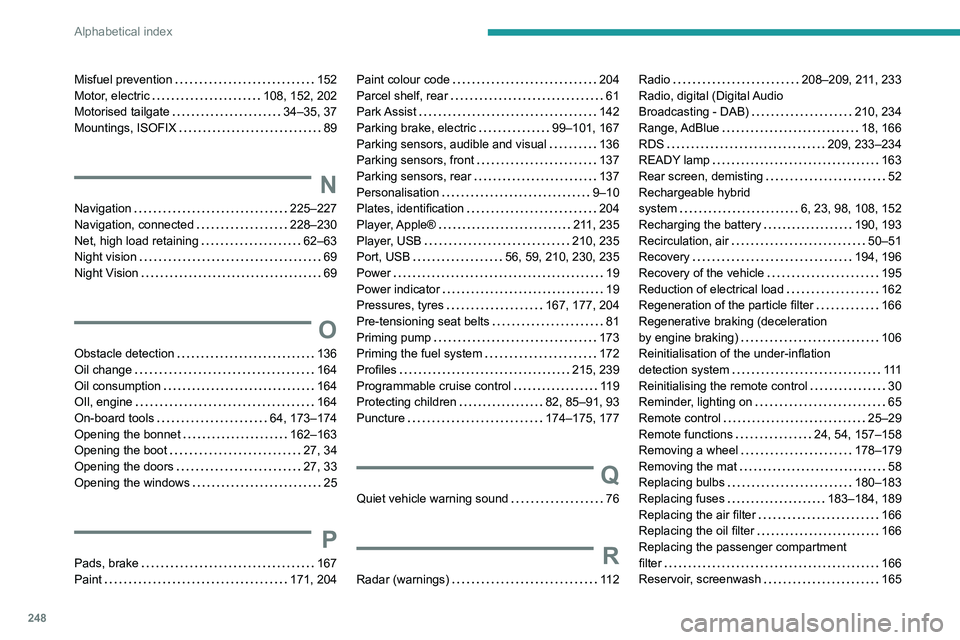
248
Alphabetical index
Misfuel prevention 152
Motor, electric
108, 152, 202
Motorised tailgate
34–35, 37
Mountings, ISOFIX
89
N
Navigation 225–227
Navigation, connected
228–230
Net, high load retaining
62–63
Night vision
69
Night Vision
69
O
Obstacle detection 136
Oil change
164
Oil consumption
164
OIl, engine
164
On-board tools
64, 173–174
Opening the bonnet
162–163
Opening the boot
27, 34
Opening the doors
27, 33
Opening the windows
25
P
Pads, brake 167
Paint
171, 204
Paint colour code 204
Parcel shelf, rear
61
Park Assist
142
Parking brake, electric
99–101, 167
Parking sensors, audible and visual
136
Parking sensors, front
137
Parking sensors, rear
137
Personalisation
9–10
Plates, identification
204
Player, Apple®
211, 235
Player, USB
210, 235
Port, USB
56, 59, 210, 230, 235
Power
19
Power indicator
19
Pressures, tyres
167, 177, 204
Pre-tensioning seat belts
81
Priming pump
173
Priming the fuel system
172
Profiles
215, 239
Programmable cruise control
119
Protecting children
82, 85–91, 93
Puncture
174–175, 177
Q
Quiet vehicle warning sound 76
R
Radar (warnings) 11 2
Radio 208–209, 211, 233
Radio, digital (Digital Audio
Broadcasting - DAB)
210, 234
Range, AdBlue
18, 166
RDS
209, 233–234
READY lamp
163
Rear screen, demisting
52
Rechargeable hybrid
system
6, 23, 98, 108, 152
Recharging the battery
190, 193
Recirculation, air
50–51
Recovery
194, 196
Recovery of the vehicle
195
Reduction of electrical load
162
Regeneration of the particle filter
166
Regenerative braking (deceleration
by engine braking)
106
Reinitialisation of the under-inflation
detection system
111
Reinitialising the remote control
30
Reminder, lighting on
65
Remote control
25–29
Remote functions
24, 54, 157–158
Removing a wheel
178–179
Removing the mat
58
Replacing bulbs
180–183
Replacing fuses
183–184, 189
Replacing the air filter
166
Replacing the oil filter
166
Replacing the passenger compartment
filter
166
Reservoir, screenwash
165
Page 252 of 276
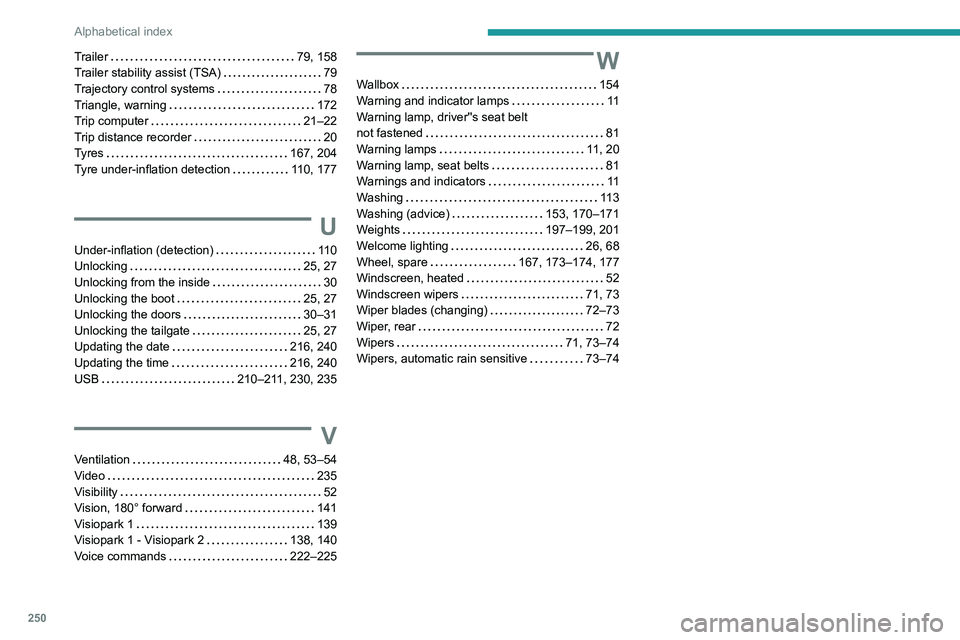
250
Alphabetical index
Trailer 79, 158
Trailer stability assist (TSA)
79
Trajectory control systems
78
Triangle, warning
172
Trip computer
21–22
Trip distance recorder
20
Tyres
167, 204
Tyre under-inflation detection
110, 177
U
Under-inflation (detection) 11 0
Unlocking
25, 27
Unlocking from the inside
30
Unlocking the boot
25, 27
Unlocking the doors
30–31
Unlocking the tailgate
25, 27
Updating the date
216, 240
Updating the time
216, 240
USB
210–211, 230, 235
V
Ventilation 48, 53–54
Video
235
Visibility
52
Vision, 180° forward
141
Visiopark 1
139
Visiopark 1 - Visiopark 2
138, 140
Voice commands
222–225
W
Wallbox 154
Warning and indicator lamps
11
Warning lamp, driver''s seat belt
not fastened
81
Warning lamps
11, 20
Warning lamp, seat belts
81
Warnings and indicators
11
Washing
11 3
Washing (advice)
153, 170–171
Weights
197–199, 201
Welcome lighting
26, 68
Wheel, spare
167, 173–174, 177
Windscreen, heated
52
Windscreen wipers
71, 73
Wiper blades (changing)
72–73
Wiper, rear
72
Wipers
71, 73–74
Wipers, automatic rain sensitive
73–74