steering PEUGEOT 508 DAG 2010 Owner's Manual
[x] Cancel search | Manufacturer: PEUGEOT, Model Year: 2010, Model line: 508 DAG, Model: PEUGEOT 508 DAG 2010Pages: 330, PDF Size: 11.59 MB
Page 181 of 330
7169
!
Safety
Sit in a normal upright position. Wear a correctly adjusted seat belt. Do not leave anything between the occupants and the airbags (a child, pet, object...). This could hamper the operation of
the airbags or injure the occupants. After an accident or if the vehicle has been stolen or broken into, have the airbag systems checked. All work on the airbag system must be carried out by a PEUGEOT dealer or a qualified workshop. Even if all of the precautions mentioned are obser ved, a risk of injury or of minor burns to the head, chest or arms when an airbag is deployed cannot be ruled out. The bag inflates almost instantly (within a few milliseconds) then deflates within the same time discharging the hot gas via openings provided for this purpose.
Lateral airbags
Use only approved covers on the seats, compatible with the deployment the lateral airbags. For information on the range of seat covers suitable for your vehicle, you can contact a PEUGEOT dealer (see "Practical information - § Accessories"). Do not fix or attach anything to the seat backs (clothing...). This could cause injury to the chest or arms if the lateral airbag is deployed. Do not sit with the upper par t of the body any nearer to the door than necessary.
Front airbags
Do not drive holding the steering wheel by its spokes or resting your hands on the centre par t of the wheel. Passengers must not place their feet on the dashboard. If possible, do not smoke as deployment of the airbags can cause burns or the risk of injury from a cigarette or pipe. Never remove or pierce the steering wheel or hit it violently.
Curtain airbags
Do not fix or attach anything to the roof. This could cause injury to the head if the cur tain airbag is deployed. Do not remove the grab handles installed on the roof, they play a par t in securing the cur tain airbags.
For the airbags to be fully effective, observe the following safety rules:
Page 183 of 330
7169
!
Safety
Sit in a normal upright position. Wear a correctly adjusted seat belt. Do not leave anything between the occupants and the airbags (a child, pet, object...). This could hamper the operation of
the airbags or injure the occupants. After an accident or if the vehicle has been stolen or broken into, have the airbag systems checked. All work on the airbag system must be carried out by a PEUGEOT dealer or a qualified workshop. Even if all of the precautions mentioned are obser ved, a risk of injury or of minor burns to the head, chest or arms when an airbag is deployed cannot be ruled out. The bag inflates almost instantly (within a few milliseconds) then deflates within the same time discharging the hot gas via openings provided for this purpose.
Lateral airbags
Use only approved covers on the seats, compatible with the deployment the lateral airbags. For information on the range of seat covers suitable for your vehicle, you can contact a PEUGEOT dealer (see "Practical information - § Accessories"). Do not fix or attach anything to the seat backs (clothing...). This could cause injury to the chest or arms if the lateral airbag is deployed. Do not sit with the upper par t of the body any nearer to the door than necessary.
Front airbags
Do not drive holding the steering wheel by its spokes or resting your hands on the centre par t of the wheel. Passengers must not place their feet on the dashboard. If possible, do not smoke as deployment of the airbags can cause burns or the risk of injury from a cigarette or pipe. Never remove or pierce the steering wheel or hit it violently.
Curtain airbags
Do not fix or attach anything to the roof. This could cause injury to the head if the cur tain airbag is deployed. Do not remove the grab handles installed on the roof, they play a par t in securing the cur tain airbags.
For the airbags to be fully effective, observe the following safety rules:
Page 185 of 330
8171
i
Practical information
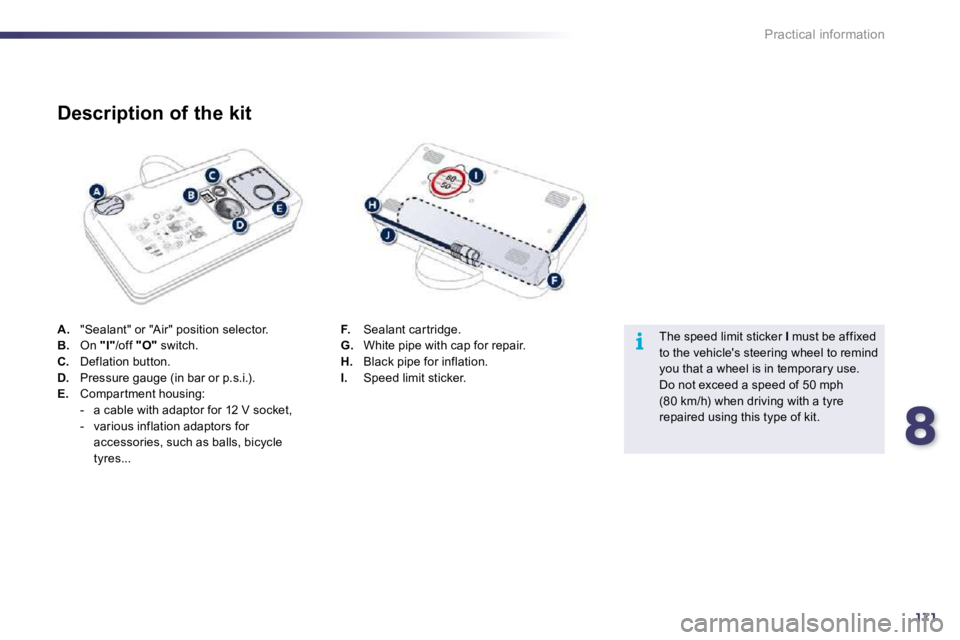
A. "Sealant" or "Air" position selector. B. On "I" /off "O" switch. C. Deflation button. D. Pressure gauge (in bar or p.s.i.). E. Compar tment housing: - a cable with adaptor for 12 V socket, - various inflation adaptors for accessories, such as balls, bicycle tyres...
Description of the kit
F. Sealant car tridge. G. White pipe with cap for repair. H. Black pipe for inflation. I. Speed limit sticker.
The speed limit sticker I must be affixed to the vehicle's steering wheel to remind you that a wheel is in temporary use. Do not exceed a speed of 50 mph (80 km/h) when driving with a tyre repaired using this type of kit.
Page 217 of 330

8201
i!
Practical information
Towing the vehicle
Procedure for having your vehicle towed or for towing another vehicle using a removable towing eye.
Towing your vehicle Towing another vehicle Access to the tools
The towing eye is installed in the boot under the floor. To gain access to it: open the boot, position the floor ver tically, remove the towing eye.
On the front bumper, unclip the cover by pressing at the bottom. Screw the towing eye in fully. Install the towing bar. Switch on the hazard warning lamps on the towed vehicle.
On the rear bumper, unclip the cover by pressing at the bottom. Screw the towing eye in fully. Install the towing bar. Switch on the hazard warning lamps on the towed vehicle.
When towing with all four wheels on the ground, always use a towing bar. When towing with only two wheels on the ground, always use professional lifting equipment. When towing with the engine off, there is no longer any braking or steering assistance.
Place the gear lever in neutral (position N on the electronic gear control gearbox or automatic gearbox). Failure to obser ve this special condition could result in damage to cer tain braking components and the absence of braking assistance the next time the engine is star ted.
Page 226 of 330
210
Checks
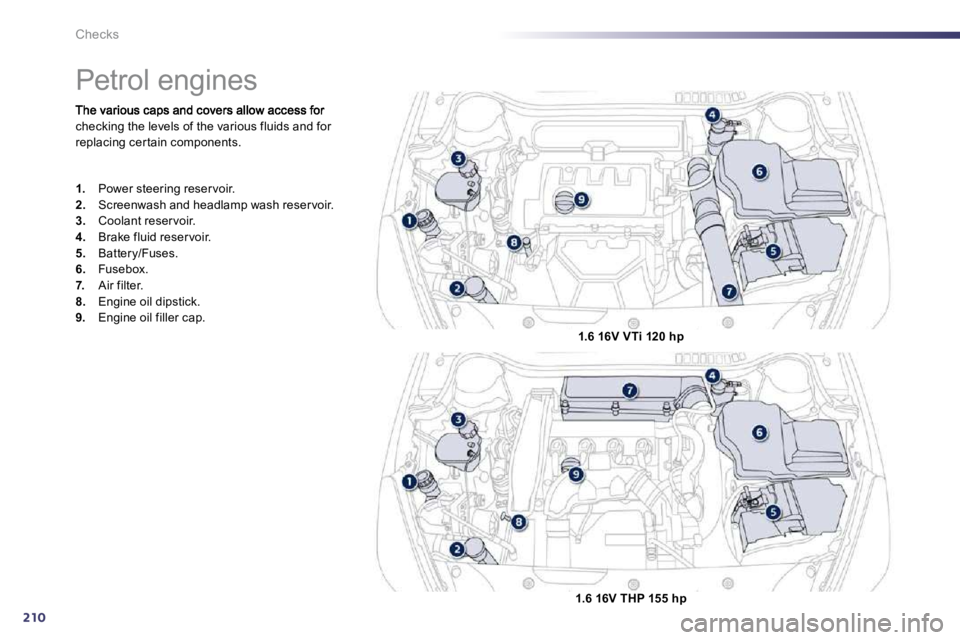
checking the levels of the various fluids and for replacing cer tain components.
Petrol engines
1. Power steering reser voir. 2. Screenwash and headlamp wash reser voir. 3. Coolant reser voir. 4. Brake fluid reser voir. 5. Battery/Fuses. 6. Fusebox. 7. Air filter. 8. Engine oil dipstick. 9. Engine oil filler cap.
1.6 16V VTi 120 hp
1.6 16V THP 155 hp
Page 227 of 330
9211
Checks
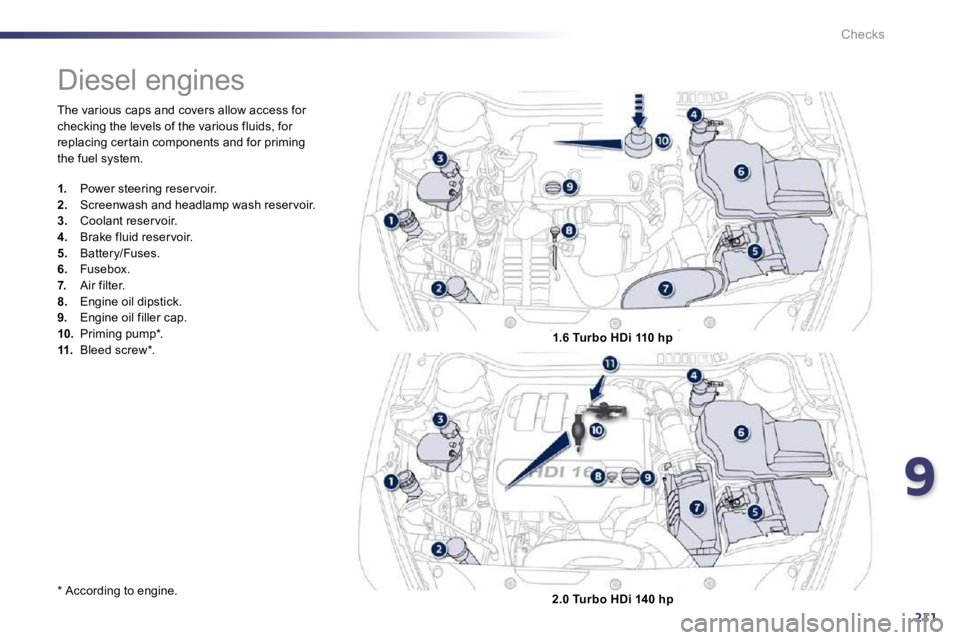
The various caps and covers allow access for checking the levels of the various fluids, for replacing cer tain components and for priming the fuel system.
* According to engine.
Diesel engines
1. Power steering reser voir. 2. Screenwash and headlamp wash reser voir. 3. Coolant reser voir. 4. Brake fluid reser voir. 5. Battery/Fuses. 6. Fusebox. 7. Air filter. 8. Engine oil dipstick. 9. Engine oil filler cap. 10. Priming pump * . 11. Bleed screw * . 1.6 Turbo HDi 110 hp
2.0 Turbo HDi 140 hp
Page 228 of 330
212
Checks
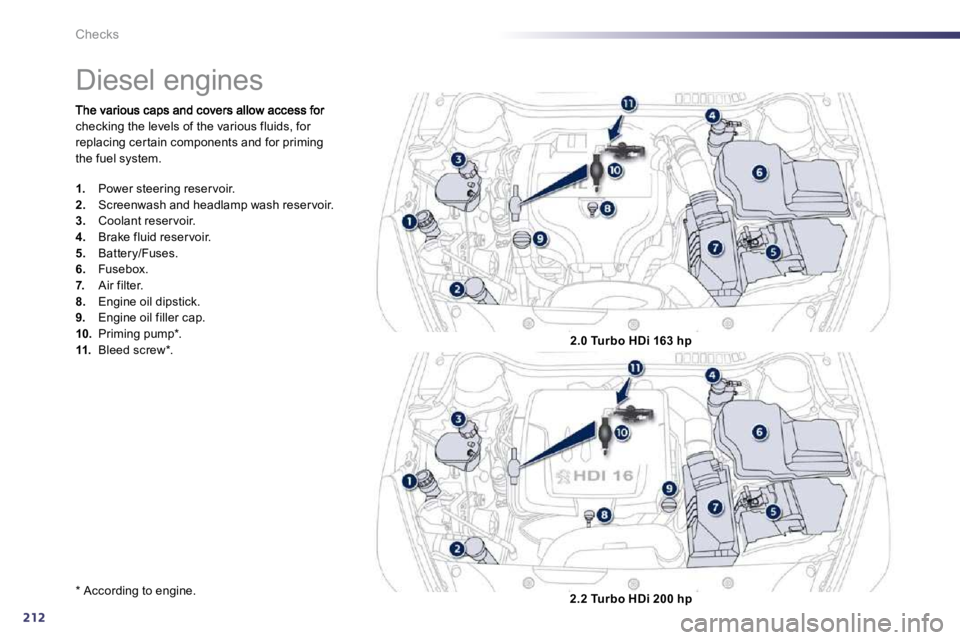
checking the levels of the various fluids, for replacing cer tain components and for priming the fuel system.
* According to engine.
Diesel engines
1. Power steering reser voir. 2. Screenwash and headlamp wash reser voir. 3. Coolant reser voir. 4. Brake fluid reser voir. 5. Battery/Fuses. 6. Fusebox. 7. Air filter. 8. Engine oil dipstick. 9. Engine oil filler cap. 10. Priming pump * . 11. Bleed screw * . 2.0 Turbo HDi 163 hp
2.2 Turbo HDi 200 hp
Page 229 of 330

9213
!
Checks
Checking leve ls
Check all of these levels regularly and top them up if necessary, unless other wise indicated. If a level drops significantly, have the corresponding system checked by a PEUGEOT dealer or a qualified wo rkshop.
When working under the bonnet, take care, as cer tain areas of the engine may be extremely hot (risk of burns).
Oil level
The check is carried out either when the ignition is switched on using the oil level indicator on the instrument panel, or using the dipstick. This manual check will only be correct if the vehicle is on level ground and the engine has been off for more than 30 minutes. After topping up the oil, the check when switching on the ignition with the oil level indicator in the instrument panel will only be valid 30 minutes after topping up.
Engine oil change
Refer to the Warranty and Maintenance Record for details of the inter val for this operation. In order to maintain the reliability of the engine and emission control system, the use of additives in the engine oil is prohibited.
Oil specifi cation
The oil must be the correct grade for your engine and conform to the manufacturer's recommendations.
The brake fluid level should be close to the "MA X" mark. If it is not, check the brake pad wear.
Brake fluid level
Changing the fl uid
Refer to the Warranty and Maintenance Record for details of the inter val for this operation.
Fluid specifi cation
The brake fluid must conform to the manufacturer's recommendations and meet the DOT4 standard.
Power steering fluid level
The power steering fluid level should be close to the "MA X" mark. Unscrew the cap, with the engine cold, to
check the level.
Page 245 of 330
231
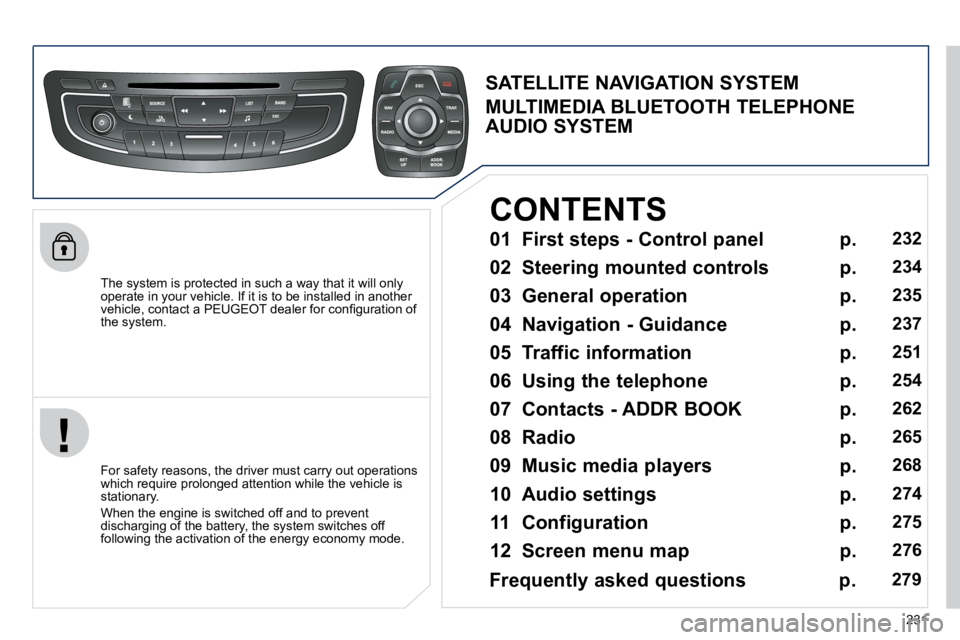
The system is protected in such a way that it will only operate in your vehicle. If it is to be installed in another vehicle, contact a PEUGEOT dealer for confi guration of the system.
SATELLITE NAVIGATION SYSTEM
MULTIMEDIA BLUETOOTH TELEPHONE
AUDIO SYSTEM
01 First steps - Control panel
For safety reasons, the driver must carry out operations which require prolonged attention while the vehicle is stationary.
When the engine is switched off and to prevent discharging of the battery, the system switches off following the activation of the energy economy mode.
CONTENTS
02 Steering mounted controls
03 General operation
04 Navigation - Guidance
05 Traffic information
06 Using the telephone
07 Contacts - ADDR BOOK
08 Radio
09 Music media players
10 Audio settings
11 Configuration
12 Screen menu map p.
p.
p.
p.
p.
p.
p.
p.
p.
p.
p.
p.
232
234
235
237
251
254
262
265
268
274
275
276
Frequently asked questions p. 279
Page 248 of 330
234
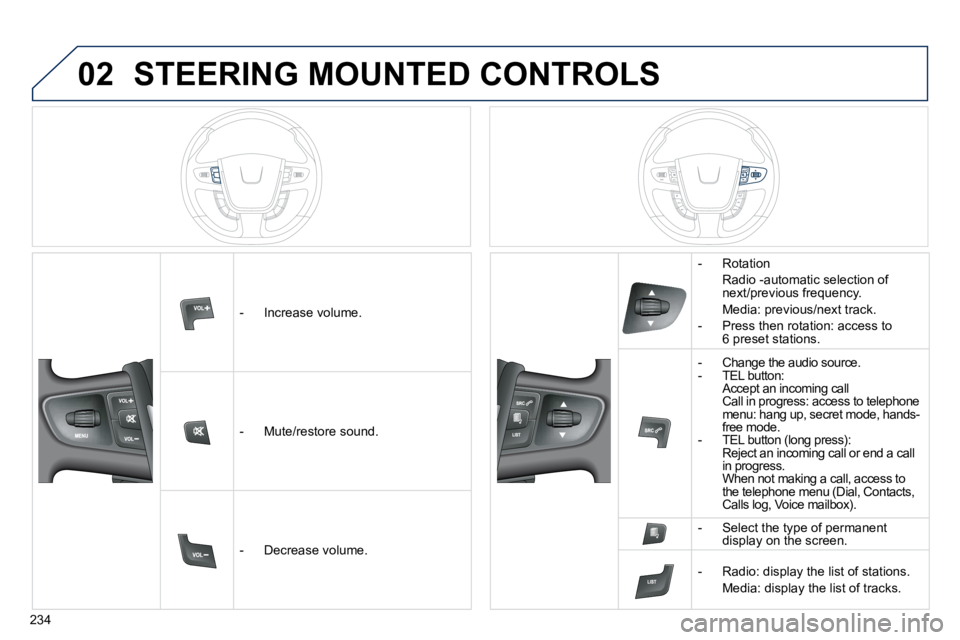
02 STEERING MOUNTED CONTROLS
- Increase volume.
- Mute/restore sound.
- Decrease volume.
- Rotation
Radio -automatic selection of next/previous frequency.
Media: previous/next track.
- Press then rotation: access to 6 preset stations.
- Change the audio source. - TEL button: Accept an incoming call Call in progress: access to telephone menu: hang up, secret mode, hands-free mode. - TEL button (long press): Reject an incoming call or end a call in progress. When not making a call, access to the telephone menu (Dial, Contacts, Calls log, Voice mailbox).
- Select the type of permanent display on the screen.
- Radio: display the list of stations.
Media: display the list of tracks.