lock PEUGEOT 807 2008 Owner's Manual
[x] Cancel search | Manufacturer: PEUGEOT, Model Year: 2008, Model line: 807, Model: PEUGEOT 807 2008Pages: 194, PDF Size: 5.17 MB
Page 133 of 194
138
Driving safety
ANTI-LOCK BRAKING
SYSTEM (ABS) AND
ELECTRONIC BRAKE FORCE
DISTRIBUTION (EBFD)
The ABS, in conjunction with the
electronic brake force distribution,
increases the stability and
manoeuvrability of your vehicle on
braking, in particular on poor or
slippery road surfaces.
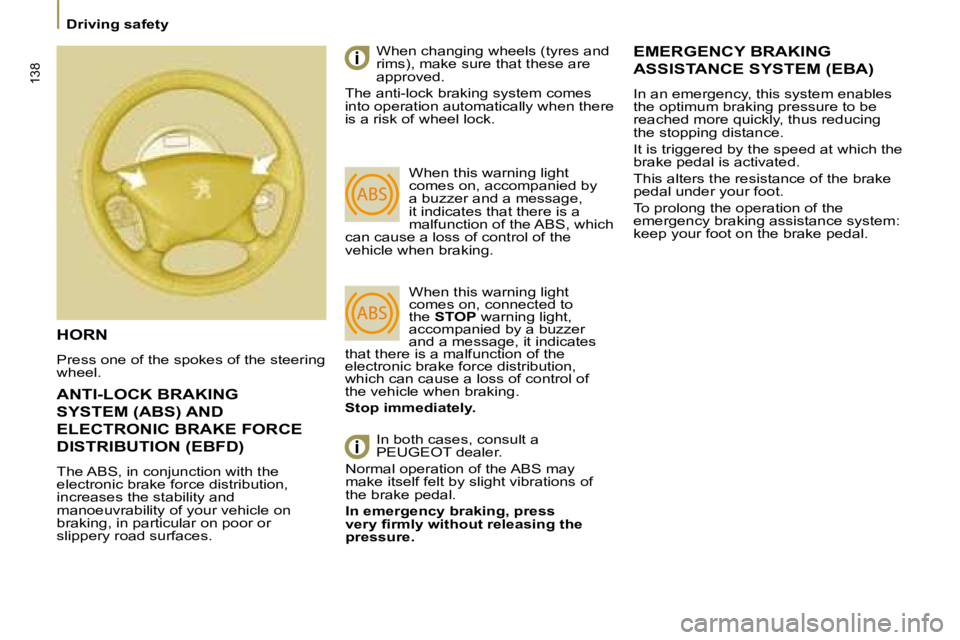
HORN
Press one of the spokes of the steering
wheel.When changing wheels (tyres and
rims), make sure that these are
approved.
The anti-lock braking system comes
into operation automatically when there
is a risk of wheel lock.
When this warning light
comes on, accompanied by
a buzzer and a message,
it indicates that there is a
malfunction of the ABS, which
can cause a loss of control of the
vehicle when braking.
When this warning light
comes on, connected to
the STOP warning light,
accompanied by a buzzer
and a message, it indicates
that there is a malfunction of the
electronic brake force distribution,
which can cause a loss of control of
the vehicle when braking.
Stop immediately.
In both cases, consult a
PEUGEOT dealer.
Normal operation of the ABS may
make itself felt by slight vibrations of
the brake pedal.
In emergency braking, press
very irmly without releasing the
pressure.
EMERGENCY BRAKING
ASSISTANCE SYSTEM (EBA)
In an emergency, this system enables
the optimum braking pressure to be
reached more quickly, thus reducing
the stopping distance.
It is triggered by the speed at which the
brake pedal is activated.
This alters the resistance of the brake
pedal under your foot.
To prolong the operation of the
emergency braking assistance system:
keep your foot on the brake pedal.
Page 136 of 194
SAFETY
141
Seat belts
5
FRONT AND REAR SIDE SEAT
BELTS
The front seats and the rear side seats
of row 2 are itted with pre-tensioners
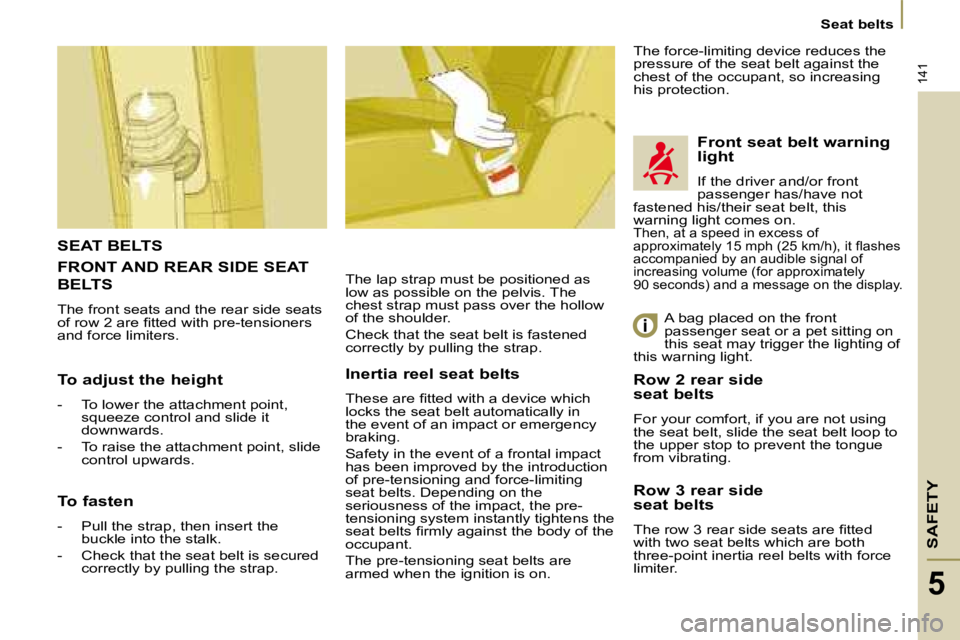
and force limiters.The lap strap must be positioned as
low as possible on the pelvis. The
chest strap must pass over the hollow
of the shoulder.
Check that the seat belt is fastened
correctly by pulling the strap.The force-limiting device reduces the
pressure of the seat belt against the
chest of the occupant, so increasing
his protection.
A bag placed on the front
passenger seat or a pet sitting on
this seat may trigger the lighting of
this warning light.
SEAT BELTS
Front seat belt warning
light
If the driver and/or front
passenger has/have not
fastened his/their seat belt, this
warning light comes on.
Then, at a speed in excess of
approximately 15 mph (25 km/h), it lashes
accompanied by an audible signal of
increasing volume (for approximately
90 seconds) and a message on the display.
Row 2 rear side
seat belts
For your comfort, if you are not using
the seat belt, slide the seat belt loop to
the upper stop to prevent the tongue
from vibrating.
To adjust the height
- To lower the attachment point,
squeeze control and slide it
downwards.
- To raise the attachment point, slide control upwards.
To fasten
- Pull the strap, then insert the buckle into the stalk.
- Check that the seat belt is secured correctly by pulling the strap. Inertia reel seat belts
These are itted with a device which
locks the seat belt automatically in
the event of an impact or emergency
braking.
Safety in the event of a frontal impact
has been improved by the introduction
of pre-tensioning and force-limiting
seat belts. Depending on the
seriousness of the impact, the pre-
tensioning system instantly tightens the
seat belts irmly against the body of the
occupant.
The pre-tensioning seat belts are
armed when the ignition is on.
Row 3 rear side
seat belts
The row 3 rear side seats are itted
with two seat belts which are both
three-point inertia reel belts with force
limiter.
Page 137 of 194

142
Seat beltsThe force limiter reduces the pressure
of the seat belt against the body of the
occupants. The equipment itted to
these seat belts is operational when
the ignition is switched on.
The inertia reels are itted with a device
which automatically locks the strap in
the event of a collision or emergency
braking.
You can release the seat belt and allow
the strap to roll up. Do not invert the seat belt buckles as
they will not fulil their role completely.
If the seats are itted with armrests, the
lap part of the seat belt should always
pass under the armrest.
Check that the seat belt is fastened
correctly by pulling the strap irmly.
Good practice
Wherever you are seated in the
vehicle, always fasten your seat belt,
even for short journeys.
The seat belts are itted with an inertia
reel which automatically adjusts the
length of the strap to your size. The
seat belt is rolled up automatically
when not in use.
Ensure that the seat belt is rolled up
correctly after use.
After folding or moving a rear seat or
bench seat, ensure that the seat belt is
rolled up correctly in its compartment
and that the buckle is ready to
accommodate the tongue.
Depending on the nature and
seriousness of any impact, the
pretensioning device may be triggered
before and independently of inlation
of the air bags. It instantly tightens
the seat belts against the body of
the occupants. Triggering of the
pretensioners is accompanied by a
slight discharge of harmless smoke
and a noise, due to the activation of
the pyrotechnic cartridge incorporated
in the system.
To install the seat belt, move the
tongue into position to insert it into the
buckle.
Row 2 and 3 rear centre
seat belts
The row 2 rear centre seat and the
rear bench seat centre seat have an
integrated three-point inertia reel seat
belt.
The air bag warning light comes on
if the pretensioners are triggered.
Consult a PEUGEOT dealer.
In order to be effective, a seat belt
must:
- restrain one person only,
- must not be twisted, check by pulling in front of you with an even
movement,
- be tightened as close to the body as possible.
The upper part of the seat belt should
be positioned in the hollow of the
shoulder.
The lap part should be placed as low
as possible on the pelvis. Recommendations for children:
- use a suitable child seat if the
passenger is less than 12 years old
or shorter than one metre ifty,
- never allow a child to travel on your lap, even with the seat belt
fastened.
For further information regarding child
seats, refer to the "Children on board"
section of chapter 5.
In accordance with current safety
regulations, your PEUGEOT dealer
guarantees all work or any checks,
from testing to maintenance, on your
seat belt equipment.
Have the seat belts checked regularly
(even after a minor impact) by a
PEUGEOT dealer: they must not show
any signs of wear, cutting or fraying
and they must not be transformed or
modiied.
Clean the seat belt straps with soapy
water or a textile cleaning product, sold
by PEUGEOT dealers.
Page 145 of 194
148
Child safety
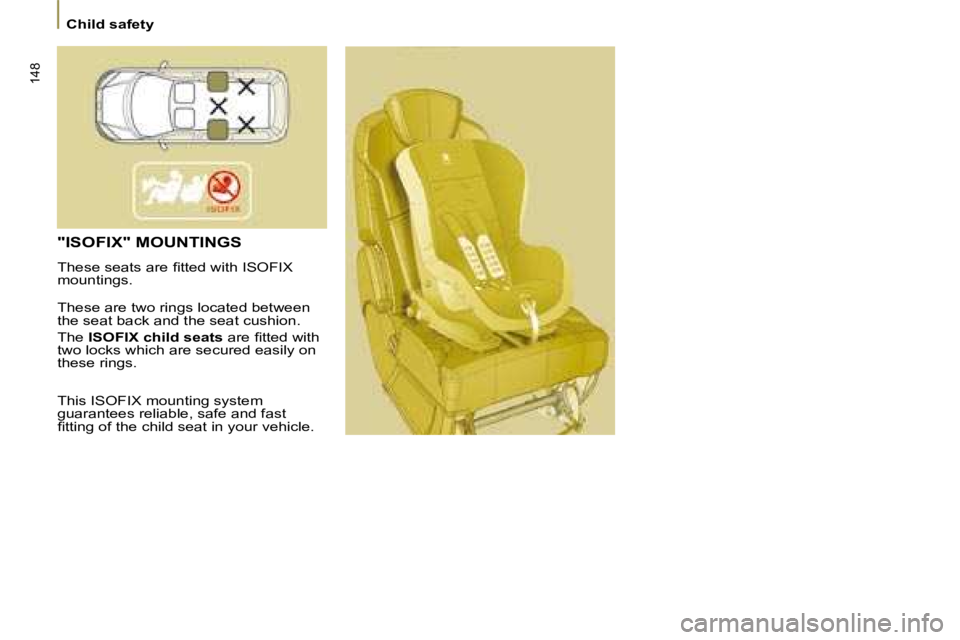
"ISOFIX" MOUNTINGS
These seats are itted with ISOFIX
mountings.
These are two rings located between
the seat back and the seat cushion.
The ISOFIX child seats are itted with
two locks which are secured easily on
these rings.
This ISOFIX mounting system
guarantees reliable, safe and fast
itting of the child seat in your vehicle.
Page 149 of 194
152
Child safety
ADVICE ON CHILD SEATS
Otherwise, the child would risk being
seriously injured or killed if the air bag
were to inlate.
The incorrect installation of a child seat
in a vehicle compromises the child’s
protection in the event of an accident.
Remember to fasten the seat belts or
the child seat harnesses
keeping the
slack in relation to the child’s body to
a minimum , even for short journeys.
To protect young children from the
rays of the sun, it side blinds on
the rear windows.
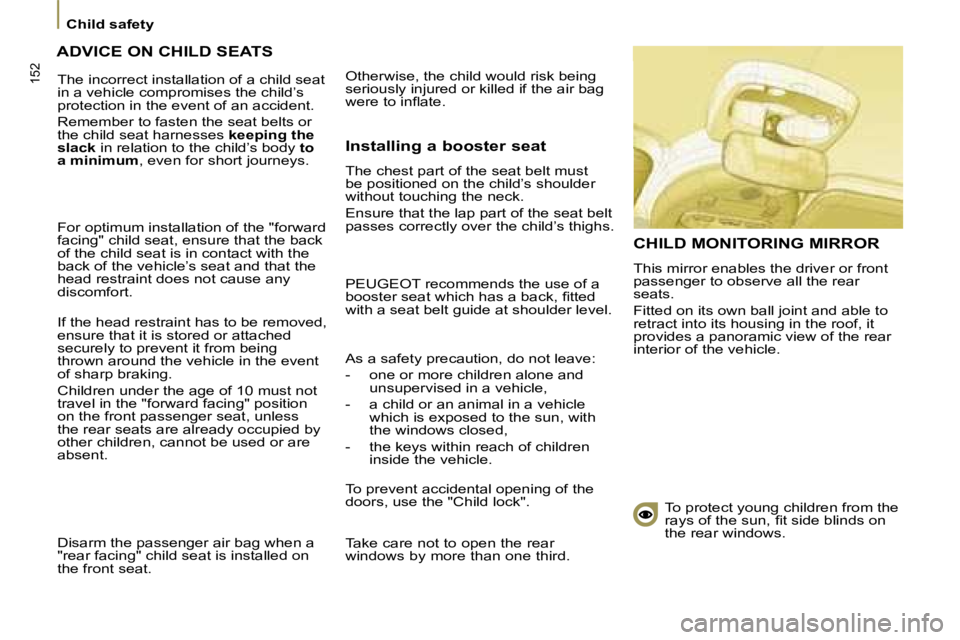
CHILD MONITORING MIRROR
This mirror enables the driver or front
passenger to observe all the rear
seats.
Fitted on its own ball joint and able to
retract into its housing in the roof, it
provides a panoramic view of the rear
interior of the vehicle.
For optimum installation of the "forward
facing" child seat, ensure that the back
of the child seat is in contact with the
back of the vehicle’s seat and that the
head restraint does not cause any
discomfort.
If the head restraint has to be removed,
ensure that it is stored or attached
securely to prevent it from being
thrown around the vehicle in the event
of sharp braking.
Children under the age of 10 must not
travel in the "forward facing" position
on the front passenger seat, unless
the rear seats are already occupied by
other children, cannot be used or are
absent.
Disarm the passenger air bag when a
"rear facing" child seat is installed on
the front seat. Installing a booster seat
The chest part of the seat belt must
be positioned on the child’s shoulder
without touching the neck.
Ensure that the lap part of the seat belt
passes correctly over the child’s thighs.
PEUGEOT recommends the use of a
booster seat which has a back, itted
with a seat belt guide at shoulder level.
As a safety precaution, do not leave:
- one or more children alone and
unsupervised in a vehicle,
- a child or an animal in a vehicle which is exposed to the sun, with
the windows closed,
- the keys within reach of children inside the vehicle.
To prevent accidental opening of the
doors, use the "Child lock".
Take care not to open the rear
windows by more than one third.
Page 150 of 194
152
Child safety
ADVICE ON CHILD SEATS
Otherwise, the child would risk being
seriously injured or killed if the air bag
were to inlate.
The incorrect installation of a child seat
in a vehicle compromises the child’s
protection in the event of an accident.
Remember to fasten the seat belts or
the child seat harnesses
keeping the
slack in relation to the child’s body to
a minimum , even for short journeys.
To protect young children from the
rays of the sun, it side blinds on
the rear windows.
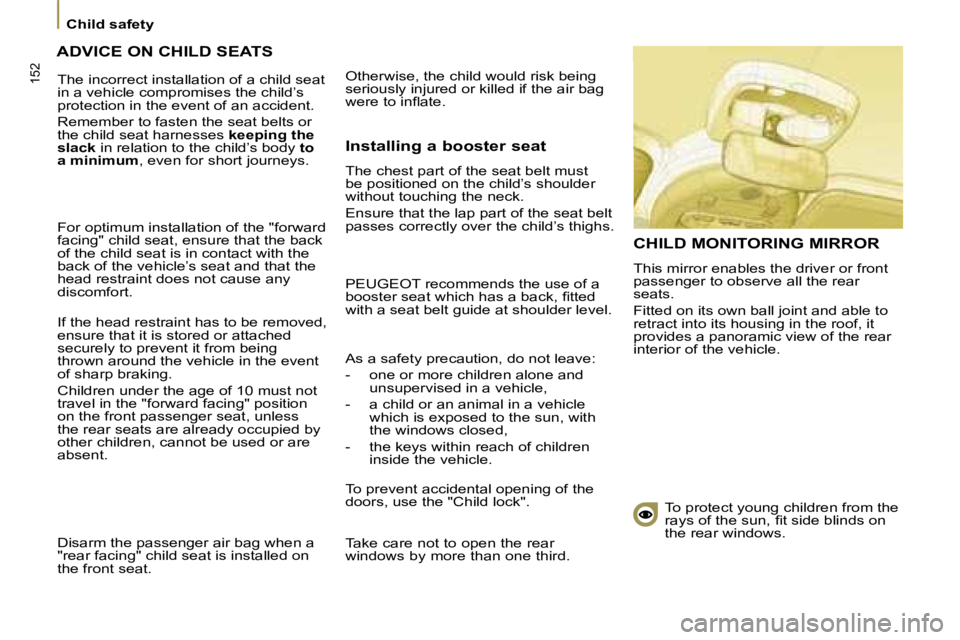
CHILD MONITORING MIRROR
This mirror enables the driver or front
passenger to observe all the rear
seats.
Fitted on its own ball joint and able to
retract into its housing in the roof, it
provides a panoramic view of the rear
interior of the vehicle.
For optimum installation of the "forward
facing" child seat, ensure that the back
of the child seat is in contact with the
back of the vehicle’s seat and that the
head restraint does not cause any
discomfort.
If the head restraint has to be removed,
ensure that it is stored or attached
securely to prevent it from being
thrown around the vehicle in the event
of sharp braking.
Children under the age of 10 must not
travel in the "forward facing" position
on the front passenger seat, unless
the rear seats are already occupied by
other children, cannot be used or are
absent.
Disarm the passenger air bag when a
"rear facing" child seat is installed on
the front seat. Installing a booster seat
The chest part of the seat belt must
be positioned on the child’s shoulder
without touching the neck.
Ensure that the lap part of the seat belt
passes correctly over the child’s thighs.
PEUGEOT recommends the use of a
booster seat which has a back, itted
with a seat belt guide at shoulder level.
As a safety precaution, do not leave:
- one or more children alone and
unsupervised in a vehicle,
- a child or an animal in a vehicle which is exposed to the sun, with
the windows closed,
- the keys within reach of children inside the vehicle.
To prevent accidental opening of the
doors, use the "Child lock".
Take care not to open the rear
windows by more than one third.
Page 153 of 194
155
Roof bars
ACCESSORIES
6
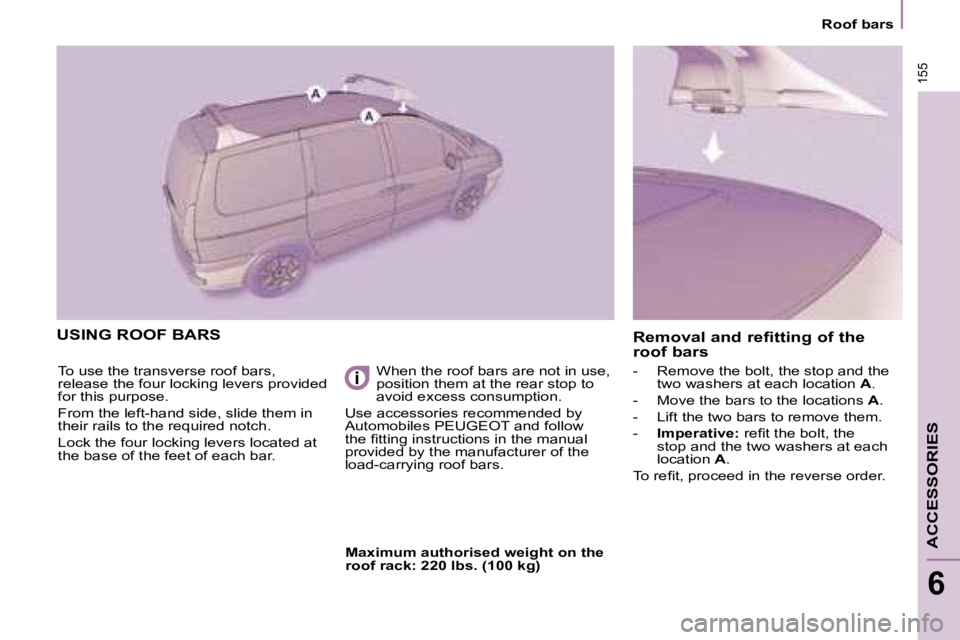
USING ROOF BARS
To use the transverse roof bars,
release the four locking levers provided
for this purpose.
From the left-hand side, slide them in
their rails to the required notch.
Lock the four locking levers located at
the base of the feet of each bar.When the roof bars are not in use,
position them at the rear stop to
avoid excess consumption.
Use accessories recommended by
Automobiles PEUGEOT and follow
the itting instructions in the manual
provided by the manufacturer of the
load-carrying roof bars. - Remove the bolt, the stop and the
two washers at each location A.
- Move the bars to the locations A.
- Lift the two bars to remove them.
- Imperative: reit the bolt, the
stop and the two washers at each
location A.
To reit, proceed in the reverse order.
Removal and refitting of the
roof bars
Maximum authorised weight on the
roof rack: 220 lbs. (100 kg)
Page 158 of 194
161
Opening the bonnet
CHECKS
7
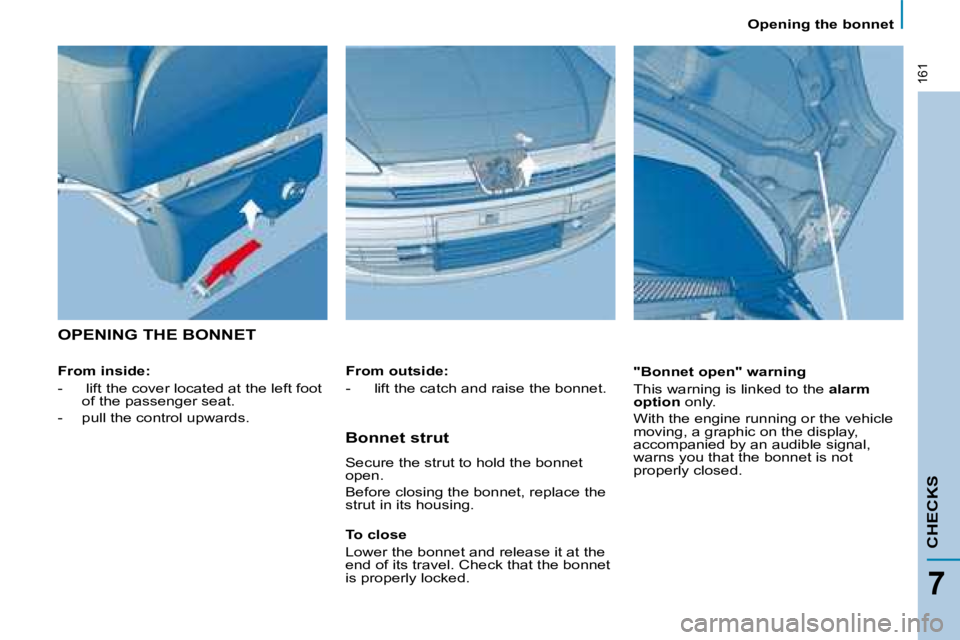
OPENING THE BONNET
From inside:
- lift the cover located at the left foot of the passenger seat.
- pull the control upwards. "Bonnet open" warning
This warning is linked to the
alarm
option only.
With the engine running or the vehicle
moving, a graphic on the display,
accompanied by an audible signal,
warns you that the bonnet is not
properly closed.
From outside:
- lift the catch and raise the bonnet.
Bonnet strut
Secure the strut to hold the bonnet
open.
Before closing the bonnet, replace the
strut in its housing.
To close
Lower the bonnet and release it at the
end of its travel. Check that the bonnet
is properly locked.
Page 175 of 194
176
Changing a fuse
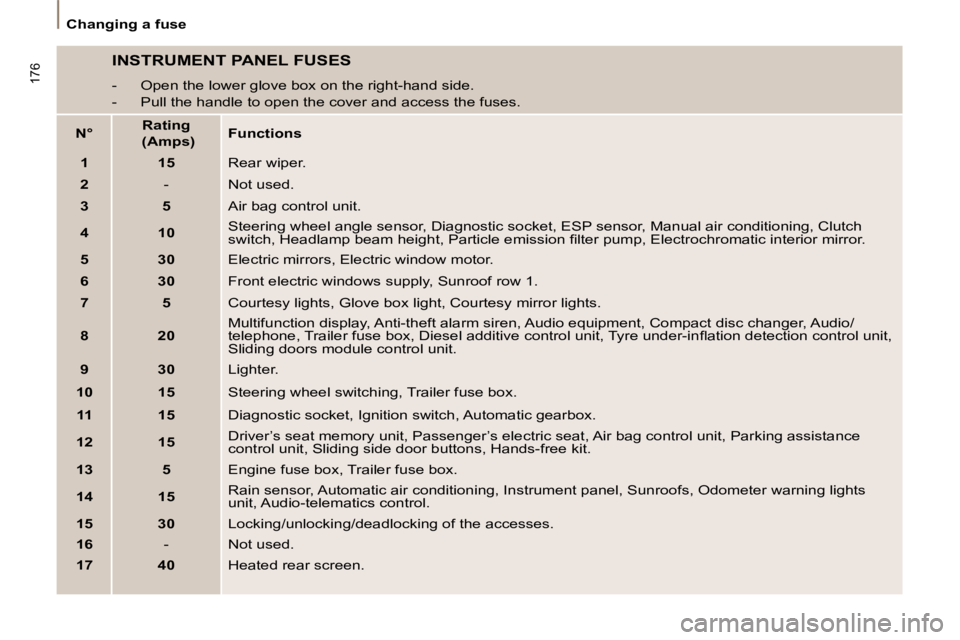
INSTRUMENT PANEL FUSES
- Open the lower glove box on the right-hand side. -
Pull the handle to open the cover and access the fuses.
N° Rating
(Amps) Functions
1 15 Rear wiper.
2 - Not used.
3 5 Air bag control unit.
4 10 Steering wheel angle sensor, Diagnostic socket, ESP sensor, Manua
l air conditioning, Clutch
switch, Headlamp beam height, Particle emission ilter pump, Electro chromatic interior mirror.
5 30 Electric mirrors, Electric window motor.
6 30 Front electric windows supply, Sunroof row 1.
7 5 Courtesy lights, Glove box light, Courtesy mirror lights.
8 20 Multifunction display, Anti-theft alarm siren, Audio equipment
, Compact disc changer, Audio/
telephone, Trailer fuse box, Diesel additive control unit, Tyre under-inlation detection control unit,
Sliding doors module control unit.
9 30 Lighter.
10 15 Steering wheel switching, Trailer fuse box.
11 15 Diagnostic socket, Ignition switch, Automatic gearbox.
12 15 Driver’s seat memory unit, Passenger’s electric seat, Air bag control u
nit, Parking assistance
control unit, Sliding side door buttons, Hands-free kit.
13 5 Engine fuse box, Trailer fuse box.
14 15 Rain sensor, Automatic air conditioning, Instrument panel, Sun
roofs, Odometer warning lights
unit, Audio-telematics control.
15 30 Locking/unlocking/deadlocking of the accesses.
16 - Not used.
17 40 Heated rear screen.
Page 181 of 194
182
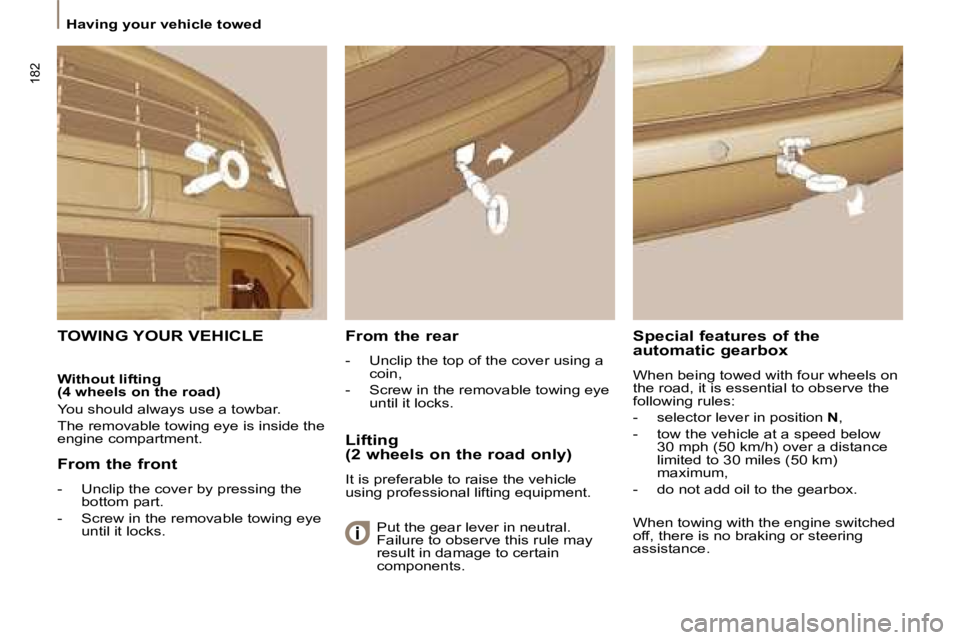
Having your vehicle towedFrom the rear
- Unclip the top of the cover using a coin,
- Screw in the removable towing eye until it locks.
TOWING YOUR VEHICLESpecial features of the
automatic gearbox
When being towed with four wheels on
the road, it is essential to observe the
following rules:
- selector lever in position N,
- tow the vehicle at a speed below
30 mph (50 km/h) over a distance
limited to 30 miles (50 km)
maximum,
- do not add oil to the gearbox.
When towing with the engine switched
off, there is no braking or steering
assistance.
Without lifting
(4 wheels on the road)
You should always use a towbar.
The removable towing eye is inside the
engine compartment.
From the front- Unclip the cover by pressing the
bottom part.
- Screw in the removable towing eye until it locks. Lifting
(2 wheels on the road only)
It is preferable to raise the vehicle
using professional lifting equipment.
Put the gear lever in neutral.
Failure to observe this rule may
result in damage to certain
components.