window PEUGEOT BOXER 2011 User Guide
[x] Cancel search | Manufacturer: PEUGEOT, Model Year: 2011, Model line: BOXER, Model: PEUGEOT BOXER 2011Pages: 184, PDF Size: 4.86 MB
Page 131 of 184
Child safety
12
9
5
SAFETY
ADVICE ON CHILD SEATS
The incorrect installation of a child seat in
a vehicle compromises the child's protection
in the event of an accident.
Remember to fasten the seat belts or the
child seat harnesses keeping the slack
in
relation to the child's body to a minimum
,
even for short journeys.
For optimum installation of the "forward
facing" child seat, ensure that the back of
the child seat is in contact with the back of
the vehicle's seat and that the head restraint
does not cause any discomfort.
If the head restraint has to be removed,
ensure that it is stored or attached securely
to prevent it from being thrown around the
vehicle in the event of sharp braking.
Children under the age of 10 must not travel
in the "forward facing" position on the front
passenger seat, unless the rear seats are
already occupied by other children, cannot
be used or are absent. Deactivate the passenger airbag when
a "rear facing" child seat is installed on
the front seat.
Otherwise, the child would risk being
seriously injured or killed if the airbag were
to inflate.
As a safety precaution, do not leave:
- one or more children alone and
unsupervised in a vehicle,
- a child or an animal in a vehicle which
is exposed to the sun, with the windows
closed,
- the keys within reach of children inside
the vehicle.
To prevent accidental opening of the doors,
use the "Child Lock".
Take care not to open the rear windows by
more than one third.
To protect young children from the rays of
the sun, fit side blinds to the rear windows.
Installing a booster seat
The chest part of the seat belt must be
positioned on the child's shoulder without
touching the neck.
Ensure that the lap part of the seat belt
passes correctly over the child's thighs.
PEUGEOT recommends the use of a
booster seat which has a back, fitted with
a seat belt guide at shoulder level.
Crew cab
Do not install child seats, booster cushions
or carrycots on the rear seats of the cab.
Page 135 of 184
Equipment
133
6
ACCESSORIE
S
Another range is also available, structured
around comfort, leisure and maintenance:
Anti-theft alarm, window etching, first aid
kit, high visibility safety jacket, rear parking
sensors, warning triangle, ...
Front seat covers compatible with aibags,
rubber mats, carpet mats, snow chains.
To prevent the mat from becoming caught
under the pedals:
- ensure that the mat and its fixings are
positioned correctly,
- never fit one mat on top of another. Audio equipment, hands-free system,
speakers, navigation, ... Trims, front mud flaps, rear mud flaps,
wooden floor, deflectors...
Installation of radiocommunication
transmitters
You are advised to contact a representative
of the PEUGEOT marque before installing
accessory radiocommunication transmitters
with external aerial on your vehicle.
The PEUGEOT Network will inform
you of the specifications (frequency
waveband, maximum output power, aerial
position, specific installation conditions)
of the transmitters which can be fitted,
in accordance with the Motor Vehicle
Electromagnetic Compatibility Directive
(2004/104/EC). Screenwash, interior and exterior cleaning
and maintenance products, replacement
bulbs, ...
The fitting of electrical equipment
or accessories which are not
recommended by Automobiles PEUGEOT
may result in the failure of your vehicle's
electronic system.
Please note this specific warning. You
are advised to contact a representative
of the Marque to be shown the range of
recommended equipment and accessories.
Depending on the country in which the
vehicle is sold or operated, it is compulsory
to have a high visibility safety jacket,
warning triangle and replacement bulbs
available in the vehicle.
Page 145 of 184
14
3
Battery
QUICK HELP
8
The batteries contain harmful
substances such as sulphuric acid and
lead. They must be discarded in accordance
with the provisions of the law and must not,
in any circumstances, be discarded with
household waste.
Take used batteries to a special collection
point.
It is advisable to disconnect the negative (-)
terminal of the battery if the vehicle is not to be
used for a period of more than one month.
Before disconnecting the battery, you
must wait for 2 minutes after switching off
the ignition.
Never disconnect a terminal when the
engine is running.
Never charge a battery without first
disconnecting the terminals.
Close the windows and doors before
disconnecting the battery.
After every reconnection of the battery,
switch on the ignition and wait 1 minute
before starting to allow the electronic
systems to be initialised. If slight difficulties
are experienced after this, please contact a
PEUGEOT dealer.
If the battery has been disconnected
for some time, it may be necessary to
reinitialise the following functions:
- the display parameters (date,
time, language, distance unit and
temperature unit),
- the radio stations,
- the central locking.
Some settings are cleared and must be
reprogrammed, consult a PEUGEOT.
If your vehicle is fitted with a tachograph or
an alarm, disconnection of the negative (-)
terminal of the battery (located under the
floor on the left-hand side, in the cab) is
recommended if the vehicle is not to be used
for a period of more than 5 days.
Page 156 of 184

154
Changing a fuse
PASSENGER’S SIDE DASHBOARD FUSES
- Remove the bolts and tilt the box to access the fuses.
Fuses
A (amps)
Allocation
12
7.5
Right-hand dipped beam headlamp
13
7.5
Left-hand dipped beam headlamp
31
5
Relay supply
32
7.5
Interior lighting
33
20
Battery sensor
34
20
Minibus interior lighting - Hazard warning
36
10
Audio system - Diagnostic socket - Alarm siren - Programmable additional heating controls -
Air conditioning controls - Tachograph - Battery
37
7.5
Brake lamps switch - Third brake lamp - Instrument panel
38
20
Central locking
42
5
ABS control unit and sensor - ASR sensor - ESP sensor - Brake lamps switch
43
20
Windscreen wiper motor
47
20
Driver’s electric window motor
48
20
Passenger electric window motor
49
5
Audio system - Instrument panel controls
50
7.5
Airbags and pre-tensioners unit
51
5
Tachograph - Cruise control - Air conditioning controls - Reversing lamps -
water in Diesel sensor
53
7.5
Instrument panel
89
-
Not used
90
7.5
Left hand main beam headlamp
91
7.5
Right han main beam headlamp
92
7.5
Left hand foglamp
93
7.5
Right hand foglamp
Page 176 of 184
174
Instruments and controls
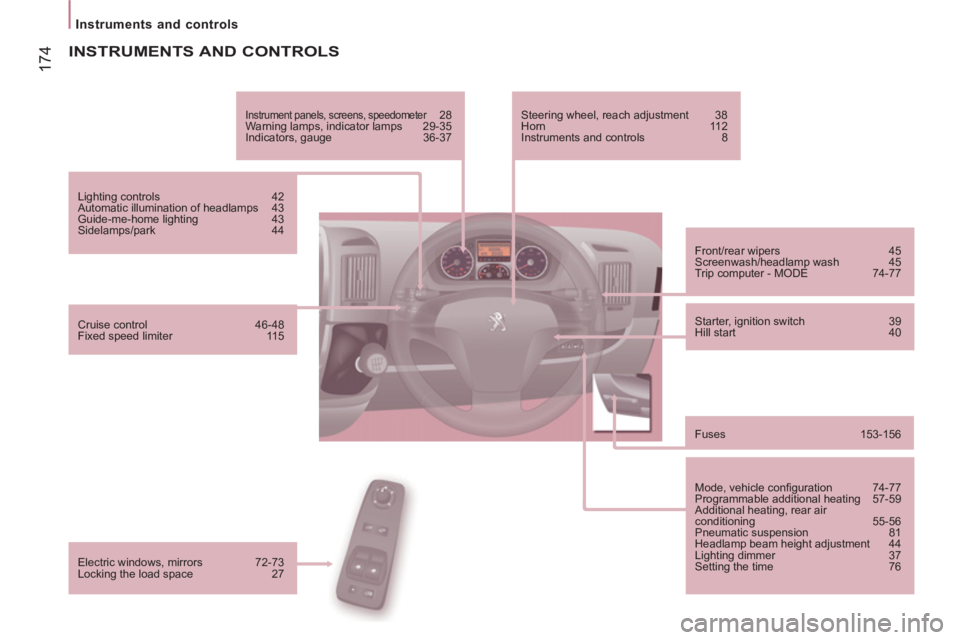
INSTRUMENTS AND CONTROLS
Instrument panels, screens, speedometer 28
Warning lamps, indicator lamps 29-35
Indicators, gauge 36-37
Lighting controls 42
Automatic illumination of headlamps 43
Guide-me-home lighting 43
Sidelamps/park 44
Fuses 153-156
Mode, vehicle confi guration 74-77
Programmable additional heating 57-59
Additional heating, rear air
conditioning 55-56
Pneumatic suspension 81
Headlamp beam height adjustment 44
Lighting dimmer 37
Setting the time 76 Front/rear wipers 45
Screenwash/headlamp wash 45
Trip computer - MODE 74-77
Starter, ignition switch 39
Hill start 40 Cruise control 46-48
Fixed speed limiter 115 Steering wheel, reach adjustment 38
Horn 112
Instruments and controls 8
Electric windows, mirrors 72-73
Locking the load space 27
Page 178 of 184
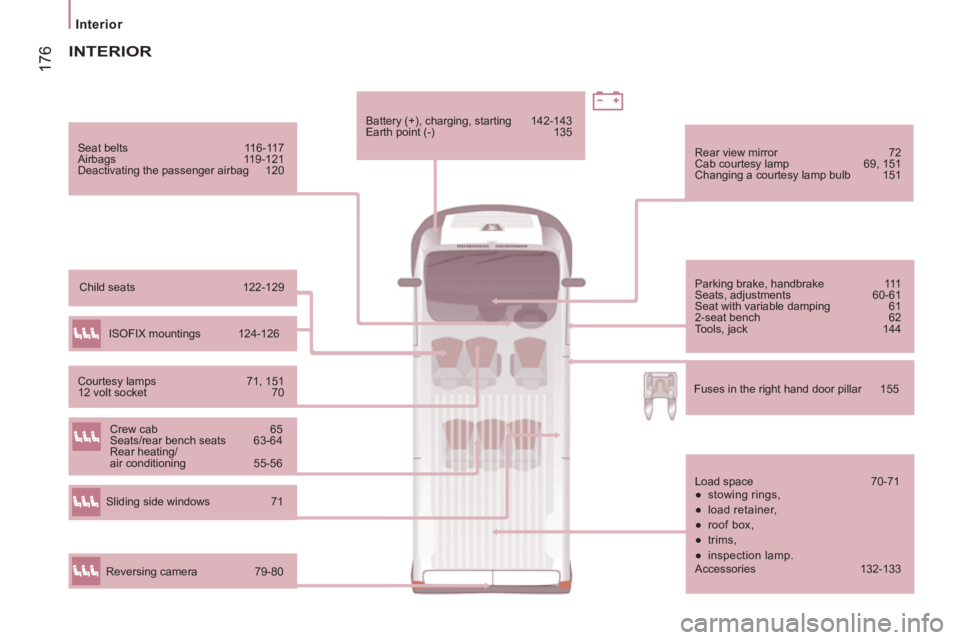
17
6
Interior
Seat belts 116-117
Airbags 119-121
Deactivating the passenger airbag 120
Parking brake, handbrake 111
Seats, adjustments 60-61
Seat with variable damping 61
2-seat bench 62
Tools, jack 144
ISOFIX mountings 124-126 Child seats 122-129
Courtesy lamps 71, 151
12 volt socket 70 Rear view mirror 72
Cab courtesy lamp 69, 151
Changing a courtesy lamp bulb 151
Load space 70-71
●
stowing rings,
●
load retainer,
●
roof box,
●
trims,
●
inspection lamp.
Accessories 132-133
INTERIOR
Sliding side windows 71 Battery (+), charging, starting 142-143
Earth point (-) 135
Reversing camera 79-80 Fuses in the right hand door pillar 155
Crew cab 65
Seats/rear bench seats 63-64
Rear heating/
air conditioning 55-56