tow PEUGEOT BOXER 2011 Owner's Manual
[x] Cancel search | Manufacturer: PEUGEOT, Model Year: 2011, Model line: BOXER, Model: PEUGEOT BOXER 2011Pages: 184, PDF Size: 4.86 MB
Page 132 of 184
130
Towing a trailer
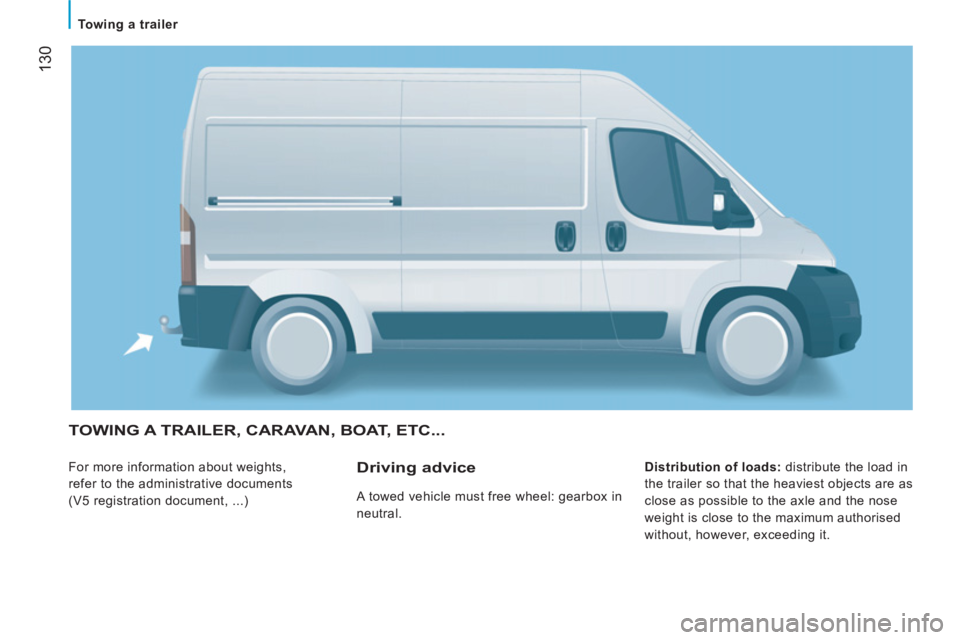
TOWING A TRAILER, CARAVAN, BOAT, ETC...
For more information about weights,
refer to the administrative documents
(V5 registration document, ...)
Distribution of loads:
distribute the load in
the trailer so that the heaviest objects are as
close as possible to the axle and the nose
weight is close to the maximum authorised
without, however, exceeding it. Driving advice
A towed vehicle must free wheel: gearbox in
neutral.
Page 133 of 184
131
6
Towing a trailer
ACCESSORIE
S
Cooling:
towing a trailer on a slope
increases the coolant temperature.
As the fan is electrically controlled, its
cooling capacity is not dependent on
the engine speed.
On the contrary, use a high gear to lower
the engine speed and reduce your speed.
In all cases, pay attention to the coolant
temperature.
Tyres:
check the tyre pressures of the
towing vehicle (see the "Identification
markings" section of chapter 9) and of
the trailer, observing the recommended
pressures.
We recommend the use of original
PEUGEOT towbars and their harnesses,
which have been tested and approved from
the design stage of your vehicle and that
the fitting of this equipment is entrusted to
a PEUGEOT dealer.
If this equipment is not fitted by a PEUGEOT
dealer, it is imperative that it is fitted using
the electrical pre-equipment installed at the
rear of the vehicle and in accordance with
the manufacturer's instructions.
Good practice
In certain cases of particularly arduous
use (towing the maximum load up a steep
slope in high temperatures), the engine
automatically limits its power. In this
case, the automatic cutting off of the air
conditioning allows the engine power to be
recovered.
If the coolant temperature
warning lamp comes on, stop the
vehicle and switch off the engine
as soon as possible.
See the "Levels" section of chapter 7.
Brakes:
towing increases the braking
distance. Drive at a moderate speed,
change down early and brake gradually.
Side wind:
sensitivity to side wind is
increased. Drive smoothly and at a moderate
speed.
ABS:
the system only controls the vehicle,
not the trailer.
Rear parking
sensors
:
the system does not
operate while the vehicle is towing.
Page 134 of 184
Equipment
132
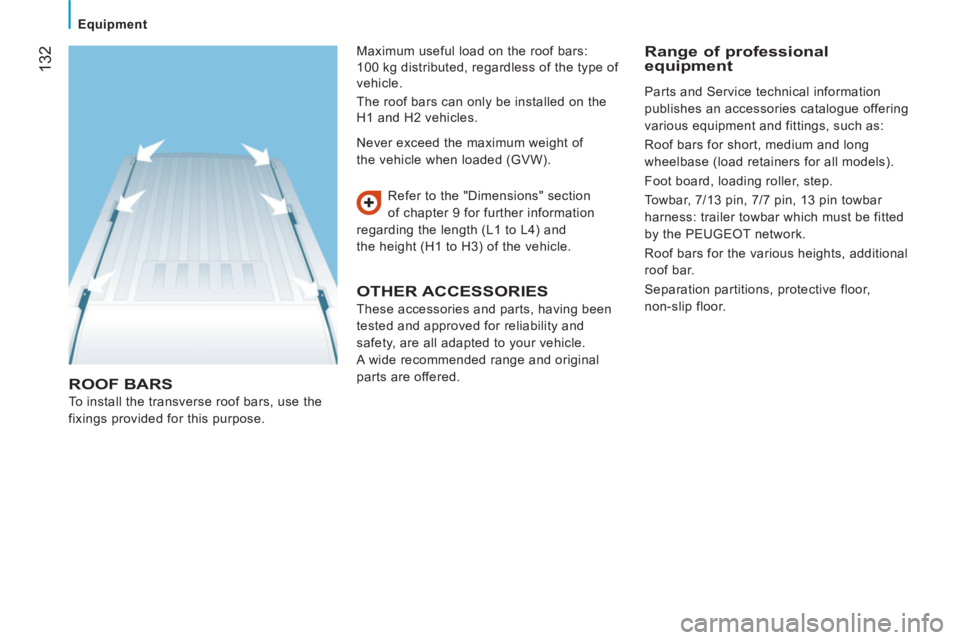
ROOF BARS
To install the transverse roof bars, use the
fixings provided for this purpose. Refer to the "Dimensions" section
of chapter 9 for further information
regarding the length (L1 to L4) and
the height (H1 to H3) of the vehicle. Never exceed the maximum weight of
the vehicle when loaded (GVW).
OTHER ACCESSORIES
These accessories and parts, having been
tested and approved for reliability and
safety, are all adapted to your vehicle.
A wide recommended range and original
parts are offered.
Range of professional equipment
Maximum useful load on the roof bars:
100 kg distributed, regardless of the type of
vehicle.
The roof bars can only be installed on the
H1 and H2 vehicles. Parts and Service technical information
publishes an accessories catalogue offering
various equipment and fittings, such as:
Roof bars for short, medium and long
wheelbase (load retainers for all models).
Foot board, loading roller, step.
Towbar, 7/13 pin, 7/7 pin, 13 pin towbar
harness: trailer towbar which must be fitted
by the PEUGEOT network.
Roof bars for the various heights, additional
roof bar.
Separation partitions, protective floor,
non-slip floor.
Page 136 of 184
134
Opening the bonnet
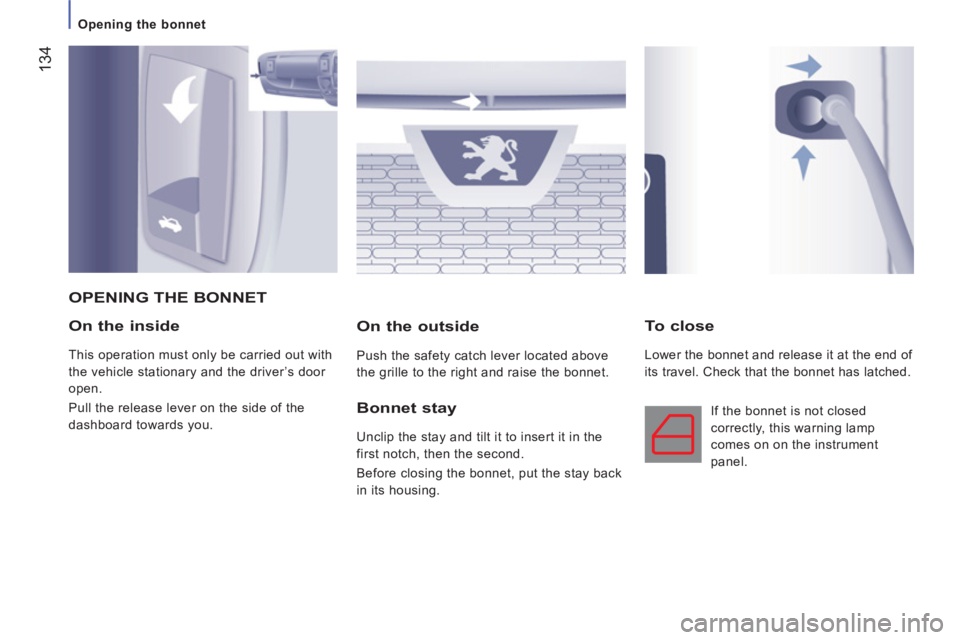
On the inside
This operation must only be carried out with
the vehicle stationary and the driver’s door
open.
Pull the release lever on the side of the
dashboard towards you.
On the outside
Push the safety catch lever located above
the grille to the right and raise the bonnet.
To close
Lower the bonnet and release it at the end of
its travel. Check that the bonnet has latched.
OPENING THE BONNET
Bonnet stay
Unclip the stay and tilt it to insert it in the
first notch, then the second.
Before closing the bonnet, put the stay back
in its housing. If the bonnet is not closed
correctly, this warning lamp
comes on on the instrument
panel.
Page 140 of 184
Checks
138
CHECKS
Air filter and passenger compartment filter
A clogged passenger compartment filter
may reduce the performance of the
air conditioning system and generate
undesirable odours. The replacement
intervals for these components are indicated
in the servicing booklet.
Depending on the environment (dusty
atmosphere...) and the use of the vehicle
(urban driving...), change them twice as
often if necessary, refer to the "Under the
bonnet" section of chapter 7.
Manual gearbox
Have the level checked in accordance with
the manufacturer's servicing schedule.
To check the main levels and certain
components, in accordance with the
manufacturer's servicing schedule, refer to
the pages of the servicing booklet which
correspond to your vehicle's engine.
Only use products recommended by
PEUGEOT or products of equivalent quality
and specification.
In order to optimise the operation of units as
important as the braking system, PEUGEOT
selects and offers specific products.
In order to avoid damaging the electrical
units, high pressure washing to clean the
engine compartment is strictly prohibited.
Parking brake
Where the parking brake travel is too great
or there is a reduction in the performance
of the system, the parking brake should be
adjusted, even between services.
Have the system checked by a PEUGEOT
dealer.
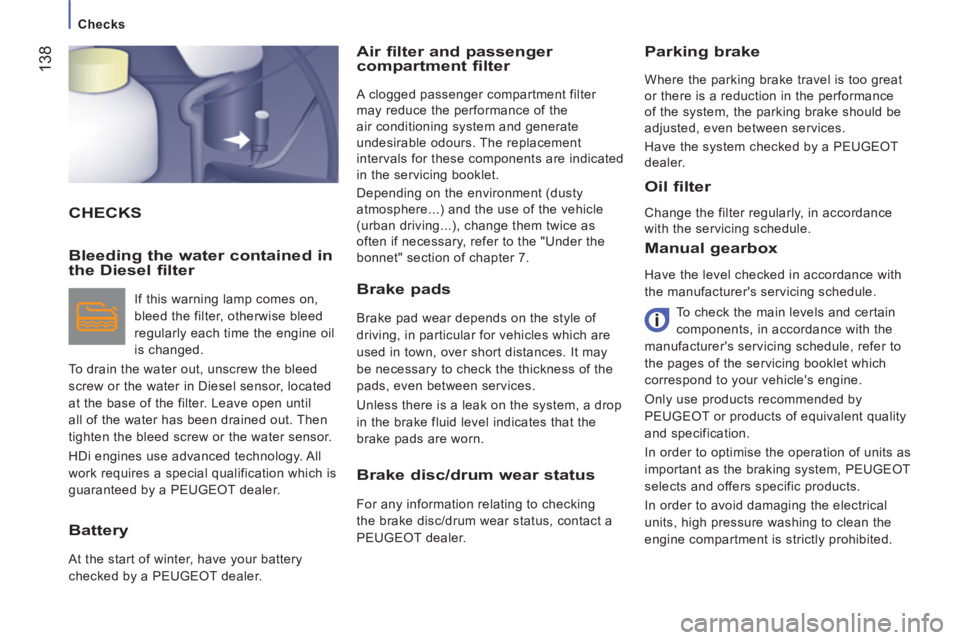
Bleeding the water contained in
the Diesel filter
If this warning lamp comes on,
bleed the filter, otherwise bleed
regularly each time the engine oil
is changed.
To drain the water out, unscrew the bleed
screw or the water in Diesel sensor, located
at the base of the filter. Leave open until
all of the water has been drained out. Then
tighten the bleed screw or the water sensor.
HDi engines use advanced technology. All
work requires a special qualification which is
guaranteed by a PEUGEOT dealer.
Battery
At the start of winter, have your battery
checked by a PEUGEOT dealer.
Brake pads
Brake pad wear depends on the style of
driving, in particular for vehicles which are
used in town, over short distances. It may
be necessary to check the thickness of the
pads, even between services.
Unless there is a leak on the system, a drop
in the brake fluid level indicates that the
brake pads are worn.
Brake disc/drum wear status
For any information relating to checking
the brake disc/drum wear status, contact a
PEUGEOT dealer.
Oil filter
Change the filter regularly, in accordance
with the servicing schedule.
Page 146 of 184
144
Changing a wheel
1. PARKING THE VEHICLE
As far as possible, park the vehicle on level,
stable and non-slippery ground.
Apply the parking brake, switch off the
ignition and engage first gear.
Put on a high visibility jacket and position
the warning triangle.
If possible, place a chock under the
wheel diagonally opposite the wheel to be
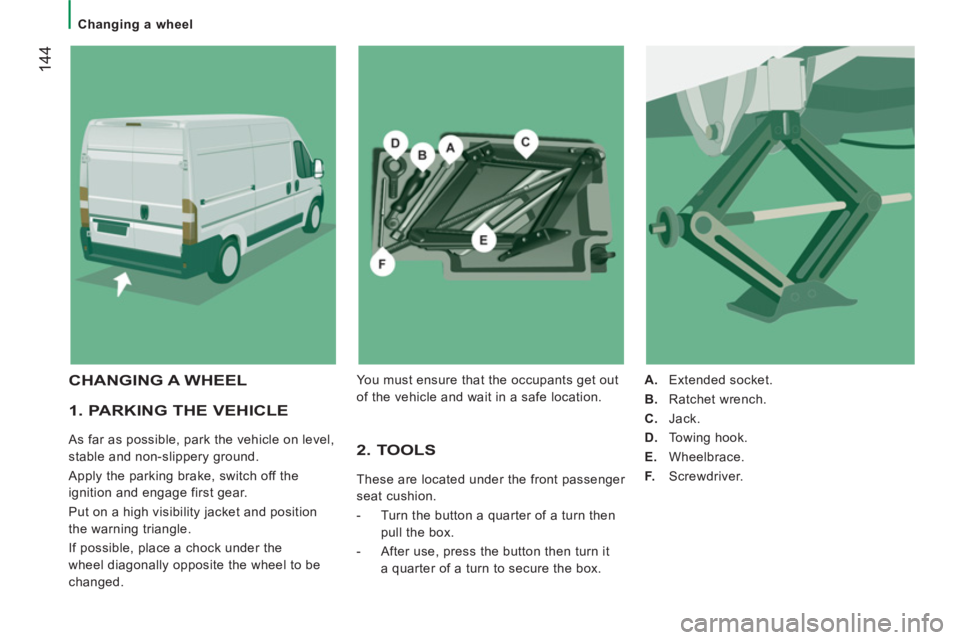
changed. 2. TOOLS
These are located under the front passenger
seat cushion.
- Turn the button a quarter of a turn then
pull the box.
- After use, press the button then turn it
a quarter of a turn to secure the box.
A.
Extended socket.
B.
Ratchet wrench.
C.
Jack.
D.
Towing hook.
E.
Wheelbrace.
F.
Screwdriver.
CHANGING A WHEEL
You must ensure that the occupants get out
of the vehicle and wait in a safe location.
Page 148 of 184
14
6
Changing a wheel
6. REFITTING THE REPAIREDWHEEL
Refitting of the wheel is identical to step 5,
do not forget to refit the wheel trim.
Refer to the "Identification markings"
section of chapter 9 to locate the tyre
label.
The spare wheel is not designed to be used
over long distances. Have the tightening of
the bolts and pressure of the spare wheel
checked by a PEUGEOT dealer without
delay.
Also, have the original wheel repaired and
refitted by a PEUGEOT dealer as soon as
possible.
5. FITTING THE SPARE WHEEL
- Put the wheel in place on the hub and
start screwing in the bolts by hand.
- Carry out an initial tightening of the bolts
using the wheelbrace E
.
- Lower the vehicle completely by folding
the jack, then remove the jack.
- Tighten the bolts again using the
wheelbrace E
, tighten them fully without
forcing them.
- Stow the wheel to be repaired at the
rear of the vehicle.
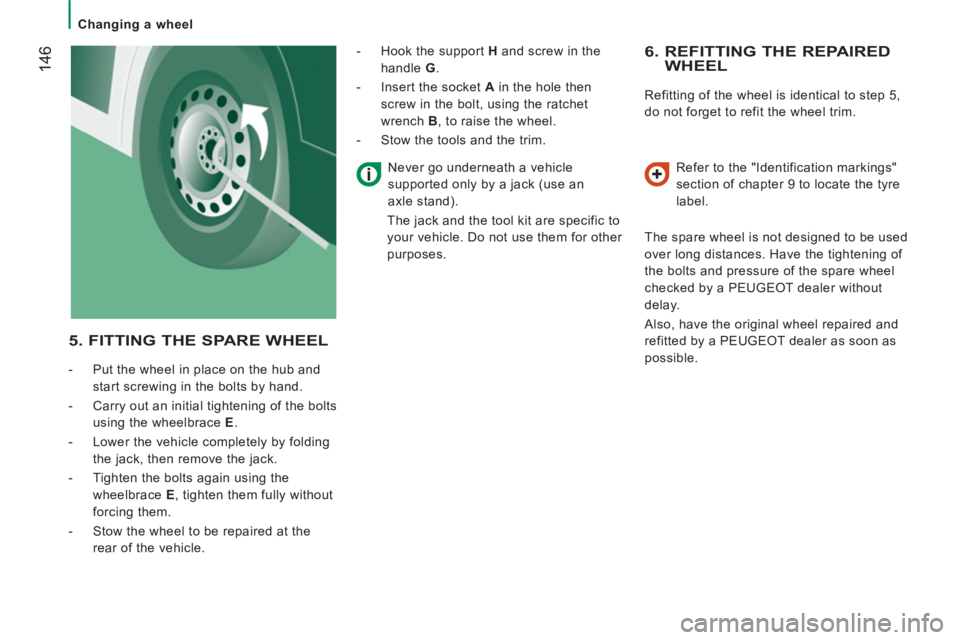
- Hook the support H
and screw in the
handle G
.
- Insert the socket A
in the hole then
screw in the bolt, using the ratchet
wrench B
, to raise the wheel.
- Stow the tools and the trim.
Never go underneath a vehicle
supported only by a jack (use an
axle stand).
The jack and the tool kit are specific to
your vehicle. Do not use them for other
purposes.
Page 160 of 184
158
Having your vehicle towed
BEING TOWED
Without liftin
g(four wheels on the ground)
You must always use a towing bar.
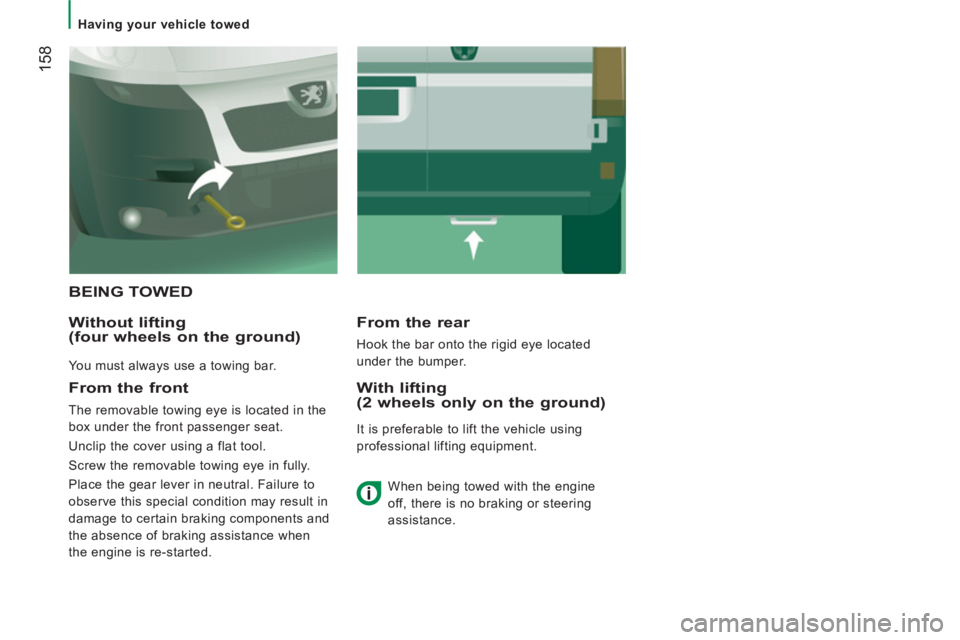
From the rear
Hook the bar onto the rigid eye located
under the bumper.
From the front
The removable towing eye is located in the
box under the front passenger seat.
Unclip the cover using a flat tool.
Screw the removable towing eye in fully.
Place the gear lever in neutral. Failure to
observe this special condition may result in
damage to certain braking components and
the absence of braking assistance when
the engine is re-started.
With lifting(2 wheels only on the ground)
It is preferable to lift the vehicle using
professional lifting equipment.
When being towed with the engine
off, there is no braking or steering
assistance.
Page 170 of 184
168
Weights
WEIGHTS
Dimensions
Model
GVW in kg
L1 H1
330
3 000
333
3 300
L2 H1
333
3 300
335
3 500
L2 H2
330
3 000
333
3 300
335
3 500
L3 H2
330
3 000
335
3 500
435
3 500
440
4 000
L3 H3
330
3 000
335
3 500
435
3 500
440
4 000
L4 H2
335
3 500
L4 H3
435
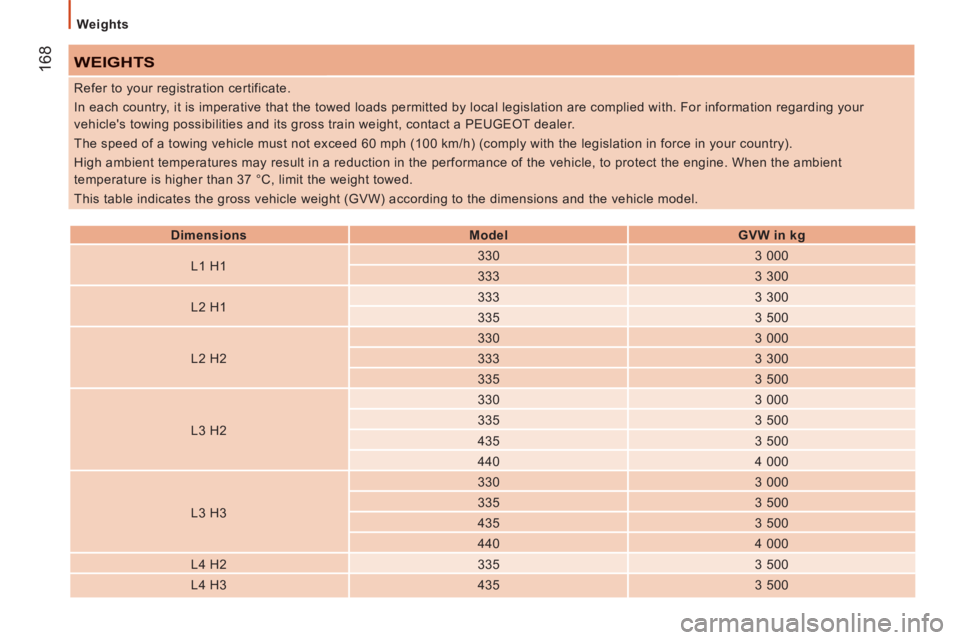
3 500 Refer to your registration certificate.
In each country, it is imperative that the towed loads permitted by local legislation are complied with. For information regarding your
vehicle's towing possibilities and its gross train weight, contact a PEUGEOT dealer.
The speed of a towing vehicle must not exceed 60 mph (100 km/h) (comply with the legislation in force in your country).
High ambient temperatures may result in a reduction in the performance of the vehicle, to protect the engine. When the ambient
temperature is higher than 37 °C, limit the weight towed.
This table indicates the gross vehicle weight (GVW) according to the dimensions and the vehicle model.
Page 171 of 184
169
9
TECHNI
CAL DAT
A
Weights
*
15 inch wheels.
**
16 inch wheels.
Load transfer
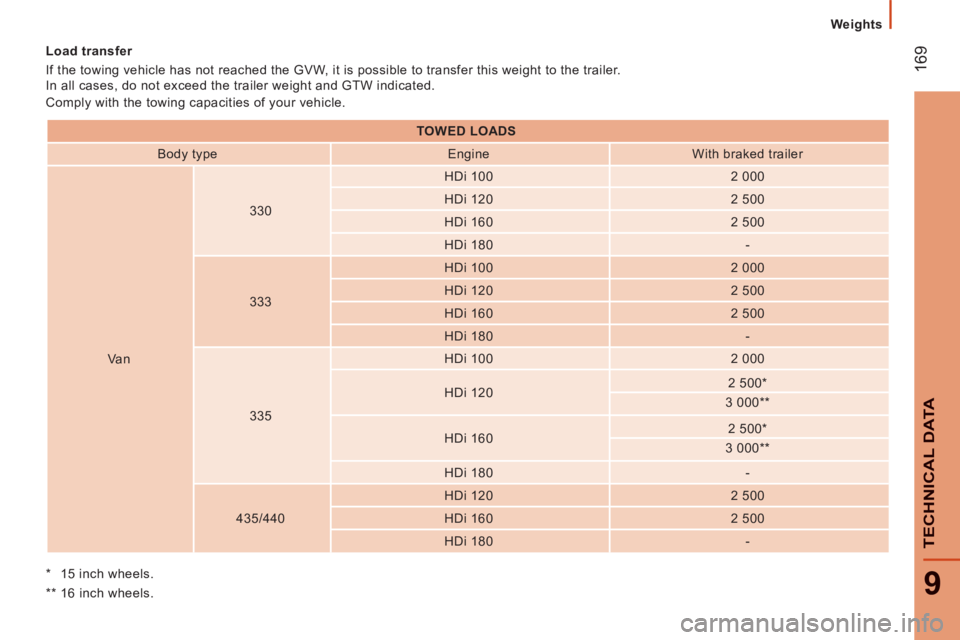
If the towing vehicle has not reached the GVW, it is possible to transfer this weight to the trailer.
In all cases, do not exceed the trailer weight and GTW indicated.
Comply with the towing capacities of your vehicle.
TOWED LOADS
Body type
Engine
With braked trailer
Va n
330
HDi 100
2 000
HDi 120
2 500
HDi 160
2 500
HDi 180
-
333
HDi 100
2 000
HDi 120
2 500
HDi 160
2 500
HDi 180
-
335
HDi 100
2 000
HDi 120
2 500 *
3 000 **
HDi 160
2 500 *
3 000 **
HDi 180
-
435/440
HDi 120
2 500
HDi 160
2 500
HDi 180
-