ECU PEUGEOT BOXER 2015 User Guide
[x] Cancel search | Manufacturer: PEUGEOT, Model Year: 2015, Model line: BOXER, Model: PEUGEOT BOXER 2015Pages: 276, PDF Size: 8.99 MB
Page 111 of 276
109
Improved safety and security
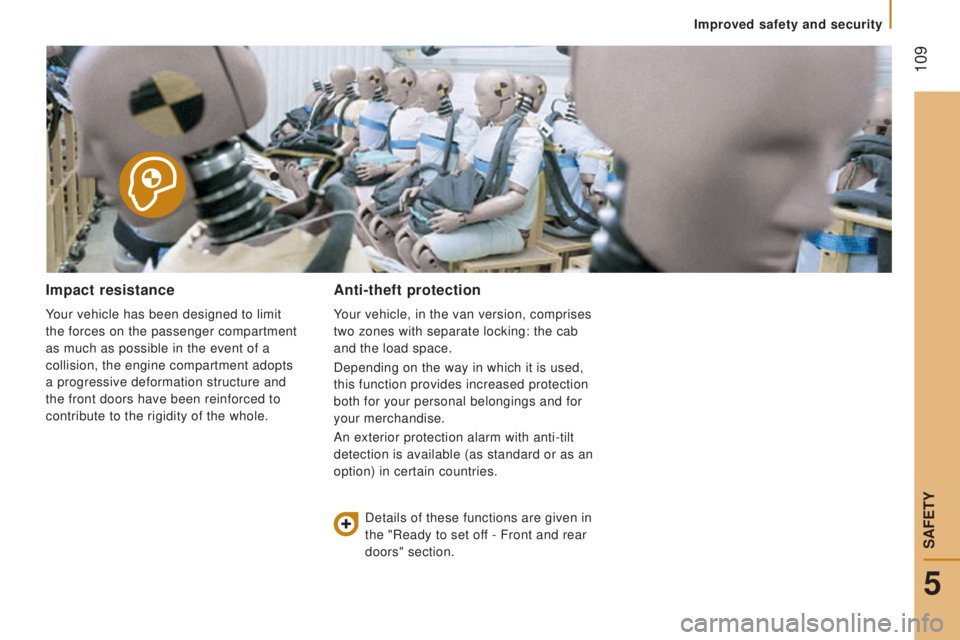
Impact resistance
Your vehicle has been designed to limit
the forces on the passenger compartment
as much as possible in the event of a
collision, the engine compartment adopts
a progressive deformation structure and
the front doors have been reinforced to
contribute to the rigidity of the whole.
Anti-theft protection
Your vehicle, in the van version, comprises
two zones with separate locking: the cab
and the load space.
Depending on the way in which it is used,
this function provides increased protection
both for your personal belongings and for
your merchandise.
An exterior protection alarm with anti-tilt
detection is available (as standard or as an
option) in certain countries.Details of these functions are given in
the "Ready to set off - Front and rear
doors" section.
5
SAFetY
Page 114 of 276
11 2
Good practice
If your vehicle is fitted with airbags, observe the safety guidelines below for these to be fully effective.
Wear a correctly adjusted seat belt.
Sit in a normal upright position.
Do not leave anything between the
occupants and the airbags (child, animal,
object...), do not fix or attach anything near
to or in the trajectory of the airbags as this
could cause injuries during deployment.
Never modify the original definition of your
vehicle, particularly in the area directly
around the airbags.
All work on the airbag systems must be
carried out by a P
eugeOt dealer or a
qualified workshop.
After an accident or if the vehicle has been
stolen or broken into, have the airbag
systems checked. Front airbags
Do not drive holding the steering wheel
by its spokes or resting your hands on the
centre part of the wheel.
Passengers must not place their feet on the
dashboard.
Smoke as little as possible; deployment of
the airbags can cause burns or the risk of
injury from a cigarette or pipe.
Never remove or pierce the steering wheel
or hit it violently.
Lateral airbags
Fit only approved covers on the front seats,
compatible with the deployment of lateral
airbags. For information on the range of
covers suitable for your vehicle, contact a
P
eugeOt dealer.
Do not fix or attach anything to the front seat
backs.
this could cause injury to the chest
or arms when the lateral airbag is deployed.
Do not sit with the upper part of the body
any nearer to the door than necessary.
curtain airbags
Do not fix or attach anything to the pillars or
the roof.
this could cause injury to the head
when the curtain airbag is deployed.
Do not remove the bolts from the grab
handles installed on the roof, they play a
part in securing the curtain airbags.
Airbags
Page 119 of 276
11 7
"ISoFIx" MountInGS
Your vehicle has been approved
to the latest ISOFIX regulation.
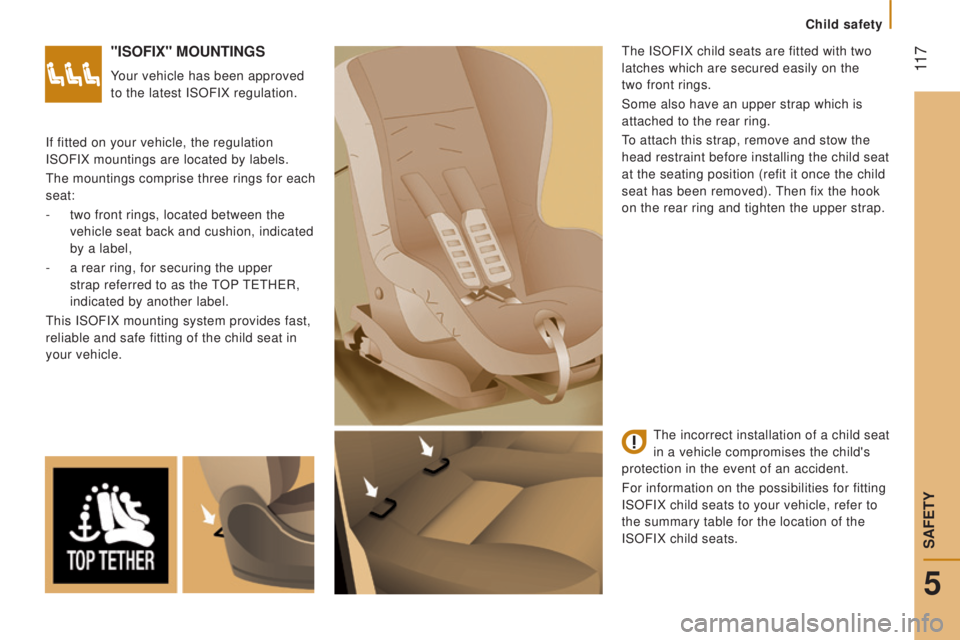
the ISOFIX child seats are fitted with two
latches which are secured easily on the
two front rings.
Some also have an upper strap which is
attached to the rear ring.
to attach this strap, remove and stow the
head restraint before installing the child seat
at the seating position (refit it once the child
seat has been removed).
then fix the hook
on the rear ring and tighten the upper strap.
If fitted on your vehicle, the regulation
ISOFIX mountings are located by labels.
the mountings comprise three rings for each
seat:
-
two front rings, located between the
vehicle seat back and cushion, indicated
by a label,
-
a rear ring, for securing the upper
strap referred to as the
tOP tetHeR,
indicated by another label.
this ISOFIX mounting system provides fast,
reliable and safe fitting of the child seat in
your vehicle.
the incorrect installation of a child seat
in a vehicle compromises the child's
protection in the event of an accident.
For information on the possibilities for fitting
ISOFIX child seats to your vehicle, refer to
the summary table for the location of the
ISOFIX child seats.
5
SAFetY
Child safety
Page 120 of 276

11 8
LocAtIonS For tHE InStALLAtIon oF ISoFIx cHILd SEAtS
In accordance with european regulations, this table indicates the options for the installati\
on of ISOFIX child seats on the vehicle seats fitted
with ISOFIX mountings.
In the case of the universal and semi-universal ISOFIX child seats, the \
child seat's ISOFIX size category, determined by a letter from
A to G ,
is indicated on the child seat next to the ISOFIX logo.
Less than
10 kg
(group 0)
up to 6 months
approx Less than 10 kg
(group 0)
Less than 13 kg
(group 0+)
up to 1 year approx From 9 to 18 kg
(group 1)
From 1 to 3 years approx
type of ISoFIx child seat Infant carrier
rearward facingforward facing
IS
oFIx size category F
G
cdEcdAB1
row 2 outer rear seats
with individual seats in
row 1 IuF
IuF IuF
row 2 outer rear seats
with 2-seat bench in
row 1 IuFxIuFxIuF
I
uF:
Seat suitable for the installation of
an ISOFIX child seat of the universal
category. Forward facing ISOFIX child
seats fitted with an upper strap secured
to the upper ring of the vehicle seats
equipped with ISOFIX mountings.
x: Seat not suitable for the installation of
an ISOFIX child seat of the size category
indicated.
Remove and stow the head restraint
before installing a child seat with
backrest on a passenger seat.
Refit the head restraint once the child seat
has been removed.
Child safety
Page 121 of 276

11 9
InStALLInG cHILd SEAtS AttAcHEd uSInG tHE SEAt BELt
In accordance with the european regulation, this table indicates the options for installing chil\
d seats secured using a seat belt and
universally approved in accordance with the weight of the child and the \
seat in the vehicle.
Weight of the child and indicative age
Seat
under 13 kg
(groups 0 (
a) and 0+)
up to approx 1 year From 9 to 18 kg
(group 1)
1 to 3 years approx From 15 to 25 kg
(group 2)
3 to 6 years approx From 22 to 36 kg
(group 3)
6 to 10 years approx
Front passenger
seat (b )
u uuu
Front passenger
bench seat with centre
and outer seat (b )
u uuu
Outer
seats
in rows 2
and 3
u uuu
Centre
seat
in rows 2
and 3
u uuu
a: group 0: from birth to 10 kg.
b :
consult the legislation in force in your
country before installing your child on this
seat.
Remove and stow the head restraint
before installing a child seat with
backrest on a passenger seat.
Refit the head restraint once the child seat
has been removed.
u: seat suitable for the installation of a
child seat secured using a seat belt and
universally approved, rearward facing
and/or forward facing.
5
SAFetY
Child safety
Page 122 of 276
120
Good practice
children at the front
the legislation on carrying a child on the
front passenger seat is specific to each
country. Refer to the legislation in force in
your country.
Deactivate the passenger's airbag when a
rearward facing child seat is installed on the
front seat.
Otherwise, the child would risk being
seriously injured or killed if the airbag were
deployed. As a safety precaution, never leave:
-
one or more children alone and
unsupervised in a vehicle,
-
a child or an animal in a vehicle which
is exposed to the sun, with the windows
closed,
-
the keys within reach of children inside
the vehicle.
to prevent accidental opening of the doors,
use the "Child Lock".
take care not to open the rear windows by
more than one third.
to protect young children from the rays of
the sun, fit side blinds to the rear windows. Installing a booster seat
the chest part of the seat belt must be
positioned on the child's shoulder without
touching the neck.
ensure that the lap part of the seat belt
passes correctly over the child's thighs.
P
eugeOt recommends the use of a
booster seat which has a back, fitted with a
seat belt guide at shoulder level.
For the optimum installation of a forward
facing child seat, ensure that the back of
the child seat is as close as possible to the
backrest of the vehicle's seat, or in contact
if possible.
the head restraint must be removed before
installing a child seat with a backrest on the
passenger seat.
ensure that the head restraint is stowed or
attached securely so that it is not thrown
around the vehicle in the event of sharp
braking.
Refit the head restraint as soon as the child
seat is removed.
At the rear, always leave sufficient space
between the front seat and:
-
a rearward facing child seat,
-
the feet of a child seated in a forward
facing child seat.
For this, move the front seat forward and, if
necessary, straighten its backrest as well.
the incorrect installation of a child seat in a
vehicle compromises the child's protection in
the event of an accident.
Check that there is no seat belt or seat belt
buckle under the child seat, as this could
destabilise the seat.
Remember to fasten the seat belts or the
child seat harnesses keeping the slack
relative to the child's body to a minimum,
even for short journeys.
For the installation of a child seat using
the seat belt, ensure that the seat belt is
well tensioned on the child seat and that
it is holding the child seat firmly against
the vehicle's seat. If the passenger seat is
adjustable, move it forward if necessary.
Child safety
Page 125 of 276
123
rooF cArrYInG SYStEMS
Refer to the "technical data -
Dimensions" section for more
information on the length (L1 to L4) and the
height (H1 to H3) of the vehicle. Maximum load on the roof, evenly
distributed: 150 kg, for all versions,
within the vehicle's weight limit (
gross
Vehicle Weight).
For reasons of safety and to avoid damaging
the roof, it is essential to use a carrying
system (roof bars or roof rack) that is
approved for your vehicle.
Roof bars can only be fitted to an H1 or H2
height van, combi and minibus versions. On
a minibus, check for the presence of roof air
conditioning units.
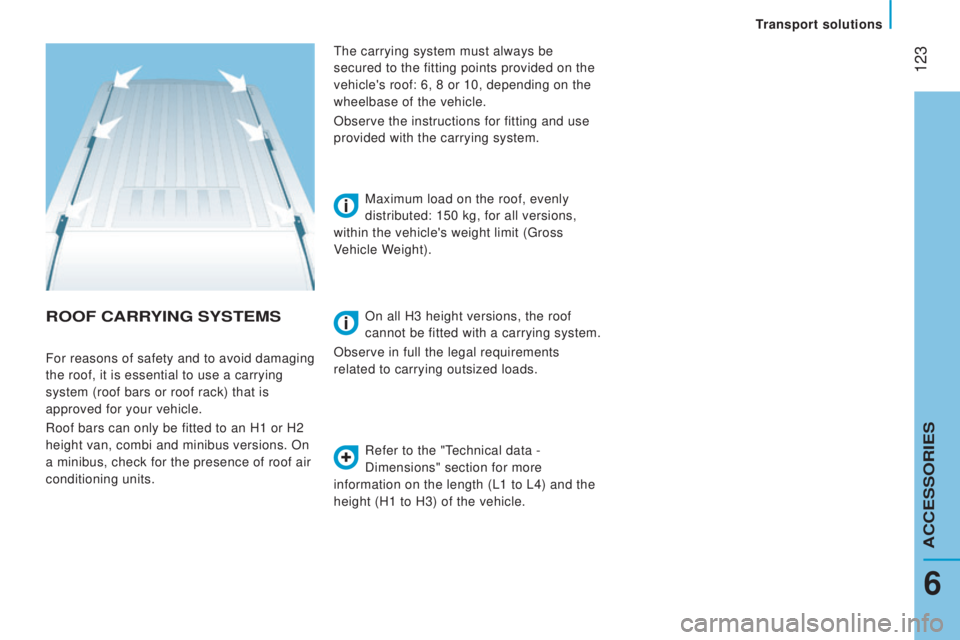
the carrying system must always be
secured to the fitting points provided on the
vehicle's roof: 6, 8 or 10, depending on the
wheelbase of the vehicle.
Observe the instructions for fitting and use
provided with the carrying system.
On all H3 height versions, the roof
cannot be fitted with a carrying system.
Observe in full the legal requirements
related to carrying outsized loads.
6
transport solutions
ACCeSSORIeS
Page 126 of 276
124
otHEr AccESSorIES
these accessories and parts, having been
tested and approved for reliability and
safety
, are all adapted to your vehicle. A
wide range of recommended and genuine
parts is available.
"comfort":
Air deflectors, insulated module, scented air
fresheners, reading lamp, cigarette lighter,
portable ashtray, non-slip seat cushions
,rear parking sensors...
"Protection":
Mats, mudflaps, vehicle protective cover,
seat covers, security grills for rear door
windows, twin rear security doors with
security locks, paint touch-up...
"Security":
Anti-intrusion alarm, vehicle tracking system,
snow chains, non-slip covers, child seats,
first aid kit, warning triangle, high visibility
vest, fire extinguisher, pet safety belt, seat
belt cutter / glass hammer...
"Style":
Alloy wheels...
"Multimedia":
CD player, Wi-Fi on Board, semi-integral
satellite navigation system, hands-free kits,
driving aids, rear multimedia support, DVD
player, navigation mapping update, portable
satellite navigation systems, telephone
carrier, aftermarket digital radio, audio
systems...
"transport solutions":
towbars, towbar wiring harness with
7/13
connector
, 7/7 connector, 13 connector,
interior protection kits, non-slip floor, wheel
arch protector, cab dividers, transverse roof
bars, roof racks, ladder for roof rack, roof
loading runners, loading plate for roof rack... Installation of radiocommunication
transmitters
You are advised to contact a P
eugeOt
dealer before installing accessory
radiocommunication transmitters with
external aerial on your vehicle.
P
eugeOt dealers can advise you on
the specifications (frequency waveband,
maximum output power, aerial position,
specific installation conditions) of the
transmitters which can be fitted, in
accordance with the Vehicle
electromagnetic
Compatibility Directive (2004/104/
eC).
the fitting of electrical equipment or
accessories which are not listed by
P
eugeOt may result in the failure of your
vehicle's electronic system.
W
e request that you take note of this point
and recommend that you contact a dealer
to be shown the range of recommended
equipment and accessories.
Depending on the country in which the
vehicle is sold or operated, it may be
compulsory to have a high visibility vest,
warning triangle, replacement bulbs and
breathalyzer in the vehicle.
to prevent the mat from becoming
caught under the pedals:
-
ensure that the mat and its fixings are
positioned correctly
,
-
never fit one mat on top of another.
equipment
Page 152 of 276
150
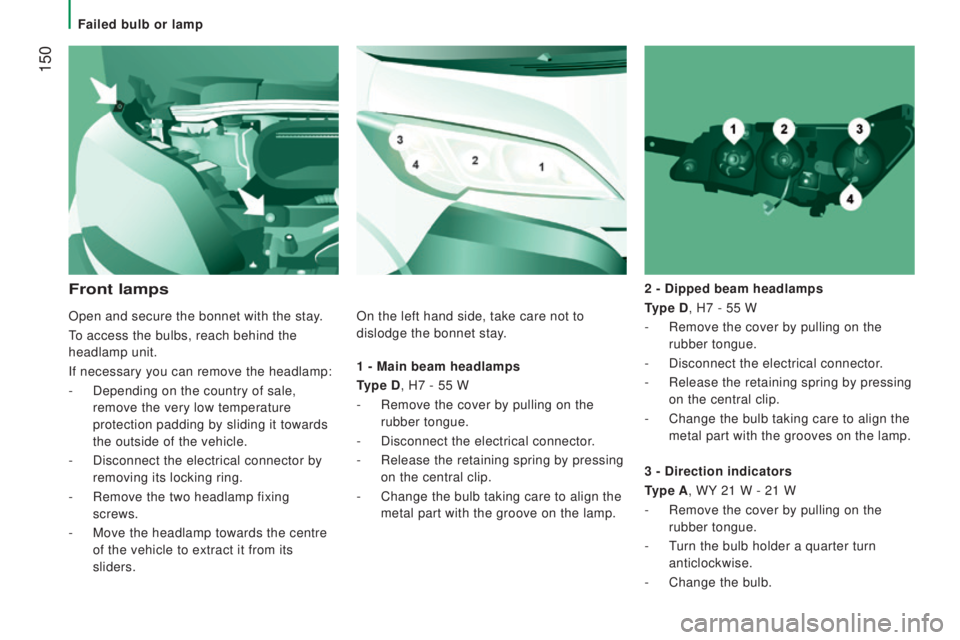
1 - Main beam headlamps
type d, H7 - 55 W
-
Remove the cover by pulling on the
rubber tongue.
-
Disconnect the electrical connector.
-
Release the retaining spring by pressing
on the central clip.
-
Change the bulb taking care to align the
metal part with the groove on the lamp. 2 -
dipped beam headlamps
type d, H7 - 55 W
-
Remove the cover by pulling on the
rubber tongue.
-
Disconnect the electrical connector.
-
Release the retaining spring by pressing
on the central clip.
-
Change the bulb taking care to align the
metal part with the grooves on the lamp.
Front lamps
3 - direction indicators
type A, WY
21 W - 21 W
-
Remove the cover by pulling on the
rubber tongue.
-
t
urn the bulb holder a quarter turn
anticlockwise.
-
Change the bulb.
Open and secure the bonnet with the stay.
to access the bulbs, reach behind the
headlamp unit.
If necessary you can remove the headlamp:
-
Depending on the country of sale,
remove the very low temperature
protection padding by sliding it towards
the outside of the vehicle.
- Disconnect the electrical connector by
removing its locking ring.
-
Remove the two headlamp fixing
screws.
-
Move the headlamp towards the centre
of the vehicle to extract it from its
sliders. On the left hand side, take care not to
dislodge the bonnet stay.
Failed bulb or lamp
Page 154 of 276
152
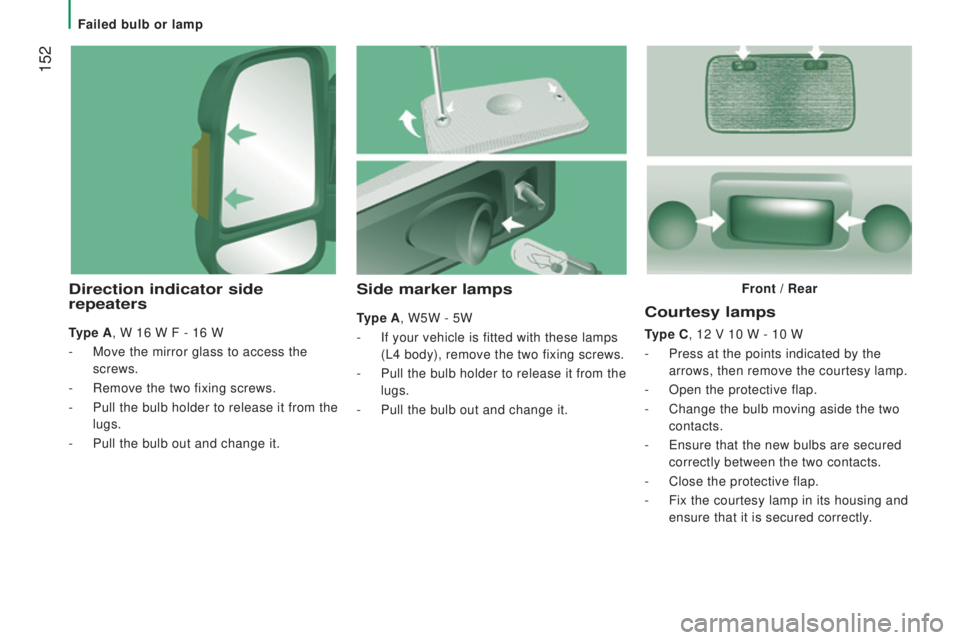
courtesy lamps
type c, 12 V 10 W - 10 W
-
Press at the points indicated by the
arrows, then remove the courtesy lamp.
-
Open the protective flap.
-
Change the bulb moving aside the two
contacts.
-
e
nsure that the new bulbs are secured
correctly between the two contacts.
-
Close the protective flap.
-
Fix the courtesy lamp in its housing and
ensure that it is secured correctly
.
Side marker lamps
type A, W5W - 5W
-
If your vehicle is fitted with these lamps
(L4 body), remove the two fixing screws.
-
Pull the bulb holder to release it from the
lugs.
-
Pull the bulb out and change it.
direction indicator side
repeaters
type A, W 16 W F - 16 W
-
Move the mirror glass to access the
screws.
-
Remove the two fixing screws.
-
Pull the bulb holder to release it from the
lugs.
-
Pull the bulb out and change it. Front /
rear
Failed bulb or lamp