instrument panel PEUGEOT BOXER 2015 User Guide
[x] Cancel search | Manufacturer: PEUGEOT, Model Year: 2015, Model line: BOXER, Model: PEUGEOT BOXER 2015Pages: 276, PDF Size: 8.99 MB
Page 42 of 276
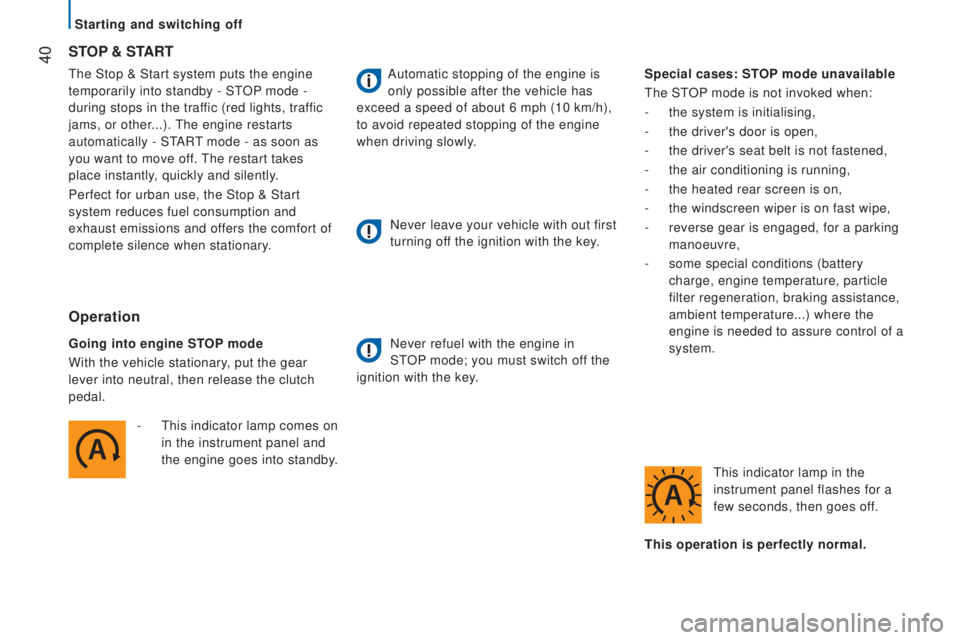
40the Stop & Start system puts the engine
temporarily into standby - S
tOP mode -
during stops in the traffic (red lights, traffic
jams, or other...).
the engine restarts
automatically - S
tARt mode - as soon as
you want to move of
f.
the restart takes
place instantly, quickly and silently.
Perfect for urban use, the Stop & Start
system reduces fuel consumption and
exhaust emissions and offers the comfort of
complete silence when stationary.
StoP & StArt
operation
Going into engine StoP mode
With the vehicle stationary, put the gear
lever into neutral, then release the clutch
pedal.
-
t
his indicator lamp comes on
in the instrument panel and
the engine goes into standby. Automatic stopping of the engine is
only possible after the vehicle has
exceed a speed of about 6 mph (10 km/h),
to avoid repeated stopping of the engine
when driving slowly.
Never leave your vehicle with out first
turning off the ignition with the key.
Never refuel with the engine in
S
tOP mode; you must switch of
f the
ignition with the key. Special cases: S
t
o
P
mode unavailable
the StOP mode is not invoked when:
-
the system is initialising,
-
the driver's door is open,
-
the driver's seat belt is not fastened,
-
the air conditioning is running,
-
the heated rear screen is on,
-
the windscreen wiper is on fast wipe,
-
reverse gear is engaged, for a parking
manoeuvre,
-
some special conditions (battery
charge, engine temperature, particle
filter regeneration, braking assistance,
ambient temperature...) where the
engine is needed to assure control of a
system.
this indicator lamp in the
instrument panel flashes for a
few seconds, then goes off.
this operation is perfectly normal.
Starting and switching off
Page 43 of 276
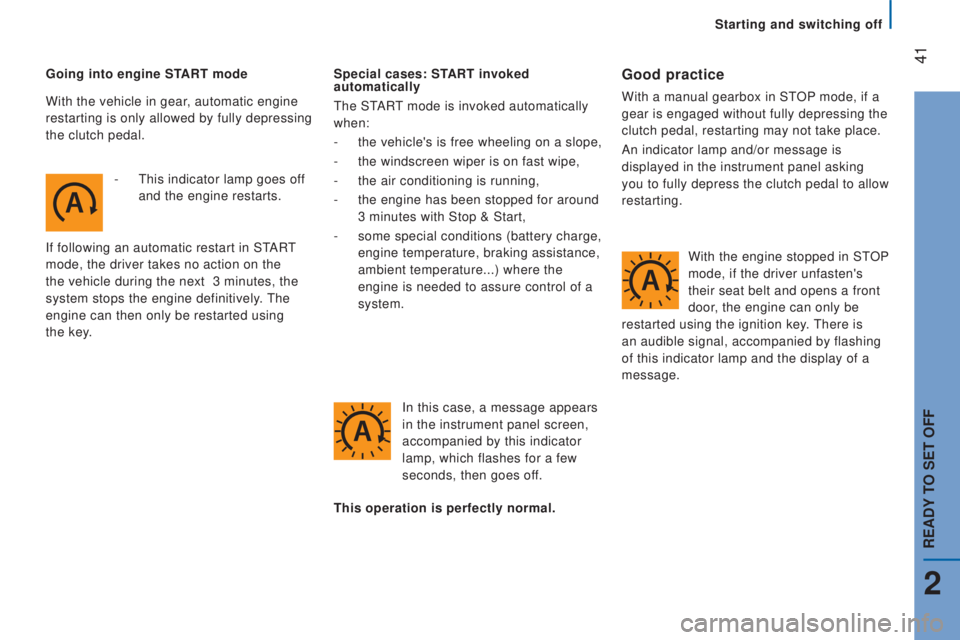
41Going into engine StArt mode
-
t
his indicator lamp goes of
f
and the engine restarts.
If following an automatic restart in S
tARt
mode, the driver takes no action on the
the vehicle during the next
3 minutes, the
system stops the engine definitively.
the
engine can then only be restarted using
the
key
. Special cases: StArt invoked
automatically
the StARt mode is invoked automatically
when:
-
the vehicle's is free wheeling on a slope,
-
the windscreen wiper is on fast wipe,
-
the air conditioning is running,
-
the engine has been stopped for around
3 minutes with Stop & Start,
-
some special conditions (battery charge,
engine temperature, braking assistance,
ambient temperature...) where the
engine is needed to assure control of a
system.
In this case, a message appears
in the instrument panel screen,
accompanied by this indicator
lamp, which flashes for a few
seconds, then goes off.Good practice
With a manual gearbox in StOP mode, if a
gear is engaged without fully depressing the
clutch pedal, restarting may not take place.
An indicator lamp and/or message is
displayed in the instrument panel asking
you to fully depress the clutch pedal to allow
restarting.
this operation is perfectly normal.
With the vehicle in gear
, automatic engine
restarting is only allowed by fully depressing
the clutch pedal.
With the engine stopped in S
tOP
mode, if the driver unfasten's
their seat belt and opens a front
door, the engine can only be
restarted using the ignition key.
there is
an audible signal, accompanied by flashing
of this indicator lamp and the display of a
message.
2
rEAdY to SEt oFF
Starting and switching off
Page 44 of 276
42
deactivation
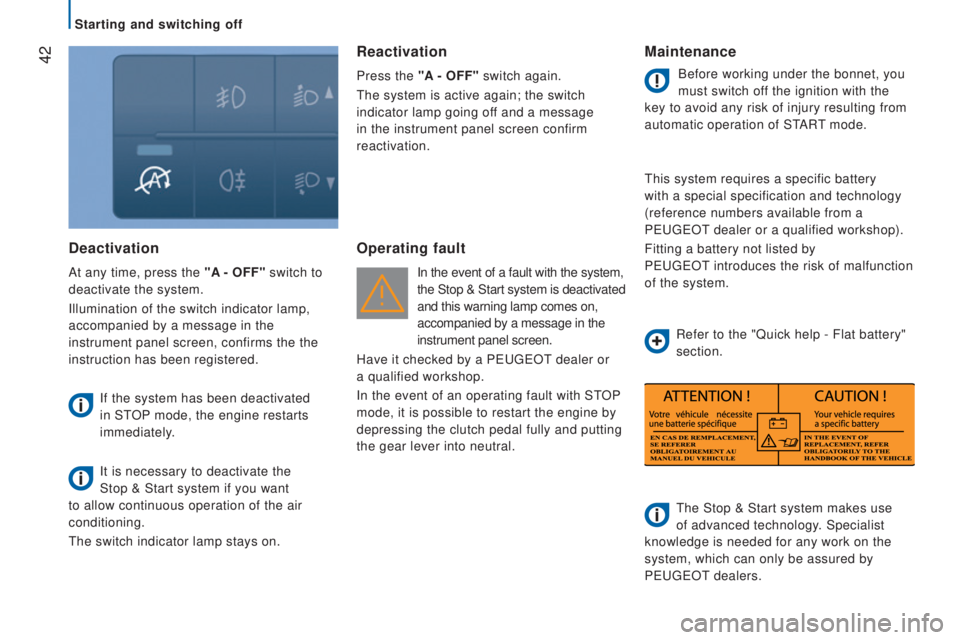
At any time, press the "A - oFF" switch to
deactivate the system.
Illumination of the switch indicator lamp,
accompanied by a message in the
instrument panel screen, confirms the the
instruction has been registered.
If the system has been deactivated
in S
tOP mode, the engine restarts
immediately.
It is necessary to deactivate the
Stop
& Start system if you want
to allow continuous operation of the air
conditioning.
the switch indicator lamp stays on.
reactivation
Press the "A - oFF" switch again.
the system is active again; the switch
indicator lamp going off and a message
in the instrument panel screen confirm
reactivation.
operating fault
In the event of a fault with the system,
the Stop & Start system is deactivated
and this warning lamp comes on,
accompanied by a message in the
instrument panel screen.
Have it checked by a P
eugeOt dealer or
a
qualified workshop.
In the event of an operating fault with S
tOP
mode, it is possible to restart the engine by
depressing the clutch pedal fully and putting
the gear lever into neutral.
Maintenance
Before working under the bonnet, you
must switch off the ignition with the
key to avoid any risk of injury resulting from
automatic operation of S
tARt mode.
this system requires a specific battery
with a special specification and technology
(reference numbers available from a
P
eugeOt dealer or a qualified workshop).
Fitting a battery not listed by
P
eugeOt
introduces the risk of malfunction
of the system.
the Stop & Start system makes use
of advanced technology. Specialist
knowledge is needed for any work on the
system, which can only be assured by
P
eugeOt dealers.
Refer to the "Quick help - Flat battery"
section.
Starting and switching off
Page 48 of 276
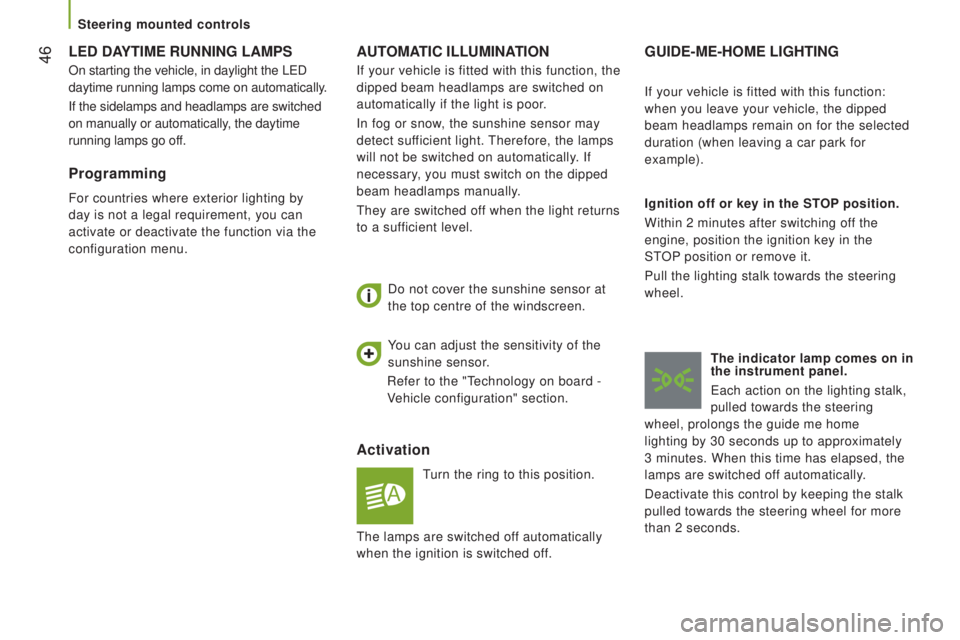
46AutoMAtIc ILLuMInAtIon
Activation
turn the ring to this position.
Do not cover the sunshine sensor at
the top centre of the windscreen.
GuIdE-ME-HoME LIGHtInG
Ignition off or key in the StoP position.
Within 2 minutes after switching off the
engine, position the ignition key in the
S
tOP position or remove it.
Pull the lighting stalk towards the steering
wheel.
the indicator lamp comes on in
the instrument panel.
each action on the lighting stalk,
pulled towards the steering
wheel, prolongs the guide me home
lighting by 30 seconds up to approximately
3
minutes. When this time has elapsed, the
lamps are switched off automatically.
Deactivate this control by keeping the stalk
pulled towards the steering wheel for more
than 2 seconds. If your vehicle is fitted with this function:
when you leave your vehicle, the dipped
beam headlamps remain on for the selected
duration (when leaving a car park for
example).
You can adjust the sensitivity of the
sunshine sensor.
Refer to the "
technology on board -
V
ehicle configuration" section.
If your vehicle is fitted with this function, the
dipped beam headlamps are switched on
automatically if the light is poor.
In fog or snow, the sunshine sensor may
detect sufficient light.
therefore, the lamps
will not be switched on automatically. If
necessary, you must switch on the dipped
beam headlamps manually.they are switched of
f when the light returns
to a sufficient level.
LEd dAYtIME runnInG LAMPS
On starting the vehicle, in daylight the LeD
daytime running lamps come on automatically.
If the sidelamps and headlamps are switched
on manually or automatically, the daytime
running lamps go off.
Programming
For countries where exterior lighting by
day is not a legal requirement, you can
activate or deactivate the function via the
configuration menu.
the lamps are switched of
f automatically
when the ignition is switched off.
Steering mounted controls
Page 49 of 276
47
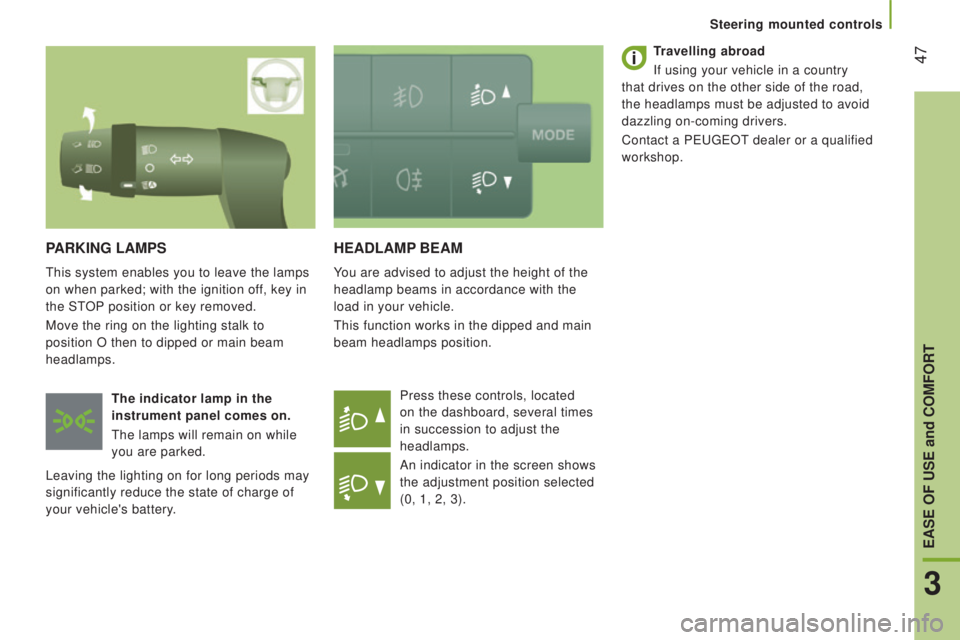
HEAdLAMP BEAM
You are advised to adjust the height of the
headlamp beams in accordance with the
load in your vehicle.
this function works in the dipped and main
beam headlamps position.
Press these controls, located
on the dashboard, several times
in succession to adjust the
headlamps.
An indicator in the screen shows
the adjustment position selected
(0, 1, 2, 3).
PArKInG LAMPS
this system enables you to leave the lamps
on when parked; with the ignition off, key in
the S
tOP position or key removed.
Move the ring on the lighting stalk to
position
O then to dipped or main beam
headlamps.
the
indicator lamp in the
instrument panel comes on.
the lamps will remain on while
you are parked.
Leaving the lighting on for long periods may
significantly reduce the state of charge of
your vehicle's battery.
travelling abroad
If using your vehicle in a country
that drives on the other side of the road,
the headlamps must be adjusted to avoid
dazzling on-coming drivers.
Contact a P
eugeOt dealer or a qualified
workshop.
3
EASE oF uSE and coMFort
Steering mounted controls
Page 51 of 276
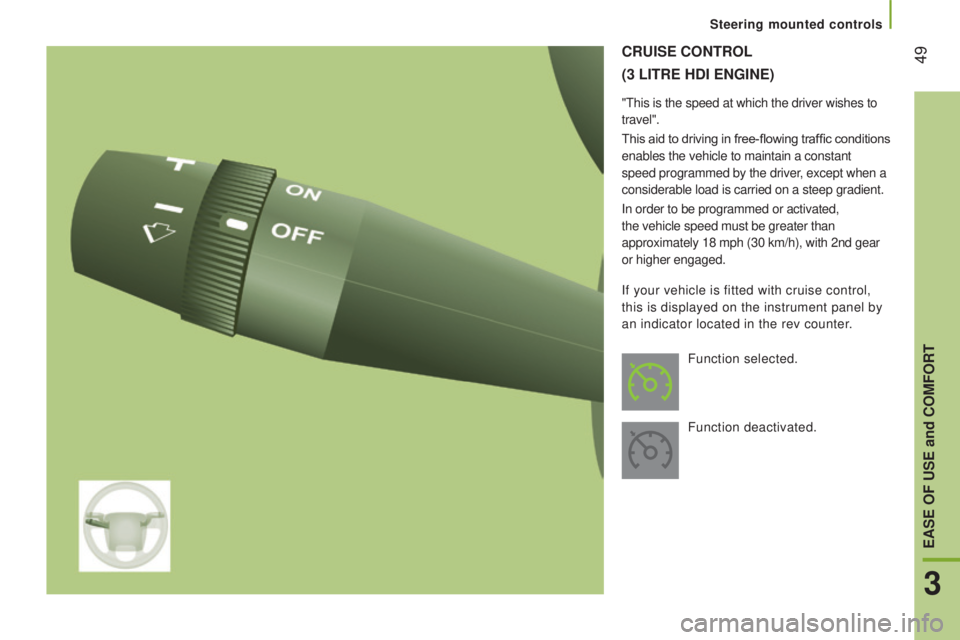
49cruISE controL
(3 LItrE HdI EnGInE)
"this is the speed at which the driver wishes to
travel".
This aid to driving in free-flowing traffic conditions
enables the vehicle to maintain a constant
speed programmed by the driver, except when a
considerable load is carried on a steep gradient.
In order to be programmed or activated,
the vehicle speed must be greater than
approximately 18 mph (30 km/h), with 2nd gear
or higher engaged.
Function selected.
Function deactivated.
If your vehicle is fitted with cruise control,
this is displayed on the instrument panel by
an indicator located in the rev counter.
3
EASE oF uSE and coMFort
Steering mounted controls
Page 52 of 276
50
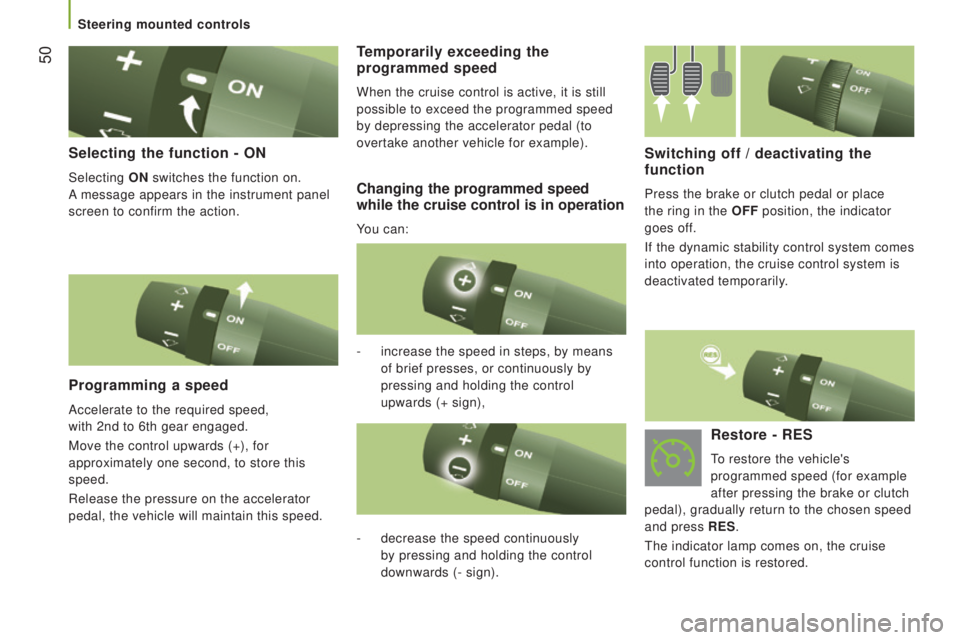
Selecting the function - on
Selecting on switches the function on.
A
message appears in the instrument panel
screen to confirm the action.
Programming a speed
Accelerate to the required speed,
with 2nd to 6th gear engaged.
Move the control upwards (+), for
approximately one second, to store this
speed.
Release the pressure on the accelerator
pedal, the vehicle will maintain this speed.
Switching off / deactivating the
function
Press the brake or clutch pedal or place
the
ring in the oFF
position, the indicator
goes off.
If the dynamic stability control system comes
into operation, the cruise control system is
deactivated temporarily.
-
increase the speed in steps, by means
of brief presses, or continuously by
pressing and holding the control
upwards (+ sign),
temporarily exceeding the
programmed speed
When the cruise control is active, it is still
possible to exceed the programmed speed
by depressing the accelerator pedal (to
overtake another vehicle for example).
-
decrease the speed continuously
by pressing and holding the control
downwards (- sign).
restore - rES
to restore the vehicle's
programmed speed (for example
after pressing the brake or clutch
pedal), gradually return to the chosen speed
and press
rES
.
the indicator lamp comes on, the cruise
control function is restored.
changing the programmed speed
while the cruise control is in operation
You can:
Steering mounted controls
Page 54 of 276
52
cruISE controL
"this is the speed at which the driver wishes
to drive".
this aid to driving in free-flowing traf
fic
enables the vehicle to maintain the speed
programmed by the driver, unless a
steep gradient or heavy load makes this
impossible. In order for it to be programmed or
activated, the vehicle speed must be greater
than 18 mph (30 km/h) with 2
nd gear or
higher engaged. Function selected.
Function deactivated.
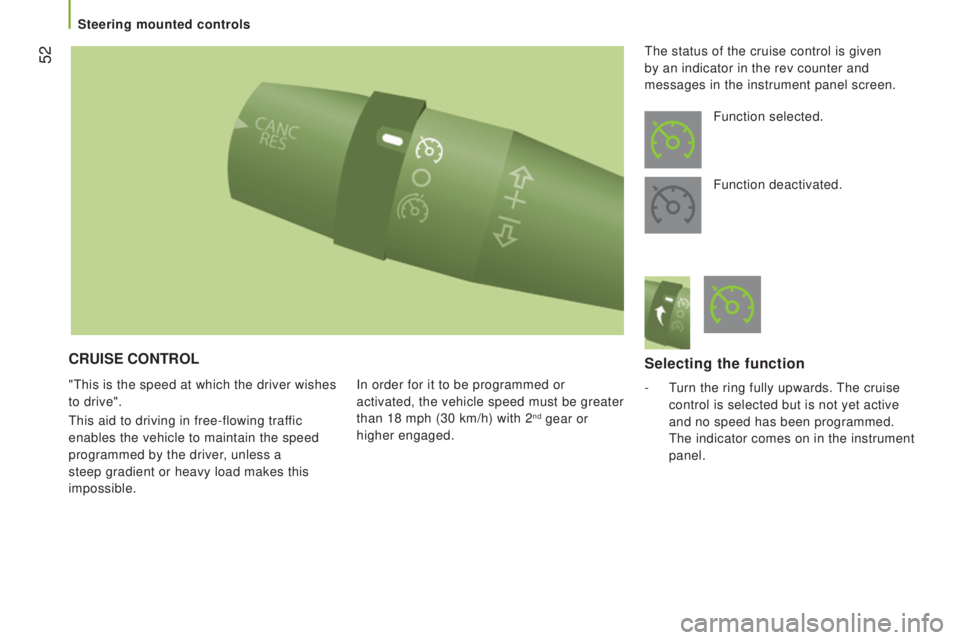
Selecting the function
- turn the ring fully upwards. the cruise
control is selected but is not yet active
and no speed has been programmed.
the
indicator comes on in the instrument
panel.
the status of the cruise control is given
by an indicator in the rev counter and
messages in the instrument panel screen.
Steering mounted controls
Page 55 of 276
53
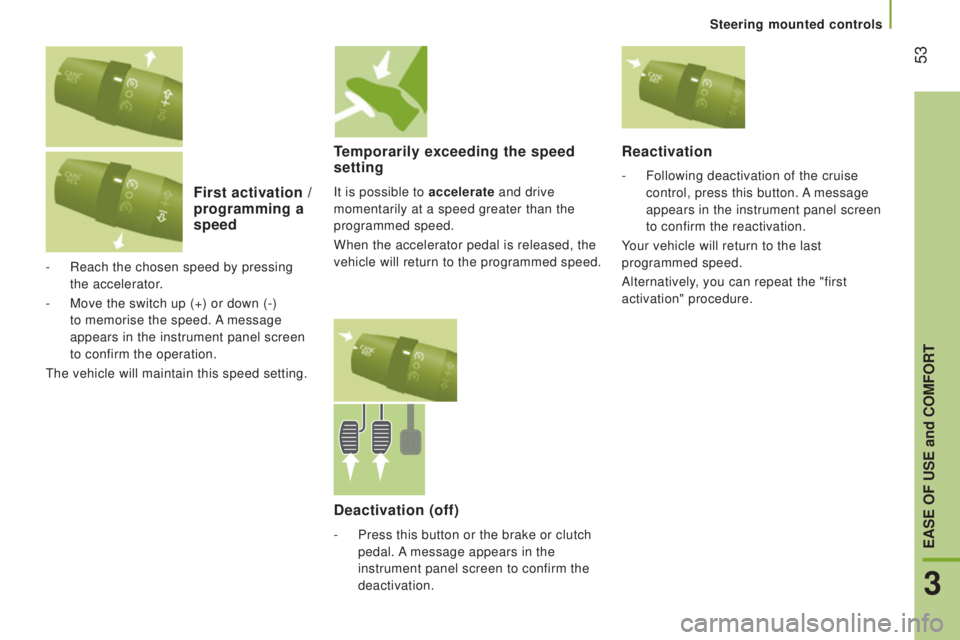
First activation /
programming a
speed
- Reach the chosen speed by pressing
the accelerator.
-
Move the switch up (+) or down (-)
to memorise the speed.
A message
appears in the instrument panel screen
to confirm the operation.
the vehicle will maintain this speed setting.
temporarily exceeding the speed
setting
It is possible to accelerate and drive
momentarily at a speed greater than the
programmed speed.
When the accelerator pedal is released, the
vehicle will return to the programmed speed.
reactivation
- Following deactivation of the cruise
control, press this button.
A message
appears in the instrument panel screen
to confirm the reactivation.
Your vehicle will return to the last
programmed speed.
Alternatively, you can repeat the "first
activation" procedure.
deactivation (off)
- Press this button or the brake or clutch
pedal. A message appears in the
instrument panel screen to confirm the
deactivation.
3
EASE oF uSE and coMFort
Steering mounted controls
Page 57 of 276
55
SPEEd LIMItEr
"this is the selected speed which the driver
does not wish to exceed".
this selection is made with the vehicle
stationary and the engine running or with the
vehicle moving and 2
nd gear or higher engaged.
the lowest speed that can be programmed
is 20 mph (30 km/h).
the speed of the vehicle responds to the
pressure of the driver's foot as far as the
accelerator pedal point of resistance which
indicates that the programmed speed has been
reached. However
, pressing the pedal beyond this
point of resistance to the floor permits
exceeding of the programmed speed.
to
resume use of the limiter
, simply reduce
the pressure on the accelerator pedal
gradually and return to a speed below that
programmed.
the operating actions may be carried out
with the vehicle stationary and the engine
running, or with the vehicle moving.
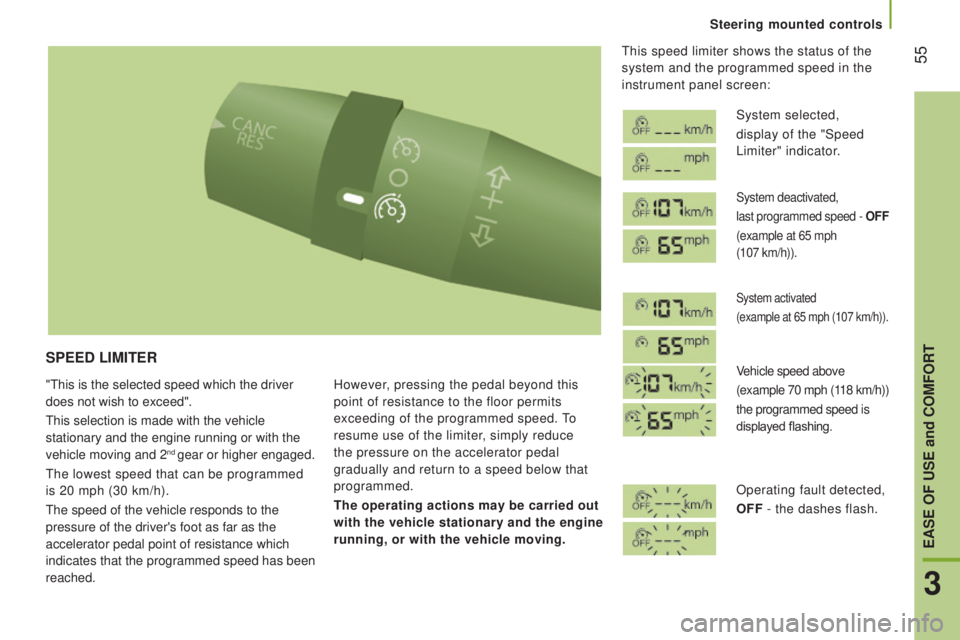
this speed limiter shows the status of the
system and the programmed speed in the
instrument panel screen:
System selected,
display of the "Speed
Limiter" indicator.
System deactivated,
last programmed speed -
oFF
(example at 65 mph
(107 km/h)).
System activated
(example at 65 mph (107 km/h)).
Vehicle speed above
(example 70 mph (118 km/h))
the programmed speed is
displayed flashing.
Operating fault detected,
oFF
- the dashes flash.
3
EASE oF uSE and coMFort
Steering mounted controls