brake PEUGEOT BOXER 2015 Owner's Manual
[x] Cancel search | Manufacturer: PEUGEOT, Model Year: 2015, Model line: BOXER, Model: PEUGEOT BOXER 2015Pages: 276, PDF Size: 8.99 MB
Page 123 of 276
121
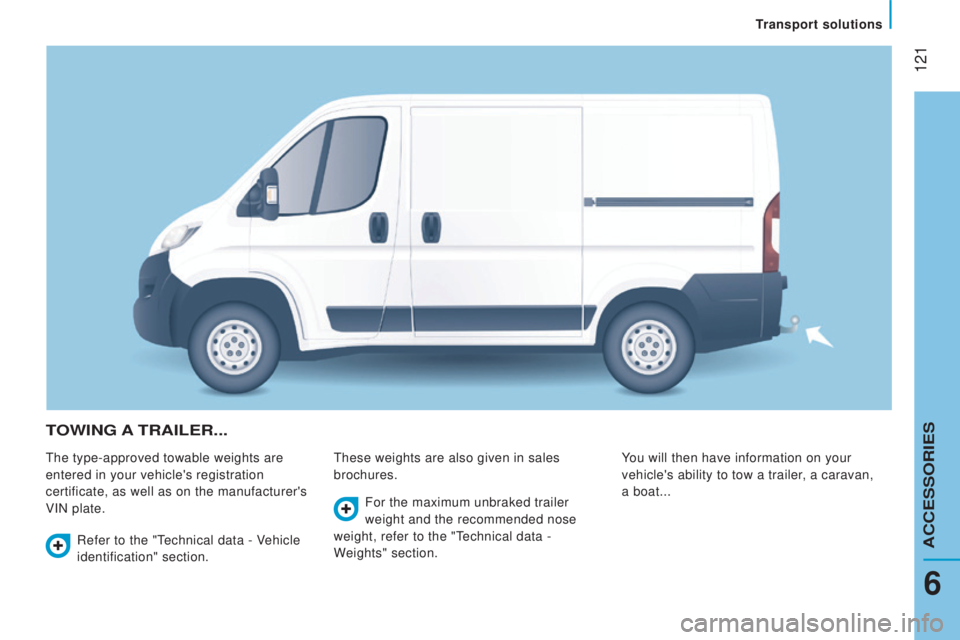
toWInG A trAILEr...
the type-approved towable weights are
entered in your vehicle's registration
certificate, as well as on the manufacturer's
VIN plate.these weights are also given in sales
brochures. You will then have information on your
vehicle's ability to tow a trailer, a caravan,
a boat...
Refer to the "
technical data - Vehicle
identification" section. For the maximum unbraked trailer
weight and the recommended nose
weight, refer to the "
technical data -
W
eights" section.
6
transport solutions
ACCeSSORIeS
Page 124 of 276
122
driving advice
distribution of loads: distribute the load in
the trailer so that the heaviest objects are as
close as possible to the axle and the nose
weight is close to the maximum authorised
without, however, exceeding it.
cooling:
towing a trailer on a slope
increases the coolant temperature.
As the fan is electrically controlled, its
cooling capacity is not dependent on the
engine speed.
On the contrary, use a high gear to lower the
engine speed and reduce your speed.
In all cases, pay attention to the coolant
temperature.
tyres: check the tyre pressures of the
towing vehicle and of the trailer, observing
the recommended pressures.
Fitting a towbar
We recommend the use of genuine
P
eugeOt towbars and their harnesses,
which have been tested and approved from
the design stage of your vehicle and that
the fitting of this equipment is entrusted to a
P
eugeOt dealer.
these genuine towbars are compatible with
the operation of the rear parking sensors
and the reversing camera, if fitted to your
vehicle.
If this equipment is not fitted by a P
eugeOt
dealer, it must be fitted in line with the
manufacturer's instructions.
Good practice
If the coolant temperature
warning lamp comes on, stop the
vehicle and switch off the engine
as soon as possible.
Refer to the "Checks - Levels and
checks" section.
Brakes: towing increases the braking
distance. Drive at a moderate speed,
change down early and brake gradually. Side wind: sensitivity to side wind is
increased. Drive smoothly and at a
moderate speed. ABS: the system only controls the vehicle,
not the trailer.
rear parking sensors:
the system is
deactivated while the vehicle is towing with a
genuine P
eugeOt towbar fitted.
Refer to the "
technical data -
Identification markings" section.
transport solutions
Page 127 of 276
125
SnoW cHAInS
In wintry conditions, snow chains improve
traction as well as the behaviour of the
vehicle when braking.
the snow chains must be fitted only to
the driving wheels.
they must never be
fitted to "space-saver" type spare wheels.
take account of the legislation in force
in your country on the use of snow
chains and the maximum running speed
authorised . Advice on installation
F
If you have to fit the chains during
a journey
, stop the vehicle on a flat
surface on the side of the road.
F
Apply the parking brake and position any
wheel chocks to prevent movement of
your vehicle.
F
Fit the chains following the instructions
provided by the manufacturer
.
F
Move off gently and drive for a few
moments, without exceeding 30 mph
(50
km/h).
F
Stop your vehicle and check that the
snow chains are correctly tightened.
It is recommended that before you
leave, you practise fitting the snow
chains on a level and dry surface.
Avoid driving with chains on roads that
have been cleared of snow, to avoid
damaging your vehicle's tyres and the road
surface. If your vehicle is fitted with alloy
wheels, check that no part of the chain or its
fixings is in contact with the wheel rim.use only the chains designed to be fitted to
the type of wheel fitted to your vehicle:
Original
tyre size Maximum link
size.
215/70 R15 12 mm
225/75 R15 16 mm
215/75 R16 16 mm
225/75 R16 16 mm
For more information on snow chains,
contact a P
eugeOt dealer or a qualified
workshop.
6
ACCeSSORIeS
equipment
Page 130 of 276
128
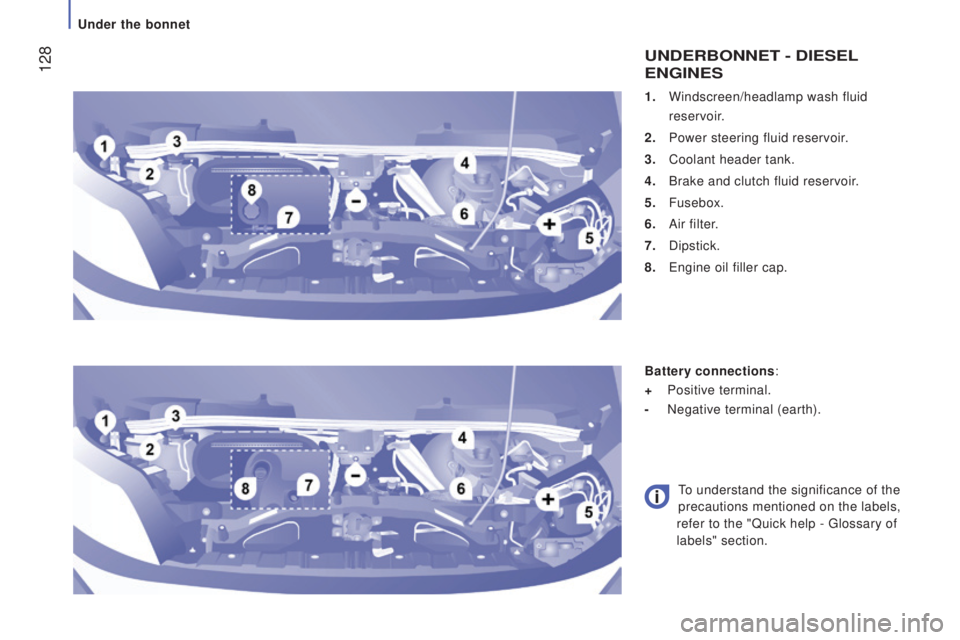
1. Windscreen/headlamp wash fluid
reservoir.
2.
Power steering fluid reservoir.
3.
Coolant header tank.
4.
Brake and clutch fluid reservoir.
5.
Fusebox.
6.
Air filter.
7.
Dipstick.
8.
e
ngine oil filler cap.
undErBonnEt - dIESEL
EnGInES
Battery connections:
+
Positive terminal.
-
Negative terminal (earth).
to understand the significance of the
precautions mentioned on the labels,
refer to the "Quick help -
glossary of
labels" section.
under the bonnet
Page 131 of 276
129
used products
Avoid prolonged contact of used oil or fluids
with the skin.
Most of these fluids are harmful to health or
indeed very corrosive.
Do not discard used oil or fluids into sewers
or onto the ground.
take used oil to a PeugeOt dealer or
a qualified workshop (France) or to an
authorised waste disposal site.
LEVELS
these regular maintenance operations
will keep your vehicle in good running
order
. Ask for advice at a P
eugeOt dealer
or consult the warranty and maintenance
record contained in the handbook pack.
to maintain the reliability of engines and
emission control systems, the use of
additives in engine oil is prohibited.
changing the brake fluid
the brake fluid must be changed at
the intervals stated, according to the
manufacturer's servicing schedule.
use fluids recommended by the
manufacturer, which fulfil DO
t4 standards.
the level must be between the
MI
n and
MA
x marks on the reservoir
.
If fluid has to be added frequently, this
indicates a failure which must be checked by
a P
eugeOt dealer or a qualified workshop
as soon as possible.
If you have to remove/refit the engine
styling cover, handle it with care to
avoid damaging the fixing clips.
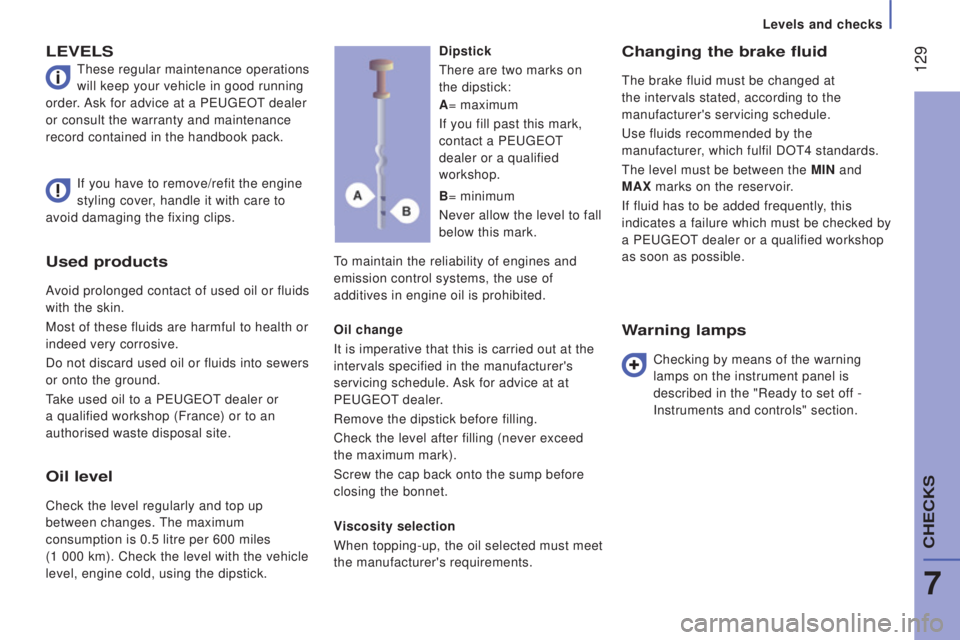
dipstick
there are two marks on
the dipstick:
oil change
It is imperative that this is carried out at the
intervals specified in the manufacturer's
servicing schedule. Ask for advice at at
P
eugeOt dealer.
Remove the dipstick before filling.
Check the level after filling (never exceed
the maximum mark).
Screw the cap back onto the sump before
closing the bonnet.
Viscosity selection
When topping-up, the oil selected must meet
the manufacturer's requirements.
Warning lamps
Checking by means of the warning
lamps on the instrument panel is
described in the "Ready to set off -
Instruments and controls" section.
A
= maximum
If you fill past this mark,
contact a P
eugeOt
dealer or a qualified
workshop.
B = minimum
Never allow the level to fall
below this mark.
oil level
Check the level regularly and top up
between changes.
the maximum
consumption is 0.5 litre per 600 miles
(1 000
km). Check the level with the vehicle
level, engine cold, using the dipstick.
7
CHeCKS
Levels and checks
Page 134 of 276
132
Manual gearbox
Have the level checked in accordance with
the manufacturer's servicing schedule.
Good practiceoil filter
Brake pads
Brake pad wear depends on the style of
driving, in particular for vehicles which are
used in town, over short distances. It may
be necessary to check the thickness of the
pads, even between services.
Brake disc wear
For any information on checking the brake
disc wear, contact a P
eugeOt dealer or a
qualified workshop.
Parking brake
Where the parking brake travel is too great
or there is a reduction in the performance
of the system, the parking brake should be
adjusted, even between services.
Have the system checked by a P
eugeOt
dealer or a qualified workshop.
If this warning lamp comes on,
have the brake pad wear checked
by a P
eugeOt dealer or a
qualified workshop. In order to avoid damaging the
electrical units, we strongly advise you
not to use high pressure washing to clean
the engine compartment.
After washing the vehicle dampness, or in
winter, ice may form on the brake discs and
pads: braking efficiency may be reduced.
Make some light brake applications to dry
and de-ice the brakes. Only use products recommended by
P
eugeOt or products of equivalent quality
and specification.
In order to optimise the operation of units as
important as the braking system, P
eugeOt
selects and offers specific products.
Change the filter regularly
, in accordance
with the manufacturer's servicing schedule.
Levels and checks
Page 148 of 276
 Allocation
12 7.5Right-hand dipped headlamp
13 7.5Left-hand dipped headlamp
31 5
engine compartment control unit relay - Dashboard control unit relay (ig\
nition switch +)
32 7.5Cabi")
146FusesA (amps) Allocation
12 7.5Right-hand dipped headlamp
13 7.5Left-hand dipped headlamp
31 5
engine compartment control unit relay - Dashboard control unit relay (ig\
nition switch +)
32 7.5Cabin lighting (battery +)
33 7.5Battery check sensor on Stop & Start version (battery +)
34 7.5Minibus interior lighting - Hazard warning lamps
36 10Audio system -
Air conditioning controls - Alarm -
tachograph - Battery cut-off control unit -
Additional heating programmer (battery +)
37 7.5Brake lamp switch -
third brake lamp Instrument panel (ignition +)
38 20Central door locking (battery +)
42 5ABS control unit and sensor -
ASR sensor - DSC sensor - Brake lamp switch
43 20Windscreen wiper motor (ignition switch +)
47 20Driver's electric window motor
48 20Passenger's electric window motor
49 5Parking sensors control unit - Audio system - Steering mounted controls - Centre and side switch panels\
-
Auxiliary switch panel - Battery cut-off control unit (ignition switch +)
50 7.5Airbags and pre-tensioners control unit
51 5
tachograph - Power steering control unit - Air conditioning - Reversing lamps - W
ater in Diesel sensor -
Air flow sensor (ignition switch +)
53 7.5Instrument panel (battery +)
89 -Not used
90 7.5Left-hand main beam
91 7.5Right-hand main beam
92 7.5Left-hand front foglamp
93 7.5Right-hand front foglamp
Failed fuse
Page 155 of 276
153
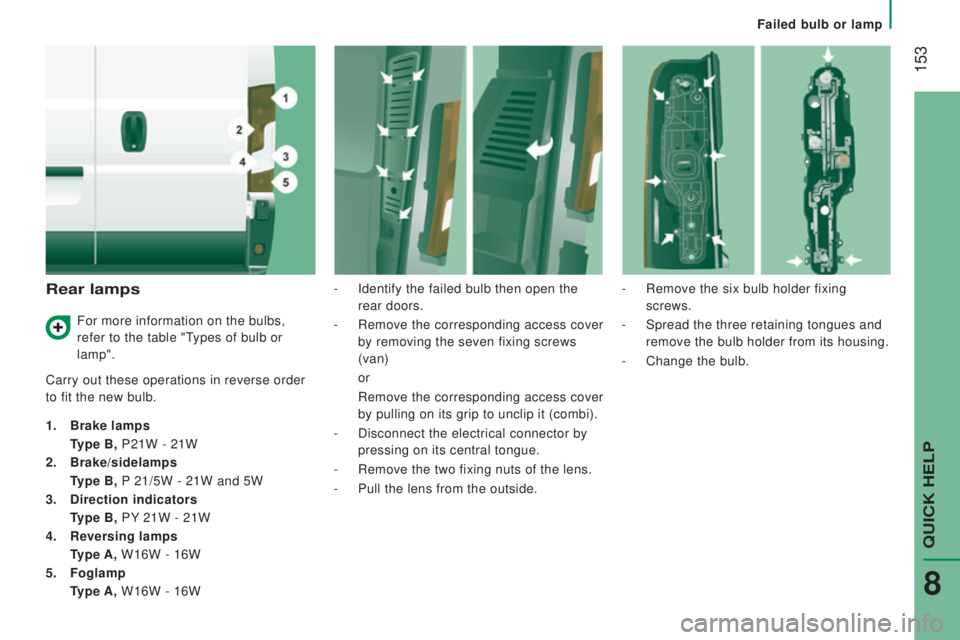
rear lamps
Carry out these operations in reverse order
to fit the new bulb.
1.
Brake lamps
type B, P21W - 21W
2.
Brake/sidelamps
type B, P
21/5W - 21W and 5W
3.
direction indicators
type B, PY
21W - 21W
4.
reversing lamps
type A, W16W - 16W
5.
Foglamp
type A, W16W - 16W -
Identify the failed bulb then open the
rear doors.
-
Remove the corresponding access cover
by removing the seven fixing screws
(van) or
Remove the corresponding access cover
by pulling on its grip to unclip it (combi).
-
Disconnect the electrical connector by
pressing on its central tongue.
-
Remove the two fixing nuts of the lens.
-
Pull the lens from the outside. -
Remove the six bulb holder fixing
screws.
-
Spread the three retaining tongues and
remove the bulb holder from its housing.
-
Change the bulb.
For more information on the bulbs,
refer to the table "
types of bulb or
lamp".
QuICK HeLP
8
Failed bulb or lamp
Page 156 of 276
154
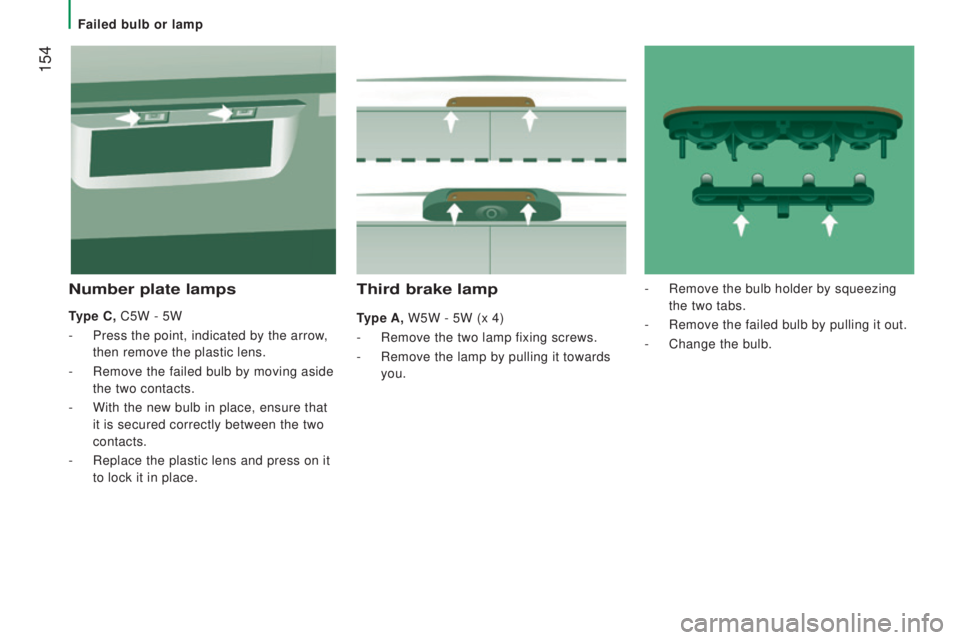
third brake lamp
type A, W5W - 5W (x 4)
-
Remove the two lamp fixing screws.
-
Remove the lamp by pulling it towards
you.
number plate lamps
type c, C5W - 5W
-
Press the point, indicated by the arrow,
then remove the plastic lens.
-
Remove the failed bulb by moving aside
the two contacts.
-
With the new bulb in place, ensure that
it is secured correctly between the two
contacts.
-
Replace the plastic lens and press on it
to lock it in place. -
Remove the bulb holder by squeezing
the two tabs.
-
Remove the failed bulb by pulling it out.
-
Change the bulb.
Failed bulb or lamp
Page 158 of 276
156
Parking the vehicle
Where possible, park the vehicle on level,
stable and non-slippery ground.
Apply the parking brake, switch off the
ignition and engage first gear.
Wear a high visibility vest and position the
warning triangle on the road.
You must ensure that the occupants get out
of the vehicle and wait in a safe location.
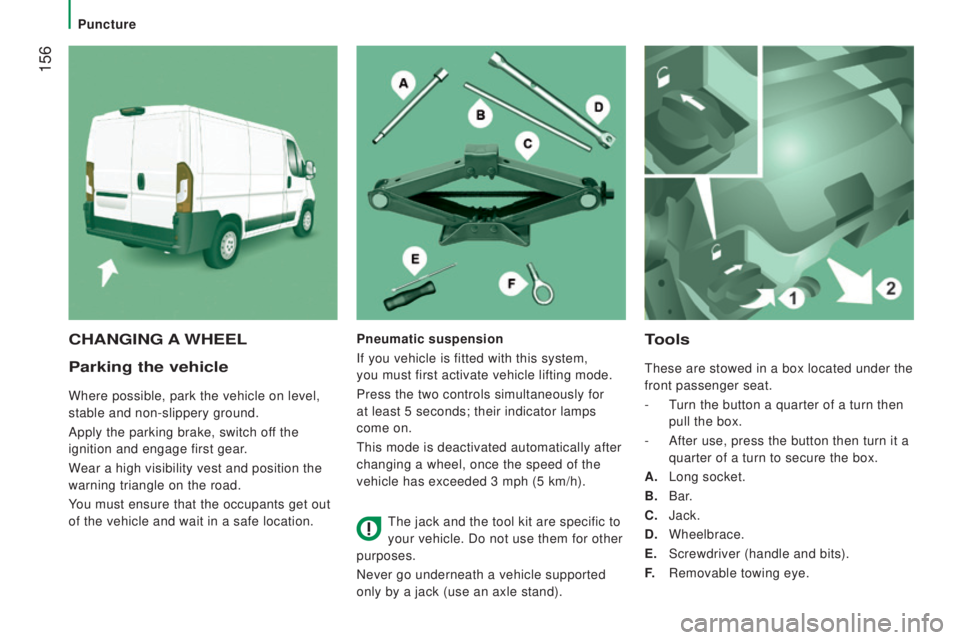
tools
these are stowed in a box located under the
front passenger seat.
-
t
urn the button a quarter of a turn then
pull the box.
-
After use, press the button then turn it a
quarter of a turn to secure the box.
A.
Long socket.
B.
Bar
.
c. Jack.
d. Wheelbrace.
E.
Screwdriver (handle and bits).
F.
Removable towing eye.
cHAnGInG A WHEELPneumatic suspension
If you vehicle is fitted with this system,
you must first activate vehicle lifting mode.
Press the two controls simultaneously for
at least 5 seconds; their indicator lamps
come on.
this mode is deactivated automatically after
changing a wheel, once the speed of the
vehicle has exceeded 3 mph (5 km/h).
the jack and the tool kit are specific to
your vehicle. Do not use them for other
purposes.
Never go underneath a vehicle supported
only by a jack (use an axle stand).
Puncture