key PEUGEOT BOXER 2015 Owner's Manual
[x] Cancel search | Manufacturer: PEUGEOT, Model Year: 2015, Model line: BOXER, Model: PEUGEOT BOXER 2015Pages: 276, PDF Size: 8.99 MB
Page 108 of 276
106
cAB SEAt BELtS
If you install a front bench seat as
an accessory, it it must be fitted with
approved seat belts.
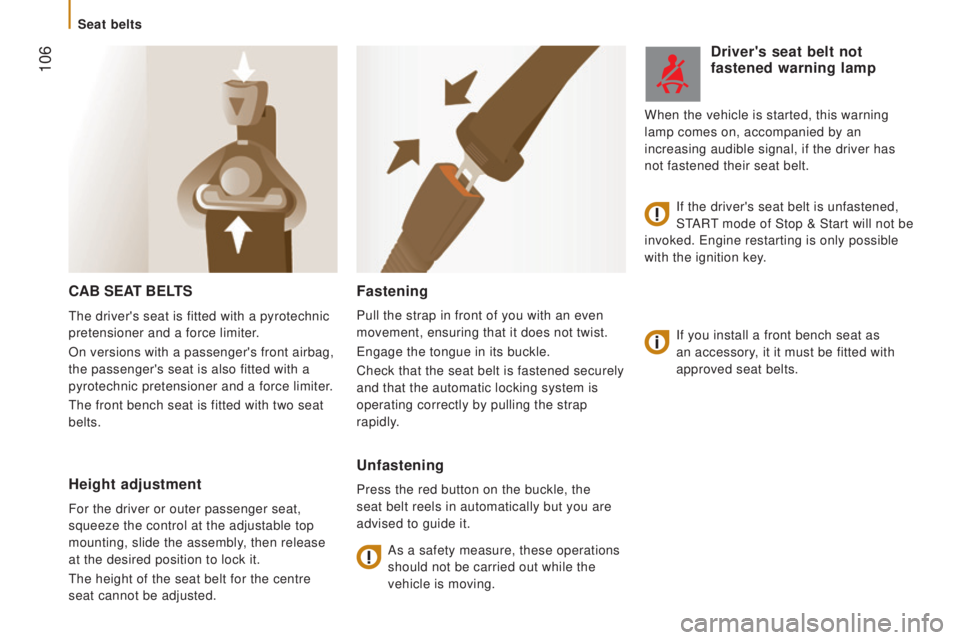
Fastening
Pull the strap in front of you with an even
movement, ensuring that it does not twist.
engage the tongue in its buckle.
Check that the seat belt is fastened securely
and that the automatic locking system is
operating correctly by pulling the strap
rapidly.
unfastening
Press the red button on the buckle, the
seat belt reels in automatically but you are
advised to guide it.
As a safety measure, these operations
should not be carried out while the
vehicle is moving.
driver's seat belt not
fastened warning lamp
If the driver's seat belt is unfastened,
S
tARt mode of Stop & Start will not be
invoked.
engine restarting is only possible
with the ignition key. When the vehicle is started, this warning
lamp comes on, accompanied by an
increasing audible signal, if the driver has
not fastened their seat belt.
the driver's seat is fitted with a pyrotechnic
pretensioner and a force limiter.
On versions with a passenger's front airbag,
the passenger's seat is also fitted with a
pyrotechnic pretensioner and a force limiter.
the front bench seat is fitted with two seat
belts.
Height adjustment
For the driver or outer passenger seat,
squeeze the control at the adjustable top
mounting, slide the assembly, then release
at the desired position to lock it.
the height of the seat belt for the centre
seat cannot be adjusted.
Seat belts
Page 122 of 276
120
Good practice
children at the front
the legislation on carrying a child on the
front passenger seat is specific to each
country. Refer to the legislation in force in
your country.
Deactivate the passenger's airbag when a
rearward facing child seat is installed on the
front seat.
Otherwise, the child would risk being
seriously injured or killed if the airbag were
deployed. As a safety precaution, never leave:
-
one or more children alone and
unsupervised in a vehicle,
-
a child or an animal in a vehicle which
is exposed to the sun, with the windows
closed,
-
the keys within reach of children inside
the vehicle.
to prevent accidental opening of the doors,
use the "Child Lock".
take care not to open the rear windows by
more than one third.
to protect young children from the rays of
the sun, fit side blinds to the rear windows. Installing a booster seat
the chest part of the seat belt must be
positioned on the child's shoulder without
touching the neck.
ensure that the lap part of the seat belt
passes correctly over the child's thighs.
P
eugeOt recommends the use of a
booster seat which has a back, fitted with a
seat belt guide at shoulder level.
For the optimum installation of a forward
facing child seat, ensure that the back of
the child seat is as close as possible to the
backrest of the vehicle's seat, or in contact
if possible.
the head restraint must be removed before
installing a child seat with a backrest on the
passenger seat.
ensure that the head restraint is stowed or
attached securely so that it is not thrown
around the vehicle in the event of sharp
braking.
Refit the head restraint as soon as the child
seat is removed.
At the rear, always leave sufficient space
between the front seat and:
-
a rearward facing child seat,
-
the feet of a child seated in a forward
facing child seat.
For this, move the front seat forward and, if
necessary, straighten its backrest as well.
the incorrect installation of a child seat in a
vehicle compromises the child's protection in
the event of an accident.
Check that there is no seat belt or seat belt
buckle under the child seat, as this could
destabilise the seat.
Remember to fasten the seat belts or the
child seat harnesses keeping the slack
relative to the child's body to a minimum,
even for short journeys.
For the installation of a child seat using
the seat belt, ensure that the seat belt is
well tensioned on the child seat and that
it is holding the child seat firmly against
the vehicle's seat. If the passenger seat is
adjustable, move it forward if necessary.
Child safety
Page 128 of 276
126PeugeOt & tOtAL,
A PARtNeRSHIP tO DeLI VeR
Bet
te
R PeR
FORMANC
e!
Innovation, the key to success
the tOtAL R esearch and Development and
Peu geOt teams work together to develop high
quality lubricants that meet the requirements of
P
eu
ge
Ot v
ehicles. For you, this is the assurance
that the performance of your engine is optimised
while also ensuring its durability.
the 2
08 HYbrid F
e d
emonstrates the ability of
P
eu
ge
Ot
and
tOtAL t
o develop innovative
technologies and provide other ways of moving
towards the future.
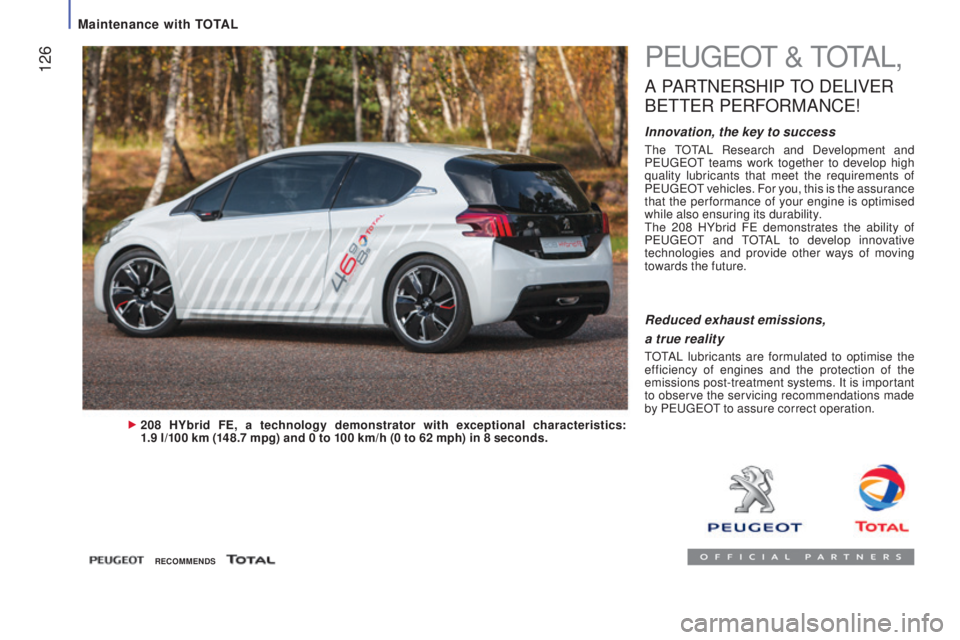
208 HYbrid FE, a technology demonstrator with exceptional characteristics:
1.9 l/100 km (148.7 mpg) and 0 to 100 km/h (0 to 62 mph) in 8 seconds.
Reduced exhaust emissions,
a true reality
tOtAL lubricants are formulated to optimise the
e fficiency of engines and the protection of the
emissions post-treatment systems. It is important
to observe the servicing recommendations made
by P
eu
ge
Ot t
o assure correct operation.
rEcoMMEndS
Maintenance with tOtAL
Page 129 of 276
127
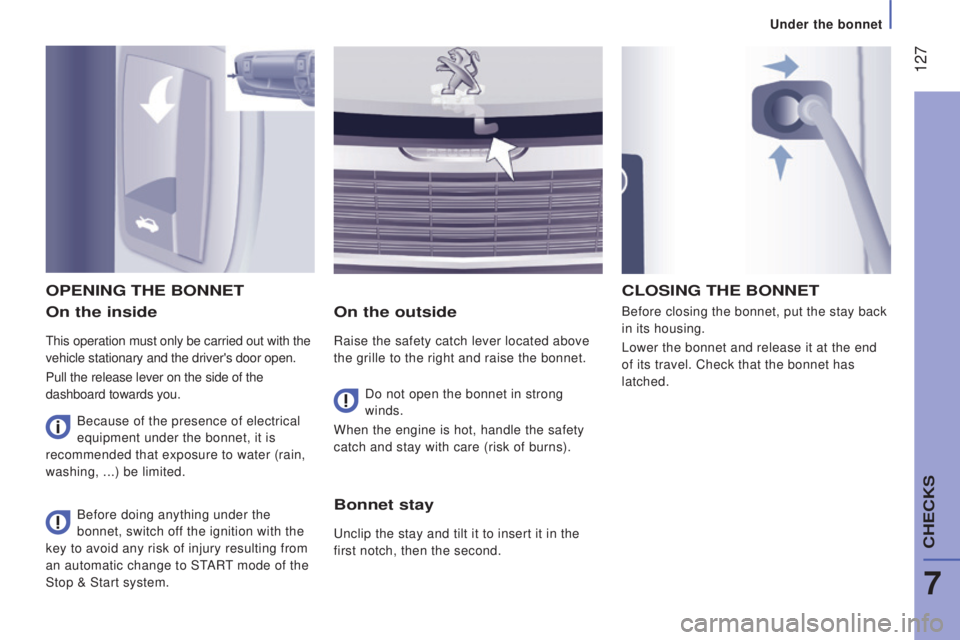
on the inside
this operation must only be carried out with the
vehicle stationary and the driver's door open.
Pull the release lever on the side of the
dashboard towards you.
on the outside
Raise the safety catch lever located above
the grille to the right and raise the bonnet. Before closing the bonnet, put the stay back
in its housing.
Lower the bonnet and release it at the end
of its travel. Check that the bonnet has
latched.
oPEnInG tHE BonnEt
Do not open the bonnet in strong
winds.
When the engine is hot, handle the safety
catch and stay with care (risk of burns).
Before doing anything under the
bonnet, switch off the ignition with the
key to avoid any risk of injury resulting from
an automatic change to S
tARt mode of the
Stop & Start system.
cLoSInG tHE BonnEt
Bonnet stay
unclip the stay and tilt it to insert it in the
first notch, then the second.
Because of the presence of electrical
equipment under the bonnet, it is
recommended that exposure to water (rain,
washing,
...) be limited.
7
under the bonnet
CHeCKS
Page 132 of 276
130
cooling systemPower steering fluid level
the vehicle must be parked on level ground
with the engine cold.
unscrew the cap
integrated with the gauge and check the
level which must be between the MI
n and
MA
x marks.
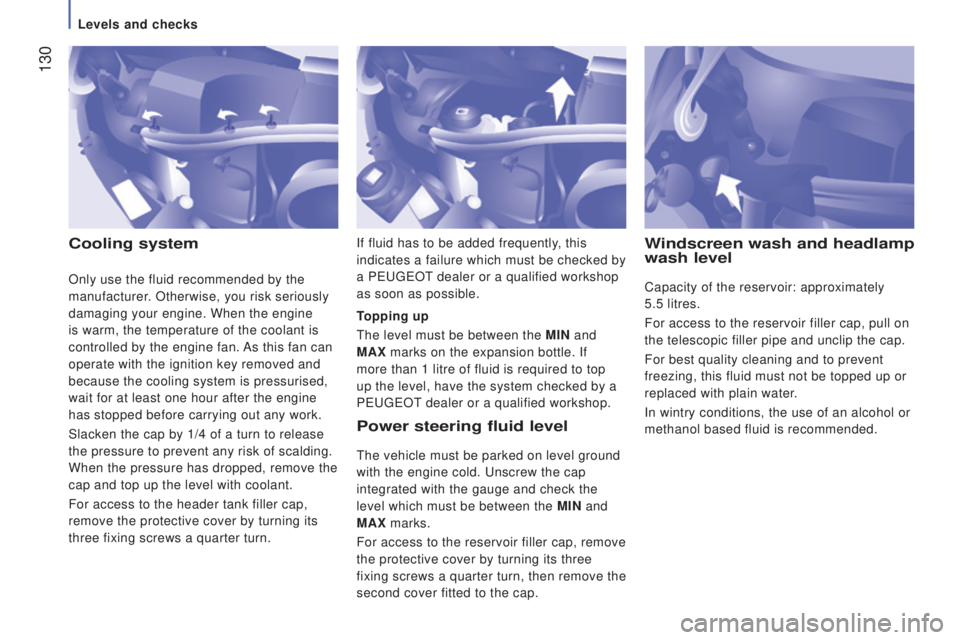
For access to the reservoir filler cap, remove
the protective cover by turning its three
fixing screws a quarter turn, then remove the
second cover fitted to the cap.
topping up
the level must be between the
MI
n and
MA
x marks on the expansion bottle. If
more than 1 litre of fluid is required to top
up the level, have the system checked by a
P
eugeOt dealer or a qualified workshop.
Windscreen wash and headlamp
wash level
Capacity of the reservoir: approximately
5.5
litres.
For access to the reservoir filler cap, pull on
the telescopic filler pipe and unclip the cap.
For best quality cleaning and to prevent
freezing, this fluid must not be topped up or
replaced with plain water.
In wintry conditions, the use of an alcohol or
methanol based fluid is recommended.
If fluid has to be added frequently, this
indicates a failure which must be checked by
a PeugeOt dealer or a qualified workshop
as soon as possible.
Only use the fluid recommended by the
manufacturer. Otherwise, you risk seriously
damaging your engine. When the engine
is warm, the temperature of the coolant is
controlled by the engine fan. As this fan can
operate with the ignition key removed and
because the cooling system is pressurised,
wait for at least one hour after the engine
has stopped before carrying out any work.
Slacken the cap by 1/4 of a turn to release
the pressure to prevent any risk of scalding.
When the pressure has dropped, remove the
cap and top up the level with coolant.
For access to the header tank filler cap,
remove the protective cover by turning its
three fixing screws a quarter turn.
Levels and checks
Page 136 of 276
134
Low fuel level
rEFuELLInG
In low temperatures
In mountainous and/or cold areas, it is
advisable to use a "winter" type fuel suited
to low or minus temperatures.With Stop & Start, never refuel with
the system in S
tOP mode; you must
switch off the ignition with the key. When the fuel tank level E
(
empty) is reached, this warning
lamp comes on.
You then have around 10 to
12 litres in the reserve, depending on the
capacity of the tank, the engine type, the
driving conditions and the profile of the road.
Refuel without delay to avoid running out of
fuel.
the capacity of the fuel tank is
approximately 90 litres.
Fuel tanks of different capacities, 60
and
120 litres, may be fitted.
the fuel tank must be filled
with the engine
off.
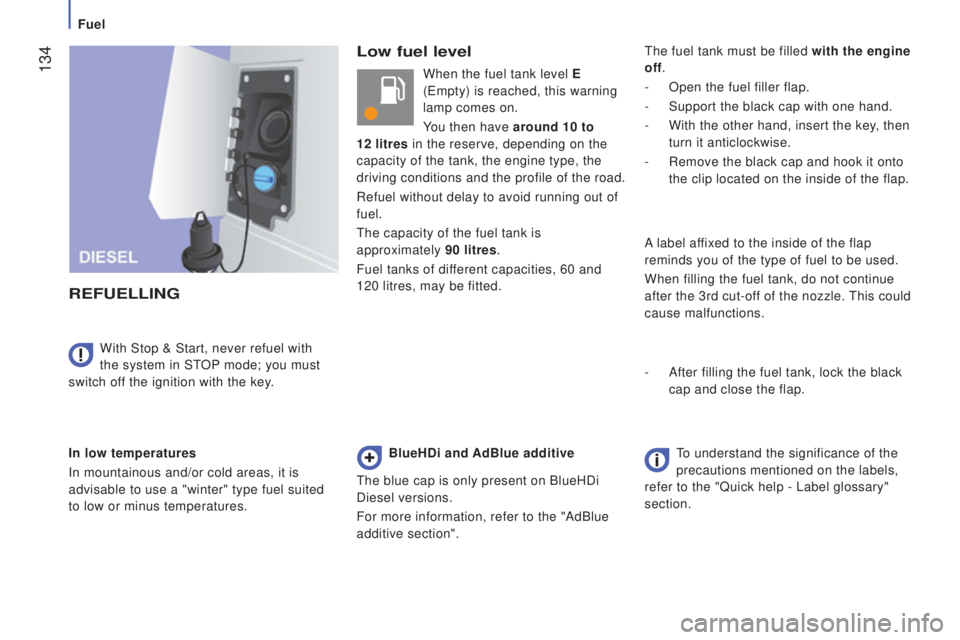
-
Open the fuel filler flap.
-
Support the black cap with one hand.
-
With the other hand, insert the key, then
turn it anticlockwise.
-
Remove the black cap and hook it onto
the clip located on the inside of the flap.
A
label affixed to the inside of the flap
reminds you of the type of fuel to be used.
When filling the fuel tank, do not continue
after the 3rd cut-off of the nozzle.
this could
cause malfunctions.
-
After filling the fuel tank, lock the black
cap and close the flap.
BlueH
di and AdBlue additive
the blue cap is only present on BlueHDi
Diesel versions.
For more information, refer to the "AdBlue
additive section".to understand the significance of the
precautions mentioned on the labels,
refer to the "Quick help - Label glossary"
section.
Fuel
Page 166 of 276
164
toWBAr WItH QuIcKLY
d
EtAcHABLE t
o
WBALL
Presentation
this towball can be fitted and removed
quickly and easily without the use of tools. For information on the maximum
trailer weight and the recommended
nose weight, refer to the "
technical data -
W
eights" section.
For information on safely towing a trailer,
refer to the "Accessories -
towing a trailer"
section.
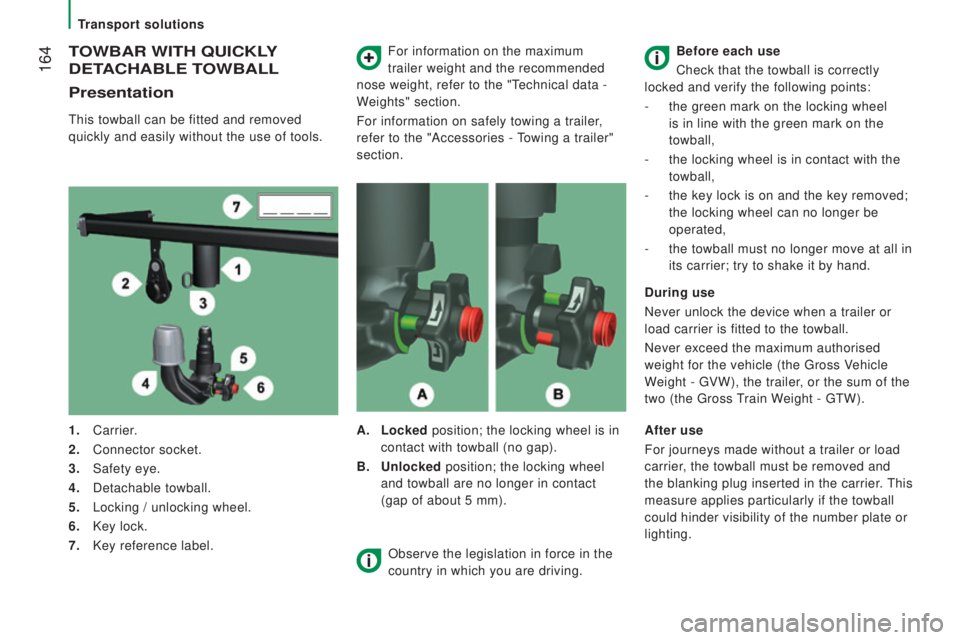
1.
Carrier
.
2.
Connector socket.
3.
Safety eye.
4.
Detachable towball.
5.
Locking / unlocking wheel.
6.
Key lock.
7.
Key reference label. A.
Locked position; the locking wheel is in
contact with towball (no gap).
B.
unlocked
position; the locking wheel
and towball are no longer in contact
(gap of about 5 mm). Before each use
Check that the towball is correctly
locked and verify the following points:
- the green mark on the locking wheel
is in line with the green mark on the
towball,
-
the locking wheel is in contact with the
towball,
-
the key lock is on and the key removed;
the locking wheel can no longer be
operated,
-
the towball must no longer move at all in
its carrier; try to shake it by hand.
during use
Never unlock the device when a trailer or
load carrier is fitted to the towball.
Never exceed the maximum authorised
weight for the vehicle (the
gross V
ehicle
Weight -
gVW), the trailer
, or the sum of the
two (the
gross train Weight - gtW).
Observe the legislation in force in the
country in which you are driving. After use
For journeys made without a trailer or load
carrier, the towball must be removed and
the blanking plug inserted in the carrier.
this
measure applies particularly if the towball
could hinder visibility of the number plate or
lighting.
transport solutions
Page 167 of 276
165
Fitting the towball
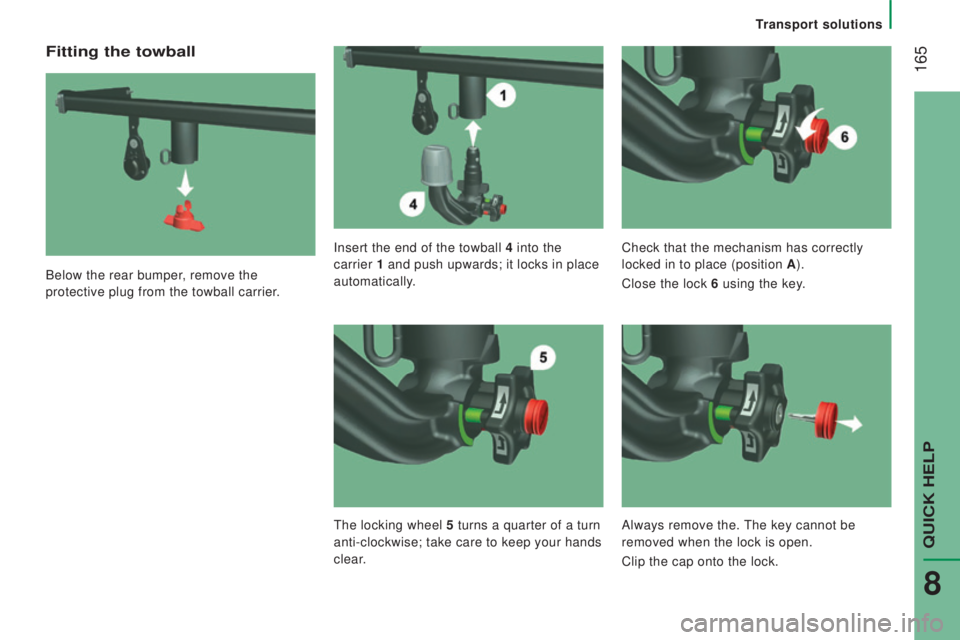
Below the rear bumper, remove the
protective plug from the towball carrier.Insert the end of the towball 4
into the
carrier 1 and push upwards; it locks in place
automatically. Check that the mechanism has correctly
locked in to place (position A
).
Close the lock 6 using the key.
the locking wheel
5 turns a quarter of a turn
anti-clockwise; take care to keep your hands
clear. Always remove the.
the key cannot be
removed when the lock is open.
Clip the cap onto the lock.
transport solutions
QuICK HeLP
8
Page 168 of 276
166
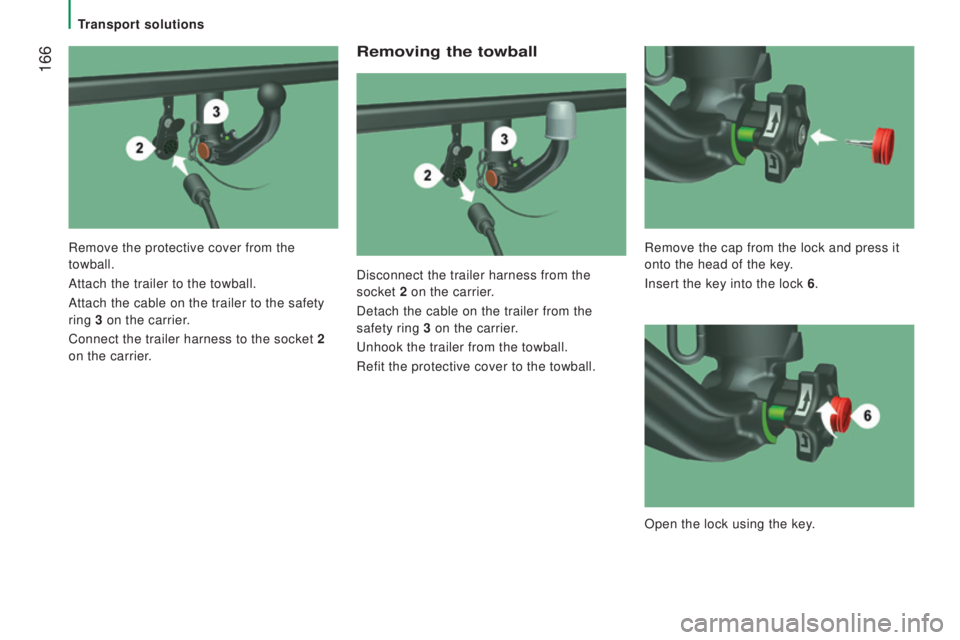
removing the towball
Disconnect the trailer harness from the
socket 2 on the carrier.
Detach the cable on the trailer from the
safety ring 3 on the carrier.
unhook the trailer from the towball.
Refit the protective cover to the towball.
Remove the protective cover from the
towball.
Attach the trailer to the towball.
Attach the cable on the trailer to the safety
ring 3 on the carrier.
Connect the trailer harness to the socket 2
on the carrier. Remove the cap from the lock and press it
onto the head of the key.
Insert the key into the lock 6
.
Open the lock using the key.
transport solutions
Page 170 of 276

168
GLoSSArY oF LABELS
this section groups together all of the texts that appear on labels prese\
nt on the vehicle.under the bonnet
A
Original painting
Colour
Code
R e
FINISHINg CODe
B
AIR CONDI
tIONeD VeHICLe - R134A
-
"CFC" FR
ee
QtY
R134A (kg)
c
ONLY
FOR J
uMP
S
tARt
d
DANgeR
A
utOMAtIC eNgINe ReStARt. eXtRACt
tHe KeY
FROM DASHBOARD WH
eN
HOOD IS OP
eNeD
For the vehicle identification labels, refer to the "
technical data" section.
Precautions...