light PEUGEOT BOXER 2015 Owner's Manual
[x] Cancel search | Manufacturer: PEUGEOT, Model Year: 2015, Model line: BOXER, Model: PEUGEOT BOXER 2015Pages: 276, PDF Size: 8.99 MB
Page 101 of 276
99
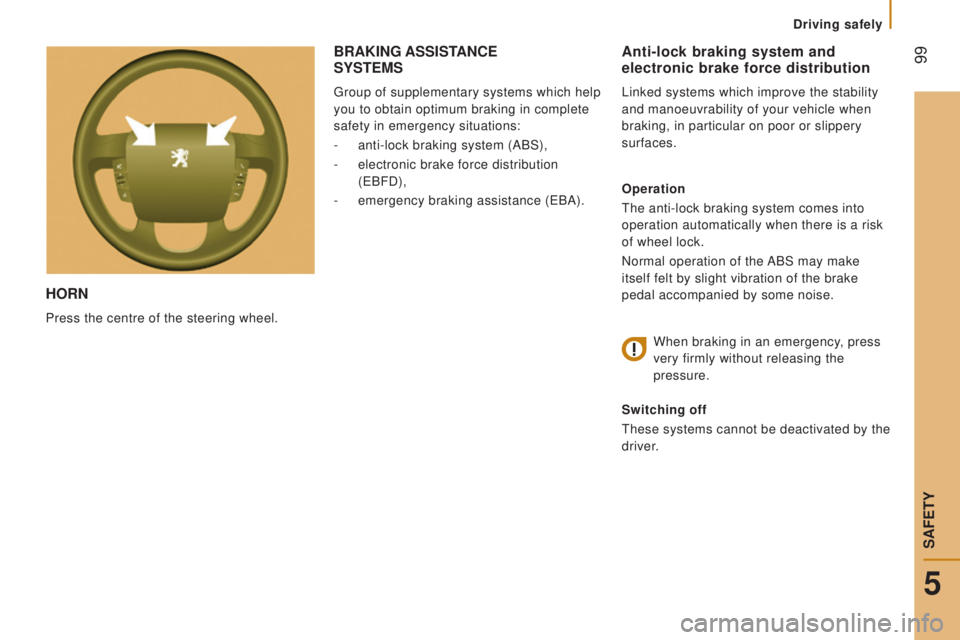
Horn
Press the centre of the steering wheel.
Anti-lock braking system and
electronic brake force distribution
Linked systems which improve the stability
and manoeuvrability of your vehicle when
braking, in particular on poor or slippery
surfaces.
operation
the anti-lock braking system comes into
operation automatically when there is a risk
of wheel lock.
Normal operation of the ABS may make
itself felt by slight vibration of the brake
pedal accompanied by some noise.
When braking in an emergency, press
very firmly without releasing the
pressure.
Switching off
these systems cannot be deactivated by the
driver.
BrAKInG ASSIStAncE SYStEMS
group of supplementary systems which help
you to obtain optimum braking in complete
safety in emergency situations:
-
anti-lock braking system (ABS),
-
electronic brake force distribution
(
eBFD),
-
emergency braking assistance (eBA).
5
Driving safely
SAFetY
Page 109 of 276
107
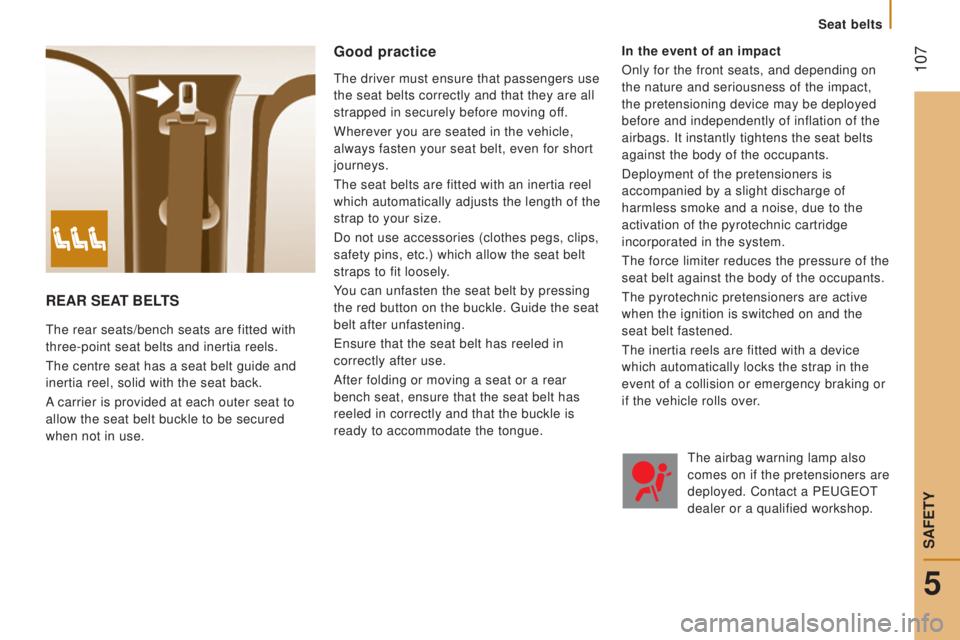
rEAr SEAt BELtS
the rear seats/bench seats are fitted with
three-point seat belts and inertia reels.
the centre seat has a seat belt guide and
inertia reel, solid with the seat back.
A carrier is provided at each outer seat to
allow the seat belt buckle to be secured
when not in use.
Good practice
the driver must ensure that passengers use
the seat belts correctly and that they are all
strapped in securely before moving of
f.
Wherever you are seated in the vehicle,
always fasten your seat belt, even for short
journeys.
the seat belts are fitted with an inertia reel
which automatically adjusts the length of the
strap to your size.
Do not use accessories (clothes pegs, clips,
safety pins, etc.) which allow the seat belt
straps to fit loosely.
You can unfasten the seat belt by pressing
the red button on the buckle.
guide the seat
belt after unfastening.
ensure that the seat belt has reeled in
correctly after use.
After folding or moving a seat or a rear
bench seat, ensure that the seat belt has
reeled in correctly and that the buckle is
ready to accommodate the tongue.
the airbag warning lamp also
comes on if the pretensioners are
deployed. Contact a P
eugeOt
dealer or a qualified workshop.
In the event of an impact
Only for the front seats, and depending on
the nature and seriousness of the impact,
the pretensioning device may be deployed
before and independently of inflation of the
airbags. It instantly tightens the seat belts
against the body of the occupants.
Deployment of the pretensioners is
accompanied by a slight discharge of
harmless smoke and a noise, due to the
activation of the pyrotechnic cartridge
incorporated in the system.
the force limiter reduces the pressure of the
seat belt against the body of the occupants.
the pyrotechnic pretensioners are active
when the ignition is switched on and the
seat belt fastened.
the inertia reels are fitted with a device
which automatically locks the strap in the
event of a collision or emergency braking or
if the vehicle rolls over.
5
SAFetY
Seat belts
Page 112 of 276
11 0
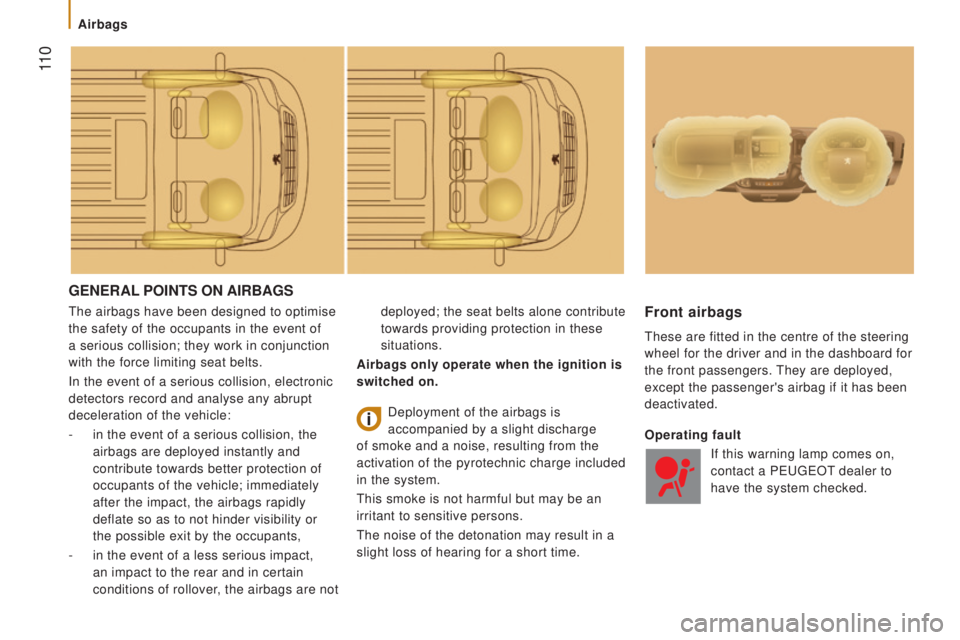
GEnErAL PoIntS on AIrBAGS
the airbags have been designed to optimise
the safety of the occupants in the event of
a serious collision; they work in conjunction
with the force limiting seat belts.
In the event of a serious collision, electronic
detectors record and analyse any abrupt
deceleration of the vehicle:
-
in the event of a serious collision, the
airbags are deployed instantly and
contribute towards better protection of
occupants of the vehicle; immediately
after the impact, the airbags rapidly
deflate so as to not hinder visibility or
the possible exit by the occupants,
-
in the event of a less serious impact,
an impact to the rear and in certain
conditions of rollover, the airbags are not deployed; the seat belts alone contribute
towards providing protection in these
situations.
Airbags only operate when the ignition is
switched on.Front airbags
these are fitted in the centre of the steering
wheel for the driver and in the dashboard for
the front passengers.
they are deployed,
except the passenger's airbag if it has been
deactivated.
Deployment of the airbags is
accompanied by a slight discharge
of smoke and a noise, resulting from the
activation of the pyrotechnic charge included
in the system.
this smoke is not harmful but may be an
irritant to sensitive persons.
the noise of the detonation may result in a
slight loss of hearing for a short time.
operating fault
If this warning lamp comes on,
contact a P
eugeOt dealer to
have the system checked.
Airbags
Page 126 of 276
124
otHEr AccESSorIES
these accessories and parts, having been
tested and approved for reliability and
safety
, are all adapted to your vehicle. A
wide range of recommended and genuine
parts is available.
"comfort":
Air deflectors, insulated module, scented air
fresheners, reading lamp, cigarette lighter,
portable ashtray, non-slip seat cushions
,rear parking sensors...
"Protection":
Mats, mudflaps, vehicle protective cover,
seat covers, security grills for rear door
windows, twin rear security doors with
security locks, paint touch-up...
"Security":
Anti-intrusion alarm, vehicle tracking system,
snow chains, non-slip covers, child seats,
first aid kit, warning triangle, high visibility
vest, fire extinguisher, pet safety belt, seat
belt cutter / glass hammer...
"Style":
Alloy wheels...
"Multimedia":
CD player, Wi-Fi on Board, semi-integral
satellite navigation system, hands-free kits,
driving aids, rear multimedia support, DVD
player, navigation mapping update, portable
satellite navigation systems, telephone
carrier, aftermarket digital radio, audio
systems...
"transport solutions":
towbars, towbar wiring harness with
7/13
connector
, 7/7 connector, 13 connector,
interior protection kits, non-slip floor, wheel
arch protector, cab dividers, transverse roof
bars, roof racks, ladder for roof rack, roof
loading runners, loading plate for roof rack... Installation of radiocommunication
transmitters
You are advised to contact a P
eugeOt
dealer before installing accessory
radiocommunication transmitters with
external aerial on your vehicle.
P
eugeOt dealers can advise you on
the specifications (frequency waveband,
maximum output power, aerial position,
specific installation conditions) of the
transmitters which can be fitted, in
accordance with the Vehicle
electromagnetic
Compatibility Directive (2004/104/
eC).
the fitting of electrical equipment or
accessories which are not listed by
P
eugeOt may result in the failure of your
vehicle's electronic system.
W
e request that you take note of this point
and recommend that you contact a dealer
to be shown the range of recommended
equipment and accessories.
Depending on the country in which the
vehicle is sold or operated, it may be
compulsory to have a high visibility vest,
warning triangle, replacement bulbs and
breathalyzer in the vehicle.
to prevent the mat from becoming
caught under the pedals:
-
ensure that the mat and its fixings are
positioned correctly
,
-
never fit one mat on top of another.
equipment
Page 134 of 276
132
Manual gearbox
Have the level checked in accordance with
the manufacturer's servicing schedule.
Good practiceoil filter
Brake pads
Brake pad wear depends on the style of
driving, in particular for vehicles which are
used in town, over short distances. It may
be necessary to check the thickness of the
pads, even between services.
Brake disc wear
For any information on checking the brake
disc wear, contact a P
eugeOt dealer or a
qualified workshop.
Parking brake
Where the parking brake travel is too great
or there is a reduction in the performance
of the system, the parking brake should be
adjusted, even between services.
Have the system checked by a P
eugeOt
dealer or a qualified workshop.
If this warning lamp comes on,
have the brake pad wear checked
by a P
eugeOt dealer or a
qualified workshop. In order to avoid damaging the
electrical units, we strongly advise you
not to use high pressure washing to clean
the engine compartment.
After washing the vehicle dampness, or in
winter, ice may form on the brake discs and
pads: braking efficiency may be reduced.
Make some light brake applications to dry
and de-ice the brakes. Only use products recommended by
P
eugeOt or products of equivalent quality
and specification.
In order to optimise the operation of units as
important as the braking system, P
eugeOt
selects and offers specific products.
Change the filter regularly
, in accordance
with the manufacturer's servicing schedule.
Levels and checks
Page 138 of 276
136
BLuEHdI
A
nd AdBLuE® AddItIVE
AdBlue® is the brand name of the solution
needed for operation of the SCR system.
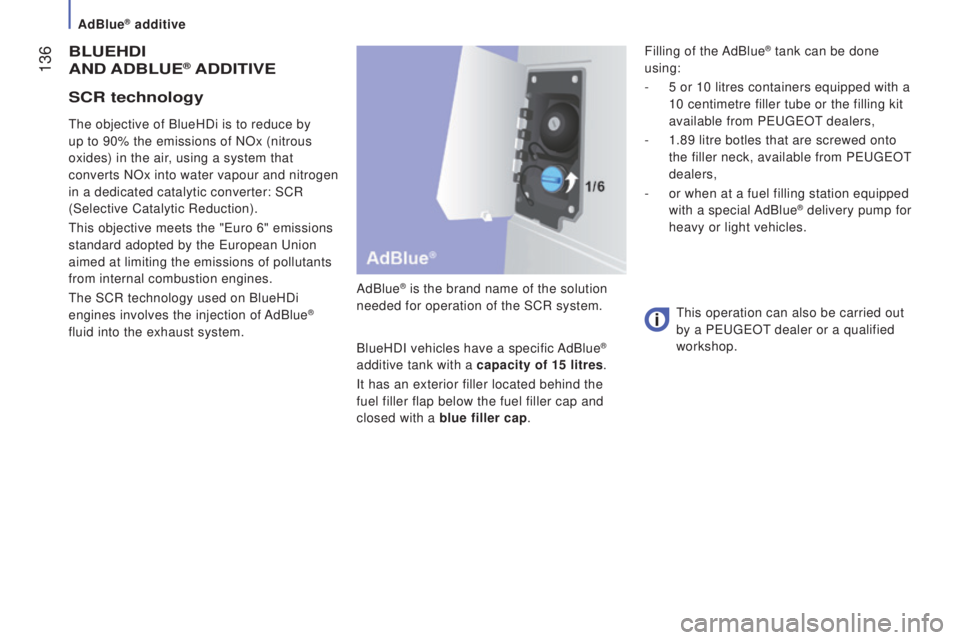
BlueHDI vehicles have a specific AdBlue
®
additive tank with a capacity of 15 litres.
It has an exterior filler located behind the
fuel filler flap below the fuel filler cap and
closed with a blue filler cap.
the objective of BlueHDi is to reduce by
up to 90% the emissions of NOx (nitrous
oxides) in the air, using a system that
converts NOx into water vapour and nitrogen
in a dedicated catalytic converter: SCR
(Selective Catalytic Reduction).
this objective meets the "euro 6" emissions
standard adopted by the
european union
aimed at limiting the emissions of pollutants
from internal combustion engines.
the SCR technology used on BlueHDi
engines involves the injection of AdBlue
®
fluid into the exhaust system.this operation can also be carried out
by a PeugeOt dealer or a qualified
workshop.
Scr technology
Filling of the AdBlue® tank can be done
using:
-
5 or 10 litres containers equipped with a
10 centimetre filler tube or the filling kit
available from P
eugeOt dealers,
-
1.89 litre botles that are screwed onto
the filler neck, available from P
eugeOt
dealers,
-
or when at a fuel filling station equipped
with a special
AdBlue
® delivery pump for
heavy or light vehicles.
AdBlue® additive
Page 139 of 276
137
Good practice
While the quantity of AdBlue® in the additive
tank is
sufficient, no information is displayed.
On the other hand, once the additive level
drops to the quantity needed for a range
of 1 500 miles (2 400 km) driving, you
are warned by different temporary signals
(warning lamp, message, audible signal).
As more miles are covered, these signals
intensify and the message becomes
permanent.
Filling the additive tank
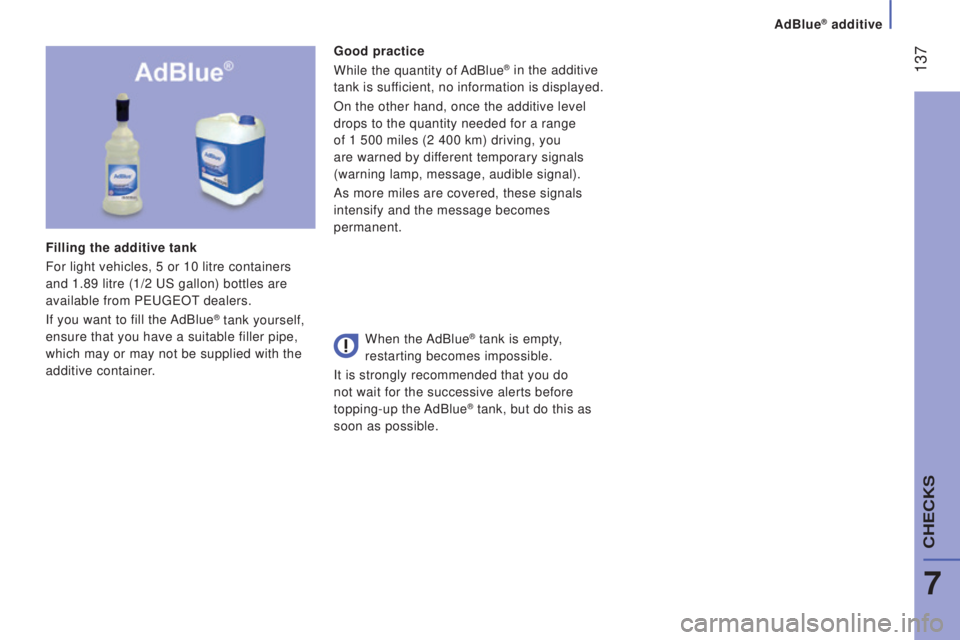
For light vehicles, 5 or 10 litre containers
and 1.89 litre (1/2
uS gallon) bottles are
available from P
eugeOt dealers.
If you want to fill the AdBlue® tank yourself,
ensure that you have a suitable filler pipe,
which may or may not be supplied with the
additive container. When the AdBlue® tank is empty,
restarting becomes impossible.
It is strongly recommended that you do
not wait for the successive alerts before
topping-up the AdBlue
® tank, but do this as
soon as possible.
AdBlue® additive
7
CHeCKS
Page 143 of 276
141
refit the filler cap
-
Refit the blue cap to the tank and turn it
a 6th of a turn clockwise, to its stop.
-
Close the filler flap.
Never dispose of AdBlue
® additive
bottles in the household waste. Place
them in a special container provided this
purpose or take them to your dealer.
Keep AdBlue
® out of the reach of
children, in its original container.
Never transfer AdBlue
® to another container:
it would loose its purity.
Never dilute the additive with water.
Never pour the additive into the Diesel fuel
tank.
recommendations on storage
Never store containers or bottles of
AdBlue® in your vehicle. Freezing of the AdBlue
® additive
AdBlue® freezes at about -11°C (12.2° F)
and deteriorates above 25°C (77°F).
It is recommended that containers and
bottles be stored in a cool area and
protected from direct sunlight.
under these conditions, the additive can be
kept for at least a year.
Additive that has been frozen can be used
once it has thawed out in ambient air.
the SCR system includes an
AdBlue
®
tank heater that ensures operation of
the vehicle in normal conditions.
In exceptional situations, such as when the
vehicle is kept at temperatures below -15°C
(5°F) for a long period, there may be an
emission fault alert related to freezing of the
AdBlue
® additive.
Park the vehicle in an area at a more
moderate temperature for a few hours until
the additive becomes a liquid again.
the emissions warning lamp does not go of
f
immediately, but does so after a few miles
of driving.
AdBlue® additive
7
CHeCKS
Page 145 of 276
143
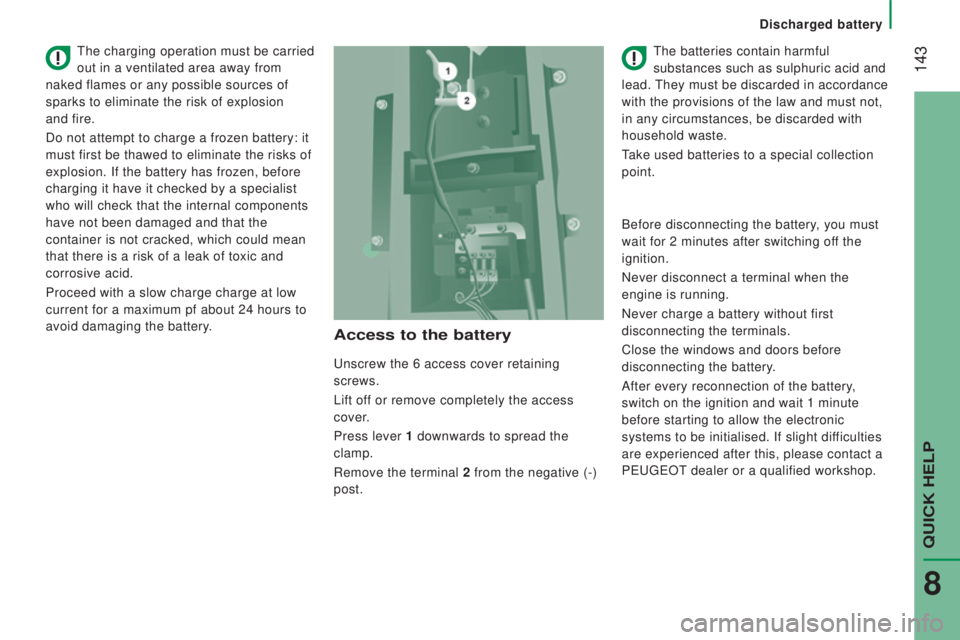
Access to the battery
unscrew the 6 access cover retaining
screws.
Lift off or remove completely the access
cover.
Press lever 1 downwards to spread the
clamp.
Remove the terminal 2 from the negative (-)
post.
the batteries contain harmful
substances such as sulphuric acid and
lead.
they must be discarded in accordance
with the provisions of the law and must not,
in any circumstances, be discarded with
household waste.
take used batteries to a special collection
point.
the charging operation must be carried
out in a ventilated area away from
naked flames or any possible sources of
sparks to eliminate the risk of explosion
and fire.
Do not attempt to charge a frozen battery: it
must first be thawed to eliminate the risks of
explosion. If the battery has frozen, before
charging it have it checked by a specialist
who will check that the internal components
have not been damaged and that the
container is not cracked, which could mean
that there is a risk of a leak of toxic and
corrosive acid.
Proceed with a slow charge charge at low
current for a maximum pf about 24 hours to
avoid damaging the battery. Before disconnecting the battery, you must
wait for 2 minutes after switching off the
ignition.
Never disconnect a terminal when the
engine is running.
Never charge a battery without first
disconnecting the terminals.
Close the windows and doors before
disconnecting the battery.
After every reconnection of the battery,
switch on the ignition and wait 1 minute
before starting to allow the electronic
systems to be initialised. If slight difficulties
are experienced after this, please contact a
P
eugeOt dealer or a qualified workshop.
Discharged battery
QuICK HeLP
8
Page 148 of 276
 Allocation
12 7.5Right-hand dipped headlamp
13 7.5Left-hand dipped headlamp
31 5
engine compartment control unit relay - Dashboard control unit relay (ig\
nition switch +)
32 7.5Cabi")
146FusesA (amps) Allocation
12 7.5Right-hand dipped headlamp
13 7.5Left-hand dipped headlamp
31 5
engine compartment control unit relay - Dashboard control unit relay (ig\
nition switch +)
32 7.5Cabin lighting (battery +)
33 7.5Battery check sensor on Stop & Start version (battery +)
34 7.5Minibus interior lighting - Hazard warning lamps
36 10Audio system -
Air conditioning controls - Alarm -
tachograph - Battery cut-off control unit -
Additional heating programmer (battery +)
37 7.5Brake lamp switch -
third brake lamp Instrument panel (ignition +)
38 20Central door locking (battery +)
42 5ABS control unit and sensor -
ASR sensor - DSC sensor - Brake lamp switch
43 20Windscreen wiper motor (ignition switch +)
47 20Driver's electric window motor
48 20Passenger's electric window motor
49 5Parking sensors control unit - Audio system - Steering mounted controls - Centre and side switch panels\
-
Auxiliary switch panel - Battery cut-off control unit (ignition switch +)
50 7.5Airbags and pre-tensioners control unit
51 5
tachograph - Power steering control unit - Air conditioning - Reversing lamps - W
ater in Diesel sensor -
Air flow sensor (ignition switch +)
53 7.5Instrument panel (battery +)
89 -Not used
90 7.5Left-hand main beam
91 7.5Right-hand main beam
92 7.5Left-hand front foglamp
93 7.5Right-hand front foglamp
Failed fuse