ignition PEUGEOT BOXER 2015 Owner's Guide
[x] Cancel search | Manufacturer: PEUGEOT, Model Year: 2015, Model line: BOXER, Model: PEUGEOT BOXER 2015Pages: 276, PDF Size: 8.99 MB
Page 104 of 276
102
reactivation
the
ASR system is reactivated automatically
every time the ignition is switched back on.
-
Press this button again to reactivate it
manually
.
operating faultIf this warning lamp comes on,
accompanied by an audible signal
and a message in the instrument
panel screen, this indicates a fault
with the ASR system.
Have it checked by a P
eugeOt dealer or a
qualified workshop. Good practice
the DSC and
ASR systems offer exceptional
safety in normal driving, but this should not
encourage the driver to take extra risks or
drive at high speed.
the correct operation of these systems
depend on observation of the manufacturer's
recommendations regarding the wheels
(tyres and rims), the braking components,
the electronic components and assembly
and repair procedures.
After an impact, have these systems
checked by a P
eugeOt dealer or a
qualified workshop.
Load inertia control
the true total weight of a commercial vehicle
can vary considerably depending on the load
carried.
As a result, the centre of gravity of
the vehicle can move, both longitudinally
and in height.
All such variations have an effect on braking,
traction, the behaviour of the vehicle when
cornering and the tendency to overturn.
Load inertia control estimates the true
total weight of the vehicle by analysing its
behaviour under acceleration and braking.
this system then adapts the operation of
the DSC and ASR systems according to the
weight distribution in the vehicle. In critical
situations, your vehicle than remains more
securely on its intended trajectory.
Driving safely
Page 107 of 276
105
LAnE dEPArturE WArnInG SYStEM
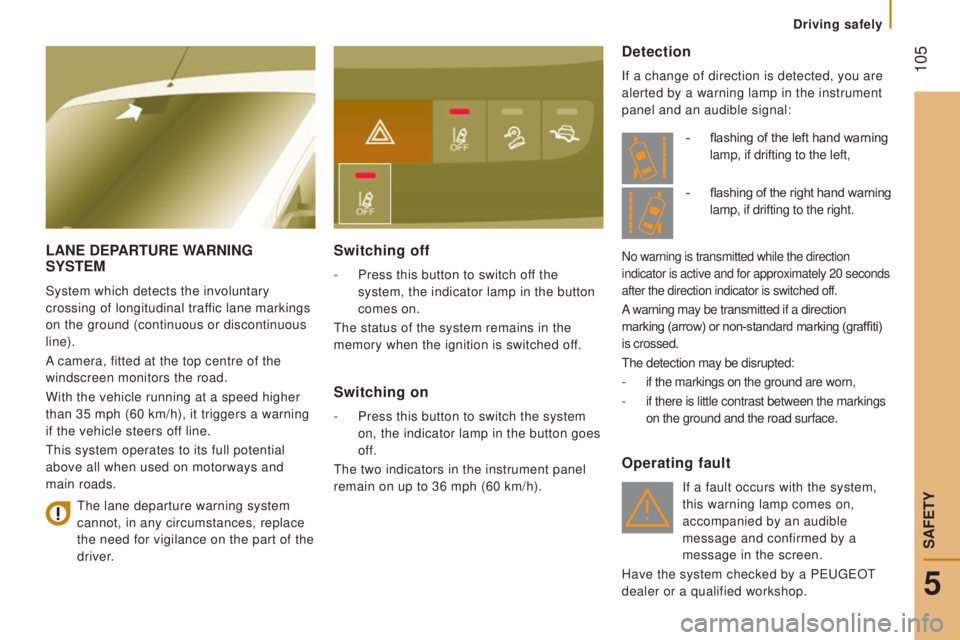
System which detects the involuntary
crossing of longitudinal traffic lane markings
on the ground (continuous or discontinuous
line).
A camera, fitted at the top centre of the
windscreen monitors the road.
With the vehicle running at a speed higher
than 35 mph (60 km/h), it triggers a warning
if the vehicle steers off line.
this system operates to its full potential
above all when used on motorways and
main roads.
Switching off
- Press this button to switch off the
system, the indicator lamp in the button
comes on.
the status of the system remains in the
memory when the ignition is switched off.
Switching on
- Press this button to switch the system
on, the indicator lamp in the button goes
off.
the two indicators in the instrument panel
remain on up to 36 mph (60 km/h).
detection
If a change of direction is detected, you are
alerted by a warning lamp in the instrument
panel and an audible signal:
operating fault
If a fault occurs with the system,
this warning lamp comes on,
accompanied by an audible
message and confirmed by a
message in the screen.
Have the system checked by a P
eugeOt
dealer or a qualified workshop.
the lane departure warning system
cannot, in any circumstances, replace
the need for vigilance on the part of the
driver. -
flashing of the left hand warning
lamp, if drifting to the left,
No warning is transmitted while the direction
indicator is active and for approximately 20
seconds
after the direction indicator is switched off.
A warning may be transmitted if a direction
marking (arrow) or non-standard marking (graffiti)
is crossed.
the detection may be disrupted:
-
if the markings on the ground are worn,
-
if there is little contrast between the markings
on the ground and the road surface. -
flashing of
the right hand warning
lamp, if drifting to the right.
5
Driving safely
SAFetY
Page 108 of 276
106
cAB SEAt BELtS
If you install a front bench seat as
an accessory, it it must be fitted with
approved seat belts.
Fastening
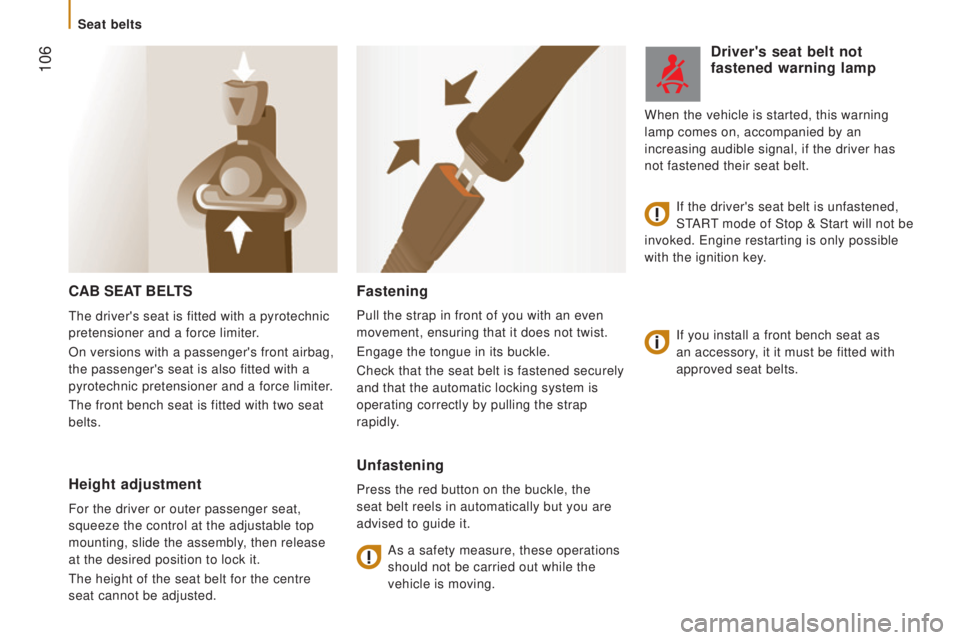
Pull the strap in front of you with an even
movement, ensuring that it does not twist.
engage the tongue in its buckle.
Check that the seat belt is fastened securely
and that the automatic locking system is
operating correctly by pulling the strap
rapidly.
unfastening
Press the red button on the buckle, the
seat belt reels in automatically but you are
advised to guide it.
As a safety measure, these operations
should not be carried out while the
vehicle is moving.
driver's seat belt not
fastened warning lamp
If the driver's seat belt is unfastened,
S
tARt mode of Stop & Start will not be
invoked.
engine restarting is only possible
with the ignition key. When the vehicle is started, this warning
lamp comes on, accompanied by an
increasing audible signal, if the driver has
not fastened their seat belt.
the driver's seat is fitted with a pyrotechnic
pretensioner and a force limiter.
On versions with a passenger's front airbag,
the passenger's seat is also fitted with a
pyrotechnic pretensioner and a force limiter.
the front bench seat is fitted with two seat
belts.
Height adjustment
For the driver or outer passenger seat,
squeeze the control at the adjustable top
mounting, slide the assembly, then release
at the desired position to lock it.
the height of the seat belt for the centre
seat cannot be adjusted.
Seat belts
Page 109 of 276
107
rEAr SEAt BELtS
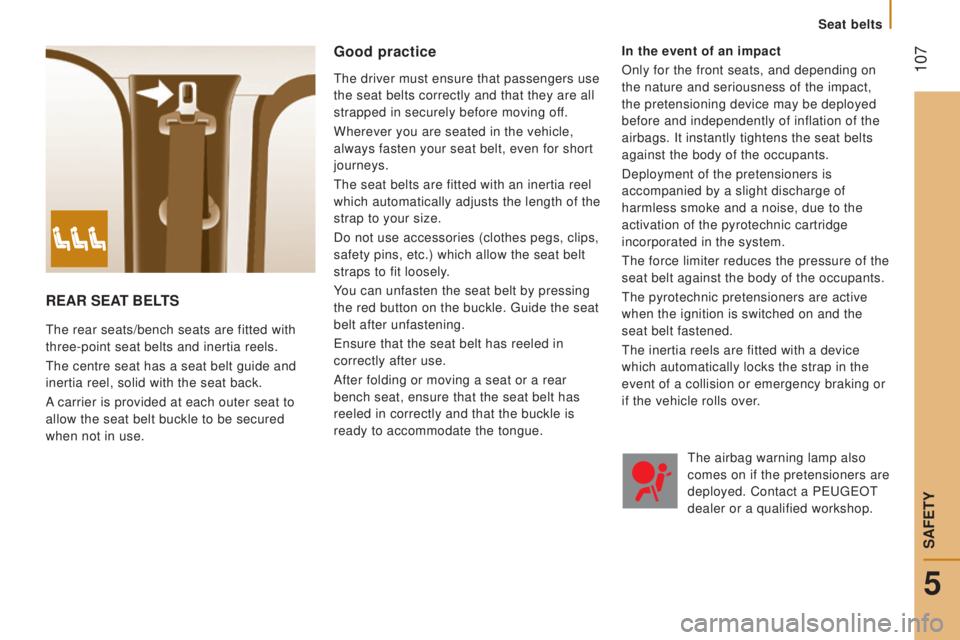
the rear seats/bench seats are fitted with
three-point seat belts and inertia reels.
the centre seat has a seat belt guide and
inertia reel, solid with the seat back.
A carrier is provided at each outer seat to
allow the seat belt buckle to be secured
when not in use.
Good practice
the driver must ensure that passengers use
the seat belts correctly and that they are all
strapped in securely before moving of
f.
Wherever you are seated in the vehicle,
always fasten your seat belt, even for short
journeys.
the seat belts are fitted with an inertia reel
which automatically adjusts the length of the
strap to your size.
Do not use accessories (clothes pegs, clips,
safety pins, etc.) which allow the seat belt
straps to fit loosely.
You can unfasten the seat belt by pressing
the red button on the buckle.
guide the seat
belt after unfastening.
ensure that the seat belt has reeled in
correctly after use.
After folding or moving a seat or a rear
bench seat, ensure that the seat belt has
reeled in correctly and that the buckle is
ready to accommodate the tongue.
the airbag warning lamp also
comes on if the pretensioners are
deployed. Contact a P
eugeOt
dealer or a qualified workshop.
In the event of an impact
Only for the front seats, and depending on
the nature and seriousness of the impact,
the pretensioning device may be deployed
before and independently of inflation of the
airbags. It instantly tightens the seat belts
against the body of the occupants.
Deployment of the pretensioners is
accompanied by a slight discharge of
harmless smoke and a noise, due to the
activation of the pyrotechnic cartridge
incorporated in the system.
the force limiter reduces the pressure of the
seat belt against the body of the occupants.
the pyrotechnic pretensioners are active
when the ignition is switched on and the
seat belt fastened.
the inertia reels are fitted with a device
which automatically locks the strap in the
event of a collision or emergency braking or
if the vehicle rolls over.
5
SAFetY
Seat belts
Page 112 of 276
11 0
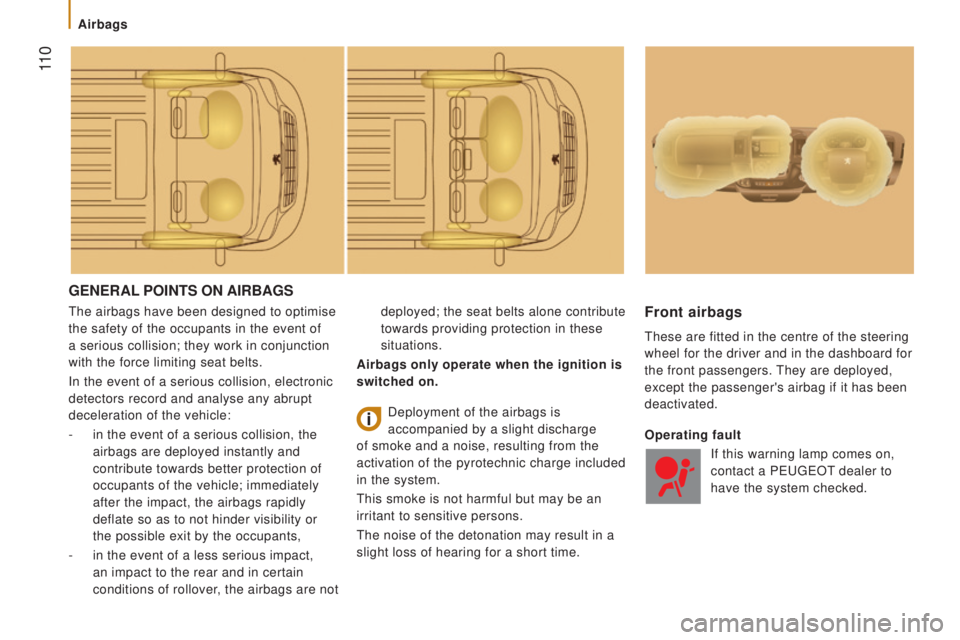
GEnErAL PoIntS on AIrBAGS
the airbags have been designed to optimise
the safety of the occupants in the event of
a serious collision; they work in conjunction
with the force limiting seat belts.
In the event of a serious collision, electronic
detectors record and analyse any abrupt
deceleration of the vehicle:
-
in the event of a serious collision, the
airbags are deployed instantly and
contribute towards better protection of
occupants of the vehicle; immediately
after the impact, the airbags rapidly
deflate so as to not hinder visibility or
the possible exit by the occupants,
-
in the event of a less serious impact,
an impact to the rear and in certain
conditions of rollover, the airbags are not deployed; the seat belts alone contribute
towards providing protection in these
situations.
Airbags only operate when the ignition is
switched on.Front airbags
these are fitted in the centre of the steering
wheel for the driver and in the dashboard for
the front passengers.
they are deployed,
except the passenger's airbag if it has been
deactivated.
Deployment of the airbags is
accompanied by a slight discharge
of smoke and a noise, resulting from the
activation of the pyrotechnic charge included
in the system.
this smoke is not harmful but may be an
irritant to sensitive persons.
the noise of the detonation may result in a
slight loss of hearing for a short time.
operating fault
If this warning lamp comes on,
contact a P
eugeOt dealer to
have the system checked.
Airbags
Page 129 of 276
127
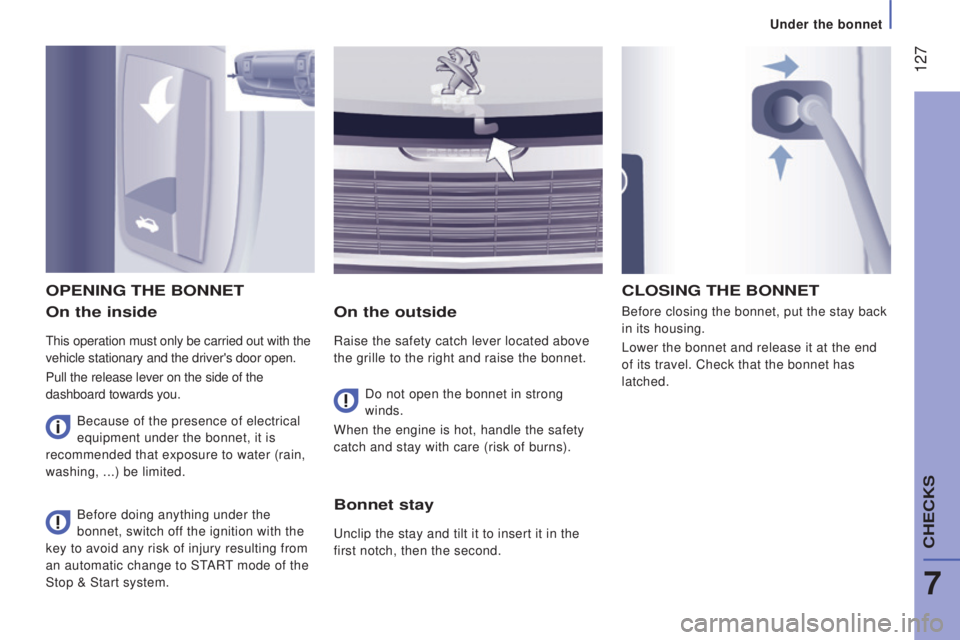
on the inside
this operation must only be carried out with the
vehicle stationary and the driver's door open.
Pull the release lever on the side of the
dashboard towards you.
on the outside
Raise the safety catch lever located above
the grille to the right and raise the bonnet. Before closing the bonnet, put the stay back
in its housing.
Lower the bonnet and release it at the end
of its travel. Check that the bonnet has
latched.
oPEnInG tHE BonnEt
Do not open the bonnet in strong
winds.
When the engine is hot, handle the safety
catch and stay with care (risk of burns).
Before doing anything under the
bonnet, switch off the ignition with the
key to avoid any risk of injury resulting from
an automatic change to S
tARt mode of the
Stop & Start system.
cLoSInG tHE BonnEt
Bonnet stay
unclip the stay and tilt it to insert it in the
first notch, then the second.
Because of the presence of electrical
equipment under the bonnet, it is
recommended that exposure to water (rain,
washing,
...) be limited.
7
under the bonnet
CHeCKS
Page 132 of 276
130
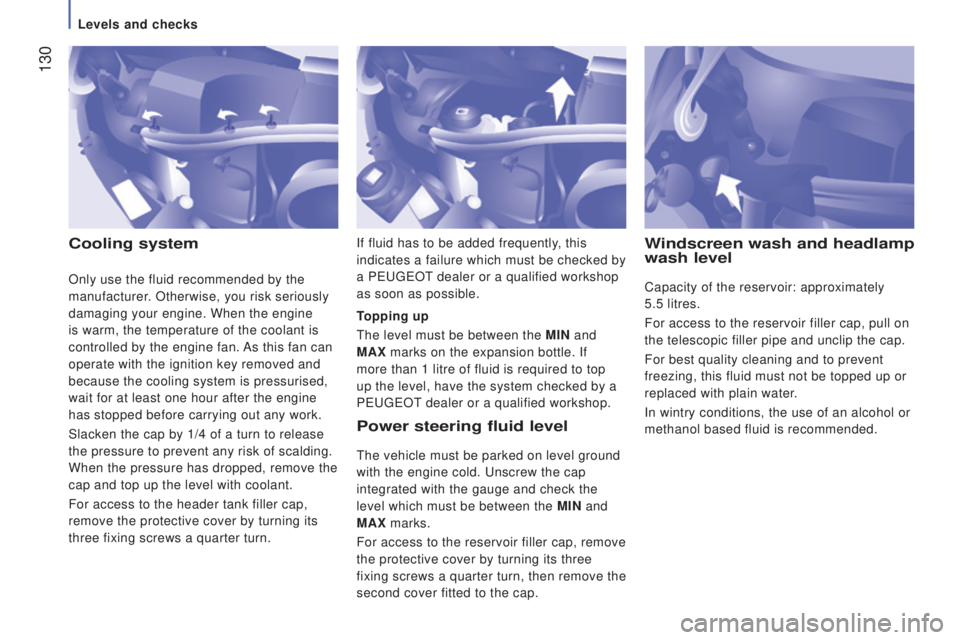
cooling systemPower steering fluid level
the vehicle must be parked on level ground
with the engine cold.
unscrew the cap
integrated with the gauge and check the
level which must be between the MI
n and
MA
x marks.
For access to the reservoir filler cap, remove
the protective cover by turning its three
fixing screws a quarter turn, then remove the
second cover fitted to the cap.
topping up
the level must be between the
MI
n and
MA
x marks on the expansion bottle. If
more than 1 litre of fluid is required to top
up the level, have the system checked by a
P
eugeOt dealer or a qualified workshop.
Windscreen wash and headlamp
wash level
Capacity of the reservoir: approximately
5.5
litres.
For access to the reservoir filler cap, pull on
the telescopic filler pipe and unclip the cap.
For best quality cleaning and to prevent
freezing, this fluid must not be topped up or
replaced with plain water.
In wintry conditions, the use of an alcohol or
methanol based fluid is recommended.
If fluid has to be added frequently, this
indicates a failure which must be checked by
a PeugeOt dealer or a qualified workshop
as soon as possible.
Only use the fluid recommended by the
manufacturer. Otherwise, you risk seriously
damaging your engine. When the engine
is warm, the temperature of the coolant is
controlled by the engine fan. As this fan can
operate with the ignition key removed and
because the cooling system is pressurised,
wait for at least one hour after the engine
has stopped before carrying out any work.
Slacken the cap by 1/4 of a turn to release
the pressure to prevent any risk of scalding.
When the pressure has dropped, remove the
cap and top up the level with coolant.
For access to the header tank filler cap,
remove the protective cover by turning its
three fixing screws a quarter turn.
Levels and checks
Page 136 of 276
134
Low fuel level
rEFuELLInG
In low temperatures
In mountainous and/or cold areas, it is
advisable to use a "winter" type fuel suited
to low or minus temperatures.With Stop & Start, never refuel with
the system in S
tOP mode; you must
switch off the ignition with the key. When the fuel tank level E
(
empty) is reached, this warning
lamp comes on.
You then have around 10 to
12 litres in the reserve, depending on the
capacity of the tank, the engine type, the
driving conditions and the profile of the road.
Refuel without delay to avoid running out of
fuel.
the capacity of the fuel tank is
approximately 90 litres.
Fuel tanks of different capacities, 60
and
120 litres, may be fitted.
the fuel tank must be filled
with the engine
off.
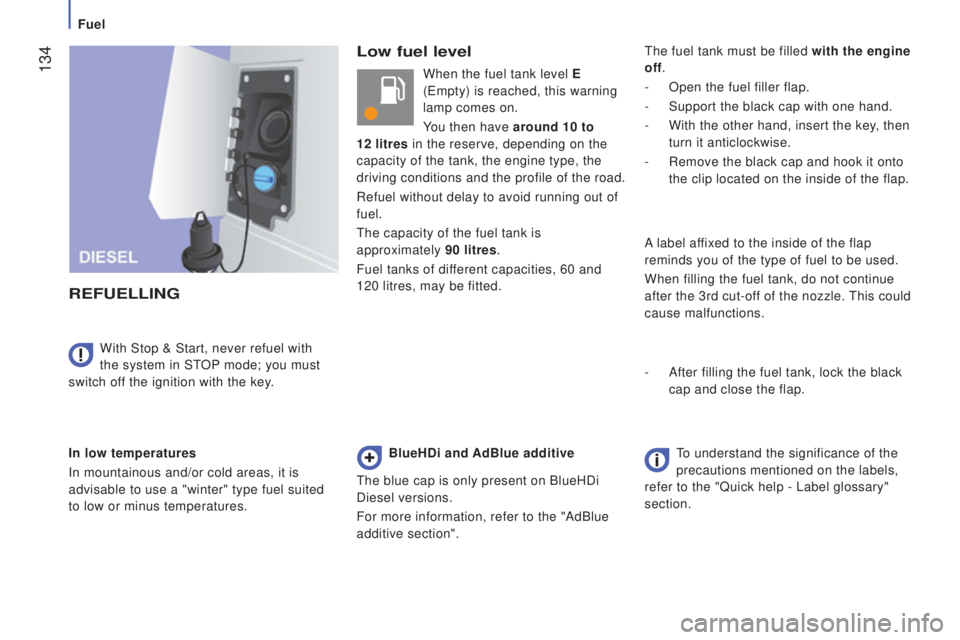
-
Open the fuel filler flap.
-
Support the black cap with one hand.
-
With the other hand, insert the key, then
turn it anticlockwise.
-
Remove the black cap and hook it onto
the clip located on the inside of the flap.
A
label affixed to the inside of the flap
reminds you of the type of fuel to be used.
When filling the fuel tank, do not continue
after the 3rd cut-off of the nozzle.
this could
cause malfunctions.
-
After filling the fuel tank, lock the black
cap and close the flap.
BlueH
di and AdBlue additive
the blue cap is only present on BlueHDi
Diesel versions.
For more information, refer to the "AdBlue
additive section".to understand the significance of the
precautions mentioned on the labels,
refer to the "Quick help - Label glossary"
section.
Fuel
Page 140 of 276
138
range indicators
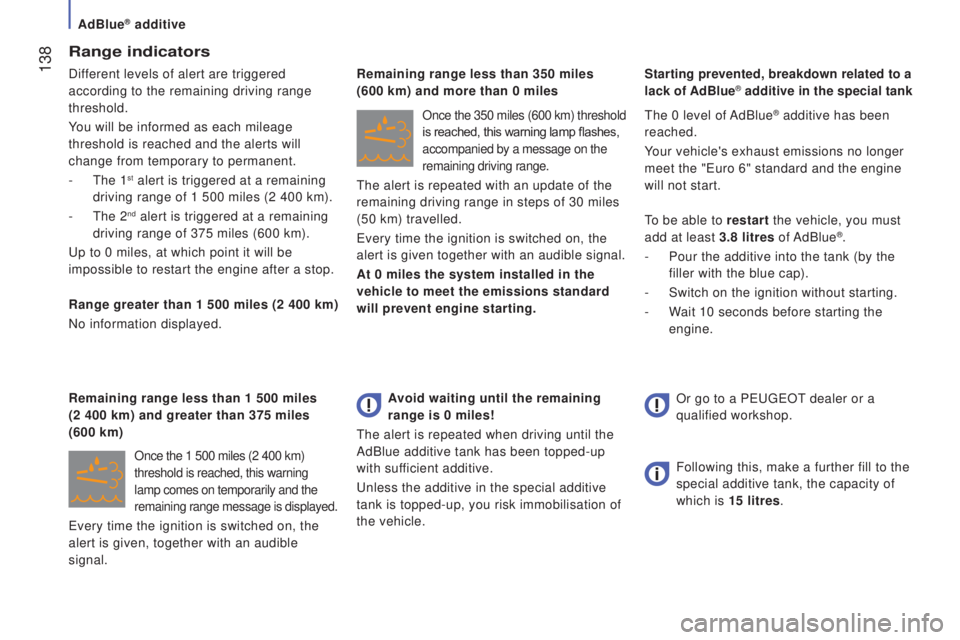
Different levels of alert are triggered
according to the remaining driving range
threshold.
You will be informed as each mileage
threshold is reached and the alerts will
change from temporary to permanent.
-
t
he 1st alert is triggered at a remaining
driving range of 1 500 miles (2 400 km).
-
t
he 2nd alert is triggered at a remaining
driving range of 375 miles (600 km).
up to 0 miles, at which point it will be
impossible to restart the engine after a stop.
range greater than 1 500 miles (2 400 km)
No information displayed.
Once the 1 500 miles (2 400 km)
threshold is reached, this warning
lamp comes on temporarily and the
remaining range message is displayed.
every time the ignition is switched on, the
alert is given, together with an audible
signal.
remaining range less than 1 500 miles
(2 400 km) and greater than 375 miles
(600 km)
Once the 350 miles (600 km) threshold
is reached, this warning lamp flashes,
accompanied by a message on the
remaining driving range.
the alert is repeated with an update of the
remaining driving range in steps of 30 miles
(50 km) travelled.
every time the ignition is switched on, the
alert is given together with an audible signal.
At 0 miles the system installed in the
vehicle to meet the emissions standard
will prevent engine starting.
the 0 level of
AdBlue
® additive has been
reached.
Your vehicle's exhaust emissions no longer
meet the "
euro 6" standard and the engine
will not start.
to be able to restart
the vehicle, you must
add at least 3.8 litres of AdBlue
®.
-
Pour the additive into the tank (by the
filler with the blue cap).
-
Switch on the ignition without starting.
-
Wait 10 seconds before starting the
engine.
remaining range less than 350 miles
(600 km) and more than 0 miles Starting prevented, breakdown related to a
lack of AdBlue
®
additive in the special tank
Avoid waiting until the remaining
range is 0 miles!
the alert is repeated when driving until the
AdBlue additive tank has been topped-up
with sufficient additive.
unless the additive in the special additive
tank is topped-up, you risk immobilisation of
the vehicle. Following this, make a further fill to the
special additive tank, the capacity of
which is 15 litres. Or go to a P
eugeOt dealer or a
qualified workshop.
AdBlue® additive
Page 141 of 276
139
Fault with the Scr system
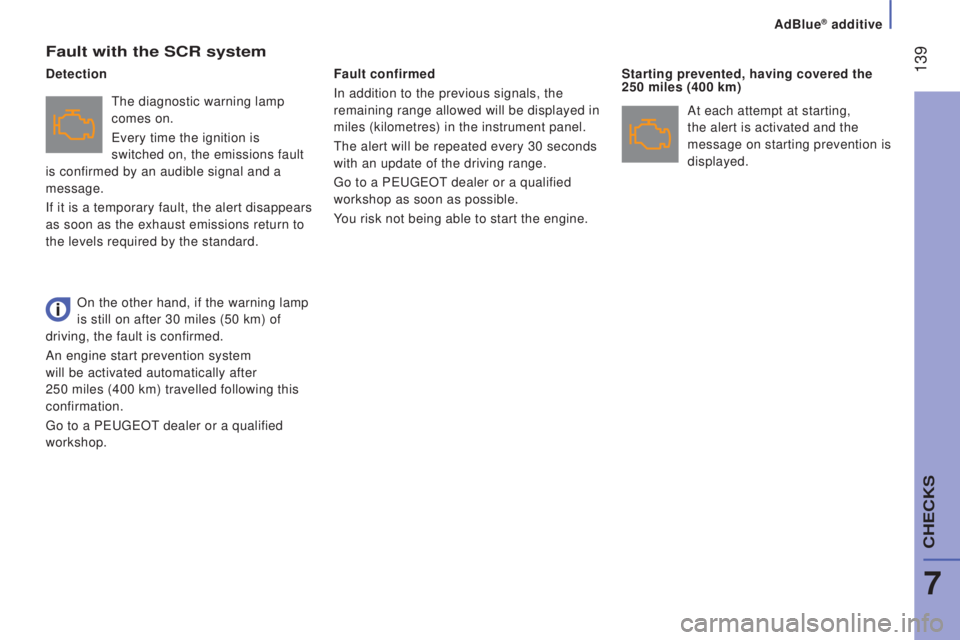
the diagnostic warning lamp
comes on.
every time the ignition is
switched on, the emissions fault
is confirmed by an audible signal and a
message.
If it is a temporary fault, the alert disappears
as soon as the exhaust emissions return to
the levels required by the standard. Fault confirmed
In addition to the previous signals, the
remaining range allowed will be displayed in
miles (kilometres) in the instrument panel.
the alert will be repeated every 30 seconds
with an update of the driving range.
go to a PeugeOt dealer or a qualified
workshop as soon as possible.
Y
ou risk not being able to start the engine. Starting prevented, having covered the
250 miles (400 km)
detection
At each attempt at starting,
the alert is activated and the
message on starting prevention is
displayed.
On the other hand, if the warning lamp
is still on after 30 miles (50 km) of
driving, the fault is confirmed.
An engine start prevention system
will be activated automatically after
250
miles (400 km) travelled following this
confirmation.
go to a PeugeOt dealer or a qualified
workshop.
AdBlue® additive
7
CHeCKS