weight PEUGEOT BOXER 2015 Owners Manual
[x] Cancel search | Manufacturer: PEUGEOT, Model Year: 2015, Model line: BOXER, Model: PEUGEOT BOXER 2015Pages: 276, PDF Size: 8.99 MB
Page 12 of 276
10
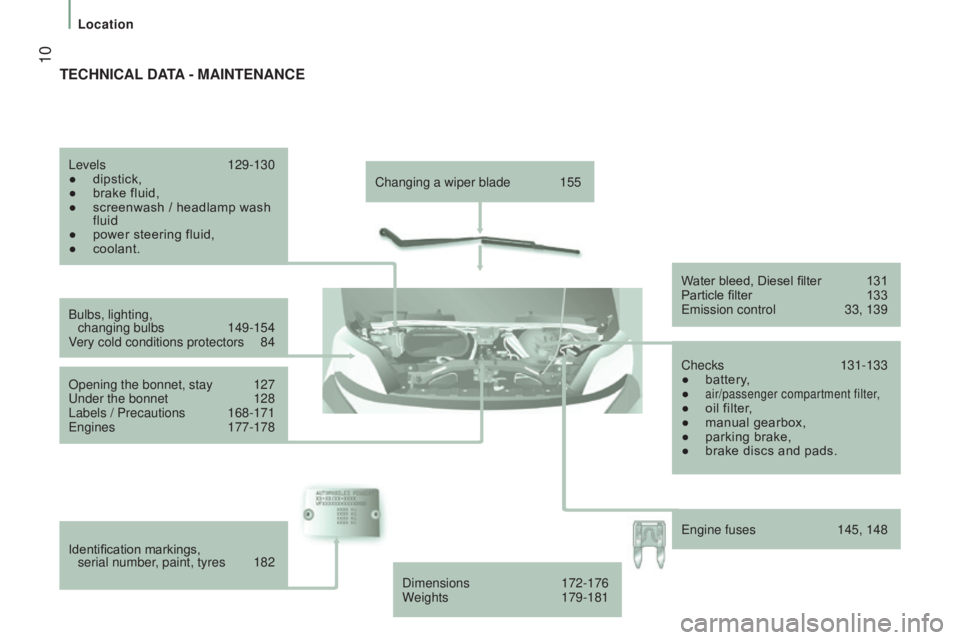
Changing a wiper blade 155
Bulbs, lighting, changing bulbs
149-154
Very cold conditions protectors 84
Opening the bonnet, stay
127under the bonnet 128
Labels / Precautions 168-171engines 177-178
Identification markings, serial
number
, paint, tyres
182
Levels
129-130
● dipstick,
● brake fluid,
● screenwash / headlamp wash
fluid
●
power steering fluid,
● coolant.
Water bleed, Diesel filter
131
Particle filter 133emission control 33, 139
Checks
131-133
● battery,
● air/passenger compartment filter,● oil filter,
● manual gearbox,
● parking brake,
● brake discs and pads.
tEcHnIcAL dAtA - MAIntEnAncE
Dimensions 172-176
Weights 179-181
engine fuses 145, 148
Location
Page 74 of 276
72
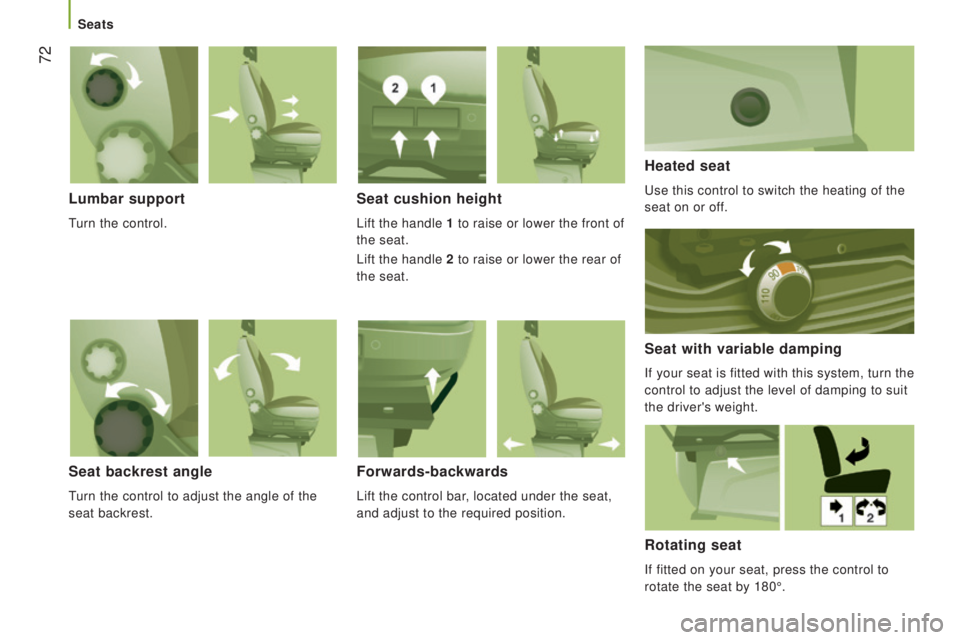
Lumbar support
turn the control.
Seat cushion height
Lift the handle 1 to raise or lower the front of
the seat.
Lift the handle 2 to raise or lower the rear of
the seat.
Heated seat
use this control to switch the heating of the
seat on or off.
Seat with variable damping
If your seat is fitted with this system, turn the
control to adjust the level of damping to suit
the driver's weight.
Seat backrest angle
turn the control to adjust the angle of the
seat backrest.
Forwards-backwards
Lift the control bar, located under the seat,
and adjust to the required position.
rotating seat
If fitted on your seat, press the control to
rotate the seat by 180°.
Seats
Page 104 of 276
102
reactivation
the
ASR system is reactivated automatically
every time the ignition is switched back on.
-
Press this button again to reactivate it
manually
.
operating faultIf this warning lamp comes on,
accompanied by an audible signal
and a message in the instrument
panel screen, this indicates a fault
with the ASR system.
Have it checked by a P
eugeOt dealer or a
qualified workshop. Good practice
the DSC and
ASR systems offer exceptional
safety in normal driving, but this should not
encourage the driver to take extra risks or
drive at high speed.
the correct operation of these systems
depend on observation of the manufacturer's
recommendations regarding the wheels
(tyres and rims), the braking components,
the electronic components and assembly
and repair procedures.
After an impact, have these systems
checked by a P
eugeOt dealer or a
qualified workshop.
Load inertia control
the true total weight of a commercial vehicle
can vary considerably depending on the load
carried.
As a result, the centre of gravity of
the vehicle can move, both longitudinally
and in height.
All such variations have an effect on braking,
traction, the behaviour of the vehicle when
cornering and the tendency to overturn.
Load inertia control estimates the true
total weight of the vehicle by analysing its
behaviour under acceleration and braking.
this system then adapts the operation of
the DSC and ASR systems according to the
weight distribution in the vehicle. In critical
situations, your vehicle than remains more
securely on its intended trajectory.
Driving safely
Page 115 of 276
11 3
GEnErAL PoIntS
on cHILd SEAtS
Although one of PeugeOt's main criteria
when designing your vehicle, the safety of
your children also depends on you.
For maximum safety
, please follow these
precautions:
-
all children under the age of 12 or less
than one metre fifty tall must travel in
approved child seats suited to their
weight, on seats fitted with a seat belt or
ISOFIX mountings,
-
statistically, the safest seats in your
vehicle for the transportation of children
are the rear seats,
-
a child weighing less than 9 kg must
travel in the "rearward facing" position
both in the front and in the rear,
-
the passenger must not travel with a
child on their lap.
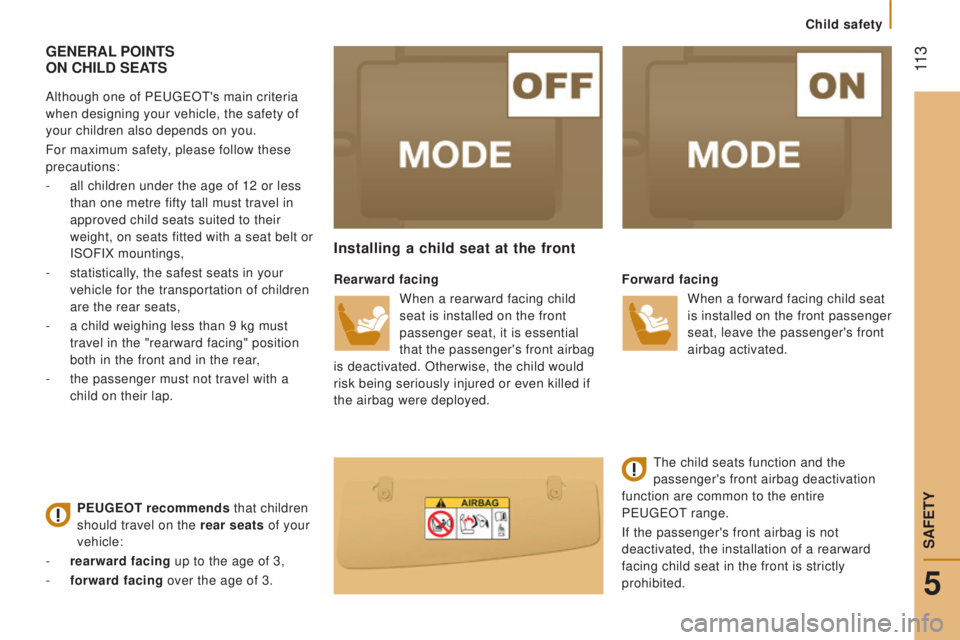
Installing a child seat at the front
rearward facing When a rearward facing child
seat is installed on the front
passenger seat, it is essential
that the passenger's front airbag
is deactivated. Otherwise, the child would
risk being seriously injured or even killed if
the airbag were deployed. Forward facing
When a forward facing child seat
is installed on the front passenger
seat, leave the passenger's front
airbag activated.
PEuGEot recommends
that children
should travel on the rear seats of your
vehicle:
-
rearward facing
up to the age of 3,
-
forward facing
over the age of 3.
the child seats function and the
passenger's front airbag deactivation
function are common to the entire
P
eugeOt range.
If the passenger's front airbag is not
deactivated, the installation of a rearward
facing child seat in the front is strictly
prohibited.
5
SAFetY
Child safety
Page 121 of 276

11 9
InStALLInG cHILd SEAtS AttAcHEd uSInG tHE SEAt BELt
In accordance with the european regulation, this table indicates the options for installing chil\
d seats secured using a seat belt and
universally approved in accordance with the weight of the child and the \
seat in the vehicle.
Weight of the child and indicative age
Seat
under 13 kg
(groups 0 (
a) and 0+)
up to approx 1 year From 9 to 18 kg
(group 1)
1 to 3 years approx From 15 to 25 kg
(group 2)
3 to 6 years approx From 22 to 36 kg
(group 3)
6 to 10 years approx
Front passenger
seat (b )
u uuu
Front passenger
bench seat with centre
and outer seat (b )
u uuu
Outer
seats
in rows 2
and 3
u uuu
Centre
seat
in rows 2
and 3
u uuu
a: group 0: from birth to 10 kg.
b :
consult the legislation in force in your
country before installing your child on this
seat.
Remove and stow the head restraint
before installing a child seat with
backrest on a passenger seat.
Refit the head restraint once the child seat
has been removed.
u: seat suitable for the installation of a
child seat secured using a seat belt and
universally approved, rearward facing
and/or forward facing.
5
SAFetY
Child safety
Page 123 of 276
121
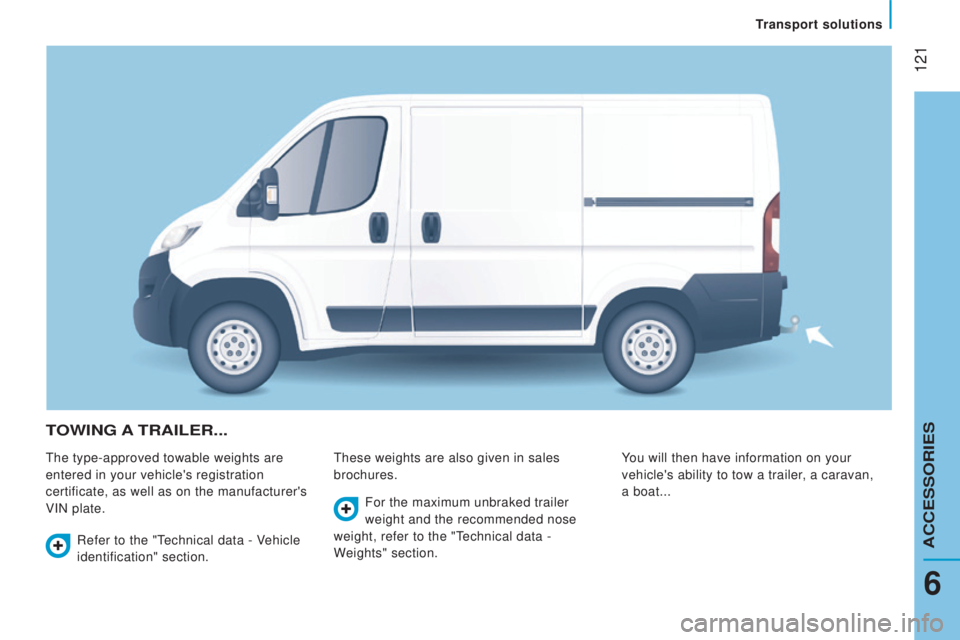
toWInG A trAILEr...
the type-approved towable weights are
entered in your vehicle's registration
certificate, as well as on the manufacturer's
VIN plate.these weights are also given in sales
brochures. You will then have information on your
vehicle's ability to tow a trailer, a caravan,
a boat...
Refer to the "
technical data - Vehicle
identification" section. For the maximum unbraked trailer
weight and the recommended nose
weight, refer to the "
technical data -
W
eights" section.
6
transport solutions
ACCeSSORIeS
Page 124 of 276
122
driving advice
distribution of loads: distribute the load in
the trailer so that the heaviest objects are as
close as possible to the axle and the nose
weight is close to the maximum authorised
without, however, exceeding it.
cooling:
towing a trailer on a slope
increases the coolant temperature.
As the fan is electrically controlled, its
cooling capacity is not dependent on the
engine speed.
On the contrary, use a high gear to lower the
engine speed and reduce your speed.
In all cases, pay attention to the coolant
temperature.
tyres: check the tyre pressures of the
towing vehicle and of the trailer, observing
the recommended pressures.
Fitting a towbar
We recommend the use of genuine
P
eugeOt towbars and their harnesses,
which have been tested and approved from
the design stage of your vehicle and that
the fitting of this equipment is entrusted to a
P
eugeOt dealer.
these genuine towbars are compatible with
the operation of the rear parking sensors
and the reversing camera, if fitted to your
vehicle.
If this equipment is not fitted by a P
eugeOt
dealer, it must be fitted in line with the
manufacturer's instructions.
Good practice
If the coolant temperature
warning lamp comes on, stop the
vehicle and switch off the engine
as soon as possible.
Refer to the "Checks - Levels and
checks" section.
Brakes: towing increases the braking
distance. Drive at a moderate speed,
change down early and brake gradually. Side wind: sensitivity to side wind is
increased. Drive smoothly and at a
moderate speed. ABS: the system only controls the vehicle,
not the trailer.
rear parking sensors:
the system is
deactivated while the vehicle is towing with a
genuine P
eugeOt towbar fitted.
Refer to the "
technical data -
Identification markings" section.
transport solutions
Page 125 of 276
123
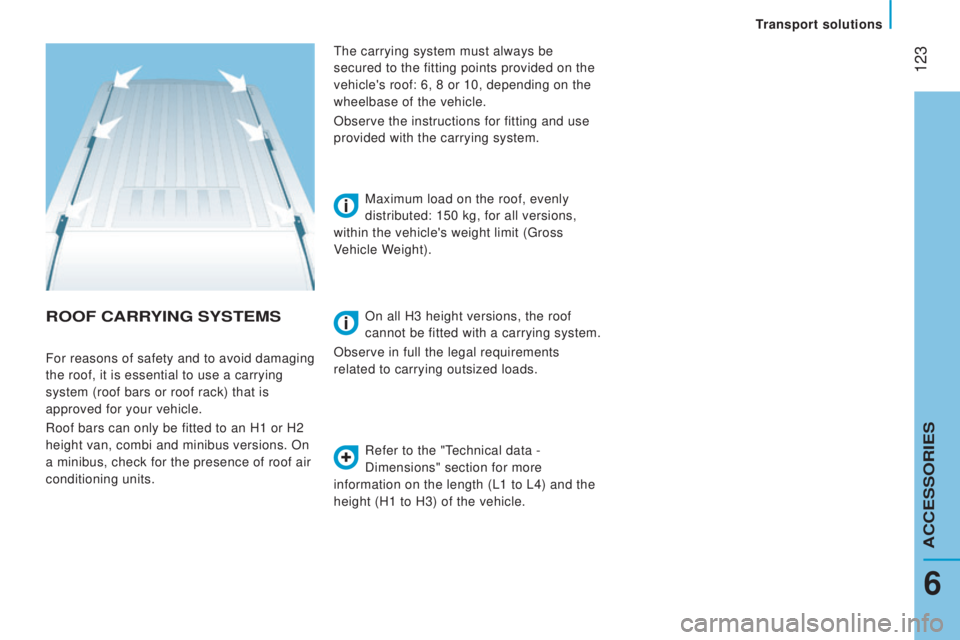
rooF cArrYInG SYStEMS
Refer to the "technical data -
Dimensions" section for more
information on the length (L1 to L4) and the
height (H1 to H3) of the vehicle. Maximum load on the roof, evenly
distributed: 150 kg, for all versions,
within the vehicle's weight limit (
gross
Vehicle Weight).
For reasons of safety and to avoid damaging
the roof, it is essential to use a carrying
system (roof bars or roof rack) that is
approved for your vehicle.
Roof bars can only be fitted to an H1 or H2
height van, combi and minibus versions. On
a minibus, check for the presence of roof air
conditioning units.
the carrying system must always be
secured to the fitting points provided on the
vehicle's roof: 6, 8 or 10, depending on the
wheelbase of the vehicle.
Observe the instructions for fitting and use
provided with the carrying system.
On all H3 height versions, the roof
cannot be fitted with a carrying system.
Observe in full the legal requirements
related to carrying outsized loads.
6
transport solutions
ACCeSSORIeS
Page 165 of 276
163
toWInG
t
owing the vehicle
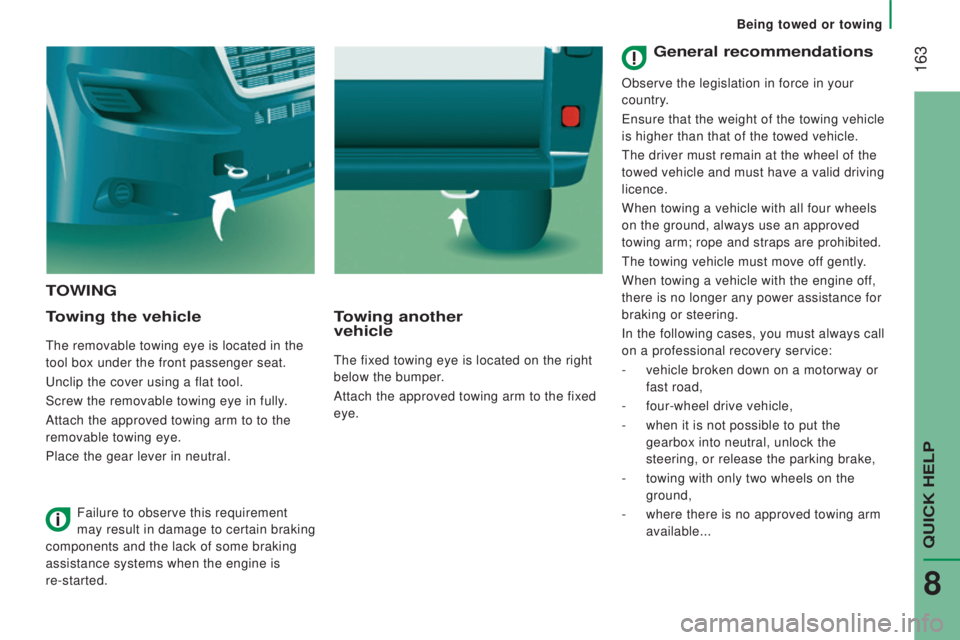
the removable towing eye is located in the
tool box under the front passenger seat.
unclip the cover using a flat tool.
Screw the removable towing eye in fully
.
Attach the approved towing arm to to the
removable towing eye.
Place the gear lever in neutral.
towing another
vehicle
the fixed towing eye is located on the right
below the bumper.
Attach the approved towing arm to the fixed
eye.
Failure to observe this requirement
may result in damage to certain braking
components and the lack of some braking
assistance systems when the engine is
re-started.
General recommendations
Observe the legislation in force in your
country.
ensure that the weight of the towing vehicle
is higher than that of the towed vehicle.
the driver must remain at the wheel of the
towed vehicle and must have a valid driving
licence.
When towing a vehicle with all four wheels
on the ground, always use an approved
towing arm; rope and straps are prohibited.
the towing vehicle must move of
f gently.
When towing a vehicle with the engine off,
there is no longer any power assistance for
braking or steering.
In the following cases, you must always call
on a professional recovery service:
-
vehicle broken down on a motorway or
fast road,
-
four-wheel drive vehicle,
-
when it is not possible to put the
gearbox into neutral, unlock the
steering, or release the parking brake,
-
towing with only two wheels on the
ground,
-
where there is no approved towing arm
available...
QuICK HeLP
8
Being towed or towing
Page 166 of 276
164
toWBAr WItH QuIcKLY
d
EtAcHABLE t
o
WBALL
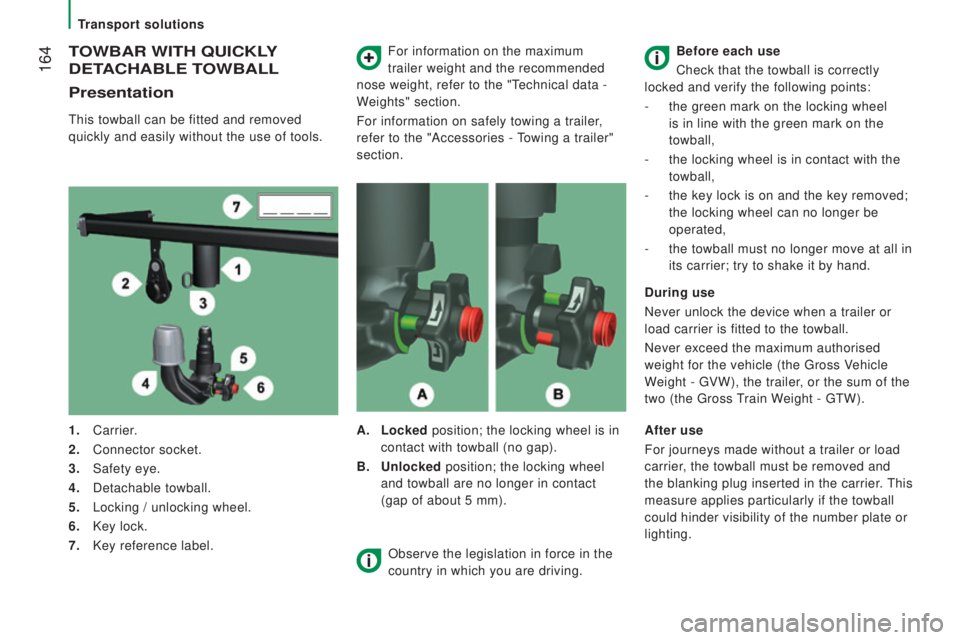
Presentation
this towball can be fitted and removed
quickly and easily without the use of tools. For information on the maximum
trailer weight and the recommended
nose weight, refer to the "
technical data -
W
eights" section.
For information on safely towing a trailer,
refer to the "Accessories -
towing a trailer"
section.
1.
Carrier
.
2.
Connector socket.
3.
Safety eye.
4.
Detachable towball.
5.
Locking / unlocking wheel.
6.
Key lock.
7.
Key reference label. A.
Locked position; the locking wheel is in
contact with towball (no gap).
B.
unlocked
position; the locking wheel
and towball are no longer in contact
(gap of about 5 mm). Before each use
Check that the towball is correctly
locked and verify the following points:
- the green mark on the locking wheel
is in line with the green mark on the
towball,
-
the locking wheel is in contact with the
towball,
-
the key lock is on and the key removed;
the locking wheel can no longer be
operated,
-
the towball must no longer move at all in
its carrier; try to shake it by hand.
during use
Never unlock the device when a trailer or
load carrier is fitted to the towball.
Never exceed the maximum authorised
weight for the vehicle (the
gross V
ehicle
Weight -
gVW), the trailer
, or the sum of the
two (the
gross train Weight - gtW).
Observe the legislation in force in the
country in which you are driving. After use
For journeys made without a trailer or load
carrier, the towball must be removed and
the blanking plug inserted in the carrier.
this
measure applies particularly if the towball
could hinder visibility of the number plate or
lighting.
transport solutions