wheel Peugeot Boxer 2016 User Guide
[x] Cancel search | Manufacturer: PEUGEOT, Model Year: 2016, Model line: Boxer, Model: Peugeot Boxer 2016Pages: 292, PDF Size: 10.07 MB
Page 38 of 292
36
boxer_en_Chap02_Pret-a-Partir_ed01-2015
to change gear easily, always depress the
clutch pedal fully.
to prevent the mat from becoming caught
under the pedal:
-
ensure that the mat is positioned
correctly,
-
never fit one mat on top of another
.
Avoid leaving your hand on the gear knob as
the force exerted, even if slight, may wear
the internal components of the gearbox over
time.
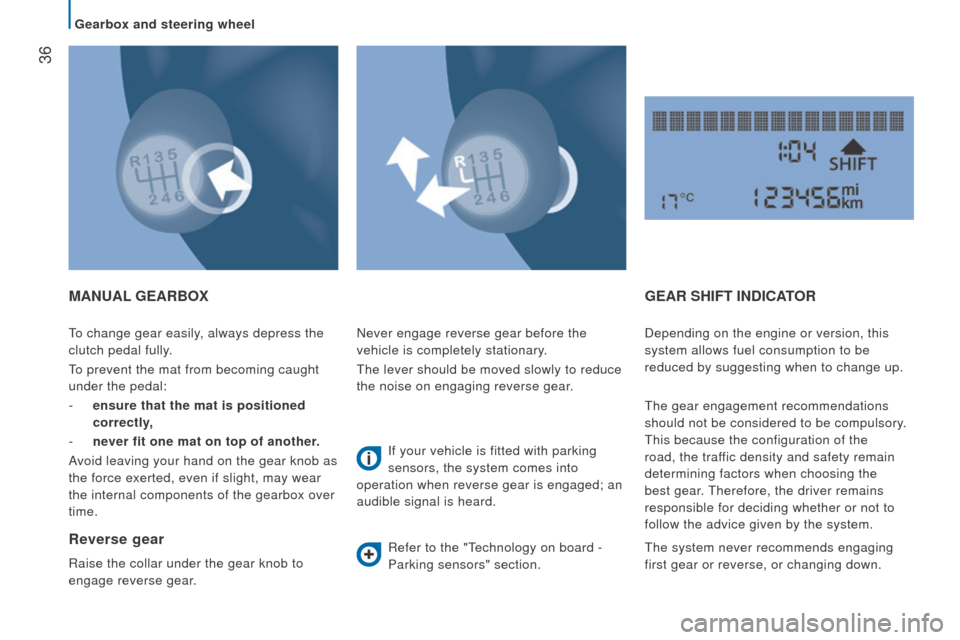
MAnuAL GEA r B ox
r
everse gear
Raise the collar under the gear knob to
engage reverse gear. Never engage reverse gear before the
vehicle is completely stationary.
t
he lever should be moved slowly to reduce
the noise on engaging reverse gear.
If your vehicle is fitted with parking
sensors, the system comes into
operation when reverse gear is engaged; an
audible signal is heard.
Refer to the " technology on board -
Parking sensors" section.
GEAr SHIFt IndIcAt or
Depending on the engine or version, this
system allows fuel consumption to be
reduced by suggesting when to change up.
t
he gear engagement recommendations
should not be considered to be compulsory.
t
his because the configuration of the
road, the traffic density and safety remain
determining factors when choosing the
best gear.
t
herefore, the driver remains
responsible for deciding whether or not to
follow the advice given by the system.
t
he system never recommends engaging
first gear or reverse, or changing down.
Gearbox and steering wheel
Page 39 of 292
37
boxer_en_Chap02_Pret-a-Partir_ed01-2015
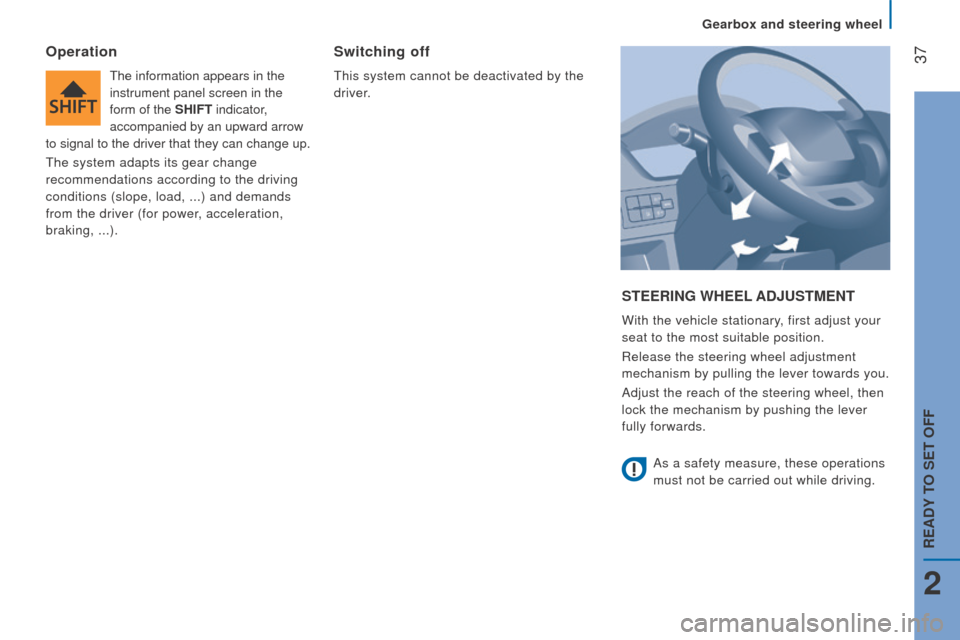
StEErInG WHEEL A dju S t ME nt
With the vehicle stationary, first adjust your
seat to the most suitable position.
Release the steering wheel adjustment
mechanism by pulling the lever towards you.
Adjust the reach of the steering wheel, then
lock the mechanism by pushing the lever
fully forwards.
operation
the information appears in the
instrument panel screen in the
form of the
SHIF t indicator,
accompanied by an upward arrow
to signal to the driver that they can change up.
t
he system adapts its gear change
recommendations according to the driving
conditions (slope, load, ...) and demands
from the driver (for power, acceleration,
braking,
...).
Switching off
this system cannot be deactivated by the
driver .
As a safety measure, these operations
must not be carried out while driving.
Gearbox and steering wheel
2
rEAdY to SEt oFF
Page 43 of 292
41
boxer_en_Chap02_Pret-a-Partir_ed01-2015
Going into engine StArt mode
- t his indicator lamp goes off
and the engine restarts.
If following an automatic restart in S
t
ARt
mode, the driver takes no action on the
the vehicle during the next
3 minutes, the
system stops the engine definitively.
t
he
engine can then only be restarted using
the
key. Special cases: S
tA rt invoked
automatically
t
he S t
ARt mode is invoked automatically
when:
-
the vehicle's is free wheeling on a slope,
-
the windscreen wiper is on fast wipe,
-
the air conditioning is running,
-
the engine has been stopped for around
3 minutes with Stop & Start,
-
some special conditions (battery charge,
engine temperature, braking assistance,
ambient temperature...) where the
engine is needed to assure control of a
system.
In this case, a message appears
in the instrument panel screen,
accompanied by this indicator
lamp, which flashes for a few
seconds, then goes off.Good practice
With a manual gearbox in StOP mode, if a
gear is engaged without fully depressing the
clutch pedal, restarting may not take place.
An indicator lamp and/or message is
displayed in the instrument panel asking
you to fully depress the clutch pedal to allow
restarting.
t
his operation is perfectly normal.
With the vehicle in gear, automatic engine
restarting is only allowed by fully depressing
the clutch pedal.
With the engine stopped in S
t
OP
mode, if the driver unfasten's
their seat belt and opens a front
door, the engine can only be
restarted using the ignition key.
t
here is
an audible signal, accompanied by flashing
of this indicator lamp and the display of a
message.
Starting and switching off
2
rEAdY to SEt oFF
Page 45 of 292
43
boxer_en_Chap02_Pret-a-Partir_ed01-2015
drIVInG rEcoMMEndAtI on S
Observe the driving regulations and remain
vigilant whatever the traffic conditions.
Pay close attention to the traffic and keep
your hands on the wheel so that you are
ready to react at any time to any eventuality.
On a long journey, a break every two hours
is strongly recommended.
In difficult weather, drive smoothly, anticipate
the need to brake and increase the distance
from other vehicles.
driving on flooded roads
We strongly advise against driving on
flooded roads, as this could cause serious
damage to the engine or gearbox, as well as
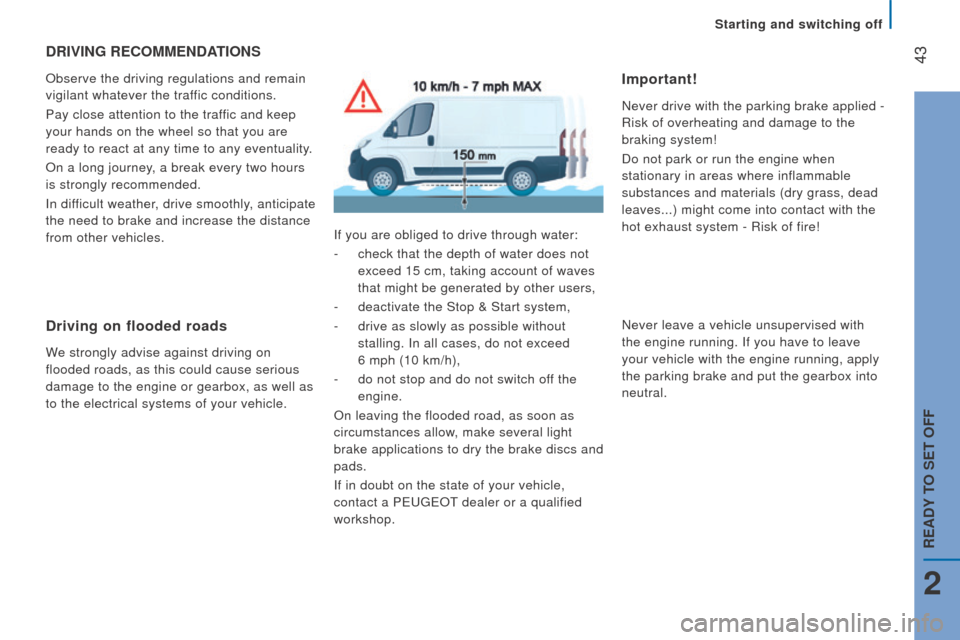
to the electrical systems of your vehicle. If you are obliged to drive through water:
-
check that the depth of water does not
exceed 15 cm, taking account of waves
that might be generated by other users,
-
deactivate the Stop & Start system,
-
drive as slowly as possible without
stalling. In all cases, do not exceed
6 mph (10 km/h),
-
do not stop and do not switch of
f the
engine.
On leaving the flooded road, as soon as
circumstances allow, make several light
brake applications to dry the brake discs and
pads.
If in doubt on the state of your vehicle,
contact a P
euge O t
dealer or a qualified
workshop.
Important!
Never drive with the parking brake applied -
Risk of overheating and damage to the
braking system!
Do not park or run the engine when
stationary in areas where inflammable
substances and materials (dry grass, dead
leaves...) might come into contact with the
hot exhaust system - Risk of fire!
Never leave a vehicle unsupervised with
the engine running. If you have to leave
your vehicle with the engine running, apply
the parking brake and put the gearbox into
neutral.
Starting and switching off
2
rEAdY to SEt oFF
Page 46 of 292
44
boxer_en_Chap03_ergo-et-confort_ed01-2015
Sound control
Your vehicle benefits from technical
suspension choices which contributes to
improving general comfort.
t
hese developments also contribute to
reducing noise disturbance.
Acoustic comfort
the underseal under the body, on the body
sills and on the wheel arches considerably
reduces noise and protects the body from
external wear.
Improved comfort
Page 47 of 292
45
boxer_en_Chap03_ergo-et-confort_ed01-2015
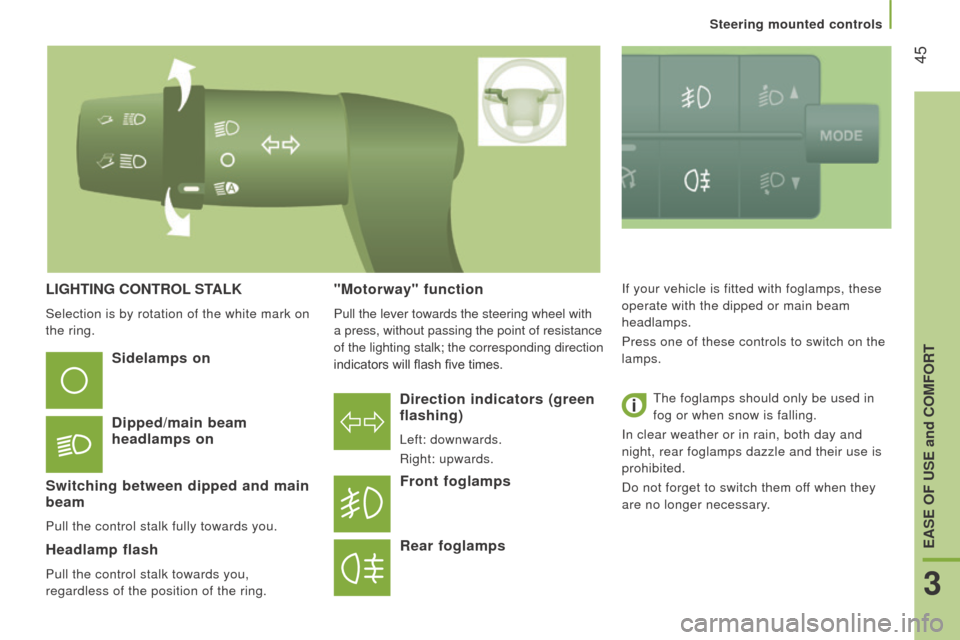
LIGHtInG controL StALK
Selection is by rotation of the white mark on
the ring.
direction indicators (green
flashing)
Left: downwards.
Right: upwards.
Sidelamps on
d
ipped/main beam
headlamps on
Switching between dipped and main
beam
Pull the control stalk fully towards you.
Headlamp flash
Pull the control stalk towards you,
regardless of the position of the ring.
Front foglamps
r
ear foglamps
If your vehicle is fitted with foglamps, these
operate with the dipped or main beam
headlamps.
Press one of these controls to switch on the
lamps.
t
he foglamps should only be used in
fog or when snow is falling.
In clear weather or in rain, both day and
night, rear foglamps dazzle and their use is
prohibited.
Do not forget to switch them off when they
are no longer necessary."Motorway" function
Pull the lever towards the steering wheel with
a press, without passing the point of resistance
of the lighting stalk; the corresponding direction
indicators will flash five times.
3
EASE oF uSE and coMFort
Steering mounted controls
Page 48 of 292
46
boxer_en_Chap03_ergo-et-confort_ed01-2015
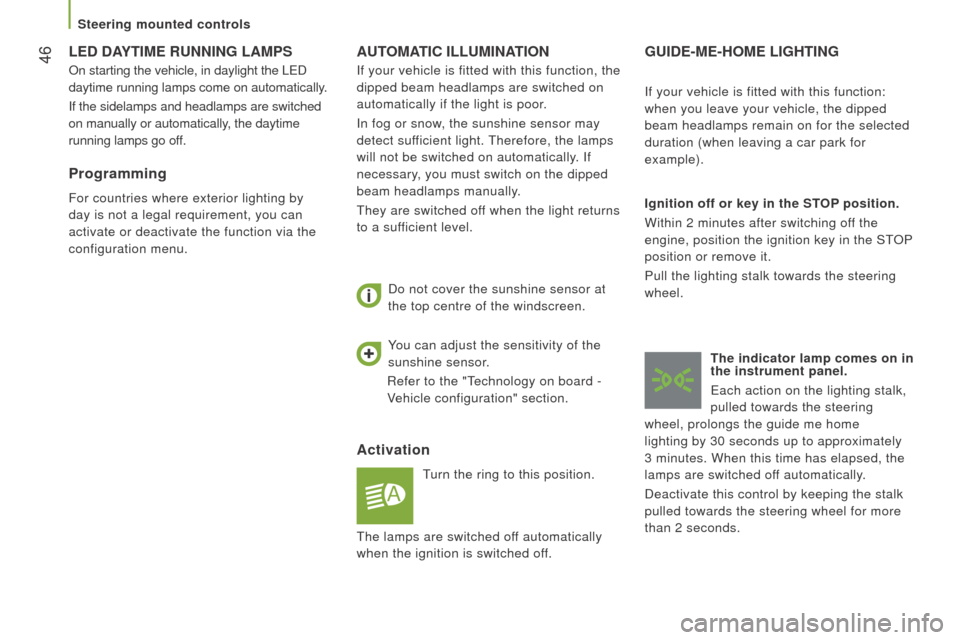
AutoMAtI c ILL u MI n At I on
Activation
turn the ring to this position.
Do not cover the sunshine sensor at
the top centre of the windscreen.
GuIdE-ME-HoME LIGHtInG
Ignition off or key in the StoP position.
Within 2 minutes after switching of f the
engine, position the ignition key in the S
t
OP
position or remove it.
Pull the lighting stalk towards the steering
wheel.
t
he indicator lamp comes on in
the instrument panel.
e
ach action on the lighting stalk,
pulled towards the steering
wheel, prolongs the guide me home
lighting by 30 seconds up to approximately
3
minutes. When this time has elapsed, the
lamps are switched off automatically.
Deactivate this control by keeping the stalk
pulled towards the steering wheel for more
than 2 seconds. If your vehicle is fitted with this function:
when you leave your vehicle, the dipped
beam headlamps remain on for the selected
duration (when leaving a car park for
example).
You can adjust the sensitivity of the
sunshine sensor.
Refer to the "
t
echnology on board -
Vehicle configuration" section.
If your vehicle is fitted with this function, the
dipped beam headlamps are switched on
automatically if the light is poor.
In fog or snow, the sunshine sensor may
detect sufficient light.
t
herefore, the lamps
will not be switched on automatically. If
necessary, you must switch on the dipped
beam headlamps manually.t
hey are switched off when the light returns
to a sufficient level.
LEd dAYtIME runnInG LAMPS
On starting the vehicle, in daylight the LeD
daytime running lamps come on automatically .
If the sidelamps and headlamps are switched
on manually or automatically, the daytime
running lamps go off.
Programming
For countries where exterior lighting by
day is not a legal requirement, you can
activate or deactivate the function via the
configuration menu.
t
he lamps are switched off automatically
when the ignition is switched off.
Steering mounted controls
Page 50 of 292
48
boxer_en_Chap03_ergo-et-confort_ed01-2015
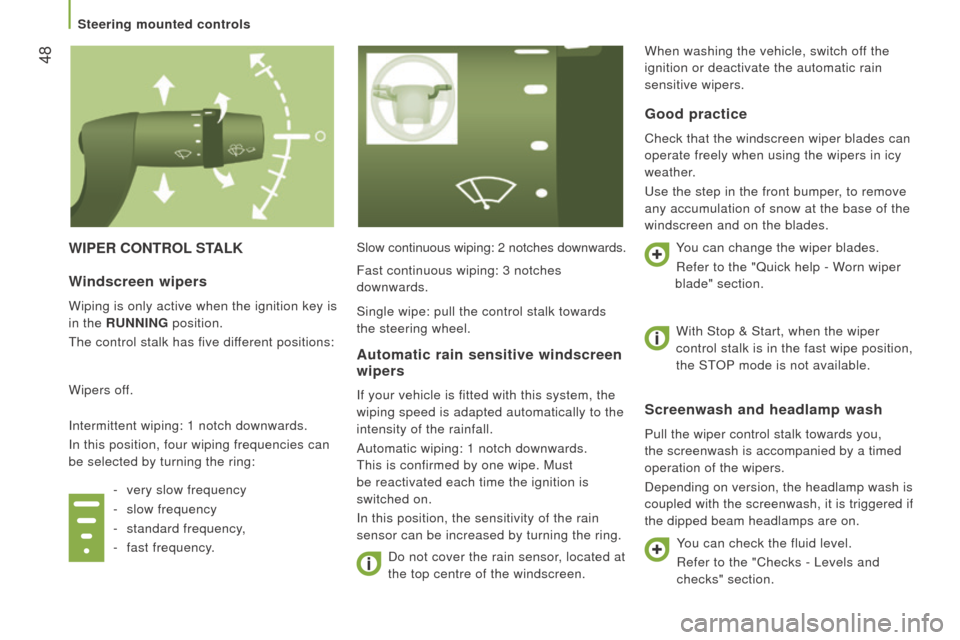
WIPEr controL S tALKSlow continuous wiping: 2 notches downwards.
Do not cover the rain sensor, located at
the top centre of the windscreen.
Screenwash and headlamp wash
Pull the wiper control stalk towards you,
the screenwash is accompanied by a timed
operation of the wipers.
Depending on version, the headlamp wash is
coupled with the screenwash, it is triggered if
the dipped beam headlamps are on.
Windscreen wipers
Wiping is only active when the ignition key is
in the runn I n G position.
t
he control stalk has five different positions:
Wipers off.
Intermittent wiping: 1 notch downwards.
In this position, four wiping frequencies can
be selected by turning the ring: -
very slow frequency
-
slow frequency
-
standard frequency
,
-
fast frequency
.
Automatic rain sensitive windscreen
wipers
If your vehicle is fitted with this system, the
wiping speed is adapted automatically to the
intensity of the rainfall.
Automatic wiping: 1 notch downwards.
t
his is confirmed by one wipe. Must
be reactivated each time the ignition is
switched
on.
In this position, the sensitivity of the rain
sensor can be increased by turning the ring.
Good practice
Check that the windscreen wiper blades can
operate freely when using the wipers in icy
weather.
u
se the step in the front bumper, to remove
any accumulation of snow at the base of the
windscreen and on the blades.
You can change the wiper blades.
Refer to the "Quick help - Worn wiper
blade" section.
You can check the fluid level.
Refer to the "Checks - Levels and
checks" section.
Fast continuous wiping: 3 notches
downwards.
Single wipe: pull the control stalk towards
the steering wheel.
With Stop & Start, when the wiper
control stalk is in the fast wipe position,
the S
t
OP
mode is not available.
When washing the vehicle, switch off the
ignition or deactivate the automatic rain
sensitive wipers.
Steering mounted controls
Page 66 of 292
64
boxer_en_Chap03_ergo-et-confort_ed01-2015
comfort value adjustment ring
the settings range between:
-
increasing the interior ambient air
temperature HI (High) which goes up to
to a maximum setting of 32,
-
cooling the interior ambient air
temperature LO (Low) which goes down
to a setting of 16.
Air distribution
A press illuminates the LeD on the buttons
which distribute the air flow towards:
the windscreen and front side
window vents (demisting/
defrosting the windows),
the central and side vents (chest
and face),
the vents in the front and rear
areas (feet).
t
he combination of buttons permits
improvement of air distribution.
Air flow
Successive presses of this button
increase (+) or reduce (-) the
force of the air flow to the interior.
Intake of exterior air / r ecirculation of interior air
When the LeD is on, the air
recirculates inside the passenger
compartment to prevent the entry of exterior
odours and smoke.
t
his position should be
temporary.
When the ambient air comfort level has been
reached, pressing the button switches the
L
e
D off and reopens the exterior air intake.
Pressing the A
uto button also restores
the intake of exterior air. Returning to this
position permits renewal of the air in the
passenger compartment and demisting.
Pressing the A
uto button again restores
the F
u
LL A uto function.
rapid demisting / defrosting
Pressing this control permits
rapid clearing of the windows.
t
he L
e
D is on.
t
he system manages the air conditioning,
the flow and intake of air, the defrosting
of the rear screen and provides optimum
distribution of the air to the windscreen and
front side windows.
If your vehicle is fitted with additional
heating, switch it off to ensure rapid and
effective demisting/defrosting.
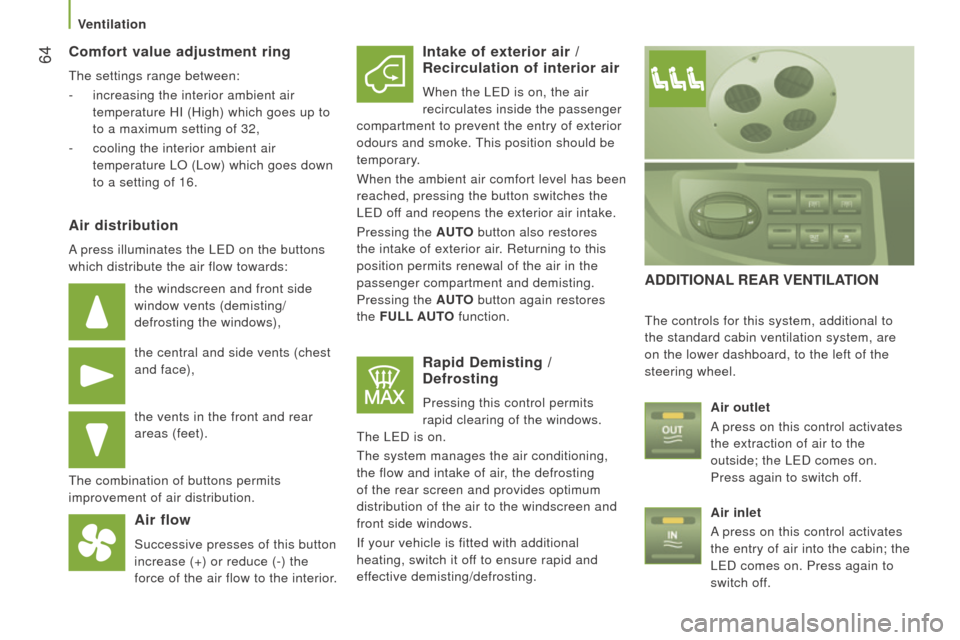
AddItIonAL r EA r VE nt ILAt I on
the controls for this system, additional to
the standard cabin ventilation system, are
on the lower dashboard, to the left of the
steering wheel.
Air outlet
A press on this control activates
the extraction of air to the
outside; the L
e D comes on.
Press again to switch off.
Air inlet
A press on this control activates
the entry of air into the cabin; the
L
e D comes on. Press again to
switch off.
Ventilation
Page 67 of 292
65
boxer_en_Chap03_ergo-et-confort_ed01-2015
AddItIonAL HEAt I n G SYS t EMS
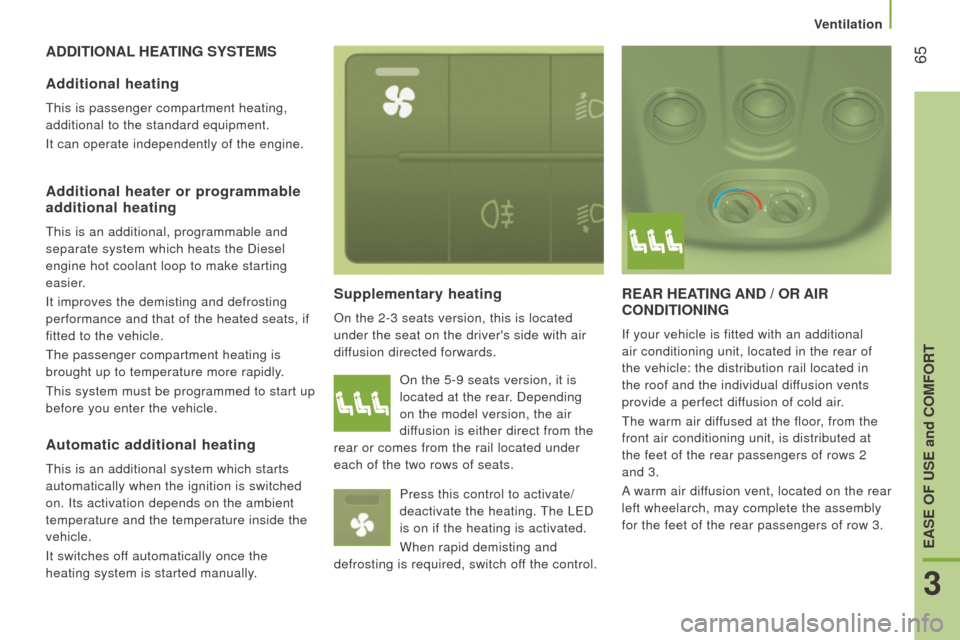
Supplementary heating
On the 2-3 seats version, this is located
under the seat on the driver's side with air
diffusion directed forwards.
rEAr HEAtI n G A nd / or AI r
cond I t I on I n G
If your vehicle is fitted with an additional
air conditioning unit, located in the rear of
the vehicle: the distribution rail located in
the roof and the individual diffusion vents
provide a perfect diffusion of cold air.
t
he warm air diffused at the floor, from the
front air conditioning unit, is distributed at
the feet of the rear passengers of rows 2
and 3.
A warm air diffusion vent, located on the rear
left wheelarch, may complete the assembly
for the feet of the rear passengers of row 3.
Additional heating
this is passenger compartment heating,
additional to the standard equipment.
It can operate independently of the engine.
Additional heater or programmable
additional heating
this is an additional, programmable and
separate system which heats the Diesel
engine hot coolant loop to make starting
easier.
It improves the demisting and defrosting
performance and that of the heated seats, if
fitted to the vehicle.
t
he passenger compartment heating is
brought up to temperature more rapidly.
t
his system must be programmed to start up
before you enter the vehicle. On the 5-9 seats version, it is
located at the rear. Depending
on the model version, the air
diffusion is either direct from the
rear or comes from the rail located under
each of the two rows of seats.
Press this control to activate/
deactivate the heating.
t
he L e D
is on if the heating is activated.
When rapid demisting and
defrosting is required, switch off the control.
Automatic additional heating
this is an additional system which starts
automatically when the ignition is switched
on. Its activation depends on the ambient
temperature and the temperature inside the
vehicle.
It switches off automatically once the
heating system is started manually.
Ventilation
3
EASE oF uSE and coMFort