tow Peugeot Boxer 2016 Owner's Guide
[x] Cancel search | Manufacturer: PEUGEOT, Model Year: 2016, Model line: Boxer, Model: Peugeot Boxer 2016Pages: 292, PDF Size: 10.07 MB
Page 100 of 292
98
boxer_en_Chap05_Securite_ed01-2015
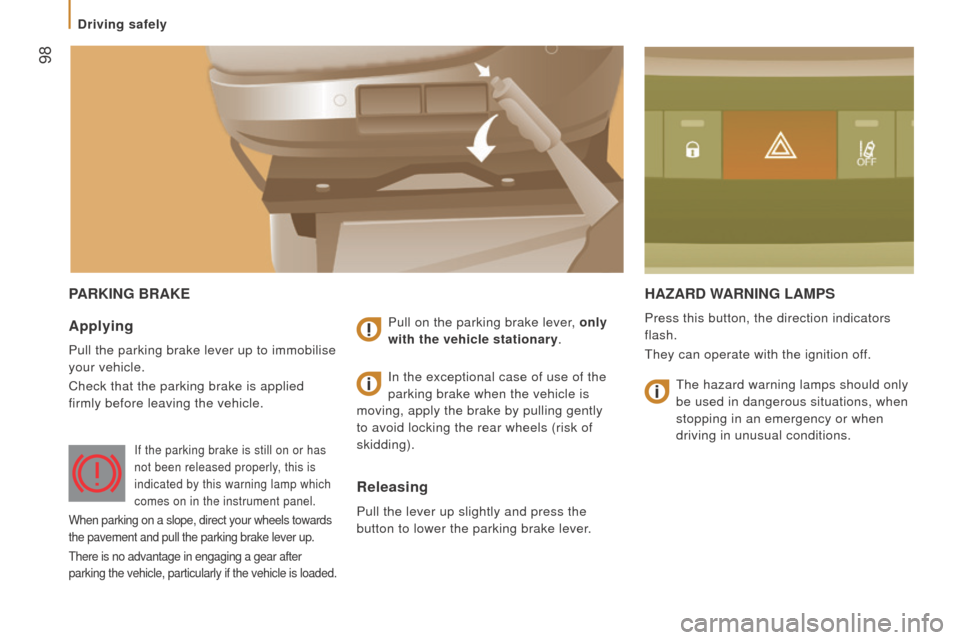
PAr KI n G B r AKEH A z A rd WA rn I n G LAMPS
Press this button, the direction indicators
flash.
t
hey can operate with the ignition off.Applying
Pull the parking brake lever up to immobilise
your vehicle.
Check that the parking brake is applied
firmly before leaving the vehicle. Pull on the parking brake lever, only
with the vehicle stationary.
releasing
Pull the lever up slightly and press the
button to lower the parking brake lever.In the exceptional case of use of the
parking brake when the vehicle is
moving, apply the brake by pulling gently
to avoid locking the rear wheels (risk of
skidding).
If the parking brake is still on or has
not been released properly, this is
indicated by this warning lamp which
comes on in the instrument panel.
When parking on a slope, direct your wheels towards
the pavement and pull the parking brake lever up.
t
here is no advantage in engaging a gear after
parking the vehicle, particularly if the vehicle is loaded.
the hazard warning lamps should only
be used in dangerous situations, when
stopping in an emergency or when
driving in unusual conditions.
Driving safely
Page 112 of 292
11 0
boxer_en_Chap05_Securite_ed01-2015
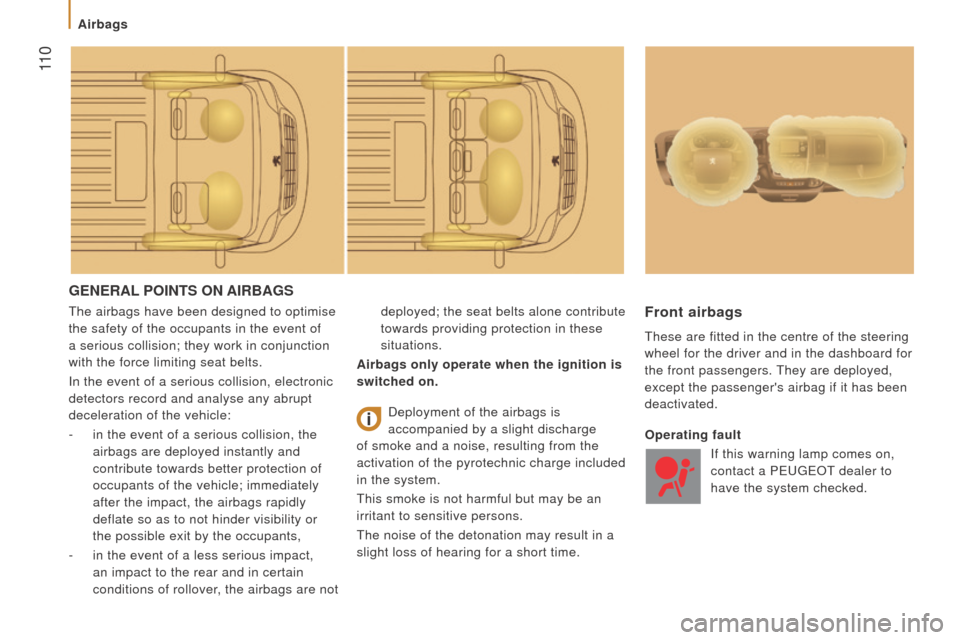
GEnErAL P o I nt S on AI r BAGS
the airbags have been designed to optimise
the safety of the occupants in the event of
a serious collision; they work in conjunction
with the force limiting seat belts.
In the event of a serious collision, electronic
detectors record and analyse any abrupt
deceleration of the vehicle:
-
in the event of a serious collision, the
airbags are deployed instantly and
contribute towards better protection of
occupants of the vehicle; immediately
after the impact, the airbags rapidly
deflate so as to not hinder visibility or
the possible exit by the occupants,
-
in the event of a less serious impact,
an impact to the rear and in certain
conditions of rollover, the airbags are not deployed; the seat belts alone contribute
towards providing protection in these
situations.
Airbags only operate when the ignition is
switched on.Front airbags
these are fitted in the centre of the steering
wheel for the driver and in the dashboard for
the front passengers.
t
hey are deployed,
except the passenger's airbag if it has been
deactivated.
Deployment of the airbags is
accompanied by a slight discharge
of smoke and a noise, resulting from the
activation of the pyrotechnic charge included
in the system.
t
his smoke is not harmful but may be an
irritant to sensitive persons.
t
he noise of the detonation may result in a
slight loss of hearing for a short time.
o
perating fault If this warning lamp comes on,
contact a P
euge O t
dealer to
have the system checked.
Airbags
Page 119 of 292
11 7
boxer_en_Chap05_Securite_ed01-2015
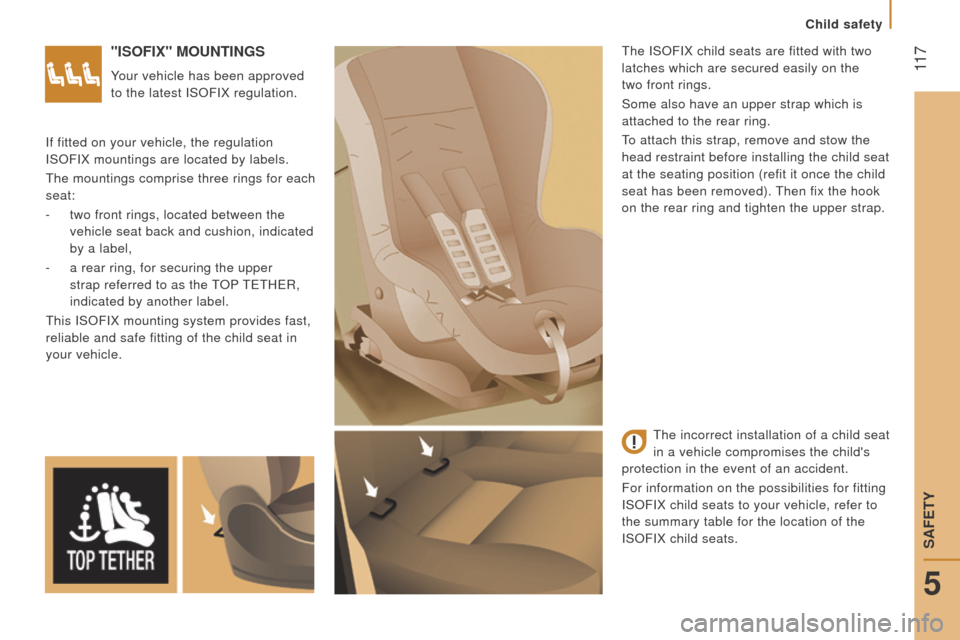
"ISoFIx" MountInGS
Your vehicle has been approved
to the latest ISOFIX regulation.
t
he ISOFIX child seats are fitted with two
latches which are secured easily on the
two front rings.
Some also have an upper strap which is
attached to the rear ring.
to attach this strap, remove and stow the
head restraint before installing the child seat
at the seating position (refit it once the child
seat has been removed).
t
hen fix the hook
on the rear ring and tighten the upper strap.
If fitted on your vehicle, the regulation
ISOFIX mountings are located by labels.
t
he mountings comprise three rings for each
seat:
-
two front rings, located between the
vehicle seat back and cushion, indicated
by a label,
-
a rear ring, for securing the upper
strap referred to as the
tOP
tet
H e R,
indicated by another label.
t
his ISOFIX mounting system provides fast,
reliable and safe fitting of the child seat in
your vehicle.
t
he incorrect installation of a child seat
in a vehicle compromises the child's
protection in the event of an accident.
For information on the possibilities for fitting
ISOFIX child seats to your vehicle, refer to
the summary table for the location of the
ISOFIX child seats.
Child safety
5
SAFetY
Page 120 of 292
11 8
boxer_en_Chap05_Securite_ed01-2015
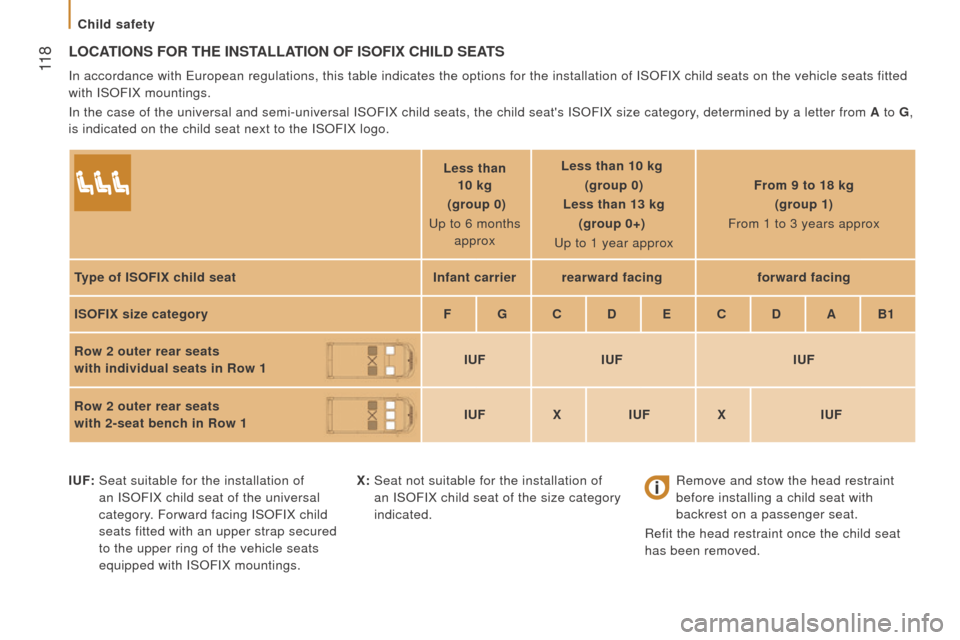
LocAtI on S F or t HE I n S tALLAt I on o F IS o FI x c HIL d SEAt S
In accordance with european regulations, this table indicates the options for the installati\
on of ISOFIX child seats on the vehicle seats fitted
with ISOFIX mountings.
In the case of the universal and semi-universal ISOFIX child seats, the \
child seat's ISOFIX size category
, determined by a letter from A to G,
is indicated on the child seat next to the ISOFIX logo.
Less than
10 kg
(group 0)
u
p to 6 months approx Less than 10 kg
(group 0)
Less than 13 kg
(group 0+)
u p to 1 year approxFrom 9 to 18 kg
(group 1)
From 1 to 3 years approx
type of IS
o FI x child seat Infant carrierrearward facing forward facing
IS
o FI x size category F G
cdEcdAB1
r
ow 2 outer rear seats
with individual seats in
r ow 1 I
u FI
u FI
u F
r
ow 2 outer rear seats
with 2-seat bench in
r ow 1 I
u F
xI
u F
xI
u F
I
u F:
Seat suitable for the installation of
an ISOFIX child seat of the universal
category. Forward facing ISOFIX child
seats fitted with an upper strap secured
to the upper ring of the vehicle seats
equipped with ISOFIX mountings.
x
:
Seat not suitable for the installation of
an ISOFIX child seat of the size category
indicated.
Remove and stow the head restraint
before installing a child seat with
backrest on a passenger seat.
Refit the head restraint once the child seat
has been removed.
Child safety
Page 121 of 292
11 9
boxer_en_Chap05_Securite_ed01-2015
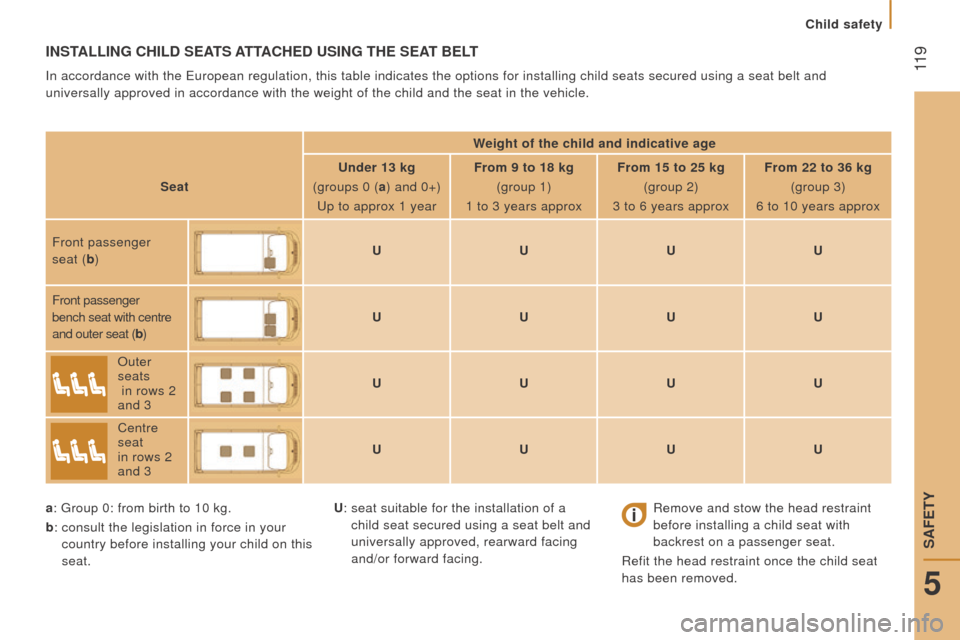
InStALLIn G c HIL d SEAt S AttA c HE d u SI n G t HE SEAt BELt
In accordance with the european regulation, this table indicates the options for installing chil\
d seats secured using a seat belt and
universally approved in accordance with the weight of the child and the \
seat in the vehicle.
W
eight of the child and indicative age
Seat
u
nder 13 kg
(groups 0 (a ) and 0+)
u
p to approx 1 yearFrom 9 to 18 kg
(group 1)
1 to 3 years approx From 15 to 25 kg
(group 2)
3 to 6 years approx From 22 to 36 kg
(group 3)
6 to 10 years approx
Front passenger
seat (b )
u uuu
Front passenger
bench seat with centre
and outer seat (b )
u uuu
Outer
seats
in rows 2
and 3
u uuu
Centre
seat
in rows 2
and 3
u uuu
a:
g roup 0: from birth to 10 kg.
b :
consult the legislation in force in your
country before installing your child on this
seat.
Remove and stow the head restraint
before installing a child seat with
backrest on a passenger seat.
Refit the head restraint once the child seat
has been removed.
u:
seat suitable for the installation of a
child seat secured using a seat belt and
universally approved, rearward facing
and/or forward facing.
Child safety
5
SAFetY
Page 122 of 292
120
boxer_en_Chap05_Securite_ed01-2015
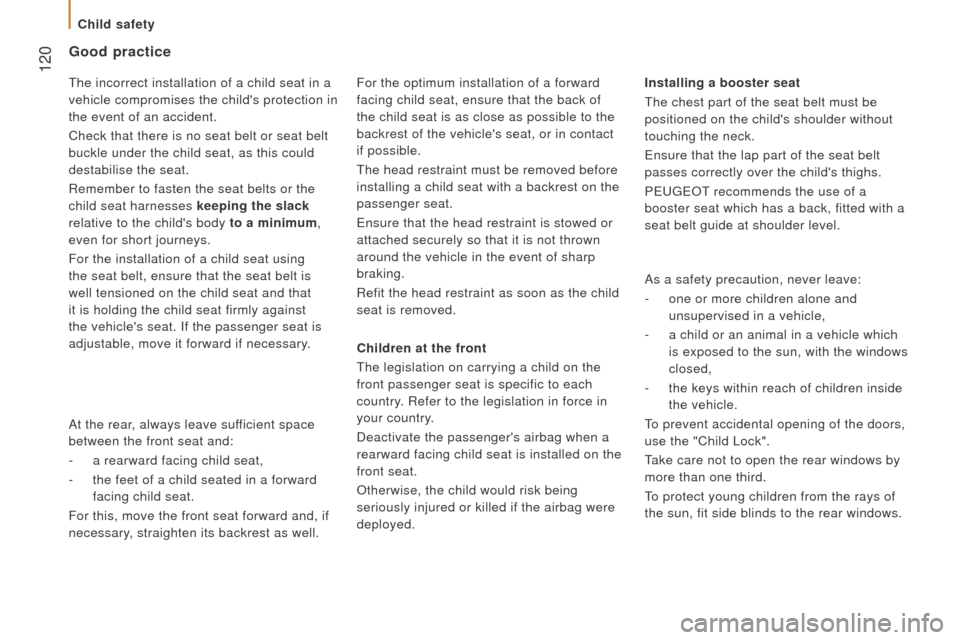
Good practice
children at the front
t
he legislation on carrying a child on the
front passenger seat is specific to each
country. Refer to the legislation in force in
your country.
Deactivate the passenger's airbag when a
rearward facing child seat is installed on the
front seat.
Otherwise, the child would risk being
seriously injured or killed if the airbag were
deployed. As a safety precaution, never leave:
-
one or more children alone and
unsupervised in a vehicle,
- a child or an animal in a vehicle which
is exposed to the sun, with the windows
closed,
-
the keys within reach of children inside
the vehicle.
to prevent accidental opening of the doors,
use the "Child Lock".
take care not to open the rear windows by
more than one third.
to protect young children from the rays of
the sun, fit side blinds to the rear windows. Installing a booster seat
t
he chest part of the seat belt must be
positioned on the child's shoulder without
touching the neck.
e
nsure that the lap part of the seat belt
passes correctly over the child's thighs.
P euge O t
recommends the use of a
booster seat which has a back, fitted with a
seat belt guide at shoulder level.
For the optimum installation of a forward
facing child seat, ensure that the back of
the child seat is as close as possible to the
backrest of the vehicle's seat, or in contact
if possible.
t
he head restraint must be removed before
installing a child seat with a backrest on the
passenger seat.
e
nsure that the head restraint is stowed or
attached securely so that it is not thrown
around the vehicle in the event of sharp
braking.
Refit the head restraint as soon as the child
seat is removed.
At the rear, always leave sufficient space
between the front seat and:
-
a rearward facing child seat,
-
the feet of a child seated in a forward
facing child seat.
For this, move the front seat forward and, if
necessary, straighten its backrest as well.
t
he incorrect installation of a child seat in a
vehicle compromises the child's protection in
the event of an accident.
Check that there is no seat belt or seat belt
buckle under the child seat, as this could
destabilise the seat.
Remember to fasten the seat belts or the
child seat harnesses keeping the slack
relative to the child's body to a minimum,
even for short journeys.
For the installation of a child seat using
the seat belt, ensure that the seat belt is
well tensioned on the child seat and that
it is holding the child seat firmly against
the vehicle's seat. If the passenger seat is
adjustable, move it forward if necessary.
Child safety
Page 123 of 292
121
boxer_en_Chap06_Accessoires_ed01-2015
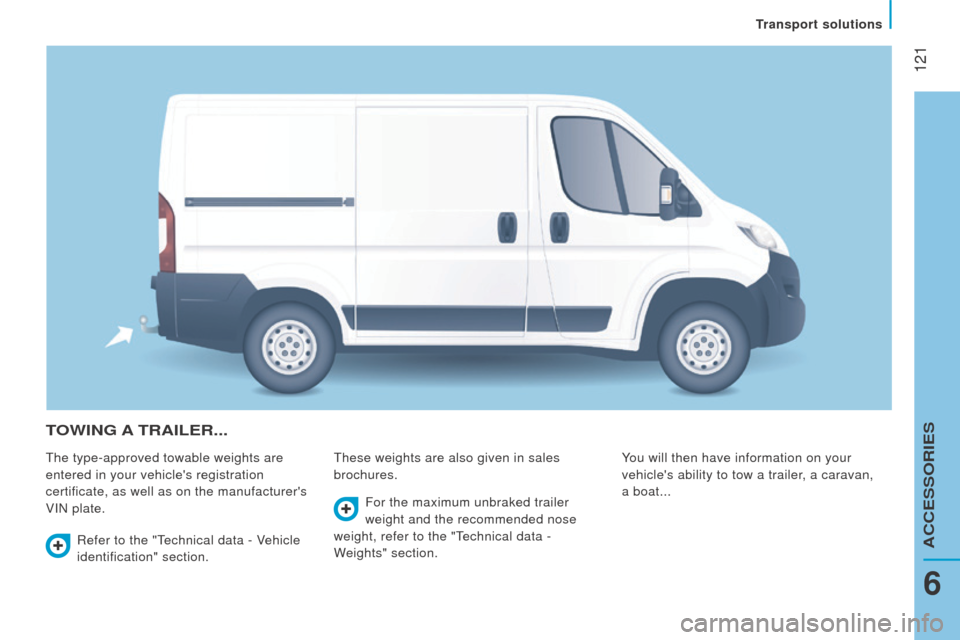
toWI n G A tr AILE r...
the type-approved towable weights are
entered in your vehicle's registration
certificate, as well as on the manufacturer's
VIN plate.t hese weights are also given in sales
brochures. You will then have information on your
vehicle's ability to tow a trailer, a caravan,
a boat...
Refer to the "
t
echnical data - V
ehicle
identification" section. For the maximum unbraked trailer
weight and the recommended nose
weight, refer to the "
t
echnical data -
Weights" section.
6
transport solutions
ACCeSSORIeS
Page 124 of 292
122
boxer_en_Chap06_Accessoires_ed01-2015
driving advice
distribution of loads: distribute the load in
the trailer so that the heaviest objects are as
close as possible to the axle and the nose
weight is close to the maximum authorised
without, however, exceeding it.
c
ooling: towing a trailer on a slope
increases the coolant temperature.
As the fan is electrically controlled, its
cooling capacity is not dependent on the
engine speed.
On the contrary, use a high gear to lower the
engine speed and reduce your speed.
In all cases, pay attention to the coolant
temperature.
tyres:
check the tyre pressures of the
towing vehicle and of the trailer, observing
the recommended pressures.
Fitting a towbar
We recommend the use of genuine
P euge O t
towbars and their harnesses,
which have been tested and approved from
the design stage of your vehicle and that
the fitting of this equipment is entrusted to a
P
euge O t
dealer
.
t
hese genuine towbars are compatible with
the operation of the rear parking sensors
and the reversing camera, if fitted to your
vehicle.
If this equipment is not fitted by a P
euge O t
dealer
, it must be fitted in line with the
manufacturer's instructions.
Good practice
If the coolant temperature
warning lamp comes on, stop the
vehicle and switch off the engine
as soon as possible.
Refer to the "Checks - Levels and
checks" section.
Brakes: towing increases the braking
distance. Drive at a moderate speed,
change down early and brake gradually. Side wind: sensitivity to side wind is
increased. Drive smoothly and at a
moderate speed. ABS: the system only controls the vehicle,
not the trailer.
r
ear parking sensors: the system is
deactivated while the vehicle is towing with a
genuine P
euge O t
towbar fitted.
Refer to the "
t
echnical data -
Identification markings" section.
transport solutions
Page 126 of 292

124
boxer_en_Chap06_Accessoires_ed01-2015
otHEr AccESSorIES
these accessories and parts, having been
tested and approved for reliability and
safety, are all adapted to your vehicle.
A
wide range of recommended and genuine
parts is available.
"
c omfort":
Air deflectors, insulated module, scented air
fresheners, reading lamp, cigarette lighter,
portable ashtray, non-slip seat cushions,
rear parking sensors...
"Protection":
Mats, mudflaps, vehicle protective cover,
seat covers, security grills for rear door
windows, twin rear security doors with
security locks, paint touch-up... "Security":
Anti-intrusion alarm, vehicle tracking system,
snow chains, non-slip covers, child seats,
first aid kit, warning triangle, high visibility
vest, fire extinguisher, pet safety belt, seat
belt cutter / glass hammer...
"Style":
Alloy wheels...
"Multimedia":
CD player, Wi-Fi on Board, semi-integral
satellite navigation system, hands-free kits,
driving aids, rear multimedia support, DVD
player, navigation mapping update, portable
satellite navigation systems, telephone
carrier, aftermarket digital radio, audio
systems, 230V socket...
"
t
ransport solutions":
towbars, towbar wiring harness with
7/13
connector, 7/7 connector, 13 connector,
interior protection kits, non-slip floor, wheel
arch protector, cab dividers, transverse roof
bars, roof racks, ladder for roof rack, roof
loading runners, loading plate for roof rack... Installation of radiocommunication
transmitters
You are advised to contact a P
euge O t
dealer before installing accessory
radiocommunication transmitters with
external aerial on your vehicle.
P
euge O t
dealers can advise you on
the specifications (frequency waveband,
maximum output power, aerial position,
specific installation conditions) of the
transmitters which can be fitted, in
accordance with the Vehicle
e lectromagnetic
Compatibility Directive (2004/104/
e C).
t
he fitting of electrical equipment or
accessories which are not listed by
P
euge O t
may result in the failure of your
vehicle's electronic system.
We request that you take note of this point
and recommend that you contact a dealer
to be shown the range of recommended
equipment and accessories.
Depending on the country in which the
vehicle is sold or operated, it may be
compulsory to have a high visibility vest,
warning triangle, replacement bulbs and
breathalyzer in the vehicle.
to prevent the mat from becoming
caught under the pedals:
-
ensure that the mat and its fixings are
positioned correctly,
-
never fit one mat on top of another
.
equipment
Page 128 of 292
126
boxer_en_Chap07_Verifications_ed01-2015
PeugeOt & t O tA L,
A PARtNeRSHIP tO DeL IVe R
Be
tte R
P
e
RFORMANC
e
!
Innovation, the key to success
the tOtA L Research and Development and
Pe ugeOt teams work together to develop high
quality lubricants that meet the requirements of
P
e
uge
Ot
vehicles. For you, this is the assurance
that the performance of your engine is optimised
while also ensuring its durability.
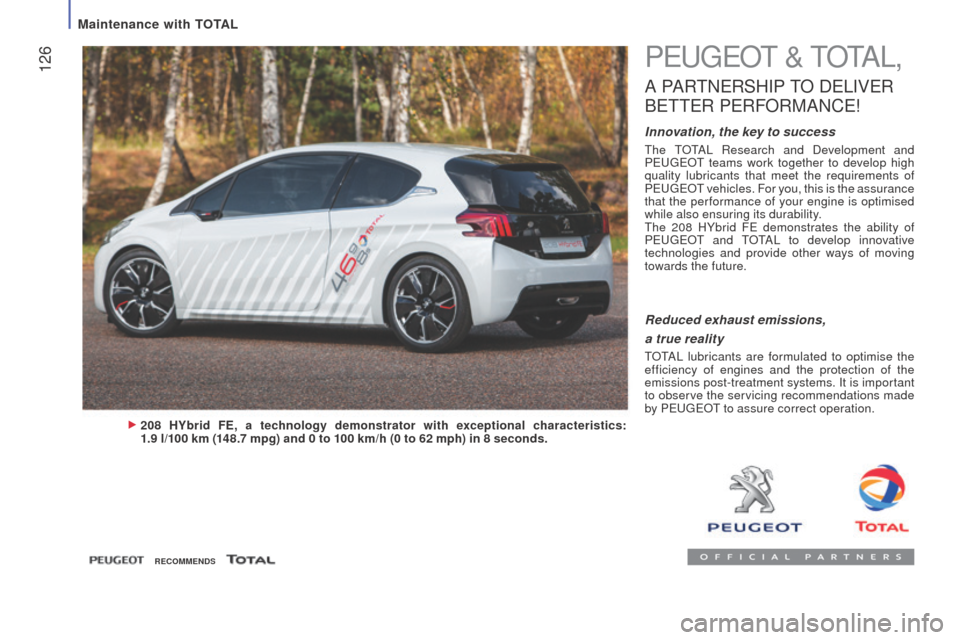
th
e 208 HYbrid F
e
demonstrates the ability of
P
e
uge
Ot
and t
OtA
L to develop innovative
technologies and provide other ways of moving
towards the future.
208 HYbrid FE, a technology demonstrator with exceptional characteristics:
1.9 l/100 km (148.7 mpg) and 0 to 100 km/h (0 to 62 mph) in 8 seconds.
Reduced exhaust emissions,
a true reality
tOtAL lubricants are formulated to optimise the
efficiency of engines and the protection of the
emissions post-treatment systems. It is important
to observe the servicing recommendations made
by P
e
uge
Ot
to assure correct operation.
rEcoMMEndS
Maintenance with tOtAL