gearbox Peugeot Boxer 2016 Owner's Manual
[x] Cancel search | Manufacturer: PEUGEOT, Model Year: 2016, Model line: Boxer, Model: Peugeot Boxer 2016Pages: 292, PDF Size: 10.07 MB
Page 12 of 292
10
boxer_en_Chap01_Vue-ensemble_ed01-2015
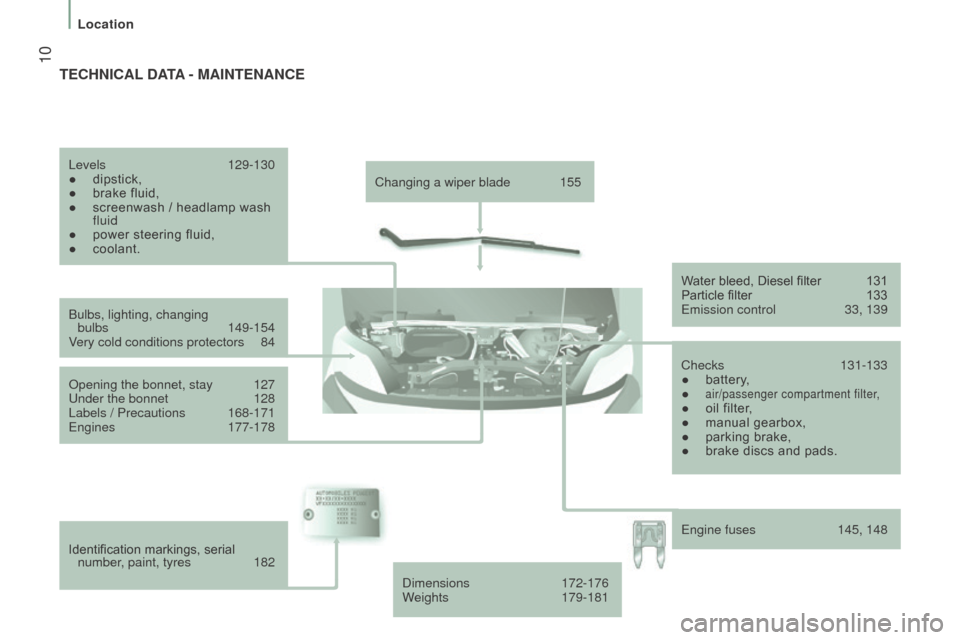
Changing a wiper blade 155
Bulbs, lighting, changing bulbs
149-154
Very cold conditions protectors
84
Opening the bonnet, stay
127u
nder the bonnet
128
Labels / Precautions
168-171e
ngines
177-178
Identification markings, serial number, paint, tyres
182
Levels
129-130
●
dipstick,
●
brake fluid,
●
screenwash / headlamp wash
fluid
●
power steering fluid,
●
coolant. W
ater bleed, Diesel filter
131
Particle filter
133e
mission control
33, 139
Checks
131-133
●
battery
,
●
air/passenger compartment filter,● oil filter,
● manual gearbox,
●
parking brake,
●
brake discs and pads.
tEcHnIcAL d AtA - M AI nt E n A nc E
Dimensions 172-176
W eights 179-181
e
ngine fuses
145, 148
Location
Page 14 of 292
12
boxer_en_Chap01_Vue-ensemble_ed01-2015
Eco-drIVInG
o ptimise the use of your gearbox
With a manual gearbox, move off gently and change up without
waiting. While accelerating changing up early. If your vehicle has
the system, the gear shift indicator invites you to engage the most
suitable gear; follow its instructions as soon as it is displayed in
the instrument panel.
drive smoothly
Maintain a safe distance between vehicles, use engine
braking rather than the brake pedal, and press the accelerator
progressively.
t
hese practices contribute towards a reduction in
fuel consumption and CO
2 emissions and also helps reduce the
background traffic noise.
If your vehicle has cruise control, make use of the system at
speeds above 20 mph (30 km/h) when the traffic is flowing well.
control the use of your electrical equipment
Before moving off, if the passenger compartment is too warm,
ventilate it by opening the windows and air vents before using the
air conditioning.
Above 30 mph (50 km/h), close the windows and leave the air
vents open.
Remember to make use of equipment that can help keep the
temperature in the passenger compartment down (window
blinds...).
Switch off the air conditioning, unless it has automatic digital
regulation, as soon as the desired temperature is attained.
Switch off the demisting and defrosting controls, if not automatic.
Switch off the heated seat as soon as possible.
Switch off the headlamps and front foglamps when the level of
light does not require their use.
e
co-driving is a range of everyday practices that allow the motorist to o\
ptimise their fuel consumption and CO
2 emissions.
Avoid running the engine before moving off, particularly in winter;
your vehicle will warm up much faster while driving.
As a passenger, if you avoid connecting your multimedia devices
(film, music, video game...), you will contribute towards limiting the\
consumption of electrical energy, and so of fuel.
Disconnect your portable devices before leaving the vehicle.
Motoring & the environment
Page 38 of 292
36
boxer_en_Chap02_Pret-a-Partir_ed01-2015
to change gear easily, always depress the
clutch pedal fully.
to prevent the mat from becoming caught
under the pedal:
-
ensure that the mat is positioned
correctly,
-
never fit one mat on top of another
.
Avoid leaving your hand on the gear knob as
the force exerted, even if slight, may wear
the internal components of the gearbox over
time.
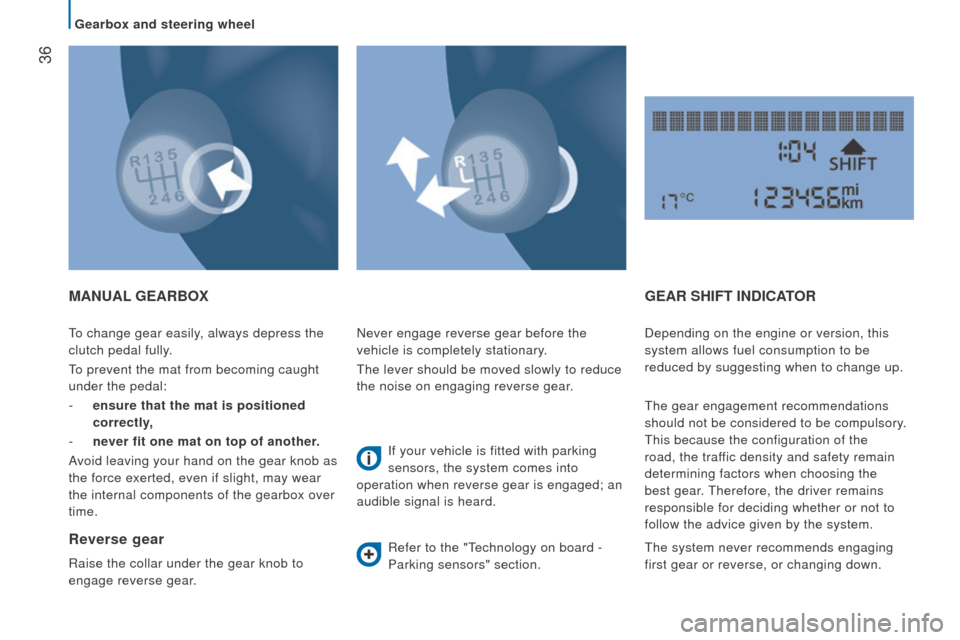
MAnuAL GEA r B ox
r
everse gear
Raise the collar under the gear knob to
engage reverse gear. Never engage reverse gear before the
vehicle is completely stationary.
t
he lever should be moved slowly to reduce
the noise on engaging reverse gear.
If your vehicle is fitted with parking
sensors, the system comes into
operation when reverse gear is engaged; an
audible signal is heard.
Refer to the " technology on board -
Parking sensors" section.
GEAr SHIFt IndIcAt or
Depending on the engine or version, this
system allows fuel consumption to be
reduced by suggesting when to change up.
t
he gear engagement recommendations
should not be considered to be compulsory.
t
his because the configuration of the
road, the traffic density and safety remain
determining factors when choosing the
best gear.
t
herefore, the driver remains
responsible for deciding whether or not to
follow the advice given by the system.
t
he system never recommends engaging
first gear or reverse, or changing down.
Gearbox and steering wheel
Page 39 of 292
37
boxer_en_Chap02_Pret-a-Partir_ed01-2015
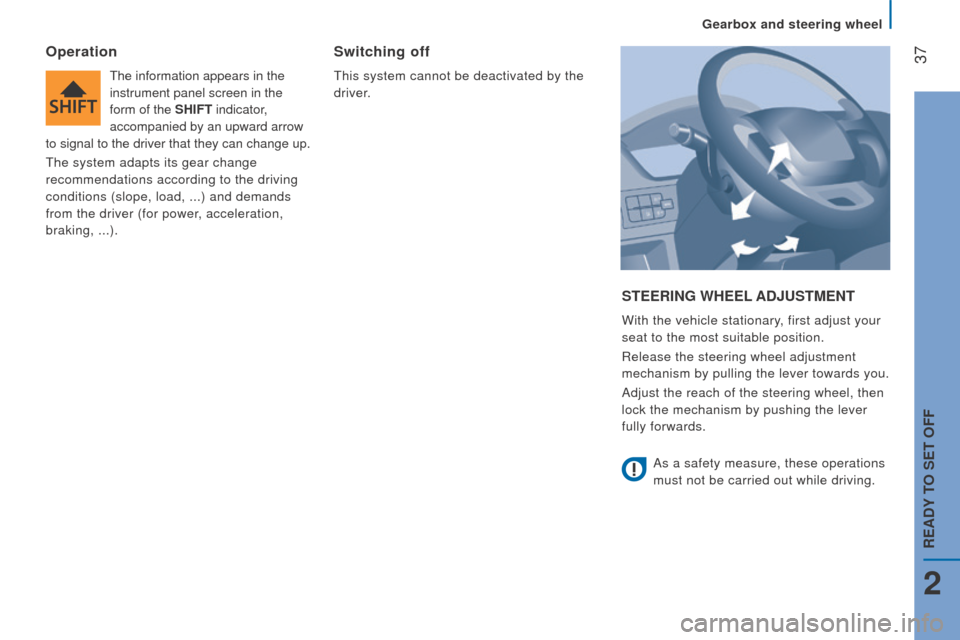
StEErInG WHEEL A dju S t ME nt
With the vehicle stationary, first adjust your
seat to the most suitable position.
Release the steering wheel adjustment
mechanism by pulling the lever towards you.
Adjust the reach of the steering wheel, then
lock the mechanism by pushing the lever
fully forwards.
operation
the information appears in the
instrument panel screen in the
form of the
SHIF t indicator,
accompanied by an upward arrow
to signal to the driver that they can change up.
t
he system adapts its gear change
recommendations according to the driving
conditions (slope, load, ...) and demands
from the driver (for power, acceleration,
braking,
...).
Switching off
this system cannot be deactivated by the
driver .
As a safety measure, these operations
must not be carried out while driving.
Gearbox and steering wheel
2
rEAdY to SEt oFF
Page 40 of 292
38
boxer_en_Chap02_Pret-a-Partir_ed01-2015
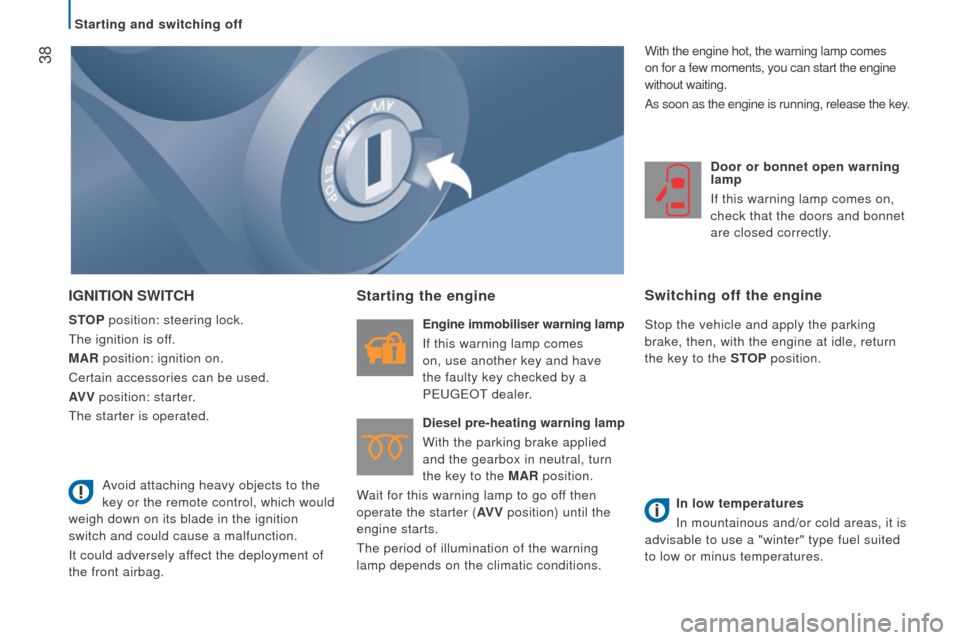
IGnItIon SWItcH
StoP position: steering lock.
t
he ignition is off.
MA
r position: ignition on.
Certain accessories can be used.
AV V position: starter.
t
he starter is operated.
Starting the engine
Engine immobiliser warning lamp
If this warning lamp comes
on, use another key and have
the faulty key checked by a
P
euge O t
dealer
.
d
iesel pre-heating warning lamp
With the parking brake applied
and the gearbox in neutral, turn
the key to the MA
r position.
Wait for this warning lamp to go off then
operate the starter (AV V position) until the
engine starts.
t
he period of illumination of the warning
lamp depends on the climatic conditions.
d
oor or bonnet open warning
lamp
If this warning lamp comes on,
check that the doors and bonnet
are closed correctly.
Switching off the engine
Stop the vehicle and apply the parking
brake, then, with the engine at idle, return
the key to the S
to P position.
In low temperatures
In mountainous and/or cold areas, it is
advisable to use a "winter" type fuel suited
to low or minus temperatures.
Avoid attaching heavy objects to the
key or the remote control, which would
weigh down on its blade in the ignition
switch and could cause a malfunction.
It could adversely affect the deployment of
the front airbag. With the engine hot, the warning lamp comes
on for a few moments, you can start the engine
without waiting.
As soon as the engine is running, release the key.
Starting and switching off
Page 41 of 292
39
boxer_en_Chap02_Pret-a-Partir_ed01-2015
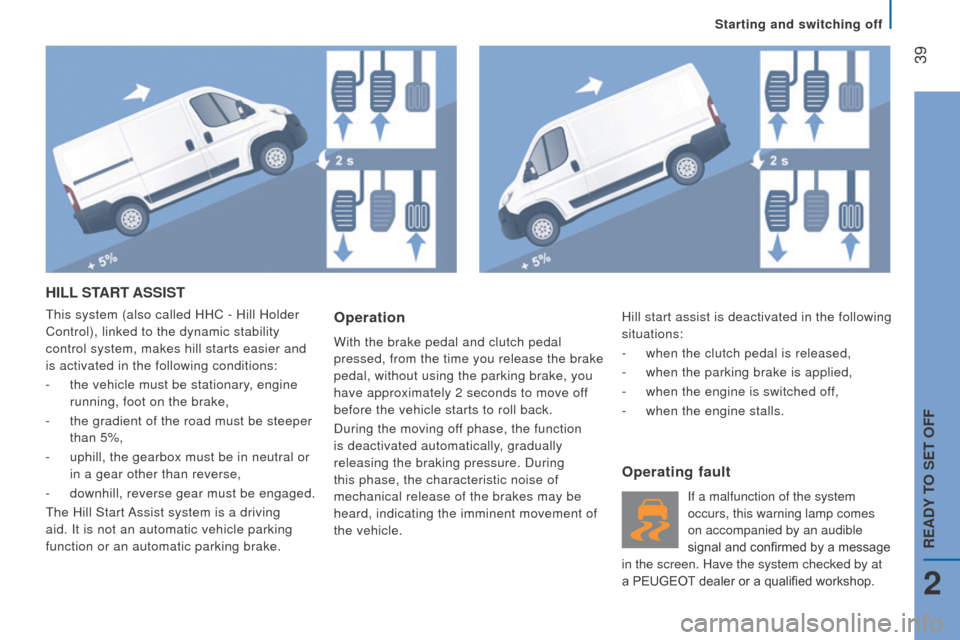
HILL StA rt ASSIS t
this system (also called HHC - Hill Holder
Control), linked to the dynamic stability
control system, makes hill starts easier and
is activated in the following conditions:
-
the vehicle must be stationary
, engine
running, foot on the brake,
-
the gradient of the road must be steeper
than 5%,
-
uphill, the gearbox must be in neutral or
in a gear other than reverse,
-
downhill, reverse gear must be engaged.
t
he Hill Start Assist system is a driving
aid. It is not an automatic vehicle parking
function or an automatic parking brake.operation
With the brake pedal and clutch pedal
pressed, from the time you release the brake
pedal, without using the parking brake, you
have approximately 2 seconds to move off
before the vehicle starts to roll back.
During the moving off phase, the function
is deactivated automatically, gradually
releasing the braking pressure. During
this phase, the characteristic noise of
mechanical release of the brakes may be
heard, indicating the imminent movement of
the vehicle.
operating fault
If a malfunction of the system
occurs, this warning lamp comes
on accompanied by an audible
signal and confirmed by a message
in the screen. Have the system checked by at
a PEUGEOT dealer or a qualified workshop. Hill start assist is deactivated in the following
situations:
-
when the clutch pedal is released,
-
when the parking brake is applied,
-
when the engine is switched of
f,
-
when the engine stalls.
Starting and switching off
2
rEAdY to SEt oFF
Page 43 of 292
41
boxer_en_Chap02_Pret-a-Partir_ed01-2015
Going into engine StArt mode
- t his indicator lamp goes off
and the engine restarts.
If following an automatic restart in S
t
ARt
mode, the driver takes no action on the
the vehicle during the next
3 minutes, the
system stops the engine definitively.
t
he
engine can then only be restarted using
the
key. Special cases: S
tA rt invoked
automatically
t
he S t
ARt mode is invoked automatically
when:
-
the vehicle's is free wheeling on a slope,
-
the windscreen wiper is on fast wipe,
-
the air conditioning is running,
-
the engine has been stopped for around
3 minutes with Stop & Start,
-
some special conditions (battery charge,
engine temperature, braking assistance,
ambient temperature...) where the
engine is needed to assure control of a
system.
In this case, a message appears
in the instrument panel screen,
accompanied by this indicator
lamp, which flashes for a few
seconds, then goes off.Good practice
With a manual gearbox in StOP mode, if a
gear is engaged without fully depressing the
clutch pedal, restarting may not take place.
An indicator lamp and/or message is
displayed in the instrument panel asking
you to fully depress the clutch pedal to allow
restarting.
t
his operation is perfectly normal.
With the vehicle in gear, automatic engine
restarting is only allowed by fully depressing
the clutch pedal.
With the engine stopped in S
t
OP
mode, if the driver unfasten's
their seat belt and opens a front
door, the engine can only be
restarted using the ignition key.
t
here is
an audible signal, accompanied by flashing
of this indicator lamp and the display of a
message.
Starting and switching off
2
rEAdY to SEt oFF
Page 45 of 292
43
boxer_en_Chap02_Pret-a-Partir_ed01-2015
drIVInG rEcoMMEndAtI on S
Observe the driving regulations and remain
vigilant whatever the traffic conditions.
Pay close attention to the traffic and keep
your hands on the wheel so that you are
ready to react at any time to any eventuality.
On a long journey, a break every two hours
is strongly recommended.
In difficult weather, drive smoothly, anticipate
the need to brake and increase the distance
from other vehicles.
driving on flooded roads
We strongly advise against driving on
flooded roads, as this could cause serious
damage to the engine or gearbox, as well as
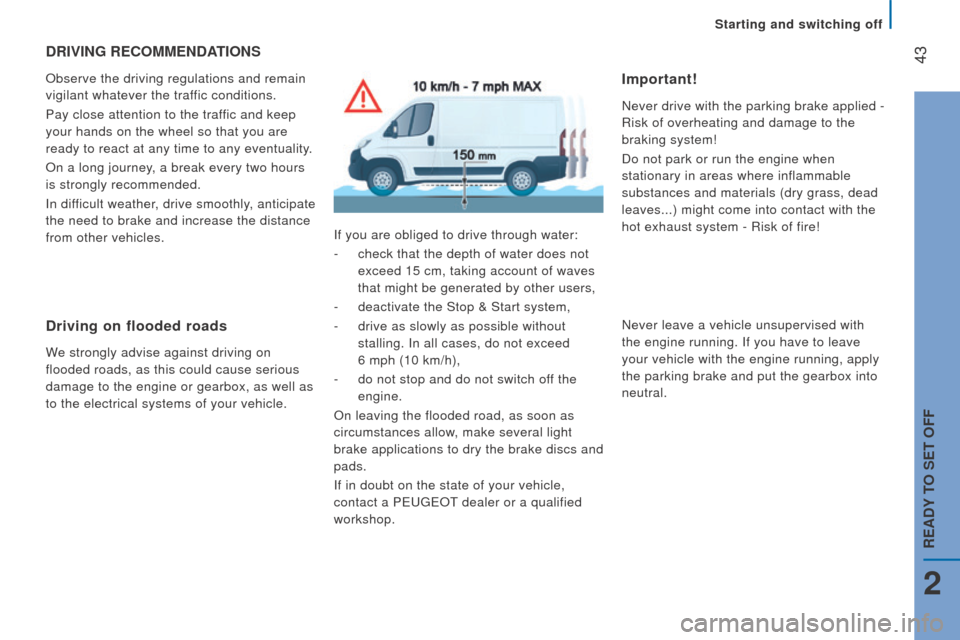
to the electrical systems of your vehicle. If you are obliged to drive through water:
-
check that the depth of water does not
exceed 15 cm, taking account of waves
that might be generated by other users,
-
deactivate the Stop & Start system,
-
drive as slowly as possible without
stalling. In all cases, do not exceed
6 mph (10 km/h),
-
do not stop and do not switch of
f the
engine.
On leaving the flooded road, as soon as
circumstances allow, make several light
brake applications to dry the brake discs and
pads.
If in doubt on the state of your vehicle,
contact a P
euge O t
dealer or a qualified
workshop.
Important!
Never drive with the parking brake applied -
Risk of overheating and damage to the
braking system!
Do not park or run the engine when
stationary in areas where inflammable
substances and materials (dry grass, dead
leaves...) might come into contact with the
hot exhaust system - Risk of fire!
Never leave a vehicle unsupervised with
the engine running. If you have to leave
your vehicle with the engine running, apply
the parking brake and put the gearbox into
neutral.
Starting and switching off
2
rEAdY to SEt oFF
Page 106 of 292
104
boxer_en_Chap05_Securite_ed01-2015
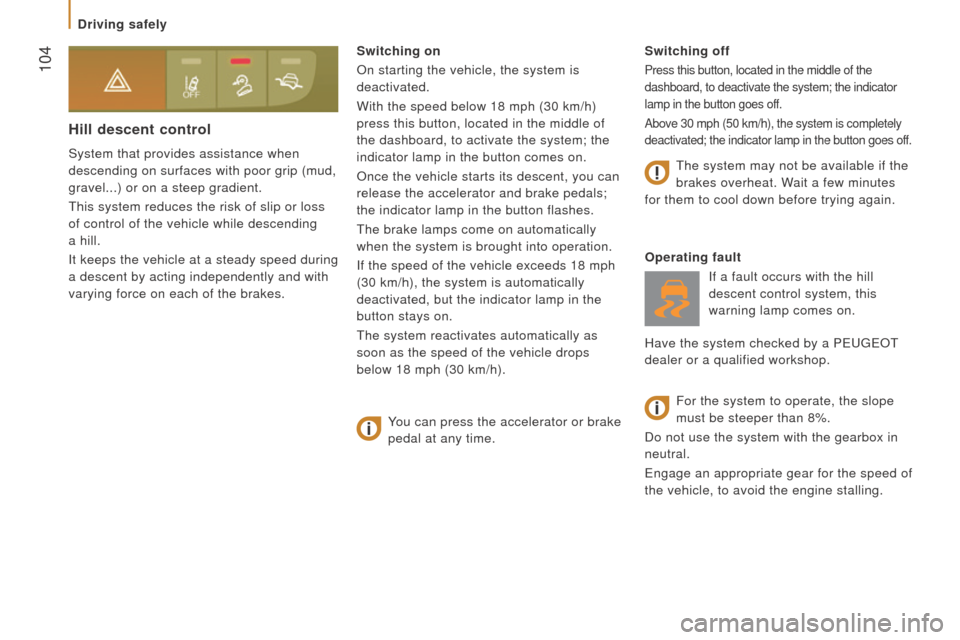
Hill descent control
System that provides assistance when
descending on surfaces with poor grip (mud,
gravel...) or on a steep gradient.
t
his system reduces the risk of slip or loss
of control of the vehicle while descending
a hill.
It keeps the vehicle at a steady speed during
a descent by acting independently and with
varying force on each of the brakes. Switching off
Press this button, located in the middle of the
dashboard, to deactivate the system; the indicator
lamp in the button goes off.
Above 30 mph (50 km/h), the system is completely
deactivated; the indicator lamp in the button goes off.
operating fault
If a fault occurs with the hill
descent control system, this
warning lamp comes on.
Have the system checked by a P
euge O t
dealer or a qualified workshop.
Switching on
On starting the vehicle, the system is
deactivated.
With the speed below 18 mph (30 km/h)
press this button, located in the middle of
the dashboard, to activate the system; the
indicator lamp in the button comes on.
Once the vehicle starts its descent, you can
release the accelerator and brake pedals;
the indicator lamp in the button flashes.
t
he brake lamps come on automatically
when the system is brought into operation.
If the speed of the vehicle exceeds 18
mph
(30 km/h), the system is automatically
deactivated, but the indicator lamp in the
button stays on.
t
he system reactivates automatically as
soon as the speed of the vehicle drops
below 18 mph (30 km/h).
For the system to operate, the slope
must be steeper than 8%.
Do not use the system with the gearbox in
neutral.
e
ngage an appropriate gear for the speed of
the vehicle, to avoid the engine stalling.
You can press the accelerator or brake
pedal at any time.
t
he system may not be available if the
brakes overheat. Wait a few minutes
for them to cool down before trying again.
Driving safely
Page 134 of 292
132
boxer_en_Chap07_Verifications_ed01-2015
Manual gearbox
Have the level checked in accordance with
the manufacturer's servicing schedule.
Good practiceo
il filter
Brake pads
Brake pad wear depends on the style of
driving, in particular for vehicles which are
used in town, over short distances. It may
be necessary to check the thickness of the
pads, even between services.
Brake disc wear
For any information on checking the brake
disc wear, contact a P euge O t
dealer or a
qualified workshop.
Parking brake
Where the parking brake travel is too great
or there is a reduction in the performance
of the system, the parking brake should be
adjusted, even between services.
Have the system checked by a P
euge O t
dealer or a qualified workshop.
If this warning lamp comes on,
have the brake pad wear checked
by a P
euge
O
t
dealer or a
qualified workshop. In order to avoid damaging the
electrical units, we strongly advise you
not to use high pressure washing to clean
the engine compartment.
After washing the vehicle dampness, or in
winter, ice may form on the brake discs and
pads: braking efficiency may be reduced.
Make some light brake applications to dry
and de-ice the brakes. Only use products recommended by
P euge O t
or products of equivalent quality
and specification.
In order to optimise the operation of units as
important as the braking system, P euge O t
selects and of
fers specific products.
Change the filter regularly, in accordance
with the manufacturer's servicing schedule.
Levels and checks