light PEUGEOT EXPERT 2001 User Guide
[x] Cancel search | Manufacturer: PEUGEOT, Model Year: 2001, Model line: EXPERT, Model: PEUGEOT EXPERT 2001Pages: 127, PDF Size: 4.95 MB
Page 46 of 127
DIESEL INJECTION EQUIPMENT*IV-3
62
The 2.0 HDi engine makes use of advanced technology.
Any repair work must be carried out by suitably qualified
personnel, such as can be provided by the dealer network.
Priming the fuel system In the event of running out of fuel:
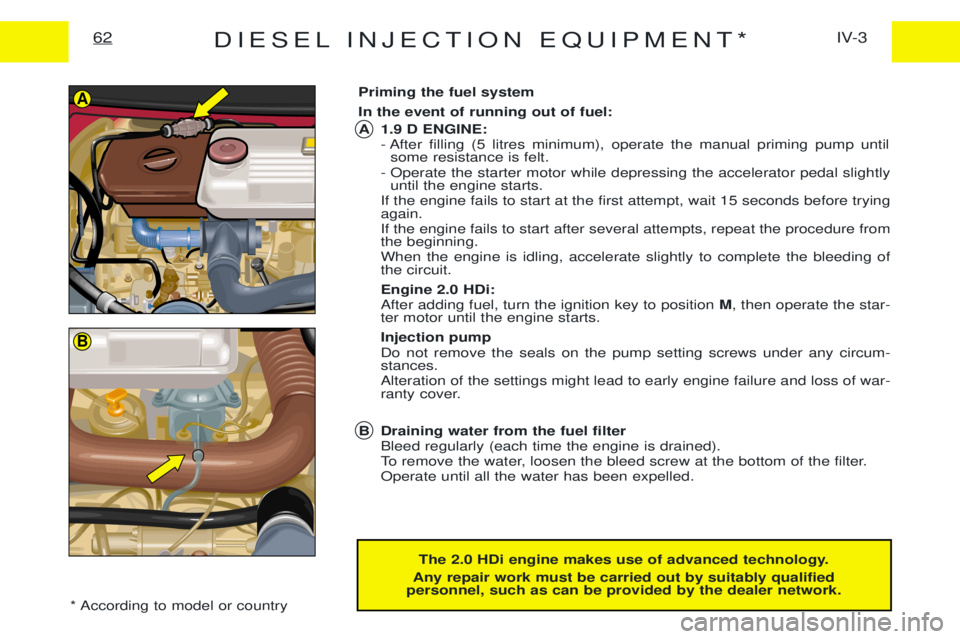
A 1.9 D ENGINE: - After filling (5 litres minimum), operate the manual priming pump untilsome resistance is felt.
- Operate the starter motor while depressing the accelerator pedal slightly until the engine starts.
If the engine fails to start at the first attempt, wait 15 seconds before trying again. If the engine fails to start after several attempts, repeat the procedure from the beginning. When the engine is idling, accelerate slightly to complete the bleeding of the circuit. Engine 2.0 HDi: After adding fuel, turn the ignition key to position M, then operate the star-
ter motor until the engine starts. Injection pump Do not remove the seals on the pump setting screws under any circum- stances. Alteration of the settings might lead to early engine failure and loss of war-
ranty cover.
B Draining water from the fuel filter Bleed regularly (each time the engine is drained).
To remove the water, loosen the bleed screw at the bottom of the filter.Operate until all the water has been expelled.
* According to model or country
A
B
Page 52 of 127
STEERING LOCK - IGNITION - STARTERII-1
40
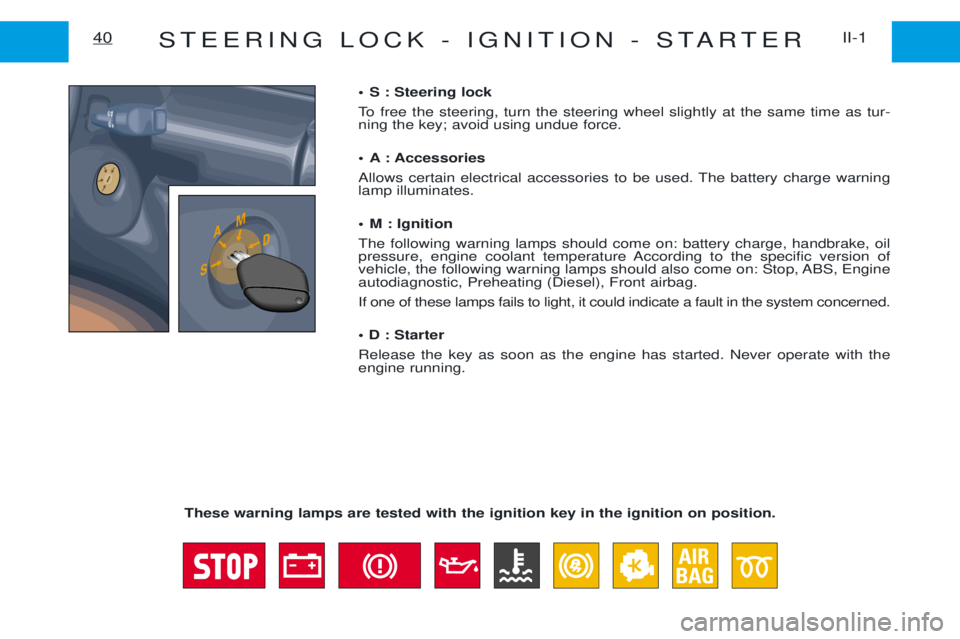
¥ S : Steering lock
To free the steering, turn the steering wheel slightly at the same time as tur- ning the key; avoid using undue force.
¥ A : Accessories
Allows certain electrical accessories to be used. The battery charge warning lamp illuminates.
¥ M : Ignition The following warning lamps should come on: battery charge, handbrake, oil
pressure, engine coolant temperature According to the specific version of
vehicle, the following warning lamps should also come on: Stop, ABS, Engineautodiagnostic, Preheating (Diesel), Front airbag. If one of these lamps fails to light, it could indicate a fault in the system concerned. ¥ D : Starter Release the key as soon as the engine has started. Never operate with the engine running.
These warning lamps are tested with the ignition key in the ignition on position.
Page 53 of 127
STEERING LOCK - IGNITION - STARTER41II-1
WARNING
NEVER REMOVE THE IGNITION KEY BEFORE THE VEHICLE IS COMPLETELY STATIONARY. NEVER ATTEMPT TO MOVE THE VEHICLE BEFORE STARTING
THE ENGINE AND WAITING FOR THE HYDRAULIC LOW PRESSURE WARNING
LAMP TO GO OUT. IF THE ENGINE IS NOT RUNNING, THE STEERING WILL NOT HAVE POWER ASSISTANCE AND THERE MAY BE NO RESERVE OF PRESSURE AVAILABLE TO OPERATE THE FOOTBRAKE. THERE IS ALSO A RISK OF THE
STEERING LOCK ENGAGING AND THE SAFETY FEATURES NOT OPERATING IF THE IGNITION IS NOT SWITCHED ON. ONLY IN AN EMERGENCY SITUATION
SHOULD YOU ATTEMPT TO MOVE A VEHICLE WITHOUT STARTING THE ENGINE.
TAKE ALL THE NECESSARY SAFETY PRECAUTIONS AND BE PREPARED TO USE THE PARKING BRAKE TO STOP THE VEHICLE.
When parking, remove the ignition key and turn the steering wheel until the steering column locking peg engages.
Steering lock
S With the key removed and the steering lock peg engaged, the steering column is locked; the lock peg will engage in
a number of positions of the steering wheel. The key can only be removed in position S.
A The steering is unlocked - to enable the key to be turned to position A, it may be necessary to turn the steering slightly.
M Running position.
D Starting position.
For starting and stopping the engine, see Ç Starting È.
Page 56 of 127
BRAKESII-3
44
Handbrake
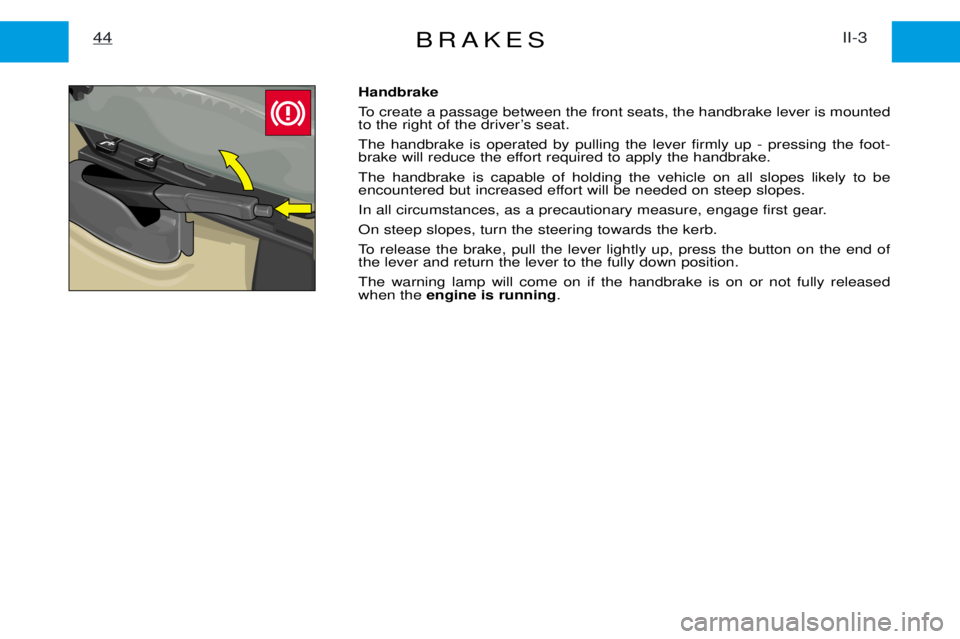
To create a passage between the front seats, the handbrake lever is mounted
to the right of the driverÕs seat. The handbrake is operated by pulling the lever firmly up - pressing the foot-
brake will reduce the effort required to apply the handbrake. The handbrake is capable of holding the vehicle on all slopes likely to be
encountered but increased effort will be needed on steep slopes.
In all circumstances, as a precautionary measure, engage first gear.On steep slopes, turn the steering towards the kerb.
To release the brake, pull the lever lightly up, press the button on the end of the lever and return the lever to the fully down position. The warning lamp will come on if the handbrake is on or not fully released when the engine is running .
Page 57 of 127
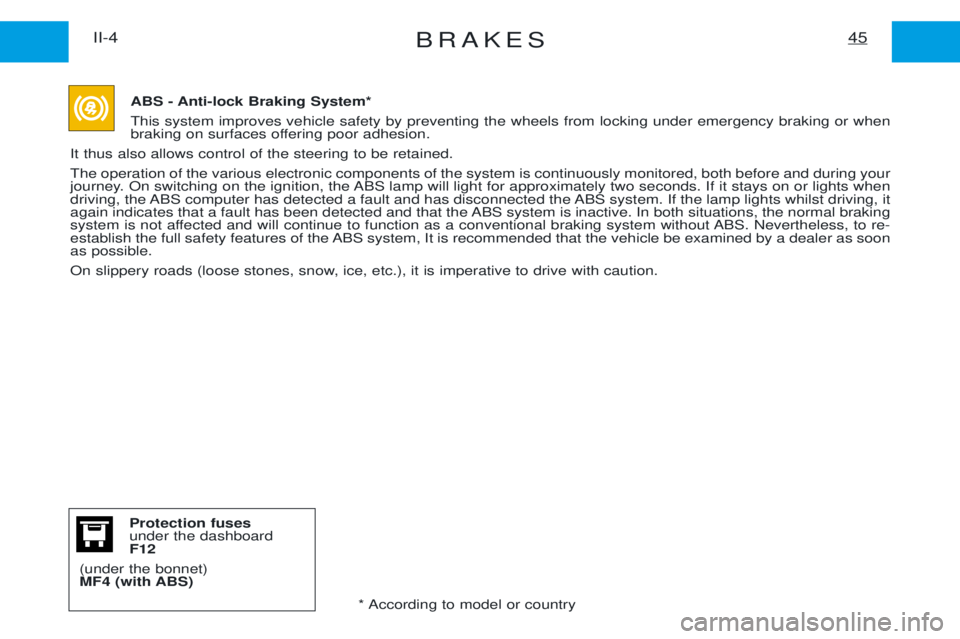
BRAKES45II-4ABS - Anti-lock Braking System* This system improves vehicle safety by preventing the wheels from locking under emergency braking or when
braking on surfaces offering poor adhesion.
It thus also allows control of the steering to be retained. The operation of the various electronic components of the system is continuously monitored, both before and during your
journey. On switching on the ignition, the ABS lamp will light for approximately two seconds. If it stays on or lights when
driving, the ABS computer has detected a fault and has disconnected the ABS system. If the lamp lights whilst driving, it
again indicates that a fault has been detected and that the ABS system is inactive. In both situations, the normal braking
system is not affected and will continue to function as a conventional braking system without ABS. Nevertheless, to re-
establish the full safety features of the ABS system, It is recommended that the vehicle be examined by a dealer as soonas possible.
On slippery roads (loose stones, snow, ice, etc.), it is imperative to drive with caution.
* According to model or country
Protection fuses under the dashboardF12
(under the bonnet)
MF4 (with ABS)
Page 59 of 127
SEAT BELTS114
Replacing the pyrotechnic pretensioner systems
They must be replaced following deployment or within ten years after first
registration of the vehicle. This must be done by the dealer network. In accordance with the strict security regulations in force, any repairs or checks must be performed exclusively by the dealer network. Any repairs that have not been carried out in strict compliance with the regulations could prevent the systems from operating correctly or couldcause their premature deployment, with the risk of bodily injuries.
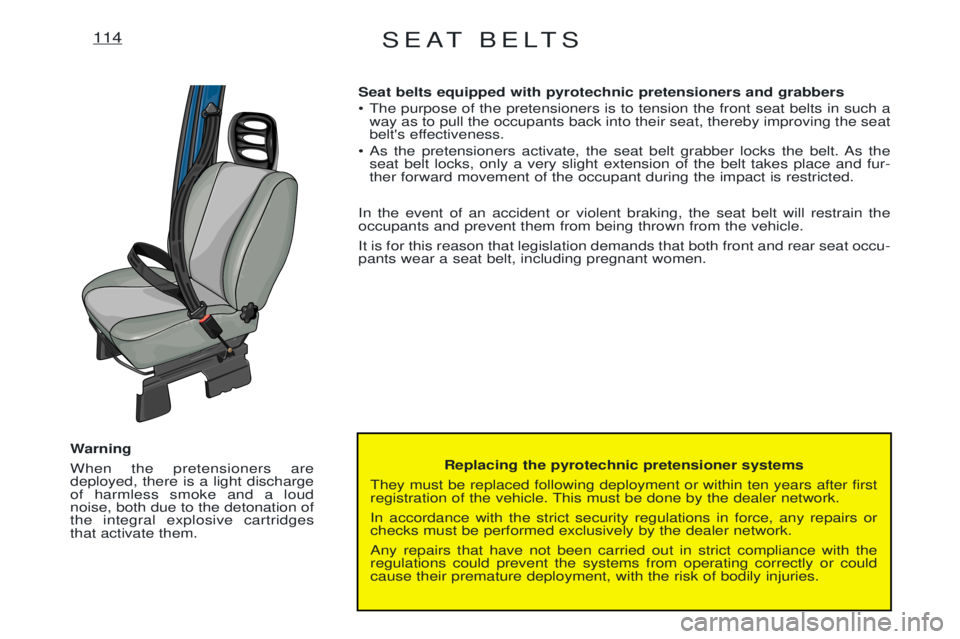
Warning When the pretensioners are deployed, there is a light dischargeof harmless smoke and a loudnoise, both due to the detonation ofthe integral explosive cartridgesthat activate them. Seat belts equipped with pyrotechnic pretensioners and grabbers
¥ The purpose of the pretensioners is to tension the front seat belts in such a
way as to pull the occupants back into their seat, thereby improving the seat
belt's effectiveness.
¥ As the pretensioners activate, the seat belt grabber locks the belt. As the seat belt locks, only a very slight extension of the belt takes place and fur-ther forward movement of the occupant during the impact is restricted.
In the event of an accident or violent braking, the seat belt will restrain theoccupants and prevent them from being thrown from the vehicle. It is for this reason that legislation demands that both front and rear seat occu- pants wear a seat belt, including pregnant women.
Page 63 of 127
AIR CONDITIONING*III-2
50
Air conditioning
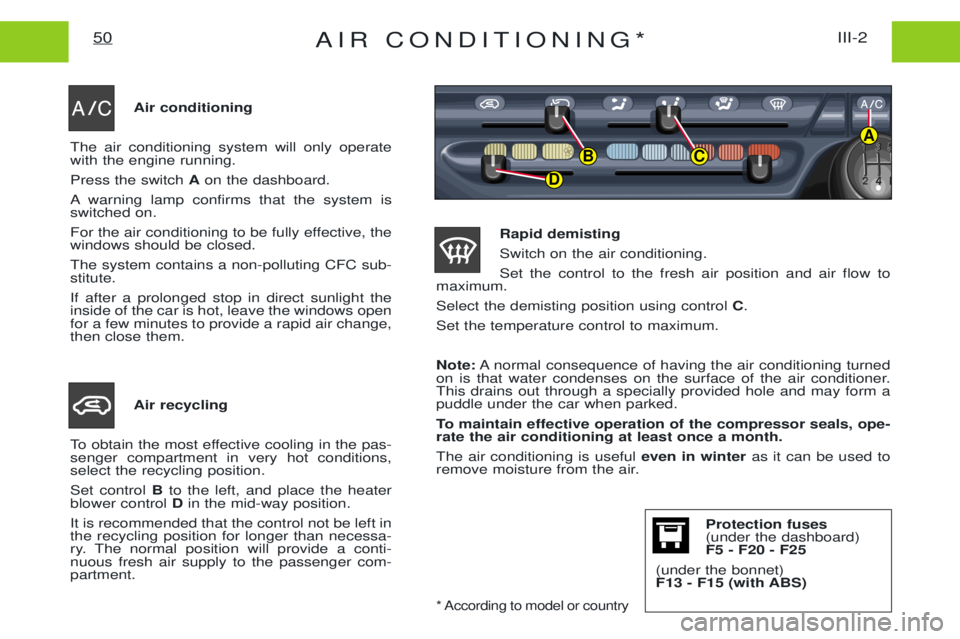
The air conditioning system will only operate with the engine running. Press the switch Aon the dashboard.
A warning lamp confirms that the system is switched on.
For the air conditioning to be fully effective, the windows should be closed. The system contains a non-polluting CFC sub- stitute. If after a prolonged stop in direct sunlight the inside of the car is hot, leave the windows openfor a few minutes to provide a rapid air change,then close them.
Air recycling
To obtain the most effective cooling in the pas-senger compartment in very hot conditions,select the recycling position. Set control Bto the left, and place the heater
blower control Din the mid-way position.
It is recommended that the control not be left in the recycling position for longer than necessa-
ry. The normal position will provide a conti-nuous fresh air supply to the passenger com-partment. Rapid demisting Switch on the air conditioning.Set the control to the fresh air position and air flow to
maximum.Select the demisting position using control C.
Set the temperature control to maximum. Note: A normal consequence of having the air conditioning turned
on is that water condenses on the surface of the air conditioner. This drains out through a specially provided hole and may form apuddle under the car when parked.
To maintain effective operation of the compressor seals, ope- rate the air conditioning at least once a month. The air conditioning is useful even in winteras it can be used to
remove moisture from the air.
* According to model or country
Protection fuses (under the dashboard)F5 - F20 - F25
(under the bonnet)
F13 - F15 (with ABS)
A
CB
D
Page 64 of 127
INTERIOR LIGHTING*51III-3
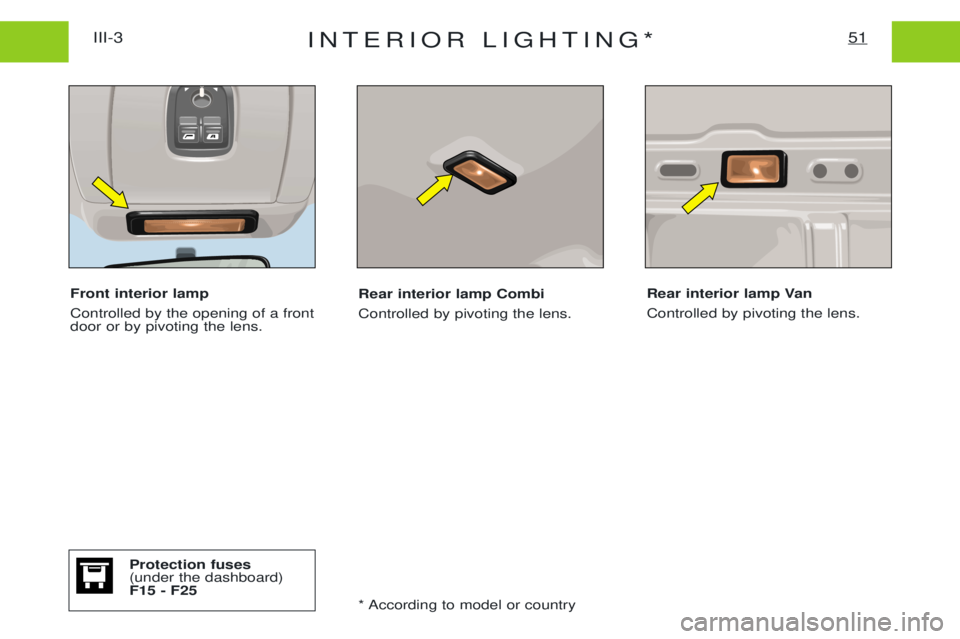
Front interior lamp Controlled by the opening of a front door or by pivoting the lens. Rear interior lamp Combi Controlled by pivoting the lens.
Rear interior lamp VanControlled by pivoting the lens.
* According to model or country
Protection fuses (under the dashboard)F15 - F25
Page 66 of 127
INTERIOR COMFORT53III-4
Ensure that children are kept away from the cigar lighter whichoperates even when the ignition is off.
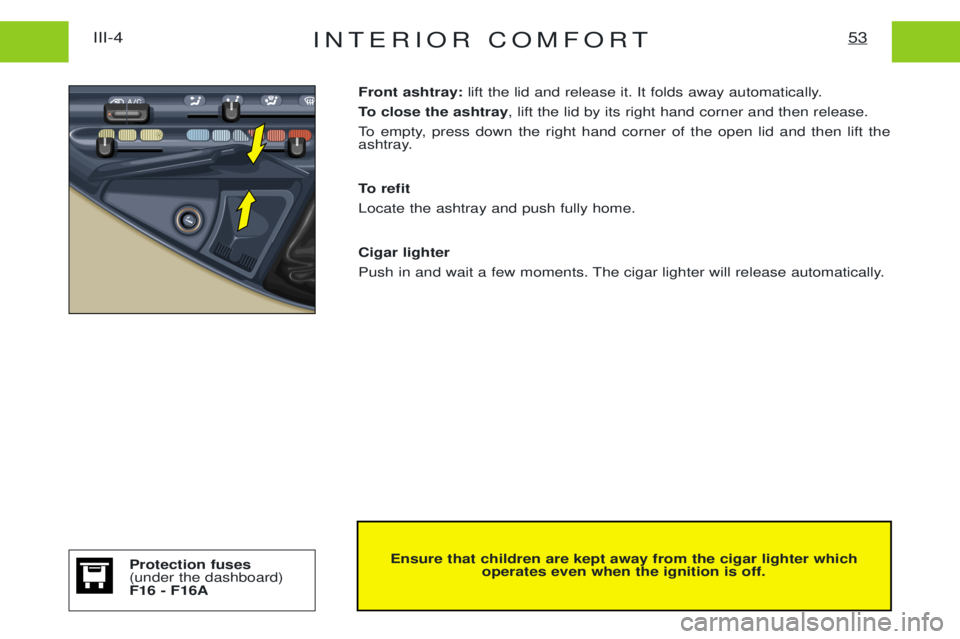
Front ashtray:
lift the lid and release it. It folds away automatically.
To close the ashtray , lift the lid by its right hand corner and then release.
To empty, press down the right hand corner of the open lid and then lift the
ashtray.
To refit Locate the ashtray and push fully home. Cigar lighter
Push in and wait a few moments. The cigar lighter will release automatically.Protection fuses (under the dashboard)F16 - F16A
Page 75 of 127
AUDIO-SYSTEM127
CASSETTE Selecting cassette mode
When a cassette is inserted, the cassette player will start automaticaily.If a cassette is already inserted, press the "SRC"button until the cassette is selected.
Ejecting the cassetteFully press both buttons "E"and "F"to eject the cassette from the player.
Direction of play
The player will play sides 1 and 2 of the cassette alternately, by automatically reversing the direction of play at the end of a side.
To manually reverse the direction of play, press both buttons "E"and "F"part way.
Fast forward/rewindFully press one of the buttons "E"or "F" to fast forward or fast rewind the cassette. At the end of the fast
forward rewind, the set plays the current side.
Note: - During fast forwards or rewind of a cassette, the audio system will automatically play the last radio station.
General precautions for use:
- Use good quality cassettes.
- Avoid the use of cassettes exceeding 90 minutes.
- Never expose cassettes to heat or direct sunlight.
- Return cassettes to their box immediately after use to protect them from dust and to avoid accidental unwin- ding of the tape.
- After prolonged use of the cassette player, build-up on the head of the player can cause reduced reproduc- tion of the treble, or even the total failure of one or both tracks. To solve this, use a cleaning cassette that plays like an ordinary cassette (approximately every 50 hours).