towing PEUGEOT EXPERT 2018 User Guide
[x] Cancel search | Manufacturer: PEUGEOT, Model Year: 2018, Model line: EXPERT, Model: PEUGEOT EXPERT 2018Pages: 416, PDF Size: 14.12 MB
Page 228 of 416
226
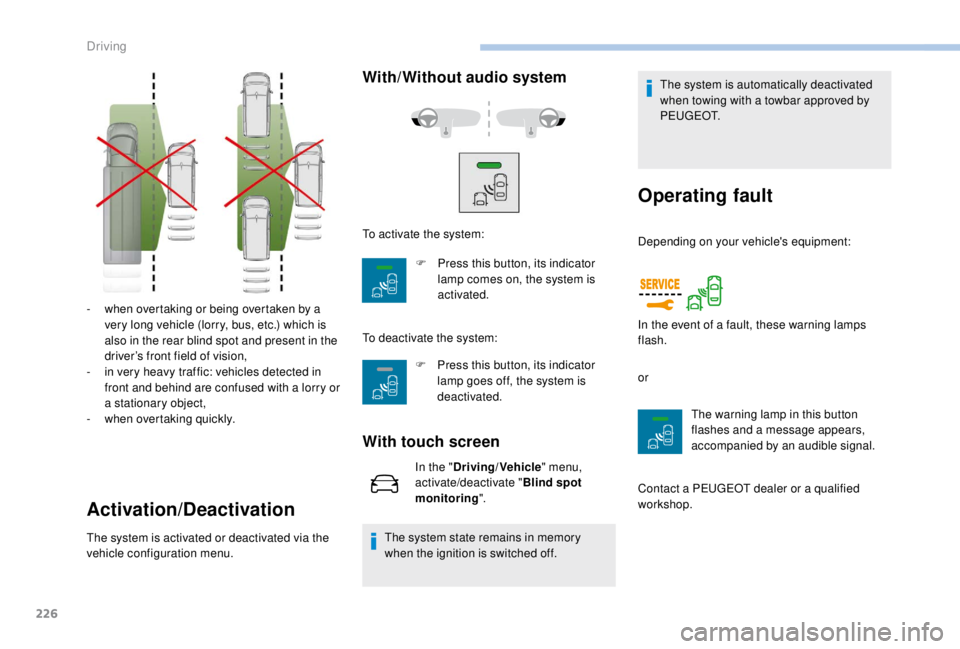
- when overtaking or being overtaken by a very long vehicle (lorry, bus, etc.) which is
also in the rear blind spot and present in the
driver’s front field of vision,
-
i
n very heavy traffic: vehicles detected in
front and behind are confused with a lorry or
a stationary object,
-
w
hen overtaking quickly.
Activation/Deactivation
The system is activated or deactivated via the
vehicle configuration menu.
With/Without audio system
F Press this button, its indicator lamp goes off, the system is
deactivated.
With touch screen
In the " Driving/Vehicle " menu,
activate/deactivate " Blind spot
monitoring ".
The system state remains in memory
when the ignition is switched off. The system is automatically deactivated
when towing with a towbar approved by
P E U G E O T.
Operating fault
To activate the system:
F
P
ress this button, its indicator
lamp comes on, the system is
activated.
To deactivate the system: Depending on your vehicle's equipment:
or
The warning lamp in this button
flashes and a message appears,
accompanied by an audible signal.
Contact a PEUGEOT dealer or a qualified
workshop. In the event of a fault, these warning lamps
flash.
Driving
Page 244 of 416
242
Towing a trailer
We recommend the use of genuine
PEUGEOT towbars and their harnesses
that have been tested and approved from
the design stage of your vehicle, and that
the fitting of the towbar is entrusted to a
PEUGEOT dealer or a qualified workshop.
If the towbar is not fitted by a PEUGEOT
dealer, it must still be fitted in accordance
with the vehicle manufacturer's
instructions.
Driving with a trailer places greater
demands on the towing vehicle and the
driver must take particular care.Please respect the maximum authorised
towable weights, indicated on the
registration certificate or in your vehicle’s
technical data.
For more information on Driving advice
,
particularly when towing, refer to the
corresponding section.
Energy economy mode
System which manages the duration of use of
certain functions to conser ve a sufficient level
of charge in the battery.
After the engine has stopped, you can still use
functions such as the audio and telematics
system, windscreen wipers, dipped beam
headlamps, courtesy lamps, etc. for a
maximum combined duration of about forty
minutes.
Switching to this mode
A message appears in the instrument panel
screen indicating that the vehicle has switched
to economy mode and the active functions are
put on standby.
If a telephone call is being made at this
time, it will be maintained for around
10
minutes with the hands-free kit of your
audio system.
Your vehicle is primarily designed for
transporting people and luggage, but it may
also be used for towing a trailer.
Practical information
Page 261 of 416
259
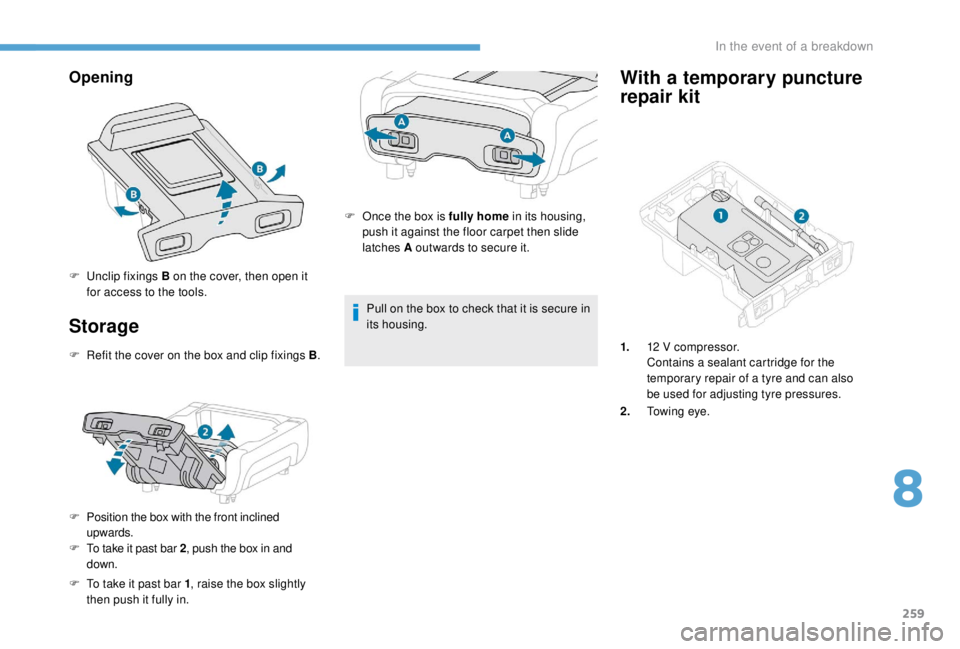
Opening
Storage
F Refit the cover on the box and clip fixings B.
F
P
osition the box with the front inclined
upwards.
F
T
o take it past bar 2, push the box in and
down.
F
T
o take it past bar 1 , raise the box slightly
then push it fully in. F
O
nce the box is fully home
in its housing,
push it against the floor carpet then slide
latches A outwards to secure it.
Pull on the box to check that it is secure in
its housing.
With a temporary puncture
repair kit
F Unclip fixings B on the cover, then open it for access to the tools.
1.12
V compressor.
Contains a sealant cartridge for the
temporary repair of a tyre and can also
be used for adjusting tyre pressures.
2. Towing eye.
8
In the event of a breakdown
Page 262 of 416
260
These tools are specific to your vehicle
and may vary according to its equipment.
Do not use them for any other purpose.
Temporary puncture
repair kit
This kit comprises a compressor and a sealant
cartridge.
It allows the temporary repair of a tyre.
You are then able to go to the nearest garage.
It is designed to repair most punctures which
could affect the tyre, located on the tyre tread
or shoulder.
Its compressor can be used to check and
adjust the pressure of the tyre.
Access to the kit
For more information on the Tool box ,
refer to the corresponding section.
List of tools
These tools are specific to your vehicle and
may vary according to the level of equipment.
Do not use them for any other purposes.
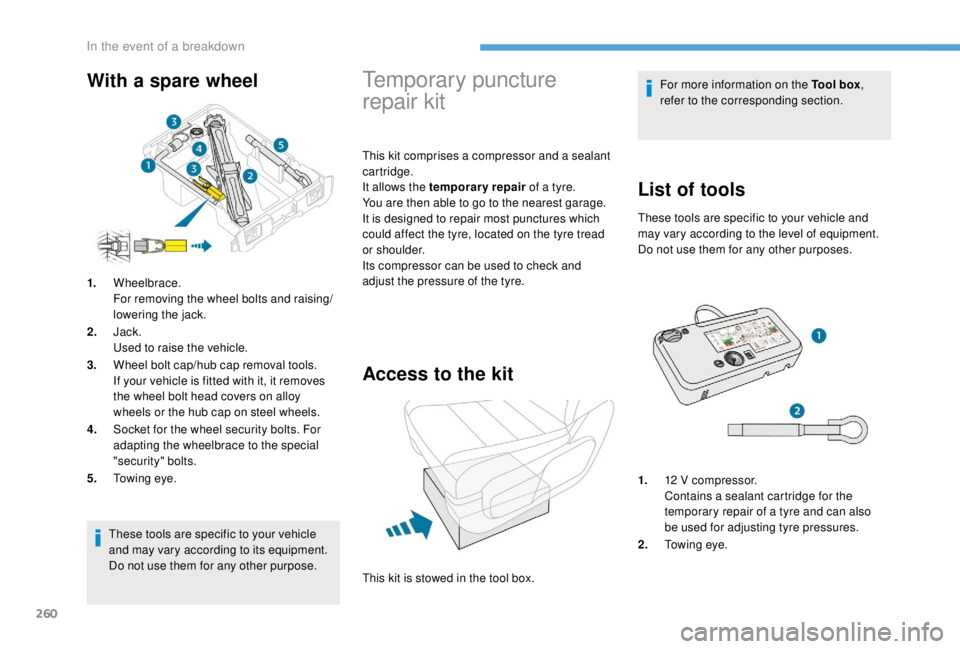
1. 12
V compressor.
Contains a sealant cartridge for the
temporary repair of a tyre and can also
be used for adjusting tyre pressures.
2. Towing eye.
With a spare wheel
1.Wheelbrace.
For removing the wheel bolts and raising/
lowering the jack.
2. Jack.
Used to raise the vehicle.
3. Wheel bolt cap/hub cap removal tools.
If your vehicle is fitted with it, it removes
the wheel bolt head covers on alloy
wheels or the hub cap on steel wheels.
4. Socket for the wheel security bolts. For
adapting the wheelbrace to the special
"security" bolts.
5. Towing eye.
This kit is stowed in the tool box.
In the event of a breakdown
Page 268 of 416
266
Spare wheel
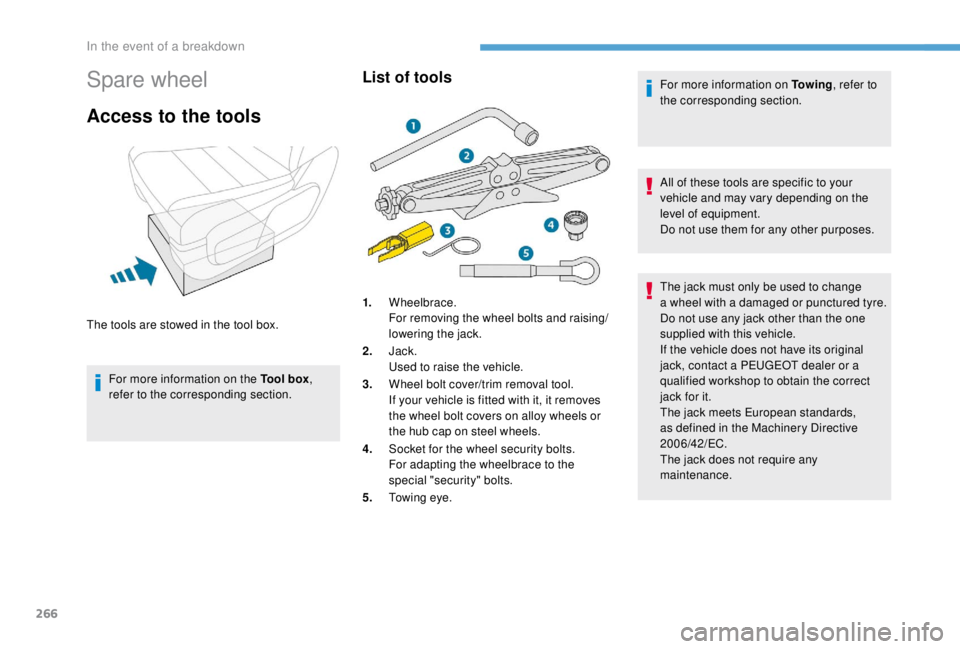
Access to the tools
For more information on the Tool box,
refer to the corresponding section.
List of toolsFor more information on To w i n g , refer to
the corresponding section.
All of these tools are specific to your
vehicle and may vary depending on the
level of equipment.
Do not use them for any other purposes.
The jack must only be used to change
a wheel with a damaged or punctured tyre.
Do not use any jack other than the one
supplied with this vehicle.
If the vehicle does not have its original
jack, contact a PEUGEOT dealer or a
qualified workshop to obtain the correct
jack for it.
The jack meets European standards,
as defined in the Machinery Directive
2006/42/EC.
The jack does not require any
maintenance.
The tools are stowed in the tool box.
1.
Wheelbrace.
For removing the wheel bolts and raising/
lowering the jack.
2. Jack.
Used to raise the vehicle.
3. Wheel bolt cover/trim removal tool.
If your vehicle is fitted with it, it removes
the wheel bolt covers on alloy wheels or
the hub cap on steel wheels.
4. Socket for the wheel security bolts.
For adapting the wheelbrace to the
special "security" bolts.
5. Towing eye.
In the event of a breakdown
Page 294 of 416
292
Battery capacity
Vehicle lengthRating in Ah
(Ampere hours)
Compact 480
Standard 640
Long 720
/ 800
Always replace the battery with one of
equivalent specification.
To w i n g
Procedure for having your vehicle towed or
for towing another vehicle using a removable
towing eye.
Access to the tools
For more information on the Tool box ,
refer to the corresponding section.
With a manual gearbox, move the gear
lever into neutral.
With an automatic or electronic gearbox,
place the gear selector into position N .
Failure to adhere to this specification
may lead to damage to braking system
components and the lack of braking
assistance on restarting the engine.
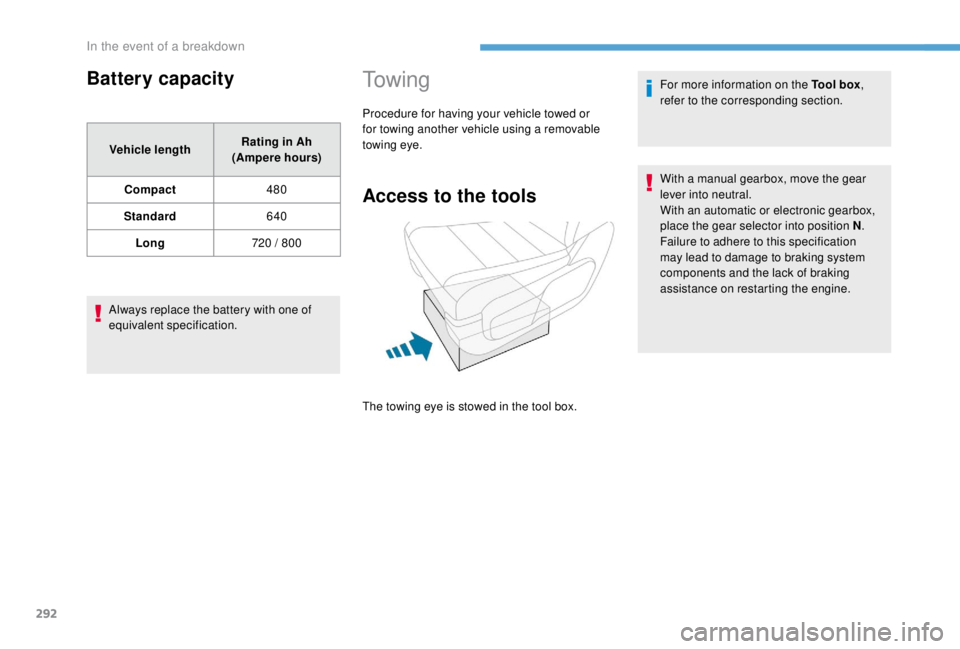
The towing eye is stowed in the tool box.
In the event of a breakdown
Page 295 of 416
293
Towing your vehicleTowing another vehicle
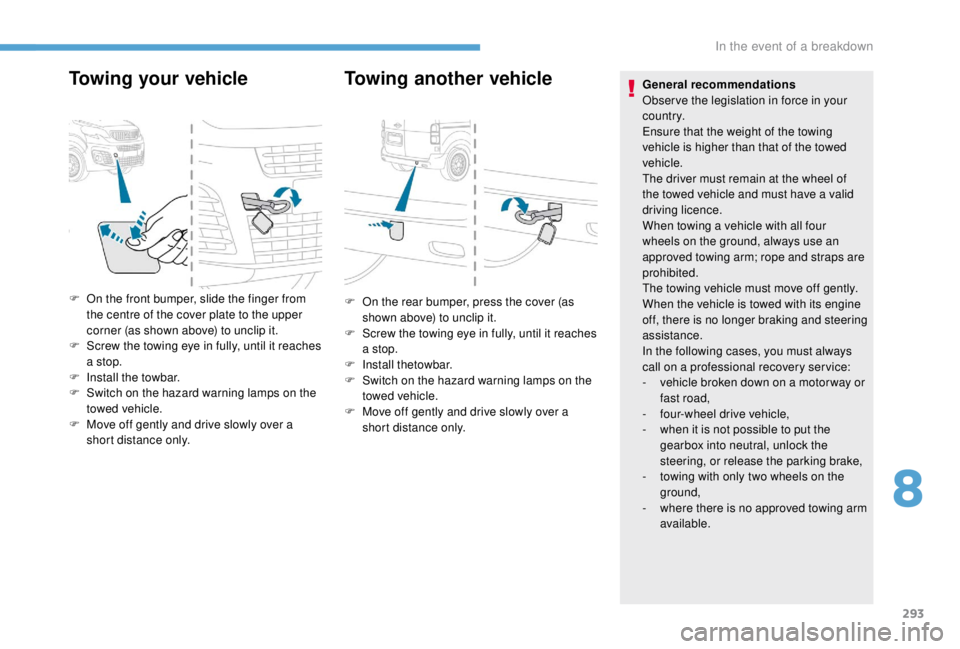
F On the front bumper, slide the finger from
the centre of the cover plate to the upper
corner (as shown above) to unclip it.
F
S
crew the towing eye in fully, until it reaches
a stop.
F
I
nstall the towbar.
F
S
witch on the hazard warning lamps on the
towed vehicle.
F
M
ove off gently and drive slowly over a
short distance only. General recommendations
Obser ve the legislation in force in your
c o u nt r y.
Ensure that the weight of the towing
vehicle is higher than that of the towed
vehicle.
The driver must remain at the wheel of
the towed vehicle and must have a valid
driving licence.
When towing a vehicle with all four
wheels on the ground, always use an
approved towing arm; rope and straps are
prohibited.
The towing vehicle must move off gently.
When the vehicle is towed with its engine
off, there is no longer braking and steering
assistance.
In the following cases, you must always
call on a professional recovery ser vice:
-
v
ehicle broken down on a motor way or
fast road,
-
f
our-wheel drive vehicle,
-
w
hen it is not possible to put the
gearbox into neutral, unlock the
steering, or release the parking brake,
-
t
owing with only two wheels on the
ground,
-
w
here there is no approved towing arm
available.
F
O n the rear bumper, press the cover (as
shown above) to unclip it.
F
S
crew the towing eye in fully, until it reaches
a stop.
F
I
nstall thetowbar.
F
S
witch on the hazard warning lamps on the
towed vehicle.
F
M
ove off gently and drive slowly over a
short distance only.
8
In the event of a breakdown
Page 296 of 416
294
Characteristics of the
engines and towed loads
Engines
The engine characteristics are given in the
vehicle's registration document, as well as in
sales brochures.The maximum power corresponds to the
value type-approved on a test bed, under
conditions defined in European legislation
(Directive 1999/99/EC).
For more information, contact a PEUGEOT
dealer or a qualified workshop.
Weights and towed loads
The maximum weights and towed loads for
your vehicle are given in the registration
document, as well as in sales brochures.
These values are also given on the
manufacturer's plate or label.
For more information, contact a PEUGEOT
dealer or a qualified workshop.
The GTW values and the towable loads
listed are valid for a maximum altitude of
1,000
metres. The towable load must be
reduced by steps of 10% for each additional
1,000
metres.
The recommended nose weight is the vertical
load on the towbar ball (removable, with or
without tools).
GT W: Gross train weight. High exterior temperatures may result
in a reduction in the per formance of the
vehicle to protect the engine. When the
exterior temperature is higher than 37°C,
limit the towed weight.
Towing using a lightly loaded vehicle can
adversely affect roadholding.
Braking distances are increased when
towing a trailer.
When using a vehicle to tow, never exceed
a speed of around 60
mph (100 km/h)
(obser ve the local legislation in force).
If the exterior temperature is high, it is
recommended that the engine be allowed
to idle for 1
to 2 minutes after the vehicle
comes to a stop, to facilitate its cooling.
Technical data
Page 409 of 416
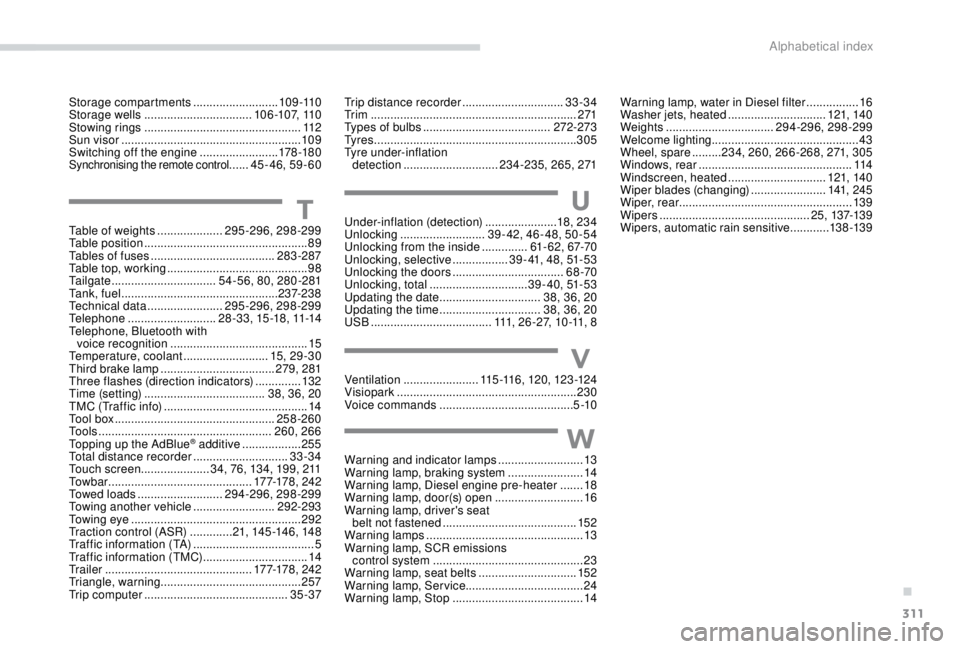
311
Table of weights ....................29 5-296, 298-299
Table position .................................................. 89
Tables of fuses
...................................... 283-287
Table top, working
........................................... 98
Tailgate
................
................54-56, 80, 280 -281
Ta n k , f u e l
................................................ 237-238
Technical data
.......................295-296, 298-299
Telephone
........................... 2
8 - 3 3 , 15 -18 , 11-14
Telephone, Bluetooth with voice recognition
.......................................... 15
T
emperature, coolant
..........................15, 29 - 3 0
Third brake lamp
................................... 279, 281
Three flashes (direction indicators)
.............. 13
2
Time (setting)
..................................... 38, 36, 20
TMC (Traffic info)
............................................ 14
T
ool box
................
................................. 258-260
To o l s
..................................................... 260, 266
Topping up the AdBlue
® additive .................. 255
Total distance recorder
............................. 33-34
Touch screen ..................... 34, 76, 134, 199, 211
To w b a r
...............................
............. 17 7-178 , 242
Towed loads
.......................... 294-296, 298-299
Towing another vehicle
......................... 292-293
Towing eye
.................................................... 292
Traction control (ASR)
............. 21, 145 -14 6, 148
Traffic information (TA)
..................................... 5
Traffic information (TMC)
................................ 14
Tr a i l e r
...............
.............................. 17 7-178 , 242
Triangle, warning ........................................... 257
Trip computer
............................................ 35 -37
T
V
W
U
Ventilation ....................... 115 -116, 120, 123 -124
Visiopark ....................................................... 23
0
Voice commands
......................................... 5 -10
Warning and indicator lamps
.......................... 13
W
arning lamp, braking system
.......................14
Warning lamp, Diesel engine pre-heater
.......18
Warning lamp, door(s) open
...........................16
Warning lamp, driver's seat belt not fastened
...............................
..........152
Warning lamps
................................................ 13
Warning lamp, SCR emissions control system
.............................................. 23
Warning lamp, seat belts
..............................152
Warning lamp, Service ....................................24
Warning lamp, Stop
........................................ 14
Under-inflation (detection)
......................
18, 234
Unlocking
..........................
39-42, 46-48, 50-54
Unlocking from the inside ..............
61- 62, 67-70
Unlocking, selective
.................
39 - 41, 48, 51-53
Unlocking the doors
.................................. 6
8 -70
Unlocking, total
..............................
3 9 - 4 0 , 51- 5 3
Updating the date
............................... 3
8, 36, 20
Updating the time
............................... 3
8, 36, 20
USB
.....................................
111, 2 6 - 2 7, 1 0 -11, 8
Storage compartments
..........................
109 -110
Storage wells
.................................
10 6 -107, 110
Stowing rings
................................................
112
Sun visor
...............................
........................
109
Switching off the engine
........................
178 -18 0
Synchronising the remote control ......45 - 46, 59 - 60 Trip distance recorder
...............................
33
-34
Tr i m
...............
................................................
271
Types of bulbs
.......................................
2
72-273
Ty r e s
..............................................................
305
Tyre under-inflation detection ............................. 23
4-235, 265, 271Warning lamp, water in Diesel filter
................
16
W
asher jets, heated
..............................
121, 14 0
Weights
...............
..................
294-296, 298-299
Welcome lighting ............................................. 43
Wheel, spare ......... 23 4, 260, 266-268, 271, 305
Windows, rear ...............................................114
Windscreen, heated
..............................121, 14 0
Wiper blades (changing)
.......................141, 2 4 5
Wiper, rear ..................................................... 13 9
Wipers
..............................................25, 137-13 9
Wipers, automatic rain sensitive
............13 8 -13 9
.
Alphabetical index