tow PEUGEOT EXPERT 2018 Owner's Manual
[x] Cancel search | Manufacturer: PEUGEOT, Model Year: 2018, Model line: EXPERT, Model: PEUGEOT EXPERT 2018Pages: 416, PDF Size: 14.12 MB
Page 121 of 416
119
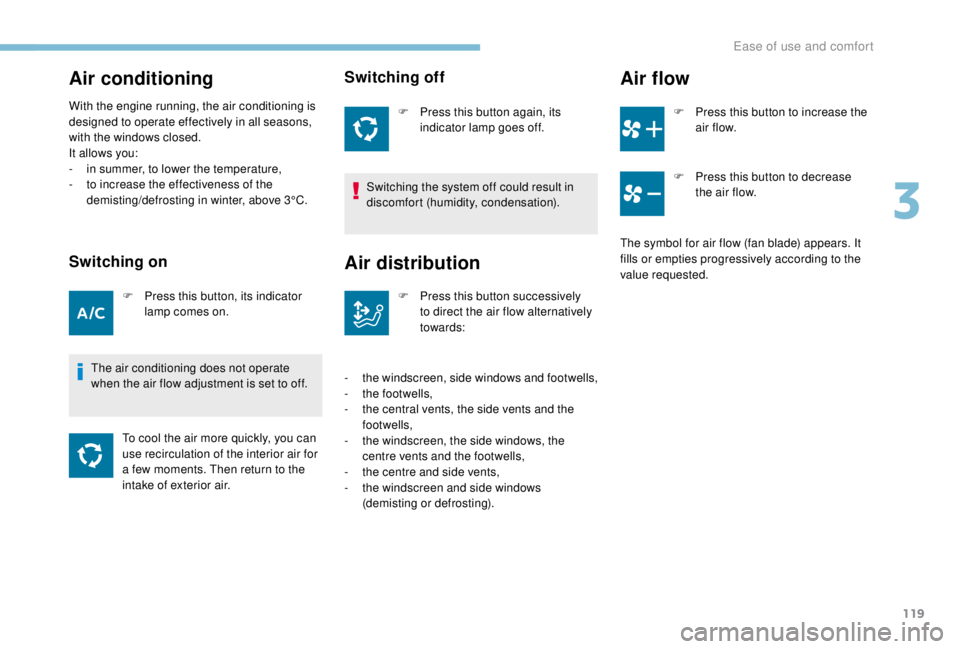
Air conditioning
With the engine running, the air conditioning is
designed to operate effectively in all seasons,
with the windows closed.
It allows you:
-
i
n summer, to lower the temperature,
-
t
o increase the effectiveness of the
demisting/defrosting in winter, above 3°C.
Switching on
F Press this button, its indicator lamp comes on.
The air conditioning does not operate
when the air flow adjustment is set to off. To cool the air more quickly, you can
use recirculation of the interior air for
a few moments. Then return to the
intake of exterior air.
Switching off
F Press this button again, its indicator lamp goes off.
Switching the system off could result in
discomfort (humidity, condensation).
Air distribution
F Press this button successively to direct the air flow alternatively
towards:
-
t
he windscreen, side windows and footwells,
-
t
he footwells,
-
t
he central vents, the side vents and the
footwells,
-
t
he windscreen, the side windows, the
centre vents and the footwells,
-
t
he centre and side vents,
-
t
he windscreen and side windows
(demisting or defrosting).
Air flow
F Press this button to increase the air f low.
F
P
ress this button to decrease
the air flow.
The symbol for air flow (fan blade) appears. It
fills or empties progressively according to the
value requested.
3
Ease of use and comfort
Page 122 of 416
120
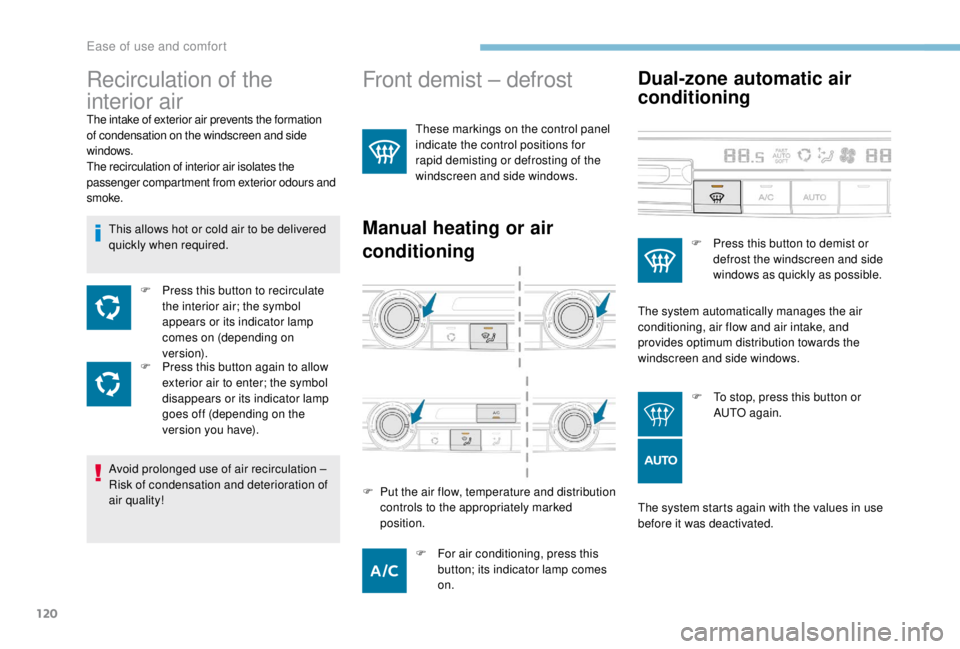
Front demist – defrost
These markings on the control panel
indicate the control positions for
rapid demisting or defrosting of the
windscreen and side windows.
Manual heating or air
conditioningDual-zone automatic air
conditioning
The system starts again with the values in use
before it was deactivated.
Recirculation of the
interior air
The intake of exterior air prevents the formation
of condensation on the windscreen and side
windows.
The recirculation of interior air isolates the
passenger compartment from exterior odours and
smoke.
This allows hot or cold air to be delivered
quickly when required.
F
P
ress this button to recirculate
the interior air; the symbol
appears or its indicator lamp
comes on (depending on
ve r s i o n).
F
P
ress this button again to allow
exterior air to enter; the symbol
disappears or its indicator lamp
goes off (depending on the
version you have).
Avoid prolonged use of air recirculation –
Risk of condensation and deterioration of
air quality!
F
F
or air conditioning, press this
button; its indicator lamp comes
on.
F
P
ut the air flow, temperature and distribution
controls to the appropriately marked
position. F
P
ress this button to demist or
defrost the windscreen and side
windows as quickly as possible.
The system automatically manages the air
conditioning, air flow and air intake, and
provides optimum distribution towards the
windscreen and side windows.
F
T
o stop, press this button or
AUTO again.
Ease of use and comfort
Page 125 of 416

123
Advice
In order for these systems to be fully effective,
follow the operation and maintenance
guidelines below:
F
T
o ensure that the air is distributed evenly,
keep the external air intake grilles at the
base of the windscreen, the nozzles, the
vents, the air outlets and the air extractor
located in the rear free from obstructions.
F
D
o not cover the sunshine sensor, located
at the top of the windscreen; this is used
for regulation of the air conditioning
system.
F
O
perate the air conditioning system for
at least 5
to 10 minutes, once or twice a
month to keep it in per fect working order.
F
T
o prevent misting or deteriorating air
quality inside the passenger compartment,
you should not deactivate the system for
too long and avoid extended operation of
the air recycling system when driving.
F
E
nsure that the passenger compartment
filter is in good condition and have the
filter elements replaced regularly. We recommend the use of a combined
passenger compartment filter. Thanks to
its special active additive, it contributes
to the purification of the air breathed by
the occupants and the cleanliness of the
passenger compartment (reduction of allergic
symptoms, bad odours and greasy deposits).
F
T
o ensure correct operation of the air
conditioning system, you are also advised
to have it checked in accordance with the
recommendations in the Warranty and
Maintenance Record.
F
I
f the system does not produce cold air,
switch it off and contact a PEUGEOT
dealer or a qualified workshop.
When towing the maximum load on a steep
gradient in high temperatures, switching off
the air conditioning increases the available
engine power and so improves the towing
ability. Vents
To close the vent, move the control outwards.
You may feel slight resistance.
3
Ease of use and comfort
Page 140 of 416

138
Model with manual wiping
(intermittent)
Model with AUTO wipingFront windscreen wipers
Raise or lower the control to the desired
position to change the wiping speed.
Fast wiping (heavy rain).
Normal wiping (moderate rain).
Intermittent wiping (proportional to
the speed of the vehicle).
Of f.
Single wipe (press downwards or
pull the stalk briefly towards you,
then release).
Or Automatic wiping (press down,
then release).
Single wipe (pull the stalk briefly
towards you).
Automatic windscreen
wipers
The windscreen wipers operate automatically
once rainfall is detected (sensor behind the
rear view mirror), adapting their speed to the
intensity of the rainfall without any action on the
part of the driver.
Switching on
Give a short downwards push to the
control.
A wiping cycle confirms that the
instruction has been accepted.
This warning lamp comes on in the
instrument panel and a message is
displayed.
Lighting and visibility
Page 142 of 416
140
Windscreen and headlamp
wash
On vehicles fitted with automatic air
conditioning, any action on the windscreen
wash control results in temporary closing
of the air intake to avoid odours inside the
passenger compartment.
Screenwash/headlamp wash
level low
In the case of vehicles fitted with
headlamp washers, when the fluid
reser voir low level is reached this
warning lamp comes on in the
instrument panel, accompanied by
an audible signal and a message.
The warning lamp comes on when the ignition
is switched on, or every time the stalk is
operated, until the reser voir is refilled.
Next time you stop, refill the screenwash/
headlamp wash reservoir.
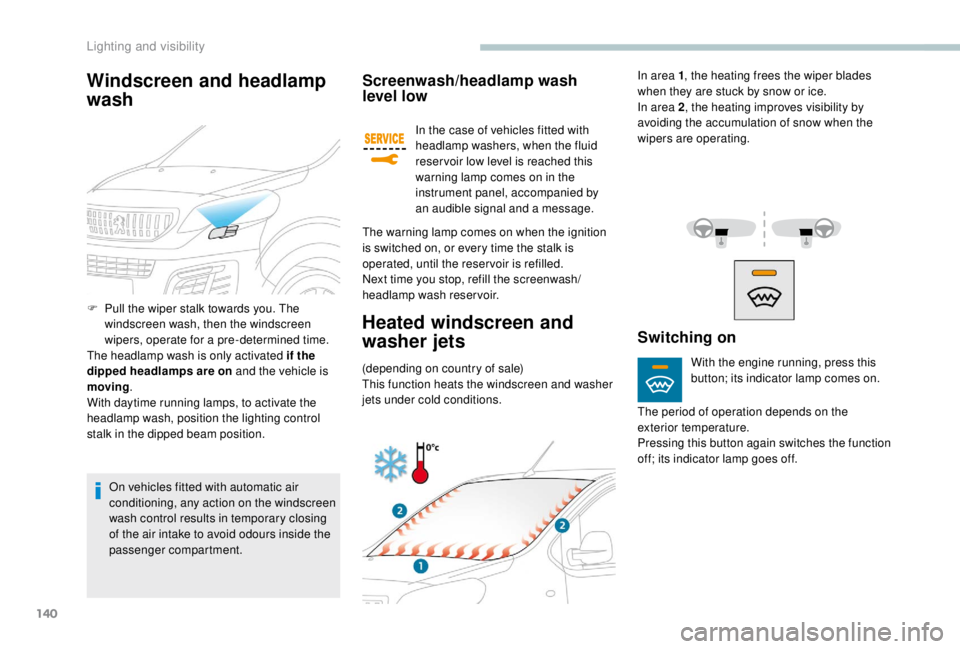
Heated windscreen and
washer jets
(depending on country of sale)
This function heats the windscreen and washer
jets under cold conditions.
F
P
ull the wiper stalk towards you. The
windscreen wash, then the windscreen
wipers, operate for a pre-determined time.
The headlamp wash is only activated if the
dipped headlamps are on and the vehicle is
moving .
With daytime running lamps, to activate the
headlamp wash, position the lighting control
stalk in the dipped beam position. In area 1
, the heating frees the wiper blades
when they are stuck by snow or ice.
In area 2 , the heating improves visibility by
avoiding the accumulation of snow when the
wipers are operating.
Switching on
With the engine running, press this
button; its indicator lamp comes on.
The period of operation depends on the
exterior temperature.
Pressing this button again switches the function
off; its indicator lamp goes off.
Lighting and visibility
Page 147 of 416
145
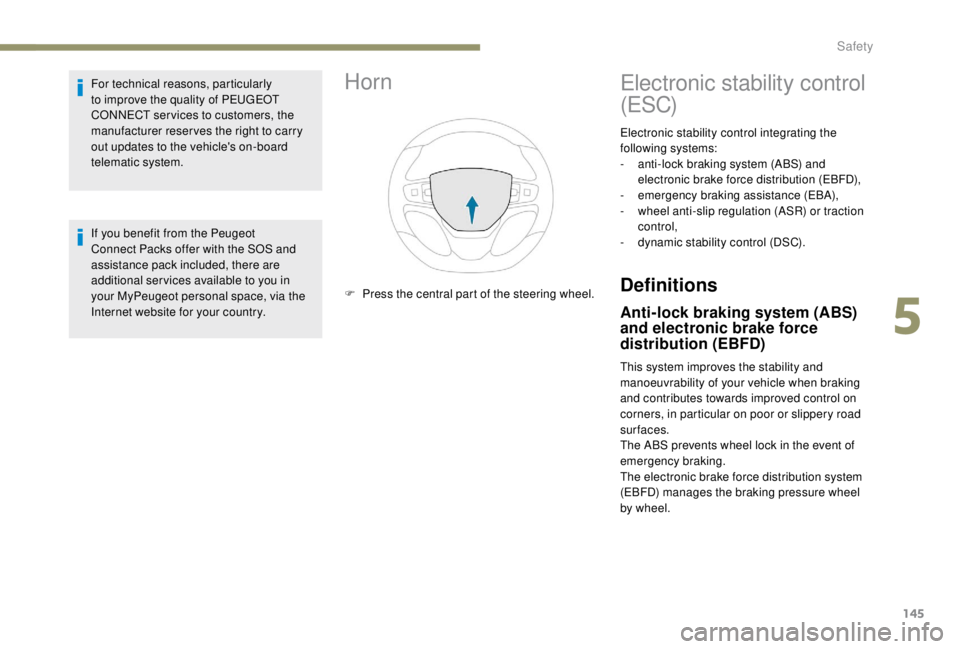
Horn
F Press the central part of the steering wheel.
Electronic stability control
(ESC)
Electronic stability control integrating the
following systems:
-
a
nti-lock braking system (ABS) and
electronic brake force distribution (EBFD),
-
em
ergency braking assistance (EBA),
-
w
heel anti-slip regulation (ASR) or traction
control,
-
d
ynamic stability control (DSC).
For technical reasons, particularly
to improve the quality of PEUGEOT
CONNECT ser vices to customers, the
manufacturer reser ves the right to carry
out updates to the vehicle's on-board
telematic system.
If you benefit from the Peugeot
Connect Packs offer with the SOS and
assistance pack included, there are
additional ser vices available to you in
your MyPeugeot personal space, via the
Internet website for your country.
Definitions
Anti-lock braking system (ABS)
and electronic brake force
distribution (EBFD)
This system improves the stability and
manoeuvrability of your vehicle when braking
and contributes towards improved control on
corners, in particular on poor or slippery road
surfaces.
The ABS prevents wheel lock in the event of
emergency braking.
The electronic brake force distribution system
(EBFD) manages the braking pressure wheel
by wheel.
5
Safety
Page 155 of 416
153
Advice
The driver must ensure that passengers use
the seat belts correctly and that they are all
restrained securely before setting off.
Wherever you are seated in the vehicle,
always fasten your seat belt, even for short
journeys.
Do not interchange the seat belt buckles as
they will not completely fulfil their role.
The seat belts are equipped with an inertia
reel which allows the strap length to adjust
automatically to your shape. The seat belt is
stowed automatically when not in use.
Before and after use, ensure that the seat belt
is reeled in correctly.
The lower part of the strap must be positioned
as low as possible on the pelvis.
The upper part must be positioned in the
hollow of the shoulder.
The inertia reels have an automatic blocking
device at the time of a collision, during
sudden braking or if the vehicle turns over.
You can release the device by pulling the
strap firmly and then releasing it so that it
reels in slightly.Instructions for children
Use a suitable child seat, if the passenger
is less than 12
years old or shorter than
one and a half metres.
Never use the same seat belt to secure
more than one person.
Never allow a child to travel on your lap.
For more information on Child seats , refer
to the corresponding section.
In case of impact
Depending on the nature and seriousness
of the impact, the pyrotechnic may be
deployed before and independent of the
airbags. Deployment of the pyrotechnics
is accompanied by a slight discharge of
harmless smoke and a noise, due to the
activation of the pyrotechnic cartridge
incorporated in the system.
In all cases, the airbag warning lamp is lit.
After an impact, get the seat belt system
checked and, if necessary, have it
replaced by a PEUGEOT dealer or a
qualified workshop.
In order to be effective, a seat belt must:
-
b e tightened as close to the body as
possible,
-
b
e pulled in front of you with a smooth
movement, checking that it does not twist,
-
b
e used to restrain only one person,
-
n
ot show any signs of cuts or fraying,
-
n
ot be converted or modified to avoid
affecting its performance.
In accordance with current safety regulations,
for all repairs on your vehicle's seat belts, go
to a qualified workshop with the skills and
equipment needed, which a PEUGEOT dealer
is able to provide.
Have your seat belts checked regularly by a
PEUGEOT dealer or a qualified workshop,
particularly if the straps show signs of
damage.
Clean the seat belt straps with soapy water or
a textile cleaning product, sold by PEUGEOT
dealers.
After folding or moving a seat or a rear bench
seat, ensure that the seat belt is positioned
and reeled in correctly.
5
Safety
Page 156 of 416
154
Airbags
The airbags do not operate when the
ignition is switched off.
This equipment will only deploy once. If a
second impact occurs (during the same or
a subsequent accident), the airbag will not
be deployed again.
Impact detection zones
Airbag deployment generates slight
smoke emissions and a noise, due to the
activation of the pyrotechnic cartridge
incorporated in the system.
This smoke is not harmful, but sensitive
individuals may experience slight irritation.
The noise of detonation associated with
the deployment of one or more airbags
may result in slight and temporary loss of
hearing.
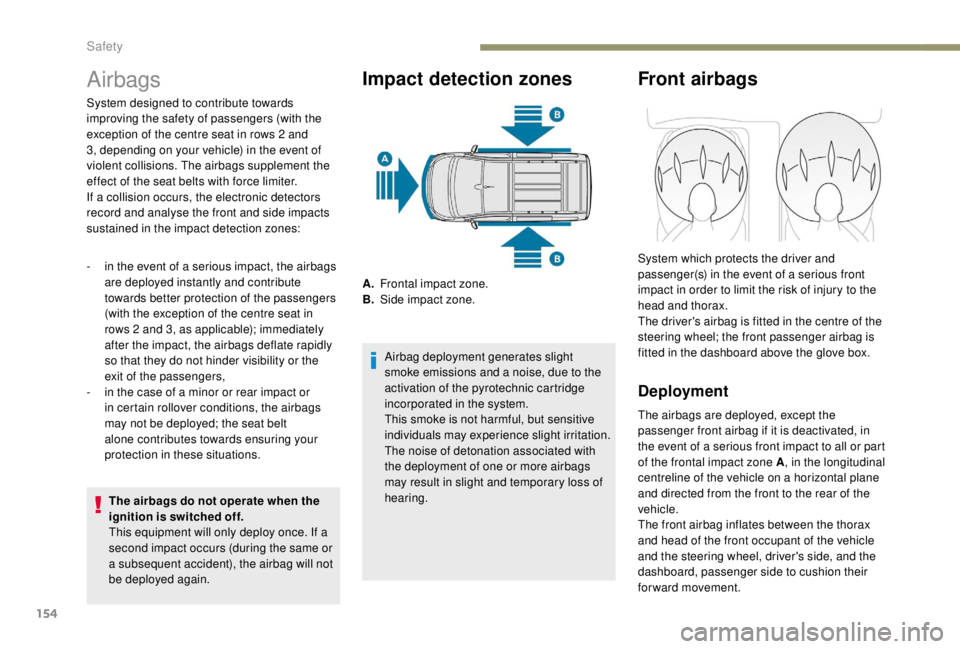
A.
F
rontal impact zone.
B.
S
ide impact zone.
Front airbags
System which protects the driver and
passenger(s) in the event of a serious front
impact in order to limit the risk of injury to the
head and thorax.
The driver's airbag is fitted in the centre of the
steering wheel; the front passenger airbag is
fitted in the dashboard above the glove box.
Deployment
The airbags are deployed, except the
passenger front airbag if it is deactivated, in
the event of a serious front impact to all or part
of the frontal impact zone A
, in the longitudinal
centreline of the vehicle on a horizontal plane
and directed from the front to the rear of the
vehicle.
The front airbag inflates between the thorax
and head of the front occupant of the vehicle
and the steering wheel, driver's side, and the
dashboard, passenger side to cushion their
for ward movement.
System designed to contribute towards
improving the safety of passengers (with the
exception of the centre seat in rows 2
and
3, depending on your vehicle) in the event of
violent collisions. The airbags supplement the
effect of the seat belts with force limiter.
If a collision occurs, the electronic detectors
record and analyse the front and side impacts
sustained in the impact detection zones:
-
i
n the event of a serious impact, the airbags
are deployed instantly and contribute
towards better protection of the passengers
(with the exception of the centre seat in
rows 2
and 3, as applicable); immediately
after the impact, the airbags deflate rapidly
so that they do not hinder visibility or the
exit of the passengers,
-
i
n the case of a minor or rear impact or
in certain rollover conditions, the airbags
may not be deployed; the seat belt
alone contributes towards ensuring your
protection in these situations.
Safety
Page 157 of 416
155
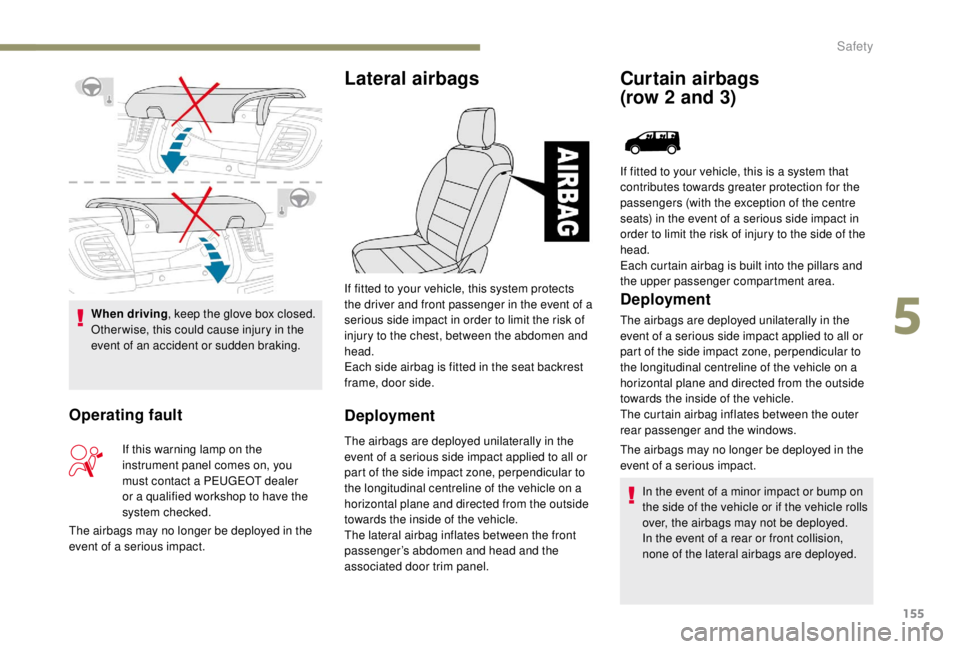
When driving, keep the glove box closed.
Other wise, this could cause injury in the
event of an accident or sudden braking.
Lateral airbags
Deployment
The airbags are deployed unilaterally in the
event of a serious side impact applied to all or
part of the side impact zone, perpendicular to
the longitudinal centreline of the vehicle on a
horizontal plane and directed from the outside
towards the inside of the vehicle.
The lateral airbag inflates between the front
passenger’s abdomen and head and the
associated door trim panel.
Curtain airbags
(row 2 and 3)
If fitted to your vehicle, this is a system that
contributes towards greater protection for the
passengers (with the exception of the centre
seats) in the event of a serious side impact in
order to limit the risk of injury to the side of the
head.
Each curtain airbag is built into the pillars and
the upper passenger compartment area.
If fitted to your vehicle, this system protects
the driver and front passenger in the event of a
serious side impact in order to limit the risk of
injury to the chest, between the abdomen and
head.
Each side airbag is fitted in the seat backrest
frame, door side.
Deployment
The airbags are deployed unilaterally in the
event of a serious side impact applied to all or
part of the side impact zone, perpendicular to
the longitudinal centreline of the vehicle on a
horizontal plane and directed from the outside
towards the inside of the vehicle.
The curtain airbag inflates between the outer
rear passenger and the windows.
The airbags may no longer be deployed in the
event of a serious impact.
Operating fault
If this warning lamp on the
instrument panel comes on, you
must contact a PEUGEOT dealer
or a qualified workshop to have the
system checked.
The airbags may no longer be deployed in the
event of a serious impact. In the event of a minor impact or bump on
the side of the vehicle or if the vehicle rolls
over, the airbags may not be deployed.
In the event of a rear or front collision,
none of the lateral airbags are deployed.
5
Safety
Page 168 of 416
166
Remove and stow the head restraint
before installing a child seat on a
passenger seat.
Refit the head restraint once the child seat
has been removed.
(a)
Universal child seat: child seat which can
be installed in all vehicles using the seat
belt.
(b) Group 0: from birth to 10
kg. Infant car
seats and "car cots" cannot be installed
on the front passenger seat(s) or the
seats in row 3.
(c) Refer to the legislation in force in your
country before carrying your child in this
seating position.
(d) To install a child seat at the rear, for ward
facing or rear ward facing, move the seats
in front for ward, then straighten their
backrests to allow sufficient room for the
child seat and the child's legs.
(e) The seat can be installed centrally in the
vehicle; it then prevents the use of the
outer seats.
(f ) When a "rear ward facing" child seat
is placed on the front passenger seat,
the front passenger airbag must be
deactivated. Otherwise, the child could
face severe injury or death if the airbag
were deployed.
U Seating position suitable for the
installation of a child seat secured using
the seat belt and universally approved
"rearward facing" and/or "forward facing". UF
Seat suitable for the installation of a child
seat secured using the seat belt and
universally approved "forward facing".
X Seat position not suitable for installation
of a child seat for the weight class
indicated.
Key"ISOFIX" mountings
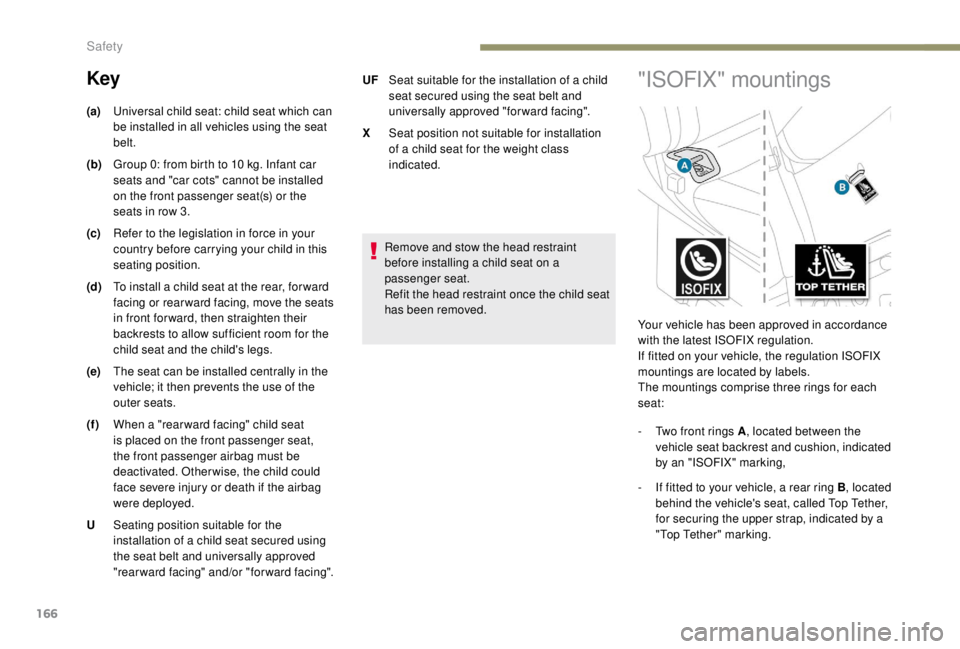
Your vehicle has been approved in accordance
with the latest ISOFIX regulation.
If fitted on your vehicle, the regulation ISOFIX
mountings are located by labels.
The mountings comprise three rings for each
seat:
-
T
wo front rings A , located between the
vehicle seat backrest and cushion, indicated
by an "ISOFIX" marking,
-
I
f fitted to your vehicle, a rear ring B , located
behind the vehicle's seat, called Top Tether,
for securing the upper strap, indicated by a
"Top Tether" marking.
Safety