Doors PEUGEOT EXPERT 2018 Owner's Guide
[x] Cancel search | Manufacturer: PEUGEOT, Model Year: 2018, Model line: EXPERT, Model: PEUGEOT EXPERT 2018Pages: 416, PDF Size: 14.12 MB
Page 84 of 416
82
Deactivation
F Press this unlocking button on the remote control.
Or
F
U
nlock the vehicle using the
K
eyless Entry
and Starting system.
The monitoring system is deactivated: the
indicator lamp in the button goes off and the
direction indicators flash for about 2
seconds.
If the vehicle locks itself automatically
(this occurs after 30
seconds if none of
the doors or the tailgate are opened),
the monitoring system is reactivated
automatically.
Protection – exterior
perimeter monitoring alone
Deactivate the interior volumetric monitoring
to avoid unwanted triggering of the alarm in
certain cases such as:
-
p
assengers on board the vehicle,
-
l
eaving a window partially open,
-
w
ashing your vehicle,
-
c
hanging a wheel,
-
h
aving your vehicle towed,
-
t
ransport on a ship or ferry.
Volumetric monitoring
Deactivation F
S
witch off the ignition and within
ten seconds, press the button
until the indicator lamp is lit
continuously.
F
G
et out of the vehicle.F
I
mmediately lock the vehicle
using the remote control or the
K
eyless Entry and Starting
system.
The exterior perimeter monitoring alone is
activated: the indicator lamp flashes once per
second.
To take effect, this deactivation must be carried
out each time the ignition is switched off.
Reactivation
F
D
eactivate the exterior perimeter
monitoring by unlocking the
vehicle using the remote control
or the
K
eyless Entry and Starting
system.
The indicator lamp in the button goes off. F
R
eactivate the full alarm system
by locking the vehicle using the
remote control or the K eyless
Entry and Starting system.
The indicator lamp in the button flashes once
per second again.
Triggering of the alarm
This results in sounding the siren and flashing
the direction indicators for thirty seconds.
The monitoring functions remain active until
the alarm has been triggered eleven times in
succession.
When the vehicle is unlocked using
the remote control or the
K
eyless
Entry and Starting system, rapid
flashing of the indicator lamp informs
you that the alarm was triggered
during your absence.
When the ignition is switched on, this
flashing stops immediately.
Access
Page 85 of 416
83
Remote control failure
To deactivate the monitoring functions:
F U nlock the vehicle using the key (integrated
with the remote control if equipped with
Keyless Entry and Starting) in the driver's
door lock.
F
O
pen the door; the alarm is triggered.
F
S
witch on the ignition; the alarm stops; the
indicator lamp in the button goes off.
Locking the vehicle without
activating the alarm
F Lock or deadlock the vehicle using the key (integrated with the remote control if
equipped with
K
eyless Entry and Starting)
in the driver's door lock.
Malfunction
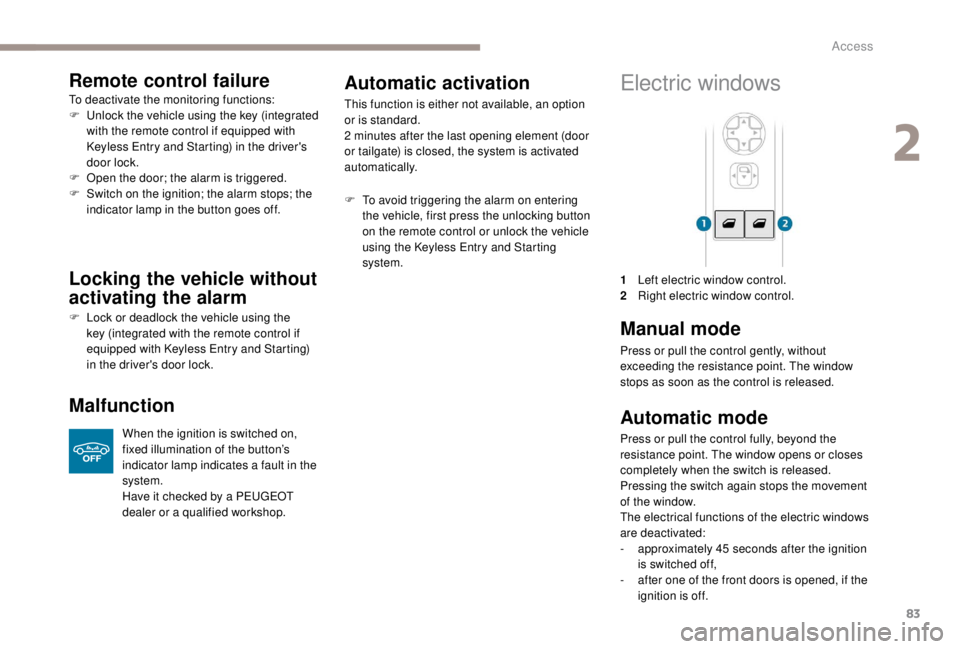
When the ignition is switched on,
fixed illumination of the button’s
indicator lamp indicates a fault in the
system.
Have it checked by a PEUGEOT
dealer or a qualified workshop.
Automatic activation
This function is either not available, an option
or is standard.
2
minutes after the last opening element (door
or tailgate) is closed, the system is activated
automatically.
F
T
o avoid triggering the alarm on entering
the vehicle, first press the unlocking button
on the remote control or unlock the vehicle
using the Keyless Entry and Starting
system.
Electric windows
1 Left electric window control.
2 R ight electric window control.
Manual mode
Press or pull the control gently, without
exceeding the resistance point. The window
stops as soon as the control is released.
Automatic mode
Press or pull the control fully, beyond the
resistance point. The window opens or closes
completely when the switch is released.
Pressing the switch again stops the movement
of the window.
The electrical functions of the electric windows
are deactivated:
-
a
pproximately 45 seconds after the ignition
is switched off,
-
a
fter one of the front doors is opened, if the
ignition is off.
2
Access
Page 130 of 416
128
Automatic operation
The front courtesy lamp comes on when the
key is removed from the ignition switch.
All of the courtesy lamps come on when
the vehicle is unlocked, when one of the
corresponding doors is opened and for location
of the vehicle using the remote control.
They go off gradually after the ignition is
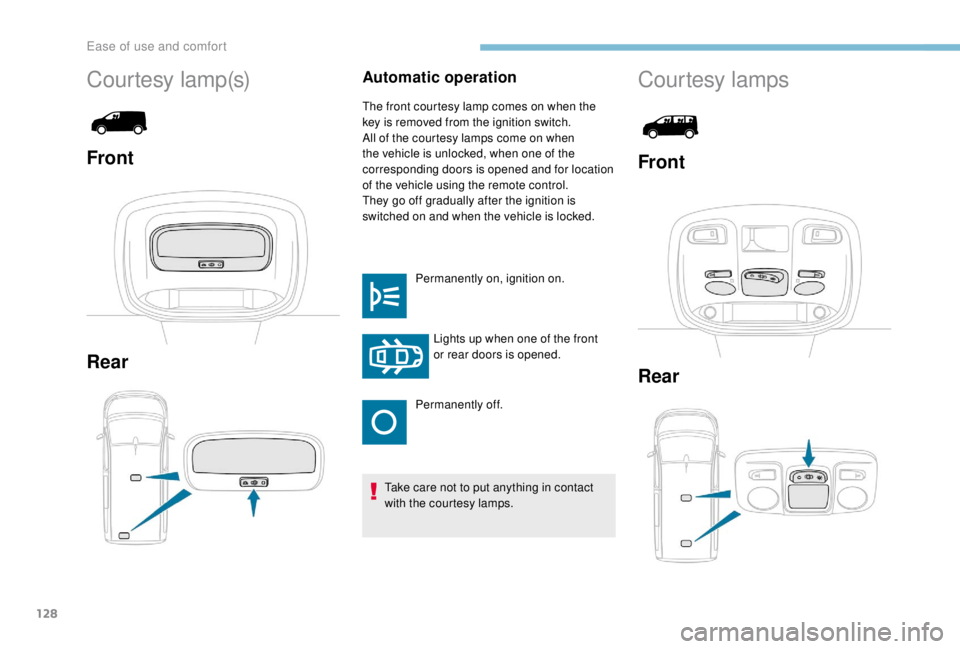
switched on and when the vehicle is locked.Permanently on, ignition on.Lights up when one of the front
or rear doors is opened.
Permanently off.
Take care not to put anything in contact
with the courtesy lamps.
Courtesy lamps
Front
Rear
Courtesy lamp(s)
Front
Rear
Ease of use and comfort
Page 131 of 416
129
Automatic operation
The front courtesy lamp comes on when the
key is removed from the ignition switch.
All of the courtesy lamps come on when
the vehicle is unlocked, when one of the
corresponding doors is opened and for location
of the vehicle using the remote control.
They go off gradually after the ignition is
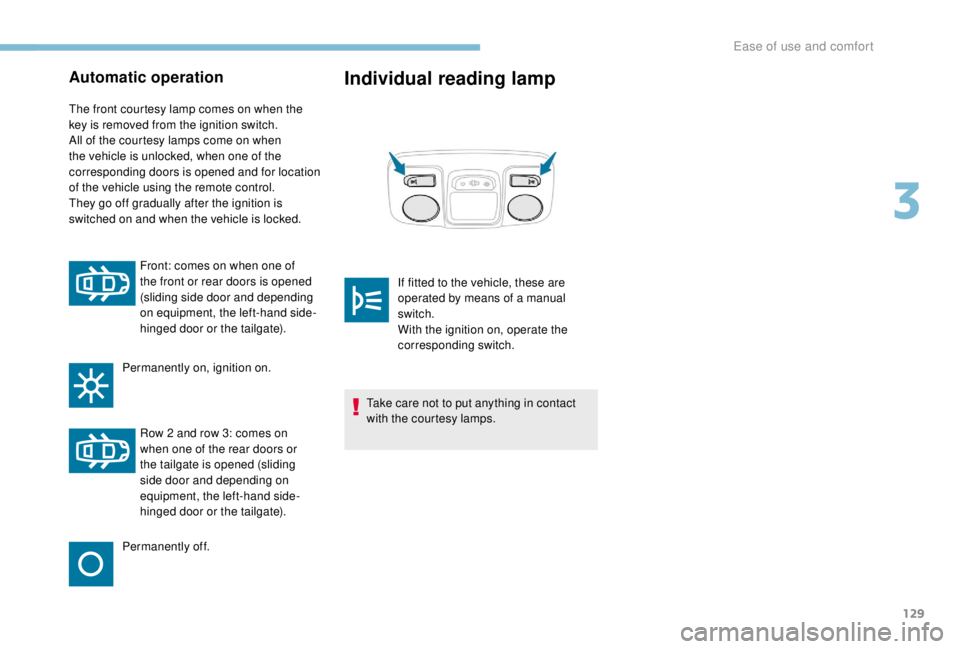
switched on and when the vehicle is locked.Front: comes on when one of
the front or rear doors is opened
(sliding side door and depending
on equipment, the left-hand side-
hinged door or the tailgate).
Permanently on, ignition on.
Row 2
and row 3: comes on
when one of the rear doors or
the tailgate is opened (sliding
side door and depending on
equipment, the left-hand side-
hinged door or the tailgate).
Permanently off.
Individual reading lamp
Take care not to put anything in contact
with the courtesy lamps. If fitted to the vehicle, these are
operated by means of a manual
switch.
With the ignition on, operate the
corresponding switch.
3
Ease of use and comfort
Page 158 of 416
156
Advice
For the airbags to be fully effective,
observe the safety recommendations
below.
Adopt a normal and upright sitting position.
Wear a correctly adjusted seat belt.
Do not leave anything between the occupants
and the airbags (a child, pet, object, etc.),
nor fix or attach anything close or in the way
of airbag trajectory; this could cause injuries
during their deployment.
Never modify the original definition of your
vehicle, particularly in the area directly
around the airbags.
After an accident or if the vehicle has been
stolen, have the airbag systems checked.
All work on the airbag system must be carried
out by a PEUGEOT dealer or a qualified
workshop.
Even when following all the precautions
listed, a risk of injuries or slight burns to
the head, the chest or the arms, when an
airbag deploys cannot be excluded. The
bag inflates almost instantly (within a few
milliseconds) then deflates within the same
time discharging the hot gas via openings
provided for this purpose.Front airbags
Do not drive holding the steering wheel by its
spokes or resting your hands on the centre
part of the wheel.
Passengers must not place their feet on the
dashboard.
Do not smoke as deployment of the airbags
can cause burns or the risk of injury from a
cigarette or pipe.
Never remove or pierce the steering wheel or
hit it violently.
Do not fit or attach anything to the steering
wheel or dashboard, this could cause injuries
in case of airbag deployment.
Curtain airbags
Do not attach anything or hang anything to the
roof, as this could cause head injuries when the
curtain airbag is deployed.
If fitted to your vehicle, do not remove the grab
handles installed on the roof, they play a part in
securing the curtain airbags. Side airbags
Use only approved covers on the seats,
compatible with the deployment of the lateral
airbags. For information on the range of seat
covers suitable for your vehicle, you can
contact a PEUGEOT dealer.
Do not attach or hang anything to the seat
backrests (clothes, etc.) as this could cause
injuries to the thorax or arm when the side
airbag is deployed.
Do not sit with the upper part of the body any
nearer to the door than necessary.
The vehicle's front door panels include side
impact sensors.
A damaged door or any unauthorised or
incorrectly executed work (modification or
repair) on the front doors or their interior trim
could compromise the operation of these
sensors – Risk of malfunction of the lateral
airbags!
Such work must only be done by a PEUGEOT
dealer or a qualified workshop.
Safety
Page 175 of 416
173
Advice
Child seats
The incorrect installation of a child seat in a
vehicle compromises the child's protection in
the event of an accident.
Ensure that there is no seat belt or seat belt
buckle under the child seat, as this could
destabilise it.
Remember to fasten the seat belts or the
child seat harnesses keeping the slack
relative to the child's body to a minimum,
even for short journeys.
When installing a child seat using the seat
belt, ensure that the seat belt is tightened
correctly on the child seat and that it secures
the child seat firmly on the seat of your
vehicle. If your passenger seat is adjustable,
move it for wards if necessary.
At rear seating positions, always leave
sufficient space between the front seat and:
-
a r
ear ward facing child seat,
-
t
he child's feet for a child seat fitted
forward facing.
To do this, move the front seat for wards
and, if necessary, move its backrest into the
upright position. For optimal installation of the forward-facing
child seat, verify that its backrest is as close
as possible to the backrest of the vehicle
seat, or if possible in contact with it.
You must remove the head restraint before
installing a child seat with backrest to a
passenger seat.
Ensure that the head restraint is stored or
attached securely to prevent it from being
thrown around the vehicle in the event of
sharp braking.
Refit the head restraint once the child seat
has been removed.
Children in front
The legislation on carrying children on the
front passenger seat is specific to each
country. Refer to the legislation in force in the
country in which you are driving.
Deactivate the passenger's front airbag when
a rear ward facing child seat is installed on
the front passenger seat. Otherwise, the child
risks being seriously injured or killed if the
airbag were deployed.
Installing a booster seat
The chest part of the seat belt must be
positioned on the child's shoulder without
touching the neck.
Ensure that the lap part of the seat belt
passes correctly over the child's thighs.
PEUGEOT recommends using a booster seat
with a backrest equipped with a belt guide at
shoulder level.
As a safety precaution, do not leave:
-
a c
hild or children alone and unattended in
a vehicle,
-
a c
hild or an animal in a vehicle under the
sun, with the windows closed,
-
t
he keys within the reach of children inside
the vehicle.
To prevent accidental opening of the doors,
use the child lock.
Take care not to open the rear windows by
more than one third.
To protect young children from the rays of the
sun, fit side blinds on the rear windows.
5
Safety
Page 176 of 416
174
Manual child lock
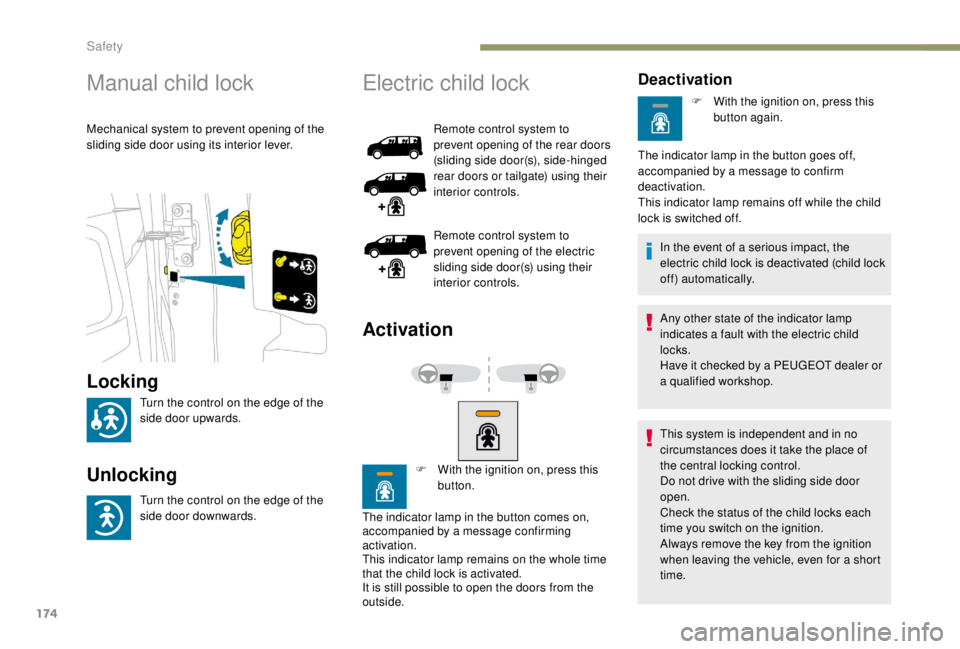
Mechanical system to prevent opening of the
sliding side door using its interior lever.
Electric child lock
Remote control system to
prevent opening of the rear doors
(sliding side door(s), side-hinged
rear doors or tailgate) using their
interior controls.
Remote control system to
prevent opening of the electric
sliding side door(s) using their
interior controls.
Activation
F With the ignition on, press this button.
Deactivation
F With the ignition on, press this button again.
The indicator lamp in the button comes on,
accompanied by a message confirming
activation.
This indicator lamp remains on the whole time
that the child lock is activated.
It is still possible to open the doors from the
outside. The indicator lamp in the button goes off,
accompanied by a message to confirm
deactivation.
This indicator lamp remains off while the child
lock is switched off.
In the event of a serious impact, the
electric child lock is deactivated (child lock
off) automatically.
Any other state of the indicator lamp
indicates a fault with the electric child
locks.
Have it checked by a PEUGEOT dealer or
a qualified workshop.
This system is independent and in no
circumstances does it take the place of
the central locking control.
Do not drive with the sliding side door
open.
Check the status of the child locks each
time you switch on the ignition.
Always remove the key from the ignition
when leaving the vehicle, even for a short
time.
Locking
Turn the control on the edge of the
side door upwards.
Unlocking
Turn the control on the edge of the
side door downwards.
Safety
Page 183 of 416
181
When leaving the vehicle, remove the key
and lock the doors.
As a safety measure (children on board),
never leave the vehicle without your
remote control with you, even for a short
period.
Switching off the engine leads to a loss of
braking assistance.
Avoid attaching heavy objects to the key,
which would weigh down on its blade
in the ignition switch and could cause a
malfunction.
Key left in the ignition
When opening the driver's door, an alert
message is displayed, accompanied by
an audible signal, to remind you that the
key is still in the ignition switch at position
1
(Stop) .
If the key has been left in the ignition
switch at position 2
(Ignition on), the
ignition will be switched off automatically
after one hour.
To switch the ignition back on, turn the key
to position 1
(Stop), then back to
position 2
(Ignition on) .
Starting/switching off the
engine,
K
eyless Entry and
Starting
Starting
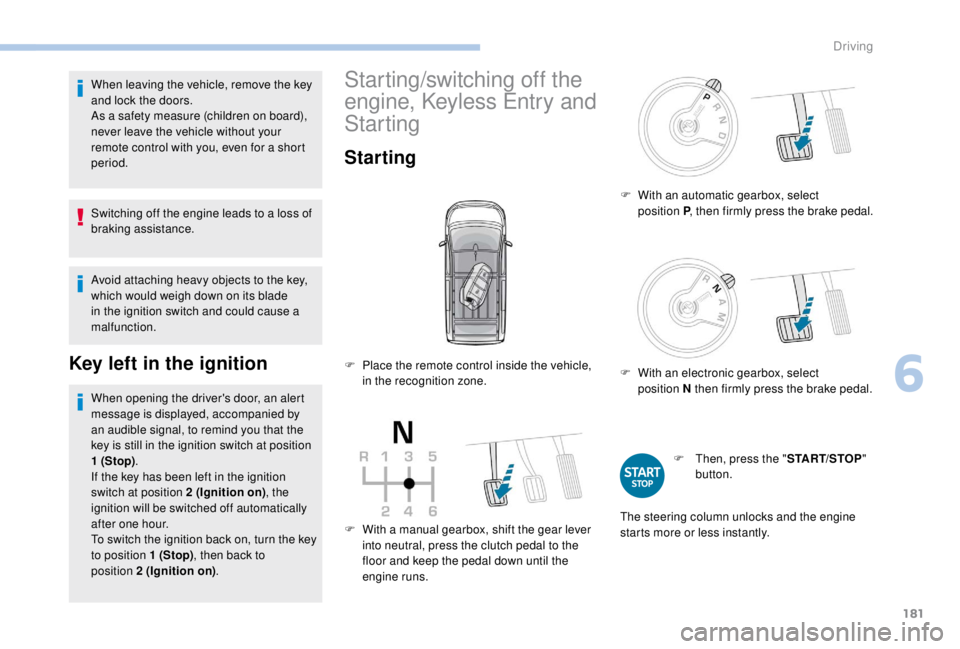
F With a manual gearbox, shift the gear lever
into neutral, press the clutch pedal to the
floor and keep the pedal down until the
engine runs. F
W
ith an automatic gearbox, select
position P, then firmly press the brake pedal.
F
W
ith an electronic gearbox, select
position N then firmly press the brake pedal.
F
T
hen, press the "
START/STOP"
button.
F
P
lace the remote control inside the vehicle,
in the recognition zone.
The steering column unlocks and the engine
starts more or less instantly.
6
Driving
Page 193 of 416
191
If your vehicle has an automatic gearbox,
never try to start the engine by pushing
the vehicle.
Automatic operation
F Select position D for automatic
changing of the six gears.
The gearbox then operates in auto-adaptive
mode, without any inter vention on the part
of the driver. It continuously selects the most
suitable gear according to the style of driving,
the profile of the road and the load in the
vehicle. For maximum acceleration without
touching the selector, depress
the accelerator fully (kick-down).
The gearbox changes down
automatically or holds the gear
selected until the maximum engine
speed is reached.
When braking, the gearbox changes down
automatically to provide effective engine
braking. Never select position N while the vehicle
is moving.
Never select position P or R unless the
vehicle is completely stationary.
Temporary manual control
of gear changes
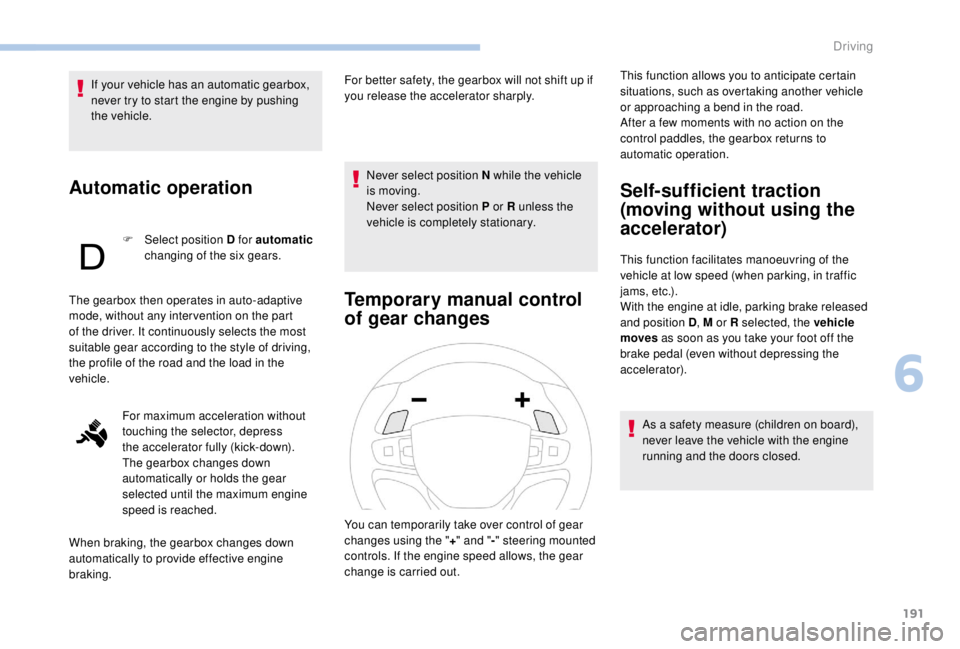
You can temporarily take over control of gear
changes using the "
+" and " -" steering mounted
controls. If the engine speed allows, the gear
change is carried out. For better safety, the gearbox will not shift up if
you release the accelerator sharply. This function allows you to anticipate certain
situations, such as overtaking another vehicle
or approaching a bend in the road.
After a few moments with no action on the
control paddles, the gearbox returns to
automatic operation.
Self-sufficient traction
(moving without using the
accelerator)
This function facilitates manoeuvring of the
vehicle at low speed (when parking, in traffic
jams, etc.).
With the engine at idle, parking brake released
and position D
, M or R selected, the vehicle
moves as soon as you take your foot off the
brake pedal (even without depressing the
accelerator).
As a safety measure (children on board),
never leave the vehicle with the engine
running and the doors closed.
6
Driving
Page 240 of 416
238
If your vehicle has sliding side doors, do
not open the left-hand sliding door as
there is a risk of damaging the fuel filler
flap when refuelling.
Your vehicle is fitted with a catalytic converter,
which helps to reduce the level of harmful
emissions in the exhaust gases.
If you have added the wrong fuel, you
must have the tank drained and refilled
with the correct fuel before you star t
the engine.
Low fuel level
When the low fuel level in
the tank is reached, this
warning lamp comes on
in the instrument panel,
accompanied by an audible
warning and a message.
Fuel cut- of f
Your vehicle is fitted with a safety system that
cuts off the supply of fuel in the event of an
impact.
Diesel misfuel prevention
Mechanical device which prevents filling the
tank of a Diesel vehicle with petrol. It helps
avoid the risk of engine damage that can result
from filling with the wrong fuel.
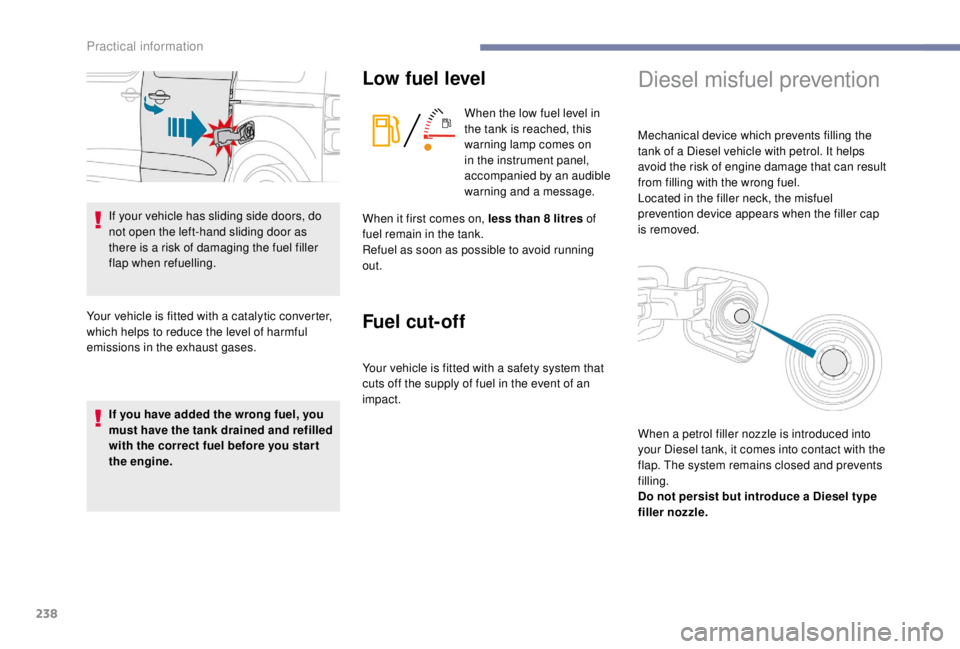
Located in the filler neck, the misfuel
prevention device appears when the filler cap
is removed.
When it first comes on, less than 8
litres of
fuel remain in the tank.
Refuel as soon as possible to avoid running
out.
When a petrol filler nozzle is introduced into
your Diesel tank, it comes into contact with the
flap. The system remains closed and prevents
filling.
Do not persist but introduce a Diesel type
filler nozzle.
Practical information