fuel PEUGEOT EXPERT 2018 Owner's Guide
[x] Cancel search | Manufacturer: PEUGEOT, Model Year: 2018, Model line: EXPERT, Model: PEUGEOT EXPERT 2018Pages: 416, PDF Size: 14.12 MB
Page 256 of 416
254
Use only AdBlue® fluid that meets the
ISO
22241
standard.
Never dilute AdBlue
® with water.
Never pour AdBlue® into the Diesel fuel
tank.
Never top up from an AdBlue
® dispenser
reserved for heavy goods vehicles.
Recommendations on storage
AdBlue® freezes below around -11°C and
deteriorates above 25°C. It is recommended
that bottles or containers be stored in a cool
place and protected from direct sunlight.
Under these conditions, the fluid can be kept
for at least a year.
If the additive has frozen, it can be used once it
has completely thawed out.
Never store bottles or containers of
AdBlue
® in your vehicle.
In winter, check that the temperature
of the vehicle is above -11°C. If not, in
freezing weather, the AdBlue
® cannot be
poured into the tank. Park your vehicle
somewhere warmer for a few hours before
topping up.
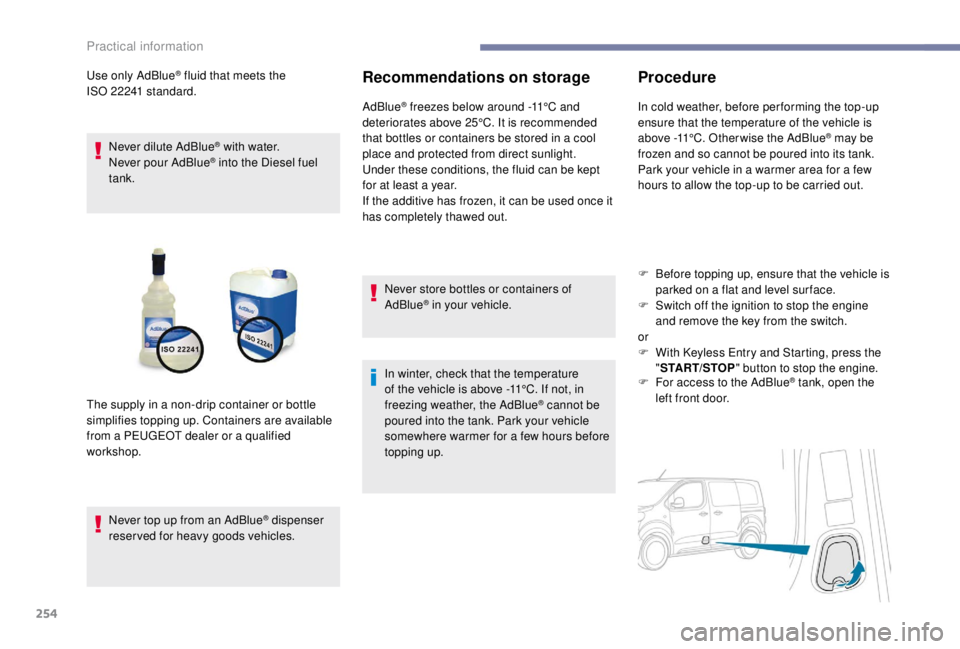
The supply in a non-drip container or bottle
simplifies topping up. Containers are available
from a PEUGEOT dealer or a qualified
workshop.
Procedure
In cold weather, before per forming the top-up
ensure that the temperature of the vehicle is
above -11°C. Other wise the AdBlue
® may be
frozen and so cannot be poured into its tank.
Park your vehicle in a warmer area for a few
hours to allow the top-up to be carried out.
F
B
efore topping up, ensure that the vehicle is
parked on a flat and level sur face.
F
S
witch off the ignition to stop the engine
and remove the key from the switch.
or
F
W
ith
K
eyless Entry and Starting, press the
" START/STOP " button to stop the engine.
F
F
or access to the AdBlue
® tank, open the
left front door.
Practical information
Page 259 of 416
257
Warning triangle
This safety equipment should be used in
addition to the hazard warning lamps.
Its presence in the vehicle may be mandatory.
Placing the triangle on the
road
Before leaving your vehicle to set up and install
the triangle, switch on the hazard warning
lamps and put on your high visibility vest.Refer to the manufacturer's instructions on
unfolding and assembly supplied with the
triangle.
The triangle is available as an accessory;
contact a PEUGEOT dealer or a qualified
workshop.
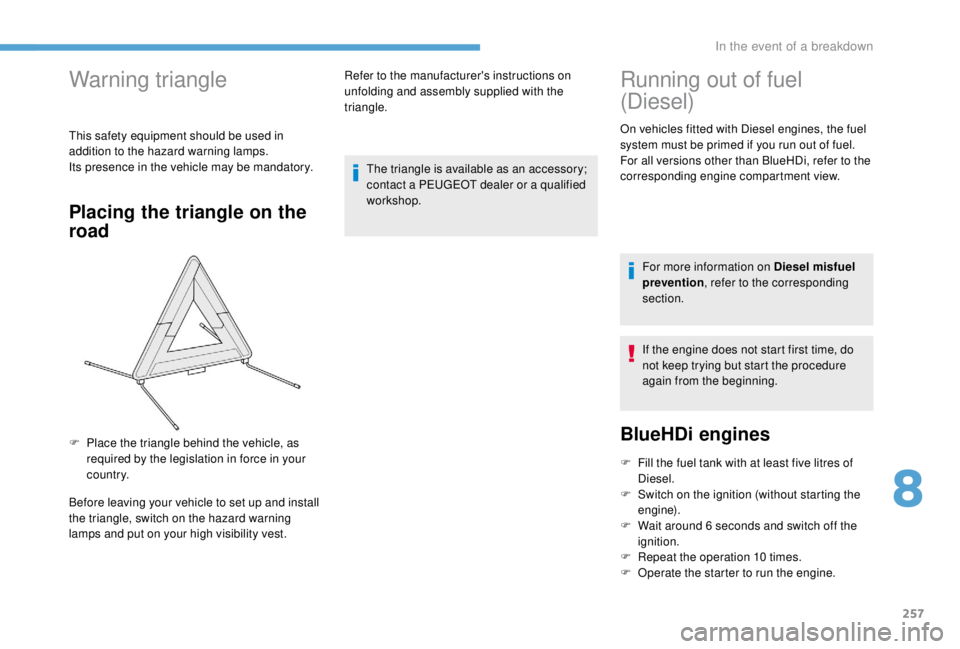
F
P
lace the triangle behind the vehicle, as
required by the legislation in force in your
c o u nt r y.
Running out of fuel
(Diesel)
On vehicles fitted with Diesel engines, the fuel
system must be primed if you run out of fuel.
For all versions other than BlueHDi, refer to the
corresponding engine compartment view.
For more information on Diesel misfuel
prevention , refer to the corresponding
section.
If the engine does not start first time, do
not keep trying but start the procedure
again from the beginning.
BlueHDi engines
F Fill the fuel tank with at least five litres of Diesel.
F
S
witch on the ignition (without starting the
engine).
F
W
ait around 6 seconds and switch off the
ignition.
F
R
epeat the operation 10
times.
F
O
perate the starter to run the engine.
8
In the event of a breakdown
Page 260 of 416
258
F Operate the priming pump repeatedly until resistance is felt (there may be resistance at
the first press).
F
O
perate the starter to start the engine (if the
engine does not start at the first attempt,
wait around 15
seconds before trying
again).
F
I
f the engine does not start after a few
attempts, operate the priming pump again
then start the engine.
F
P
ut the cover in place and clip it in.
F
C
lose the bonnet.
Tool box
Access
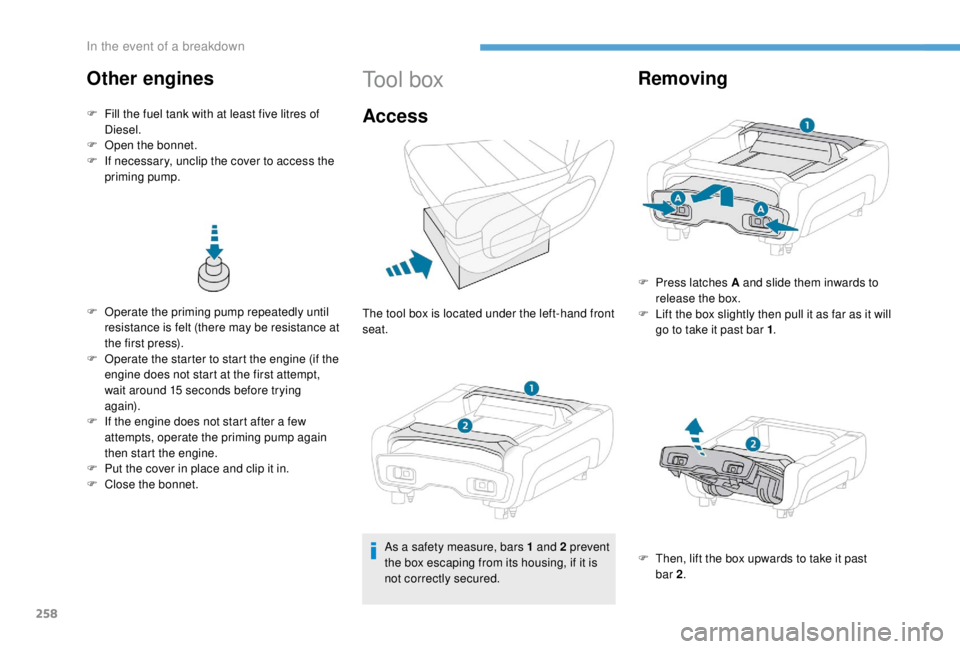
The tool box is located under the left-hand front
seat.
As a safety measure, bars 1
and 2 prevent
the box escaping from its housing, if it is
not correctly secured.
Removing
Other engines
F Fill the fuel tank with at least five litres of
Diesel.
F
O
pen the bonnet.
F
I
f necessary, unclip the cover to access the
priming pump.
F
P
ress latches A and slide them inwards to
release the box.
F
L
ift the box slightly then pull it as far as it will
go to take it past bar 1 .
F
T
hen, lift the box upwards to take it past
bar 2 .
In the event of a breakdown
Page 297 of 416
295
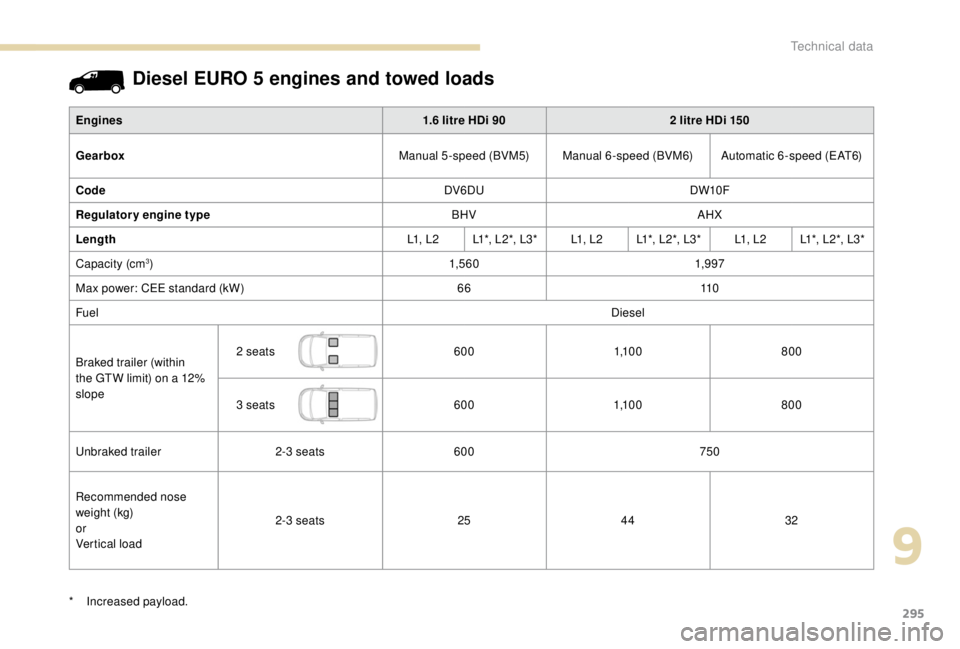
Diesel EURO 5 engines and towed loads
Engines1.6 litre HDi 902 litre HDi 150
Gearbox Manual 5-speed (BVM5) Manual 6-speed (BVM6)Automatic 6-speed (EAT6)
Code DV6DUDW10F
Regulatory engine type BHVAHX
Length L1 , L 2L1*, L 2 *, L 3 * L1 , L 2L1*, L 2 *, L 3 * L1 , L 2L1*, L 2 *, L 3 *
Capacity (cm
3) 1,5 6 01,9 97
Max power: CEE standard (kW) 6611 0
Fuel Diesel
Braked trailer (within
the GTW limit) on a 12%
slope 2
seats 6001,1 0 0 800
3
seats 6001,1 0 0 800
Unbraked trailer 2-3
seats 600 750
Recommended nose
weight (kg)
or
Vertical load 2-3
seats 25 44 32
*
I
ncreased payload.
9
Technical data
Page 298 of 416
296
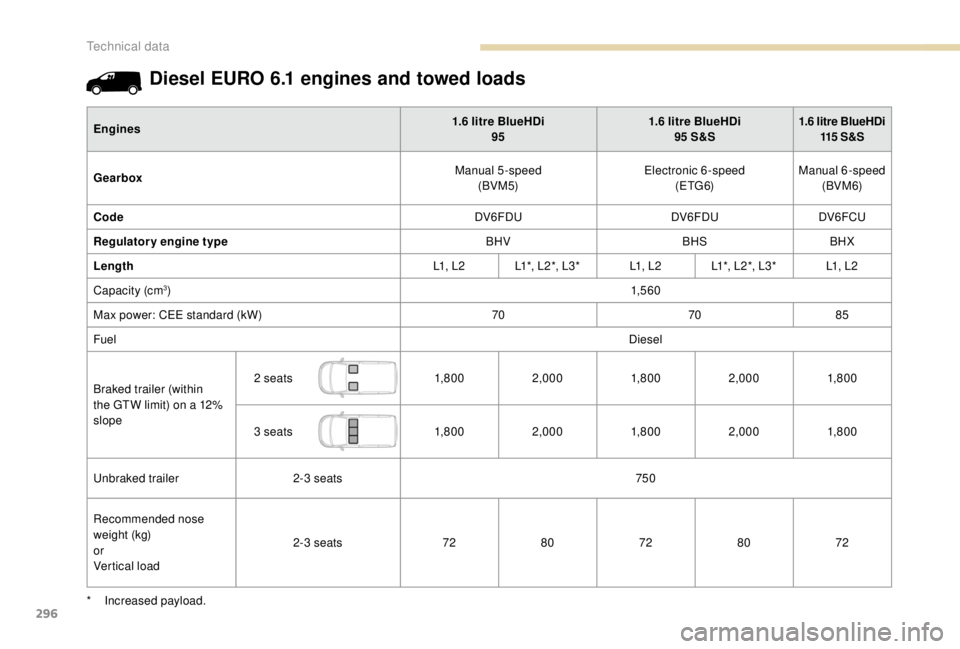
Diesel EURO 6.1 engines and towed loads
Engines1.6 litre BlueHDi
95 1.6
litre BlueHDi
95 S&S1.6
litre BlueHDi
115 S & S
Gearbox Manual 5-speed
(BVM5) Electronic 6-speed
(ETG6) Manual 6-speed
(BVM 6)
Code DV6FDUDV6FDUDV6FCU
Regulatory engine type BHVBHSBHX
Length L1 , L 2L1*, L 2 *, L 3 * L1 , L 2L1*, L 2 *, L 3 * L1 , L 2
Capacity (cm
3) 1,5 6 0
Max power: CEE standard (kW) 707085
Fuel Diesel
Braked trailer (within
the GTW limit) on a 12%
slope 2
seats 1,8 0 02,000 1,8 0 02,000 1,8 0 0
3
seats 1,8 0 02,000 1,8 0 02,000 1,8 0 0
Unbraked trailer 2-3
seats 750
Recommended nose
weight (kg)
or
Vertical load 2-3
seats7280 7280 72
*
I
ncreased payload.
Technical data
Page 299 of 416
297
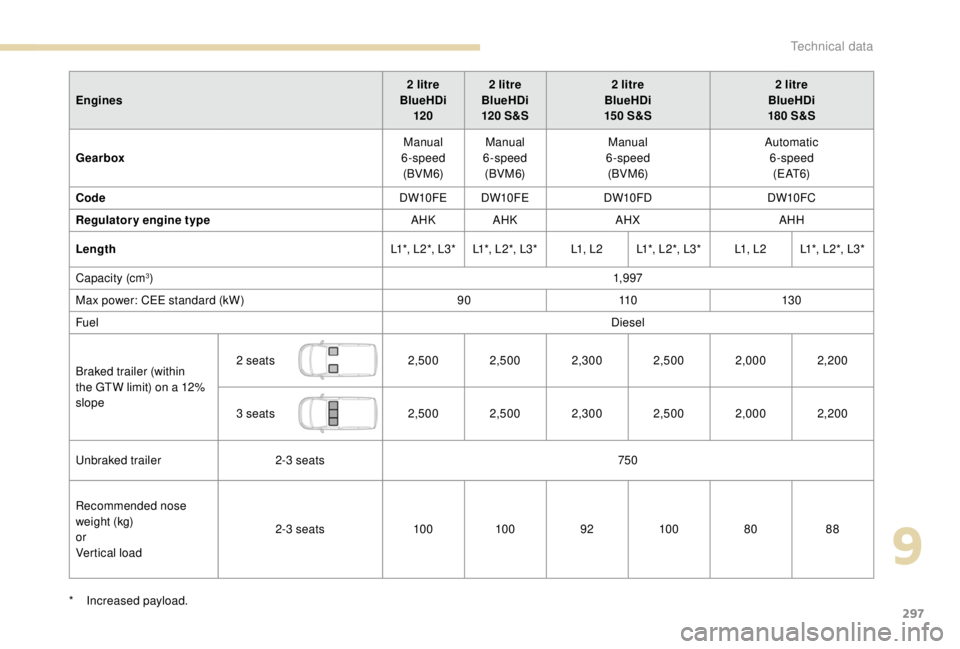
Engines2 litre
BlueHDi 120 2
litre
BlueHDi
120 S&S2
litre
BlueHDi
15 0 S&S2
litre
BlueHDi
180 S&S
Gearbox Manual
6-speed (BVM 6) Manual
6-speed (BVM 6) Manual
6-speed (BVM 6) Automatic
6-speed ( E AT 6)
Code DW10FE DW10FEDW10FDDW10FC
Regulatory engine type AHK AHKAHXAHH
Length L1*, L 2 *, L 3 * L1*, L 2 *, L 3 *L1 , L 2L1*, L 2 *, L 3 * L1 , L 2L1*, L 2 *, L 3 *
Capacity (cm
3) 1,9 97
Max power: CEE standard (kW) 9011 0 13 0
Fuel Diesel
Braked trailer (within
the GTW limit) on a 12%
slope 2
seats 2,500 2,500 2,300 2,500 2,0002,200
3
seats 2,500 2,500 2,300 2,500 2,0002,200
Unbraked trailer 2-3
seats 750
Recommended nose
weight (kg)
or
Vertical load 2-3
seats10 010 0 9210 0 8088
*
I
ncreased payload.
9
Technical data
Page 300 of 416
298
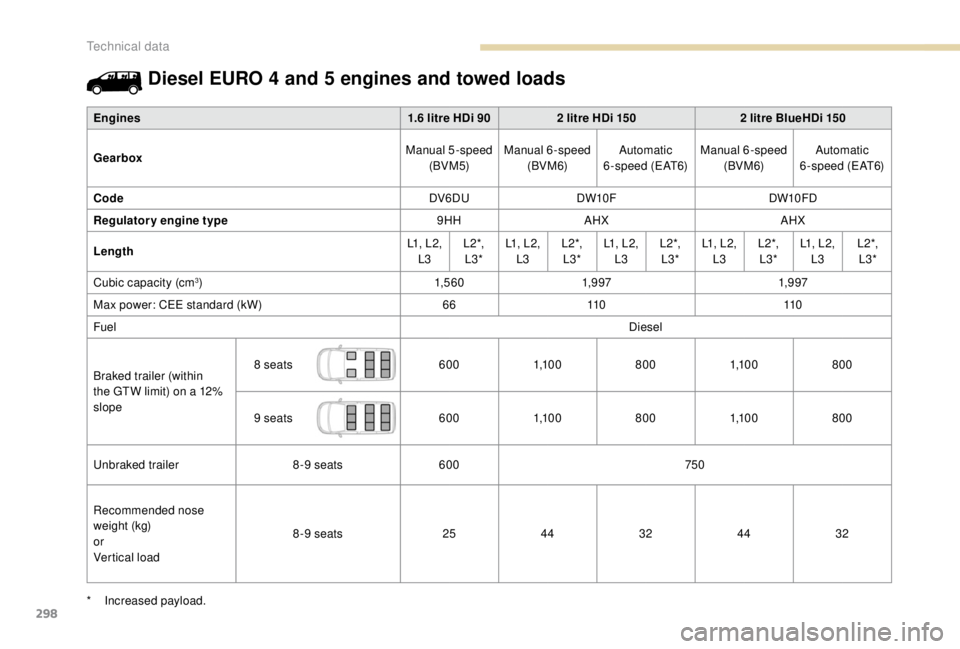
Diesel EURO 4 and 5 engines and towed loads
Engines1.6 litre HDi 902 litre HDi 1502 litre BlueHDi 150
Gearbox Manual 5-speed
(BVM5) Manual 6-speed
(BVM 6) Automatic
6-speed (EAT6) Manual 6-speed
(BVM 6) Automatic
6-speed (EAT6)
Code DV6DUDW10F DW10FD
Regulatory engine type 9HHAHX AHX
Length L1, L2,
L3 L 2 *,
L3* L1, L2,
L3 L 2 *,
L3* L1, L2,
L3 L 2 *,
L3* L1, L2,
L3 L 2 *,
L3* L1, L2,
L3 L 2 *,
L3*
Cubic capacity (cm
3) 1,5 6 01,9 97 1,9 97
Max power: CEE standard (kW) 6611 0 11 0
Fuel Diesel
Braked trailer (within
the GTW limit) on a 12%
slope 8
seats 6001,1 0 0 8001,1 0 0 800
9
seats 6001,1 0 0 8001,1 0 0 800
Unbraked trailer 8-9
seats 600 750
Recommended nose
weight (kg)
or
Vertical load 8-9
seats 2544 3244 32
*
I
ncreased payload.
Technical data
Page 301 of 416
299
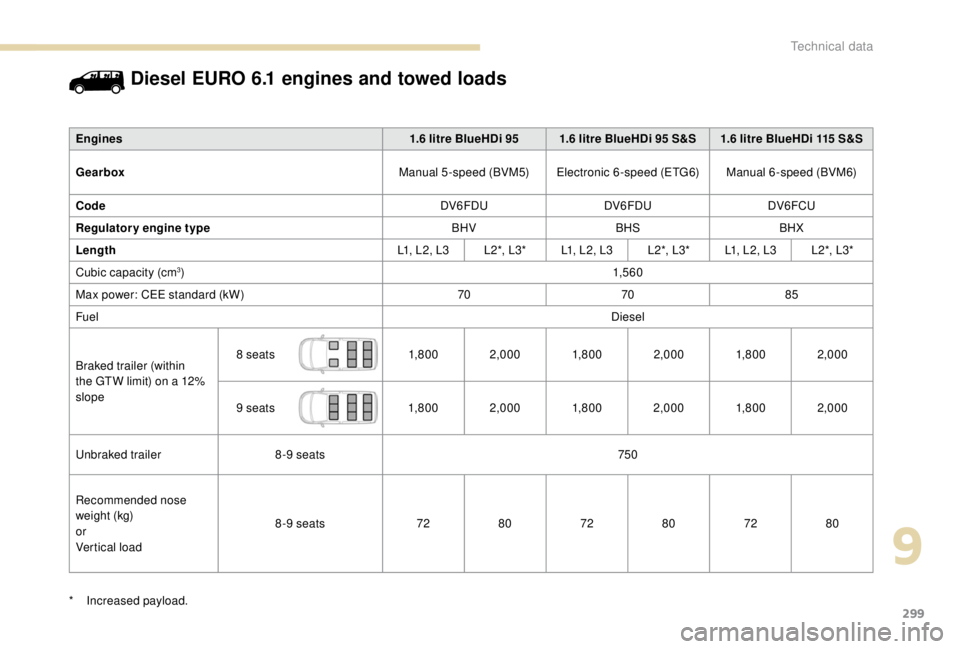
Diesel EURO 6.1 engines and towed loads
Engines1.6 litre BlueHDi 95 1.6 litre BlueHDi 95 S&S 1.6 litre BlueHDi 115 S&S
Gearbox Manual 5-speed (BVM5)Electronic 6-speed (ETG6) Manual 6-speed (BVM6)
Code DV6FDUDV6FDU DV6FCU
Regulatory engine type BHVBHSBHX
Length L1, L2, L3L 2 *, L 3 *L1, L2, L3 L 2 *, L 3 *L1, L2, L3 L 2 *, L 3 *
Cubic capacity (cm
3) 1,5 6 0
Max power: CEE standard (kW) 707085
Fuel Diesel
Braked trailer (within
the GTW limit) on a 12%
slope 8
seats 1,8 0 02,000 1,8 0 02,000 1,8 0 02,000
9
seats 1,8 0 02,000 1,8 0 02,000 1,8 0 02,000
Unbraked trailer 8-9
seats 750
Recommended nose
weight (kg)
or
Vertical load 8-9
seats 7280 7280 7280
*
I
ncreased payload.
9
Technical data
Page 302 of 416
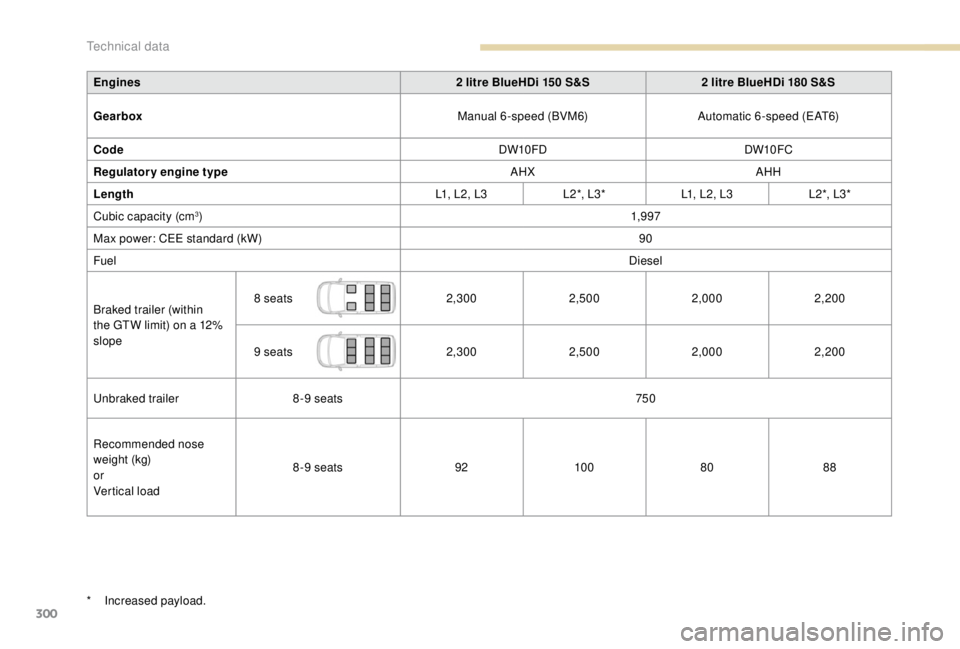
300
Engines2 litre BlueHDi 150 S&S2 litre BlueHDi 180 S&S
Gearbox Manual 6-speed (BVM6)Automatic 6-speed (EAT6)
Code DW10FDDW10FC
Regulatory engine type AHXAHH
Length L1, L2, L3L 2 *, L 3 *L1, L2, L3 L 2 *, L 3 *
Cubic capacity (cm
3) 1,9 97
Max power: CEE standard (kW) 90
Fuel Diesel
Braked trailer (within
the GTW limit) on a 12%
slope 8
seats 2,3002,5002,0002,200
9
seats 2,3002,5002,0002,200
Unbraked trailer 8-9
seats 750
Recommended nose
weight (kg)
or
Vertical load 8-9
seats 9210 0 8088
*
I
ncreased payload.
Technical data
Page 307 of 416
305
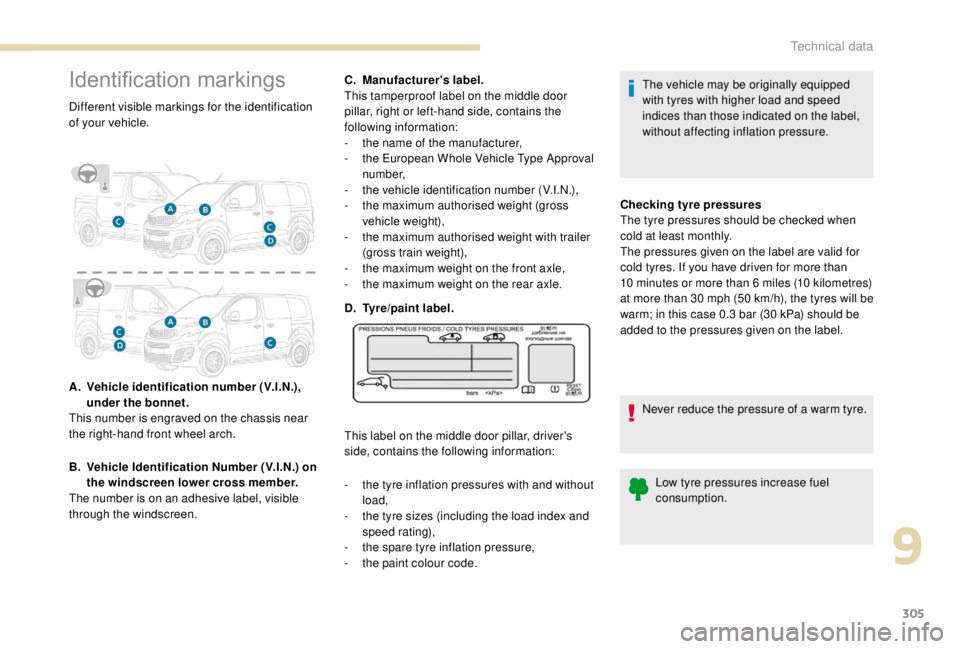
Identification markings
Different visible markings for the identification
of your vehicle.
A.
V
ehicle identification number (V.I.N.),
under the bonnet.
This number is engraved on the chassis near
the right-hand front wheel arch.
B.
V
ehicle Identification Number (V.I.N.) on
the windscreen lower cross member.
The number is on an adhesive label, visible
through the windscreen. C.
M
anufacturer's label.
This tamperproof label on the middle door
pillar, right or left-hand side, contains the
following information:
-
t
he name of the manufacturer,
-
t
he European Whole Vehicle Type Approval
number,
-
t
he vehicle identification number (V.I.N.),
-
t
he maximum authorised weight (gross
vehicle weight),
-
t
he maximum authorised weight with trailer
(gross train weight),
-
t
he maximum weight on the front axle,
-
t
he maximum weight on the rear axle.
D.
T
yre/paint label.
This label on the middle door pillar, driver's
side, contains the following information:
-
t
he tyre inflation pressures with and without
load,
-
t
he tyre sizes (including the load index and
speed rating),
-
t
he spare tyre inflation pressure,
-
t
he paint colour code. The vehicle may be originally equipped
with tyres with higher load and speed
indices than those indicated on the label,
without affecting inflation pressure.
Checking tyre pressures
The tyre pressures should be checked when
cold at least monthly.
The pressures given on the label are valid for
cold tyres. If you have driven for more than
10
minutes or more than 6 miles (10 kilometres)
at more than 30
mph (50 km/h), the tyres will be
warm; in this case 0.3
bar (30 kPa) should be
added to the pressures given on the label.
Never reduce the pressure of a warm tyre.Low tyre pressures increase fuel
consumption.
9
Technical data