air con PEUGEOT EXPERT 2018 Owners Manual
[x] Cancel search | Manufacturer: PEUGEOT, Model Year: 2018, Model line: EXPERT, Model: PEUGEOT EXPERT 2018Pages: 416, PDF Size: 14.12 MB
Page 4 of 416
2
.
.
Instrument panel 10
Warning and indicator lamps 1 3
Indicators
2
7
Lighting dimmer
3
4
Trip computer
3
5
Date and time adjustment
3
7
Key
39
Key, remote control
3
9
Keyless Entry and Starting
4
6
Locking/unlocking from inside
6
1
Front doors
6
3
Manual sliding side door(s)
6
4
Electric sliding side door(s)
6
6
Hands-free sliding side door(s)
7
4
Side-hinged rear doors
7
7
Tailgate
80
Alarm
81
Electric windows
8
3Steering wheel adjustment
8
5
Mirrors 85
Front seats
87
A
dditional adjustments
9
1
2-seat front bench seat
9
2
Moduwork
9
4
Fixed one-piece bench seat
9
9
Fixed rear seat and bench seat 1 02
Precautions for the seats and
bench seats 1 05
Fixed crew cab
1
06
Folding crew cab
1
07
Interior fittings
1
08
Loading area fittings
1
12
Seating area fittings
1
13
Heating
115
Manual air conditioning
1
15
Dual-zone automatic air conditioning
1
17
Recirculation of the interior air
1
20
Front demist – defrost
1
20
Door mirrors demist – defrost
1
21
Rear screen demist – defrost
1
22
Rear Heating – Air conditioning
1
24
Programmable Heating/Ventilation
1
25
Courtesy lamp(s)
1
28Lighting control stalk
1
30
Daytime running lamps
1
32
Automatic illumination of headlamps
1
32
Cornering lighting
1
34
Automatic headlamp dipping
1
35
Headlamp beam height
adjustment
137
Wiper control stalk
1
37
General safety recommendations
1
42
Hazard warning lamps
1
43
Emergency or assistance call
1
43
Hor n
14
5
Electronic stability control (ESC)
1
45
Grip control
1
48
Seat belts
1
50
Airbags
154
Child seats
1
57
Deactivating the passenger front airbag
1
59
ISOFIX mountings and child seats
1
66
Manual child lock
1
74
Electric child lock
1
74
Child lock on rear windows
1
75
Over view
Instruments
Access Ease of use and comfort
Safety
Lighting and visibility
Eco-driving
Instruments and controls 4
L abels 7
Eco-driving
8
Contents
Page 5 of 416
3
.
.
Driving recommendations 176
Starting/switching off the engine,
manual key, remote control
1
78
Starting/switching off the engine,
Keyless Entry and Starting
1
81
Anti-theft protection
1
85
Parking brake
1
85
Hill start assist
1
86
5-speed manual gearbox
1
87
6-speed manual gearbox
1
87
Gear shift indicator
1
88
Automatic gearbox
1
89
Electronic gearbox
1
94
Stop & Start
1
98
Head-up display
2
00
Memorising speeds
2
02
Recognition of speed limit signs and
recommendation
202
Spe
ed limiter
20
6
Cruise control
2
09
Adaptive cruise control
2
11
Collision Risk Alert and Active
Safety Brake
2
18
Lane departure warning system
2
22
Fatigue detection system
2
23
Blind spot monitoring system
2
25
Parking sensors
2
27
Reversing camera, interior mirror
2
29
Visiopark 1
2
30
Under-inflation detection
23
4Fuel
237
Diesel misfuel prevention 23 8
Compatibility of fuels
2
40
Snow chains
2
41
Towing a trailer
2
42
Energy economy mode
2
42
Load reduction mode
2
43
Roof bars/Roof rack
2
43
Changing a wiper blade
2
45
Bonnet
246
Engine
247
Checking levels
2
47
Checks
2
50
AdBlue
® (BlueHDi engines) 2 52
Advice on care 2 56
Warning triangle
2
57
Running out of fuel (Diesel)
2
57
Tool box
2
58
Temporary puncture repair kit
2
60
Spare wheel
26
6
Changing a bulb
2
72
Changing a fuse
2
83
12
V battery
2
88
To w i n g
2
9 2Characteristics of the engines and
towed loads
2
94
Dimensions
301
Identification markings
3
05
PEUGEOT Connect Nav
PEUGEOT Connect Radio
Bluetooth audio system
Driving Practical information
In the event of a breakdown Technical data
Alphabetical index
Audio equipment and telematics
.
Contents
Page 6 of 416
4
Instruments and controls
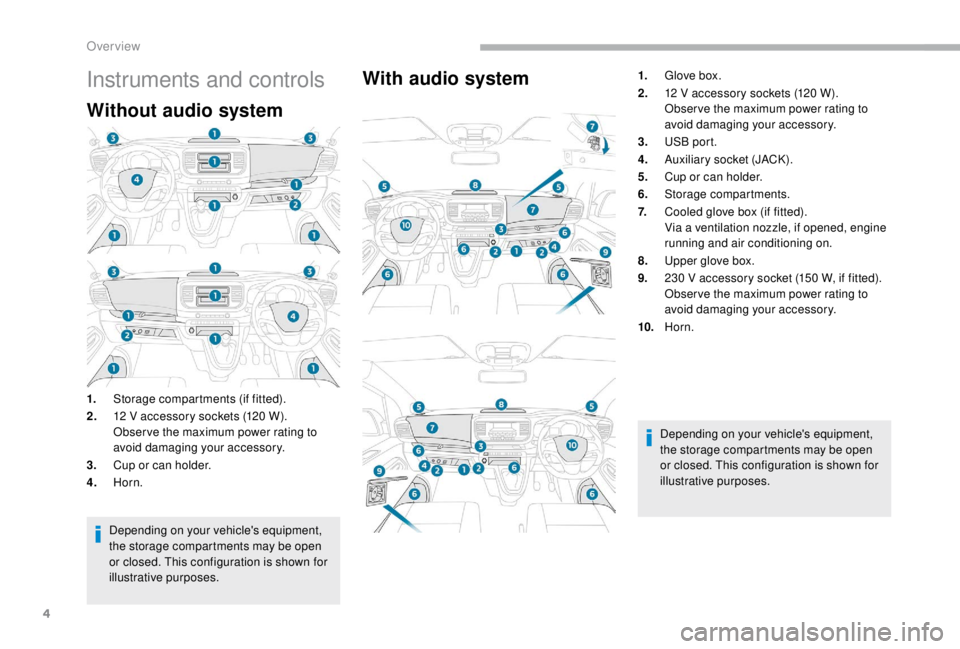
Without audio system
1.Storage compartments (if fitted).
2. 12
V accessory sockets (120 W).
Obser ve the maximum power rating to
avoid damaging your accessory.
3. Cup or can holder.
4. Horn.
Depending on your vehicle's equipment,
the storage compartments may be open
or closed. This configuration is shown for
illustrative purposes.
With audio system
Depending on your vehicle's equipment,
the storage compartments may be open
or closed. This configuration is shown for
illustrative purposes.
1.
Glove box.
2. 12 V accessory sockets (120 W).
Obser ve the maximum power rating to
avoid damaging your accessory.
3. USB port.
4. Auxiliary socket (JACK).
5. Cup or can holder.
6. Storage compartments.
7. Cooled glove box (if fitted).
Via a ventilation nozzle, if opened, engine
running and air conditioning on.
8. Upper glove box.
9. 230 V accessory socket (150 W, if fitted).
Obser ve the maximum power rating to
avoid damaging your accessory.
10. Horn.
Over view
Page 7 of 416
5
Steering mounted controls
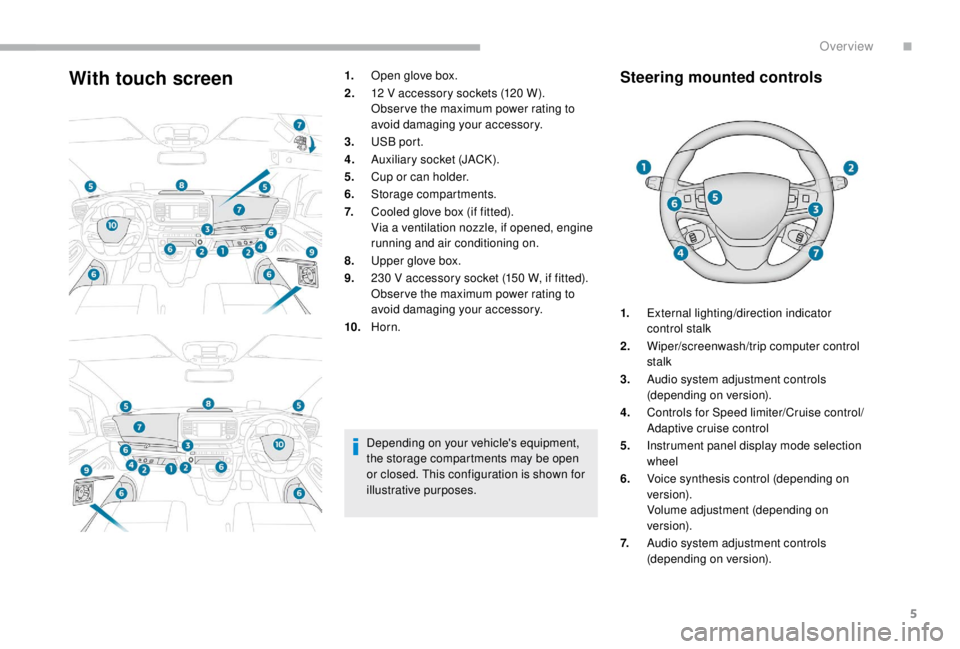
1.External lighting/direction indicator
control stalk
2. Wiper/screenwash/trip computer control
stalk
3. Audio system adjustment controls
(depending on version).
4. Controls for Speed limiter/Cruise control/
Adaptive cruise control
5. Instrument panel display mode selection
wheel
6. Voice synthesis control (depending on
ve r s i o n).
Volume adjustment (depending on
ve r s i o n).
7. Audio system adjustment controls
(depending on version).
With touch screen
Depending on your vehicle's equipment,
the storage compartments may be open
or closed. This configuration is shown for
illustrative purposes.
1.
Open glove box.
2. 12 V accessory sockets (120 W).
Obser ve the maximum power rating to
avoid damaging your accessory.
3. USB port.
4. Auxiliary socket (JACK).
5. Cup or can holder.
6. Storage compartments.
7. Cooled glove box (if fitted).
Via a ventilation nozzle, if opened, engine
running and air conditioning on.
8. Upper glove box.
9. 230 V accessory socket (150 W, if fitted).
Obser ve the maximum power rating to
avoid damaging your accessory.
10. Horn.
.
Over view
Page 10 of 416
8
As a passenger, if you avoid connecting your
multimedia devices (film, music, video game
etc.), you will contribute towards limiting the
consumption of electrical energy, and so of
fuel.
Disconnect your portable devices before
leaving the vehicle.
Eco- driving
Eco-driving is a range of everyday practices that allow the motorist to optimise their fuel consumption and CO2 emissions.
Optimise the use of your
gearbox
With a manual gearbox, move off gently
and change up without waiting. During
acceleration, change up early.
With an automatic gearbox, favour automatic
mode and avoid pressing the accelerator
pedal heavily or suddenly.
The gear shift indicator invites you to engage
the most suitable gear: as soon as the
indication is displayed in the instrument panel,
follow it straight away.
For vehicles fitted with an automatic gearbox,
this indicator appears only in manual mode.
Drive smoothly
Maintain a safe distance between vehicles,
use engine braking rather than the
brake pedal, and press the accelerator
progressively. These practices contribute
towards a reduction in fuel consumption and
CO
2 emissions and also help reduce the
background traffic noise.
If your vehicle has cruise control, make use of
the system at speeds above 25
mph (40 km/h)
when the traffic is flowing well.
Control the use of your electrical
equipment
Before moving off, if the passenger
compartment is too warm, ventilate it by
opening the windows and air vents before
using the air conditioning.
Above 30
mph (50 km/h), close the windows
and leave the air vents open.
Consider using equipment that can help
keep the temperature in the passenger
compartment down (sunroof blind and window
blinds, etc.). Switch off the headlamps and front foglamps
when the ambient light level does not require
their use.
Avoid running the engine before moving off,
particularly in winter; your vehicle will warm up
much faster while driving. Unless it has automatic regulation, switch off
the air conditioning as soon as the desired
temperature has been reached.
Switch off the demisting and defrosting
controls, if these are not automatically
managed.
Switch off the heated seat as soon as
possible.
Eco-driving
Page 11 of 416
9
Limit the causes of excess
consumption
Spread loads throughout the vehicle; place
the heaviest items in the bottom of the boot,
as close as possible to the rear seats.
Limit the loads carried in the vehicle and
reduce wind resistance (roof bars, roof rack,
bicycle carrier, trailer, etc.). Preferably, use a
roof box.
Remove roof bars and roof racks after use.
At the end of winter, remove snow tyres and
refit your summer tyres.
Observe the recommendations
on maintenance
Check the tyre pressures regularly, when cold,
referring to the label in the door aperture,
driver's side.
Carry out this check in particular:
-
b
efore a long journey,
-
a
t each change of season,
-
a
fter a long period out of use.
Do not forget the spare wheel and the tyres on
any trailer or caravan. Have your vehicle ser viced regularly (engine
oil, oil filter, air filter, cabin filter, etc.) and
obser ve the schedule of operations in the
manufacturer's service schedule.
When filling the tank, do not continue after the
3rd
cut-off of the nozzle to avoid over flow.
At the wheel of your new vehicle, it is only
after the first 1,800
miles (3,000 kilometres)
that you will see the fuel consumption settle
down to a consistent average. With a BlueHDi Diesel engine, if the SCR
system is faulty, your vehicle becomes
polluting. Visit a PEUGEOT dealer or a
qualified workshop as soon as possible to
make your vehicle’s level of nitrogen oxide
emissions compliant to the standard.
.
Eco-driving
Page 22 of 416
20
Warning/indicator lampStateCause Action/Observations
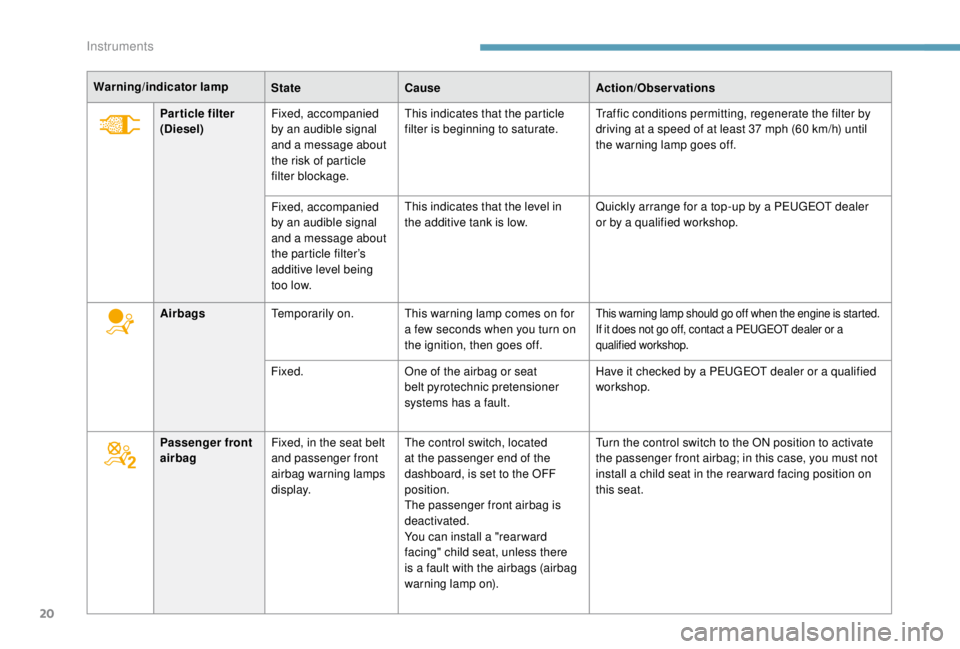
Airbags Temporarily on. This warning lamp comes on for
a few seconds when you turn on
the ignition, then goes off.
This warning lamp should go off when the engine is started.
If it does not go off, contact a PEUGEOT dealer or a
qualified workshop.
Fixed.One of the airbag or seat
belt pyrotechnic pretensioner
systems has a fault. Have it checked by a PEUGEOT dealer or a qualified
workshop.
Passenger front
airbag Fixed, in the seat belt
and passenger front
airbag warning lamps
display. The control switch, located
at the passenger end of the
dashboard, is set to the OFF
position.
The passenger front airbag is
deactivated.
You can install a "rearward
facing" child seat, unless there
is a fault with the airbags (airbag
warning lamp on). Turn the control switch to the ON position to activate
the passenger front airbag; in this case, you must not
install a child seat in the rear ward facing position on
this seat.
Par ticle filter
(Diesel)
Fixed, accompanied
by an audible signal
and a message about
the risk of particle
filter blockage. This indicates that the particle
filter is beginning to saturate.
Traffic conditions permitting, regenerate the filter by
driving at a speed of at least 37 mph (60 km/h) until
the warning lamp goes off.
Fixed, accompanied
by an audible signal
and a message about
the particle filter’s
additive level being
too low. This indicates that the level in
the additive tank is low.
Quickly arrange for a top-up by a PEUGEOT dealer
or by a qualified workshop.
Instruments
Page 23 of 416
21
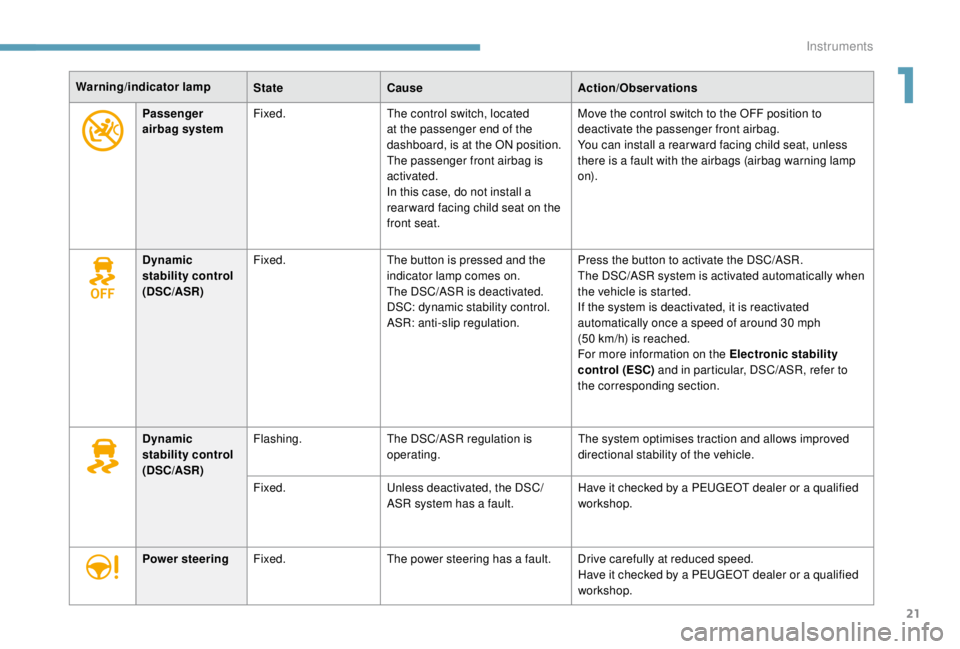
Passenger
airbag systemFixed.
The control switch, located
at the passenger end of the
dashboard, is at the ON position.
The passenger front airbag is
activated.
In this case, do not install a
rear ward facing child seat on the
front seat. Move the control switch to the OFF position to
deactivate the passenger front airbag.
You can install a rear ward facing child seat, unless
there is a fault with the airbags (airbag warning lamp
o n).
Warning/indicator lamp
StateCause Action/Observations
Dynamic
stability control
(DSC/ASR) Fixed.
The button is pressed and the
indicator lamp comes on.
The DSC/ASR is deactivated.
DSC: dynamic stability control.
ASR: anti-slip regulation. Press the button to activate the DSC/ASR.
The DSC/ASR system is activated automatically when
the vehicle is started.
If the system is deactivated, it is reactivated
automatically once a speed of around 30
mph
(50
km/h) is reached.
For more information on the Electronic stability
control (ESC) and in particular, DSC/ASR, refer to
the corresponding section.
Dynamic
stability control
(DSC/ASR) Flashing.
The DSC/ASR regulation is
operating. The system optimises traction and allows improved
directional stability of the vehicle.
Fixed. Unless deactivated, the DSC/
ASR system has a fault. Have it checked by a PEUGEOT dealer or a qualified
workshop.
Power steering Fixed. The power steering has a fault. Drive carefully at reduced speed.
Have it checked by a PEUGEOT dealer or a qualified
workshop.
1
Instruments
Page 76 of 416

74
Hands-free sliding side
d o o r (s)
The automatic locking after closing the
door is programmable in the vehicle
configuration menu.Before making the movement with your
foot, ensure that you are steady and well
positioned, so that you do not lose your
balance (rain, snow, ice, mud, etc.).
Take care not to touch the exhaust tailpipe
when making the movement with your foot
– risk of burns.
F
P
ut your foot beneath the corner of the rear
bumper, then move your foot at normal
speed with a side sweep movement.
The sensor detects your foot approaching and
leaving and triggers opening or closing of the
side door. Make the movement without interruption
and do not repeat it immediately
after wards or several times.
If the door does not open, wait about
2
seconds before trying again.
Do not leave your foot in the air.
Opening
With " Hands-Free Tailgate Access " activated
in the vehicle configuration menu.
F
W
ith the remote control on your person and
in the recognition zone A , pass your foot
under the corner of the rear bumper, on the
side you want to open the door.
By keeping the remote control on your person
and with a movement of your foot, the system
unlocks and opens the sliding side door or
closes and locks it.
The remote control must be located at the rear
of the vehicle, at least 30
cm and but no more
about 2
m from the vehicle.
Access
Page 91 of 416
89
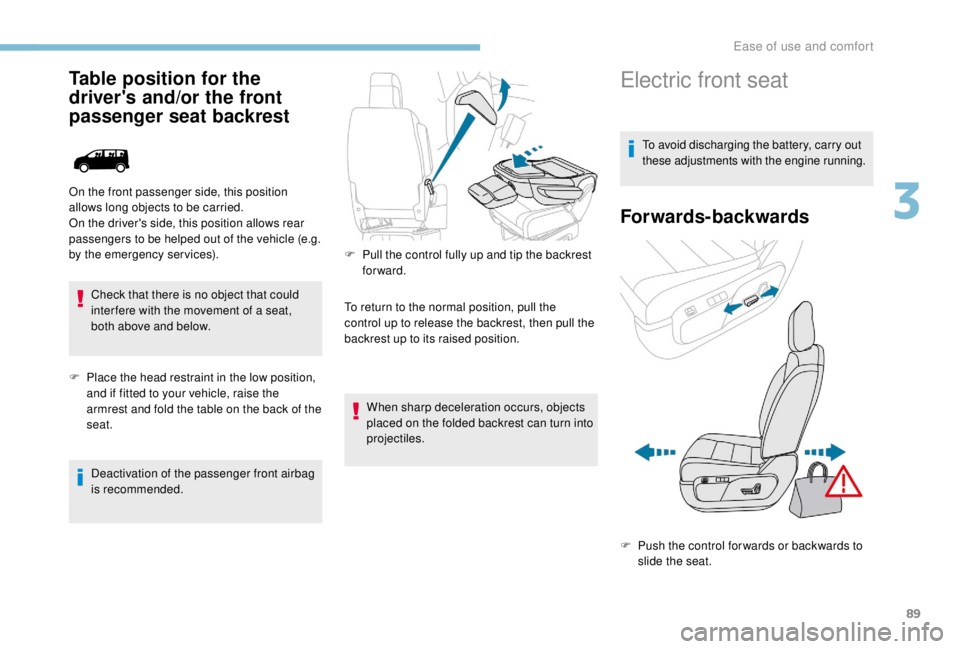
Table position for the
driver's and/or the front
passenger seat backrest
Check that there is no object that could
inter fere with the movement of a seat,
both above and below.
F
P
lace the head restraint in the low position,
and if fitted to your vehicle, raise the
armrest and fold the table on the back of the
seat.
Deactivation of the passenger front airbag
is recommended.
On the front passenger side, this position
allows long objects to be carried.
On the driver's side, this position allows rear
passengers to be helped out of the vehicle (e.g.
by the emergency services).
F
P
ull the control fully up and tip the backrest
forward.
To return to the normal position, pull the
control up to release the backrest, then pull the
backrest up to its raised position.
When sharp deceleration occurs, objects
placed on the folded backrest can turn into
projectiles.
Electric front seat
To avoid discharging the battery, carry out
these adjustments with the engine running.
Forwards-backwards
F Push the control for wards or backwards to slide the seat.
3
Ease of use and comfort