warning PEUGEOT EXPERT 2023 Manual PDF
[x] Cancel search | Manufacturer: PEUGEOT, Model Year: 2023, Model line: EXPERT, Model: PEUGEOT EXPERT 2023Pages: 348, PDF Size: 12 MB
Page 291 of 348
289
Alphabetical index
Motor, electric 136, 191, 227
Mountings, ISOFIX
117, 125, 128, 128–129
MP3 CD
237
N
Navigation 263–265
Navigation, connected
266–268
Net, cargo
53–55
Net, high load retaining
72–73
Number plate lamps
215
O
Obstacle detection 168
Oil change
192
Oil consumption
192
Oil, engine
192
On-board tools
203
Opening the bonnet
190
Opening the boot
29–30, 44
Opening the doors
29–30, 38–39
Opening to 180°
43–44
P
Pads, brake 195
Paint
200, 231
Paint colour code
231
Paint, matt 200
Paint, textured
200
Parcel shelf, rear
69
Parking brake
138, 195
Parking brake, electric
138–140, 195
Parking (sensors)
168
Parking sensors, audible and visual
168
Parking sensors, front
169
Parking sensors, rear
168
Passenger compartment temperature
pre-conditioning (Electric)
27, 85
Pedestrian horn (Electric)
100, 133
Plates, identification
231
Player, Apple®
238, 250, 273
Player, MP3 CD
237
Player, USB
236, 249, 272
Port, USB
70, 236, 249, 251, 268, 272
Power
22
Power indicator (Electric)
8, 22
Power mode
147
Pressures, tyres
195, 204, 207, 231
Pre-tensioning (seat belts)
106
Priming pump
202
Priming the fuel system
202
Profiles
254, 277
Protecting children
107, 109–113,
119–121, 128, 128–129
Public fast charging station
179, 185
Puncture
204–205, 207R
Radar (warnings) 150
Radio
234–235, 247–248, 271
Radio, digital (Digital Audio
Broadcasting - DAB)
235, 249, 272
Range, AdBlue®
20, 193
RDS
248, 271
Rear bench seat
56–57
Rear screen (demisting)
82
Recharging the battery
218–219
Recharging the traction battery
180
Recharging the traction battery
(Electric)
176, 183, 185–186
Recirculation, air
79–81
Recorder, trip distance
23
Reduction of electrical load (mode)
188
Regeneration of the particle filter
194
Regenerative braking (deceleration
by engine braking)
145–146
Reinitialising the remote control
36
Reinitialising the under-inflation
detection system
149
Reminder, key in ignition
136
Reminder, lighting on
89
Remote control
29–34, 134
Remotely operable functions
(Electric)
27, 85, 186
Removing a wheel
209–211
Removing the mat
67
Replacing bulbs
211–212, 214, 216
Replacing fuses
216 CarM an uals 2 .c o m
Page 292 of 348
290
Alphabetical index
Replacing the air filter 194
Replacing the oil filter
194
Replacing the passenger
compartment filter
194
Reservoir, screenwash
193
Resetting the trip recorder
23
Reversing camera
151, 170, 172
Reversing lamp
214, 216
Roof bars
189
Roof rack
189
Running out of fuel (Diesel)
202
S
Safety, children 107, 109–113,
119–121, 128, 128–129
Saturation of the particle filter (Diesel)
194
Screen, instrument panel
24
Screen menu map
251
Screen, multifunction (with audio system)
233
Screenwash
94
Screenwash, front
93
Screenwash, rear
94–95
SCR (Selective Catalytic Reduction)
21, 196
Seat and bench seat, rear, fixed
56–57, 59–60
Seat and bench seat,
rear, on rails
56–57, 61–62
Seat angle
48
Seat belts
103–106, 112
Seat belts, rear
105
Seat, bench front, 2-seat
50, 105
Seats, electric
49
Seats, front 48–49
Seats, heated
50–51
Seat(s), individual, rear, on rails
63–65, 105
Seats, rear
57–62, 110
Selector, gear
141–142
Sensors (warnings)
151
Serial number, vehicle
231
Servicing
18, 194–196
Settings, equipment
26–27
Settings, system
254, 277
Sidelamps
88, 212–214, 216
Side repeater (turn signal)
213
Silent vehicle warning sound
(Electric)
100, 133
Sliding side door, electric
33–34, 38–41
Sliding side door, hands-free
42–43
Smartphone
28
Snow chains
149, 188, 209
Snow chains, link
188, 209
Socket, 12 V accessory
69
Socket, 220 V
70
Socket, auxiliary
237, 250, 272
Socket, Jack
237, 272
Speed limiter
151, 153–156
Speed limit
recognition
152–153, 155, 157, 161–163
Speedometer
151
Sport mode
147
Stability control (ESC)
100, 102–103
Starting a Diesel engine
174
Starting the engine
134, 136
Starting the vehicle
135, 137, 141–145
Starting using another battery
137, 217Station, radio 234, 247–248, 271
Stay, engine bonnet
190–191
Steering mounted controls,
audio
233, 245, 258
Steering wheel (adjustment)
51
Stickers, customising
200
Stopping the vehicle
136–137, 142–145
Stop & Start
25, 78, 147–148,
174, 190, 194, 220
Storage
50, 56, 65–66, 68
Storage compartments
68
Storage wells
65–66, 68
Stowing rings
71
Sunroof, panoramic glass
74
Sunshine sensor
77
Super-fast charging (Electric)
185–186, 227
Suspension
195
Switching off the engine
134, 136
Synchronising the remote control
36
T
Table position 48
Table, retractable sliding
74–76
Tables, aircraft
69
Tables of engines
227
Tables of weights
224
Table top, working
56
Tailgate
36, 44
Tailgate rear screen
44
Tank, fuel
174–175
Technical data
224, 227 CarM an uals 2 .c o m
Page 293 of 348
291
Alphabetical index
Telephone 238–241, 252–253, 274–276
Telephone, Bluetooth with
voice recognition
241
Temperature, coolant
19–20
Thermal comfort consumption indicator
(Electric)
23
Thermal comfort equipment
23
Third brake lamp
214
Time (setting)
28, 254, 278
TMC (Traffic info)
265
Tool box
203
Tools
204, 207
Topping-up AdBlue®
197
Total distance recorder
23
Touch screen
26–27, 85
Towbar
102, 188
Towed loads
223–224, 227
Towing
220
Towing another vehicle
221–222
Towing eye
221
Towing the vehicle
220
Traction battery charge
180
Traction battery
(Electric)
22, 27, 176–177, 227
Traction control (ASR)
100–101, 103
Traffic information (TA)
234
Traffic information (TMC)
265
Trailer
102, 188
Trailer stability assist (TSA)
102
Trajectory control systems
100
Triangle, warning
202
Trip computer
24–25
Tyres
195, 231Tyre under-inflation
detection
148–149, 207, 211
U
Under-inflation (detection) 148
Unlocking
29–33
Unlocking from the inside
37
Unlocking, selective
31–33
Unlocking the doors
37–38
Unlocking, total
31–33
Updating the date
28, 255, 277
Updating the time
28, 254, 278
USB
236, 249, 251, 268, 272
V
Vehicle data recording and privacy 282
Ventilation
77–79, 83–84
Video
273
Vision, 180° rear
172
Visiopark 1
170
Voice commands
260–263
W
Wallbox (Electric) 179
Warning and indicator lamps
12
Warning lamp, driver's seat belt
not fastened
106
Warning lamps 12
Warning lamp, seat belts
106
Warnings and indicators
12
Washing
151
Washing (advice)
177, 199–200
Weights
223–224, 227
Wheel, spare
149, 195, 207–208, 211
Window, sliding side
73
Windows, rear
73
Windscreen, athermic
53
Windscreen zones for toll/car park cards
53
Wiper blades (changing)
95
Wiper, rear
94–95
Wipers
93–94
Wipers, automatic rain sensitive
94
Wipers, windscreen
93–94 CarM an uals 2 .c o m
Page 302 of 348
10 Instruments and controls
Instruments and
controls
Warning lights, gauges and indi‐ cators ........................................... 10
Instrument cluster ......................10
Hydrogen gauge ........................10
Hydrogen leakage .....................11
Fuel cell system fault .................11
Displays ....................................... 11
Driver Information Centre ..........11 Warning lights, gauges
and indicators
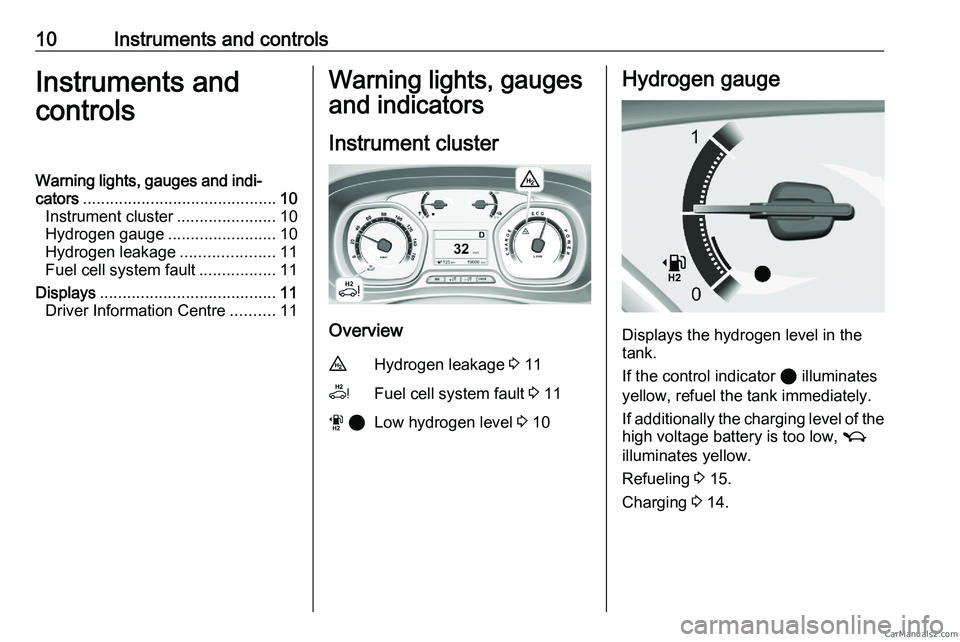
Instrument cluster Overview
u
Hydrogen leakage 3 11
v Fuel cell system fault 3 11
w 2 Low hydrogen level 3
10 Hydrogen gauge
Displays the hydrogen level in the
tank.
If the control indicator 2 illuminates
yellow, refuel the tank immediately.
If
additionally the charging level of the
high voltage battery is too low, M
illuminates yellow.
Refueling 3 15.
Charging 3 14.CarM an uals 2 .c o m
Page 303 of 348
Instruments and controls 11
Hydrogen leakage
u illuminates red together with C
and a warning message is displayed
in the Driver Information Centre.
A hydrogen leak has been detected.
Do not park or transport the vehicle
indoors,
such as a garage or the like. 9
Warning Have the cause of the fault
remedied immediately by a
workshop. Fuel cell system fault
v and C are illuminated yellow
and a warning message is displayed
in the Driver Information Centre.
The range of the vehicle might be
reduced. In order to enable the
continuation of the journey, the high
voltage battery will be used.
Therefore, ensure that the charging
level
of the high voltage battery is high
enough.
Seek the assistance of a workshop.
Charging 3 14. Displays
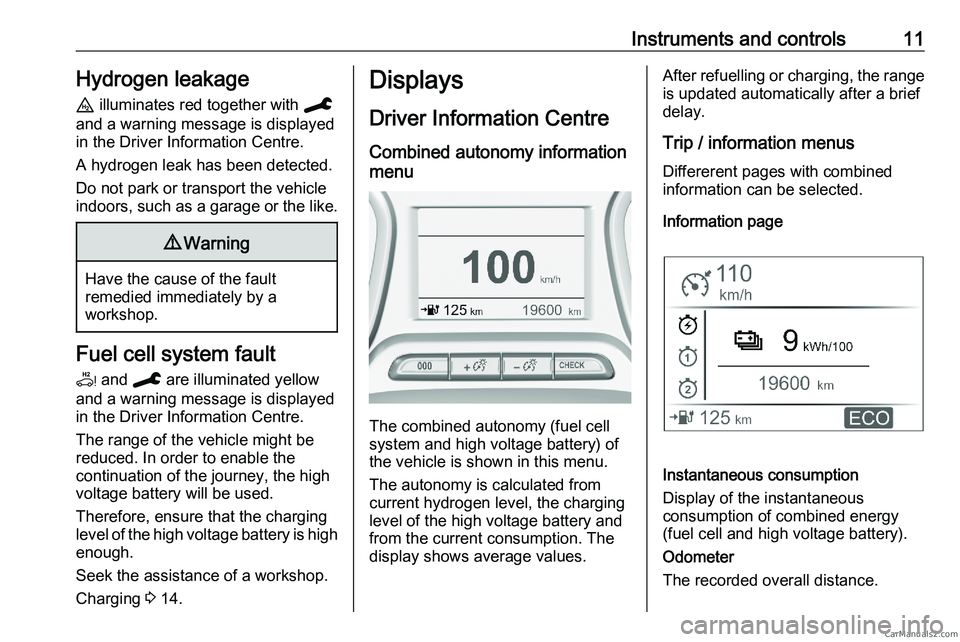
Driver Information Centre Combined autonomy information
menu The combined autonomy (fuel cell
system and high voltage battery) of
the vehicle is shown in this menu.
The autonomy is calculated from
current hydrogen level, the charging
level of the high voltage battery and
from the current consumption. The
display shows average values. After refuelling or charging, the range
is updated automatically after a brief
delay.
Trip / information menus
Differerent pages with combined
information can be selected.
Information page Instantaneous consumption
Display of the instantaneous
consumption of combined energy
(fuel cell and high voltage battery).
Odometer
The recorded overall distance.CarM an uals 2 .c o m
Page 307 of 348
Driving and operating 15
Expiring date hydrogen tanks 9
Danger Never refuel the hydrogen tanks
after the indicated expiring date.
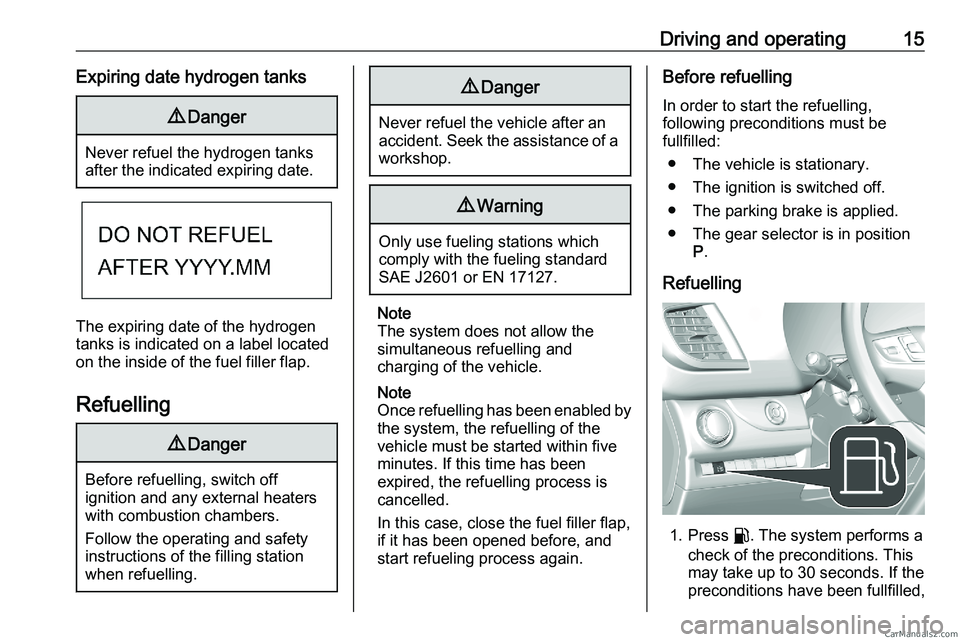
The expiring date of the hydrogen
tanks is indicated on a label located
on the inside of the fuel filler flap.
Refuelling 9
Danger Before refuelling, switch off
ignition and any external heaters
with combustion chambers.
Follow the operating and safety
instructions of the filling station
when refuelling. 9
Danger Never refuel the vehicle after an
accident.
Seek the assistance of a
workshop. 9
Warning Only use fueling stations which
comply with the fueling standard
SAE J2601 or EN 17127.
Note
The system does not allow the
simultaneous refuelling and
charging of the vehicle.
Note
Once
refuelling has been enabled by
the system, the refuelling of the
vehicle must be started within five
minutes. If this time has been
expired, the refuelling process is
cancelled.
In this case, close the fuel filler flap,
if it has been opened before, and
start refueling process again. Before refuelling
In order to start the refuelling,
following preconditions must be
fullfilled:
●
The vehicle is stationary.
● The ignition is switched off.
● The parking brake is applied.
● The gear selector is in position P.
Refuelling 1. Press r. The system performs a
check of the preconditions. This
may take up to 30 seconds. If the
preconditions have been fullfilled,CarM an uals 2 .c o m
Page 310 of 348
18 Vehicle care
Coolant level Caution
A too low coolant level can cause
engine damage.
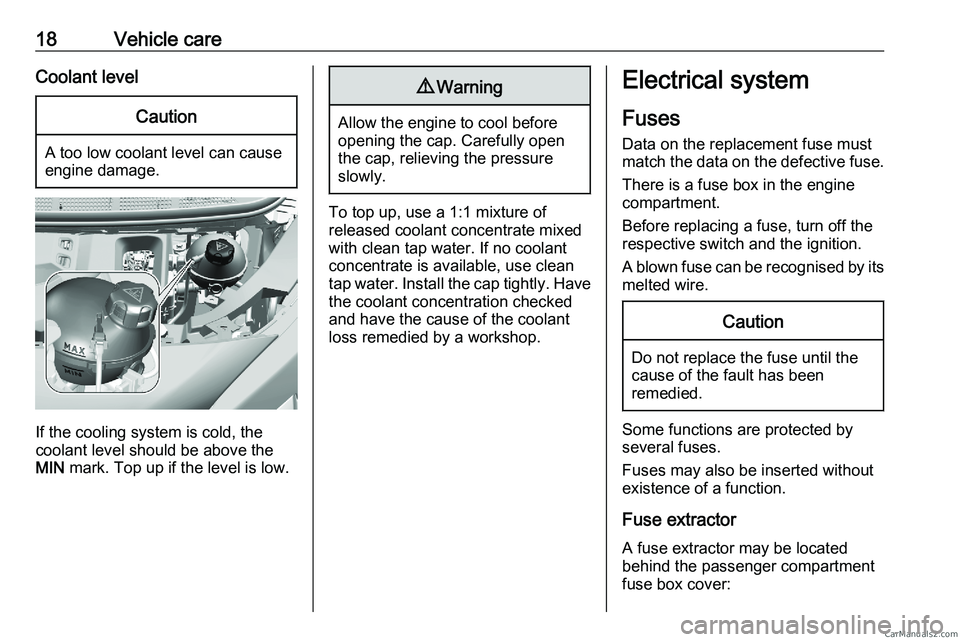
If the cooling system is cold, the
coolant level should be above the
MIN mark. Top up if the level is low. 9
Warning Allow the engine to cool before
opening the cap. Carefully open
the cap, relieving the pressure
slowly.
To top up, use a 1:1 mixture of
released coolant concentrate mixed
with clean tap water. If no coolant
concentrate is available, use clean
tap
water. Install the cap tightly. Have
the coolant concentration checked
and have the cause of the coolant
loss remedied by a workshop. Electrical system
Fuses
Data on the replacement fuse must
match
the data on the defective fuse.
There is a fuse box in the engine
compartment.
Before replacing a fuse, turn off the
respective switch and the ignition.
A blown fuse can be recognised by its melted wire. Caution
Do not replace the fuse until the
cause of the fault has been
remedied.
Some functions are protected by
several fuses.
Fuses may also be inserted without
existence of a function.
Fuse extractorA fuse extractor may be located
behind the passenger compartment
fuse box cover:CarM an uals 2 .c o m
Page 313 of 348
Vehicle care 21
Wheels and tyres
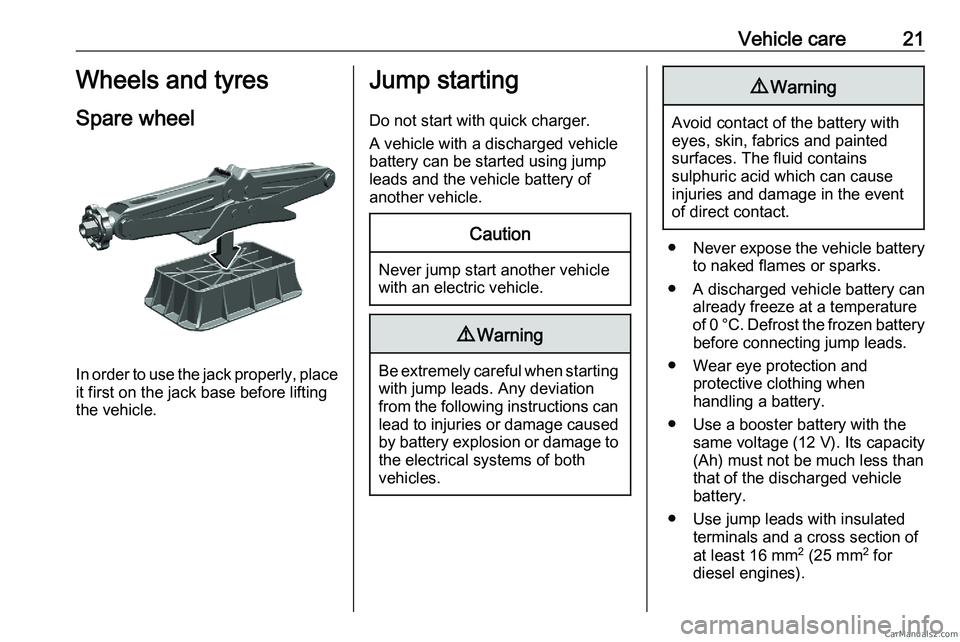
Spare wheel In order to use the jack properly, place
it first on the jack base before lifting
the vehicle. Jump starting
Do not start with quick charger.
A vehicle with a discharged vehicle
battery can be started using jump
leads and the vehicle battery of
another vehicle. Caution
Never jump start another vehicle
with an electric vehicle.
9
Warning Be extremely careful when starting
with jump leads. Any deviation
from
the following instructions can
lead to injuries or damage caused
by battery explosion or damage to the electrical systems of both
vehicles. 9
Warning Avoid contact of the battery with
eyes, skin, fabrics and painted
surfaces. The fluid contains
sulphuric acid which can cause
injuries and damage in the event
of direct contact. ● Never
expose the vehicle battery
to naked flames or sparks.
● A discharged vehicle battery can already freeze at a temperature
of 0 °C. Defrost the frozen batterybefore connecting jump leads.
● Wear eye protection and protective clothing when
handling a battery.
● Use a booster battery with the same voltage (12 V). Its capacity
(Ah) must not be much less than
that of the discharged vehicle
battery.
● Use jump leads with insulated terminals and a cross section of
at least 16 mm 2
(25 mm 2
for
diesel engines).CarM an uals 2 .c o m