bonnet PEUGEOT EXPERT DAG 2001 User Guide
[x] Cancel search | Manufacturer: PEUGEOT, Model Year: 2001, Model line: EXPERT DAG, Model: PEUGEOT EXPERT DAG 2001Pages: 149, PDF Size: 5.87 MB
Page 62 of 149
LEVELSIV-5
84
Beware: When working under the bonnet, the cooling fan could operate if the engi-
ne is hot (even when switched off).
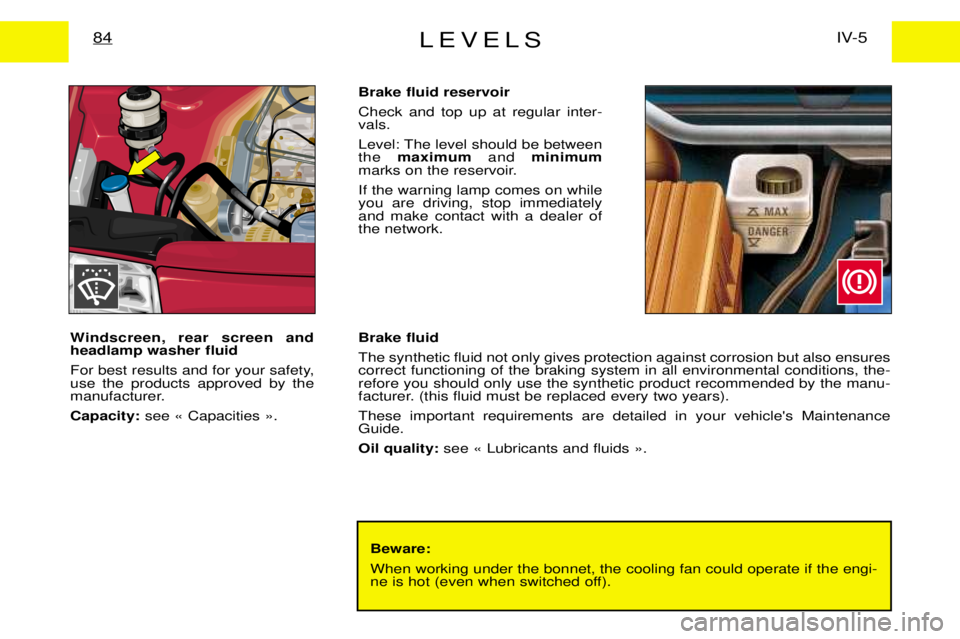
Windscreen, rear screen andheadlamp washer fluid
For best results and for your safety, use the products approved by the
manufacturer. Capacity:
see Ç Capacities È. Brake fluidThe synthetic fluid not only gives protection against corrosion but also ensures correct functioning of the braking system in all environmental conditions, the-refore you should only use the synthetic product recommended by the manu-
facturer. (this fluid must be replaced every two years). These important requirements are detailed in your vehicle's Maintenance Guide. Oil quality:
see Ç Lubricants and fluids È.
Brake fluid reservoirCheck and top up at regular inter- vals.
Level: The level should be between the
maximum and minimum
marks on the reservoir. If the warning lamp comes on while you are driving, stop immediatelyand make contact with a dealer ofthe network.
Page 69 of 149

BRAKES55II-4
ABS - Anti-lock Braking System* This system improves vehicle safety by preventing the wheels from locking under emergency braking or when
braking on surfaces offering poor adhesion.
It thus also allows control of the steering to be retained. The operation of the various electronic components of the system is continuously monitored, both before and during your
journey. On switching on the ignition, the ABS lamp will light for approximately two seconds. If it stays on or lights when
driving, the ABS computer has detected a fault and has disconnected the ABS system. If the lamp lights whilst driving, it
again indicates that a fault has been detected and that the ABS system is inactive. In both situations, the normal braking
system is not affected and will continue to function as a conventional braking system without ABS. Nevertheless, to re-
establish the full safety features of the ABS system, It is recommended that the vehicle be examined by a dealer as soonas possible.
On slippery roads (loose stones, snow, ice, etc.), it is imperative to drive with caution.
* According to model or country
Protection fuses under the dashboardF12
(under the bonnet)
MF4 (with ABS)
Page 83 of 149
AIR CONDITIONING*III-2
68
Air conditioning
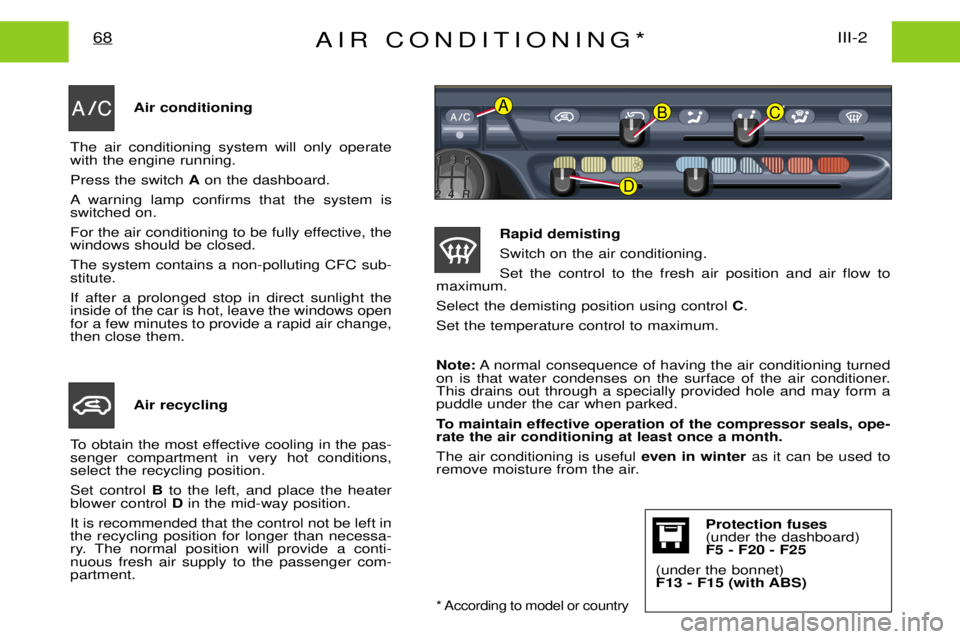
The air conditioning system will only operate with the engine running. Press the switch Aon the dashboard.
A warning lamp confirms that the system is switched on.
For the air conditioning to be fully effective, the windows should be closed. The system contains a non-polluting CFC sub- stitute. If after a prolonged stop in direct sunlight the inside of the car is hot, leave the windows openfor a few minutes to provide a rapid air change,then close them.
Air recycling
To obtain the most effective cooling in the pas-senger compartment in very hot conditions,select the recycling position. Set control Bto the left, and place the heater
blower control Din the mid-way position.
It is recommended that the control not be left in the recycling position for longer than necessa-
ry. The normal position will provide a conti-nuous fresh air supply to the passenger com-partment. Rapid demisting Switch on the air conditioning.Set the control to the fresh air position and air flow to
maximum.Select the demisting position using control C.
Set the temperature control to maximum. Note: A normal consequence of having the air conditioning turned
on is that water condenses on the surface of the air conditioner. This drains out through a specially provided hole and may form apuddle under the car when parked.
To maintain effective operation of the compressor seals, ope- rate the air conditioning at least once a month. The air conditioning is useful even in winteras it can be used to
remove moisture from the air.ABC
D
* According to model or country
Protection fuses (under the dashboard)F5 - F20 - F25
(under the bonnet)
F13 - F15 (with ABS)
Page 108 of 149
BATTERYV- 1
88
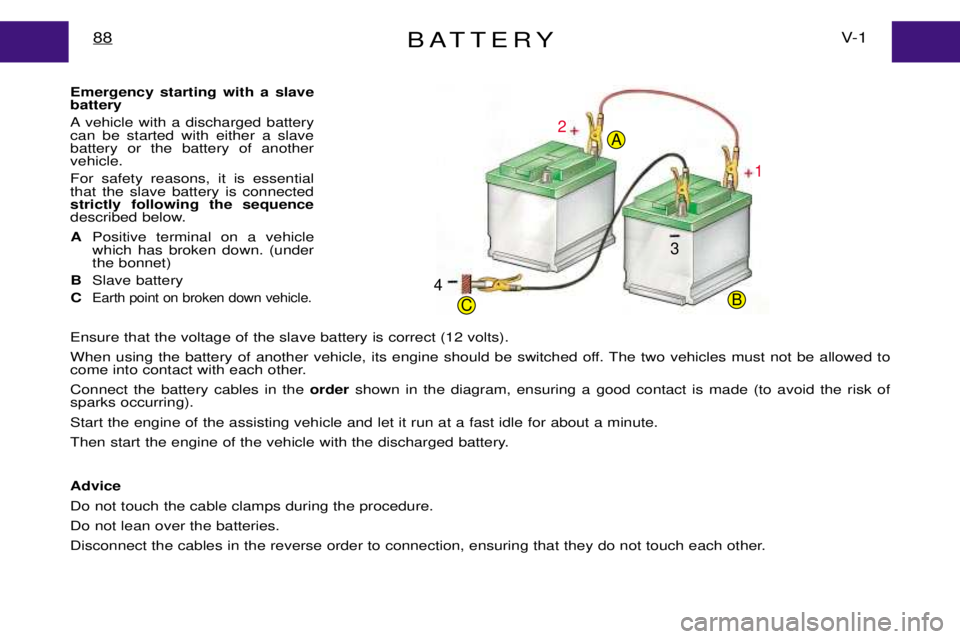
Emergency starting with a slave battery
A vehicle with a discharged battery can be started with either a slavebattery or the battery of anothervehicle. For safety reasons, it is essential that the slave battery is connectedstrictly following the sequence
described below.
A Positive terminal on a vehiclewhich has broken down. (underthe bonnet)
B Slave battery
C
Earth point on broken down vehicle.
Ensure that the voltage of the slave battery is correct (12 volts).
When using the battery of another vehicle, its engine should be switched off. The two vehicles must not be allowed to
come into contact with each other. Connect the battery cables in the ordershown in the diagram, ensuring a good contact is made (to avoid the risk of
sparks occurring).Start the engine of the assisting vehicle and let it run at a fast idle for about a minute.
Then start the engine of the vehicle with the discharged battery. Advice Do not touch the cable clamps during the procedure.Do not lean over the batteries.
Disconnect the cables in the reverse order to connection, ensuring that they do not touch each other.
2
1
3
4
CB
A
Page 110 of 149
FUSES*89V- 2
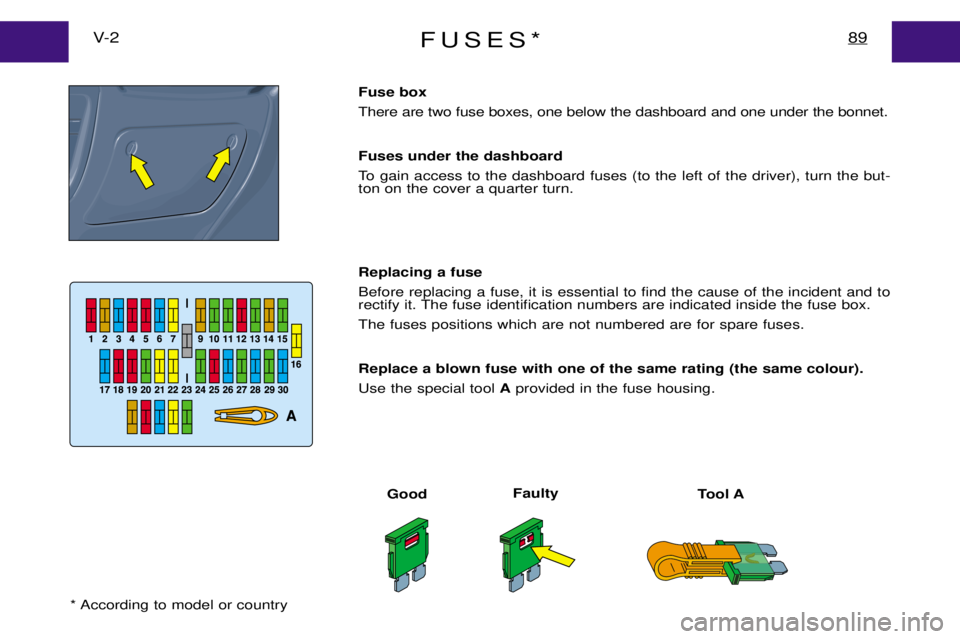
Fuse box There are two fuse boxes, one below the dashboard and one under the bonnet. Fuses under the dashboard
To gain access to the dashboard fuses (to the left of the driver), turn the but- ton on the cover a quarter turn. Replacing a fuse Before replacing a fuse, it is essential to find the cause of the incident and to
rectify it. The fuse identification numbers are indicated inside the fuse box. The fuses positions which are not numbered are for spare fuses. Replace a blown fuse with one of the same rating (the same colour). Use the special tool Aprovided in the fuse housing.
* According to model or country Good
Faulty
Tool A
Page 113 of 149
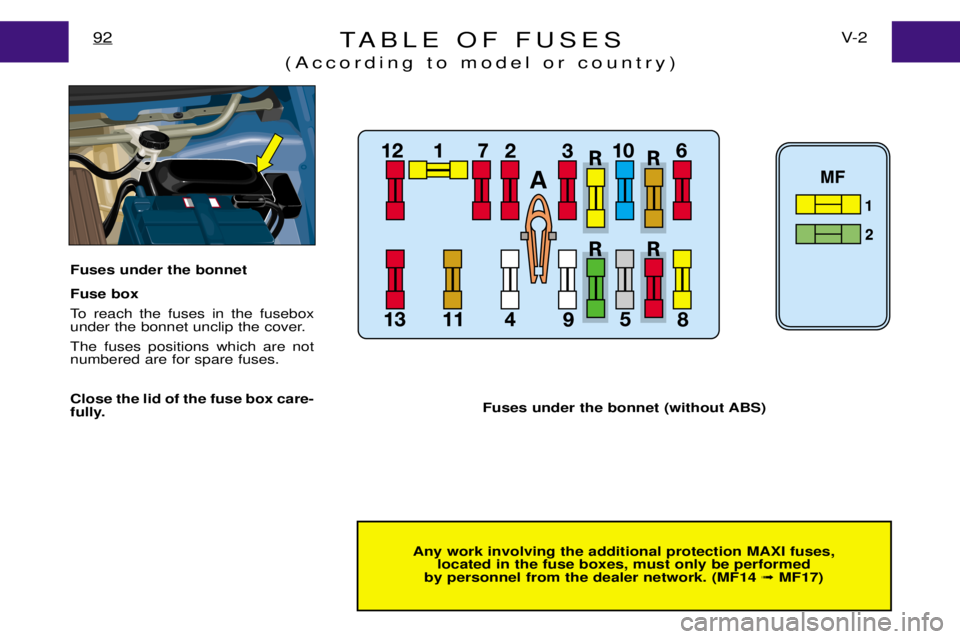
TABLE OF FUSES
(According to model or country)V- 2
92
Any work involving the additional protection MAXI fuses,
located in the fuse boxes, must only be performed
by personnel from the dealer network. (MF14 ➟ MF17)
Fuses under the bonnet Fuse box
To reach the fuses in the fusebox
under the bonnet unclip the cover. The fuses positions which are not numbered are for spare fuses. Close the lid of the fuse box care-
fully.
Fuses under the bonnet (without ABS)
Page 115 of 149
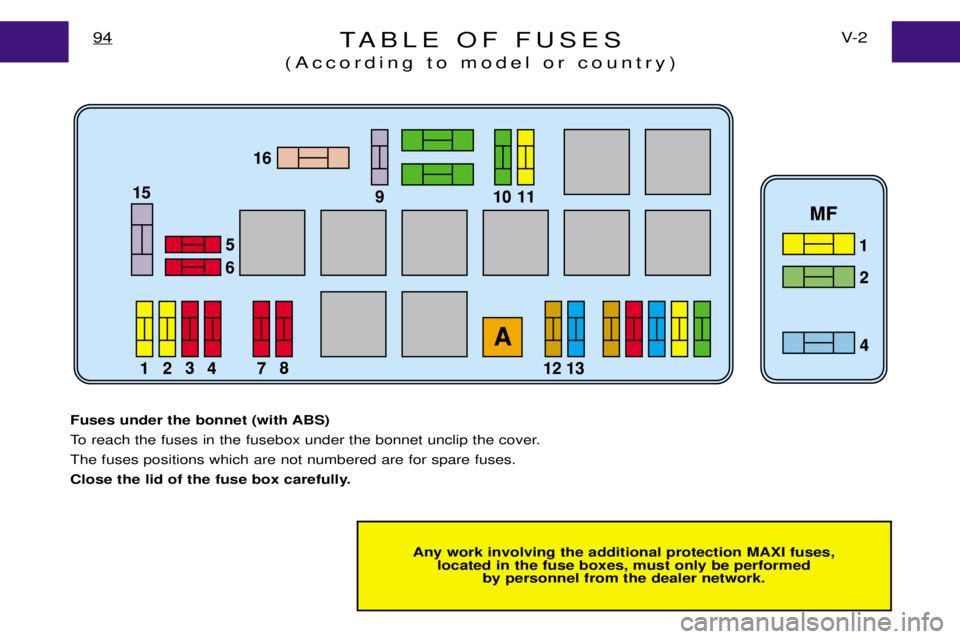
TABLE OF FUSES
(According to model or country)V- 2
94
Any work involving the additional protection MAXI fuses,
located in the fuse boxes, must only be performed by personnel from the dealer network.
Fuses under the bonnet (with ABS)
To reach the fuses in the fusebox under the bonnet unclip the cover.The fuses positions which are not numbered are for spare fuses.
Close the lid of the fuse box carefully.
Page 118 of 149
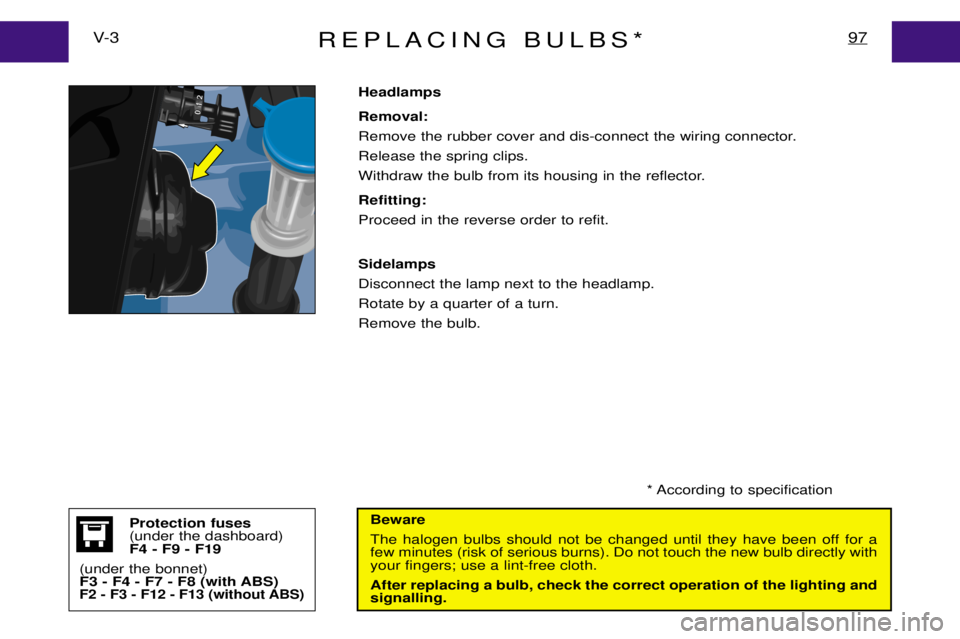
REPLACING BULBS*97V- 3
Beware
The halogen bulbs should not be changed until they have been off for a few minutes (risk of serious burns). Do not touch the new bulb directly withyour fingers; use a lint-free cloth. After replacing a bulb, check the correct operation of the lighting and signalling.
Headlamps Removal:
Remove the rubber cover and dis-connect the wiring connector.Release the spring clips.
Withdraw the bulb from its housing in the reflector. Refitting: Proceed in the reverse order to refit. Sidelamps Disconnect the lamp next to the headlamp.Rotate by a quarter of a turn.Remove the bulb.Protection fuses (under the dashboard)F4 - F9 - F19
(under the bonnet)
F3 - F4 - F7 - F8 (with ABS)
F2 - F3 - F12 - F13 (without ABS)
* According to specification
Page 119 of 149
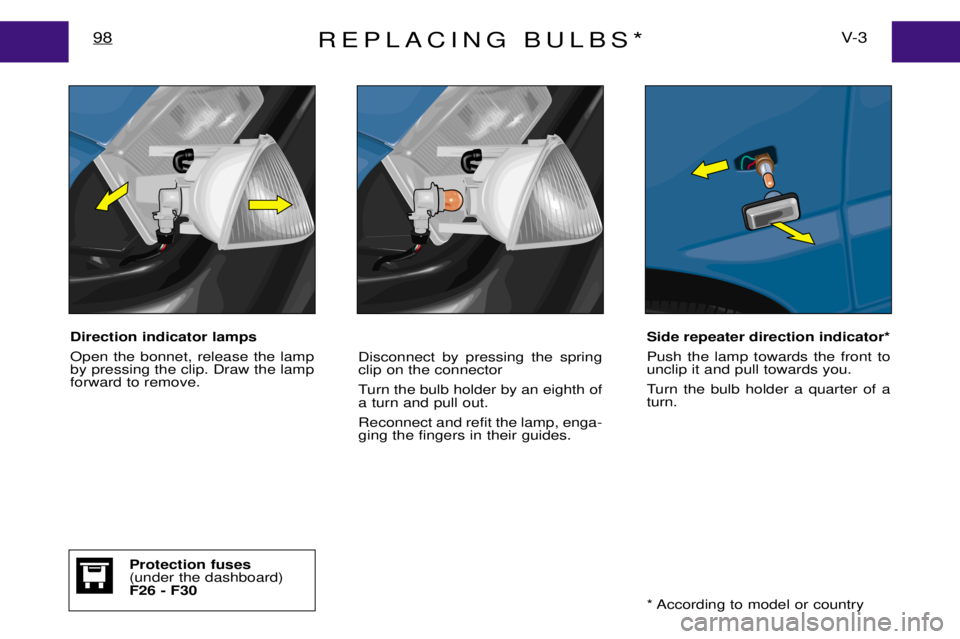
REPLACING BULBS*V- 3
98
Direction indicator lamps Open the bonnet, release the lamp by pressing the clip. Draw the lampforward to remove. Disconnect by pressing the springclip on the connector
Turn the bulb holder by an eighth of a turn and pull out. Reconnect and refit the lamp, enga- ging the fingers in their guides.Side repeater direction indicator* Push the lamp towards the front to unclip it and pull towards you.
Turn the bulb holder a quarter of a turn.
* According to model or country
Protection fuses (under the dashboard)F26 - F30
Page 121 of 149
REPLACING BULBS*V- 3
100
BEWARE
The halogen bulbs should not be changed until they have been off for a few minutes (risk of serious burns). Do not touch the new bulb di- rectly with your fingers; use a lint-free cloth.
After replacing a bulb, check the correct operation of the lighting and signalling.
Badly adjusted headlamps are dangerous. Correct headlamp adjust- ment requires precision and must be carried out by a member of the dealer network in a suitably equipped workshop. Having replaced a headlamp bulb, have the alignment checked.
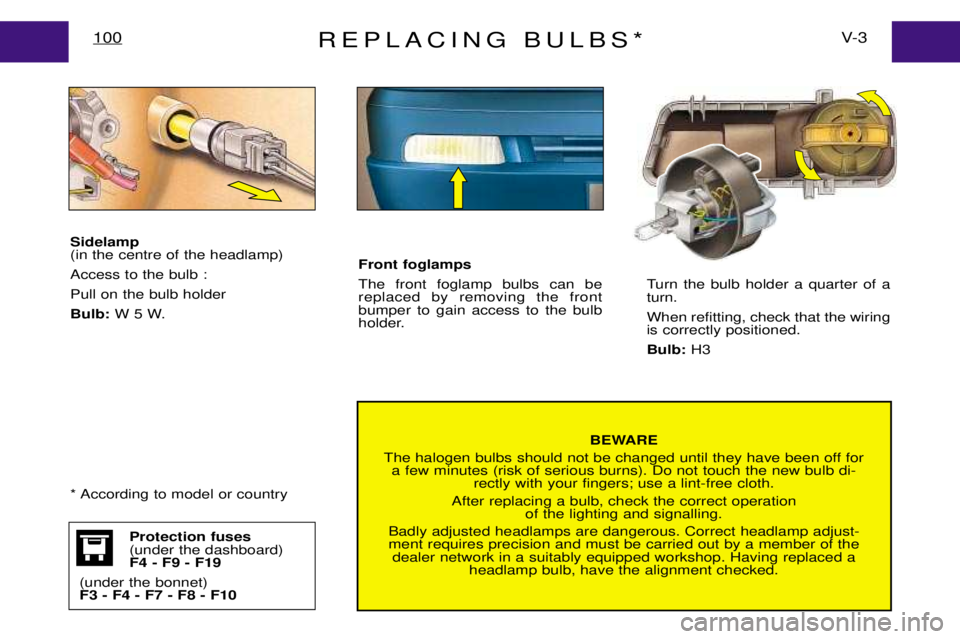
Sidelamp (in the centre of the headlamp) Access to the bulb :Pull on the bulb holderBulb:
W 5 W. Turn the bulb holder a quarter of a turn. When refitting, check that the wiring is correctly positioned. Bulb:
H3
Protection fuses (under the dashboard)F4 - F9 - F19
(under the bonnet)F3 - F4 - F7 - F8 - F10
Front foglamps The front foglamp bulbs can be replaced by removing the frontbumper to gain access to the bulb
holder.
* According to model or country