light PEUGEOT EXPERT DAG 2001 User Guide
[x] Cancel search | Manufacturer: PEUGEOT, Model Year: 2001, Model line: EXPERT DAG, Model: PEUGEOT EXPERT DAG 2001Pages: 149, PDF Size: 5.87 MB
Page 42 of 149
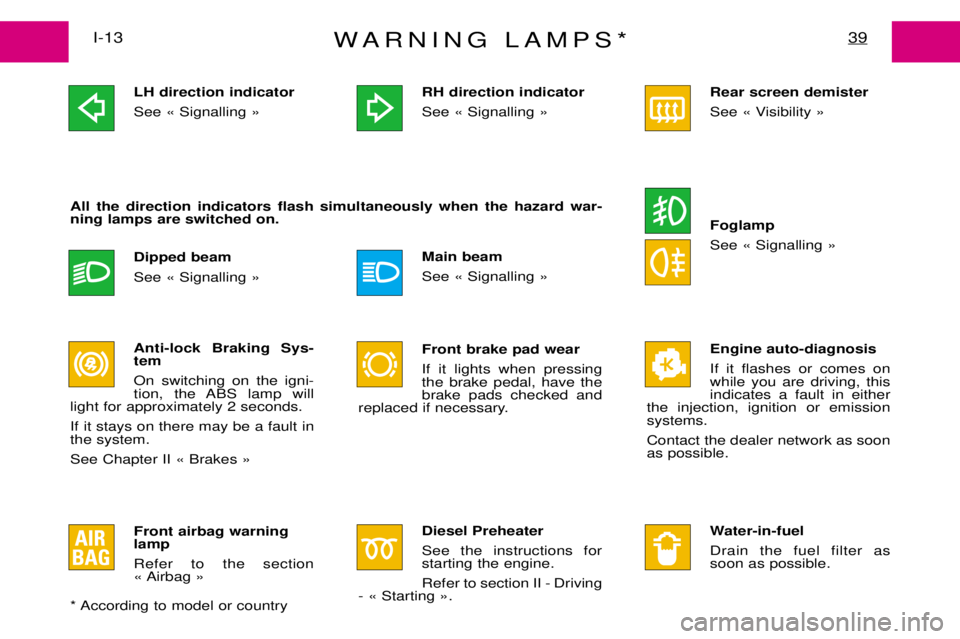
WARNING LAMPS*39I-13LH direction indicator See Ç Signalling È Dipped beam See Ç Signalling È
All the direction indicators flash simultaneously when the hazard war- ning lamps are switched on.
Anti-lock Braking Sys-tem On switching on the igni-
tion, the ABS lamp will
light for approximately 2 seconds. If it stays on there may be a fault in the system. See Chapter II Ç Brakes È RH direction indicatorSee Ç Signalling È Main beam See Ç Signalling È Front brake pad wear If it lights when pressing the brake pedal, have thebrake pads checked and
replaced if necessary.
Diesel Preheater See the instructions for starting the engine. Refer to section II - Driving
- Ç Starting È. Rear screen demister
See Ç Visibility È Foglamp See Ç Signalling È Engine auto-diagnosis If it flashes or comes on while you are driving, thisindicates a fault in either
the injection, ignition or emissionsystems. Contact the dealer network as soon as possible.
Water-in-fuel Drain the fuel filter as soon as possible.
Front airbag warninglamp Refer to the section
Ç Airbag È
* According to model or country
Page 43 of 149
WARNING LAMPS*I-13
40
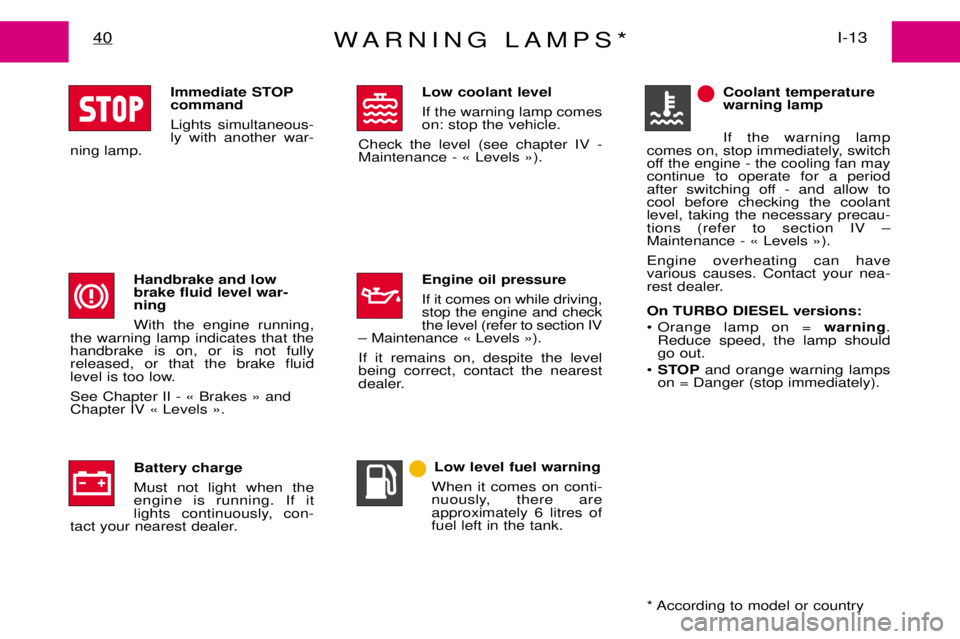
Immediate STOP command Lights simultaneous- ly with another war-
ning lamp.
Handbrake and lowbrake fluid level war-ning With the engine running,
the warning lamp indicates that the handbrake is on, or is not fullyreleased, or that the brake fluid
level is too low. See Chapter II - Ç Brakes È and Chapter IV Ç Levels È.
Battery charge Must not light when the engine is running. If it
lights continuously, con-
tact your nearest dealer. Low coolant level If the warning lamp comes on: stop the vehicle.
Check the level (see chapter IV -Maintenance - Ç Levels È).
Engine oil pressure If it comes on while driving, stop the engine and checkthe level (refer to section IV
Ð Maintenance Ç Levels È). If it remains on, despite the level being correct, contact the nearest
dealer.
Low level fuel warning
When it comes on conti-
nuously, there areapproximately 6 litres offuel left in the tank. Coolant temperaturewarning lamp If the warning lamp
comes on, stop immediately, switch
off the engine - the cooling fan maycontinue to operate for a period
after switching off - and allow tocool before checking the coolantlevel, taking the necessary precau-tions (refer to section IV ÐMaintenance - Ç Levels È). Engine overheating can have various causes. Contact your nea-
rest dealer.
On TURBO DIESEL versions:
¥ Orange lamp on = warning.
Reduce speed, the lamp should go out.
¥ STOP and orange warning lamps
on = Danger (stop immediately).
* According to model or country
Page 45 of 149
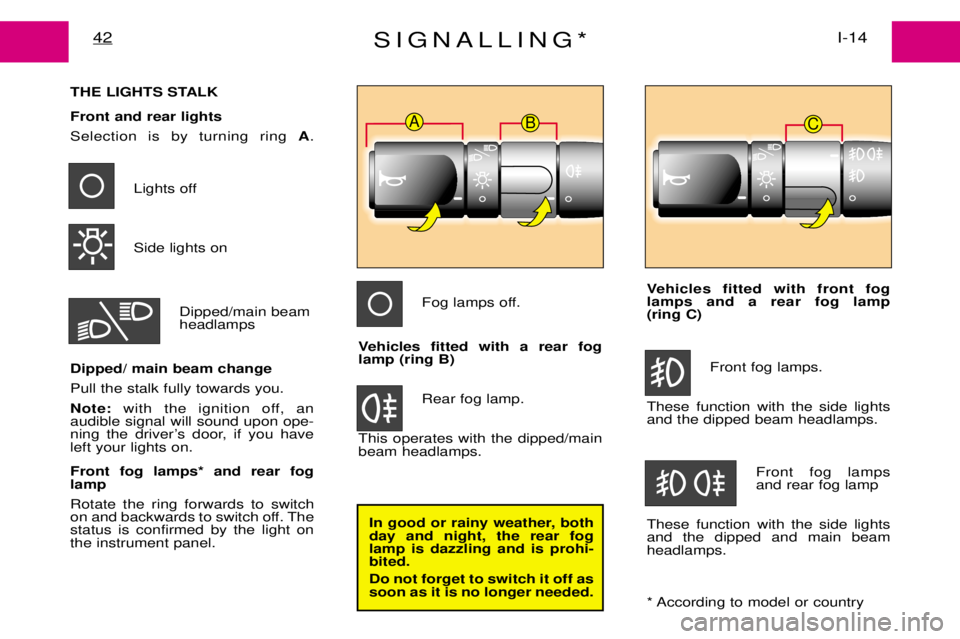
Vehicles fitted with front fog lamps and a rear fog lamp (ring C)Front fog lamps.
These function with the side lightsand the dipped beam headlamps.
Front fog lampsand rear fog lamp
These function with the side lightsand the dipped and main beamheadlamps.
Fog lamps off.
Vehicles fitted with a rear foglamp (ring B) Rear fog lamp.
This operates with the dipped/mainbeam headlamps.
THE LIGHTS STALK Front and rear lights Selection is by turning ring
A.
Lights off Side lights on
Dipped/main beam headlamps
Dipped/ main beam change Pull the stalk fully towards you. Note: with the ignition off, an
audible signal will sound upon ope-
ning the driverÕs door, if you haveleft your lights on. Front fog lamps* and rear fog lamp Rotate the ring forwards to switch
on and backwards to switch off. Thestatus is confirmed by the light onthe instrument panel.
SIGNALLING*I-14
42
BA
In good or rainy weather, both day and night, the rear foglamp is dazzling and is prohi-bited. Do not forget to switch it off as soon as it is no longer needed.
C
* According to model or country
Page 46 of 149
SIGNALLING*43I-14
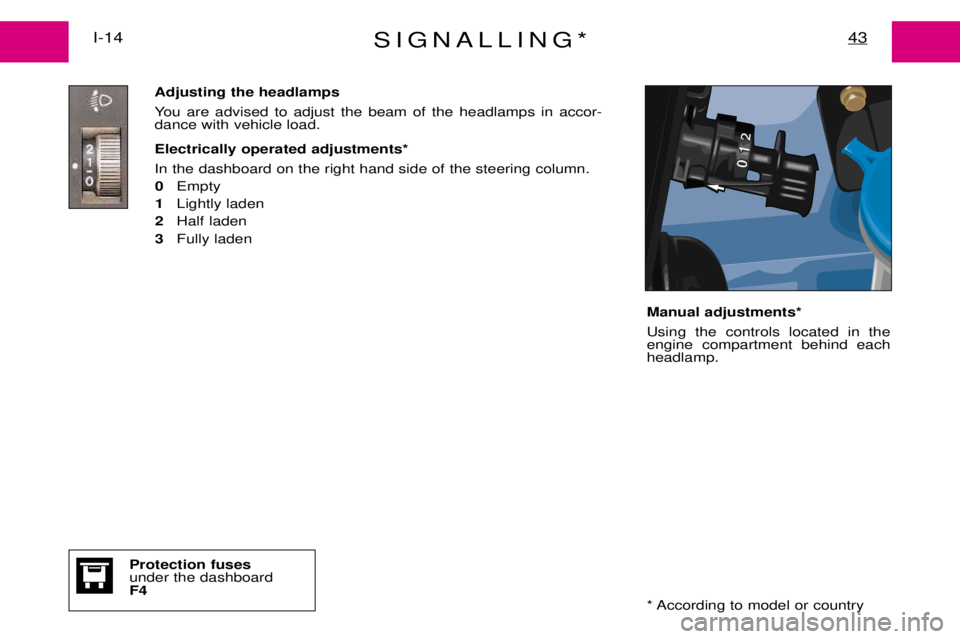
Adjusting the headlamps
You are advised to adjust the beam of the headlamps in accor- dance with vehicle load. Electrically operated adjustments* In the dashboard on the right hand side of the steering column.0 Empty
1 Lightly laden
2 Half laden
3 Fully laden
Manual adjustments*Using the controls located in the engine compartment behind eachheadlamp.
* According to model or country
Protection fuses under the dashboardF4
Page 58 of 149
DIESEL INJECTIONEQUIPMENT*IV-3
80
The 2.0 HDi engine makes use of advanced technology.
Any repair work must be carried out by suitably qualified
personnel, such as can be provided by the dealer network.
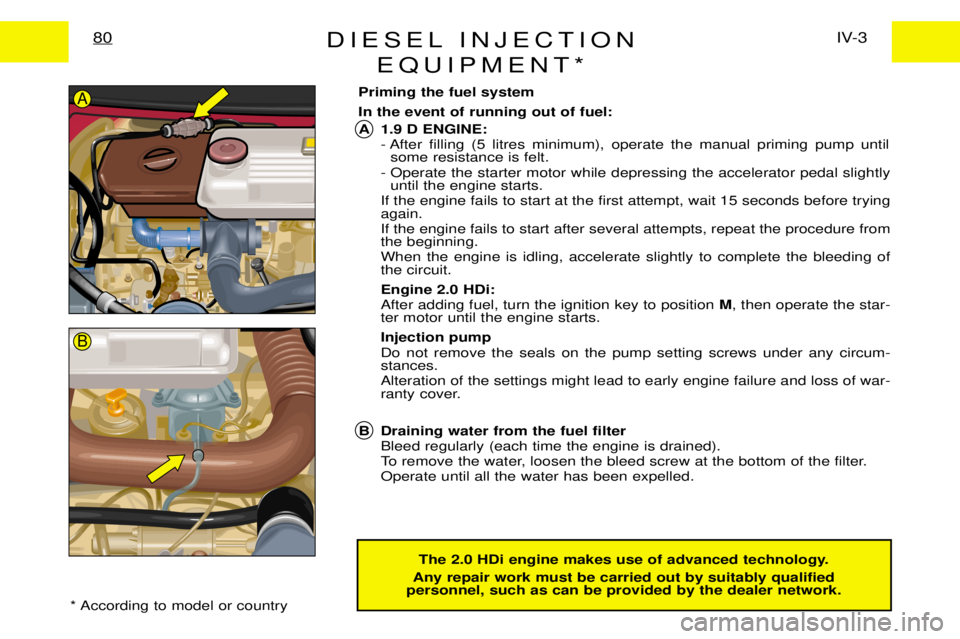
Priming the fuel system In the event of running out of fuel:
A 1.9 D ENGINE: - After filling (5 litres minimum), operate the manual priming pump untilsome resistance is felt.
- Operate the starter motor while depressing the accelerator pedal slightly until the engine starts.
If the engine fails to start at the first attempt, wait 15 seconds before trying again. If the engine fails to start after several attempts, repeat the procedure from the beginning. When the engine is idling, accelerate slightly to complete the bleeding of the circuit. Engine 2.0 HDi: After adding fuel, turn the ignition key to position M, then operate the star-
ter motor until the engine starts. Injection pump Do not remove the seals on the pump setting screws under any circum- stances. Alteration of the settings might lead to early engine failure and loss of war-
ranty cover.
B Draining water from the fuel filter Bleed regularly (each time the engine is drained).
To remove the water, loosen the bleed screw at the bottom of the filter.Operate until all the water has been expelled.
A
B
* According to model or country
Page 64 of 149
STEERING LOCK - IGNITION - STARTERII-1
50
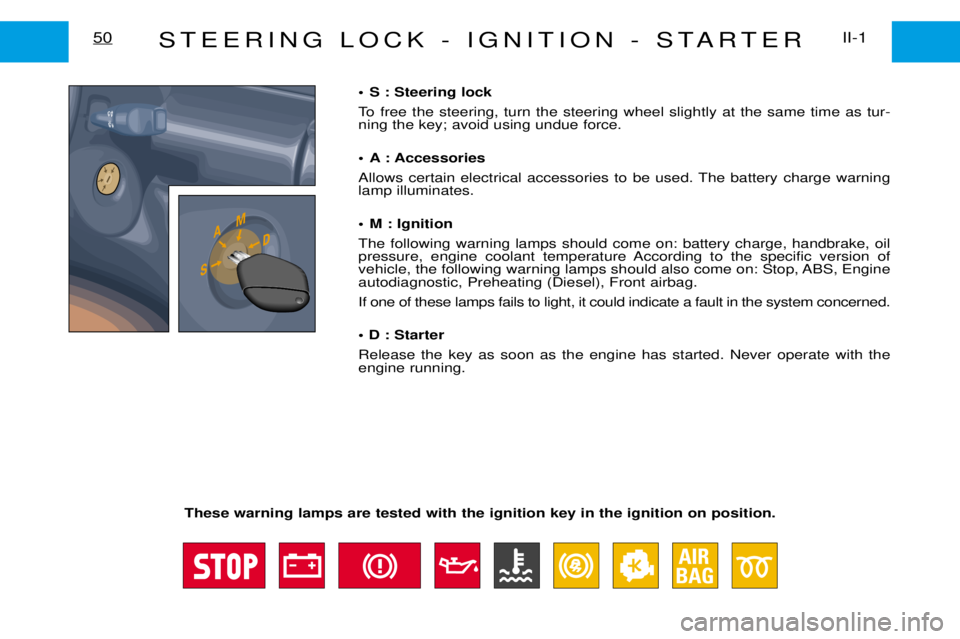
¥ S : Steering lock
To free the steering, turn the steering wheel slightly at the same time as tur- ning the key; avoid using undue force.
¥ A : Accessories
Allows certain electrical accessories to be used. The battery charge warning lamp illuminates.
¥ M : Ignition The following warning lamps should come on: battery charge, handbrake, oil
pressure, engine coolant temperature According to the specific version of
vehicle, the following warning lamps should also come on: Stop, ABS, Engineautodiagnostic, Preheating (Diesel), Front airbag. If one of these lamps fails to light, it could indicate a fault in the system concerned. ¥ D : Starter Release the key as soon as the engine has started. Never operate with the engine running.
These warning lamps are tested with the ignition key in the ignition on position.
Page 65 of 149
STEERING LOCK - IGNITION - STARTER51II-1
WARNING
NEVER REMOVE THE IGNITION KEY BEFORE THE VEHICLE IS COMPLETELY STATIONARY. NEVER ATTEMPT TO MOVE THE VEHICLE BEFORE STARTING THE ENGINE AND WAITING FOR THE HYDRAULIC LOW PRESSURE WAR-
NING LAMP TO GO OUT. IF THE ENGINE IS NOT RUNNING, THE STEERING
WILL NOT HAVE POWER ASSISTANCE AND THERE MAY BE NO RESERVE OF PRESSURE AVAILABLE TO OPERATE THE FOOTBRAKE. THERE IS ALSO ARISK OF THE STEERING LOCK ENGAGING AND THE SAFETY FEATURES NOT OPERATING IF THE IGNITION IS NOT SWITCHED ON. ONLY IN AN
EMERGENCY SITUATION SHOULD YOU ATTEMPT TO MOVE A VEHICLE
WITHOUT STARTING THE ENGINE. TAKE ALL THE NECESSARY SAFETY
PRECAUTIONS AND BE PREPARED TO USE THE PARKING BRAKE TO STOP THE VEHICLE.
When parking, remove the ignition key and turn the steering wheel until the steering column locking peg engages.
Steering lock
S With the key removed and the steering lock peg engaged, the steering column is locked; the lock peg will engage in
a number of positions of the steering wheel. The key can only be removed in position S.
A The steering is unlocked - to enable the key to be turned to position A, it may be necessary to turn the steering slightly.
M Running position.
D Starting position.
For starting and stopping the engine, see Ç Starting È.
Page 68 of 149
BRAKESII-3
54
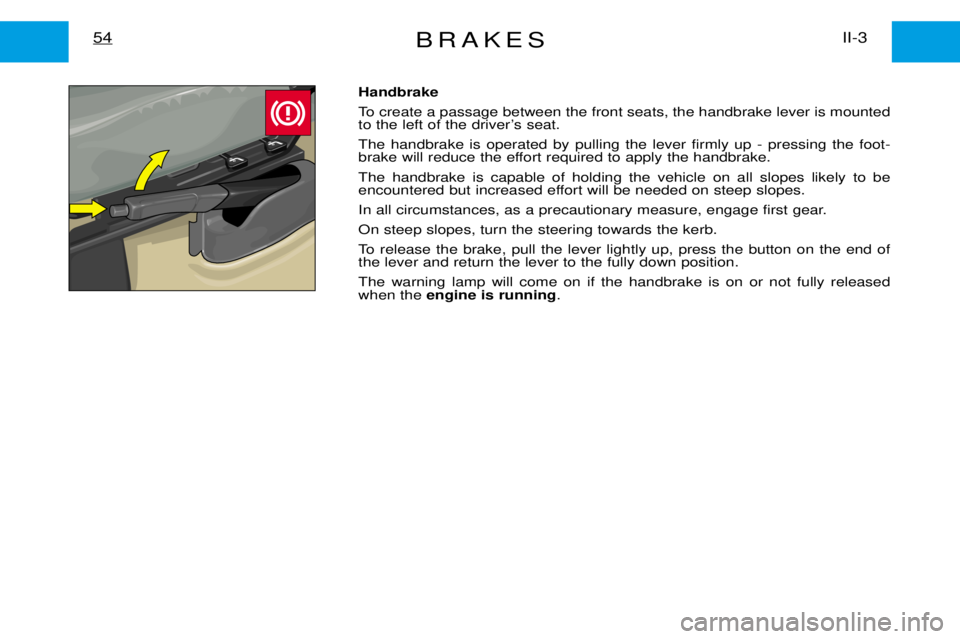
Handbrake
To create a passage between the front seats, the handbrake lever is mounted
to the left of the driverÕs seat. The handbrake is operated by pulling the lever firmly up - pressing the foot-
brake will reduce the effort required to apply the handbrake. The handbrake is capable of holding the vehicle on all slopes likely to be
encountered but increased effort will be needed on steep slopes.
In all circumstances, as a precautionary measure, engage first gear.On steep slopes, turn the steering towards the kerb.
To release the brake, pull the lever lightly up, press the button on the end of the lever and return the lever to the fully down position. The warning lamp will come on if the handbrake is on or not fully released when the engine is running .
Page 69 of 149

BRAKES55II-4
ABS - Anti-lock Braking System* This system improves vehicle safety by preventing the wheels from locking under emergency braking or when
braking on surfaces offering poor adhesion.
It thus also allows control of the steering to be retained. The operation of the various electronic components of the system is continuously monitored, both before and during your
journey. On switching on the ignition, the ABS lamp will light for approximately two seconds. If it stays on or lights when
driving, the ABS computer has detected a fault and has disconnected the ABS system. If the lamp lights whilst driving, it
again indicates that a fault has been detected and that the ABS system is inactive. In both situations, the normal braking
system is not affected and will continue to function as a conventional braking system without ABS. Nevertheless, to re-
establish the full safety features of the ABS system, It is recommended that the vehicle be examined by a dealer as soonas possible.
On slippery roads (loose stones, snow, ice, etc.), it is imperative to drive with caution.
* According to model or country
Protection fuses under the dashboardF12
(under the bonnet)
MF4 (with ABS)
Page 70 of 149
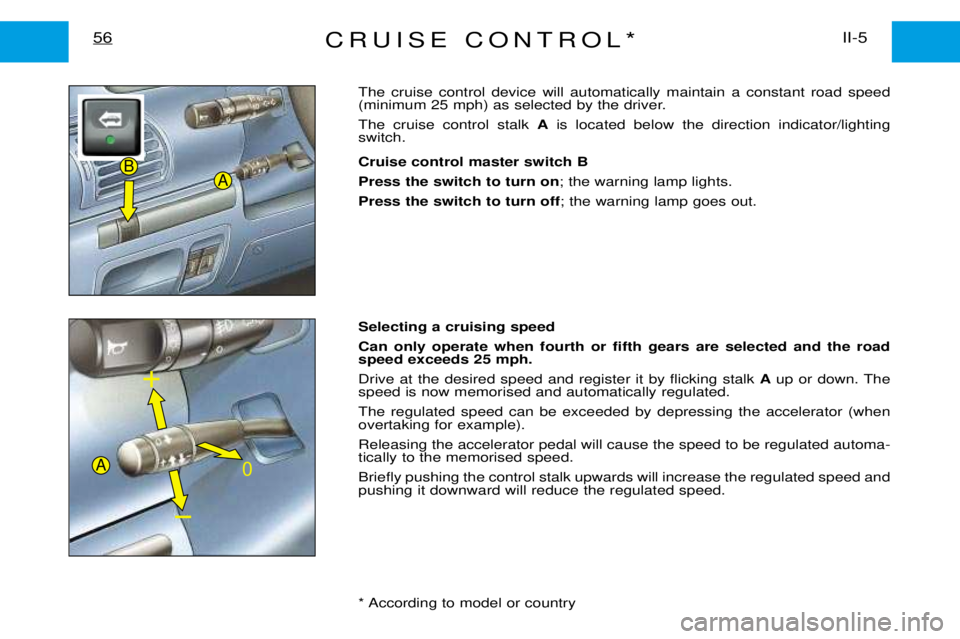
CRUISE CONTROL*II-5
56
The cruise control device will automatically maintain a constant road speed
(minimum 25 mph) as selected by the driver. The cruise control stalk Ais located below the direction indicator/lighting
switch. Cruise control master switch B Press the switch to turn on ; the warning lamp lights.
Press the switch to turn off ; the warning lamp goes out.
Selecting a cruising speedCan only operate when fourth or fifth gears are selected and the road speed exceeds 25 mph. Drive at the desired speed and register it by flicking stalk Aup or down. The
speed is now memorised and automatically regulated.The regulated speed can be exceeded by depressing the accelerator (when overtaking for example). Releasing the accelerator pedal will cause the speed to be regulated automa- tically to the memorised speed. Briefly pushing the control stalk upwards will increase the regulated speed and pushing it downward will reduce the regulated speed.
* According to model or country
0A
AB