lock PEUGEOT EXPERT DAG 2001 User Guide
[x] Cancel search | Manufacturer: PEUGEOT, Model Year: 2001, Model line: EXPERT DAG, Model: PEUGEOT EXPERT DAG 2001Pages: 149, PDF Size: 5.87 MB
Page 18 of 149
STEERING WHEEL ADJUSTMENTI-817
IMPORTANT
As a safety measure,
these manoeuvres must not be carried out when driving.
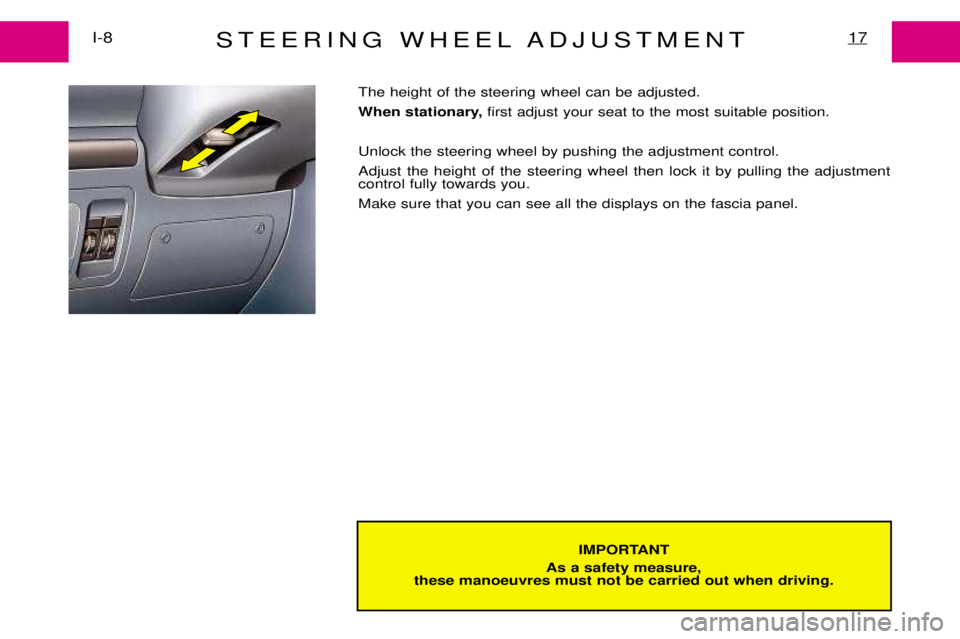
The height of the steering wheel can be adjusted.
When stationary, first adjust your seat to the most suitable position.
Unlock the steering wheel by pushing the adjustment control.Adjust the height of the steering wheel then lock it by pulling the adjustment control fully towards you. Make sure that you can see all the displays on the fascia panel.
Page 23 of 149

DASHBOARD*23I-11
1Left hand air vent & Side glass demister vent.
2 Controls for: ¥ Lighting ¥ Direction indicators ¥ Horn ¥ Foglamp
3 Instrument panel.
4 Controls for: ¥ Windscreen wash ¥ Windscreen wiper
5 Centre air vents. 6
Radio housing or oddments pocket.
7 Right hand air vent & Side glassdemister vent.
8 Glovebox.
9 Heating/ventilation controls.
10 Ashtray & Cigar lighter.
11 Gear lever. 12
Controls for: ¥ Hazard warning lamps.
¥ Heated glass of hinged rear
doors.
¥ Air conditioning
¥ Demisting and defrosting of the rear view mirrors.
13 Steering lock and ignition switch.
14 Fuse box access.
15 Adjusting the headlamps.
16 Cruise control lever.
17 Bonnet release lever.
18 Cruise control switch.
* According to model or country
Page 24 of 149
INSTRUMENT PANEL*I-12
24
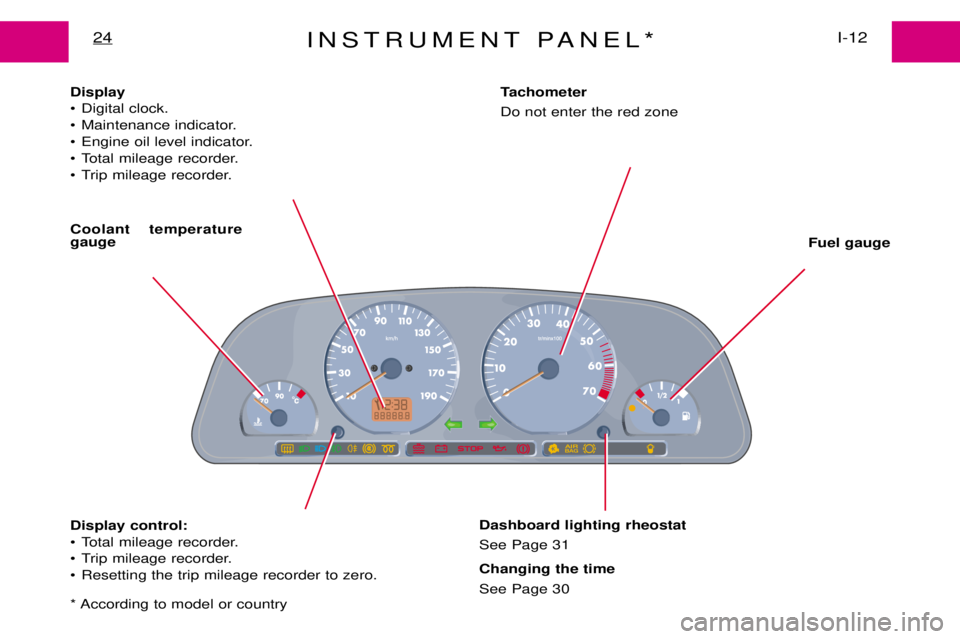
Display
¥ Digital clock.
¥ Maintenance indicator.
¥ Engine oil level indicator.
¥ Total mileage recorder.
¥ Trip mileage recorder.
Coolant temperature gauge Fuel gauge
Dashboard lighting rheostat See Page 31 Changing the time See Page 30
Display control:
¥ Total mileage recorder.
¥ Trip mileage recorder.
¥ Resetting the trip mileage recorder to zero. Tachometer Do not enter the red zone
* According to model or country
Page 31 of 149
INSTRUMENT PANEL*I-12
30
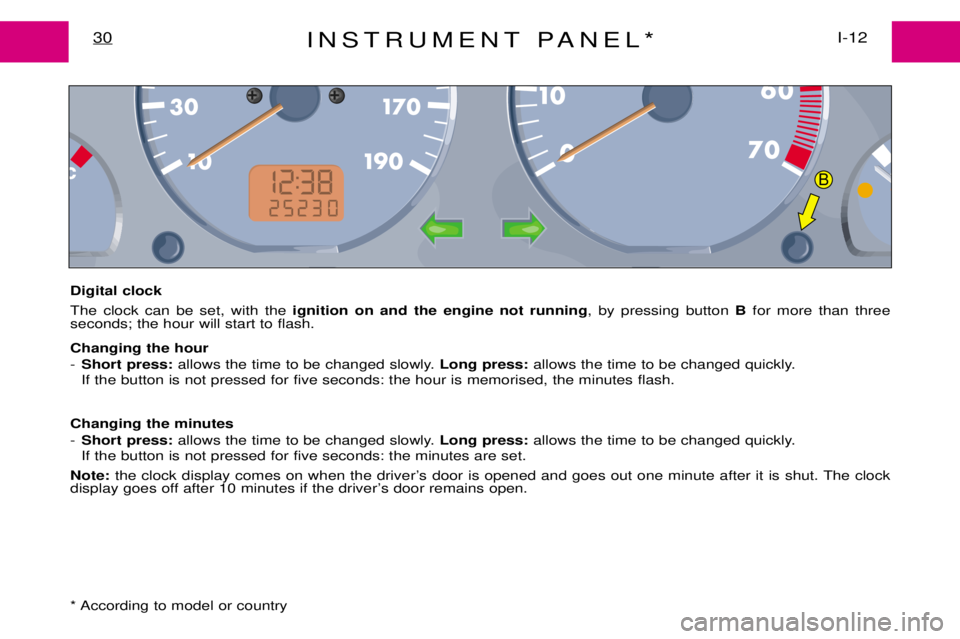
Digital clock The clock can be set, with the ignition on and the engine not running , by pressing button Bfor more than three
seconds; the hour will start to flash. Changing the hour - Short press: allows the time to be changed slowly. Long press:allows the time to be changed quickly.
If the button is not pressed for five seconds: the hour is memorised, the minutes flash.
Changing the minutes- Short press: allows the time to be changed slowly. Long press:allows the time to be changed quickly.
If the button is not pressed for five seconds: the minutes are set.
Note: the clock display comes on when the driverÕs door is opened and goes out one minute after it is shut. The clock
display goes off after 10 minutes if the driverÕs door remains open.
* According to model or country
B
Page 34 of 149

INSTRUMENT PANEL*33I-12
1Left hand air vent
2 Left hand loudspeaker (Tweeter)
3 Cruise control switch
4 Controls for: ¥ Horn¥ Lighting¥ Direction indicators¥ Front foglamps¥ Fog lamps
5 Instrument panel
6 Radio control on steering wheel
7 Controls for:¥ Windscreen wiper¥ Windscreen wash¥ Rear screen wiper
8 Centre air vents
9 Radio housing or oddments pocket
10 Electronic key indicator lamp 11
Passenger Airbag*
12 Right hand loudspeaker
(Tweeter)
13 Right hand air vent
14 Glovebox
15 Controls for:
¥ Air conditioning or heating/
air distribution
16 Front ashtray with cigar lighter
17 Gear lever
18 Controls for:
¥ Air conditioning¥ Hazard warning lamps¥ Rear screen demister
19 Steering lock and ignition switch
20 Fuse box access
21 Driver's airbag 22
Steering column adjustment lever
23 Cruise control lever
24 Controls for:
¥ Adjusting the headlamps¥ Dashboard lighting rheostat
25 Oddments pocket
26 Bonnet release lever
* According to model or country
Page 42 of 149
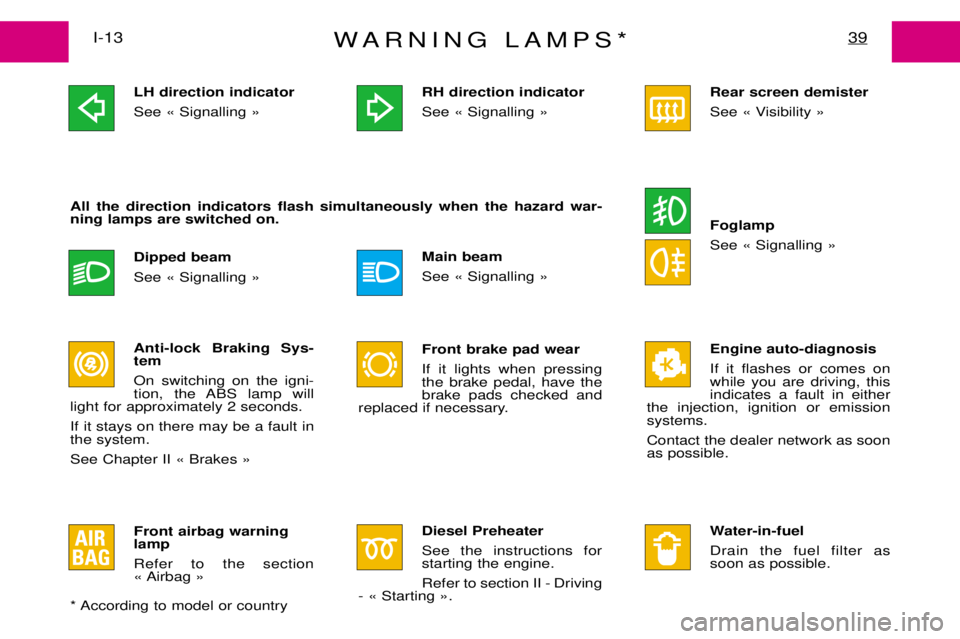
WARNING LAMPS*39I-13LH direction indicator See Ç Signalling È Dipped beam See Ç Signalling È
All the direction indicators flash simultaneously when the hazard war- ning lamps are switched on.
Anti-lock Braking Sys-tem On switching on the igni-
tion, the ABS lamp will
light for approximately 2 seconds. If it stays on there may be a fault in the system. See Chapter II Ç Brakes È RH direction indicatorSee Ç Signalling È Main beam See Ç Signalling È Front brake pad wear If it lights when pressing the brake pedal, have thebrake pads checked and
replaced if necessary.
Diesel Preheater See the instructions for starting the engine. Refer to section II - Driving
- Ç Starting È. Rear screen demister
See Ç Visibility È Foglamp See Ç Signalling È Engine auto-diagnosis If it flashes or comes on while you are driving, thisindicates a fault in either
the injection, ignition or emissionsystems. Contact the dealer network as soon as possible.
Water-in-fuel Drain the fuel filter as soon as possible.
Front airbag warninglamp Refer to the section
Ç Airbag È
* According to model or country
Page 49 of 149
WINDOWS*I-16
46
ALWAYS PAY ATTENTION TO WHERE CHILDREN
ARE WHEN OPENING OR CLOSING WINDOWS.
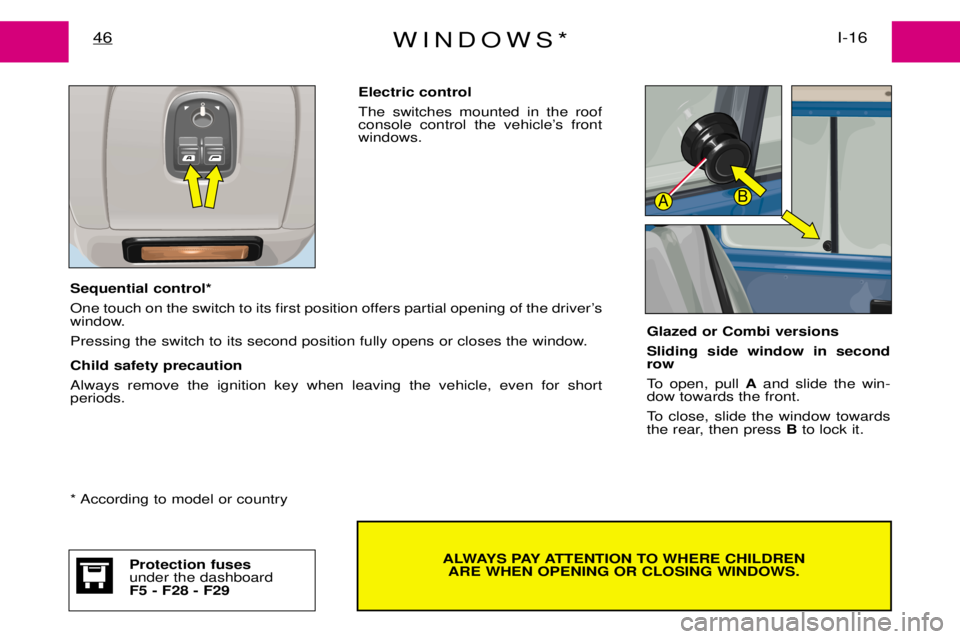
Sequential control*
One touch on the switch to its first position offers partial opening of the driverÕs
window.
Pressing the switch to its second position fully opens or closes the window. Child safety precaution Always remove the ignition key when leaving the vehicle, even for short periods. Electric control The switches mounted in the roof
console control the vehicleÕs frontwindows.
Glazed or Combi versions Sliding side window in second row
To open, pull Aand slide the win-
dow towards the front.
To close, slide the window towards
the rear, then press Bto lock it.
* According to model or countryProtection fuses under the dashboardF5 - F28 - F29
AB
Page 64 of 149
STEERING LOCK - IGNITION - STARTERII-1
50
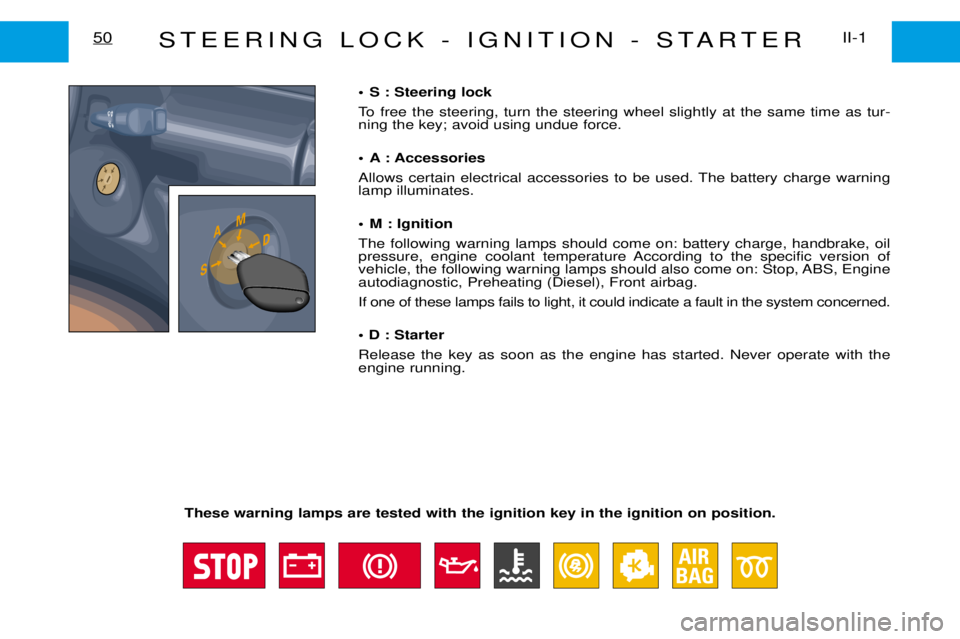
¥ S : Steering lock
To free the steering, turn the steering wheel slightly at the same time as tur- ning the key; avoid using undue force.
¥ A : Accessories
Allows certain electrical accessories to be used. The battery charge warning lamp illuminates.
¥ M : Ignition The following warning lamps should come on: battery charge, handbrake, oil
pressure, engine coolant temperature According to the specific version of
vehicle, the following warning lamps should also come on: Stop, ABS, Engineautodiagnostic, Preheating (Diesel), Front airbag. If one of these lamps fails to light, it could indicate a fault in the system concerned. ¥ D : Starter Release the key as soon as the engine has started. Never operate with the engine running.
These warning lamps are tested with the ignition key in the ignition on position.
Page 65 of 149
STEERING LOCK - IGNITION - STARTER51II-1
WARNING
NEVER REMOVE THE IGNITION KEY BEFORE THE VEHICLE IS COMPLETELY STATIONARY. NEVER ATTEMPT TO MOVE THE VEHICLE BEFORE STARTING THE ENGINE AND WAITING FOR THE HYDRAULIC LOW PRESSURE WAR-
NING LAMP TO GO OUT. IF THE ENGINE IS NOT RUNNING, THE STEERING
WILL NOT HAVE POWER ASSISTANCE AND THERE MAY BE NO RESERVE OF PRESSURE AVAILABLE TO OPERATE THE FOOTBRAKE. THERE IS ALSO ARISK OF THE STEERING LOCK ENGAGING AND THE SAFETY FEATURES NOT OPERATING IF THE IGNITION IS NOT SWITCHED ON. ONLY IN AN
EMERGENCY SITUATION SHOULD YOU ATTEMPT TO MOVE A VEHICLE
WITHOUT STARTING THE ENGINE. TAKE ALL THE NECESSARY SAFETY
PRECAUTIONS AND BE PREPARED TO USE THE PARKING BRAKE TO STOP THE VEHICLE.
When parking, remove the ignition key and turn the steering wheel until the steering column locking peg engages.
Steering lock
S With the key removed and the steering lock peg engaged, the steering column is locked; the lock peg will engage in
a number of positions of the steering wheel. The key can only be removed in position S.
A The steering is unlocked - to enable the key to be turned to position A, it may be necessary to turn the steering slightly.
M Running position.
D Starting position.
For starting and stopping the engine, see Ç Starting È.
Page 69 of 149

BRAKES55II-4
ABS - Anti-lock Braking System* This system improves vehicle safety by preventing the wheels from locking under emergency braking or when
braking on surfaces offering poor adhesion.
It thus also allows control of the steering to be retained. The operation of the various electronic components of the system is continuously monitored, both before and during your
journey. On switching on the ignition, the ABS lamp will light for approximately two seconds. If it stays on or lights when
driving, the ABS computer has detected a fault and has disconnected the ABS system. If the lamp lights whilst driving, it
again indicates that a fault has been detected and that the ABS system is inactive. In both situations, the normal braking
system is not affected and will continue to function as a conventional braking system without ABS. Nevertheless, to re-
establish the full safety features of the ABS system, It is recommended that the vehicle be examined by a dealer as soonas possible.
On slippery roads (loose stones, snow, ice, etc.), it is imperative to drive with caution.
* According to model or country
Protection fuses under the dashboardF12
(under the bonnet)
MF4 (with ABS)