steering PEUGEOT EXPERT DAG 2001 User Guide
[x] Cancel search | Manufacturer: PEUGEOT, Model Year: 2001, Model line: EXPERT DAG, Model: PEUGEOT EXPERT DAG 2001Pages: 149, PDF Size: 5.87 MB
Page 60 of 149
LEVELSIV-5
82
Beware: When working under the bonnet, the cooling fan could operate if the engi-
ne is hot (even when switched off).
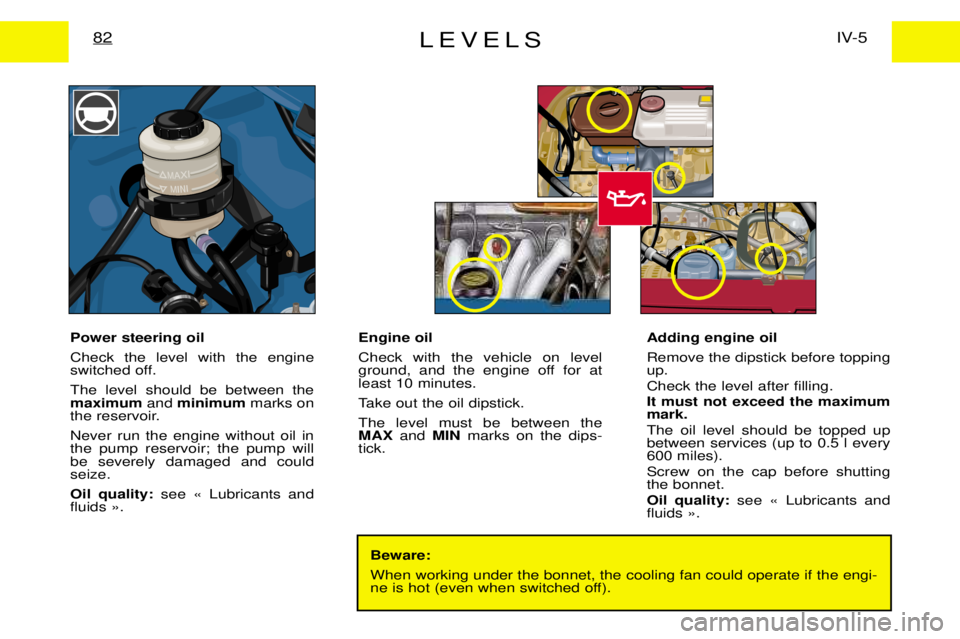
Power steering oil Check the level with the engine
switched off. The level should be between the maximum
and minimum marks on
the reservoir. Never run the engine without oil in the pump reservoir; the pump willbe severely damaged and couldseize. Oil quality: see Ç Lubricants and
fluids È. Engine oilCheck with the vehicle on level
ground, and the engine off for atleast 10 minutes.
Take out the oil dipstick.The level must be between the MAX
and MIN marks on the dips-
tick. Adding engine oil Remove the dipstick before topping up. Check the level after filling.It must not exceed the maximum mark. The oil level should be topped up between services (up to 0.5 l every600 miles). Screw on the cap before shutting the bonnet. Oil quality:
see Ç Lubricants and
fluids È.
Page 64 of 149
STEERING LOCK - IGNITION - STARTERII-1
50
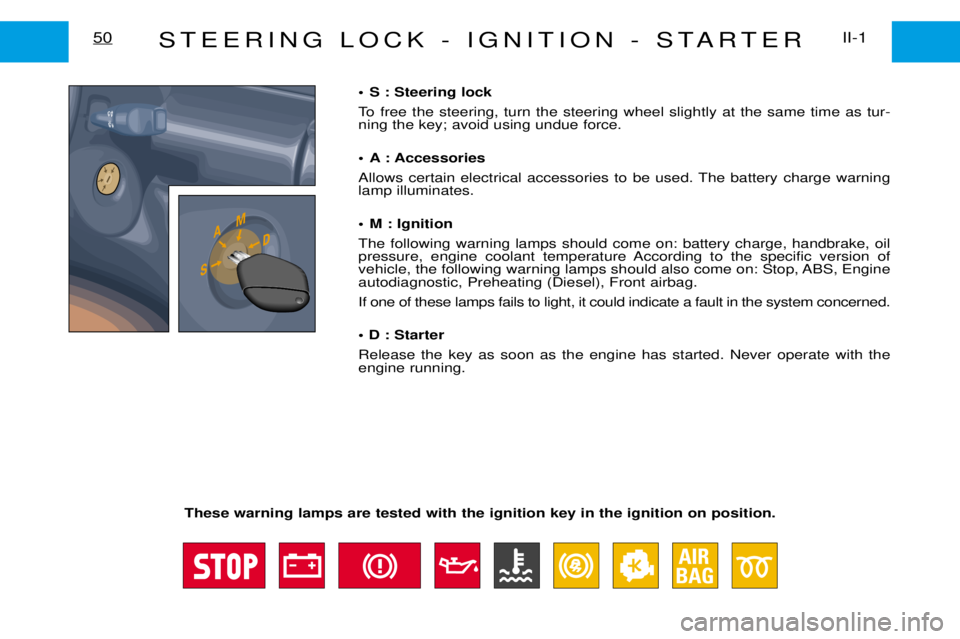
¥ S : Steering lock
To free the steering, turn the steering wheel slightly at the same time as tur- ning the key; avoid using undue force.
¥ A : Accessories
Allows certain electrical accessories to be used. The battery charge warning lamp illuminates.
¥ M : Ignition The following warning lamps should come on: battery charge, handbrake, oil
pressure, engine coolant temperature According to the specific version of
vehicle, the following warning lamps should also come on: Stop, ABS, Engineautodiagnostic, Preheating (Diesel), Front airbag. If one of these lamps fails to light, it could indicate a fault in the system concerned. ¥ D : Starter Release the key as soon as the engine has started. Never operate with the engine running.
These warning lamps are tested with the ignition key in the ignition on position.
Page 65 of 149
STEERING LOCK - IGNITION - STARTER51II-1
WARNING
NEVER REMOVE THE IGNITION KEY BEFORE THE VEHICLE IS COMPLETELY STATIONARY. NEVER ATTEMPT TO MOVE THE VEHICLE BEFORE STARTING THE ENGINE AND WAITING FOR THE HYDRAULIC LOW PRESSURE WAR-
NING LAMP TO GO OUT. IF THE ENGINE IS NOT RUNNING, THE STEERING
WILL NOT HAVE POWER ASSISTANCE AND THERE MAY BE NO RESERVE OF PRESSURE AVAILABLE TO OPERATE THE FOOTBRAKE. THERE IS ALSO ARISK OF THE STEERING LOCK ENGAGING AND THE SAFETY FEATURES NOT OPERATING IF THE IGNITION IS NOT SWITCHED ON. ONLY IN AN
EMERGENCY SITUATION SHOULD YOU ATTEMPT TO MOVE A VEHICLE
WITHOUT STARTING THE ENGINE. TAKE ALL THE NECESSARY SAFETY
PRECAUTIONS AND BE PREPARED TO USE THE PARKING BRAKE TO STOP THE VEHICLE.
When parking, remove the ignition key and turn the steering wheel until the steering column locking peg engages.
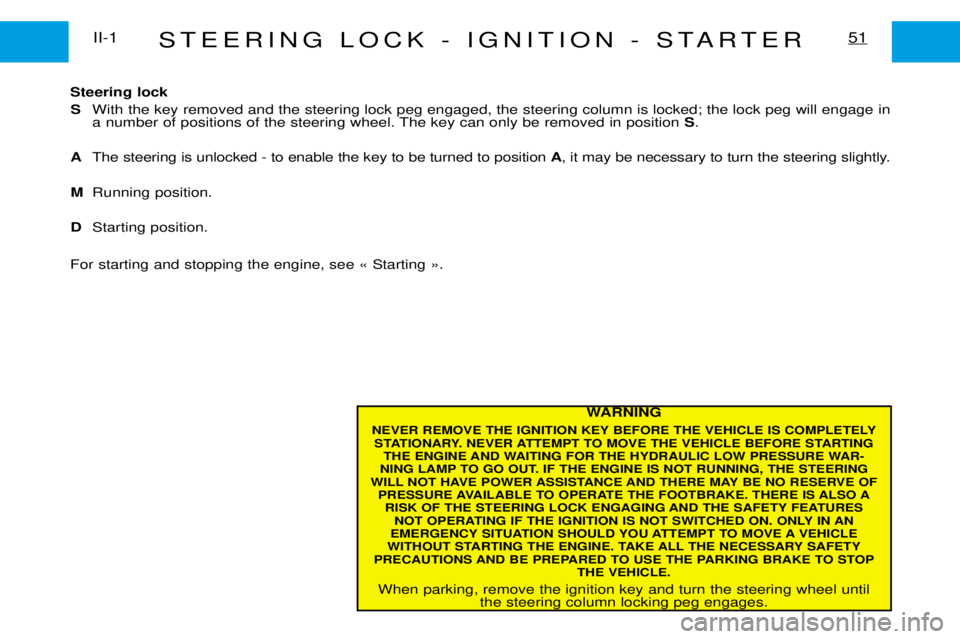
Steering lock
S With the key removed and the steering lock peg engaged, the steering column is locked; the lock peg will engage in
a number of positions of the steering wheel. The key can only be removed in position S.
A The steering is unlocked - to enable the key to be turned to position A, it may be necessary to turn the steering slightly.
M Running position.
D Starting position.
For starting and stopping the engine, see Ç Starting È.
Page 68 of 149
BRAKESII-3
54
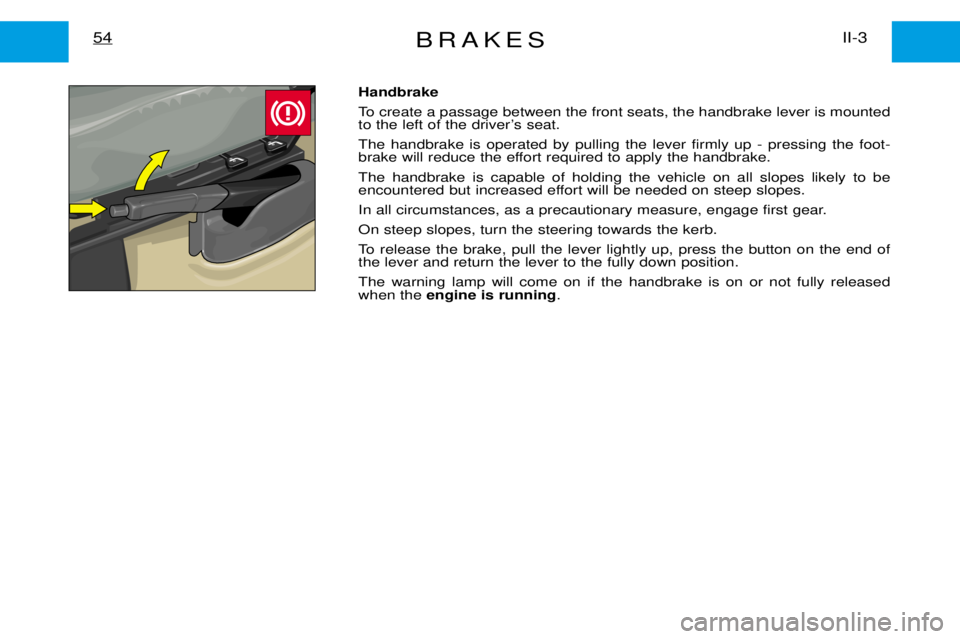
Handbrake
To create a passage between the front seats, the handbrake lever is mounted
to the left of the driverÕs seat. The handbrake is operated by pulling the lever firmly up - pressing the foot-
brake will reduce the effort required to apply the handbrake. The handbrake is capable of holding the vehicle on all slopes likely to be
encountered but increased effort will be needed on steep slopes.
In all circumstances, as a precautionary measure, engage first gear.On steep slopes, turn the steering towards the kerb.
To release the brake, pull the lever lightly up, press the button on the end of the lever and return the lever to the fully down position. The warning lamp will come on if the handbrake is on or not fully released when the engine is running .
Page 69 of 149

BRAKES55II-4
ABS - Anti-lock Braking System* This system improves vehicle safety by preventing the wheels from locking under emergency braking or when
braking on surfaces offering poor adhesion.
It thus also allows control of the steering to be retained. The operation of the various electronic components of the system is continuously monitored, both before and during your
journey. On switching on the ignition, the ABS lamp will light for approximately two seconds. If it stays on or lights when
driving, the ABS computer has detected a fault and has disconnected the ABS system. If the lamp lights whilst driving, it
again indicates that a fault has been detected and that the ABS system is inactive. In both situations, the normal braking
system is not affected and will continue to function as a conventional braking system without ABS. Nevertheless, to re-
establish the full safety features of the ABS system, It is recommended that the vehicle be examined by a dealer as soonas possible.
On slippery roads (loose stones, snow, ice, etc.), it is imperative to drive with caution.
* According to model or country
Protection fuses under the dashboardF12
(under the bonnet)
MF4 (with ABS)
Page 130 of 149
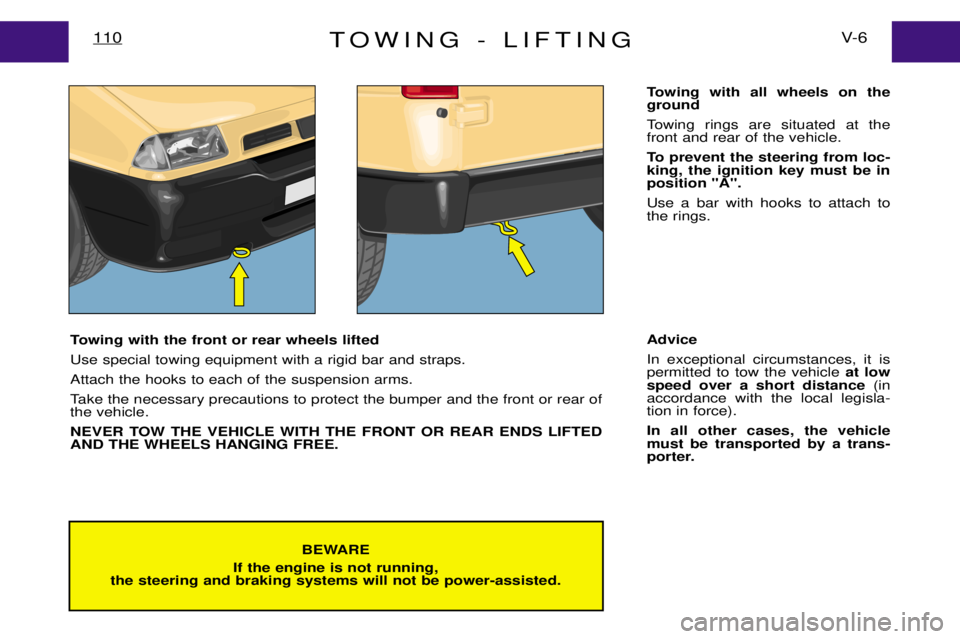
TOWING - LIFTINGV- 6
110
BEWARE
If the engine is not running,
the steering and braking systems will not be power-assisted.
Towing with the front or rear wheels lifted Use special towing equipment with a rigid bar and straps.Attach the hooks to each of the suspension arms.
Take the necessary precautions to protect the bumper and the front or rear of the vehicle.
NEVER TOW THE VEHICLE WITH THE FRONT OR REAR ENDS LIFTED AND THE WHEELS HANGING FREE. Towing with all wheels on theground
Towing rings are situated at the front and rear of the vehicle.
To prevent the steering from loc- king, the ignition key must be inposition "A". Use a bar with hooks to attach to the rings. Advice In exceptional circumstances, it is permitted to tow the vehicle
at low
speed over a short distance (in
accordance with the local legisla-tion in force). In all other cases, the vehicle must be transported by a trans-
porter.
Page 131 of 149
FRONT AIRBAG130
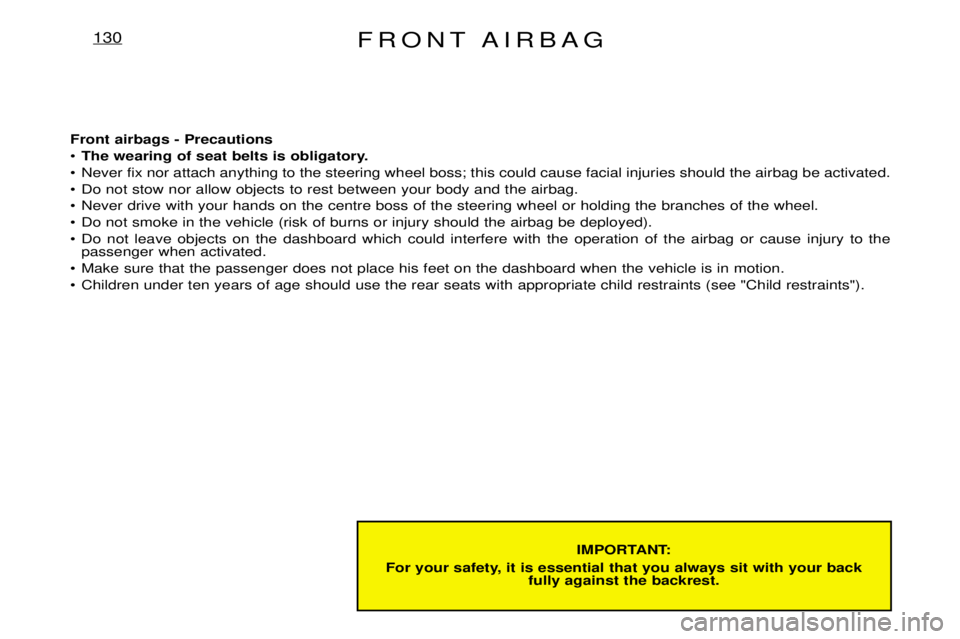
IMPORTANT:
For your safety, it is essential that you always sit with your back fully against the backrest.
Front airbags - Precautions ¥
The wearing of seat belts is obligatory.
¥ Never fix nor attach anything to the steering wheel boss; this could cause facial injuries should the airbag be activated.
¥ Do not stow nor allow objects to rest between your body and the airbag.
¥ Never drive with your hands on the centre boss of the steering wheel or holding the branches of the wheel.
¥ Do not smoke in the vehicle (risk of burns or injury should the airbag be deployed).
¥ Do not leave objects on the dashboard which could interfere with the operation of the airbag or cause injury to the passenger when activated.
¥ Make sure that the passenger does not place his feet on the dashboard when the vehicle is in motion.
¥ Children under ten years of age should use the rear seats with appropriate child restraints (see "Child restraints").
Page 145 of 149
ACCESSORIESVI-6
124
When choosing accessories for your vehicle, you should consult
your dealer. He is in the best position to advise you, as a result of hisproduct knowledge and the close contact maintained with the manu-
facturer.
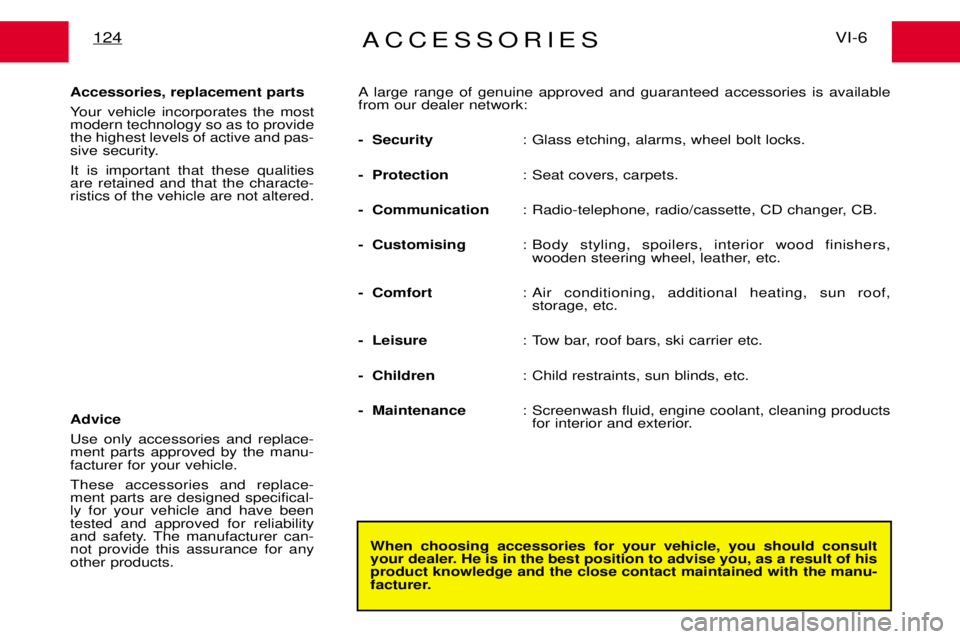
Accessories, replacement parts
Your vehicle incorporates the most modern technology so as to providethe highest levels of active and pas-
sive security. It is important that these qualities are retained and that the characte-ristics of the vehicle are not altered. Advice Use only accessories and replace- ment parts approved by the manu-facturer for your vehicle. These accessories and replace- ment parts are designed specifical-ly for your vehicle and have beentested and approved for reliability
and safety. The manufacturer can-not provide this assurance for anyother products.
A large range of genuine approved and guaranteed accessories is availablefrom our dealer network:
- Security
: Glass etching, alarms, wheel bolt locks.
- Protection : Seat covers, carpets.
- Communication : Radio-telephone, radio/cassette, CD changer, CB.
- Customising : Body styling, spoilers, interior wood finishers,
wooden steering wheel, leather, etc.
- Comfort : Air conditioning, additional heating, sun roof,
storage, etc.
- Leisure : Tow bar, roof bars, ski carrier etc.
- Children : Child restraints, sun blinds, etc.
- Maintenance : Screenwash fluid, engine coolant, cleaning products
for interior and exterior.
Page 149 of 149
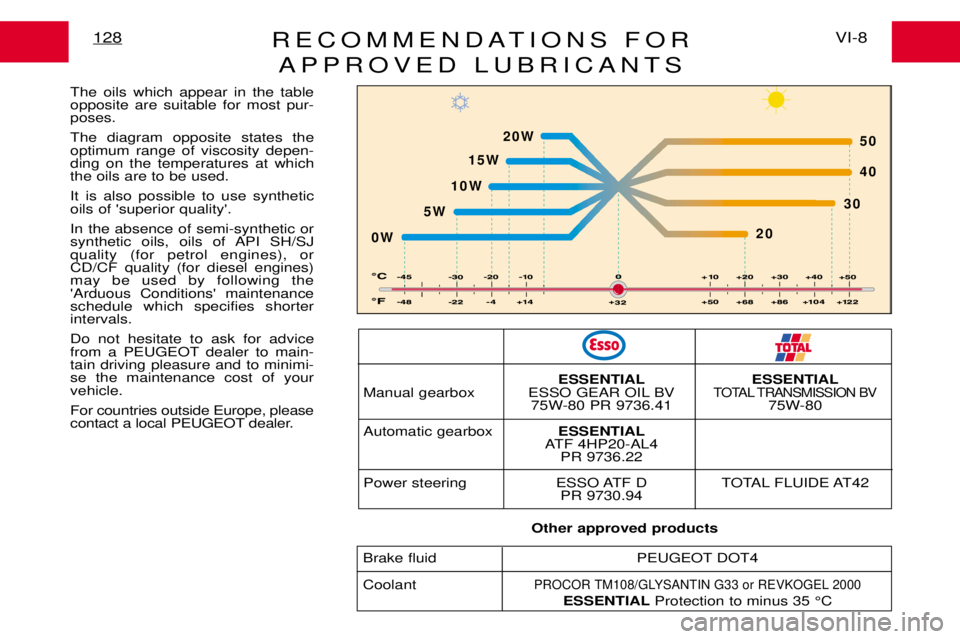
RECOMMENDATIONS FORAPPROVED LUBRICANTSVI-8
128
The oils which appear in the table opposite are suitable for most pur-poses. The diagram opposite states the optimum range of viscosity depen-ding on the temperatures at whichthe oils are to be used. It is also possible to use synthetic oils of 'superior quality'. In the absence of semi-synthetic or
synthetic oils, oils of API SH/SJquality (for petrol engines), orCD/CF quality (for diesel engines)may be used by following the'Arduous Conditions' maintenanceschedule which specifies shorterintervals. Do not hesitate to ask for advice
from a PEUGEOT dealer to main-tain driving pleasure and to minimi-se the maintenance cost of yourvehicle. For countries outside Europe, please
contact a local PEUGEOT dealer.
0 W2 0 4 0
5 0
2 0 W
1 5 W
1 0 W
5 W
3 0
ESSENTIAL ESSENTIAL
Manual gearbox ESSO GEAR OIL BVTOTAL TRANSMISSION BV75W-80 PR 9736.41 75W-80
Automatic gearbox ESSENTIAL
ATF 4HP20-AL4 PR 9736.22
Power steering ESSO ATF D TOTAL FLUIDE AT42 PR 9730.94
Other approved products
Brake fluid PEUGEOT DOT4 Coolant
PROCOR TM108/GLYSANTIN G33 or REVKOGEL 2000
ESSENTIAL Protection to minus 35 ¡C