warning PEUGEOT EXPERT DAG 2001 User Guide
[x] Cancel search | Manufacturer: PEUGEOT, Model Year: 2001, Model line: EXPERT DAG, Model: PEUGEOT EXPERT DAG 2001Pages: 149, PDF Size: 5.87 MB
Page 43 of 149
WARNING LAMPS*I-13
40
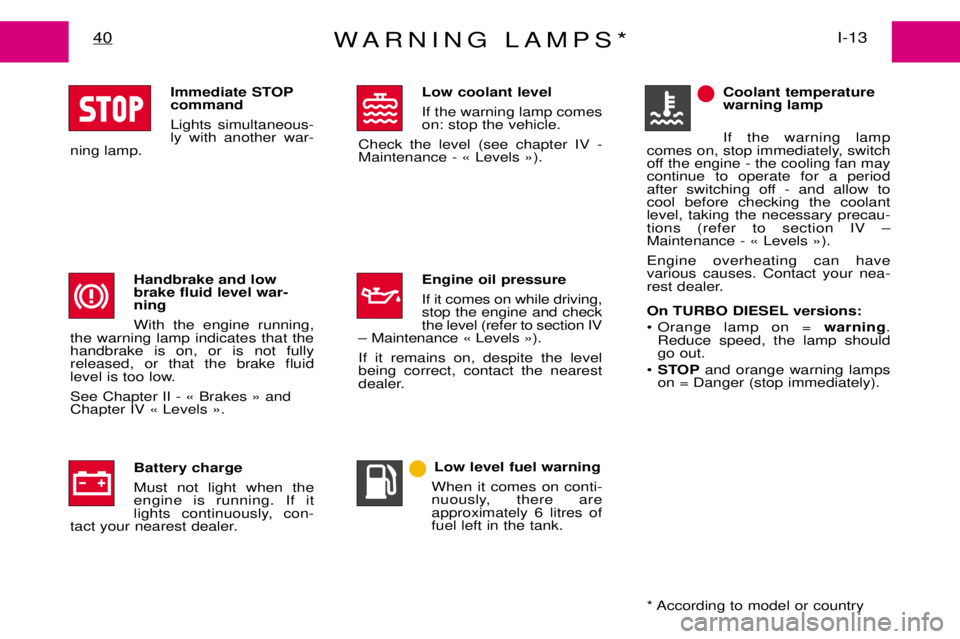
Immediate STOP command Lights simultaneous- ly with another war-
ning lamp.
Handbrake and lowbrake fluid level war-ning With the engine running,
the warning lamp indicates that the handbrake is on, or is not fullyreleased, or that the brake fluid
level is too low. See Chapter II - Ç Brakes È and Chapter IV Ç Levels È.
Battery charge Must not light when the engine is running. If it
lights continuously, con-
tact your nearest dealer. Low coolant level If the warning lamp comes on: stop the vehicle.
Check the level (see chapter IV -Maintenance - Ç Levels È).
Engine oil pressure If it comes on while driving, stop the engine and checkthe level (refer to section IV
Ð Maintenance Ç Levels È). If it remains on, despite the level being correct, contact the nearest
dealer.
Low level fuel warning
When it comes on conti-
nuously, there areapproximately 6 litres offuel left in the tank. Coolant temperaturewarning lamp If the warning lamp
comes on, stop immediately, switch
off the engine - the cooling fan maycontinue to operate for a period
after switching off - and allow tocool before checking the coolantlevel, taking the necessary precau-tions (refer to section IV ÐMaintenance - Ç Levels È). Engine overheating can have various causes. Contact your nea-
rest dealer.
On TURBO DIESEL versions:
¥ Orange lamp on = warning.
Reduce speed, the lamp should go out.
¥ STOP and orange warning lamps
on = Danger (stop immediately).
* According to model or country
Page 44 of 149
SIGNALLING*41I-14
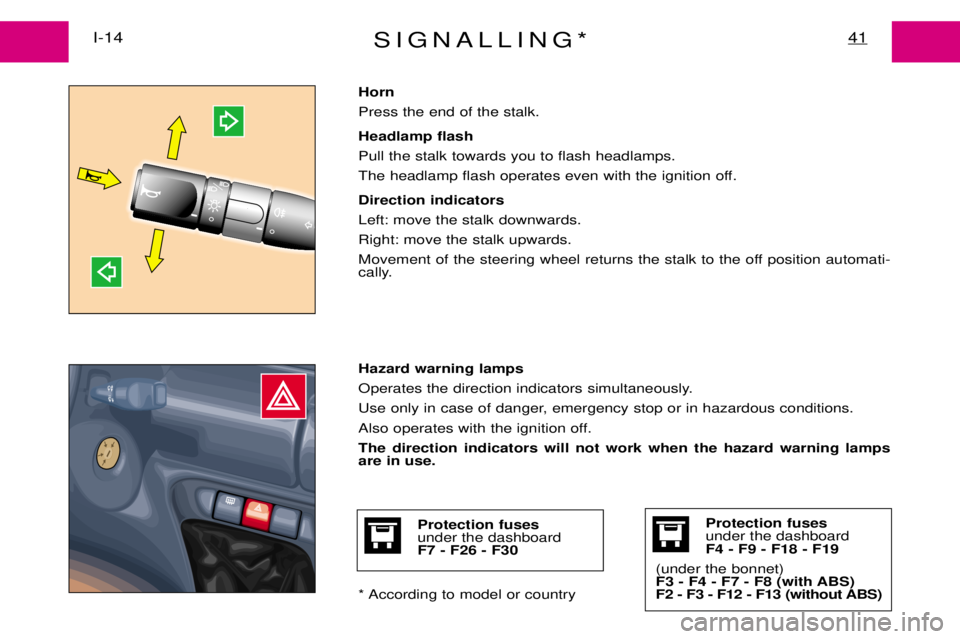
Horn Press the end of the stalk. Headlamp flash Pull the stalk towards you to flash headlamps.
The headlamp flash operates even with the ignition off. Direction indicators Left: move the stalk downwards.Right: move the stalk upwards.
Movement of the steering wheel returns the stalk to the off position automati-
cally. Hazard warning lamps
Operates the direction indicators simultaneously.
Use only in case of danger, emergency stop or in hazardous conditions.
Also operates with the ignition off.The direction indicators will not work when the hazard warning lamps are in use.
* According to model or country
Protection fuses under the dashboardF7 - F26 - F30Protection fuses under the dashboardF4 - F9 - F18 - F19
(under the bonnet)
F3 - F4 - F7 - F8 (with ABS)
F2 - F3 - F12 - F13 (without ABS)
Page 53 of 149
CHECKS*
Beware:When working under the bonnet, the cooling fan could operate if
the engine is hot (even when switched off). The engine oil level should be checked frequently between services (as recommended by the manufacturer), as well as before long journeys.
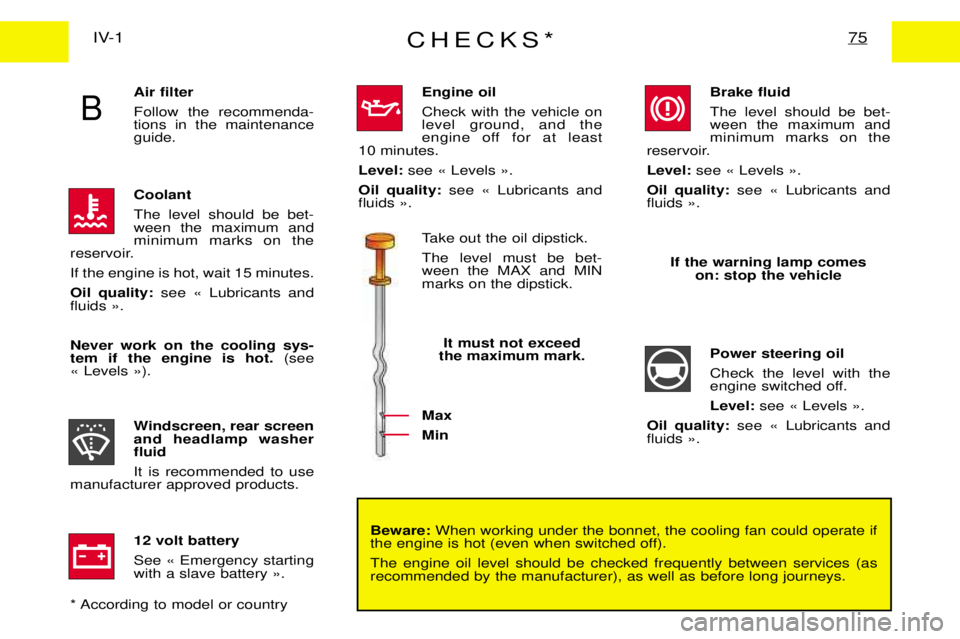
Air filter Follow the recommenda- tions in the maintenanceguide. Coolant The level should be bet- ween the maximum andminimum marks on the
reservoir. If the engine is hot, wait 15 minutes.Oil quality: see Ç Lubricants and
fluids È. Never work on the cooling sys- tem if the engine is hot. (see
Ç Levels È).
Windscreen, rear screenand headlamp washerfluid It is recommended to use
manufacturer approved products.
12 volt batterySee Ç Emergency starting with a slave battery È. Engine oil Check with the vehicle on level ground, and the
engine off for at least
10 minutes. Level: see Ç Levels È.
Oil quality: see Ç Lubricants and
fluids È.
Take out the oil dipstick.The level must be bet- ween the MAX and MINmarks on the dipstick.
It must not exceed
the maximum mark. Brake fluid The level should be bet- ween the maximum andminimum marks on the
reservoir. Level: see Ç Levels È.
Oil quality: see Ç Lubricants and
fluids È.
If the warning lamp comes on: stop the vehicle
Power steering oilCheck the level with the
engine switched off. Level: see Ç Levels È.
Oil quality: see Ç Lubricants and
fluids È.
MaxMin
* According to model or country
75IV-1
B
Page 55 of 149
CHECKS*77IV-2Beware:When working under the bonnet, the cooling fan could operate if
the engine is hot (even when switched off). The engine oil level should be checked frequently between services (as recommended by the manufacturer), as well as before long journeys.
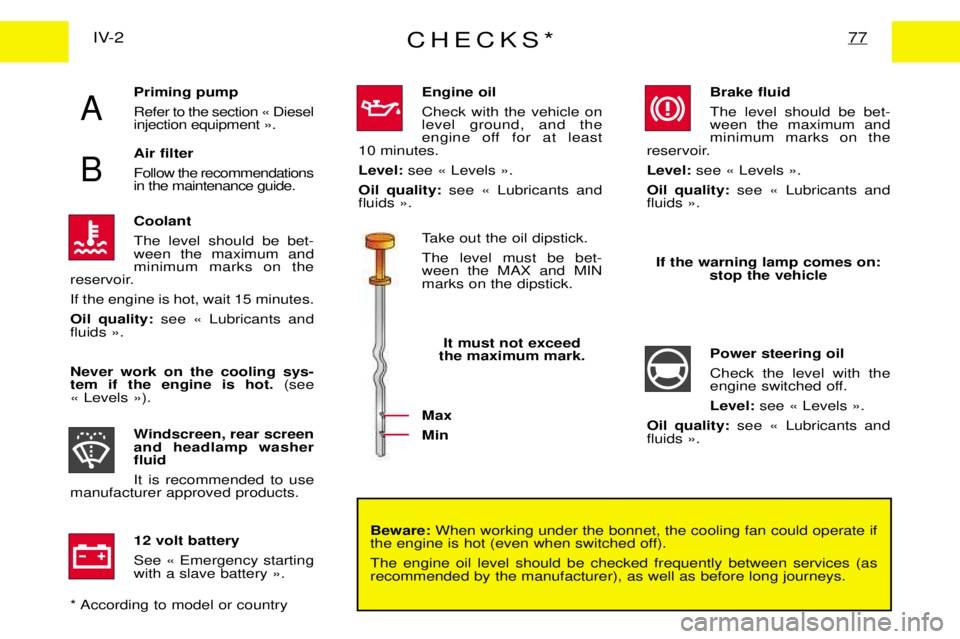
Priming pump Refer to the section Ç Diesel injection equipment È. Coolant The level should be bet- ween the maximum andminimum marks on the
reservoir. If the engine is hot, wait 15 minutes.Oil quality: see Ç Lubricants and
fluids È. Never work on the cooling sys- tem if the engine is hot. (see
Ç Levels È).
Windscreen, rear screenand headlamp washerfluid It is recommended to use
manufacturer approved products.
12 volt batterySee Ç Emergency starting with a slave battery È. Engine oil Check with the vehicle on level ground, and the
engine off for at least
10 minutes. Level: see Ç Levels È.
Oil quality: see Ç Lubricants and
fluids È.
Take out the oil dipstick.The level must be bet- ween the MAX and MINmarks on the dipstick.
It must not exceed
the maximum mark. Brake fluid The level should be bet- ween the maximum andminimum marks on the
reservoir. Level: see Ç Levels È.
Oil quality: see Ç Lubricants and
fluids È.
If the warning lamp comes on: stop the vehicle
Power steering oilCheck the level with the
engine switched off. Level: see Ç Levels È.
Oil quality: see Ç Lubricants and
fluids È.
Air filterFollow the recommendations in the maintenance guide.
Max Min
* According to model or country
A
B
Page 57 of 149
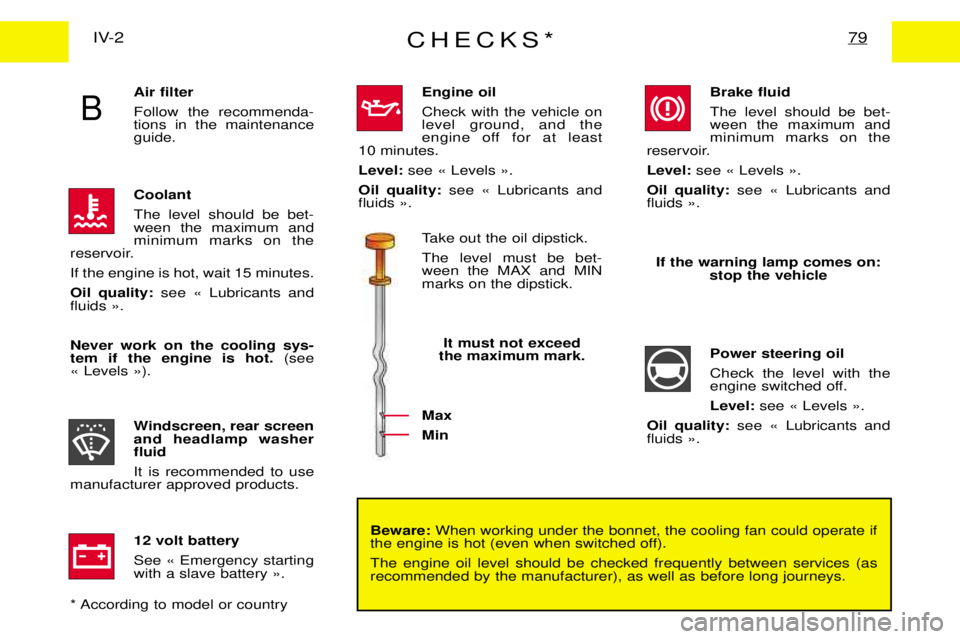
CHECKS*79IV-2Beware:When working under the bonnet, the cooling fan could operate if
the engine is hot (even when switched off). The engine oil level should be checked frequently between services (as recommended by the manufacturer), as well as before long journeys.
Air filter Follow the recommenda- tions in the maintenanceguide. Coolant The level should be bet- ween the maximum andminimum marks on the
reservoir. If the engine is hot, wait 15 minutes.Oil quality: see Ç Lubricants and
fluids È. Never work on the cooling sys- tem if the engine is hot. (see
Ç Levels È).
Windscreen, rear screenand headlamp washerfluid It is recommended to use
manufacturer approved products.
12 volt batterySee Ç Emergency starting with a slave battery È. Engine oil Check with the vehicle on level ground, and the
engine off for at least
10 minutes. Level: see Ç Levels È.
Oil quality: see Ç Lubricants and
fluids È.
Take out the oil dipstick.The level must be bet- ween the MAX and MINmarks on the dipstick.
It must not exceed
the maximum mark. Brake fluid The level should be bet- ween the maximum andminimum marks on the
reservoir. Level: see Ç Levels È.
Oil quality: see Ç Lubricants and
fluids È.
If the warning lamp comes on: stop the vehicle
Power steering oilCheck the level with the
engine switched off. Level: see Ç Levels È.
Oil quality: see Ç Lubricants and
fluids È.
MaxMin
* According to model or country
B
Page 62 of 149
LEVELSIV-5
84
Beware: When working under the bonnet, the cooling fan could operate if the engi-
ne is hot (even when switched off).
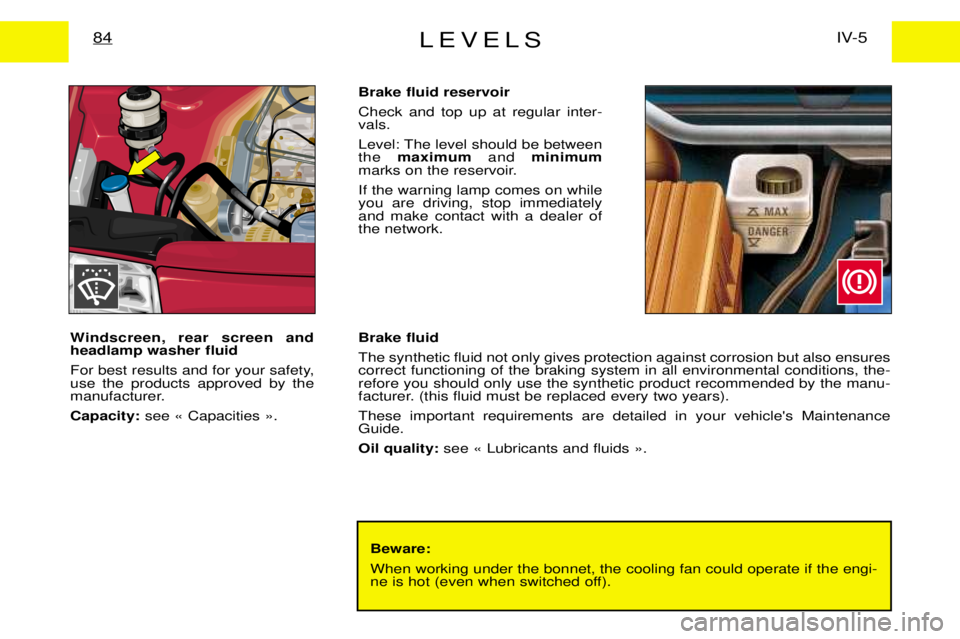
Windscreen, rear screen andheadlamp washer fluid
For best results and for your safety, use the products approved by the
manufacturer. Capacity:
see Ç Capacities È. Brake fluidThe synthetic fluid not only gives protection against corrosion but also ensures correct functioning of the braking system in all environmental conditions, the-refore you should only use the synthetic product recommended by the manu-
facturer. (this fluid must be replaced every two years). These important requirements are detailed in your vehicle's Maintenance Guide. Oil quality:
see Ç Lubricants and fluids È.
Brake fluid reservoirCheck and top up at regular inter- vals.
Level: The level should be between the
maximum and minimum
marks on the reservoir. If the warning lamp comes on while you are driving, stop immediatelyand make contact with a dealer ofthe network.
Page 64 of 149
STEERING LOCK - IGNITION - STARTERII-1
50
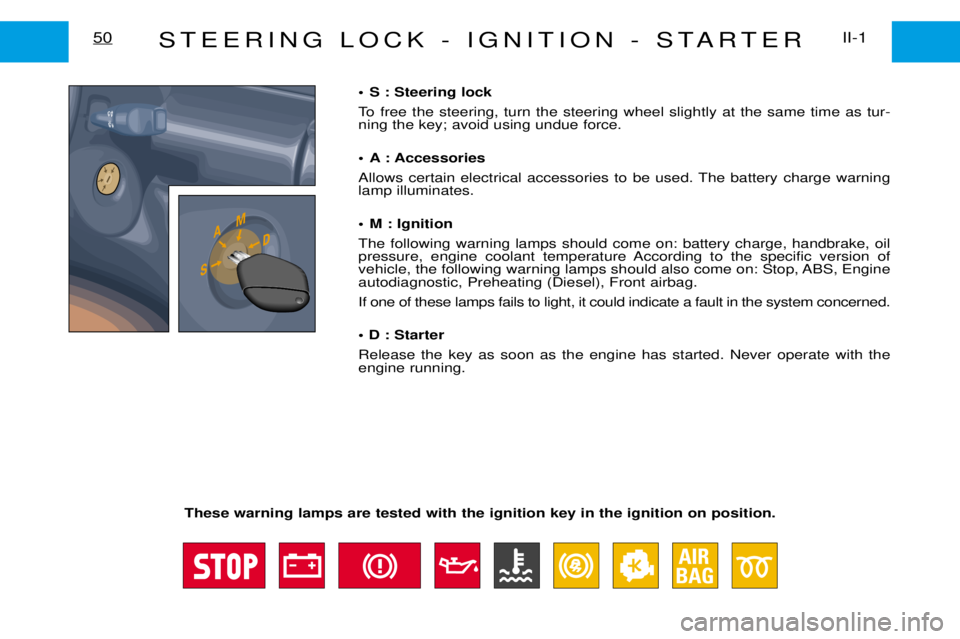
¥ S : Steering lock
To free the steering, turn the steering wheel slightly at the same time as tur- ning the key; avoid using undue force.
¥ A : Accessories
Allows certain electrical accessories to be used. The battery charge warning lamp illuminates.
¥ M : Ignition The following warning lamps should come on: battery charge, handbrake, oil
pressure, engine coolant temperature According to the specific version of
vehicle, the following warning lamps should also come on: Stop, ABS, Engineautodiagnostic, Preheating (Diesel), Front airbag. If one of these lamps fails to light, it could indicate a fault in the system concerned. ¥ D : Starter Release the key as soon as the engine has started. Never operate with the engine running.
These warning lamps are tested with the ignition key in the ignition on position.
Page 65 of 149
STEERING LOCK - IGNITION - STARTER51II-1
WARNING
NEVER REMOVE THE IGNITION KEY BEFORE THE VEHICLE IS COMPLETELY STATIONARY. NEVER ATTEMPT TO MOVE THE VEHICLE BEFORE STARTING THE ENGINE AND WAITING FOR THE HYDRAULIC LOW PRESSURE WAR-
NING LAMP TO GO OUT. IF THE ENGINE IS NOT RUNNING, THE STEERING
WILL NOT HAVE POWER ASSISTANCE AND THERE MAY BE NO RESERVE OF PRESSURE AVAILABLE TO OPERATE THE FOOTBRAKE. THERE IS ALSO ARISK OF THE STEERING LOCK ENGAGING AND THE SAFETY FEATURES NOT OPERATING IF THE IGNITION IS NOT SWITCHED ON. ONLY IN AN
EMERGENCY SITUATION SHOULD YOU ATTEMPT TO MOVE A VEHICLE
WITHOUT STARTING THE ENGINE. TAKE ALL THE NECESSARY SAFETY
PRECAUTIONS AND BE PREPARED TO USE THE PARKING BRAKE TO STOP THE VEHICLE.
When parking, remove the ignition key and turn the steering wheel until the steering column locking peg engages.
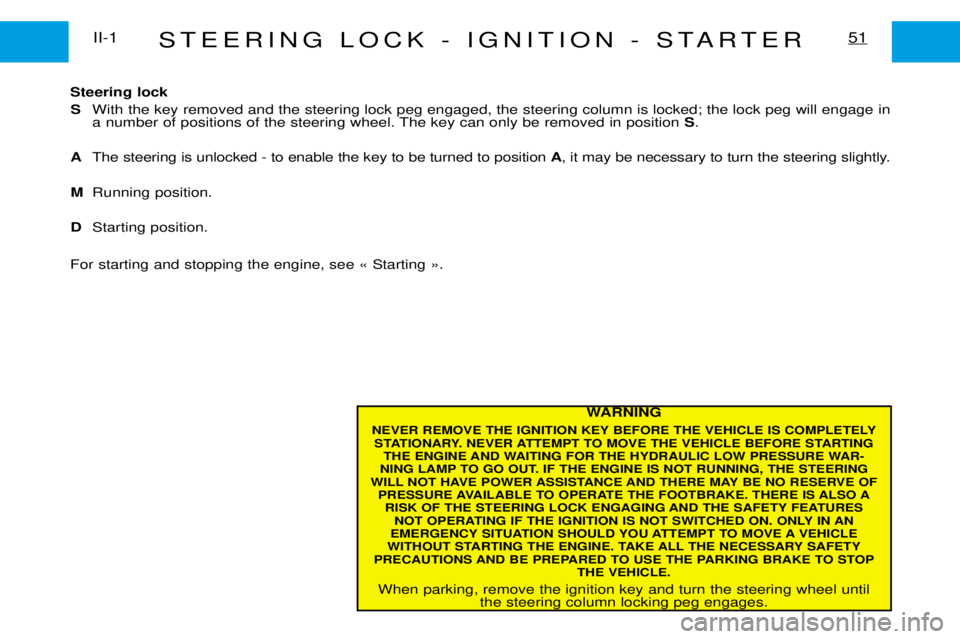
Steering lock
S With the key removed and the steering lock peg engaged, the steering column is locked; the lock peg will engage in
a number of positions of the steering wheel. The key can only be removed in position S.
A The steering is unlocked - to enable the key to be turned to position A, it may be necessary to turn the steering slightly.
M Running position.
D Starting position.
For starting and stopping the engine, see Ç Starting È.
Page 67 of 149
STARTING53II-2
WARNING
DO NOT RUN THE ENGINE IN AN ENCLOSED OR POORLY VENTILATED AREA
DIESEL Starting the engine
Turn the ignition key to the ignition position. Wait for the preheater lamp to go out, then operate the starter motor until the engine starts.
If the engine does not start, switch off the ignition and start again.At temperatures below 0¡C, depress the clutch pedal to ease starting. Release the pedal slowly when the engine has started. Note:
Do not depress the accelerator pedal while operating the starter.
Advice
Vehicles equipped with a Turbo:
Turbo equipped engines MUST be allowed to return to idle for several seconds before switching off the ignition. Failure to do so could cause serious damage to the turbo unit.
Flicking the throttle pedal as the ignition is turned off can lead to severe damage to the turbo unit.
Page 68 of 149
BRAKESII-3
54
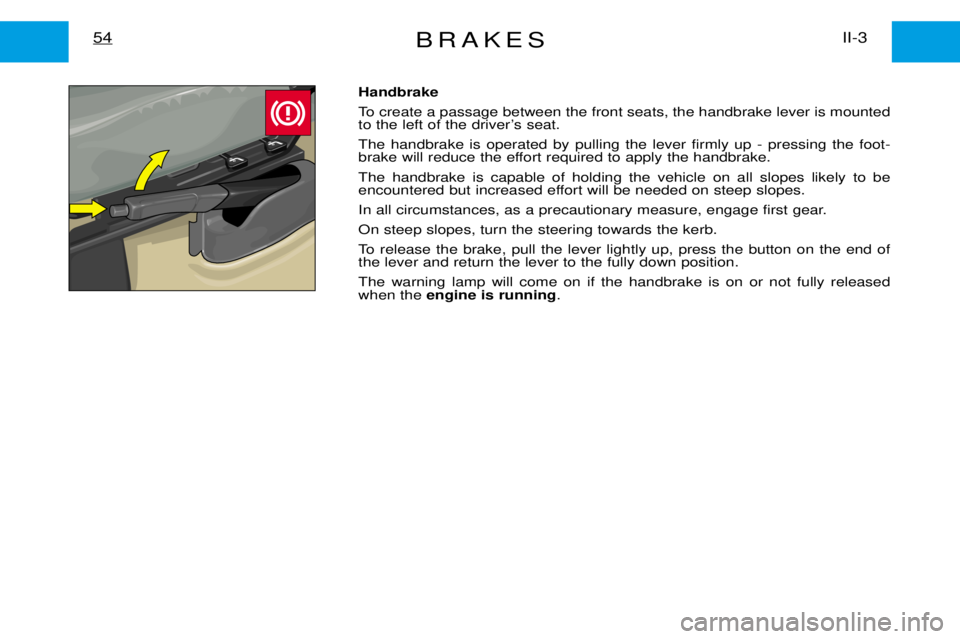
Handbrake
To create a passage between the front seats, the handbrake lever is mounted
to the left of the driverÕs seat. The handbrake is operated by pulling the lever firmly up - pressing the foot-
brake will reduce the effort required to apply the handbrake. The handbrake is capable of holding the vehicle on all slopes likely to be
encountered but increased effort will be needed on steep slopes.
In all circumstances, as a precautionary measure, engage first gear.On steep slopes, turn the steering towards the kerb.
To release the brake, pull the lever lightly up, press the button on the end of the lever and return the lever to the fully down position. The warning lamp will come on if the handbrake is on or not fully released when the engine is running .