ignition PEUGEOT EXPERT DAG 2001 Owner's Guide
[x] Cancel search | Manufacturer: PEUGEOT, Model Year: 2001, Model line: EXPERT DAG, Model: PEUGEOT EXPERT DAG 2001Pages: 149, PDF Size: 5.87 MB
Page 109 of 149
BATTERY137
BEWARE
Never expose a battery to a naked flame or spark (explosive gases present).
The battery contains dilute sulphuric acid which is corrosive. When handling a battery, protect the hands, eyes and face. In case of contact with the skin, rinse immediately and abundantly with clean water.
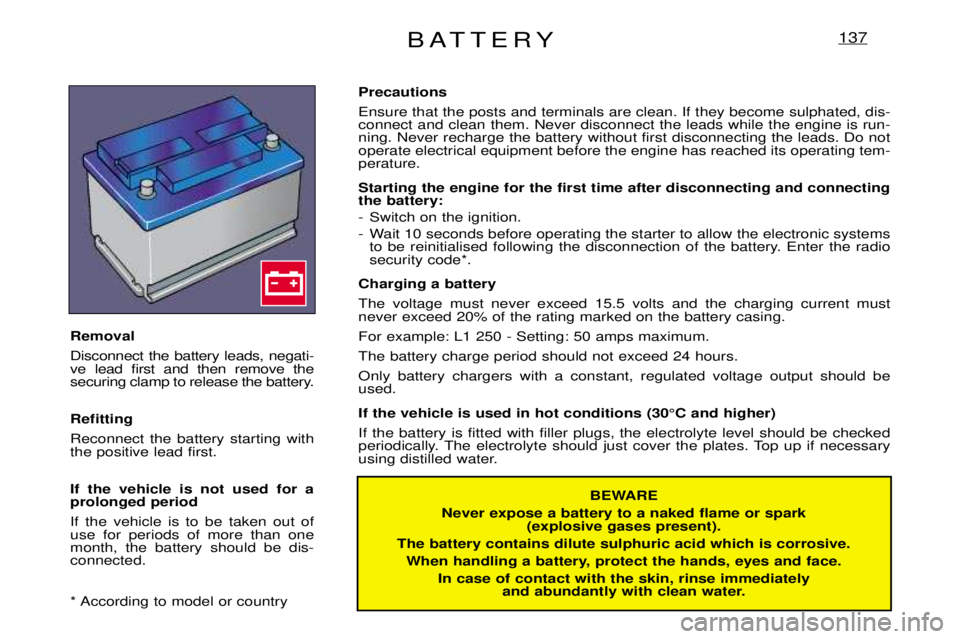
Removal Disconnect the battery leads, negati- ve lead first and then remove the
securing clamp to release the battery. Refitting Reconnect the battery starting with the positive lead first. If the vehicle is not used for a prolonged period If the vehicle is to be taken out of use for periods of more than onemonth, the battery should be dis-connected.
* According to model or country Precautions Ensure that the posts and terminals are clean. If they become sulphated, dis- connect and clean them. Never disconnect the leads while the engine is run-ning. Never recharge the battery without first disconnecting the leads. Do notoperate electrical equipment before the engine has reached its operating tem-perature. Starting the engine for the first time after disconnecting and connecting the battery:
- Switch on the ignition.
- Wait 10 seconds before operating the starter to allow the electronic systems
to be reinitialised following the disconnection of the battery. Enter the radio security code*.
Charging a battery The voltage must never exceed 15.5 volts and the charging current must never exceed 20% of the rating marked on the battery casing. For example: L1 250 - Setting: 50 amps maximum.The battery charge period should not exceed 24 hours.Only battery chargers with a constant, regulated voltage output should be used. If the vehicle is used in hot conditions (30¡C and higher) If the battery is fitted with filler plugs, the electrolyte level should be checked
periodically. The electrolyte should just cover the plates. Top up if necessary
using distilled water.
Page 111 of 149
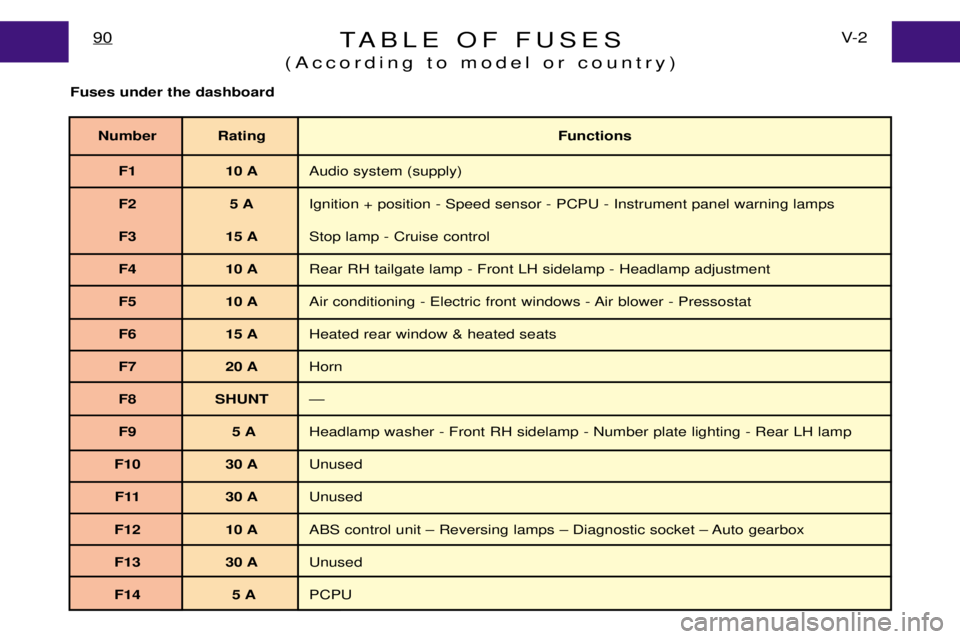
TABLE OF FUSES
(According to model or country)V- 2
90
Fuses under the dashboard
Number Rating Functions
F1 10 A Audio system (supply)
F2 5 A Ignition + position - Speed sensor - PCPU - Instrument panel warning lamps
F3 15 A Stop lamp - Cruise control
F4 10 A Rear RH tailgate lamp - Front LH sidelamp - Headlamp adjustment
F5 10 A Air conditioning - Electric front windows - Air blower - Pressostat
F6 15 A Heated rear window & heated seats
F7 20 A Horn
F8 SHUNT Ñ
F9 5 A Headlamp washer - Front RH sidelamp - Number plate lighting - Rear LH lamp
F10 30 A Unused
F11 30 A Unused
F12 10 A ABS control unit Ð Reversing lamps Ð Diagnostic socket Ð Auto gearbox
F13 30 A Unused
F14 5 A PCPU
Page 127 of 149
CHANGING A WHEEL107V- 5
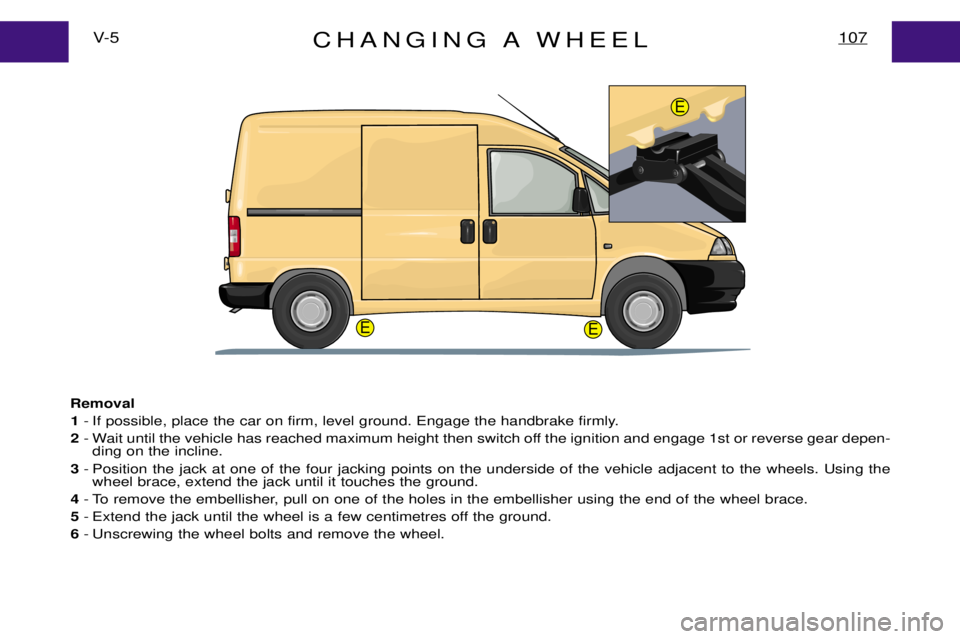
Removal1 - If possible, place the car on firm, level ground. Engage the handbrake firmly.
2 - Wait until the vehicle has reached maximum height then switch off the ignition and engage 1st or reverse gear depen-
ding on the incline.
3 - Position the jack at one of the four jacking points on the underside of the vehicle adjacent to the wheels. Using the
wheel brace, extend the jack until it touches the ground.
4 - To remove the embellisher, pull on one of the holes in the embellisher using the end of the wheel brace.
5 - Extend the jack until the wheel is a few centimetres off the ground.
6 - Unscrewing the wheel bolts and remove the wheel.
EE
E
Page 130 of 149
TOWING - LIFTINGV- 6
110
BEWARE
If the engine is not running,
the steering and braking systems will not be power-assisted.
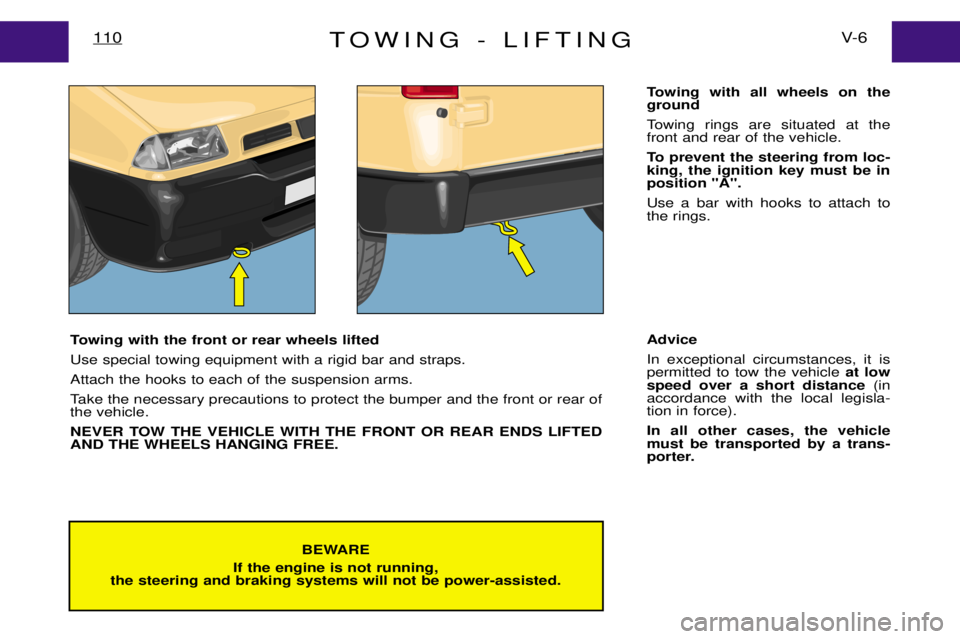
Towing with the front or rear wheels lifted Use special towing equipment with a rigid bar and straps.Attach the hooks to each of the suspension arms.
Take the necessary precautions to protect the bumper and the front or rear of the vehicle.
NEVER TOW THE VEHICLE WITH THE FRONT OR REAR ENDS LIFTED AND THE WHEELS HANGING FREE. Towing with all wheels on theground
Towing rings are situated at the front and rear of the vehicle.
To prevent the steering from loc- king, the ignition key must be inposition "A". Use a bar with hooks to attach to the rings. Advice In exceptional circumstances, it is permitted to tow the vehicle
at low
speed over a short distance (in
accordance with the local legisla-tion in force). In all other cases, the vehicle must be transported by a trans-
porter.