brake Peugeot Expert Tepee 2013 User Guide
[x] Cancel search | Manufacturer: PEUGEOT, Model Year: 2013, Model line: Expert Tepee, Model: Peugeot Expert Tepee 2013Pages: 260, PDF Size: 9.78 MB
Page 91 of 260
89
Rear suspension
EASE OF USE and COMFOR
T
3
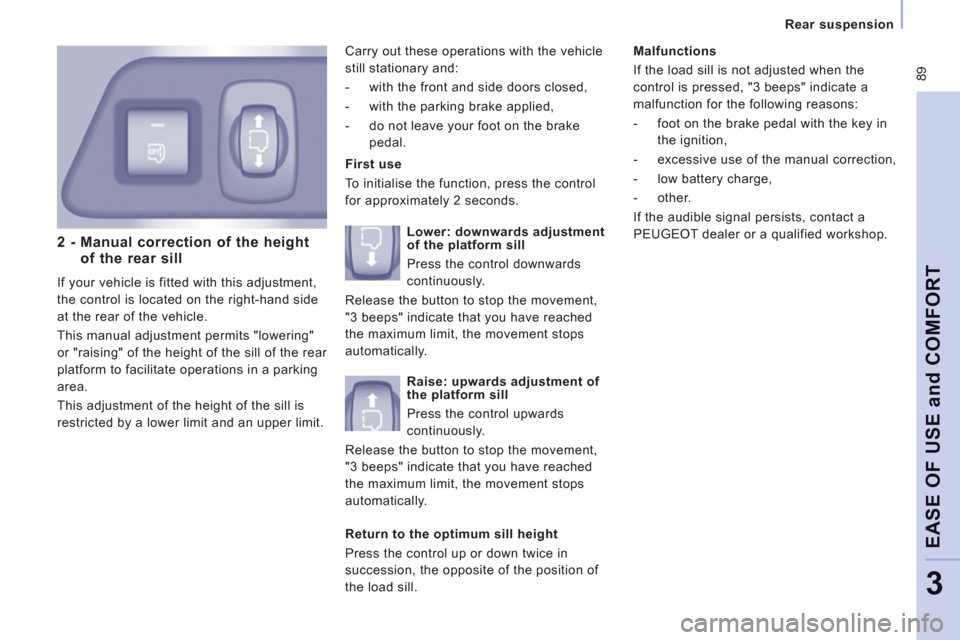
2 - Manual correction of the height
of the rear sill
If your vehicle is fitted with this adjustment,
the control is located on the right-hand side
at the rear of the vehicle.
This manual adjustment permits "lowering"
or "raising" of the height of the sill of the rear
platform to facilitate operations in a parking
area.
This adjustment of the height of the sill is
restricted by a lower limit and an upper limit.
First use
To initialise the function, press the control
for approximately 2 seconds.
Malfunctions
If the load sill is not adjusted when the
control is pressed, "3 beeps" indicate a
malfunction for the following reasons:
- foot on the brake pedal with the key in
the ignition,
- excessive use of the manual correction,
- low battery charge,
- other.
If the audible signal persists, contact a
PEUGEOT dealer or a qualified workshop. Carry out these operations with the vehicle
still stationary and:
- with the front and side doors closed,
- with the parking brake applied,
- do not leave your foot on the brake
pedal.
Lower: downwards adjustment
of the platform sill
Press the control downwards
continuously.
Release the button to stop the movement,
"3 beeps" indicate that you have reached
the maximum limit, the movement stops
automatically.
Raise: upwards adjustment of
the platform sill
Press the control upwards
continuously.
Release the button to stop the movement,
"3 beeps" indicate that you have reached
the maximum limit, the movement stops
automatically.
Return to the optimum sill height
Press the control up or down twice in
succession, the opposite of the position of
the load sill.
Page 96 of 260
94
Driving safely
PARKING BRAKE There is no advantage in engaging a gear after parking
the vehicle, particularly if the vehicle is loaded. HAZARD WARNING LAMPS
Press this button, the direction indicators
flash.
They can operate with the ignition off.
The hazard warning lamps should only be
used in dangerous situations, when stopping
in an emergency or when driving in unusual
conditions.
DRIVING SAFELY
Applying
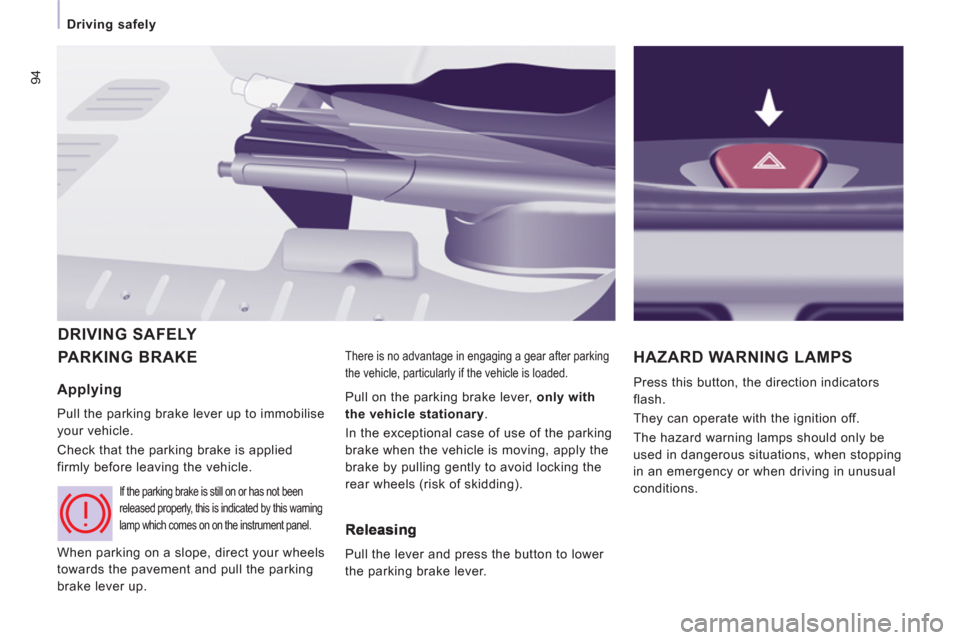
Pull the parking brake lever up to immobilise
your vehicle.
Check that the parking brake is applied
firmly before leaving the vehicle.
If the parking brake is still on or has not been
released properly, this is indicated by this warning
lamp which comes on on the instrument panel.
Pull on the parking brake lever, only with
the vehicle stationary
.
In the exceptional case of use of the parking
brake when the vehicle is moving, apply the
brake by pulling gently to avoid locking the
rear wheels (risk of skidding).
When parking on a slope, direct your wheels
towards the pavement and pull the parking
brake lever up.
Pull the lever and press the button to lower
the parking brake lever.
Page 98 of 260
ABS
ABS
Driving safely
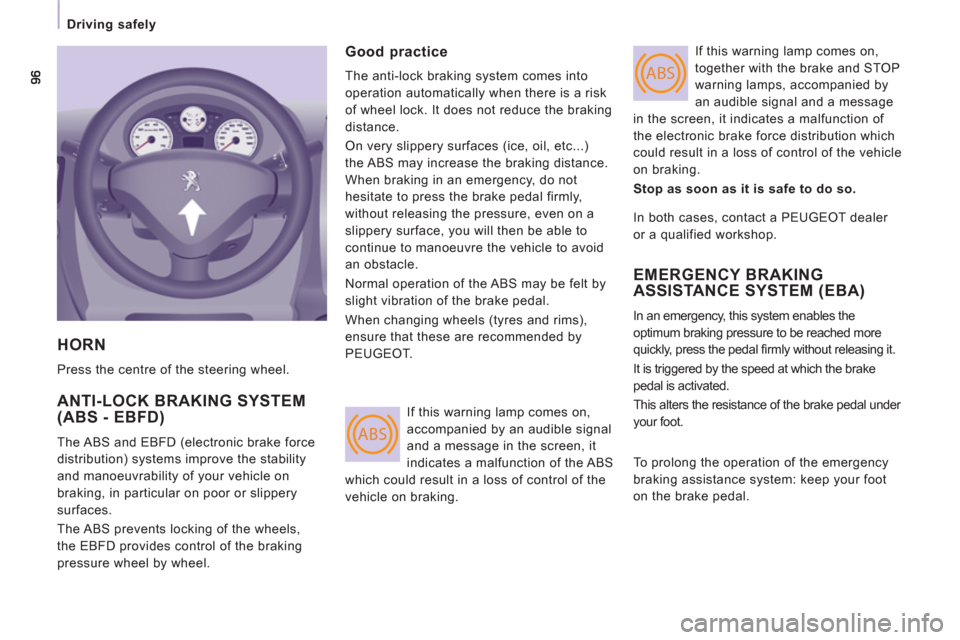
HORN
Press the centre of the steering wheel.
ANTI-LOCK BRAKING SYSTEM(ABS - EBFD)
The ABS and EBFD (electronic brake force
distribution) systems improve the stability
and manoeuvrability of your vehicle on
braking, in particular on poor or slippery
surfaces.
The ABS prevents locking of the wheels,
the EBFD provides control of the braking
pressure wheel by wheel.
Good practice
The anti-lock braking system comes into
operation automatically when there is a risk
of wheel lock. It does not reduce the braking
distance.
On very slippery surfaces (ice, oil, etc...)
the ABS may increase the braking distance.
When braking in an emergency, do not
hesitate to press the brake pedal firmly,
without releasing the pressure, even on a
slippery surface, you will then be able to
continue to manoeuvre the vehicle to avoid
an obstacle.
Normal operation of the ABS may be felt by
slight vibration of the brake pedal.
When changing wheels (tyres and rims),
ensure that these are recommended by
PEUGEOT. If this warning lamp comes on,
together with the brake and STOP
warning lamps, accompanied by
an audible signal and a message
in the screen, it indicates a malfunction of
the electronic brake force distribution which
could result in a loss of control of the vehicle
on braking.
Stop as soon as it is safe to do so.
EMERGENCY BRAKING
ASSISTANCE SYSTEM (EBA)
In an emergency, this system enables the
optimum braking pressure to be reached more
quickly, press the pedal fi rmly without releasing it.
It is triggered by the speed at which the brake
pedal is activated.
This alters the resistance of the brake pedal under
your foot. If this warning lamp comes on,
accompanied by an audible signal
and a message in the screen, it
indicates a malfunction of the ABS
which could result in a loss of control of the
vehicle on braking. In both cases, contact a PEUGEOT dealer
or a qualified workshop.
To prolong the operation of the emergency
braking assistance system: keep your foot
on the brake pedal.
Page 99 of 260
ESP
OFF
97
Driving safely
SAFETY
4
ANTI-SLIP REGULATION (ASR)AND DYNAMIC STABILITY
CONTROL (DSC)
These systems are linked and complement
the ABS.
The ASR system is very useful for
maintaining optimum drive and avoiding
losses of control of the vehicle on
acceleration.
The system optimises drive to prevent the
wheels skidding, by acting on the brakes of
the drive wheels and on the engine. It also
allows the directional stability of the vehicle
to be improved on acceleration. If there is a variation between the trajectory
followed by the vehicle and that required by
the driver, the DSC system automatically
acts on the engine and the brake of one
or more wheels, in order to put the vehicle
back on course. Deactivating the ASR/DSC systems
In certain exceptional conditions (starting
the vehicle when stuck in mud or snow, or
on loose ground...), it could prove useful
to deactivate the ASR and DSC systems to
make the wheels spin and regain grip.
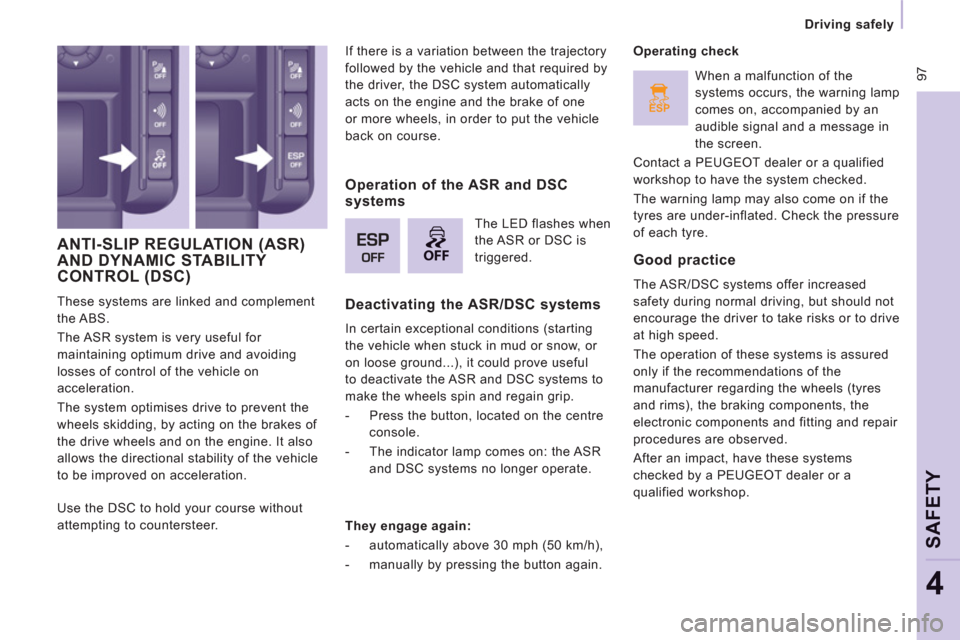
- Press the button, located on the centre
console.
- The indicator lamp comes on: the ASR
and DSC systems no longer operate.
Operating check
Good practice
The ASR/DSC systems offer increased
safety during normal driving, but should not
encourage the driver to take risks or to drive
at high speed.
The operation of these systems is assured
only if the recommendations of the
manufacturer regarding the wheels (tyres
and rims), the braking components, the
electronic components and fitting and repair
procedures are observed.
After an impact, have these systems
checked by a PEUGEOT dealer or a
qualified workshop.
Operation of the ASR and DSC systems
The LED flashes when
the ASR or DSC is
triggered.
They engage again:
- automatically above 30 mph (50 km/h),
- manually by pressing the button again.
When a malfunction of the
systems occurs, the warning lamp
comes on, accompanied by an
audible signal and a message in
the screen.
Contact a PEUGEOT dealer or a qualified
workshop to have the system checked.
The warning lamp may also come on if the
tyres are under-inflated. Check the pressure
of each tyre.
Use the DSC to hold your course without
attempting to countersteer.
Page 104 of 260
102
Improved safety and security
IMPROVED SAFETY AND SECURITY
In situations of extreme transverse
acceleration, this module limits the risks
of the vehicle rolling over by acting on the
brakes.
Roll Over Mitigation *
This system, linked with the ESP,
supplements the ABS-EBFD, ASR-ESP and
EBA braking functions, already covered in
this document, to guarantee a high level of
active safety. Indeed, the ROM system was
intended originally for top-of-the-range 4x4
type vehicles and today it is fitted on your
vehicle.
* Roll-over prevention system.
Page 120 of 260
11 8
Towing a trailer
You should therefore use a high gear to
lower the engine speed and reduce your
speed.
In all cases, pay attention to the coolant
temperature.
Ty r e s
Check the tyre pressures of the towing
vehicle (see the "Identification markings"
section of chapter 8) and of the trailer,
observing the recommended pressures.
Towbar
We recommend the use of genuine
PEUGEOT towbars and their harnesses,
which have been tested and approved from
the design stage of your vehicle, and that
you entrust the fitting of this equipment to a
PEUGEOT dealer.
If this equipment is not fitted by a PEUGEOT
dealer, it is imperative that it is fitted using
the electrical pre-equipment installed at the
rear of the vehicle and in accordance with
the manufacturer's instructions.
In accordance with the general instructions
a reminder of which has been given above,
we draw your attention to the risk associated
with fitting a towbar or electrical accessory
not recommended by PEUGEOT. Fitting
such equipment could result in the failure
of your vehicle's electronic system. Please
obtain information from the Manufacturer
before fitting this type of equipment. If the coolant temperature warning
lamp comes on, stop the vehicle
and switch off the engine as soon
as possible.
Good Practice
In certain cases of particularly arduous
use (towing the maximum load up a steep
slope in high temperatures), the engine
automatically limits its power. In this
case, the air conditioning is automatically
cut off to save engine power.
See the "Levels" section of chapter 6.
Brakes
Towing increases the braking distance. Drive
at a moderate speed, change down early
and brake gradually.
Side wind
Sensitivity to side wind is increased. Drive
smoothly and at a moderate speed.
ABS/DSC
The ABS or DSC systems only control the
vehicle, not the trailer or caravan.
Rear parking sensors
The parking sensors system does not
function while the vehicle is towing.
Page 123 of 260
121
Under the bonnet
CHECK
S
6
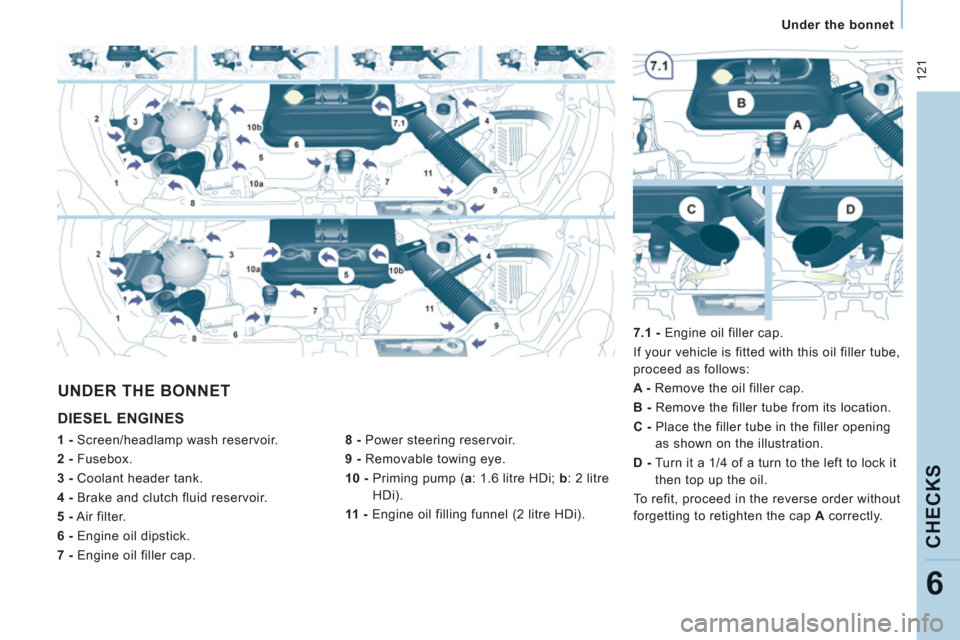
DIESEL ENGINES
8 -
Power steering reservoir.
9 -
Removable towing eye.
10 -
Priming pump ( a
: 1.6 litre HDi; b
: 2 litre
HDi).
11 -
Engine oil filling funnel (2 litre HDi).
UNDER THE BONNET
1 -
Screen/headlamp wash reservoir.
2 -
Fusebox.
3 -
Coolant header tank.
4 -
Brake and clutch fluid reservoir.
5 -
Air filter.
6 -
Engine oil dipstick.
7 -
Engine oil filler cap.
7.1 -
Engine oil filler cap.
If your vehicle is fitted with this oil filler tube,
proceed as follows:
A -
Remove the oil filler cap.
B -
Remove the filler tube from its location.
C -
Place the filler tube in the filler opening
as shown on the illustration.
D -
Turn it a 1/4 of a turn to the left to lock it
then top up the oil.
To refit, proceed in the reverse order without
forgetting to retighten the cap A
correctly.
Page 124 of 260
122
Under the bonnet
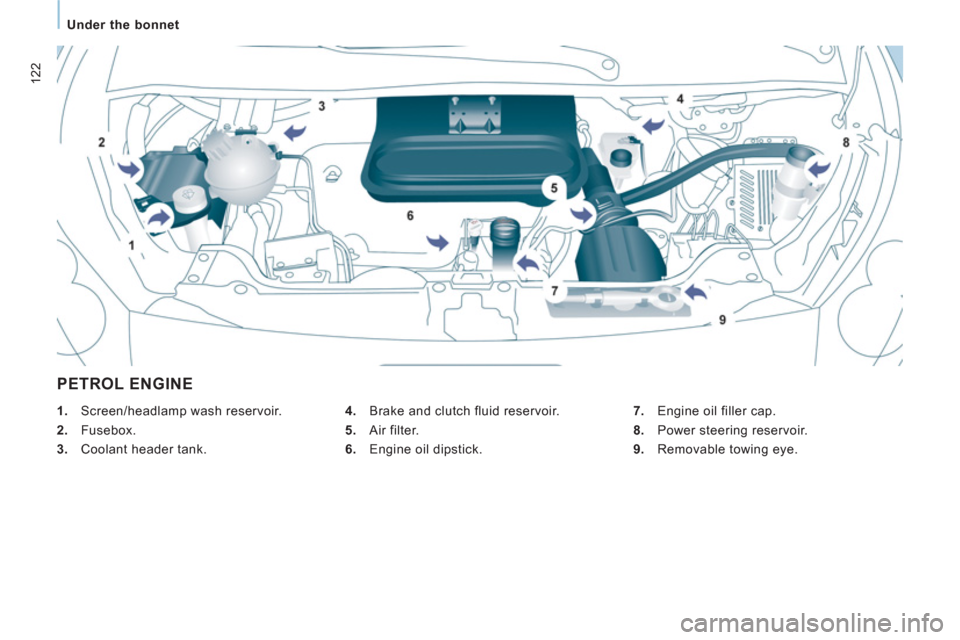
PETROL ENGINE
4.
Brake and clutch fluid reservoir.
5.
Air filter.
6.
Engine oil dipstick.
1.
Screen/headlamp wash reservoir.
2.
Fusebox.
3.
Coolant header tank.
7.
Engine oil filler cap.
8.
Power steering reservoir.
9.
Removable towing eye.
Page 125 of 260
123
Levels
CHECK
S
6
LEVELS
To maintain the reliability of engines and
emission control systems, the use of
additives in engine oil is prohibited.
Changing the brake fluid
The brake fluid must be changed at
the intervals stated, according to the
manufacturer's servicing schedule.
Use fluids recommended by the
manufacturer, which fulfil DOT4 standards.
The level must be between the MIN and
MAX marks on the reservoir.
If fluid has to be added frequently, this
indicates a fault which must be checked by a
PEUGEOT dealer or a qualified workshop as
soon as possible. These regular maintenance operations
will keep your vehicle in good running
order. Consult a PEUGEOT dealer or the
servicing and warranty booklet enclosed in
the handbook pack.
If you have to remove / refit the engine
style cover, handle it with care to avoid
damaging the fixing clips.
Check the level regularly and top up
between changes.
Check the level with the vehicle level,
engine cold, using the dipstick.
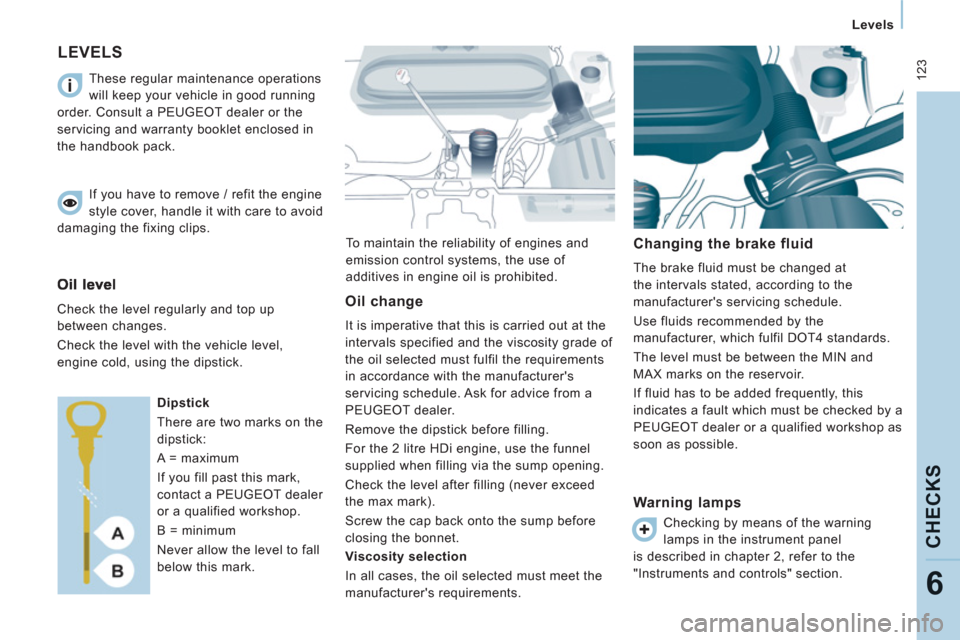
Dipstick
There are two marks on the
dipstick:
A = maximum
If you fill past this mark,
contact a PEUGEOT dealer
or a qualified workshop.
B = minimum
Never allow the level to fall
below this mark. Oil change
It is imperative that this is carried out at the
intervals specified and the viscosity grade of
the oil selected must fulfil the requirements
in accordance with the manufacturer's
servicing schedule. Ask for advice from a
PEUGEOT dealer.
Remove the dipstick before filling.
For the 2 litre HDi engine, use the funnel
supplied when filling via the sump opening.
Check the level after filling (never exceed
the max mark).
Screw the cap back onto the sump before
closing the bonnet.
Viscosity selection
In all cases, the oil selected must meet the
manufacturer's requirements.
Warning lamps
Checking by means of the warning
lamps in the instrument panel
is described in chapter 2, refer to the
"Instruments and controls" section.
Page 127 of 260
Checks
CHECK
S
6
CHECKS
Battery
At the start of winter, have your battery
checked by a PEUGEOT dealer or a
qualified workshop.
Brake pads
Brake pad wear depends on the style of
driving, in particular for vehicles which are
used in town, over short distances. It may
be necessary to check the thickness of the
pads, even between services.
Unless there is a leak in the system, a drop
in the brake fluid level indicates that the
brake pads are worn.
Brake disc / drum wear
For any information on checking the brake
disc / drum wear, contact a PEUGEOT
dealer or a qualified workshop.
Parking brake
Where the parking brake travel is too great
or there is a reduction in the performance
of the system, the parking brake should be
adjusted, even between services.
Have the system checked by a PEUGEOT
dealer or a qualified workshop.
Oil filter
Change the filter regularly, in accordance
with the servicing schedule.
Carbon filter and passenger compartment filter
The carbon filter permits continuous and
effective filtering of dust.
If the passenger compartment filter becomes
clogged, this may reduce the performance
of the air conditioning system and generate
unpleasant odours.
We recommend the use of a combined
passenger compartment filter. By means of
its second special active filter, it contributes
to the purification of the air breathed by
the occupants and the cleanness of the
passenger compartment (reduction of
allergic symptoms, unpleasant odours and
greasy deposits).
Refer to the servicing and warranty booklet
to find out the replacement interval for these
components.
Depending on the environment (dusty
atmosphere...) and the use of the vehicle
(urban driving...), change them twice as
often if necessary.
Particle emission filter (Diesel)
This filter actively contributes
to the preservation of air quality
by trapping unburnt polluting
particles. It is controlled
completely and automatically by the engine
management system.
This warning lamp comes on if there is a risk
of blockage of the filter.
This alert signals the start of saturation of
the particle emissions filter (exceptionally
prolonged driving in urban conditions:
reduced speed, traffic jams…).
If this alert persists, contact a PEUGEOT
dealer or a qualified workshop.
On acceleration after the vehicle has been
running for a prolonged period at very low
speed or at idle, you may, in exceptional
circumstances, notice the emission of water
vapour at the exhaust. This water vapour
does not have any adverse effect on vehicle
handling or the environment.
To regenerate the filter, it is recommended
that as soon as driving conditions permit,
you drive at a speed of at least 36 mph
(60 km/h) for at least 5 minutes (until the
warning lamp goes off and/or the message
disappears).
Refer to "Under the bonnet" in
section 6.