warning Peugeot Expert Tepee 2013 Owner's Manual
[x] Cancel search | Manufacturer: PEUGEOT, Model Year: 2013, Model line: Expert Tepee, Model: Peugeot Expert Tepee 2013Pages: 260, PDF Size: 9.78 MB
Page 3 of 260
WELCOME
The new Expert Tepee has been designed to satisfy all your
requirements in terms of practicality, comfort, safety and
aesthetics. In order to get the most out of your vehicle, we
suggest that you take a tour, from the cab to the seating area,
with the "Handbook" in front of you.
The handbook presents the operation of the equipment
available on board in detail.
Your vehicle is fitted with only some of the equipment described
in this document, depending on its trim level, version and the
specification for the country in which it was sold. Please note the following point: the fitting of electrical equipment
or accessories which are not recommended by PEUGEOT
may result in a failure of your vehicle's electronic system.
Please note this specific warning. It is advisable to contact a
PEUGEOT dealer to be shown the recommended equipment and
accessories.
1
PEUGEOT thanks you for your confidence and wishes you
very happy motoring.
For any work on your vehicle, use a qualified workshop that has
the technical information, competence and equipment required,
which a PEUGEOT dealer is able to provide.
Page 4 of 260
2
Contents
Remote control 21Key 22Alarm 23Doors 24Instrument panel 28Adjusting the time 29Warning lamps 30Fuel gauge 36Coolant 36Tyre under-inflation detection 37Service indicator 38Lighting dimmer 39Gearboxes 40Gear shift indicator 41Automatic gearbox 42Steering wheel adjustment 45Starting and stopping 45
Controls for 46lighting 46wipers 49Cruise control 51Fixed speed limiter 53Speed limiter 54Heating / air conditioning,manual 57digital 59Demisting and defrosting 63Rear ventilation 65Additional heating 66Seats 692-seat front bench 71Rear seats 73Seat and bench configuration 80Cab fittings 81Courtesy lamps 84Toll cards/car park tickets 85Seating area fittings 85
Rear suspension 88Mirrors 91Electric windows 93
Presentation 4Exterior 6Sitting comfortably 11Seeing clearly 13Driving safely 14Cab fittings 15Rear fittings 15Child safety 16Ventilation 17Eco-driving 18
Parking brake 94Hazard warning lamps 94Parking sensors 95Horn 96Anti-lock braking system (ABS) 96Emergency braking assistance 96ASR and DSC 97"Grip control" 98Seat belts 100Airbags 103Lateral airbags 105Front airbags 106Deactivating the passenger'sairbag 106Child seats 107ISOFIX seats 111Recommended seats 114
2. READY TO SET OFF
21-45
4. SAFETY
94-116
1. FAMILIARISATION
4-203. EASE OF USE and COMFORT 46-93
Page 12 of 260
Interior
10
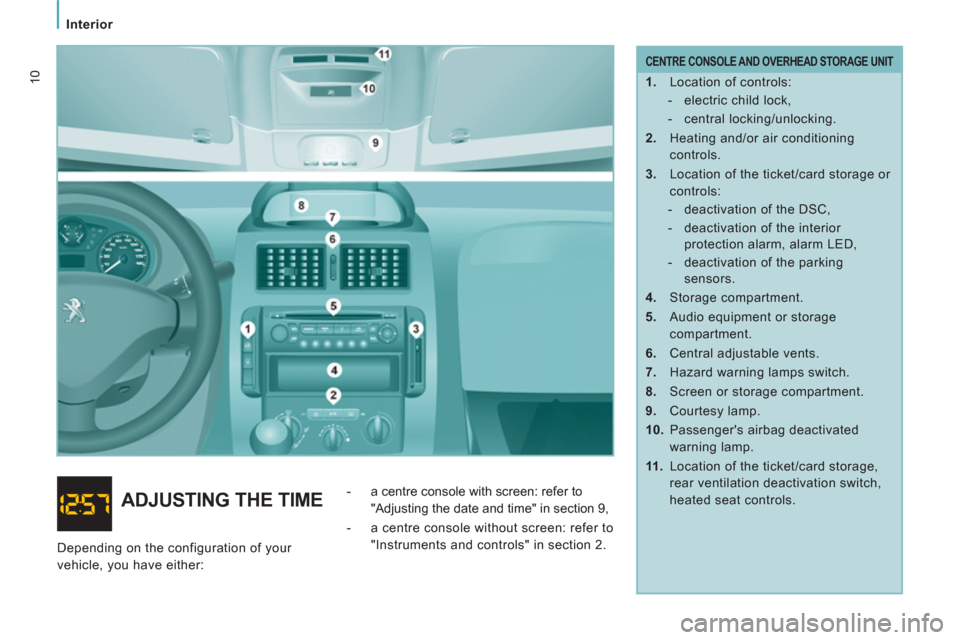
CENTRE CONSOLE AND OVERHEAD STORAGE UNIT
1.
Location of controls:
- electric child lock,
- central locking/unlocking.
2.
Heating and/or air conditioning
controls.
3.
Location of the ticket/card storage or
controls:
- deactivation of the DSC,
- deactivation of the interior
protection alarm, alarm LED,
- deactivation of the parking
sensors.
4.
Storage compartment.
5.
Audio equipment or storage
compartment.
6.
Central adjustable vents.
7.
Hazard warning lamps switch.
8.
Screen or storage compartment.
9.
Courtesy lamp.
10.
Passenger's airbag deactivated
warning lamp.
11 .
Location of the ticket/card storage,
rear ventilation deactivation switch,
heated seat controls.
ADJUSTING THE TIME
- a centre console with screen: refer to
"Adjusting the date and time" in section 9,
- a centre console without screen: refer to
"Instruments and controls" in section 2.
Depending on the configuration of your
vehicle, you have either:
Page 27 of 260
25
Access
REA
DY
TO SET OFF
2
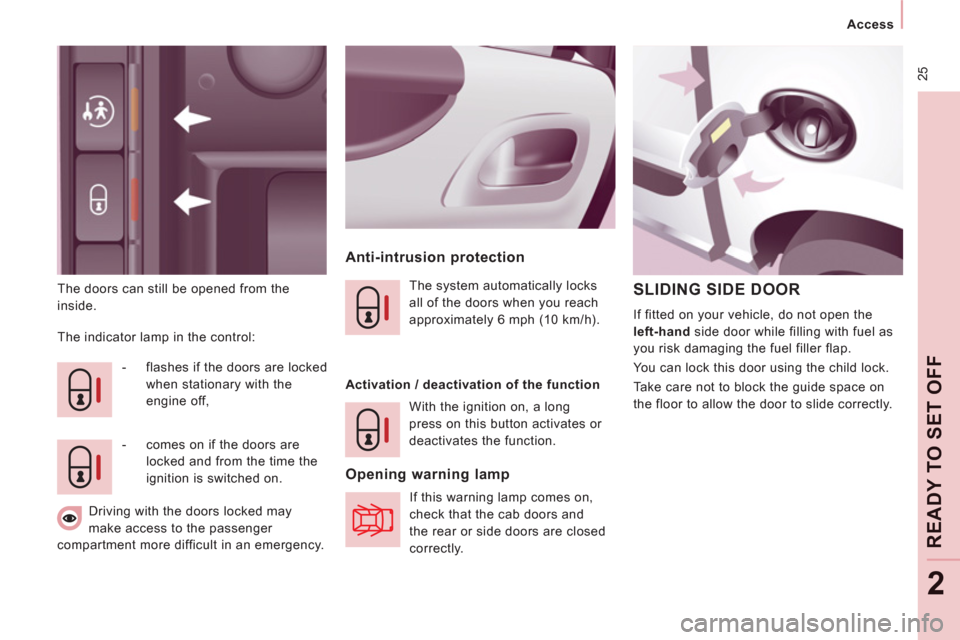
The doors can still be opened from the
inside.
Anti-intrusion protection
The indicator lamp in the control:
- flashes if the doors are locked
when stationary with the
engine off,
- comes on if the doors are
locked and from the time the
ignition is switched on. The system automatically locks
all of the doors when you reach
approximately 6 mph (10 km/h).
Activation / deactivation of the function
With the ignition on, a long
press on this button activates or
deactivates the function.
Opening warning lamp
If this warning lamp comes on,
check that the cab doors and
the rear or side doors are closed
correctly.
SLIDING SIDE DOOR
If fitted on your vehicle, do not open the
left-hand
side door while filling with fuel as
you risk damaging the fuel filler flap.
You can lock this door using the child lock.
Take care not to block the guide space on
the floor to allow the door to slide correctly.
Driving with the doors locked may
make access to the passenger
compartment more difficult in an emergency.
Page 29 of 260
27
Access
REA
DY
TO SET OFF
2
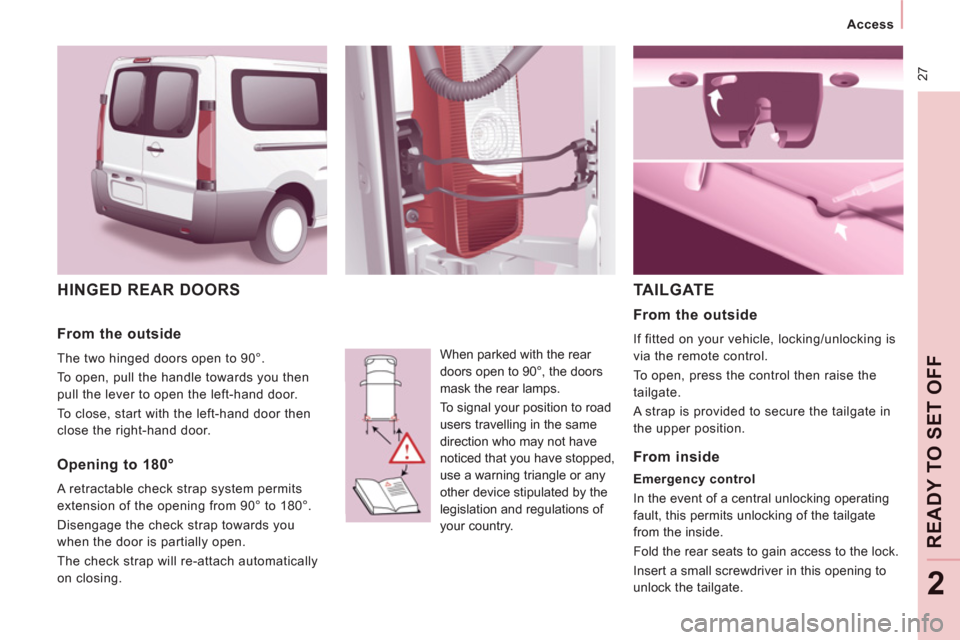
HINGED REAR DOORS
When parked with the rear
doors open to 90°, the doors
mask the rear lamps.
To signal your position to road
users travelling in the same
direction who may not have
noticed that you have stopped,
use a warning triangle or any
other device stipulated by the
legislation and regulations of
your country.
TAILGATE
From the outside
The two hinged doors open to 90°.
To open, pull the handle towards you then
pull the lever to open the left-hand door.
To close, start with the left-hand door then
close the right-hand door.
Opening to 180°
A retractable check strap system permits
extension of the opening from 90° to 180°.
Disengage the check strap towards you
when the door is partially open.
The check strap will re-attach automatically
on closing.
From the outside
If fitted on your vehicle, locking/unlocking is
via the remote control.
To open, press the control then raise the
tailgate.
A strap is provided to secure the tailgate in
the upper position.
From inside
Emergency control
In the event of a central unlocking operating
fault, this permits unlocking of the tailgate
from the inside.
Fold the rear seats to gain access to the lock.
Insert a small screwdriver in this opening to
unlock the tailgate.
Page 30 of 260
28
Instruments and controls
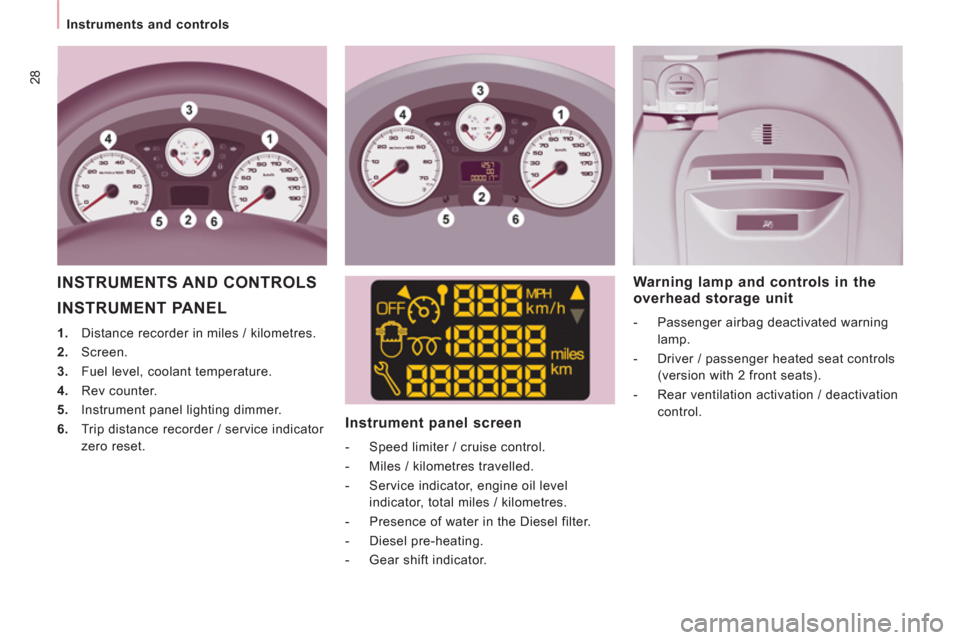
INSTRUMENT PANEL
1.
Distance recorder in miles / kilometres.
2.
Screen.
3.
Fuel level, coolant temperature.
4.
Rev counter.
5.
Instrument panel lighting dimmer.
6.
Trip distance recorder / service indicator
zero reset.
Instrument panel screen
- Speed limiter / cruise control.
- Miles / kilometres travelled.
- Service indicator, engine oil level
indicator, total miles / kilometres.
- Presence of water in the Diesel filter.
- Diesel pre-heating.
- Gear shift indicator.
Warning lamp and controls in the
overhead storage unit
- Passenger airbag deactivated warning
lamp.
- Driver / passenger heated seat controls
(version with 2 front seats).
- Rear ventilation activation / deactivation
control.
INSTRUMENTS AND CONTROLS
Page 32 of 260
Instruments and controls
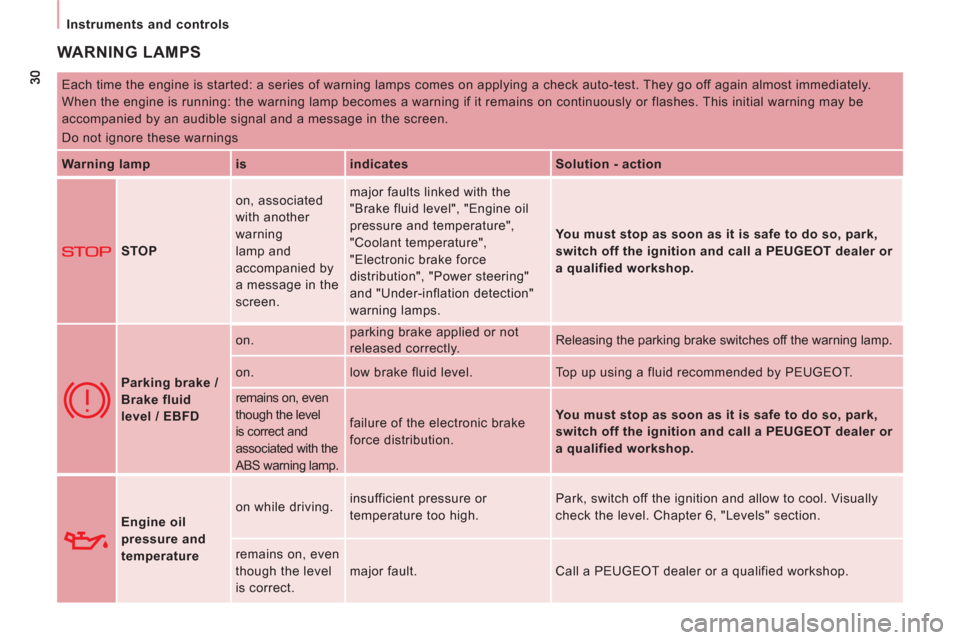
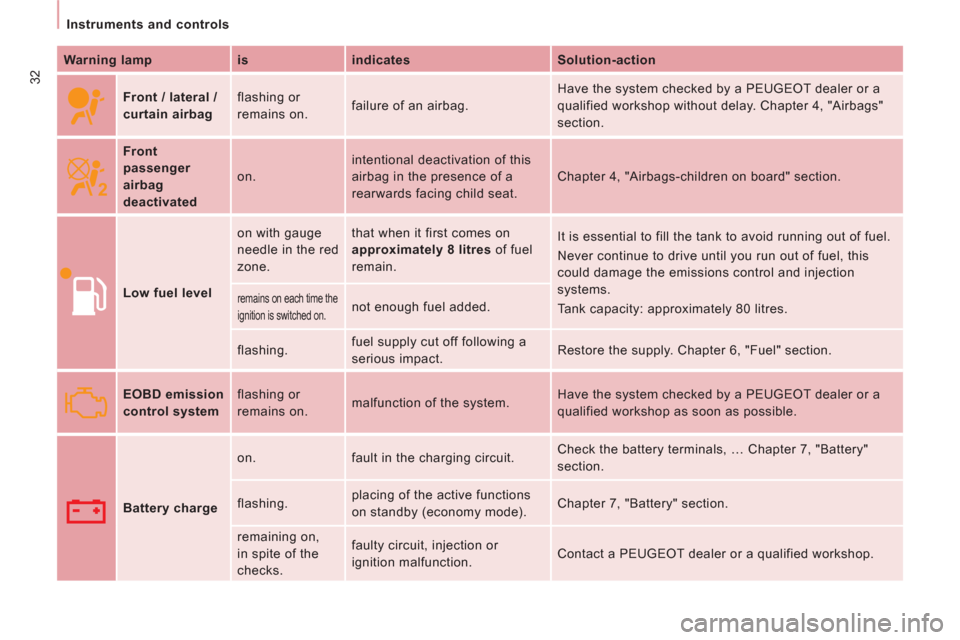
WARNING LAMPS
Each time the engine is started: a series of warning lamps comes on applying a check auto-test. They go off again almost immediately.
When the engine is running: the warning lamp becomes a warning if it remains on continuously or flashes. This initial warning may be
accompanied by an audible signal and a message in the screen.
Do not ignore these warnings
Warning lamp
is
indicates
Solution - action
STOP on, associated
with another
warning
lamp and
accompanied by
a message in the
screen. major faults linked with the
"Brake fluid level", "Engine oil
pressure and temperature",
"Coolant temperature",
"Electronic brake force
distribution", "Power steering"
and "Under-inflation detection"
warning lamps.
You must stop as soon as it is safe to do so, park,
switch off the ignition and call a PEUGEOT dealer or
a qualified workshop.
Parking brake /
Brake fluid
level / EBFD on. parking brake applied or not
released correctly. Releasing the parking brake switches off the warning lamp.
on. low brake fluid level. Top up using a fluid recommended by PEUGEOT.
remains on, even
though the level
is correct and
associated with the
ABS warning lamp. failure of the electronic brake
force distribution.
You must stop as soon as it is safe to do so, park,
switch off the ignition and call a
PEUGEOT dealer or
a qualified workshop.
Engine oil
pressure and
temperature on while driving. insufficient pressure or
temperature too high. Park, switch off the ignition and allow to cool. Visually
check the level. Chapter 6, "Levels" section.
remains on, even
though the level
is correct. major fault. Call a PEUGEOT dealer or a qualified workshop.
Page 33 of 260
31
Instruments and controls
REA
DY
TO SET OFF
2
Warning lamp
is
indicates
Solution-action
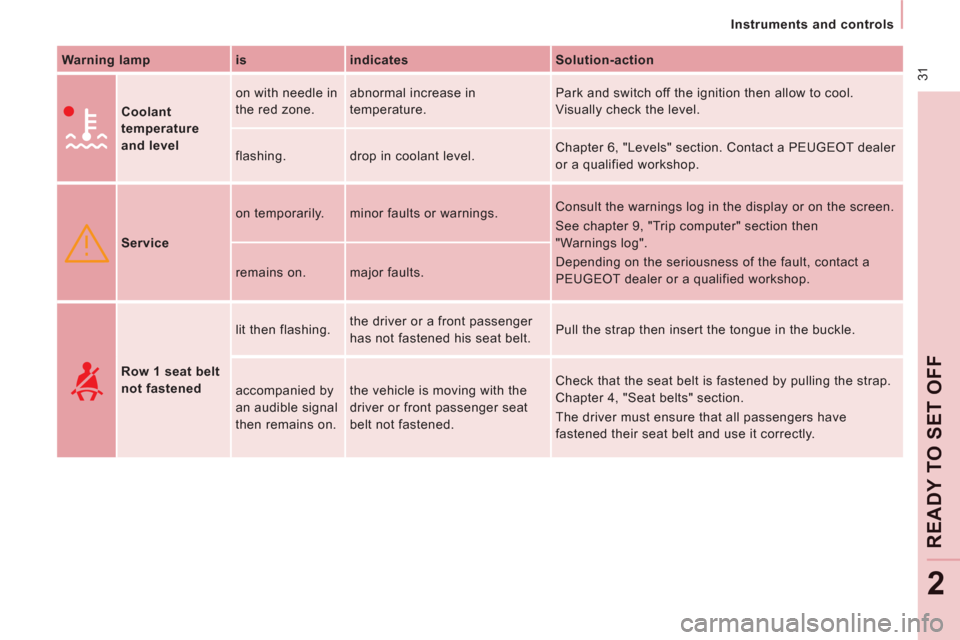
Coolant
temperature
and level on with needle in
the red zone. abnormal increase in
temperature. Park and switch off the ignition then allow to cool.
Visually check the level.
flashing. drop in coolant level. Chapter 6, "Levels" section. Contact a PEUGEOT dealer
or a qualified workshop.
Service on temporarily. minor faults or warnings. Consult the warnings log in the display or on the screen.
See chapter 9, "Trip computer" section then
"Warnings log".
Depending on the seriousness of the fault, contact a
PEUGEOT dealer or a qualified workshop. remains on. major faults.
Row 1 seat belt
not fastened lit then flashing. the driver or a front passenger
has not fastened his seat belt. Pull the strap then insert the tongue in the buckle.
accompanied by
an audible signal
then remains on. the vehicle is moving with the
driver or front passenger seat
belt not fastened. Check that the seat belt is fastened by pulling the strap.
Chapter 4, "Seat belts" section.
The driver must ensure that all passengers have
fastened their seat belt and use it correctly.
Page 34 of 260
32
Instruments and controls
Warning lamp
is
indicates
Solution-action
Front / lateral /
curtain airbag flashing or
remains on. failure of an airbag. Have the system checked by a PEUGEOT dealer or a
qualified workshop without delay. Chapter 4, "Airbags"
section.
Front
passenger
airbag
deactivated on. intentional deactivation of this
airbag in the presence of a
rearwards facing child seat. Chapter 4, "Airbags-children on board" section.
Low fuel level on with gauge
needle in the red
zone. that when it first comes on
approximately 8 litres
of fuel
remain. It is essential to fill the tank to avoid running out of fuel.
Never continue to drive until you run out of fuel, this
could damage the emissions control and injection
systems.
Tank capacity: approximately 80 litres.
remains on each time the
ignition is switched on. not enough fuel added.
flashing. fuel supply cut off following a
serious impact. Restore the supply. Chapter 6, "Fuel" section.
EOBD emission
control system flashing or
remains on. malfunction of the system. Have the system checked by a PEUGEOT dealer or a
qualified workshop as soon as possible.
Battery charge on. fault in the charging circuit. Check the battery terminals, … Chapter 7, "Battery"
section.
flashing. placing of the active functions
on standby (economy mode). Chapter 7, "Battery" section.
remaining on,
in spite of the
checks. faulty circuit, injection or
ignition malfunction. Contact a PEUGEOT dealer or a qualified workshop.
Page 35 of 260
ABS
ESP
33
Instruments and controls
REA
DY
TO SET OFF
2
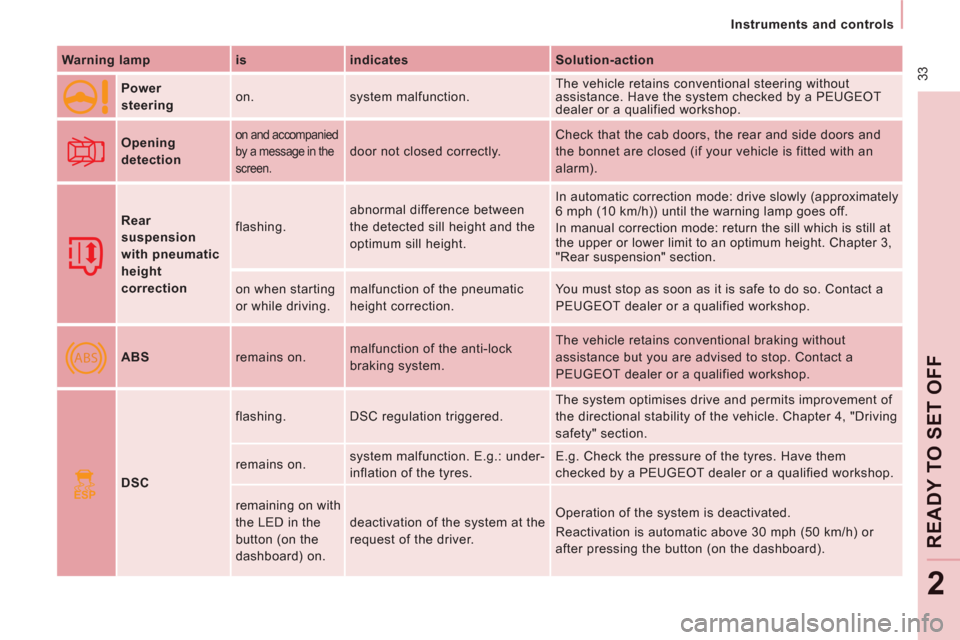
Warning lamp
is
indicates
Solution-action
Power
steering on. system malfunction. The vehicle retains conventional steering without
assistance. Have the system checked by a PEUGEOT
dealer or a qualified workshop.
Opening
detection
on and accompanied
by a message in the
screen.
door not closed correctly. Check that the cab doors, the rear and side doors and
the bonnet are closed (if your vehicle is fitted with an
alarm).
Rear
suspension
with pneumatic
height
correction flashing. abnormal difference between
the detected sill height and the
optimum sill height. In automatic correction mode: drive slowly (approximately
6 mph (10 km/h)) until the warning lamp goes off.
In manual correction mode: return the sill which is still at
the upper or lower limit to an optimum height. Chapter 3,
"Rear suspension" section.
on when starting
or while driving. malfunction of the pneumatic
height correction. You must stop as soon as it is safe to do so. Contact a
PEUGEOT dealer or a qualified workshop.
ABS remains on. malfunction of the anti-lock
braking system. The vehicle retains conventional braking without
assistance but you are advised to stop. Contact a
PEUGEOT dealer or a qualified workshop.
DSC flashing. DSC regulation triggered. The system optimises drive and permits improvement of
the directional stability of the vehicle. Chapter 4, "Driving
safety" section.
remains on. system malfunction. E.g.: under-
inflation of the tyres. E.g. Check the pressure of the tyres. Have them
checked by a PEUGEOT dealer or a qualified workshop.
remaining on with
the LED in the
button (on the
dashboard) on. deactivation of the system at the
request of the driver. Operation of the system is deactivated.
Reactivation is automatic above 30 mph (50 km/h) or
after pressing the button (on the dashboard).