display Peugeot Expert VU 2009 Owner's Guide
[x] Cancel search | Manufacturer: PEUGEOT, Model Year: 2009, Model line: Expert VU, Model: Peugeot Expert VU 2009Pages: 226, PDF Size: 10.49 MB
Page 48 of 226
46
Steering wheel controls
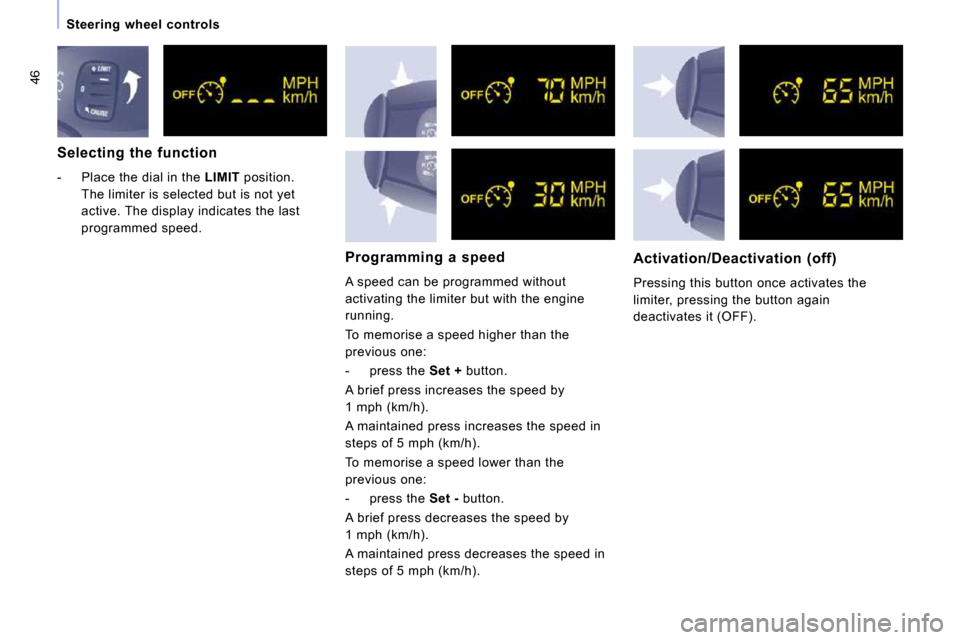
Selecting the function
- Place the dial in the LIMIT position.
The limiter is selected but is not yet
active. The display indicates the last
programmed speed.
Programming a speed
A speed can be programmed without
activating the limiter but with the engine
running.
To memorise a speed higher than the
previous one:
- press the Set + button.
A brief press increases the speed by
1 mph (km/h).
A maintained press increases the speed in
steps of 5 mph (km/h).
To memorise a speed lower than the
previous one:
- press the Set - button.
A brief press decreases the speed by
1 mph (km/h).
A maintained press decreases the speed in
steps of 5 mph (km/h). Activation/Deactivation (off)
Pressing this button once activates the
limiter, pressing the button again
deactivates it (OFF).
Page 52 of 226
50
Ventilation
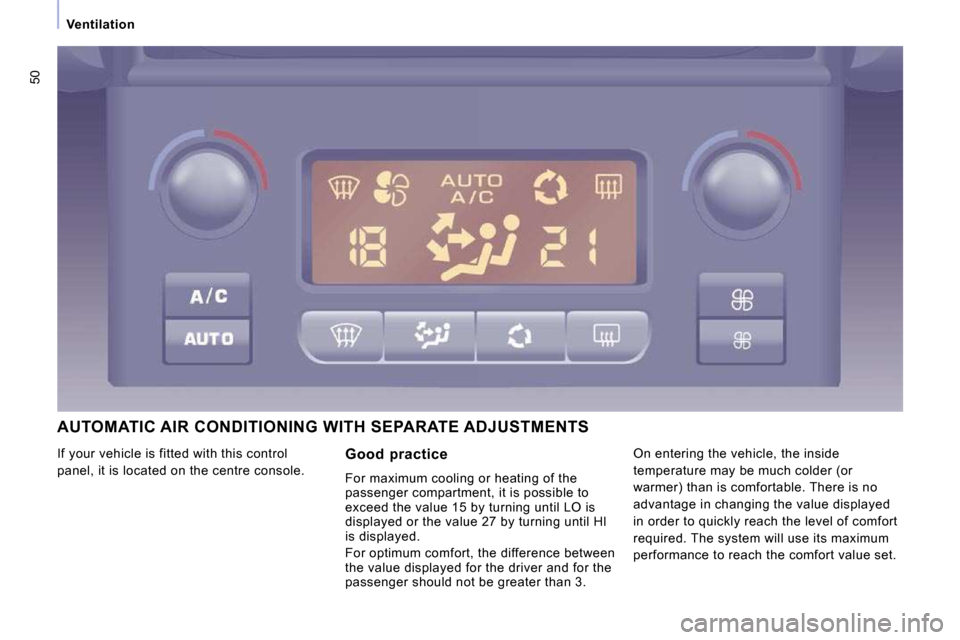
AUTOMATIC AIR CONDITIONING WITH SEPARATE ADJUSTMEN TS
Good practice
For maximum cooling or heating of the passenger compartment, it is possible to exceed the value 15 by turning until LO is displayed or the value 27 by turning until HI is displayed.
For optimum comfort, the difference between the value displayed for the driver and for the passenger should not be greater than 3.
If your vehicle is fitted with this control
panel, it is located on the centre console.
On entering the vehicle, the inside
temperature may be much colder (or
warmer) than is comfortable. There is no
advantage in changing the value displayed
in order to quickly reach the level of comfort
required. The system will use its maximum
performance to reach the comfort value set.
Page 53 of 226
51
Ventilation
ERGONOMICS and COMFORT
3
Driver or passenger side comfort value
The value indicated on the display
corresponds to a level of comfort and
not a temperature in degrees Celsius or
Fahrenheit.
Automatic operation Do not cover the sunshine sensor,
located on the windscreen behind the
mirror, it is used for regulation of the air
conditioning.
AUTO comfort programme
This is the normal air conditioning system
operating mode.
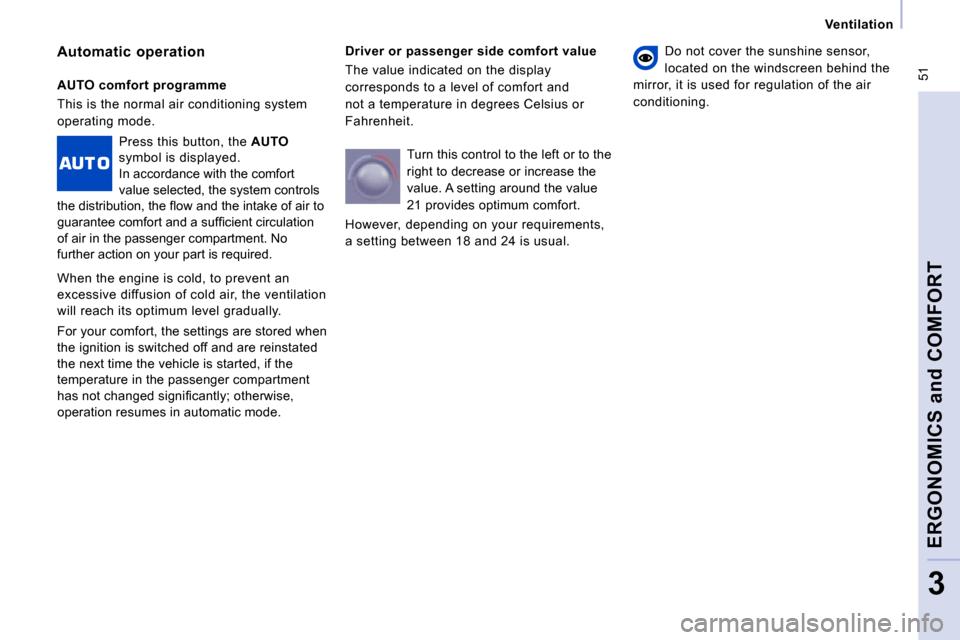
Press this button, the AUTO symbol is displayed. In accordance with the comfort value selected, the system controls the distribution, the fl ow and the intake of air to guarantee comfort and a suffi cient circulation of air in the passenger compartment. No further action on your part is required.
When the engine is cold, to prevent an excessive diffusion of cold air, the ventilation will reach its optimum level gradually.
For your comfort, the settings are stored when the ignition is switched off and are reinstated the next time the vehicle is started, if the temperature in the passenger compartment has not changed signifi cantly; otherwise, operation resumes in automatic mode.
Turn this control to the left or to the
right to decrease or increase the
value. A setting around the value
21 provides optimum comfort.
However, depending on your requirements,
a setting between 18 and 24 is usual.
Page 54 of 226
52
Ventilation
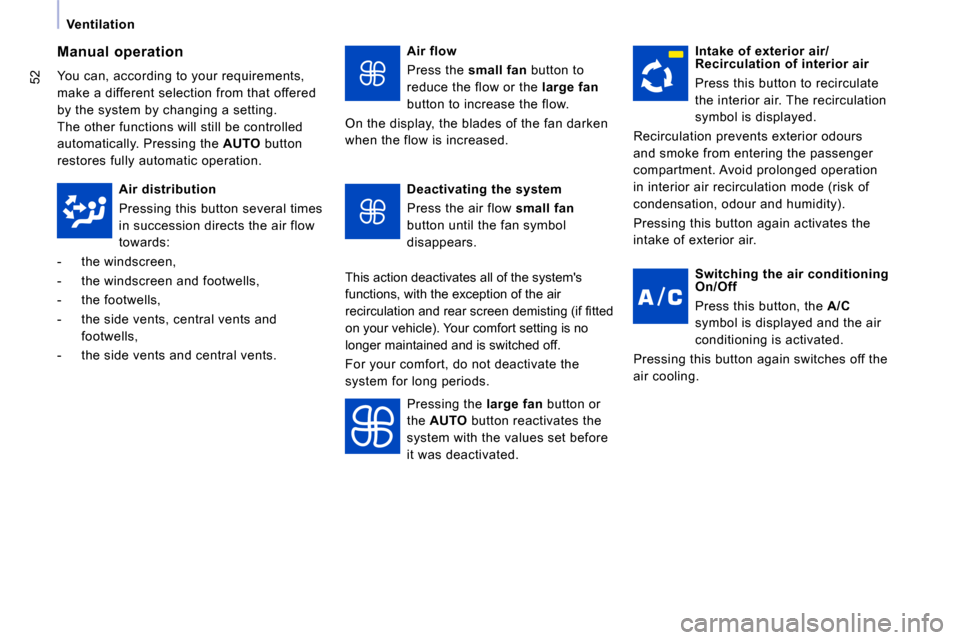
Air flow
Press the small fan button to
reduce the flow or the large fan
button to increase the flow.
On the display, the blades of the fan darken
when the flow is increased.
Manual operation
You can, according to your requirements,
make a different selection from that offered
by the system by changing a setting.
The other functions will still be controlled
automatically. Pressing the AUTO button
restores fully automatic operation.
Intake of exterior air/Recirculation of interior air
Press this button to recirculate
the interior air. The recirculation
symbol is displayed.
Recirculation prevents exterior odours
and smoke from entering the passenger
compartment. Avoid prolonged operation
in interior air recirculation mode (risk of
condensation, odour and humidity).
Pressing this button again activates the
intake of exterior air.
Air distribution
Pressing this button several times
in succession directs the air flow
towards:
- the windscreen,
- the windscreen and footwells,
- the footwells,
- the side vents, central vents and
footwells,
- the side vents and central vents.
Deactivating the system
Press the air flow small fan
button until the fan symbol
disappears.
This action deactivates all of the system's
functions, with the exception of the air
recirculation and rear screen demisting (if fi tted
on your vehicle). Your comfort setting is no
longer maintained and is switched off.
For your comfort, do not deactivate the
system for long periods.
Pressing the large fan button or
the AUTO button reactivates the
system with the values set before
it was deactivated.
Switching the air conditioning On/Off
Press this button, the A/C
symbol is displayed and the air
conditioning is activated.
Pressing this button again switches off the
air cooling.
Page 79 of 226
77
Parking assistance
SAFETY
4
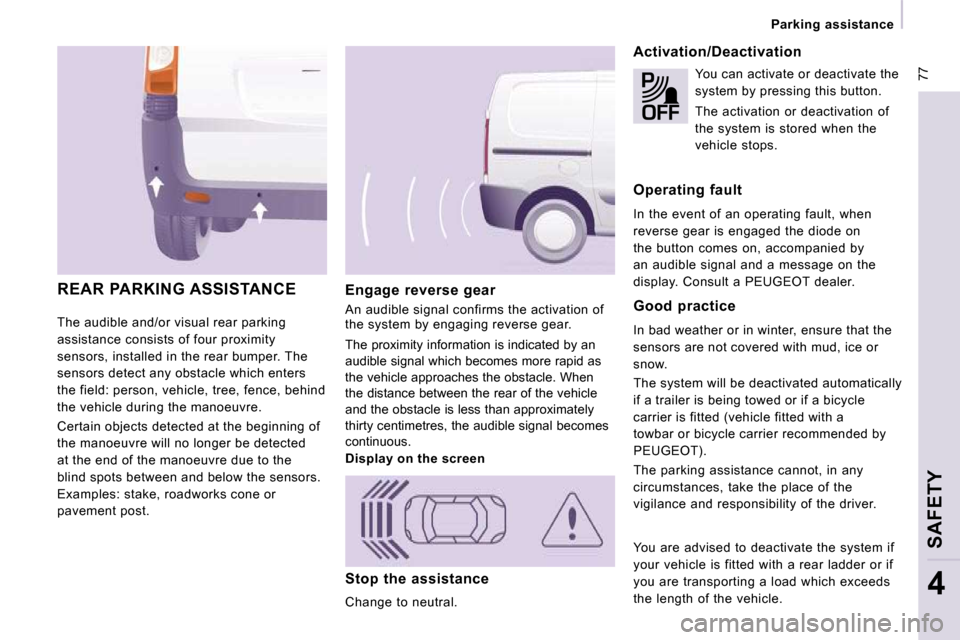
The audible and/or visual rear parking
assistance consists of four proximity
sensors, installed in the rear bumper. The
sensors detect any obstacle which enters
the field: person, vehicle, tree, fence, behind
the vehicle during the manoeuvre.
Certain objects detected at the beginning of
the manoeuvre will no longer be detected
at the end of the manoeuvre due to the
blind spots between and below the sensors.
Examples: stake, roadworks cone or
pavement post.
Engage reverse gear
An audible signal confirms the activation of
the system by engaging reverse gear.
The proximity information is indicated by an
audible signal which becomes more rapid as
the vehicle approaches the obstacle. When
the distance between the rear of the vehicle
and the obstacle is less than approximately
thirty centimetres, the audible signal becomes
continuous.
Stop the assistance
Change to neutral.
REAR PARKING ASSISTANCE
Activation/Deactivation
You can activate or deactivate the
system by pressing this button.
The activation or deactivation of
the system is stored when the
vehicle stops.
Operating fault
In the event of an operating fault, when
reverse gear is engaged the diode on
the button comes on, accompanied by
an audible signal and a message on the
display. Consult a PEUGEOT dealer.
Good practice
In bad weather or in winter, ensure that the
sensors are not covered with mud, ice or
snow.
The system will be deactivated automatically
if a trailer is being towed or if a bicycle
carrier is fitted (vehicle fitted with a
towbar or bicycle carrier recommended by
PEUGEOT ).
The parking assistance cannot, in any
circumstances, take the place of the
vigilance and responsibility of the driver.
Display on the screen
You are advised to deactivate the system if
your vehicle is fitted with a rear ladder or if
you are transporting a load which exceeds
the length of the vehicle.
Page 80 of 226
ABS
ABS
Driving safety
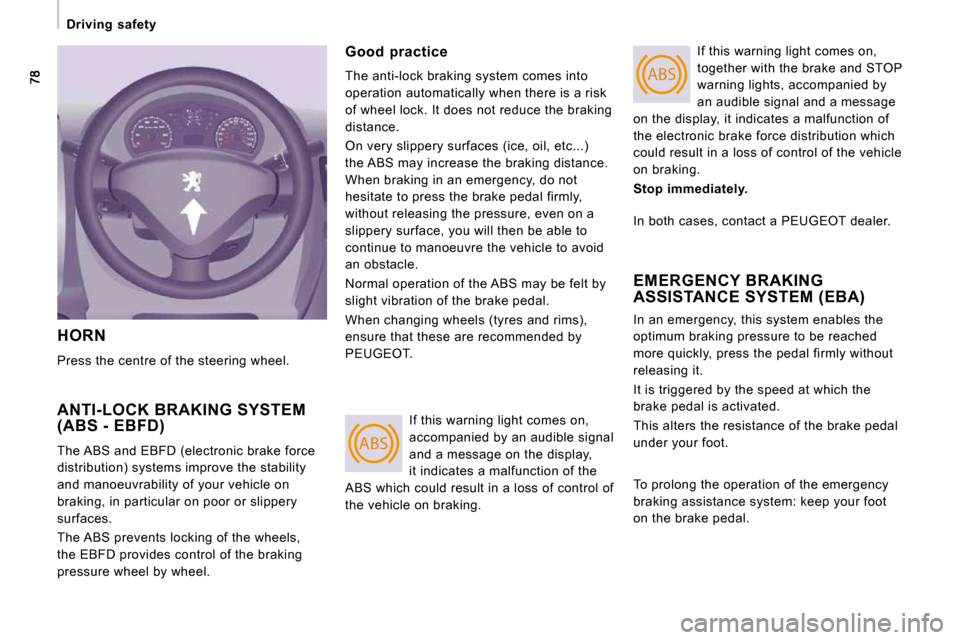
HORN
Press the centre of the steering wheel.
ANTI-LOCK BRAKING SYSTEM (ABS - EBFD)
The ABS and EBFD (electronic brake force
distribution) systems improve the stability
and manoeuvrability of your vehicle on
braking, in particular on poor or slippery
surfaces.
The ABS prevents locking of the wheels,
the EBFD provides control of the braking
pressure wheel by wheel. Good practice
The anti-lock braking system comes into
operation automatically when there is a risk
of wheel lock. It does not reduce the braking
distance.
On very slippery surfaces (ice, oil, etc...)
the ABS may increase the braking distance.
When braking in an emergency, do not
hesitate to press the brake pedal firmly,
without releasing the pressure, even on a
slippery surface, you will then be able to
continue to manoeuvre the vehicle to avoid
an obstacle.
Normal operation of the ABS may be felt by
slight vibration of the brake pedal.
When changing wheels (tyres and rims),
ensure that these are recommended by
PEUGEOT .
If this warning light comes on,
together with the brake and STOP
warning lights, accompanied by
an audible signal and a message
on the display, it indicates a malfunction of
the electronic brake force distribution which
could result in a loss of control of the vehicle
on braking.
Stop immediately.
EMERGENCY BRAKING ASSISTANCE SYSTEM (EBA)
In an emergency, this system enables the
optimum braking pressure to be reached
more quickly, press the pedal firmly without
releasing it.
It is triggered by the speed at which the
brake pedal is activated.
This alters the resistance of the brake pedal
under your foot.
If this warning light comes on,
accompanied by an audible signal
and a message on the display,
it indicates a malfunction of the
ABS which could result in a loss of control of
the vehicle on braking. In both cases, contact a PEUGEOT dealer.
To prolong the operation of the emergency
braking assistance system: keep your foot
on the brake pedal.
Page 81 of 226
ESP
79
Driving safety
SAFETY
4
TRACTION CONTROL (ASR) AND DYNAMIC STABILITY CONTROL (ESP)
These systems are linked and
complement the ABS.
The ASR system is very useful for
maintaining optimum drive and avoiding
losses of control of the vehicle on
acceleration.
The system optimises drive to prevent the
wheels skidding, by acting on the brakes of
the drive wheels and on the engine. It also
allows the directional stability of the vehicle
to be improved on acceleration. acts on the engine and the brake of one
or more wheels, in order to put the vehicle
back on course.
Disarming the ASR/ESP systems
In certain exceptional conditions (starting
the vehicle when stuck in mud or snow, or
on loose ground...), it could prove useful to
disarm the ASR and ESP systems to make
the wheels spin and regain grip.
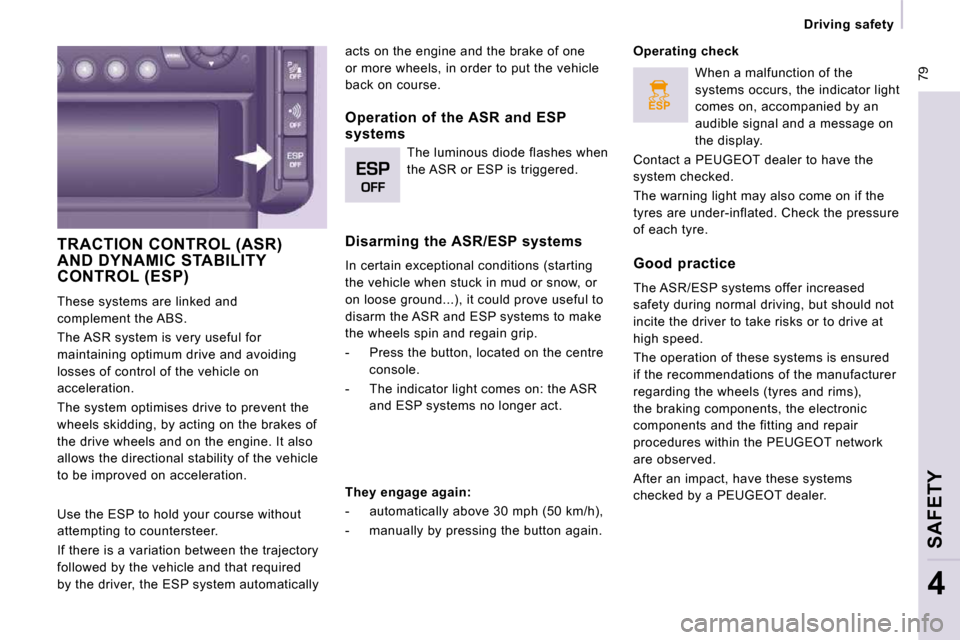
- Press the button, located on the centre
console.
- The indicator light comes on: the ASR and ESP systems no longer act. Operating check
Good practice
The ASR/ESP systems offer increased
safety during normal driving, but should not
incite the driver to take risks or to drive at
high speed.
The operation of these systems is ensured
if the recommendations of the manufacturer
regarding the wheels (tyres and rims),
the braking components, the electronic
components and the fitting and repair
procedures within the PEUGEOT network
are observed.
After an impact, have these systems
checked by a PEUGEOT dealer.
Use the ESP to hold your course without
attempting to countersteer.
If there is a variation between the trajectory
followed by the vehicle and that required
by the driver, the ESP system automatically Operation of the ASR and ESP
systems
The luminous diode flashes when
the ASR or ESP is triggered.
They engage again:
- automatically above 30 mph (50 km/h),
- manually by pressing the button again. When a malfunction of the
systems occurs, the indicator light
comes on, accompanied by an
audible signal and a message on
the display.
Contact a PEUGEOT dealer to have the
system checked.
The warning light may also come on if the
tyres are under-inflated. Check the pressure
of each tyre.
Page 87 of 226
86
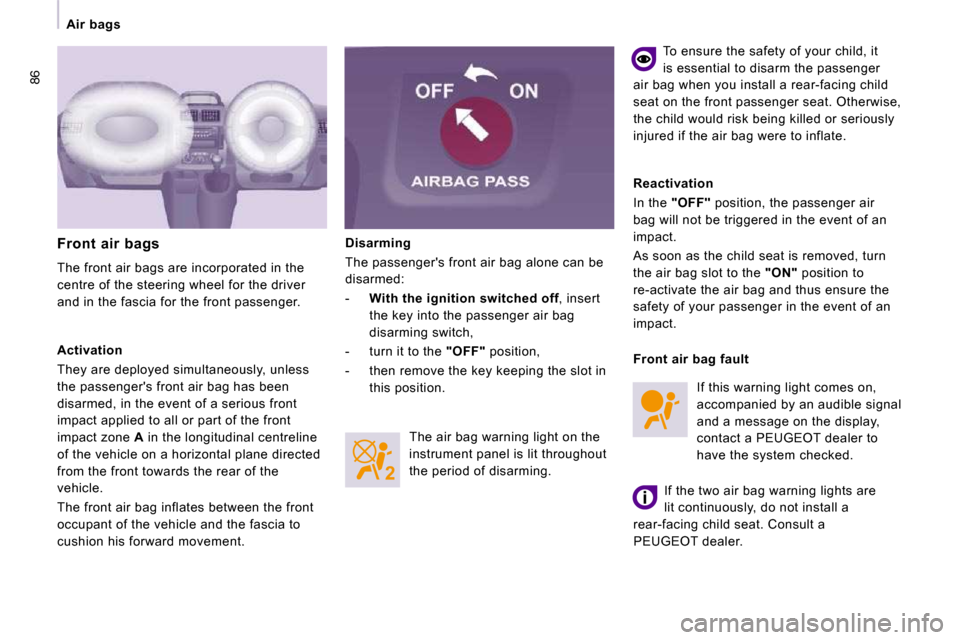
Air bags Disarming
The passenger's front air bag alone can be
disarmed:
- With the ignition switched off , insert
the key into the passenger air bag
disarming switch,
- turn it to the "OFF" position,
- then remove the key keeping the slot in this position.
Front air bags
The front air bags are incorporated in the
centre of the steering wheel for the driver
and in the fascia for the front passenger.
Reactivation
In the
"OFF" position, the passenger air
bag will not be triggered in the event of an
impact.
As soon as the child seat is removed, turn
the air bag slot to the "ON" position to
re-activate the air bag and thus ensure the
safety of your passenger in the event of an
impact. To ensure the safety of your child, it
is essential to disarm the passenger
air bag when you install a rear-facing child
seat on the front passenger seat. Otherwise,
the child would risk being killed or seriously
injured if the air bag were to inflate.
The air bag warning light on the
instrument panel is lit throughout
the period of disarming.
Activation
They are deployed simultaneously, unless
the passenger's front air bag has been
disarmed, in the event of a serious front
impact applied to all or part of the front
impact zone
A in the longitudinal centreline
of the vehicle on a horizontal plane directed
from the front towards the rear of the
vehicle.
The front air bag inflates between the front
occupant of the vehicle and the fascia to
cushion his forward movement. If this warning light comes on,
accompanied by an audible signal
and a message on the display,
contact a PEUGEOT dealer to
have the system checked.
Front air bag fault
If the two air bag warning lights are
lit continuously, do not install a
rear-facing child seat. Consult a
PEUGEOT dealer.
Page 90 of 226
85
Air bags
SAFETY
4
If this warning light comes
on on the instrument panel,
accompanied by an audible signal
and a message on the display,
contact a PEUGEOT dealer to
have the system checked. The air bags
may no longer be triggered in the event of a
serious impact.
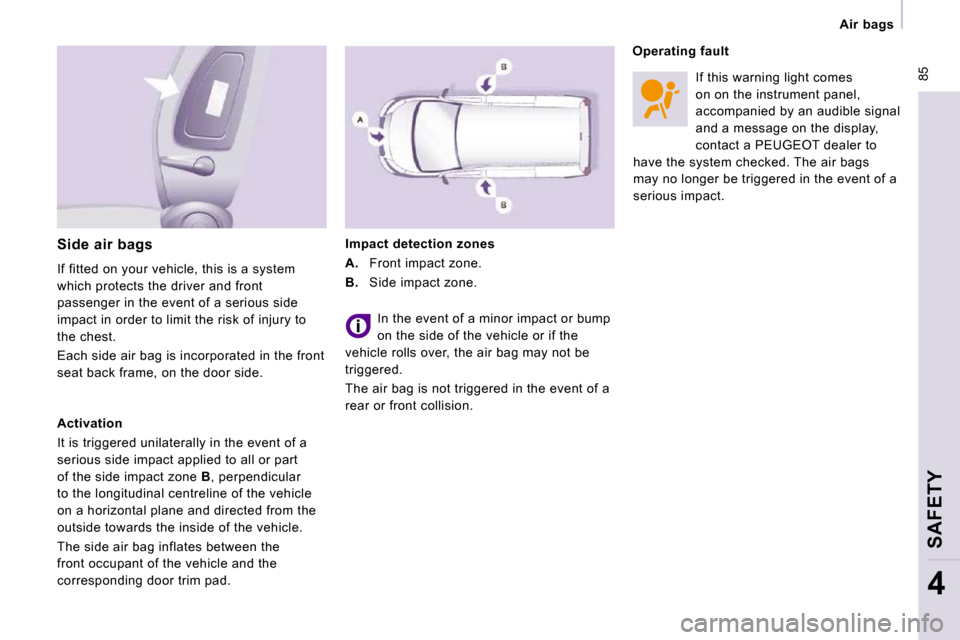
Side air bags
If fitted on your vehicle, this is a system
which protects the driver and front
passenger in the event of a serious side
impact in order to limit the risk of injury to
the chest.
Each side air bag is incorporated in the front
seat back frame, on the door side. Impact detection zones
A. Front impact zone.
B. Side impact zone.
In the event of a minor impact or bump
on the side of the vehicle or if the
vehicle rolls over, the air bag may not be
triggered.
The air bag is not triggered in the event of a
rear or front collision. Operating fault
Activation
It is triggered unilaterally in the event of a
serious side impact applied to all or part
of the side impact zone B , perpendicular
to the longitudinal centreline of the vehicle
on a horizontal plane and directed from the
outside towards the inside of the vehicle.
The side air bag inflates between the
front occupant of the vehicle and the
corresponding door trim pad.
Page 101 of 226
95
Opening the bonnet
CHECKS
6
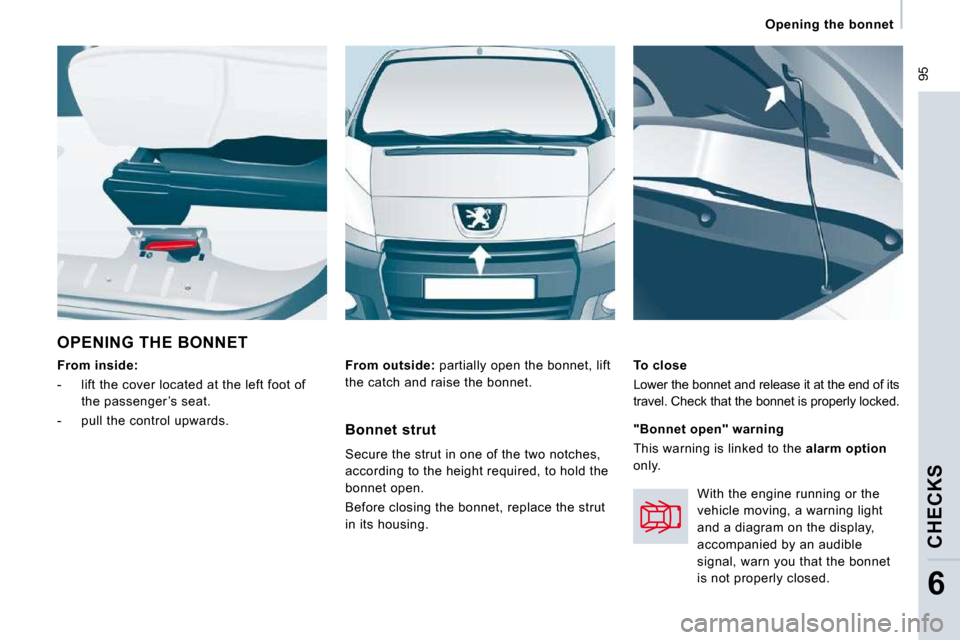
OPENING THE BONNET
From inside:
- lift the cover located at the left foot of
the passenger ’s seat.
- pull the control upwards.
To close
Lower the bonnet and release it at the end of its
travel. Check that the bonnet is properly locked.
From outside: partially open the bonnet, lift
the catch and raise the bonnet.
Bonnet strut
Secure the strut in one of the two notches,
according to the height required, to hold the
bonnet open.
Before closing the bonnet, replace the strut
in its housing.
"Bonnet open" warning
This warning is linked to the alarm option
only.
With the engine running or the
vehicle moving, a warning light
and a diagram on the display,
accompanied by an audible
signal, warn you that the bonnet
is not properly closed.