light Peugeot Expert VU 2012 User Guide
[x] Cancel search | Manufacturer: PEUGEOT, Model Year: 2012, Model line: Expert VU, Model: Peugeot Expert VU 2012Pages: 268, PDF Size: 9.73 MB
Page 49 of 268
47
Steering mounted controls
EASE OF USE AND COMFOR
T
3
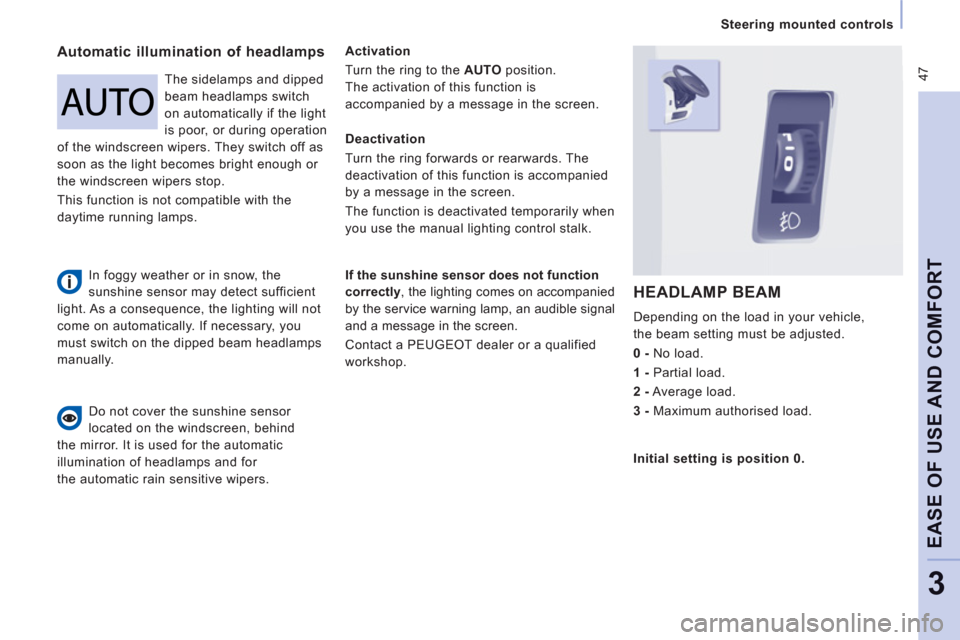
Automatic illumination of headlamps
Activation
Turn the ring to the
AUTOposition.
Th
e activation of this function is
accompanied by a message in the screen.
If the sunshine sensor does not function
correctly, the lighting comes on accompanied
by the service warning lamp, an audible signal
and a message in the screen.
Contact a PEUGEOT dealer or a qualified
workshop.
HEADLAMP BEAM
Depending on the load in your vehicle,
the beam settin
g must be adjusted.
0 -
N
o load.
1 -
Partial load.
2-
Average load.
3 -
Maximum authorised load.
Do not cover the sunshine sensor
located on the windscreen, behind
th
e mirror. It is used for the automatic
illumination of headlamps and for
the automatic rain sensitive wipers.The sidelam
ps and dipped
beam headlamps switch
on automaticall
y if the light
is poor, or durin
g operation
of the windscreen wipers. The
y switch off as
soon as the light becomes bright enough or
the windscreen wi
pers stop.
This
function is not compatible with the
da
ytime running lamps.
Deactivation
Turn the ring
forwards or rearwards. The
deactivation of this function is accom
panied
by a message in the screen.
The function is deactivated temporaril
y when
you use the manual lighting control stalk.
Initial settin
g is position 0.
In foggy weather or in snow, the
sunshine sensor may detect sufficient
light. As a consequence, the lighting will not
come on automatically. If necessary, you
must switch on the dipped beam headlamps
manually.
Page 74 of 268
72
Practical information
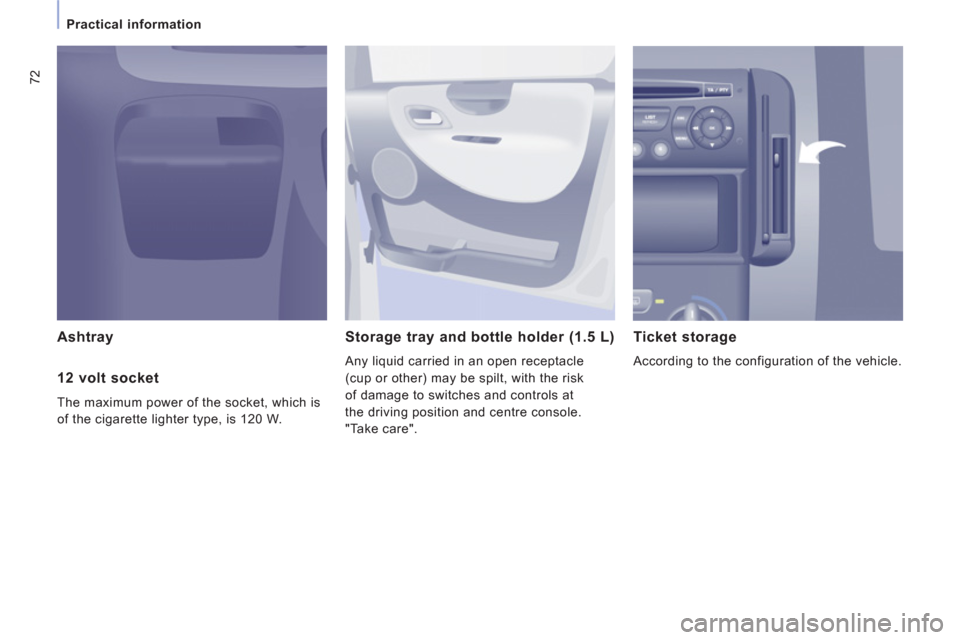
Ashtray Storage tray and bottle holder (1.5 L)
Any liquid carried in an open receptacle
(cup or other) may be spilt, with the risk
of dama
ge to switches and controls at
t
he driving position and centre console.
"T
ake care".
Ticket storage
According to the configuration of the vehicle.
12 volt socket
The maximum power of the socket, which is
of the ci
garette lighter type, is 120 W.
Page 80 of 268
78
Rear suspension
Metal suspension
This equipment adopts long movement limiters
which make it possible to
guarantee stable
behaviour both when loaded and when empt
y.
No action on your part is required except to
ensure that maintenance is carried out and that
the authorised loads are com
plied with.irrespective o
f the weight of the load, within
the limit of the authorised values.
On board,
the increasin
g or lightening of the load on
the vehicle's plat
form is detected by two
hei
ght sensors. When all of the doors are
closed, the sensors trigger the automatic
hei
ght correction and determine the optimum
hei
ght of the sill for the vehicle's driving
conditions.
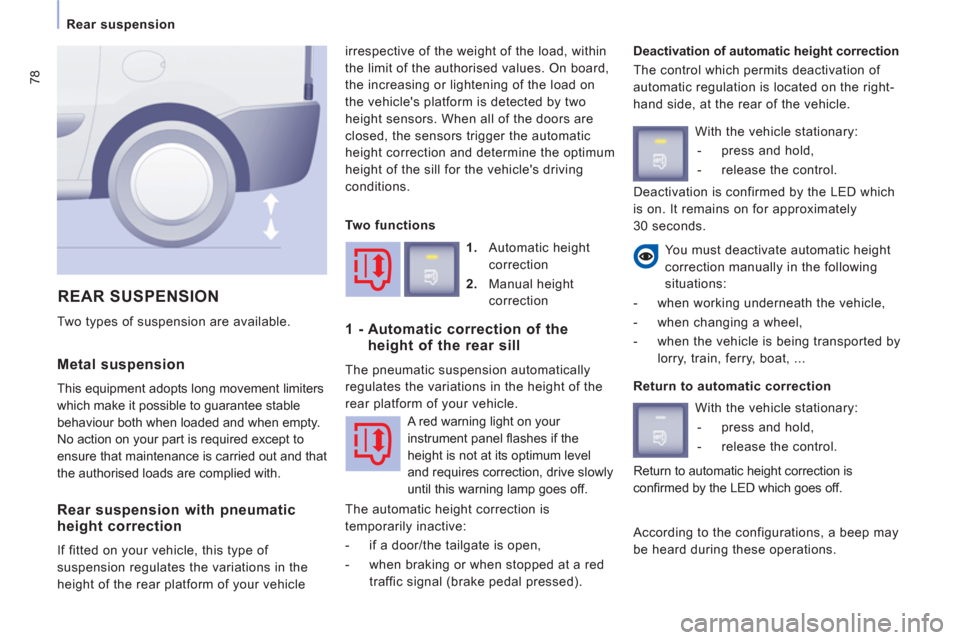
Deactivation of automatic height correction
The control which permits deactivation o
f
automatic re
gulation is located on the right-
hand side, at the rear of the vehicle.
REAR SUSPENSION
You must deactivate automatic height
correction manually in the following
situations:
- when working underneath the vehicle,
- when changing a wheel,
- when the vehicle is being transported by
lorry, train, ferry, boat, ...
Two t
ypes of suspension are available.
Rear suspension with pneumatic height correction
If fitted on your vehicle, this type of
suspension regulates the variations in the
height of the rear platform of your vehicle
1.
Automatic height
correction
2.
Manual height
correction
1 - Automatic correction of the
height of the rear sill
The pneumatic suspension automatically
re
gulates the variations in the height of the
rear plat
form of your vehicle.
A red warning light on your
instrument panel
fl ashes if the
height is not at its optimum level
and requires correction, drive slowl
y
until this warning lamp goes off.
The automatic hei
ght correction is
temporar
ily inactive:
- if a door/the tailgate is open,
- when braking or when stopped at a red
traffic signal (brake pedal pressed).
With the vehicle stationary:
- press and hold,
- release the control.
Return to automatic correction
With the vehicle stationary:
- press and hold,
- release the control.
According to the configurations, a beep may
be heard durin
g these operations.
Two functions Deactivation is con
firmed by the LED which
is on. It remains on for approximatel
y
30 seconds.
Return to automatic hei
ght correction is
confi rmed by the LED which goes off.
Page 88 of 268
ABS
ABS
Driving safely
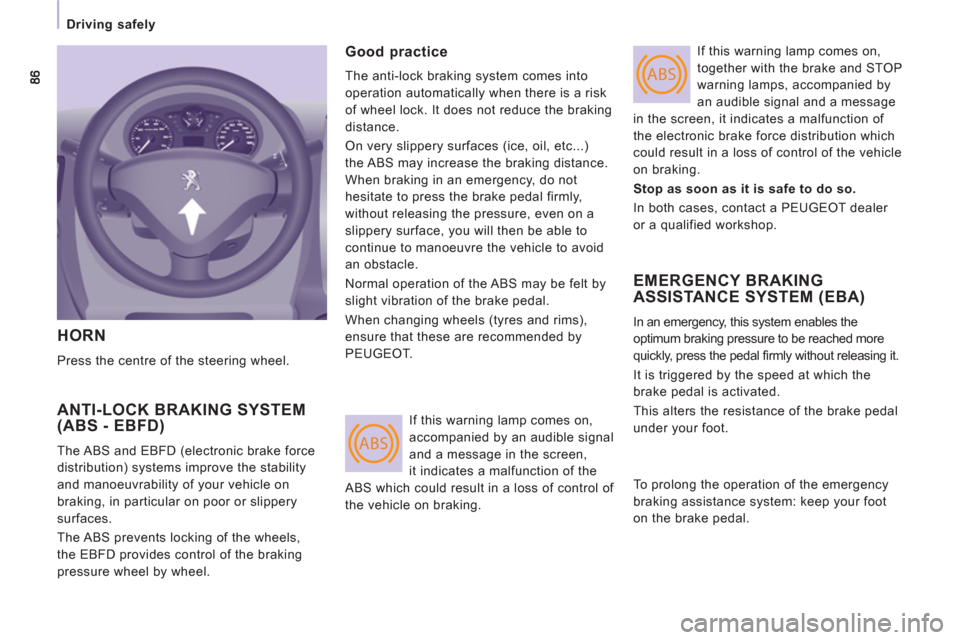
HORN
Press the centre of the steering wheel.
ANTI-LOCK BRAKING SYSTEM(ABS - EBFD)
The ABS and EBFD (electronic brake force
distribution) systems improve the stability
and manoeuvrability of your vehicle on
braking, in particular on poor or slippery
surfaces.
The ABS prevents locking of the wheels,
the EBFD provides control of the braking
pressure wheel by wheel.
Good practice
The anti-lock braking system comes into
operation automatically when there is a risk
of wheel lock. It does not reduce the braking
distance.
On very slippery surfaces (ice, oil, etc...)
the ABS may increase the braking distance.
When braking in an emergency, do not
hesitate to press the brake pedal firmly,
without releasing the pressure, even on a
slippery surface, you will then be able to
continue to manoeuvre the vehicle to avoid
an obstacle.
Normal operation of the ABS may be felt by
slight vibration of the brake pedal.
When changing wheels (tyres and rims),
ensure that these are recommended by
PEUGEOT. If this warning lamp comes on,
together with the brake and STOP
warning lamps, accompanied by
an audible signal and a message
in the screen, it indicates a malfunction of
the electronic brake force distribution which
could result in a loss of control of the vehicle
on braking.
Stop
as soon as it is safe to do so
.
In both cases, contact a PEUGEOT dealer
or a qualified workshop.
EMERGENCY BRAKING
ASSISTANCE SYSTEM (EBA)
In an emergency, this system enables the
optimum braking pressure to be reached more
quickly, press the pedal fi rmly without releasing it.
It is triggered by the speed at which the
brake pedal is activated.
This alters the resistance of the brake pedal
under your foot. If this warning lamp comes on,
accompanied by an audible signal
and a message in the screen,
it indicates a malfunction of the
ABS which could result in a loss of control of
the vehicle on braking. To prolong the operation of the emergency
braking assistance system: keep your foot
on the brake pedal.
Page 92 of 268
90
Seat belts
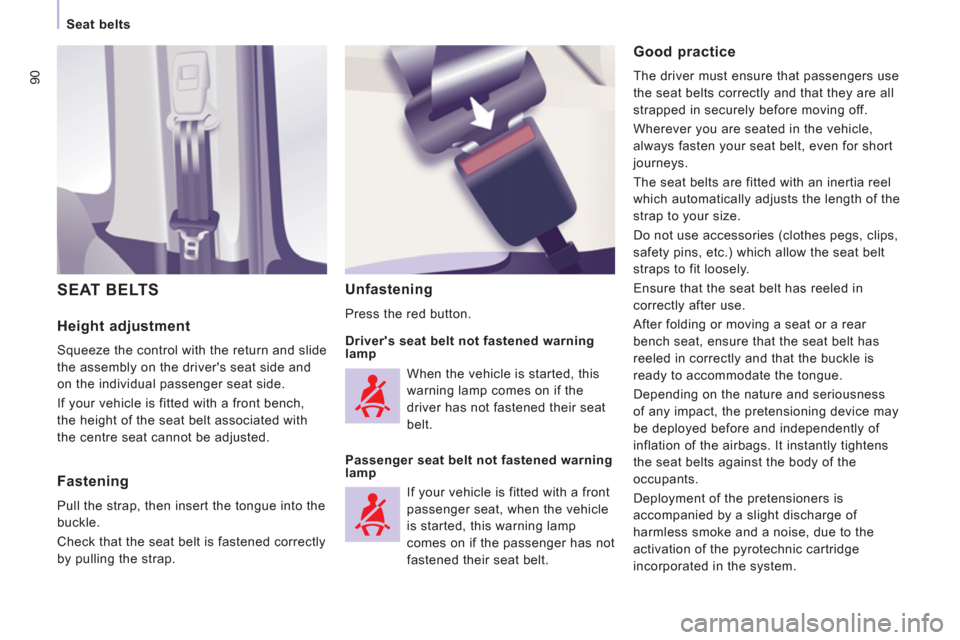
Height adjustment
Squeeze the control with the return and slide
the assembly on the driver's seat side and
on the individual passenger seat side.
If your vehicle is fitted with a front bench,
the height of the seat belt associated with
the centre seat cannot be adjusted.
Unfastening
Press the red button.
SEAT BELTS
Good practice
The driver must ensure that passengers use
the seat belts correctly and that they are all
strapped in securely before moving off.
Wherever you are seated in the vehicle,
always fasten your seat belt, even for short
journeys.
The seat belts are fitted with an inertia reel
which automatically adjusts the length of the
strap to your size.
Do not use accessories (clothes pegs, clips,
safety pins, etc.) which allow the seat belt
straps to fit loosely.
Ensure that the seat belt has reeled in
correctly after use.
After folding or moving a seat or a rear
bench seat, ensure that the seat belt has
reeled in correctly and that the buckle is
ready to accommodate the tongue.
Depending on the nature and seriousness
of any impact, the pretensioning device may
be deployed before and independently of
inflation of the airbags. It instantly tightens
the seat belts against the body of the
occupants.
Deployment of the pretensioners is
accompanied by a slight discharge of
harmless smoke and a noise, due to the
activation of the pyrotechnic cartridge
incorporated in the system.
Fastening
Pull the strap, then insert the tongue into the
buckle.
Check that the seat belt is fastened correctly
by pulling the strap.
Driver's seat belt not fastened warning
lamp
Passenger seat belt not fastened warning
lamp When the vehicle is started, this
warning lamp comes on if the
driver has not fastened their seat
belt.
If your vehicle is fitted with a front
passenger seat, when the vehicle
is started, this warning lamp
comes on if the passenger has not
fastened their seat belt.
Page 95 of 268
93
Airbags
SAFETY
4
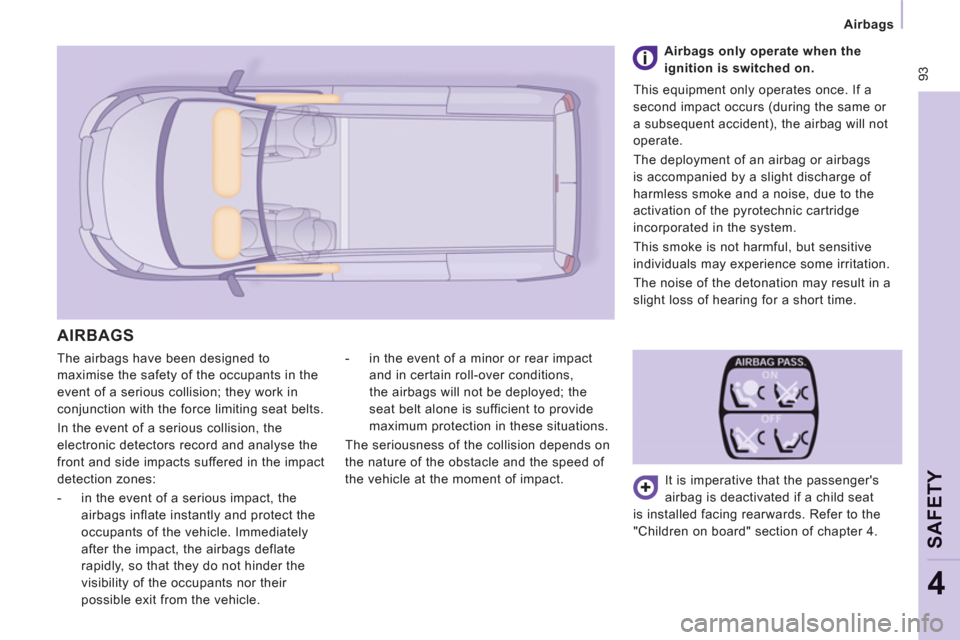
The airbags have been designed to
maximise the safety of the occupants in the
event of a serious collision; they work in
conjunction with the force limiting seat belts.
In the event of a serious collision, the
electronic detectors record and analyse the
front and side impacts suffered in the impact
detection zones:
- in the event of a serious impact, the
airbags inflate instantly and protect the
occupants of the vehicle. Immediately
after the impact, the airbags deflate
rapidly, so that they do not hinder the
visibility of the occupants nor their
possible exit from the vehicle.
- in the event of a minor or rear impact
and in certain roll-over conditions,
the airbags will not be deployed; the
seat belt alone is sufficient to provide
maximum protection in these situations.
The seriousness of the collision depends on
the nature of the obstacle and the speed of
the vehicle at the moment of impact.
It is imperative that the passenger's
airbag is deactivated if a child seat
is installed facing rearwards. Refer to the
"Children on board" section of chapter 4.
Airbags
only operate when the
ignition is switched on.
AIRBAGS
This equipment only operates once. If a
second impact occurs (during the same or
a subsequent accident), the airbag will not
operate.
The deployment of an airbag or airbags
is accompanied by a slight discharge of
harmless smoke and a noise, due to the
activation of the pyrotechnic cartridge
incorporated in the system.
This smoke is not harmful, but sensitive
individuals may experience some irritation.
The noise of the detonation may result in a
slight loss of hearing for a short time.
Page 112 of 268
11 0
Levels
Cooling system
Only use the fluid recommended by the
manufacturer.
Otherwise, you risk seriously damaging your
engine.
When the engine is warm, the temperature
of the coolant is controlled by the engine
fan. As this fan can operate with the ignition
key removed and because the cooling
system is pressurised, wait for at least one
hour after the engine has stopped before
carrying out any work.
Slacken the cap by 1/4 of a turn to release
the pressure to prevent any risk of scalding.
When the pressure has dropped, remove the
cap and top up the level with coolant.
If fluid has to be added frequently, this
indicates a fault which must be checked by a
PEUGEOT dealer or a qualified workshop as
soon as possible.
Power steering fluid level
The vehicle must be parked on level ground
with the engine cold. Unscrew the cap
integrated with the gauge and check the
level which must be between the MIN and
MAX marks. When this occurs with the engine running it
is due to the start of saturation of the particle
emission filter (exceptionally prolonged
urban type driving conditions: low speed,
long traffic jams, ...).
In order to regenerate the filter, you are
advised to drive at a speed higher than
40 mph (60 km/h) for at least five minutes
as soon as possible, when traffic conditions
permit (until the message disappears and
the service warning lamp goes off).
During regeneration of the particle emission
filter, relay noise may be heard under the
dashboard.
If the message is still displayed and if the
service warning lamp remains on, contact a
PEUGEOT dealer or a qualified workshop.
Topping up
The level must be between the MIN and
MAX marks on the expansion bottle. If
more than 1 litre of fluid is required to top
up the level, have the system checked by a
PEUGEOT dealer or a qualified workshop.
Screenwash and headlamp wash
level
For best quality cleaning and for your safety,
we would advise that you use products of
the PEUGEOT range.
Capacity of the screenwash reservoir:
approximately 4.5 litres.
If your vehicle is fitted with headlamp
washers, the capacity of the reservoir is
7.5 litres.
To ensure optimum cleaning and prevent
freezing, this fluid must not be topped up or
replaced with plain water.
Diesel additive level (Diesel
with particle emission filter)
The minimum level of this additive
is indicated by lighting of the
service warning light, accompanied by an
audible signal and a message in the screen.
Topping up
This additive must be topped up by a
PEUGEOT dealer or a qualified workshop
without delay.
Page 128 of 268
126
Changing a bulb
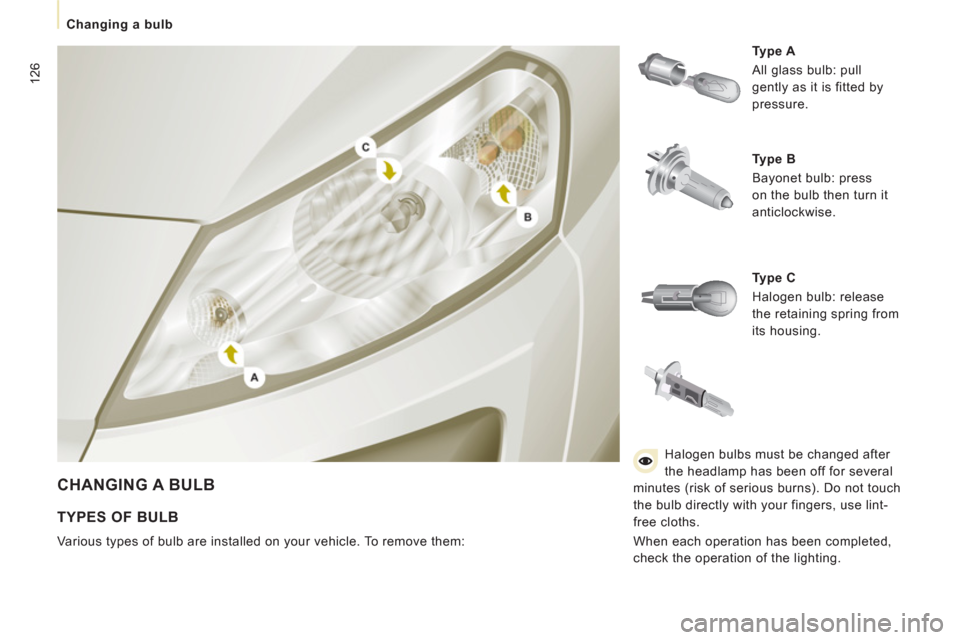
CHANGING A BULB
Type A
All glass bulb: pull
gently as it is fitted by
pressure.
Type B
Bayonet bulb: press
on the bulb then turn it
anticlockwise.
Type C
Halogen bulb: release
the retaining spring from
its housing.
TYPES OF BULB
Various types of bulb are installed on your vehicle. To remove them: Halogen bulbs must be changed after
the headlamp has been off for several
minutes (risk of serious burns). Do not touch
the bulb directly with your fingers, use lint-
free cloths.
When each operation has been completed,
check the operation of the lighting.
Page 129 of 268
12
7
Changing a bulb
QUICK HEL
P
7
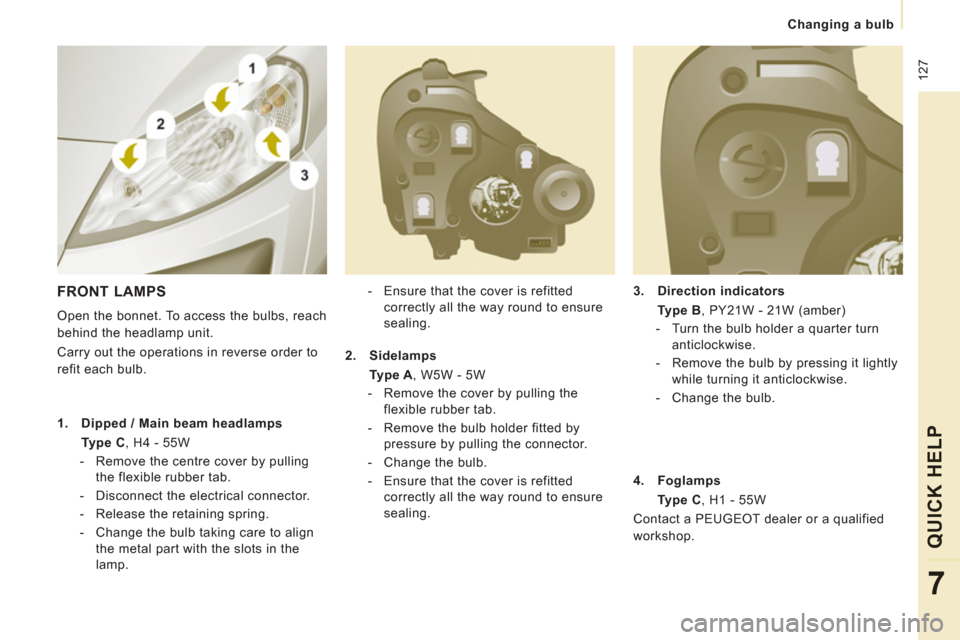
3.
Direction indicators
Type B
, PY21W - 21W (amber)
- Turn the bulb holder a quarter turn
anticlockwise.
- Remove the bulb by pressing it lightly
while turning it anticlockwise.
- Change the bulb.
- Ensure that the cover is refitted
correctly all the way round to ensure
sealing.
FRONT LAMPS
Open the bonnet. To access the bulbs, reach
behind the headlamp unit.
Carry out the operations in reverse order to
refit each bulb.
1.
Dipped / Main beam headlamps
Type C
, H4 - 55W
- Remove the centre cover by pulling
the flexible rubber tab.
- Disconnect the electrical connector.
- Release the retaining spring.
- Change the bulb taking care to align
the metal part with the slots in the
lamp.
2.
Sidelamps
Type A
, W5W - 5W
- Remove the cover by pulling the
flexible rubber tab.
- Remove the bulb holder fitted by
pressure by pulling the connector.
- Change the bulb.
- Ensure that the cover is refitted
correctly all the way round to ensure
sealing.
4.
Foglamps
Type C
, H1 - 55W
Contact a PEUGEOT dealer or a qualified
workshop.
Page 131 of 268
12
9
Changing a bulb
QUICK HEL
P
7
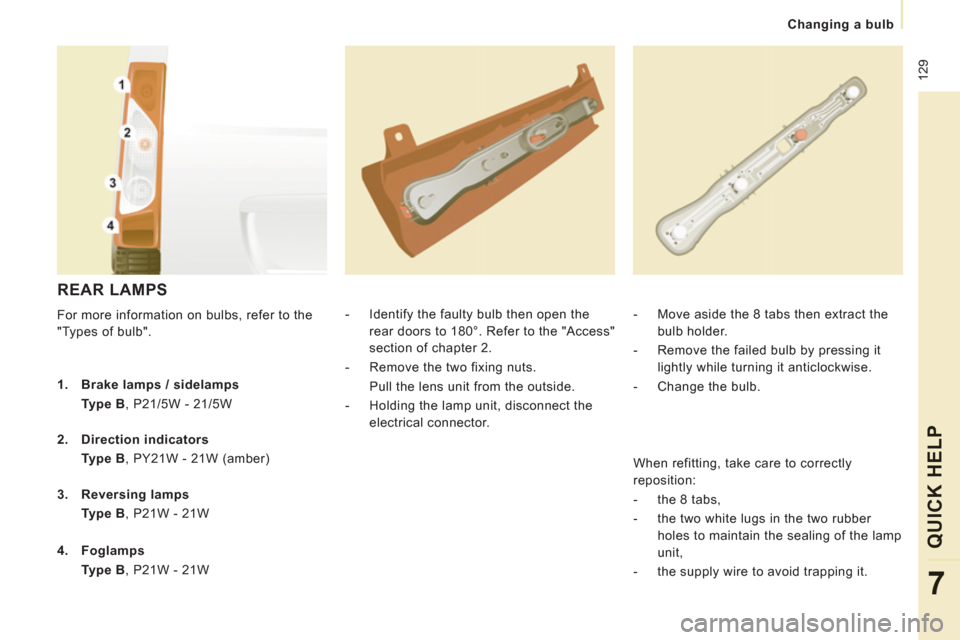
REAR LAMPS
For more information on bulbs, refer to the
"Types of bulb".
- Identify the faulty bulb then open the
rear doors to 180°. Refer to the "Access"
section of chapter 2.
- Remove the two fixing nuts.
Pull the lens unit from the outside.
- Holding the lamp unit, disconnect the
electrical connector.
- Move aside the 8 tabs then extract the
bulb holder.
- Remove the failed bulb by pressing it
lightly while turning it anticlockwise.
- Change the bulb.
1.
Brake
lamps
/
sidelamps
Type B
, P21/5W - 21/5W
2.
Direction indicators
Type B
, PY21W - 21W (amber)
3.
Reversing
lamps
Type B
, P21W - 21W
4.
Foglamps
Type B
, P21W - 21W When refitting, take care to correctly
reposition:
- the 8 tabs,
- the two white lugs in the two rubber
holes to maintain the sealing of the lamp
unit,
- the supply wire to avoid trapping it.