warning Peugeot Expert VU 2012 Owner's Guide
[x] Cancel search | Manufacturer: PEUGEOT, Model Year: 2012, Model line: Expert VU, Model: Peugeot Expert VU 2012Pages: 268, PDF Size: 9.73 MB
Page 82 of 268
80
Rear suspension
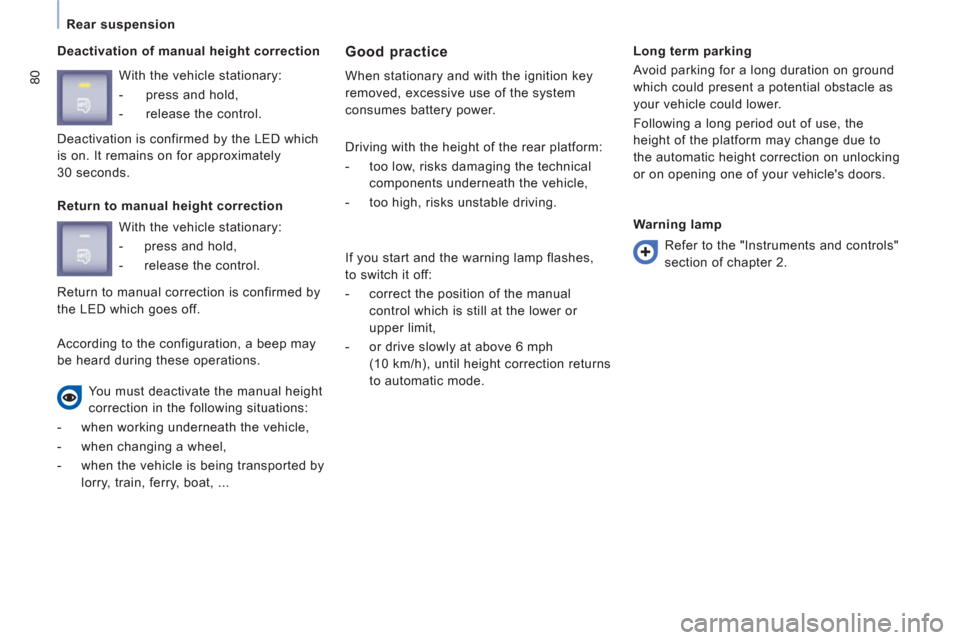
Deactivation of manual height correction
Good practice
When stationary and with the ignition key
removed, excessive use of the s
ystem
consumes battery power.
Long term parking
Avoid parking for a long duration on ground
which could
present a potential obstacle as
your vehicle could lower.
Followin
g a long period out of use, the
height of the platform may change due to
the automatic hei
ght correction on unlocking
or on openin
g one of your vehicle's doors. With the vehicle stationar
y:
- press and hold,
- release the control.
Return to manual height correction
According to the configuration, a beep may
be heard during these operations.
You must deactivate the manual hei
ght
correction in the following situations:
- when working underneath the vehicle,
- when changing a wheel,
- when the vehicle is being transported by
lorry, train, ferry, boat, ...
Warning lamp Driving with the height o
f the rear platform:
- too low, risks damaging the technical
components underneath the vehicle,
- too high, risks unstable driving.
With the vehicle stationary:
- press and hold,
- release the control. R
efer to the "Instruments and controls"
section of chapter 2.
If you start and the warning lamp flashes,
t
o switch it off:
- correct the position of the manual
control which is still at the lower or
upper limit,
- or drive slowly at above 6 mph
(10 km/h), until height correction returns
to automatic mode. Return to manual correction is confirmed b
y
the LED which goes off. Deactivation is con
firmed by the LED which
is on. It remains on
for approximately
30 seconds.
Page 86 of 268
84
Driving safely
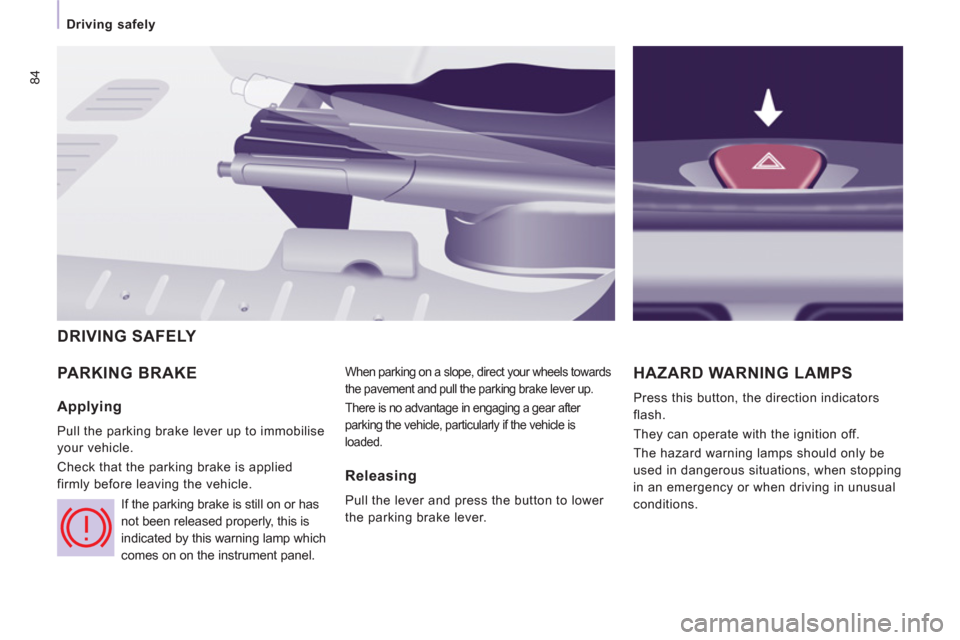
PARKING BRAKE
When parking on a slope, direct your wheels towards
the pavement and pull the parking brake lever up.
There is no advantage in engaging a gear after
parking the vehicle, particularly if the vehicle is
loaded.
HAZARD WARNING LAMPS
Press this button, the direction indicators
flash.
They can operate with the ignition off.
The hazard warning lamps should only be
used in dangerous situations, when stopping
in an emergency or when driving in unusual
conditions.
DRIVING SAFELY
Applying
Pull the parking brake lever up to immobilise
your vehicle.
Check that the parking brake is applied
firmly before leaving the vehicle.
If the parking brake is still on or has
not been released properly, this is
indicated by this warning lamp which
comes on on the instrument panel.
Releasing
Pull the lever and press the button to lower
the parking brake lever.
Page 88 of 268
ABS
ABS
Driving safely
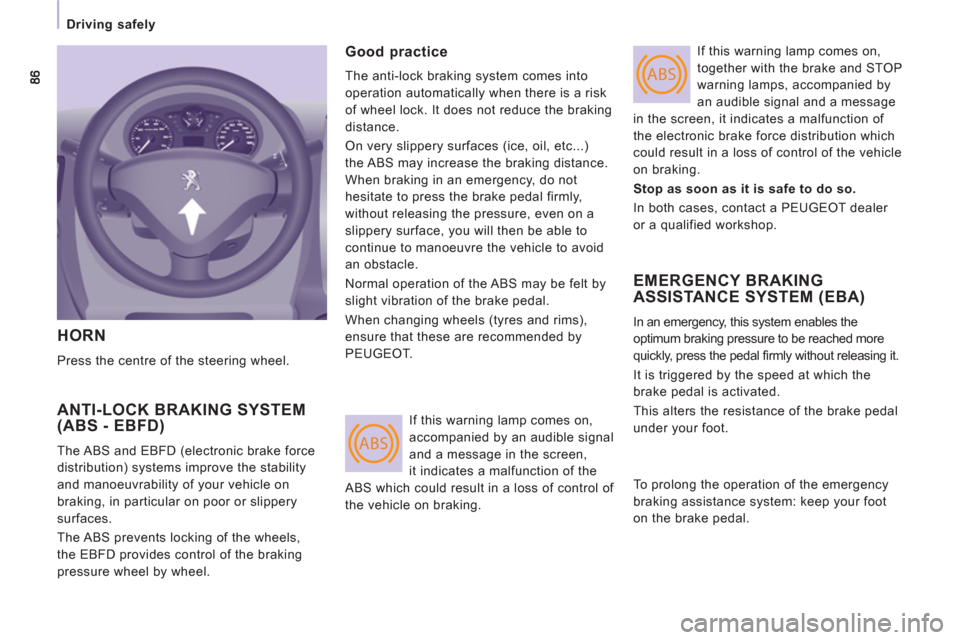
HORN
Press the centre of the steering wheel.
ANTI-LOCK BRAKING SYSTEM(ABS - EBFD)
The ABS and EBFD (electronic brake force
distribution) systems improve the stability
and manoeuvrability of your vehicle on
braking, in particular on poor or slippery
surfaces.
The ABS prevents locking of the wheels,
the EBFD provides control of the braking
pressure wheel by wheel.
Good practice
The anti-lock braking system comes into
operation automatically when there is a risk
of wheel lock. It does not reduce the braking
distance.
On very slippery surfaces (ice, oil, etc...)
the ABS may increase the braking distance.
When braking in an emergency, do not
hesitate to press the brake pedal firmly,
without releasing the pressure, even on a
slippery surface, you will then be able to
continue to manoeuvre the vehicle to avoid
an obstacle.
Normal operation of the ABS may be felt by
slight vibration of the brake pedal.
When changing wheels (tyres and rims),
ensure that these are recommended by
PEUGEOT. If this warning lamp comes on,
together with the brake and STOP
warning lamps, accompanied by
an audible signal and a message
in the screen, it indicates a malfunction of
the electronic brake force distribution which
could result in a loss of control of the vehicle
on braking.
Stop
as soon as it is safe to do so
.
In both cases, contact a PEUGEOT dealer
or a qualified workshop.
EMERGENCY BRAKING
ASSISTANCE SYSTEM (EBA)
In an emergency, this system enables the
optimum braking pressure to be reached more
quickly, press the pedal fi rmly without releasing it.
It is triggered by the speed at which the
brake pedal is activated.
This alters the resistance of the brake pedal
under your foot. If this warning lamp comes on,
accompanied by an audible signal
and a message in the screen,
it indicates a malfunction of the
ABS which could result in a loss of control of
the vehicle on braking. To prolong the operation of the emergency
braking assistance system: keep your foot
on the brake pedal.
Page 89 of 268
ESP
87
Driving safely
SAFETY
4
ANTI-SLIP REGULATION (ASR)AND ELECTRONIC STABILITY PROGRAMME (ESP)
These systems are linked and complement
the ABS.
The ASR system is very useful for
maintaining optimum drive and avoiding
losses of control of the vehicle on
acceleration.
The system optimises drive to prevent the
wheels skidding, by acting on the brakes of
the drive wheels and on the engine. It also
allows the directional stability of the vehicle
to be improved on acceleration. acts on the engine and the brake of one
or more wheels, in order to put the vehicle
back on course.
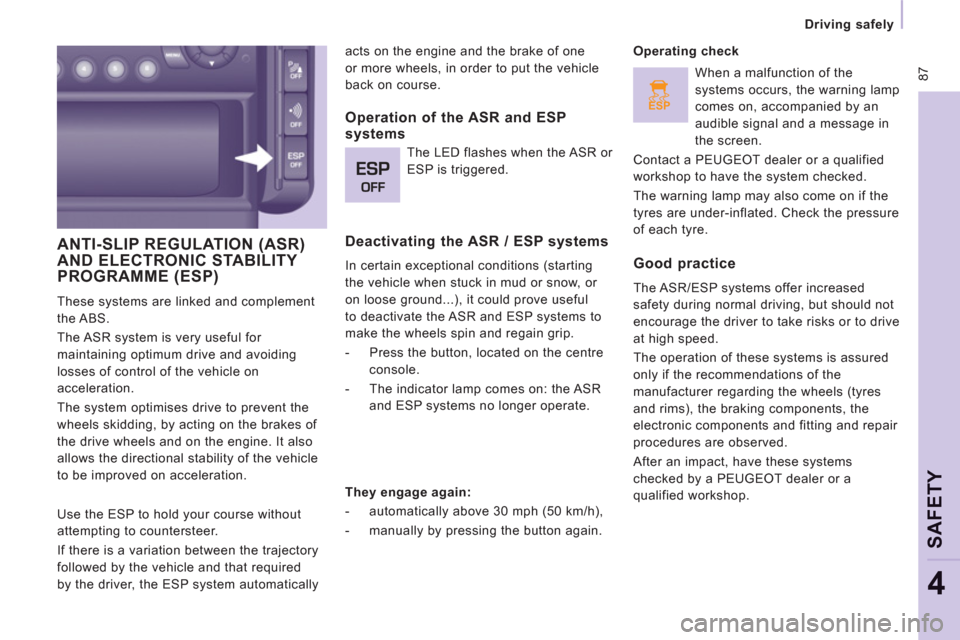
Deactivating the ASR / ESP systems
In certain exceptional conditions (starting
the vehicle when stuck in mud or snow, or
on loose ground...), it could prove useful
to deactivate the ASR and ESP systems to
make the wheels spin and regain grip.
- Press the button, located on the centre
console.
- The indicator lamp comes on: the ASR
and ESP systems no longer operate.
Operating check
Good practice
The ASR/ESP systems offer increased
safety during normal driving, but should not
encourage the driver to take risks or to drive
at high speed.
The operation of these systems is assured
only if the recommendations of the
manufacturer regarding the wheels (tyres
and rims), the braking components, the
electronic components and fitting and repair
procedures are observed.
After an impact, have these systems
checked by a PEUGEOT dealer or a
qualified workshop.
Use the ESP to hold your course without
attempting to countersteer.
If there is a variation between the trajectory
followed by the vehicle and that required
by the driver, the ESP system automatically
Operation of the ASR and ESP
systems
The LED flashes when the ASR or
ESP is triggered.
They engage again:
- automatically above 30 mph (50 km/h),
- manually by pressing the button again.
When a malfunction of the
systems occurs, the warning lamp
comes on, accompanied by an
audible signal and a message in
the screen.
Contact a PEUGEOT dealer or a qualified
workshop to have the system checked.
The warning lamp may also come on if the
tyres are under-inflated. Check the pressure
of each tyre.
Page 92 of 268
90
Seat belts
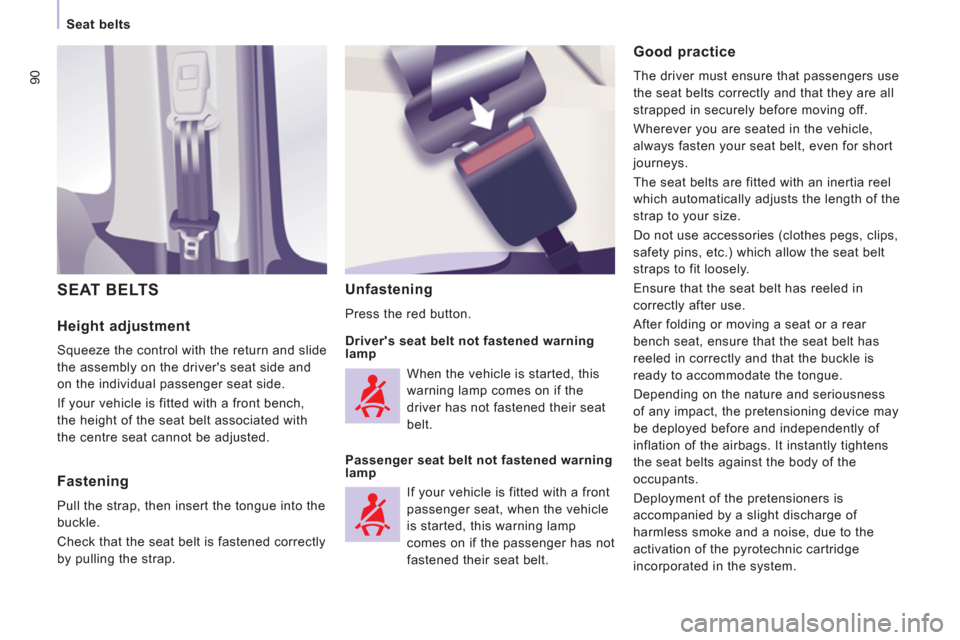
Height adjustment
Squeeze the control with the return and slide
the assembly on the driver's seat side and
on the individual passenger seat side.
If your vehicle is fitted with a front bench,
the height of the seat belt associated with
the centre seat cannot be adjusted.
Unfastening
Press the red button.
SEAT BELTS
Good practice
The driver must ensure that passengers use
the seat belts correctly and that they are all
strapped in securely before moving off.
Wherever you are seated in the vehicle,
always fasten your seat belt, even for short
journeys.
The seat belts are fitted with an inertia reel
which automatically adjusts the length of the
strap to your size.
Do not use accessories (clothes pegs, clips,
safety pins, etc.) which allow the seat belt
straps to fit loosely.
Ensure that the seat belt has reeled in
correctly after use.
After folding or moving a seat or a rear
bench seat, ensure that the seat belt has
reeled in correctly and that the buckle is
ready to accommodate the tongue.
Depending on the nature and seriousness
of any impact, the pretensioning device may
be deployed before and independently of
inflation of the airbags. It instantly tightens
the seat belts against the body of the
occupants.
Deployment of the pretensioners is
accompanied by a slight discharge of
harmless smoke and a noise, due to the
activation of the pyrotechnic cartridge
incorporated in the system.
Fastening
Pull the strap, then insert the tongue into the
buckle.
Check that the seat belt is fastened correctly
by pulling the strap.
Driver's seat belt not fastened warning
lamp
Passenger seat belt not fastened warning
lamp When the vehicle is started, this
warning lamp comes on if the
driver has not fastened their seat
belt.
If your vehicle is fitted with a front
passenger seat, when the vehicle
is started, this warning lamp
comes on if the passenger has not
fastened their seat belt.
Page 93 of 268
91
Seat belts
SAFETY
4
The force limiter reduces the pressure of the
seat belt against the body of the occupants.
The pretensioning seat belts are active
when the ignition is switched on.
The inertia reels are fitted with a device
which automatically locks the strap in the
event of a collision or emergency braking or
if the vehicle rolls over.
You can unfasten the seat belt by pressing
the red button on the buckle. Guide the seat
belt after unfastening.
The airbag warning lamp comes on if the
pretensioners are deployed. Contact a
PEUGEOT dealer or a qualified workshop.
In order to be effective, a seat belt must:
- restrain one person only,
- must not be twisted, check by pulling in
front of you with an even movement,
- be tightened as close to the body as
possible.
The upper part of the seat belt should be
positioned in the hollow of the shoulder.
The lap part should be placed as low as
possible on the pelvis.
Recommendations for children:
- use a suitable child seat if the
passenger is less than 12 years old or
shorter than one metre fifty,
- never allow a child to travel on your lap,
even with the seat belt fastened.
FRONT SEAT BELTS
For more information on child seats,
refer to the "Children on board" section
of chapter 4.
In accordance with current safety
regulations, your PEUGEOT dealer can
guarantee all work or any checks, from
testing to maintenance, on your seat belt
equipment.
Have the seat belts checked regularly (even
after a minor impact) by a PEUGEOT dealer
or a qualified workshop: they must not show
any signs of wear, cutting or fraying and they
must not be converted or modified.
Clean the seat belt straps with soapy
water or a textile cleaning product, sold
by PEUGEOT dealers.
With front airbags
The front seats are fitted with pretensioners
and force limiters.
Without front airbag
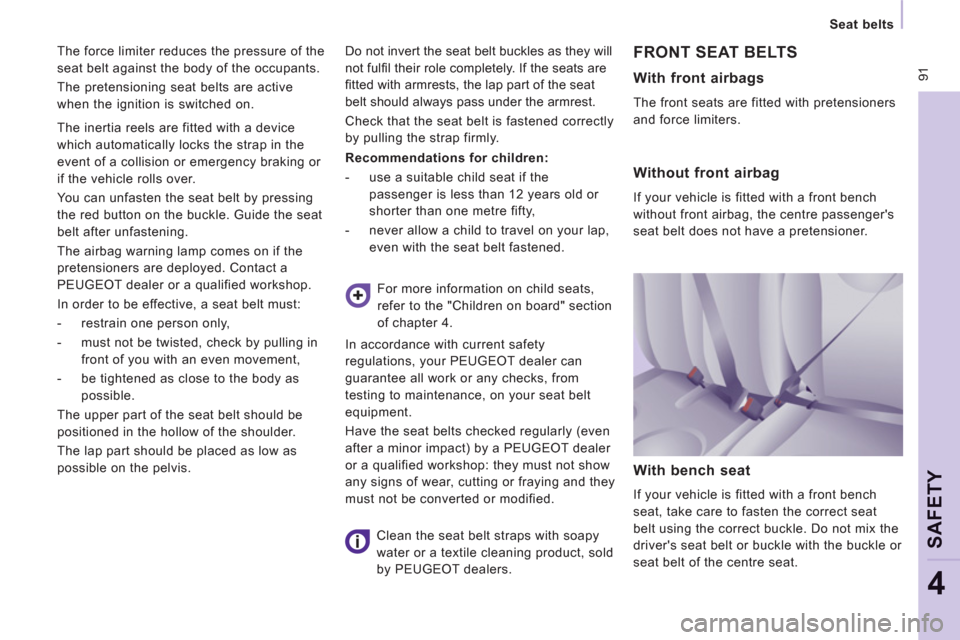
If your vehicle is fitted with a front bench
without front airbag, the centre passenger's
seat belt does not have a pretensioner.
With bench seat
If your vehicle is fitted with a front bench
seat, take care to fasten the correct seat
belt using the correct buckle. Do not mix the
driver's seat belt or buckle with the buckle or
seat belt of the centre seat. Do not invert the seat belt buckles as they will
not fulfi l their role completely. If the seats are
fi tted with armrests, the lap part of the seat
belt should always pass under the armrest.
Check that the seat belt is fastened correctly
by pulling the strap firmly.
Page 97 of 268
95
Airbags
SAFETY
4
If this warning lamp comes
on in the instrument panel,
accompanied by an audible signal
and a message in the screen,
contact a PEUGEOT dealer or a qualified
workshop to have the system checked. The
airbags may no longer be deployed in the
event of a serious impact.
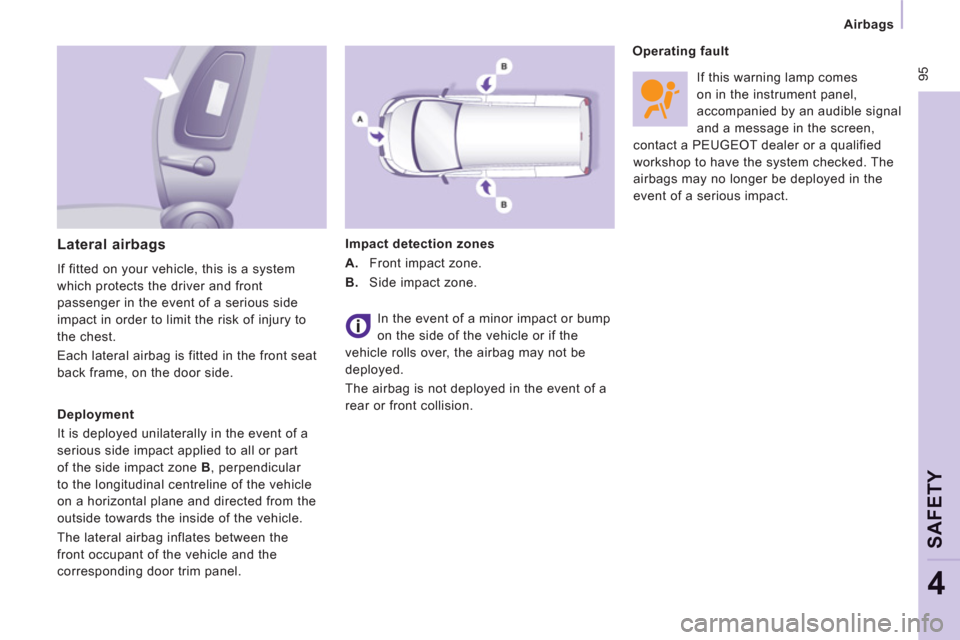
Lateral airbags
If fitted on your vehicle, this is a system
which protects the driver and front
passenger in the event of a serious side
impact in order to limit the risk of injury to
the chest.
Each lateral airbag is fitted in the front seat
back frame, on the door side.
Impact detection zones
A.
Front impact zone.
B.
Side impact zone.
In the event of a minor impact or bump
on the side of the vehicle or if the
vehicle rolls over, the airbag may not be
deployed.
The airbag is not deployed in the event of a
rear or front collision.
Operating fault
Deployment
It is deployed unilaterally in the event of a
serious side impact applied to all or part
of the side impact zone B
, perpendicular
to the longitudinal centreline of the vehicle
on a horizontal plane and directed from the
outside towards the inside of the vehicle.
The lateral airbag inflates between the
front occupant of the vehicle and the
corresponding door trim panel.
Page 98 of 268
96
Airbags
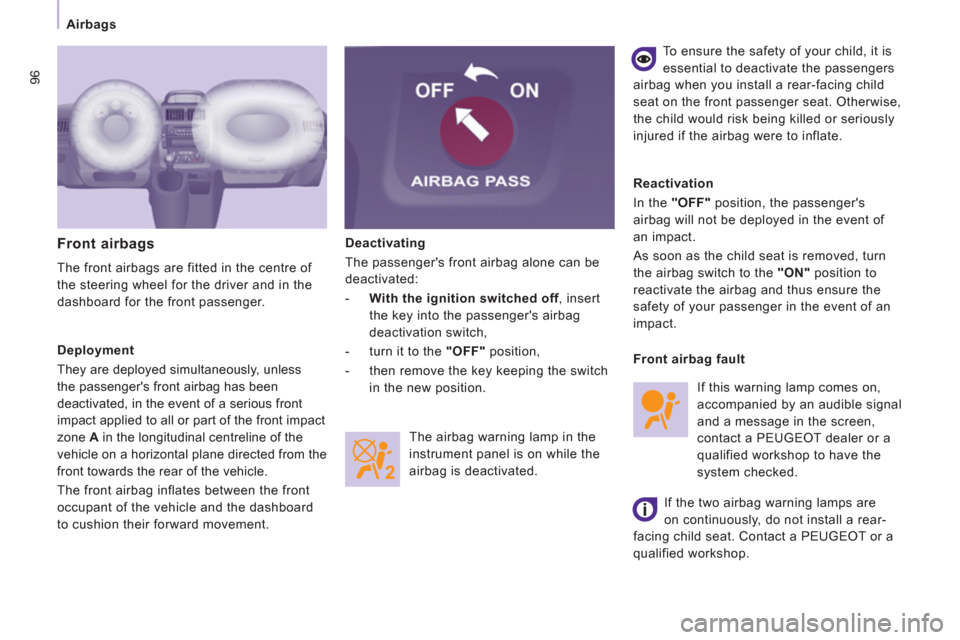
Deactivating
The passenger's front airbag alone can be
deactivated:
- With the ignition switched off
, insert
the key into the passenger's airbag
deactivation switch,
- turn it to the "OFF"
position,
- then remove the key keeping the switch
in the new position.
Front airbags
The front airbags are fitted in the centre of
the steering wheel for the driver and in the
dashboard for the front passenger.
Reactivation
In the "OFF"
position, the passenger's
airbag will not be deployed in the event of
an impact.
As soon as the child seat is removed, turn
the airbag switch to the "ON"
position to
reactivate the airbag and thus ensure the
safety of your passenger in the event of an
impact. To ensure the safety of your child, it is
essential to deactivate the passengers
airbag when you install a rear-facing child
seat on the front passenger seat. Otherwise,
the child would risk being killed or seriously
injured if the airbag were to inflate.
The airbag warning lamp in the
instrument panel is on while the
airbag is deactivated.
Deployment
They are deployed simultaneously, unless
the passenger's front airbag has been
deactivated, in the event of a serious front
impact applied to all or part of the front impact
zone A
in the longitudinal centreline of the
vehicle on a horizontal plane directed from the
front towards the rear of the vehicle.
The front airbag inflates between the front
occupant of the vehicle and the dashboard
to cushion their forward movement.
If this warning lamp comes on,
accompanied by an audible signal
and a message in the screen,
contact a PEUGEOT dealer or a
qualified workshop to have the
system checked.
Front airbag fault
If the two airbag warning lamps are
on continuously, do not install a rear-
facing child seat. Contact a PEUGEOT or a
qualified workshop.
Page 105 of 268
10
3
Towing a trailer
ACCESSORIE
S
5
You should therefore use a high gear to
lower the engine speed and reduce your
speed.
In all cases, pay attention to the coolant
temperature.
Tyres
Check the tyre pressures of the towing
vehicle (see the "Identification markings"
section of chapter 8) and of the trailer,
observing the recommended pressures.
Towbar
We recommend the use of genuine
PEUGEOT towbars and their harnesses,
which have been tested and approved from
the design stage of your vehicle, and that
you entrust the fitting of this equipment to a
PEUGEOT dealer.
If this equipment is not fitted by a PEUGEOT
dealer, it is imperative that it is fitted using
the electrical pre-equipment installed at the
rear of the vehicle and in accordance with
the manufacturer's instructions.
In accordance with the general instructions
a reminder of which has been given above,
we draw your attention to the risk associated
with fitting a towbar or electrical accessory
not recommended by PEUGEOT. Fitting
such equipment could result in the failure
of your vehicle's electronic system. Please
obtain information from the Manufacturer
before fitting this type of equipment.
See the "Levels" section of chapter 6.
Good Practice
In certain cases of particularly arduous
use (towing the maximum load up a steep
slope in high temperatures), the engine
automatically limits its power. In this
case, the air conditioning is automatically
cut off to save engine power.
If the coolant temperature warning
lamp comes on, stop the vehicle
and switch off the engine as soon
as possible.
Brakes
Towing increases the braking distance. Drive
at a moderate speed, change down early
and brake gradually.
Side wind
Sensitivity to side wind is increased. Drive
smoothly and at a moderate speed.
ABS/ESP
The ABS or ESP systems only control the
vehicle, not the trailer or caravan.
Rear parking sensors
The parking sensors system does not
function while the vehicle is towing.
Page 107 of 268
105
Equipment
ACCESSORIE
S
5
The fitting of electrical equipment
or accessories which are not
recommended by PEUGEOT may result
in the failure of your vehicle's electronic
system. Please note this specific warning.
You are advised to contact a representative
of the Marque to be shown the range of
recommended equipment and accessories.
Depending on the country in which the
vehicle is sold or operated, it is compulsory
to have a high visibility safety vest, warning
triangle and replacement bulbs available in
the vehicle.
Front mud flaps, rear mud flaps, ...
Installation of radiocommunication
transmitters
Before installing accessory
radiocommunication transmitters with an
external aerial on your vehicle, you are
advised to contact a representative of the
PEUGEOT marque.
The PEUGEOT dealer network can inform
you of the specifications (frequency
band, maximum output power, aerial
position, specific installation conditions)
of the transmitters which can be fitted,
in accordance with the Motor Vehicle
Electromagnetic Compatibility Directive
(2004/104/CE). Screenwash, replacement fuses, wiper
blades, interior and exterior cleaning and
maintenance products, replacement bulbs, ... To prevent the mat from becoming caught
under the pedals:
- ensure that the mat and its fi xings are
positioned correctly,
- never fi t one mat on top of another.
Audio equipment, hands-free kit, speakers,
CD changer, navigation, ...
Regardless of the audio and telematic
equipment offered on the market, the
technical constraints linked with the fi tting of
equipment of these families of products mean
that the special features of the equipment and
its compatibility with the capacities of the your
vehicle's standard equipment must be taken
into account. Please contact a dealer for
information before fi tting such equipment.
Range of trade equipment
Parts and Services technical information
publishes an accessory catalogue offering
various equipment and fittings, such as:
Roof bars for short, medium and long
wheelbase (load retainers for all models).
Sill plate, loading roller, sill. Sill plate,
loading roller, sill.
Towbar, towbar harness: trailer towbar which
must be fitted by the network.
Roof bars for the various heights, roof bars,
ladder.
Separation partitions and grilles, smooth,
non-slip wooden protective floor.
Protective grilles, multimedia.
Another range is also available, structured
around comfort, leisure and maintenance:
Anti-theft alarm, window engraving, first aid
kit, high visibility safety vest, rear parking
sensors, warning triangle,
Front seat covers compatible with airbags,
bench, rubber mats, carpet mats, snow
chains.