ESP Peugeot Expert VU 2013 User Guide
[x] Cancel search | Manufacturer: PEUGEOT, Model Year: 2013, Model line: Expert VU, Model: Peugeot Expert VU 2013Pages: 248, PDF Size: 9.37 MB
Page 80 of 248
78
Rear suspension
Metal suspension
This equipment adopts long movement limiters
which make it possible to
guarantee stable
behaviour both when loaded and when empt
y.
No action on your part is required except to
ensure that maintenance is carried out and that
the authorised loads are com
plied with.irrespective o
f the weight of the load, within
the limit of the authorised values.
On board,
the increasin
g or lightening of the load on
the vehicle's plat
form is detected by two
hei
ght sensors. When all of the doors are
closed, the sensors trigger the automatic
hei
ght correction and determine the optimum
hei
ght of the sill for the vehicle's driving
conditions.
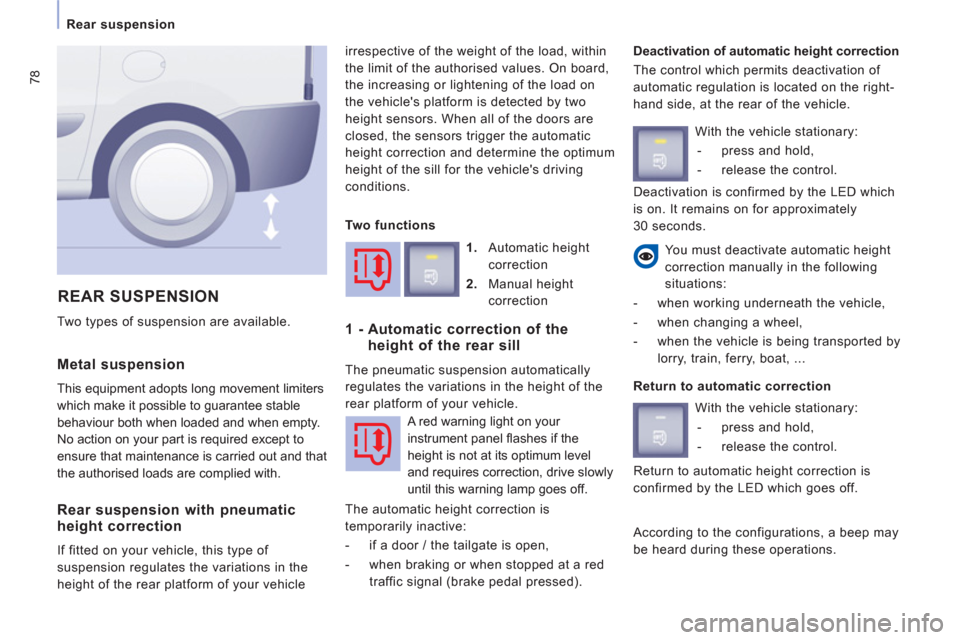
Deactivation of automatic height correction
The control which permits deactivation o
f
automatic re
gulation is located on the right-
hand side, at the rear of the vehicle.
REAR SUSPENSION
You must deactivate automatic height
correction manually in the following
situations:
- when working underneath the vehicle,
- when changing a wheel,
- when the vehicle is being transported by
lorry, train, ferry, boat, ...
Two t
ypes of suspension are available.
Rear suspension with pneumatic height correction
If fitted on your vehicle, this type of
suspension regulates the variations in the
height of the rear platform of your vehicle
1.
Automatic height
correction
2.
Manual height
correction
1 - Automatic correction of the
height of the rear sill
The pneumatic suspension automatically
re
gulates the variations in the height of the
rear plat
form of your vehicle.
A red warning light on your
instrument panel
fl ashes if the
height is not at its optimum level
and requires correction, drive slowl
y
until this warning lamp goes off.
The automatic hei
ght correction is
temporar
ily inactive:
- if a door / the tailgate is open,
- when braking or when stopped at a red
traffic signal (brake pedal pressed).
With the vehicle stationary:
- press and hold,
- release the control.
Return to automatic correction
With the vehicle stationary:
- press and hold,
- release the control.
According to the configurations, a beep may
be heard durin
g these operations.
Two functions Deactivation is con
firmed by the LED which
is on. It remains on for approximatel
y
30 seconds.
Return to automatic hei
ght correction is
confirmed by the LED which goes off.
Page 83 of 248
81
Mirrors and windows
EASE OF USE AND COMFOR
T
3
MIRRORS MIRRORS AND WINDOWS
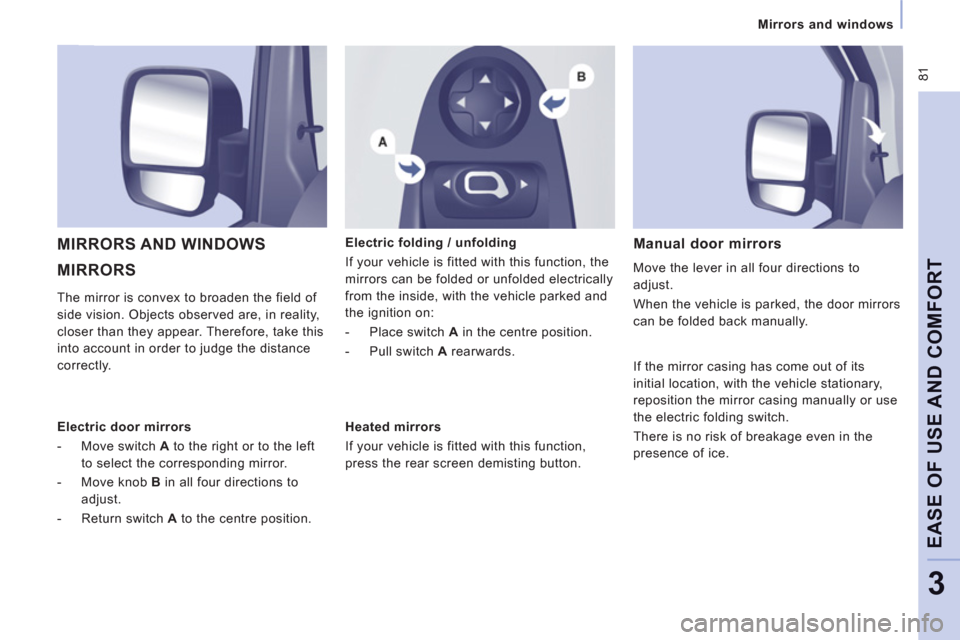
Electric folding / unfolding
If
your vehicle is fitted with this function, the
mirrors can be
folded or unfolded electrically
from the inside, with the vehicle parked and
the i
gnition on:
- Place switch A
in the centre position.
- Pull switch A
rearwards.
Manual door mirrors
Move the lever in all four directions to
ad
just.
When the vehicle is parked, the door mirrors
can be folded back manually.
Th
e mirror is convex to broaden the field of
side vision. Objects observed are, in reality,
closer than they appear. Therefore, take this
into account in order to
judge the distance
correctly.
Heated mirrors
If
your vehicle is fitted with this function,
press t
he rear screen demisting button.
I
f the mirror casing has come out of its
initial location, with the vehicle stationar
y,
reposition the mirror casing manually or use
the electric
folding switch.
There is no risk o
f breakage even in the
presence of ice.
Electric door mirrors
- Move switch A
to the right or to the left
to select the corresponding mirror.
- Move knob B
in all four directions to
adjust.
- Return switch A
to the centre position.
Page 87 of 248
85
Parking sensors
SAFETY
4
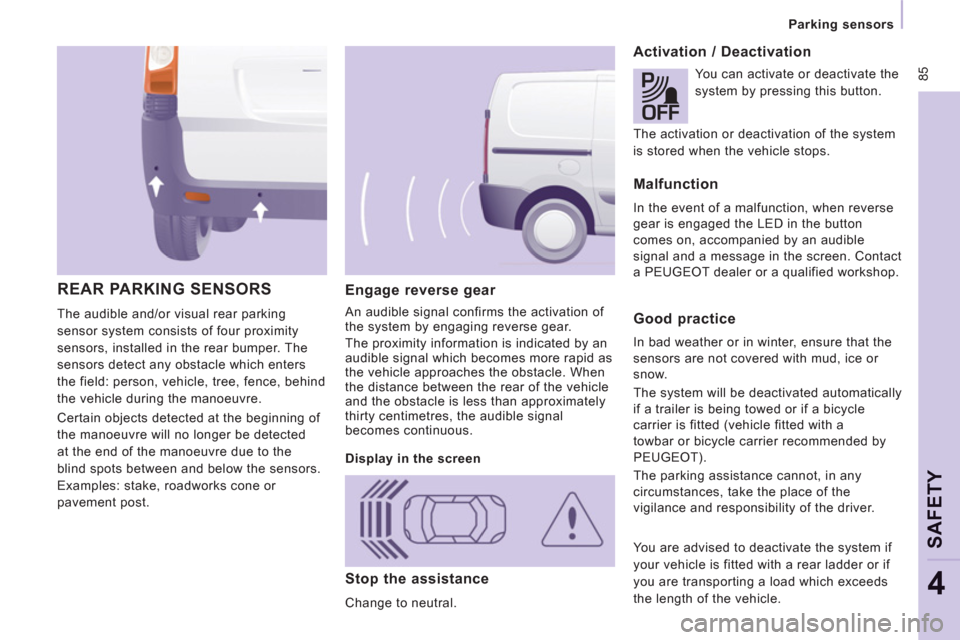
Engage reverse gear
An audible signal confirms the activation of
the system by engaging reverse gear.
The proximity information is indicated by an
audible signal which becomes more rapid as
the vehicle approaches the obstacle. When
the distance between the rear of the vehicle
and the obstacle is less than approximately
thirty centimetres, the audible signal
becomes continuous.
Stop the assistance
Change to neutral.
REAR PARKING SENSORS
The audible and/or visual rear parking
sensor system consists of four proximity
sensors, installed in the rear bumper. The
sensors detect any obstacle which enters
the field: person, vehicle, tree, fence, behind
the vehicle during the manoeuvre.
Certain objects detected at the beginning of
the manoeuvre will no longer be detected
at the end of the manoeuvre due to the
blind spots between and below the sensors.
Examples: stake, roadworks cone or
pavement post.
Activation / Deactivation
You can activate or deactivate the
system by pressing this button.
Malfunction
In the event of a malfunction, when reverse
gear is engaged the LED in the button
comes on, accompanied by an audible
signal and a message in the screen. Contact
a PEUGEOT dealer or a qualified workshop.
Good practice
In bad weather or in winter, ensure that the
sensors are not covered with mud, ice or
snow.
The system will be deactivated automatically
if a trailer is being towed or if a bicycle
carrier is fitted (vehicle fitted with a
towbar or bicycle carrier recommended by
PEUGEOT).
The parking assistance cannot, in any
circumstances, take the place of the
vigilance and responsibility of the driver.
Display in the screen
You are advised to deactivate the system if
your vehicle is fitted with a rear ladder or if
you are transporting a load which exceeds
the length of the vehicle. The activation or deactivation of the system
is stored when the vehicle stops.
Page 89 of 248
ESP
OFF
87
Driving safely
SAFETY
4
ANTI-SLIP REGULATION (ASR)AND DYNAMIC STABILITY
CONTROL (DSC)
These systems are linked and complement
the ABS.
The ASR system is very useful for
maintaining optimum drive and avoiding
losses of control of the vehicle on
acceleration.
The system optimises drive to prevent the
wheels skidding, by acting on the brakes of
the drive wheels and on the engine. It also
allows the directional stability of the vehicle
to be improved on acceleration. acts on the engine and the brake of one
or more wheels, in order to put the vehicle
back on course.
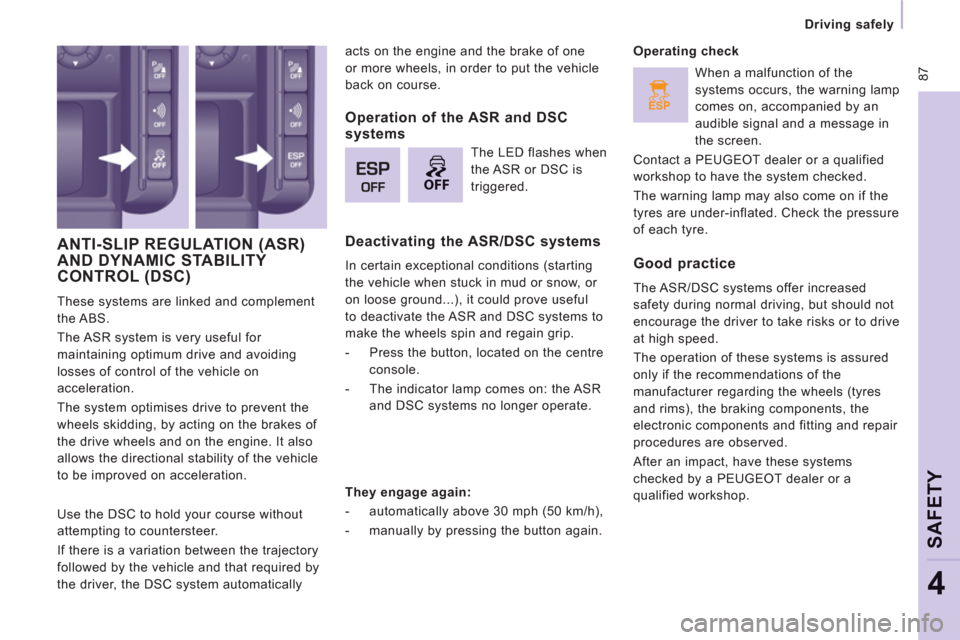
Deactivating the ASR/DSC systems
In certain exceptional conditions (starting
the vehicle when stuck in mud or snow, or
on loose ground...), it could prove useful
to deactivate the ASR and DSC systems to
make the wheels spin and regain grip.
- Press the button, located on the centre
console.
- The indicator lamp comes on: the ASR
and DSC systems no longer operate.
Operating check
Good practice
The ASR/DSC systems offer increased
safety during normal driving, but should not
encourage the driver to take risks or to drive
at high speed.
The operation of these systems is assured
only if the recommendations of the
manufacturer regarding the wheels (tyres
and rims), the braking components, the
electronic components and fitting and repair
procedures are observed.
After an impact, have these systems
checked by a PEUGEOT dealer or a
qualified workshop.
Use the DSC to hold your course without
attempting to countersteer.
If there is a variation between the trajectory
followed by the vehicle and that required by
the driver, the DSC system automatically
Operation of the ASR and DSC
systems
The LED flashes when
the ASR or DSC is
triggered.
They engage again:
- automatically above 30 mph (50 km/h),
- manually by pressing the button again.
When a malfunction of the
systems occurs, the warning lamp
comes on, accompanied by an
audible signal and a message in
the screen.
Contact a PEUGEOT dealer or a qualified
workshop to have the system checked.
The warning lamp may also come on if the
tyres are under-inflated. Check the pressure
of each tyre.
Page 91 of 248
ESP OFF
89
Driving safely
SAFETY
4
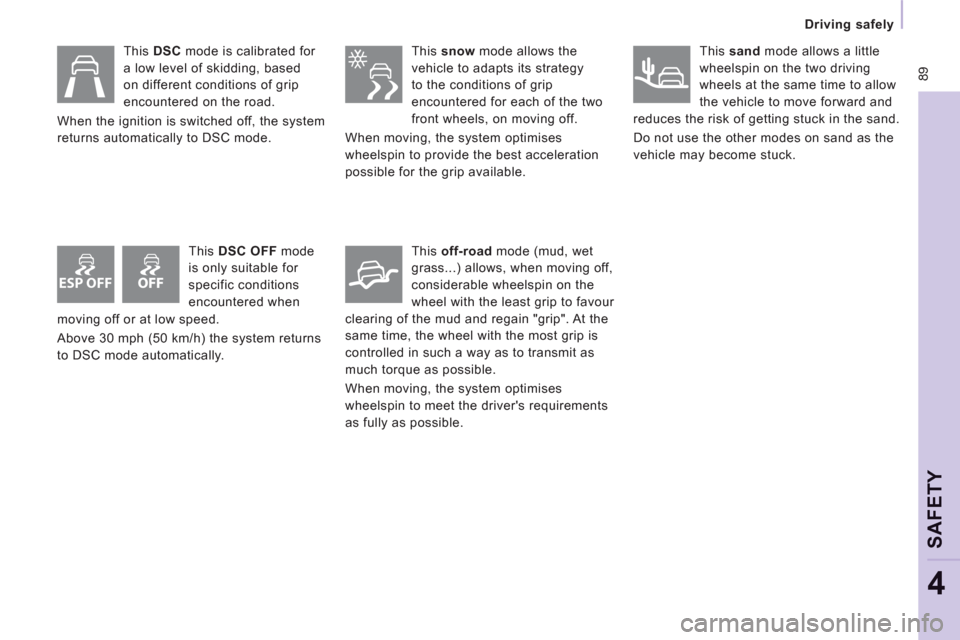
This DSC mode is calibrated for
a low level of skidding, based
on different conditions of grip
encountered on the road.
When the ignition is switched off, the system
returns automatically to DSC mode.
This DSC OFF
mode
is only suitable for
specific conditions
encountered when
This snow
mode allows the
vehicle to adapts its strategy
to the conditions of grip
encountered for each of the two
front wheels, on moving off.
When moving, the system optimises
wheelspin to provide the best acceleration
possible for the grip available.
This off-road
mode (mud, wet
grass...) allows, when moving off,
considerable wheelspin on the
wheel with the least grip to favour
clearing of the mud and regain "grip". At the
same time, the wheel with the most grip is
controlled in such a way as to transmit as
much torque as possible.
When moving, the system optimises
wheelspin to meet the driver's requirements
as fully as possible.
This sand
mode allows a little
wheelspin on the two driving
wheels at the same time to allow
the vehicle to move forward and
reduces the risk of getting stuck in the sand.
Do not use the other modes on sand as the
vehicle may become stuck.
moving off or at low speed.
Above 30 mph (50 km/h) the system returns
to DSC mode automatically.
Page 94 of 248
92
Improved safety and security
IMPROVED SAFETY AND
SECURITY
In situations of extreme transverse
acceleration, this module limits the risks
of the vehicle rolling over by acting on the
brakes.
Roll Over Mitigation *
This system, linked with the ESP,
supplements the ABS-EBFD, ASR-ESP and
EBA braking functions, already covered in
this document, to guarantee a high level
of active safety. Indeed, the ROM system
was intended originally for top-of-the-
range 4x4 type vehicles and today it is
fitted on your vehicle.
* Roll-over prevention system.
Page 97 of 248
95
Airbags
SAFETY
4
If this warning lamp comes
on in the instrument panel,
accompanied by an audible signal
and a message in the screen,
contact a PEUGEOT dealer or a qualified
workshop to have the system checked. The
airbags may no longer be deployed in the
event of a serious impact.
Lateral airbags
If fitted on your vehicle, this is a system
which protects the driver and front
passenger in the event of a serious side
impact in order to limit the risk of injury to
the chest.
Each lateral airbag is fitted in the front seat
back frame, on the door side.
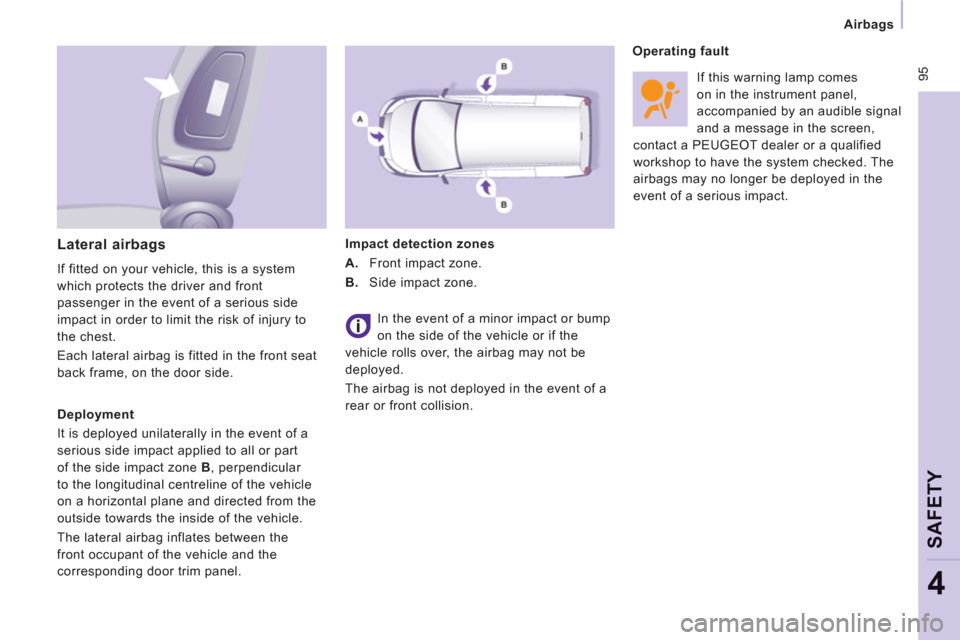
Impact detection zones
A.
Front impact zone.
B.
Side impact zone.
In the event of a minor impact or bump
on the side of the vehicle or if the
vehicle rolls over, the airbag may not be
deployed.
The airbag is not deployed in the event of a
rear or front collision.
Operating fault
Deployment
It is deployed unilaterally in the event of a
serious side impact applied to all or part
of the side impact zone B
, perpendicular
to the longitudinal centreline of the vehicle
on a horizontal plane and directed from the
outside towards the inside of the vehicle.
The lateral airbag inflates between the
front occupant of the vehicle and the
corresponding door trim panel.
Page 101 of 248
AR
BGНИКОГА НЕ инсталирайте детско столче на седалка с АКТИВИРАНА предна ВЪЗДУШНА ВЪЗГЛАВНИЦА. То в а можеда причини СМЪРТ или
СЕРИОЗНО НАРАНЯВАНЕ на детето.
CS NIKDY neumisťujte dětské zádržné zařízení orientované směrem dozadu na sedadlo chráněné AKTIVOVANÝM čelním AIRBAGEM. Hrozí nebezpečí
SMRTI DÍTĚTE nebo VÁŽNÉHO ZRANĚNÍ.
DA Brug aldrig en bagudvendt barnestol på et sæde der er beskyttet af en aktiv airbag. Død eller alvorlig skade på barnet kan forekomme.
DE Verwenden Sie NIEMALS einen Kindersitz oder Babyschale gegen die Fahrtrichtung bei AKTIVIERTEM Airbag, TOD oder ERNSTHAFTE
VERLETZUNGEN können die Folge sein.
ELΜη χρησιμοποιείτε ΠΟΤΕ παιδικό κάθισμα με την πλάτη του προς το εμπρός μέρος του αυτοκινήτου, σε
μια θέση που προστατεύεται από ΜΕΤΩΠΙΚΟ
αερόσακο που είναι ΕΝΕΡΓΟΣ. Αυτό μπορεί να έχει σαν συνέπεια το ΘΑΝΑΤΟ ή το ΣΟΒΑΡΟ ΤΡΑΥΜΑΤΙΣΜΟ του ΠΑΙΔΙΟΥ
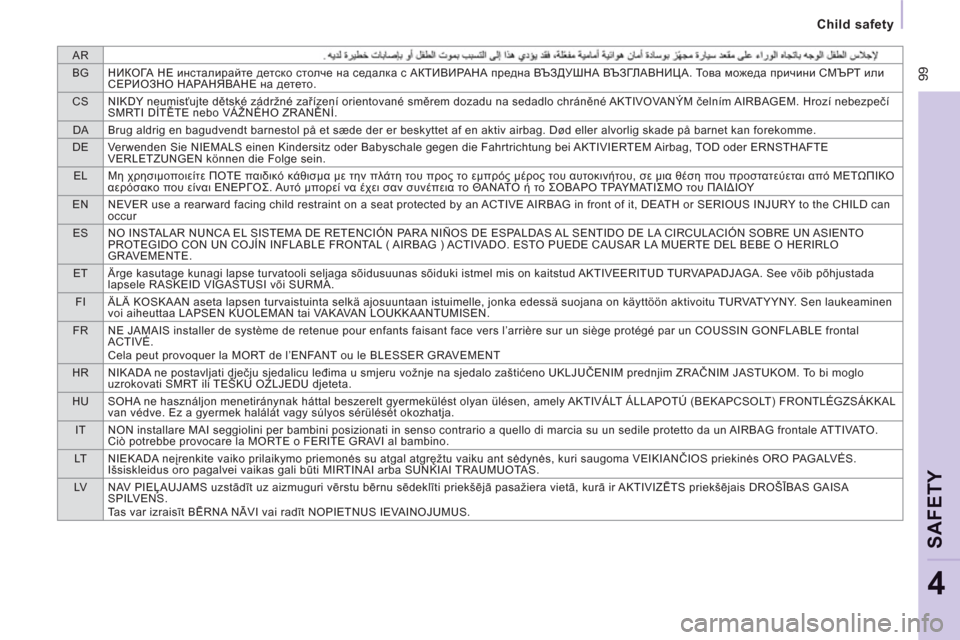
EN NEVER use a rearward facing child restraint on a seat protected by an ACTIVE AIRBAG in front of it, DEATH or SERIOUS INJURY to the CHILD can
occur
ES NO INSTALAR NUNCA EL SISTEMA DE RETENCIÓN PARA NIÑOS DE ESPALDAS AL SENTIDO DE LA CIRCULACIÓN SOBRE UN ASIENTO
PROTEGIDO CON UN COJÍN INFLABLE FRONTAL ( AIRBAG ) ACTIVADO. ESTO PUEDE CAUSAR LA MUERTE DEL BEBE O HERIRLO
GRAVEMENTE.
ET Ärge kasutage kunagi lapse turvatooli seljaga sõidusuunas sõiduki istmel mis on kaitstud AKTIVEERITUD TURVAPADJAGA. See võib põhjustada
lapsele RASKEID VIGASTUSI või SURMA.
FI ÄLÄ KOSKAAN aseta lapsen turvaistuinta selkä ajosuuntaan istuimelle, jonka edessä suojana on käyttöön aktivoitu TURVATYYNY. Sen laukeaminen
voi aiheuttaa LAPSEN KUOLEMAN tai VAKAVAN LOUKKAANTUMISEN.
FR NE JAMAIS installer de système de retenue pour enfants faisant face vers l’arrière sur un siège protégé par un COUSSIN GONFLABLE frontal
ACTIVÉ.
Cela peut provoquer la MORT de l’ENFANT ou le BLESSER GRAVEMENT
HR NIKADA ne postavljati dječju sjedalicu leđima u smjeru vožnje na sjedalo zaštićeno UKLJUČENIM prednjim ZRAČNIM JASTUKOM. To bi moglo
uzrokovati SMRT ili TEŠKU OZLJEDU djeteta.
HU SOHA ne használjon menetiránynak háttal beszerelt gyermekülést olyan ülésen, amely AKTIVÁLT ÁLLAPOTÚ (BEKAPCSOLT) FRONTLÉGZSÁKKAL
van védve. Ez a gyermek halálát vagy súlyos sérülését okozhatja.
IT NON installare MAI seggiolini per bambini posizionati in senso contrario a quello di marcia su un sedile protetto da un AIRBAG frontale ATTIVATO.
Ciò potrebbe provocare la MORTE o FERITE GRAVI al bambino.
LT NIEKADA neįrenkite vaiko prilaikymo priemonės su atgal atgręžtu vaiku ant sėdynės, kuri saugoma VEIKIANČIOS priekinės ORO PAGALVĖS.
Išsiskleidus oro pagalvei vaikas gali būti MIRTINAI arba SUNKIAI TRAUMUOTAS.
LV NAV PIE
ĻAUJAMS uzstādīt uz aizmuguri vērstu bērnu sēdeklīti priekšējā pasažiera vietā, kurā ir AKTIVIZĒTS priekšējais DROŠĪBAS GAISA
SPILVENS.
Tas var izraisīt BĒRNA NĀVI vai radīt NOPIETNUS IEVAINOJUMUS.
99
Child safety
SAFETY
4
Page 116 of 248
11 4
Checks
Manual gearbox
Have the level checked in accordance with
the manufacturer's servicing schedule.
To check the main levels and certain
components, in accordance with the
manufacturer's servicing schedule, refer
to the pages of the servicing and warranty
booklet which correspond to your vehicle's
engine.
Only use products recommended by
PEUGEOT or products of equivalent
quality and specification.
In order to optimise the operation of units as
important as the braking system, PEUGEOT
selects and offers specific products.
In order to avoid damaging the electrical
units, high pressure washing to clean the
engine compartment is strictly prohibited.
After washing the vehicle dampness, or in
winter, ice may form on the brake discs and
pads: braking efficiency may be reduced.
Make some light brake applications to dry
and de-ice the brakes.
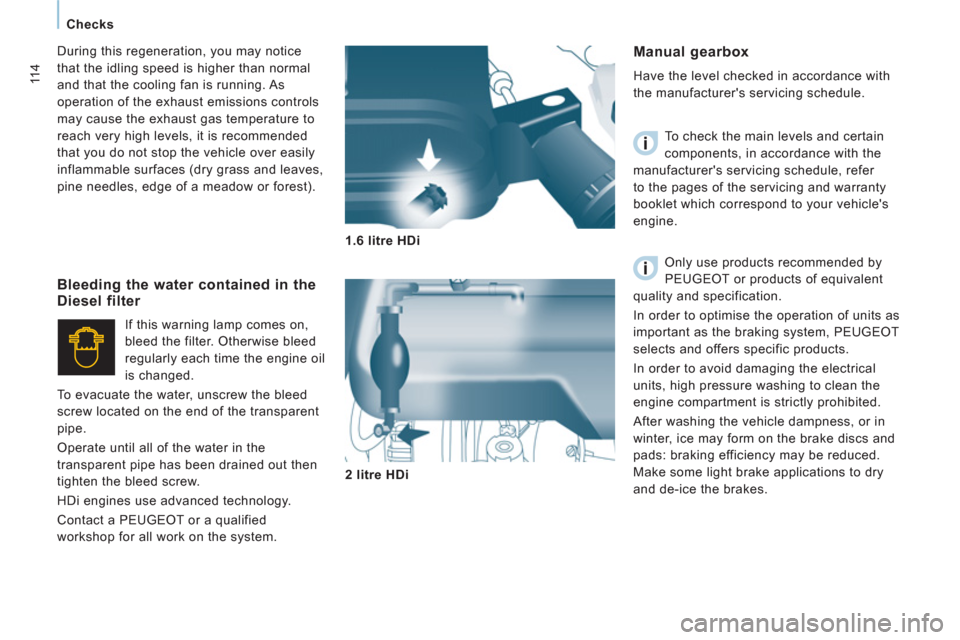
Bleeding the water contained in the
Diesel filter
If this warning lamp comes on,
bleed the filter. Otherwise bleed
regularly each time the engine oil
is changed.
To evacuate the water, unscrew the bleed
screw located on the end of the transparent
pipe.
Operate until all of the water in the
transparent pipe has been drained out then
tighten the bleed screw.
HDi engines use advanced technology.
Contact a PEUGEOT or a qualified
workshop for all work on the system.
1.6 litre HDi
2 litre HDi
During this regeneration, you may notice
that the idling speed is higher than normal
and that the cooling fan is running. As
operation of the exhaust emissions controls
may cause the exhaust gas temperature to
reach very high levels, it is recommended
that you do not stop the vehicle over easily
inflammable surfaces (dry grass and leaves,
pine needles, edge of a meadow or forest).
Page 136 of 248
134
Changing a fuse
CHANGING A FUSE
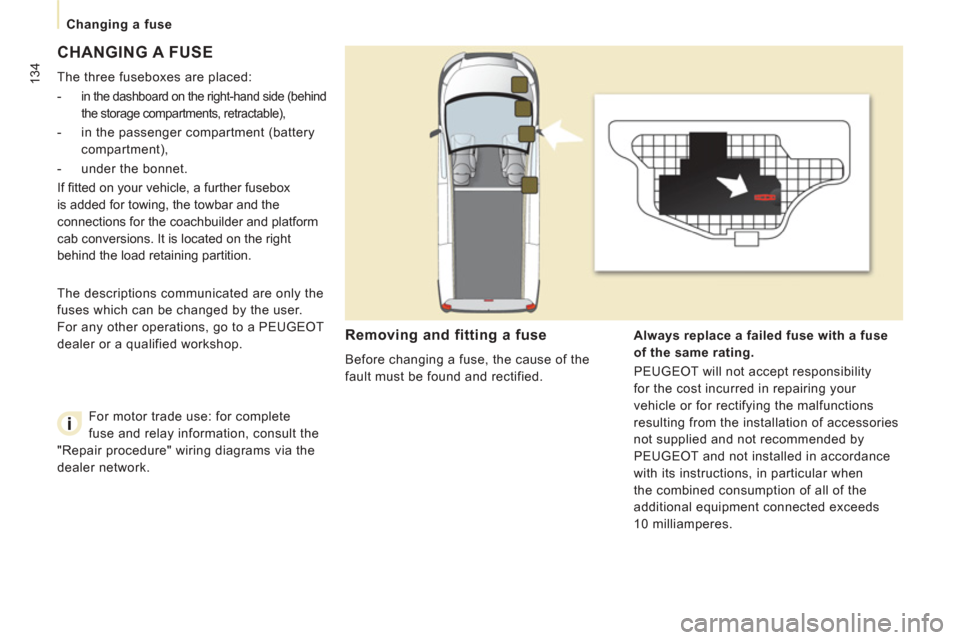
The three fuseboxes are placed:
-
in the dashboard on the right-hand side (behind
the storage compartments, retractable),
- in the passenger compartment (battery
compartment),
- under the bonnet.
If fi tted on your vehicle, a further fusebox
is added for towing, the towbar and the
connections for the coachbuilder and platform
cab conversions. It is located on the right
behind the load retaining partition.
Removing and fitting a fuse
Before changing a fuse, the cause of the
fault must be found and rectified. Always replace a failed fuse with a fuse
of the same rating.
PEUGEOT will not accept responsibility
for the cost incurred in repairing your
vehicle or for rectifying the malfunctions
resulting from the installation of accessories
not supplied and not recommended by
PEUGEOT and not installed in accordance
with its instructions, in particular when
the combined consumption of all of the
additional equipment connected exceeds
10 milliamperes.
The descriptions communicated are only the
fuses which can be changed by the user.
For any other operations, go to a PEUGEOT
dealer or a qualified workshop.
For motor trade use: for complete
fuse and relay information, consult the
"Repair procedure" wiring diagrams via the
dealer network.