engine Peugeot Expert VU 2013 User Guide
[x] Cancel search | Manufacturer: PEUGEOT, Model Year: 2013, Model line: Expert VU, Model: Peugeot Expert VU 2013Pages: 248, PDF Size: 9.37 MB
Page 43 of 248
41
Gearboxes and steering wheel
READY TO SET OFF
2
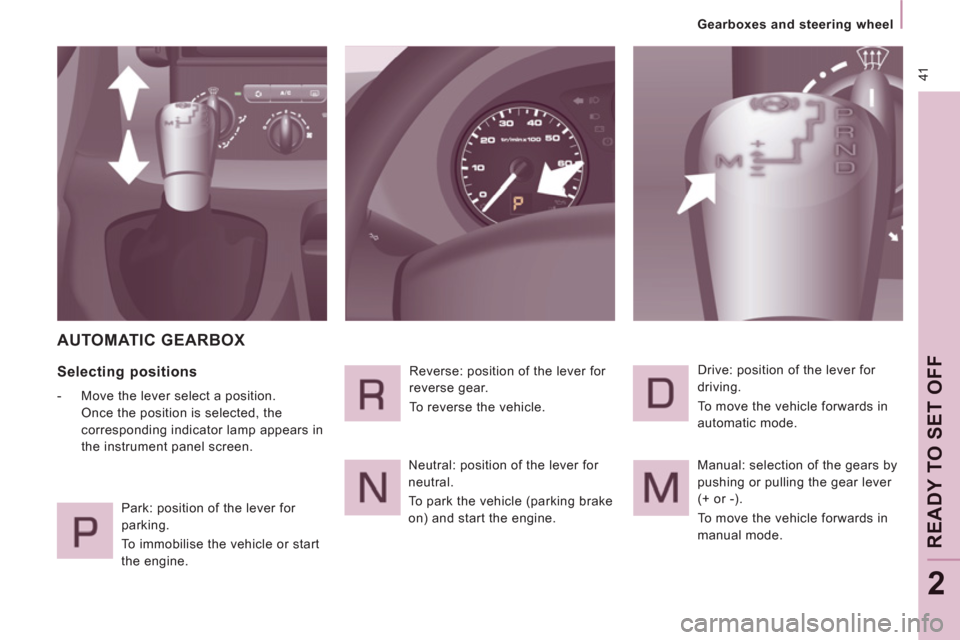
AUTOMATIC GEARBOX
Selecting positions
- Move the lever select a position.
Once the position is selected, the
corresponding indicator lamp appears in
the instrument panel screen.
Park: position of the lever for
parking.
To immobilise the vehicle or start
the engine. Reverse: position of the lever for
reverse gear.
To reverse the vehicle.
Neutral: position of the lever for
neutral.
To park the vehicle (parking brake
on) and start the engine. Drive: position of the lever for
driving.
To move the vehicle forwards in
automatic mode.
Manual: selection of the gears by
pushing or pulling the gear lever
(+ or -).
To move the vehicle forwards in
manual mode.
Page 44 of 248
42
Gearboxes and steering wheel
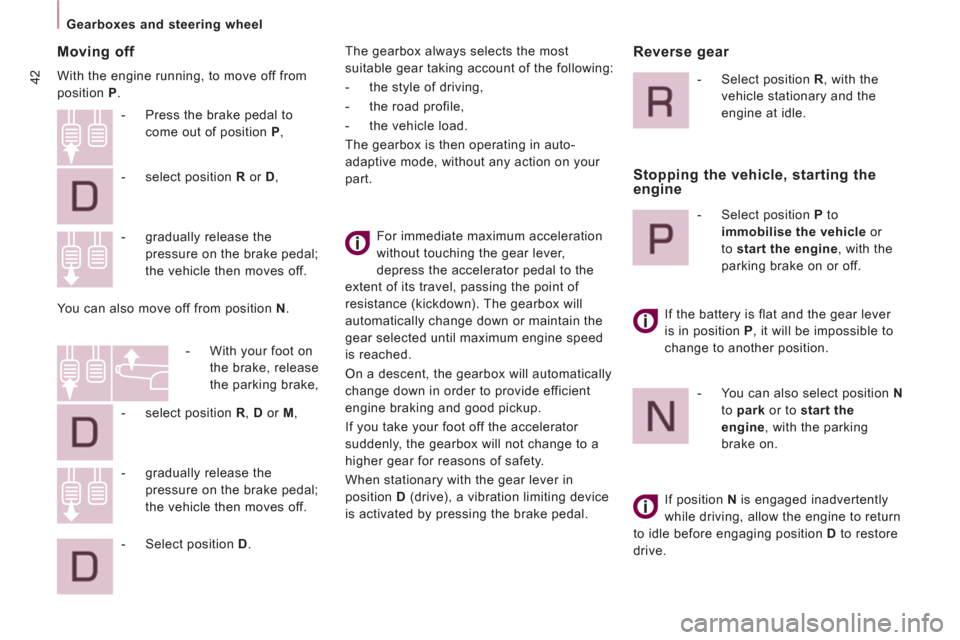
Moving off
With the engine running, to move off from
position P
.
For immediate maximum acceleration
without touching the gear lever,
depress the accelerator pedal to the
extent of its travel, passing the point of
resistance (kickdown). The gearbox will
automatically change down or maintain the
gear selected until maximum engine speed
is reached.
On a descent, the gearbox will automatically
change down in order to provide efficient
engine braking and good pickup.
If you take your foot off the accelerator
suddenly, the gearbox will not change to a
higher gear for reasons of safety.
When stationary with the gear lever in
position D
(drive), a vibration limiting device
is activated by pressing the brake pedal.
- gradually release the
pressure on the brake pedal;
the vehicle then moves off.
- Press the brake pedal to
come out of position P
,
- select position R
or D
,
- gradually release the
pressure on the brake pedal;
the vehicle then moves off.
You can also move off from position N
.
- With your foot on
the brake, release
the parking brake,
- select position R
, D
or M
,
- Select position D
. The gearbox always selects the most
suitable gear taking account of the following:
- the style of driving,
- the road profile,
- the vehicle load.
The gearbox is then operating in auto-
adaptive mode, without any action on your
part.
Reverse gear
- Select position R
, with the
vehicle stationary and the
engine at idle.
Stopping the vehicle, starting the
engine
- Select position P
to
immobilise the vehicle
or
to start the engine
, with the
parking brake on or off.
If the battery is flat and the gear lever
is in position P
, it will be impossible to
change to another position.
- You can also select position N
to park
or to start the
engine
, with the parking
brake on.
If position N
is engaged inadvertently
while driving, allow the engine to return
to idle before engaging position D
to restore
drive.
Page 45 of 248
43
Gearboxes and steering wheel
READY TO SET OFF
2
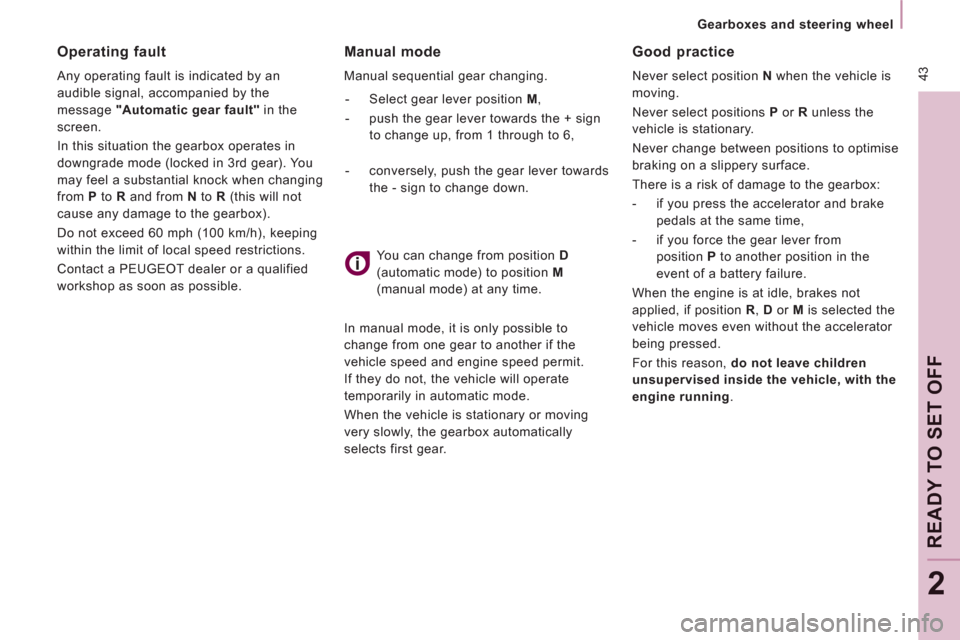
Manual mode
Manual sequential gear changing.
- Select gear lever position M
,
- push the gear lever towards the + sign
to change up, from 1 through to 6,
In manual mode, it is only possible to
change from one gear to another if the
vehicle speed and engine speed permit.
If they do not, the vehicle will operate
temporarily in automatic mode.
When the vehicle is stationary or moving
very slowly, the gearbox automatically
selects first gear.
- conversely, push the gear lever towards
the - sign to change down.
You can change from position D
(automatic mode) to position M
(manual mode) at any time.
Good practice
Never select position N
when the vehicle is
moving.
Never select positions P
or R
unless the
vehicle is stationary.
Never change between positions to optimise
braking on a slippery surface.
There is a risk of damage to the gearbox:
- if you press the accelerator and brake
pedals at the same time,
- if you force the gear lever from
position P
to another position in the
event of a battery failure.
When the engine is at idle, brakes not
applied, if position R
, D
or M
is selected the
vehicle moves even without the accelerator
being pressed.
For this reason, do not leave children
unsupervised inside the vehicle, with the
engine running
.
Operating fault
Any operating fault is indicated by an
audible signal, accompanied by the
message "Automatic gear fault"
in the
screen.
In this situation the gearbox operates in
downgrade mode (locked in 3rd gear). You
may feel a substantial knock when changing
from P
to R
and from N
to R
(this will not
cause any damage to the gearbox).
Do not exceed 60 mph (100 km/h), keeping
within the limit of local speed restrictions.
Contact a PEUGEOT dealer or a qualified
workshop as soon as possible.
Page 46 of 248
44
Gearboxes and steering wheel
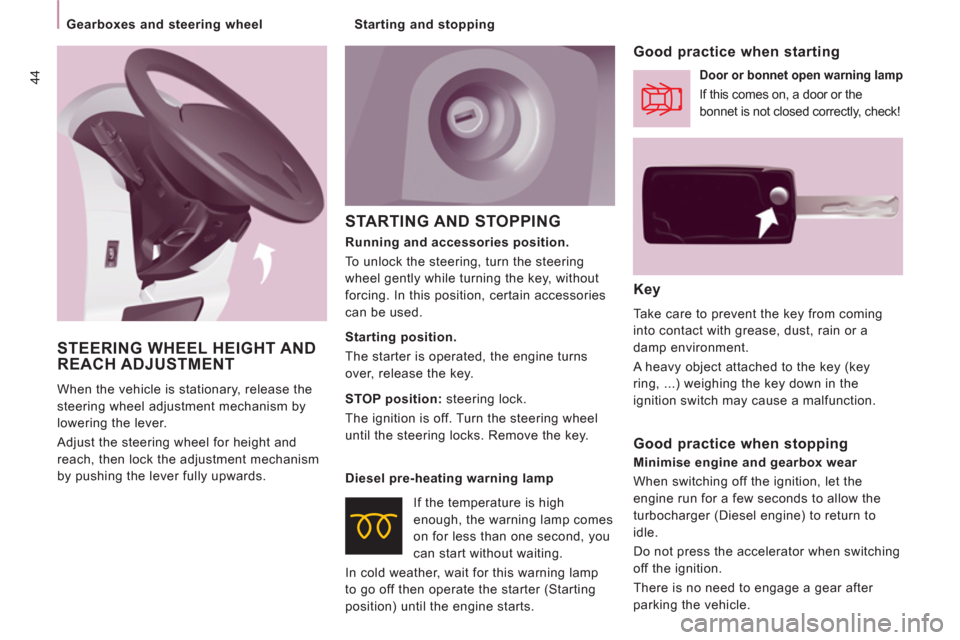
STARTING AND STOPPING
Key
Take care to prevent the key from coming
into contact with grease, dust, rain or a
damp environment.
A heavy object attached to the key (key
ring, ...) weighing the key down in the
ignition switch may cause a malfunction.
Good practice when starting
Door or bonnet open warning lamp
If this comes on, a door or the
bonnet is not closed correctly, check!
Diesel pre-heating warning lamp
If the temperature is high
enough, the warning lamp comes
on for less than one second, you
can start without waiting.
In cold weather, wait for this warning lamp
to go off then operate the starter (Starting
position) until the engine starts.
Good practice when stopping
Minimise engine and gearbox wear
When switching off the ignition, let the
engine run for a few seconds to allow the
turbocharger (Diesel engine) to return to
idle.
Do not press the accelerator when switching
off the ignition.
There is no need to engage a gear after
parking the vehicle.
Running and accessories position.
To unlock the steering, turn the steering
wheel gently while turning the key, without
forcing. In this position, certain accessories
can be used.
Starting position.
The starter is operated, the engine turns
over, release the key.
STOP position:
steering lock.
The ignition is off. Turn the steering wheel
until the steering locks. Remove the key.
STEERING WHEEL HEIGHT AND
REACH ADJUSTMENT
When the vehicle is stationary, release the
steering wheel adjustment mechanism by
lowering the lever.
Adjust the steering wheel for height and
reach, then lock the adjustment mechanism
by pushing the lever fully upwards.
Starting and stopping
Page 55 of 248
53
Steering mounted controls
EASE OF USE AND COMFOR
T
3
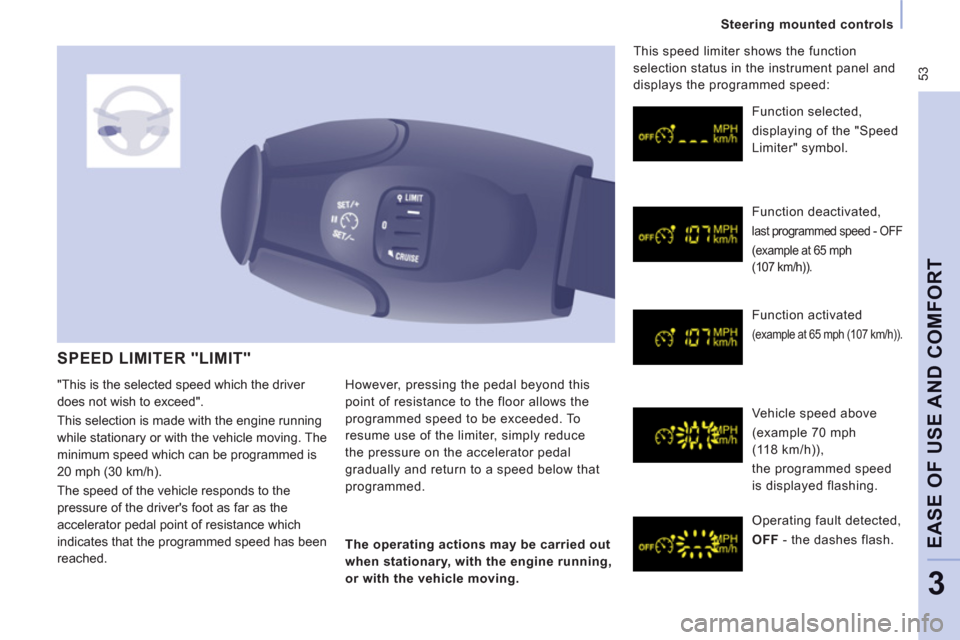
SPEED LIMITER "LIMIT"
However, pressing the pedal beyond this
point of resistance to the floor allows the
pro
grammed speed to be exceeded. To
resume use o
f the limiter, simply reduce
the
pressure on the accelerator pedal
gradually and return to a speed below that
programmed.
Function selected,
displa
ying of the "Speed
Limiter" s
ymbol.
Function deactivated,
last programmed speed - OFF
(example at 65 mph
(107 km/h)).
Function activated
(example at 65 mph (107 km/h)).
Vehicle speed above
(example 70 mph
(118 km/h)),
t
he programmed speed
is displayed flashing.
Operating fault detected,
OFF- th
e dashes flash. This speed limiter shows the
function
selection status in the instrument panel and
displays the programmed speed:
The operating actions may be carried out
w
hen stationary, with the engine running,
or with the vehicle movin
g.
"This is the selected speed which the driver
does not wish to exceed".
This selection is made with the en
gine running
while stationar
y or with the vehicle moving. The
minimum speed which can be programmed is
20 mph
(30 km/h).
The speed o
f the vehicle responds to the
pressure of the driver's foot as far as the
accelerator pedal point of resistance which
indicates that the programmed speed has been
reached.
Page 56 of 248
54
Steering mounted controls
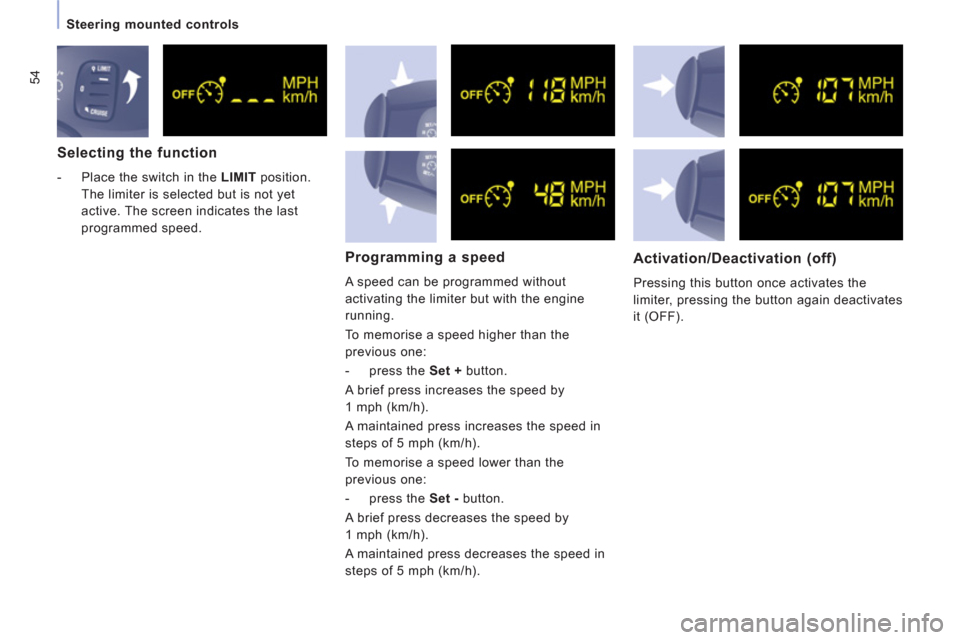
Selecting the function
- Place the switch in the LIMIT
position.
The limiter is selected but is not yet
active. The screen indicates the last
programmed speed.
Programming a speed
A speed can be programmed without
activating the limiter but with the engine
runnin
g.
To memorise a speed hi
gher than the
prev
ious one:
- press the Set +
button.
A brief press increases the speed b
y
1 mph (km/h).
A maintained press increases the speed in
steps of 5 mph (km/h).
To memorise a speed lower than the
previous one:
- press the Set -
button.
A brie
f press decreases the speed by
1 mph (km/h).
A maintained press decreases the speed in
steps of 5 mph (km/h).
Activation/Deactivation (off)
Pressing this button once activates the
limiter, pressing the button again deactivates
it
(OFF).
Page 58 of 248
Ventilation
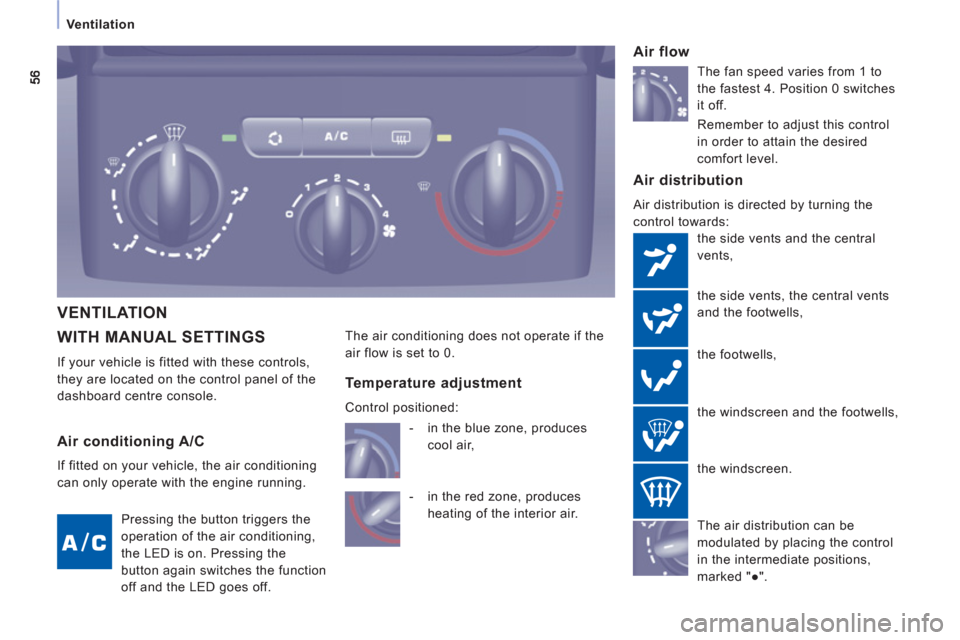
WITH MANUAL SETTINGS
If your vehicle is fitted with these controls,
the
y are located on the control panel of the
dashboard centre console.
Air distribution
Air distribution is directed by turning the
control towards:
t
he side vents and the central
vents,
t
he side vents, the central vents
and the
footwells,
the footwells,
the windscreen and the
footwells,
Air flow
The air conditioning does not operate if the
air flow is set to 0.
th
e windscreen.
Air conditioning A/C
If fitted on your vehicle, the air conditioning
can only operate with the engine running.
Pressing the button triggers the
operation of the air conditioning,
the LED is on. Pressin
g the
button a
gain switches the function
off and the LED goes off.
Temperature adjustment
Control positioned:
- in the red zone, produces
heating of the interior air.
- in the blue zone, produces
cool air,
Th
e air distribution can be
modulated by placing the control
in the intermediate positions,
m
arked "●". The
fan speed varies from 1 to
th
e fastest 4. Position 0 switches
it off.
Remember to ad
just this control
in order to attain the desired
comfort level.
VENTILATION
Page 61 of 248
59
Ventilation
EASE OF USE AND COMFOR
T
3
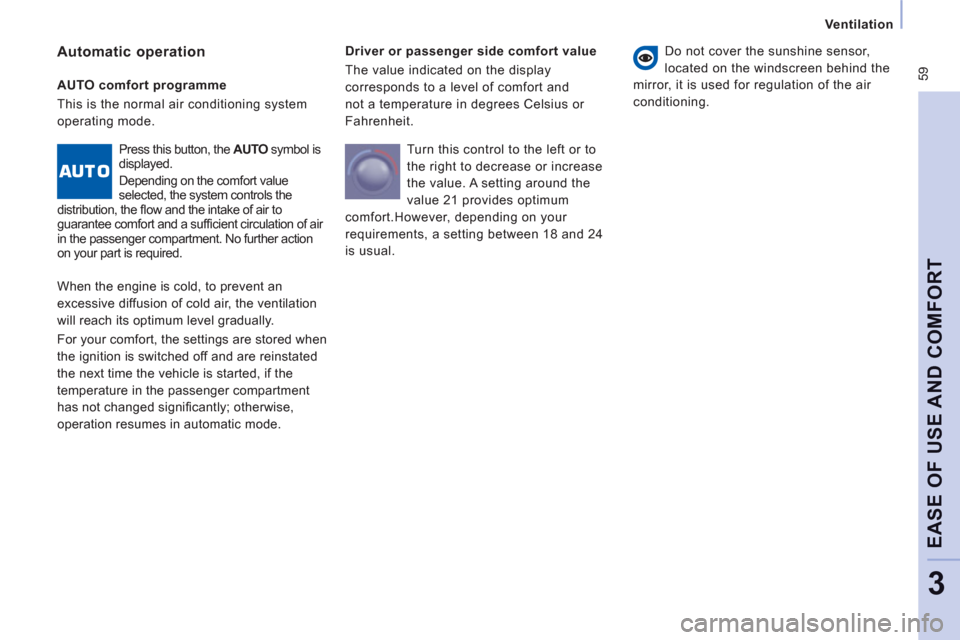
Driver or passenger side comfort value
The value indicated on the display
corresponds to a level of comfort and
not a temperature in de
grees Celsius or
F
ahrenheit.
Automatic operation
Do not cover the sunshine sensor,
l
ocated on the windscreen behind the
mirror, it is used for regulation of the air
conditioning.
AUTO comfort programme
This is the normal air conditioning system
operat
ing mode.
Press this button, the
AUTO
symbol is
displayed.
Depending on the com
fort valueselected, the system controls the
distribution, the fl ow and the intake of air to
guarantee comfort and a suffi cient circulation of air
in the passenger compartment. No further action
on your part is required.
When the engine is cold, to prevent an
excessive diffusion of cold air, the ventilation
will reach its optimum level
gradually.
For
your comfort, the settings are stored when
the i
gnition is switched off and are reinstated
the next time the vehicle is started, i
f the
temperature in the passen
ger compartment
has not changed signifi cantly; otherwise,
operat
ion resumes in automatic mode. T
urn this control to the left or to
the right to decrease or increase
the value. A settin
g around the
value 21 provides optimum
comfort.However, depending on your
requirements, a settin
g between 18 and 24
i
s usual.
Page 65 of 248
63
Ventilation
EASE OF USE AND COMFOR
T
3
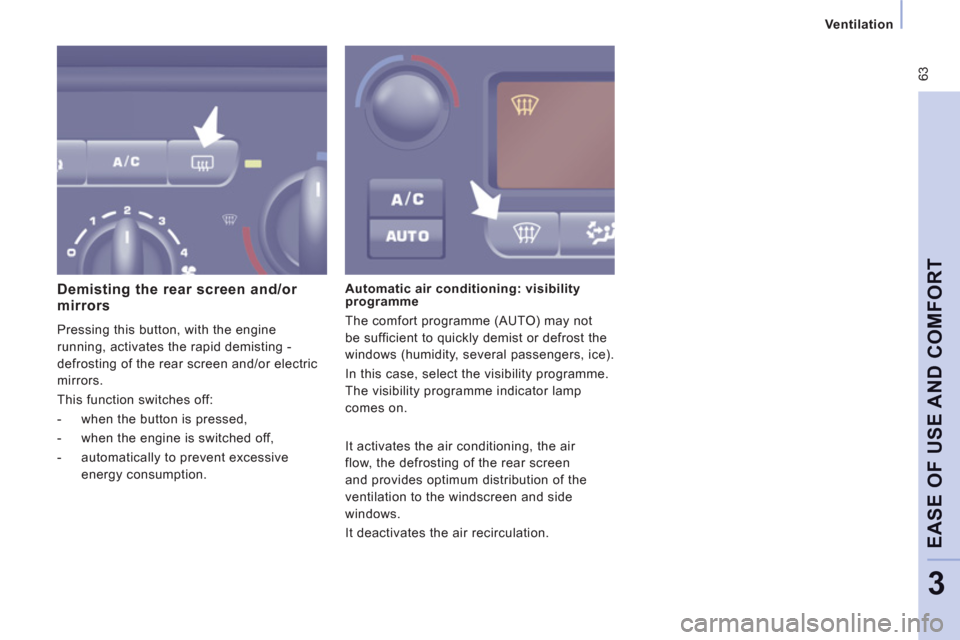
Demisting the rear screen and/or mirrors
Pressing this button, with the engine
running, activates the rapid demisting -
de
frosting of the rear screen and/or electric
mirrors.
Thi
s function switches off:
- when the button is pressed,
- when the engine is switched off,
- automatically to prevent excessive
energy consumption.
Automatic air conditioning: visibility
programme
The com
fort programme (AUTO) may not
be sufficient to quickl
y demist or defrost the
windows
(humidity, several passengers, ice).
In this case, select the visibility programme.
The visibilit
y programme indicator lamp
comes on.
It activates the air conditionin
g, the air
flow, the defrostin
g of the rear screen
and provides optimum distribution of the
v
entilation to the windscreen and side
w
indows.
It
deactivates the air recirculation.
Page 66 of 248
64
Ventilation
Good practice
To avoid any risk of poisoning or
asphyxiation, the heater must not be used,
even
for short periods, in an enclosed space
such as a garage or workshop which is not
fitted with an exhaust
gas extraction system.
Do not
park the vehicle on an inflammable
surface (dry grass, dead leaves, paper…),
th
ere is a risk of fire. The temperature near the heater must not
exceed 120 °C. A temperature higher than
this
(for example in the case of painting in
an oven
) could damage the components of
th
e electronic circuits.
The heater is supplied b
y the vehicle's fuel
tank. Ensure that the low fuel warnin
g lamp
i
s not on.
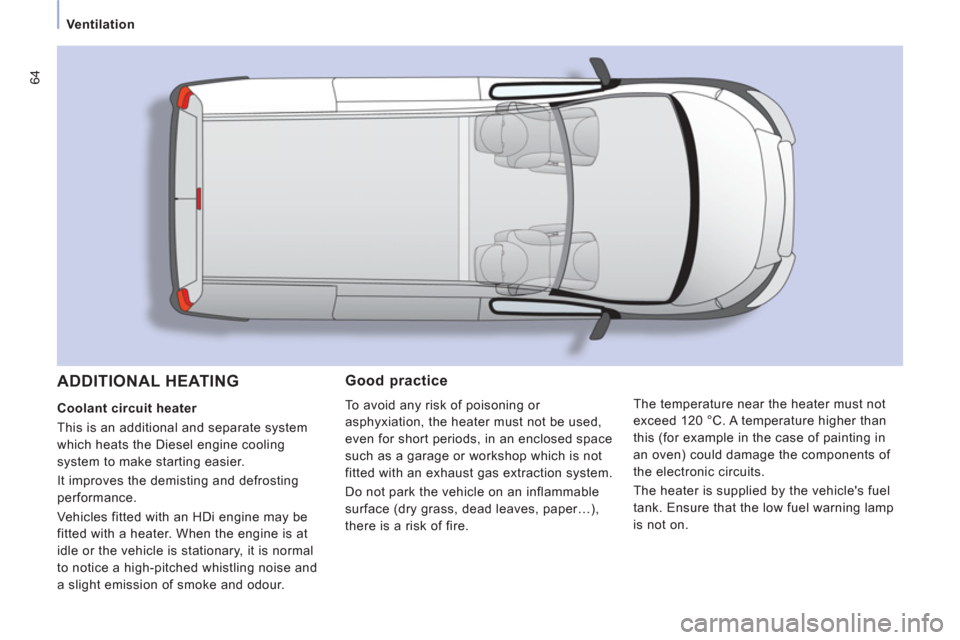
ADDITIONAL HEATING
Coolant circuit heater
This is an additional and separate s
ystem
which heats the Diesel en
gine cooling
system to make starting easier.
It improves the demistin
g and defrosting
performance.
Vehicles
fitted with an HDi engine may be
fitted with a heater. When the engine is at
idle or the vehicle is stationar
y, it is normal
to not
ice a high-pitched whistling noise and
a sli
ght emission of smoke and odour.