seats Peugeot Partner 2012 User Guide
[x] Cancel search | Manufacturer: PEUGEOT, Model Year: 2012, Model line: Partner, Model: Peugeot Partner 2012Pages: 208, PDF Size: 6.5 MB
Page 75 of 208
Practical information
73
EASE OF USE and COMFOR
T
33
CREW CAB
Bench seat
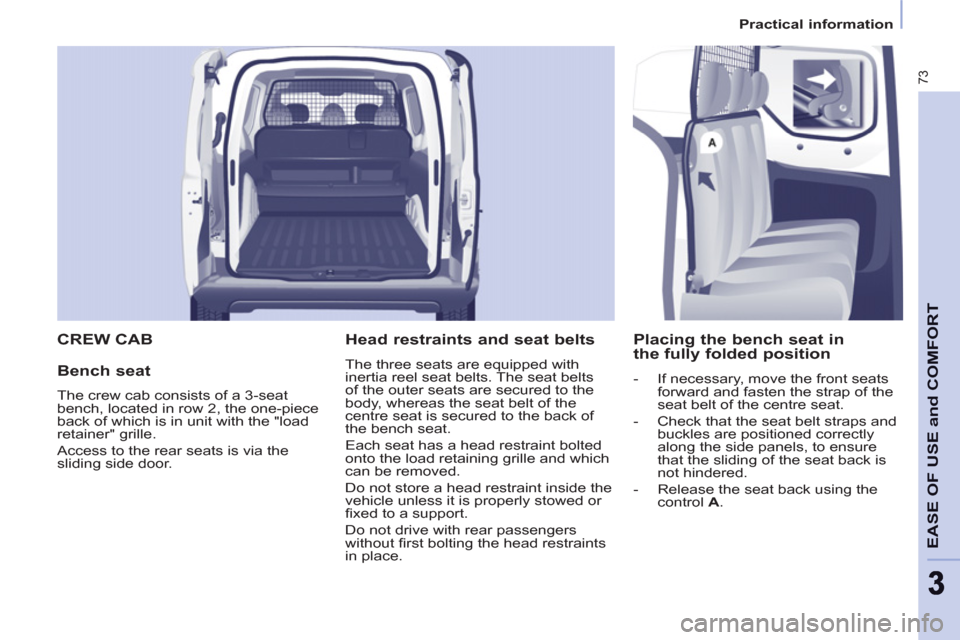
The crew cab consists of a 3-seat
bench, located in row 2, the one-piece
back of which is in unit with the "load
retainer" grille.
Access to the rear seats is via the
sliding side door.
Head restraints and seat belts
The three seats are equipped with
inertia reel seat belts. The seat belts
of the outer seats are secured to the
body, whereas the seat belt of the
centre seat is secured to the back of
the bench seat.
Each seat has a head restraint bolted
onto the load retaining grille and which
can be removed.
Do not store a head restraint inside the
vehicle unless it is properly stowed or
fi xed to a support.
Do not drive with rear passengers
without fi rst bolting the head restraints
in place.
Placing the bench seat in
the fully folded position
- If necessary, move the front seats
forward and fasten the strap of the
seat belt of the centre seat.
- Check that the seat belt straps and
buckles are positioned correctly
along the side panels, to ensure
that the sliding of the seat back is
not hindered.
- Release the seat back using the
control A
.
Page 76 of 208
Practical information
74
Putting the bench seat back in
the seat position
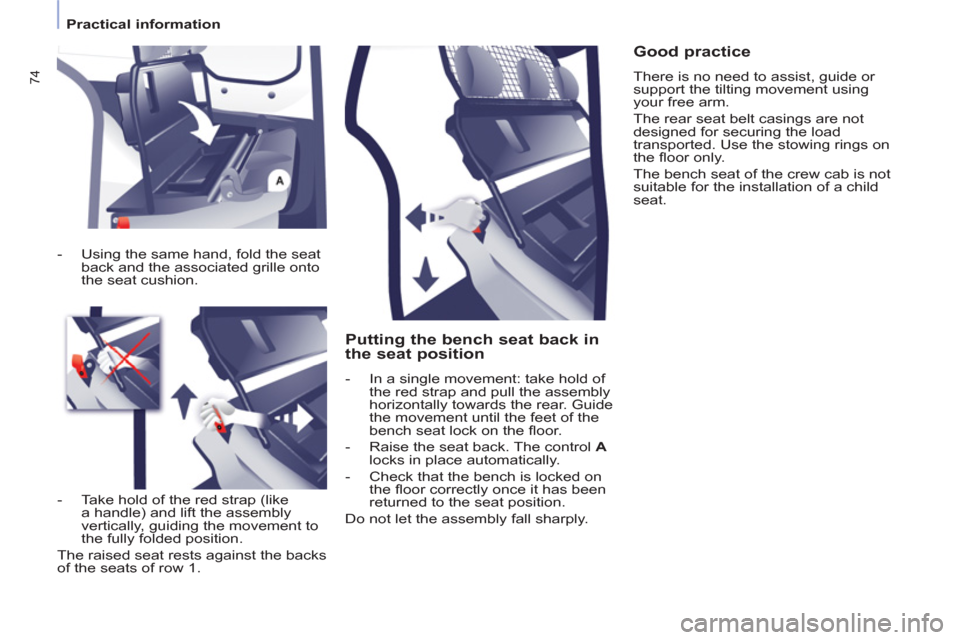
- In a single movement: take hold of
the red strap and pull the assembly
horizontally towards the rear. Guide
the movement until the feet of the
bench seat lock on the fl oor.
- Raise the seat back. The control A
locks in place automatically.
- Check that the bench is locked on
the fl oor correctly once it has been
returned to the seat position.
Do not let the assembly fall sharply.
Good practice
There is no need to assist, guide or
support the tilting movement using
your free arm.
The rear seat belt casings are not
designed for securing the load
transported. Use the stowing rings on
the fl oor only.
The bench seat of the crew cab is not
suitable for the installation of a child
seat.
- Using the same hand, fold the seat
back and the associated grille onto
the seat cushion.
- Take hold of the red strap (like
a handle) and lift the assembly
vertically, guiding the movement to
the fully folded position.
The raised seat rests against the backs
of the seats of row 1.
Page 92 of 208
Seat belts
90
The inertia reels are fi tted with a device
which automatically locks the strap in
the event of a collision or emergency
braking or if the vehicle rolls over.
You can unfasten the seat belt by
pressing the red button on the buckle.
Guide the seat belt after unfastening.
The airbag warning lamp comes on
if the pretensioners are deployed.
Contact a PEUGEOT dealer or a
qualifi ed workshop.
Recommendations for children:
- use a suitable child seat if the
passenger is less than 12 years old
or shorter than one metre fi fty,
- never allow a child to travel on
your lap, even with the seat belt
fastened.
For more information on child
seats, refer to the "Children on
board" section of chapter 4.
Clean the seat belt straps with
soapy water or a textile cleaning
product, sold by PEUGEOT
dealers.
In accordance with current safety
regulations, your PEUGEOT dealer
can guarantee all work or any checks,
from testing to maintenance, on your
seat belt equipment.
Have the seat belts checked regularly
(even after a minor impact) by a
PEUGEOT dealer or a qualifi ed
workshop: they must not show any
signs of wear, cutting or fraying
and they must not be converted or
modifi ed.
Front seat belts
The front seats are fi tted with
pretensioners and force limiters.
The seat belt associated with the centre
seat of the front bench does not have a
pretensioner.
In order to be effective, a seat belt
must:
- restrain one person only,
- must not be twisted, check by
pulling in front of you with an even
movement,
- be tightened as close to the body
as possible.
The upper part of the seat belt should
be positioned in the hollow of the
shoulder.
The lap part should be placed as low
as possible on the pelvis.
Do not invert the seat belt buckles as
they will not fulfi l their role completely.
If the seats are fi tted with armrests, the
lap part of the seat belt should always
pass under the armrest.
Check that the seat belt is fastened
correctly by pulling the strap fi rmly.
Page 94 of 208
Airbags
92
Good practice
Sit in a normal upright position.
Wear a correctly adjusted seat belt.
Do not leave anything between the
occupants and the airbags (a child,
pet, object...). This could hinder the
operation of the airbags or injure the
occupants.
After an accident or if the vehicle has
been stolen or broken into, have the
airbag systems checked.
All work on the airbag system is strictly
forbidden unless it is carried out by
qualifi ed personnel at a PEUGEOT
dealer or a qualifi ed workshop.
Even if all of the precautions
mentioned are observed, a risk of
injury or of minor burns to the head,
chest or arms when an airbag is
deployed cannot be ruled out. In fact,
the bag infl ates almost instantly (within
a few milliseconds) then defl ates within
the same time discharging the hot gas
via openings provided for this purpose.
Lateral airbags
Only put recommended covers on
the seats. These will not hinder
infl ation of the lateral airbags. Contact
a PEUGEOT dealer or a qualifi ed
workshop.
Do not fi x or attach anything to the seat
backs. This could cause injury to the
chest or arms when the lateral airbag
infl ates.
Do not sit with the upper part of the
body any nearer to the door than
necessary.
Front airbags
Do not drive holding the steering wheel
by its spokes or resting your hands on
the centre part of the wheel.
Do not allow passengers to place
their feet on the dashboard, they risk
serious injury if the airbag is deployed.
Smoke as little as possible as
deployment of the airbags can cause
burns or the risk of injury from a
cigarette or pipe.
Never remove or pierce the steering
wheel or hit it violently.
Airbags
only operate when the
ignition is switched on.
This equipment only operates once.
If a second impact occurs (during the
same or a subsequent accident), the
airbag will not operate.
The deployment of an airbag or airbags
is accompanied by a slight discharge
of harmless smoke and a noise, due
to the activation of the pyrotechnic
cartridge incorporated in the system.
This smoke is not harmful, but
sensitive individuals may experience
some irritation.
The noise of the detonation may result
in a slight loss of hearing for a short
time.
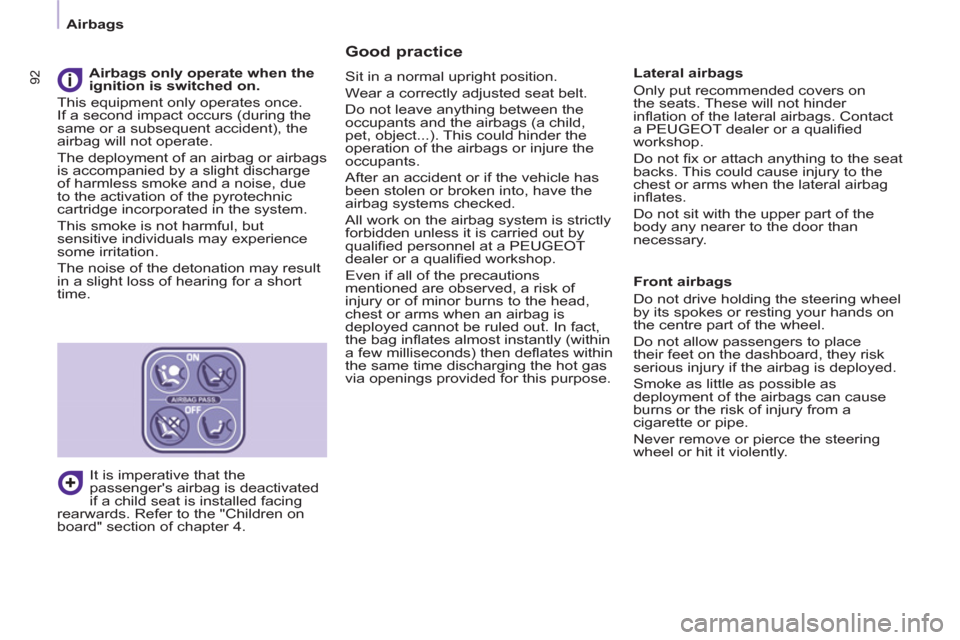
It is imperative that the
passenger's airbag is deactivated
if a child seat is installed facing
rearwards. Refer to the "Children on
board" section of chapter 4.
Page 97 of 208
Child safety
95
SAFETY
4
GENERAL POINTS RELATING
TO CHILD SEATS
Although one of PEUGEOT's main
criteria when designing your vehicle,
the safety of your children also
depends on you.
For maximum safety, please follow
these precautions:
- all children under the age of 12 or
less than one metre fi fty tall must
travel in approved child seats suited
to their weight, on seats fi tted with
a seat belt or ISOFIX mountings,
- statistically, the safest seats in your
vehicle for the transportation of
children are the rear seats,
- a child weighing less than 9 kg
must travel in the "rearwards-
facing" position both in the front
and in the rear,
- the passenger must not travel with
a child on his lap.
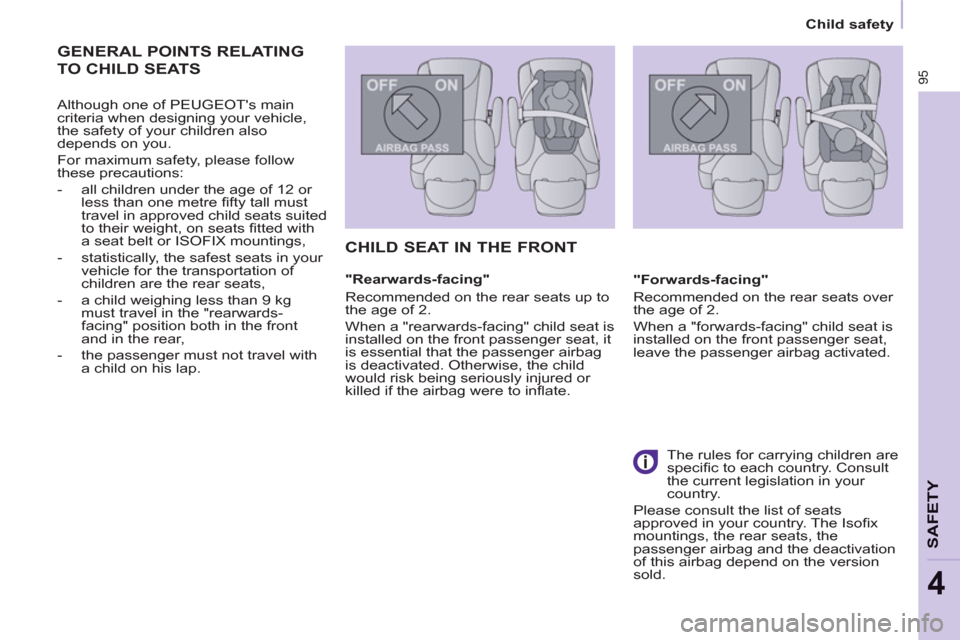
CHILD SEAT IN THE FRONT
"Rearwards-facing"
Recommended on the rear seats up to
the age of 2.
When a "rearwards-facing" child seat is
installed on the front passenger seat, it
is essential that the passenger airbag
is deactivated. Otherwise, the child
would risk being seriously injured or
killed if the airbag were to infl ate.
"Forwards-facing"
Recommended on the rear seats over
the age of 2.
When a "forwards-facing" child seat is
installed on the front passenger seat,
leave the passenger airbag activated.
The rules for carrying children are
specifi c to each country. Consult
the current legislation in your
country.
Please consult the list of seats
approved in your country. The Isofi x
mountings, the rear seats, the
passenger airbag and the deactivation
of this airbag depend on the version
sold.
Page 98 of 208
Child safety
96
Refer to chapter 4, "Airbags" section.
The child seats function and the
passenger's airbag deativation
function are common to the entire
PEUGEOT range.
If the passenger's airbag is not
deactivated, the installation of a
"rearwards-facing" child seat in the
front is strictly prohibited.
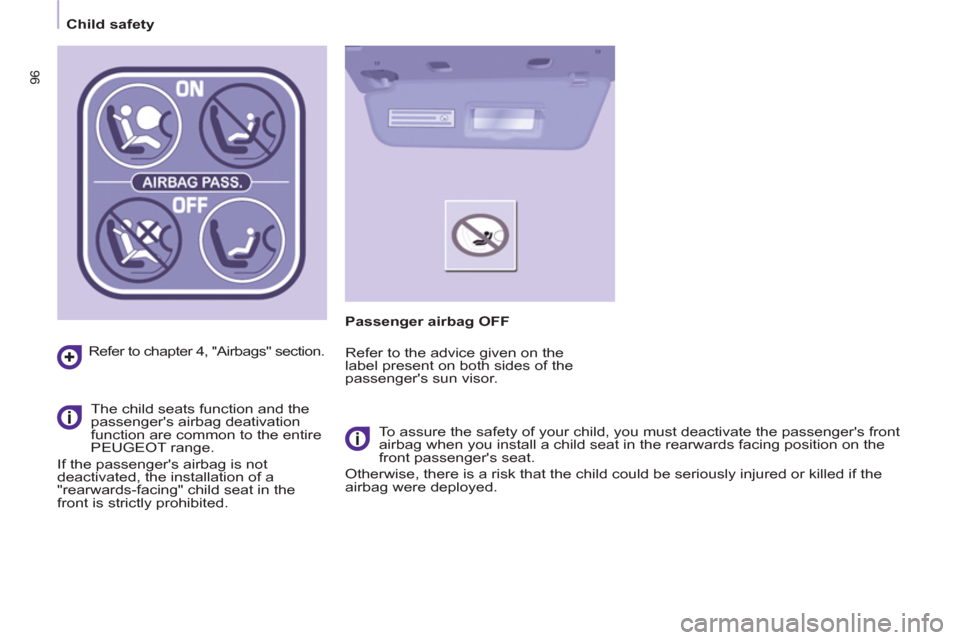
Passenger airbag OFF
Refer to the advice given on the
label present on both sides of the
passenger's sun visor.
To assure the safety of your child, you must deactivate the passenger's front
airbag when you install a child seat in the rearwards facing position on the
front passenger's seat.
Otherwise, there is a risk that the child could be seriously injured or killed if the
airbag were deployed.
Page 99 of 208
Child safety
97
SAFETY
4
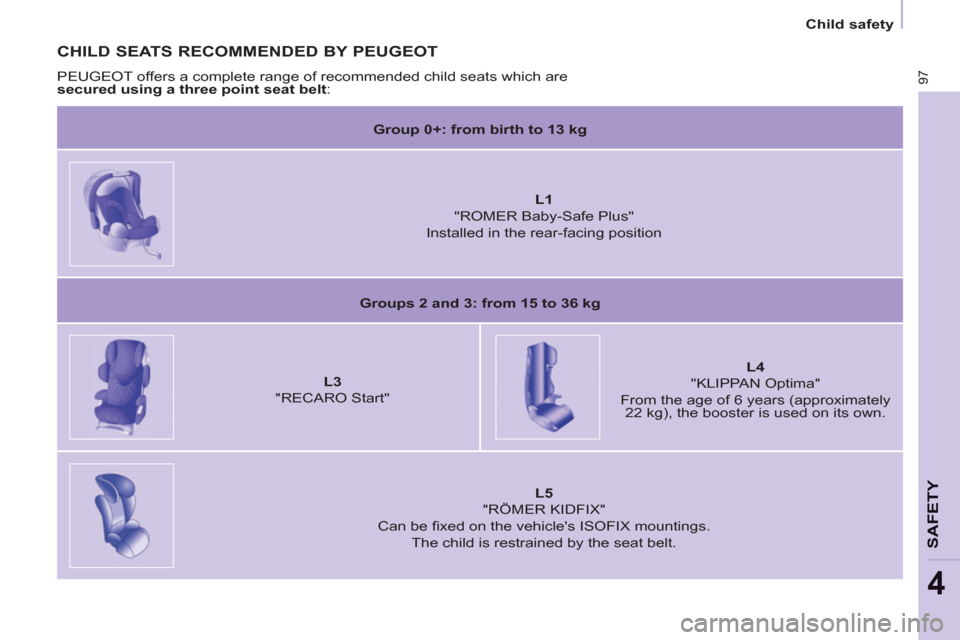
CHILD SEATS RECOMMENDED BY PEUGEOT
PEUGEOT offers a complete range of recommended child seats which are
secured using a three point seat belt
:
Group 0+: from birth to 13 kg
L1
"ROMER Baby-Safe Plus"
Installed in the rear-facing position
Groups 2 and 3: from 15 to 36 kg
L3
"RECARO Start''
L4
"KLIPPAN Optima"
From the age of 6 years (approximately
22 kg), the booster is used on its own.
L5
"RÖMER KIDFIX"
Can be fi xed on the vehicle's ISOFIX mountings.
The child is restrained by the seat belt.
Page 100 of 208
Child safety
98
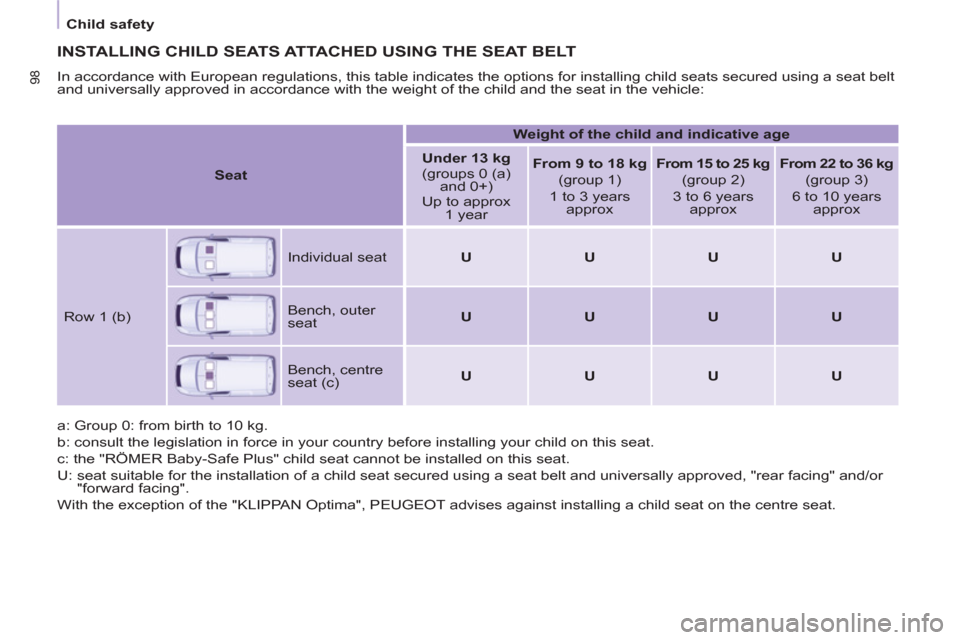
INSTALLING CHILD SEATS ATTACHED USING THE SEAT BELT
In accordance with European regulations, this table indicates the options for installing child seats secured using a seat belt
and universally approved in accordance with the weight of the child and the seat in the vehicle:
a: Group 0: from birth to 10 kg.
b: consult the legislation in force in your country before installing your child on this seat.
c: the "RÖMER Baby-Safe Plus" child seat cannot be installed on this seat.
U: seat suitable for the installation of a child seat secured using a seat belt and universally approved, "rear facing" and/or
"forward facing".
With the exception of the "KLIPPAN Optima", PEUGEOT advises against installing a child seat on the centre seat.
Seat
Weight of the child and indicative age
Under 13 kg
(groups 0 (a)
and 0+)
Up to approx
1 year
From 9 to 18 kg
(group 1)
1 to 3 years
approx
From 15 to 25 kg
(group 2)
3 to 6 years
approx
From 22 to 36 kg
(group 3)
6 to 10 years
approx
Row 1 (b)
Individual seat
U
U
U
U
Bench, outer
seat
U
U
U
U
Bench, centre
seat (c)
U
U
U
U
Page 101 of 208
Child safety
99
SAFETY
4
ADVICE ON CHILD SEATS
The incorrect installation of a child seat
in a vehicle compromises the child's
protection in the event of an accident.
Remember to fasten the seat belts or
the child seat harnesses keeping the
slack
in relation to the child's body to a
minimum
, even for short journeys.
For optimum installation of the "forward
facing" child seat, ensure that the back
of the child seat is in contact with the
back of the vehicle's seat and that the
head restraint does not cause any
discomfort.
If the head restraint has to be removed,
ensure that it is stored or attached
securely to prevent it from being
thrown around the vehicle in the event
of sharp braking.
Children under the age of 10 must not
travel in the "forward facing" position
on the front passenger seat, unless
the rear seats are already occupied by
other children, cannot be used or are
absent.
Deactivate the passenger's airbag
when a "rear facing" child seat is
installed on the front seat.
Otherwise, the child would risk being
seriously injured or killed if the airbag
were to infl ate.
As a safety precaution, do not leave:
- one or more children alone and
unsupervised in a vehicle,
- a child or an animal in a vehicle
which is exposed to the sun, with
the windows closed,
- the keys within reach of children
inside the vehicle.
To prevent accidental opening of the
doors, use the "Child Lock".
Take care not to open the rear windows
by more than one third.
To protect young children from the rays
of the sun, fi t side blinds to the rear
windows.
Installing a booster seat
The chest part of the seat belt must
be positioned on the child's shoulder
without touching the neck.
Ensure that the lap part of the seat belt
passes correctly over the child's thighs.
PEUGEOT recommends the use of a
booster seat which has a back, fi tted
with a seat belt guide at shoulder level.
Page 129 of 208
Changing a fuse
127
QUICK HEL
P
7
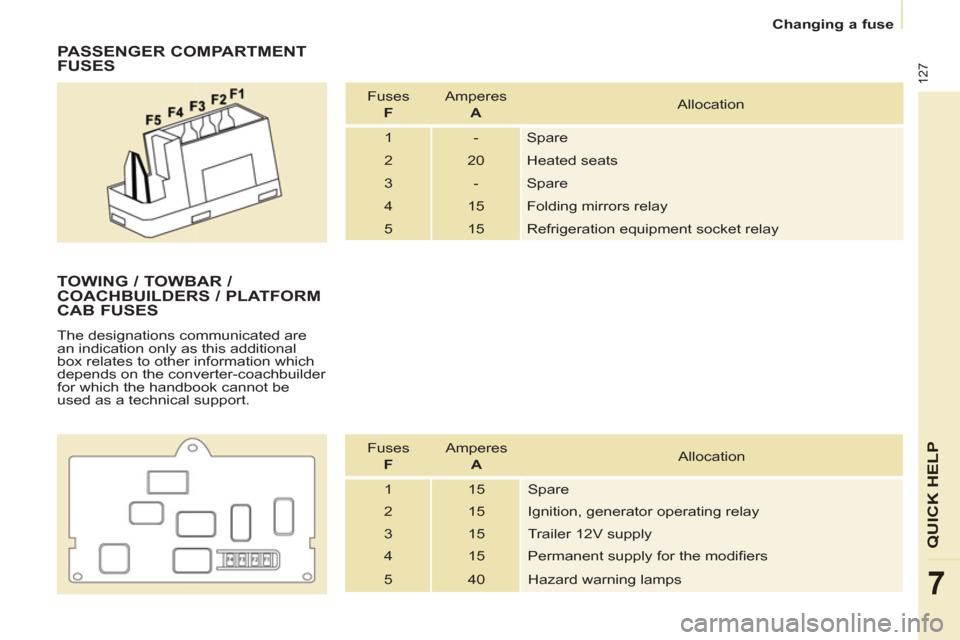
PASSENGER COMPARTMENT
FUSES
Fuses
F
Amperes
A
Allocation
1 - Spare
2 20 Heated seats
3 - Spare
4 15 Folding mirrors relay
5 15 Refrigeration equipment socket relay
TOWING / TOWBAR /
COACHBUILDERS / PLATFORM
CAB FUSES
The designations communicated are
an indication only as this additional
box relates to other information which
depends on the converter-coachbuilder
for which the handbook cannot be
used as a technical support.
Fuses
F
Amperes
A
Allocation
1 15 Spare
2 15 Ignition, generator operating relay
3 15 Trailer 12V supply
4 15 Permanent supply for the modifi ers
5 40 Hazard warning lamps