wheel Peugeot Partner 2012 Owner's Manual
[x] Cancel search | Manufacturer: PEUGEOT, Model Year: 2012, Model line: Partner, Model: Peugeot Partner 2012Pages: 208, PDF Size: 6.5 MB
Page 4 of 208
2
Contents
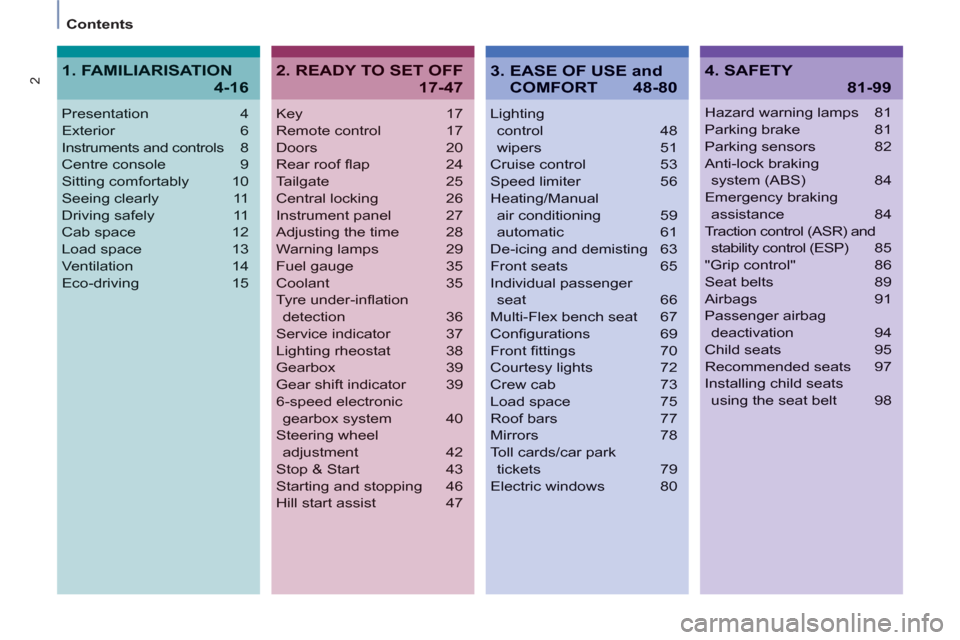
Key 17
Remote control 17
Doors 20
Rear roof fl ap 24
Tailgate 25
Central locking 26
Instrument panel 27
Adjusting the time 28
Warning lamps 29
Fuel gauge 35
Coolant 35
Tyre under-infl ation
detection 36
Service indicator 37
Lighting rheostat 38
Gearbox 39
Gear shift indicator 39
6-speed electronic
gearbox system 40
Steering wheel
adjustment 42
Stop & Start 43
Starting and stopping 46
Hill start assist 47
Lighting
control 48
wipers 51
Cruise control 53
Speed limiter 56
Heating/Manual
air conditioning 59
automatic 61
De-icing and demisting 63
Front seats 65
Individual passenger
seat 66
Multi-Flex bench seat 67
Confi gurations 69
Front fi ttings 70
Courtesy lights 72
Crew cab 73
Load space 75
Roof bars 77
Mirrors 78
Toll cards/car park
tickets 79
Electric windows 80
Presentation4
Exterior 6
Instruments and controls8
Centre console9
Sitting comfortably 10
Seeing clearly 11
Driving safely 11
Cab space 12
Load space 13
Ventilation 14
Eco-driving 15
Hazard warning lamps 81
Parking brake 81
Parking sensors 82
Anti-lock braking
system (ABS) 84
Emergency braking
assistance 84
Traction control (ASR) and
stability control (ESP)85
"Grip control" 86
Seat belts 89
Airbags 91
Passenger airbag
deactivation 94
Child seats 95
Recommended seats 97
Installing child seats
using the seat belt 98
2. READY TO SET OFF
17-47
4. SAFETY
81-99
1. FAMILIARISATION
4-16
3. EASE OF USE and
COMFORT 48-80
Page 5 of 208
3
Contents
CONTENT
S
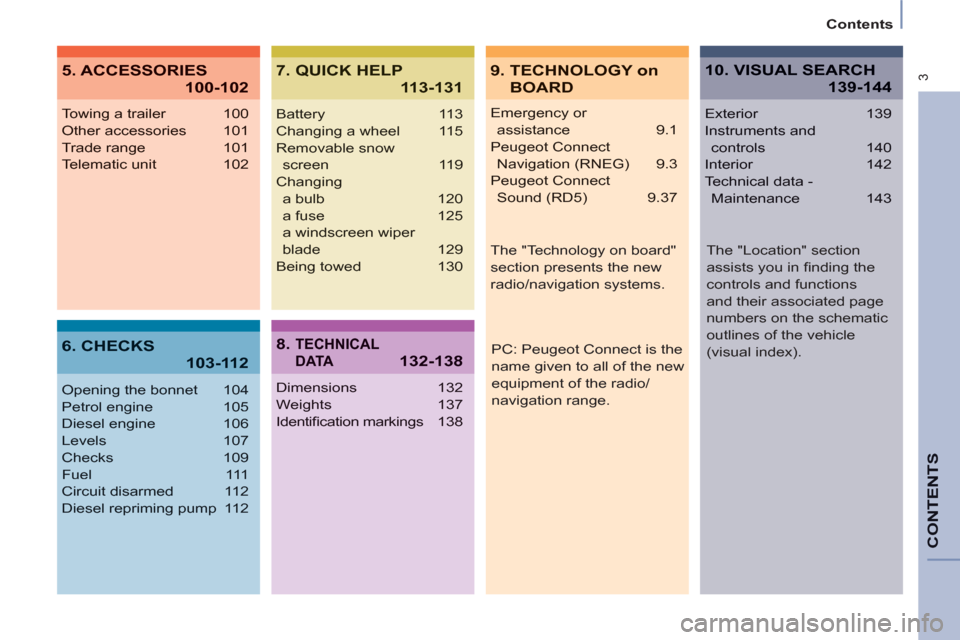
Emergency or
assistance 9.1
Peugeot Connect
Navigation (RNEG) 9.3
Peugeot Connect
Sound (RD5) 9.37
Towing a trailer 100
Other accessories 101
Trade range 101
Telematic unit 102
Opening the bonnet 104
Petrol engine 105
Diesel engine 106
Levels 107
Checks 109
Fuel 111
Circuit disarmed 112
Diesel repriming pump 112
Battery 113
Changing a wheel 115
Removable snow
screen 119
Changing
a bulb 120
a fuse 125
a windscreen wiper
blade 129
Being towed 130
Dimensions 132
Weights 137
Identifi cation markings138
Exterior 139
Instruments and
controls 140
Interior 142
Technical data -
Maintenance 143
9. TECHNOLOGY on
BOARD
5. ACCESSORIES
100-102
7. QUICK HELP
113-131
10. VISUAL SEARCH
139-144
6. CHECKS
103-112
8. TECHNICAL
D ATA132-138
PC: Peugeot Connect is the
name given to all of the new
equipment of the radio/
navigation range.
The "Technology on board"
section presents the new
radio/navigation systems.
The "Location" section
assists you in fi nding the
controls and functions
and their associated page
numbers on the schematic
outlines of the vehicle
(visual index).
Page 6 of 208
4PRESENTATION
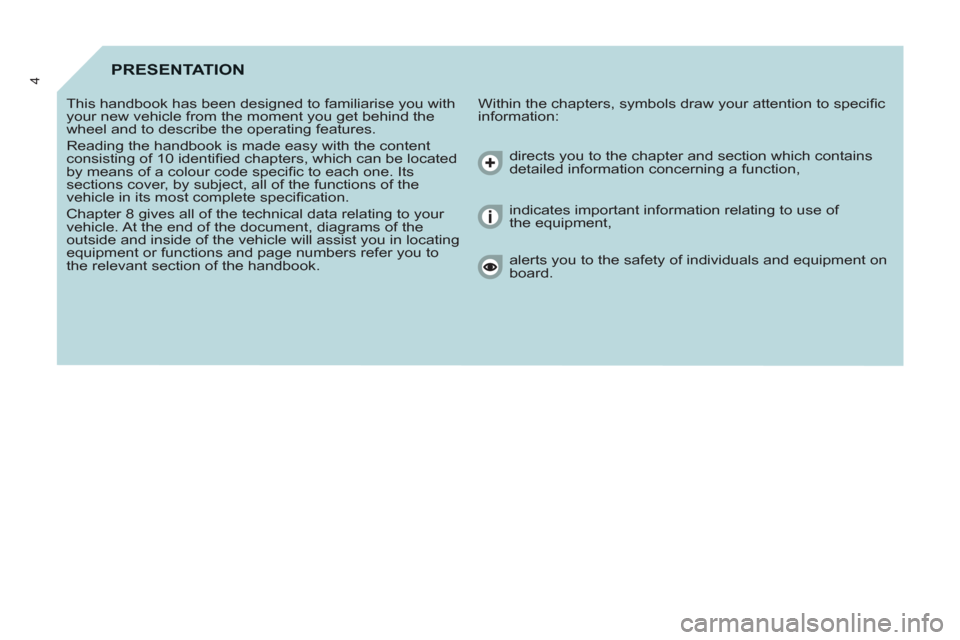
Within the chapters, symbols draw your attention to specifi c
information: This handbook has been designed to familiarise you with
your new vehicle from the moment you get behind the
wheel and to describe the operating features.
Reading the handbook is made easy with the content
consisting of 10 identifi ed chapters, which can be located
by means of a colour code specifi c to each one. Its
sections cover, by subject, all of the functions of the
vehicle in its most complete specifi cation.
Chapter 8 gives all of the technical data relating to your
vehicle. At the end of the document, diagrams of the
outside and inside of the vehicle will assist you in locating
equipment or functions and page numbers refer you to
the relevant section of the handbook. directs you to the chapter and section which contains
detailed information concerning a function,
indicates important information relating to use of
the equipment,
alerts you to the safety of individuals and equipment on
board.
Page 9 of 208
2c
2e
2b7a4
5
7b
2a6
5
82d
7
1
FAMILIARISATION
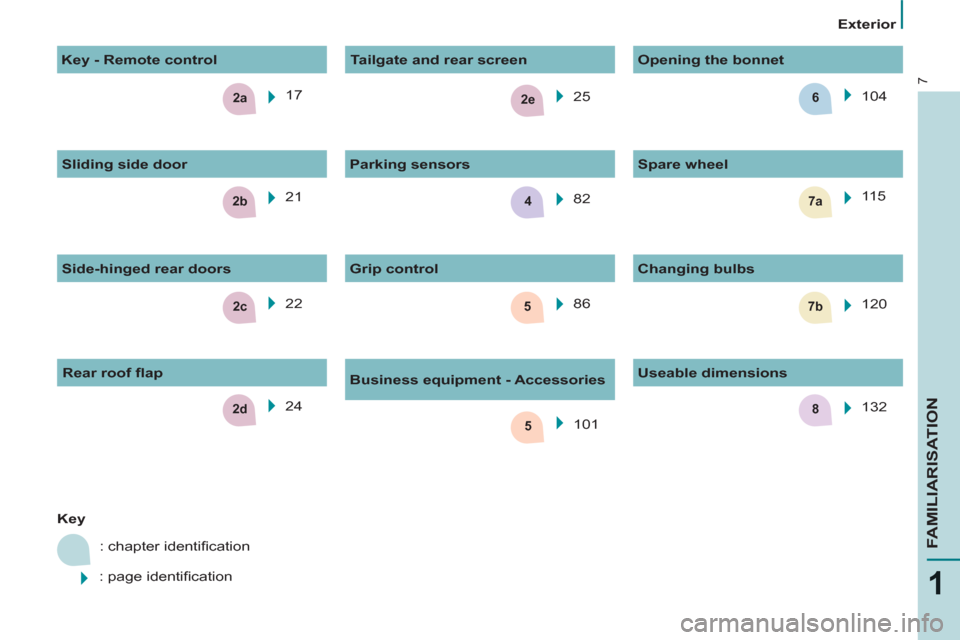
Exterior
17
22 25
Key
: chapter identifi cation
: page identifi cation 82
86
Grip control
Changing bulbs
120 104
Opening the bonnet
Parking sensors
Business equipment - Accessories
101 21
Key - Remote control
Side-hinged rear doors
Sliding side door
Tailgate and rear screen
Useable dimensions
132
Spare wheel
115
24
Rear roof fl ap
Page 10 of 208
8
Interior
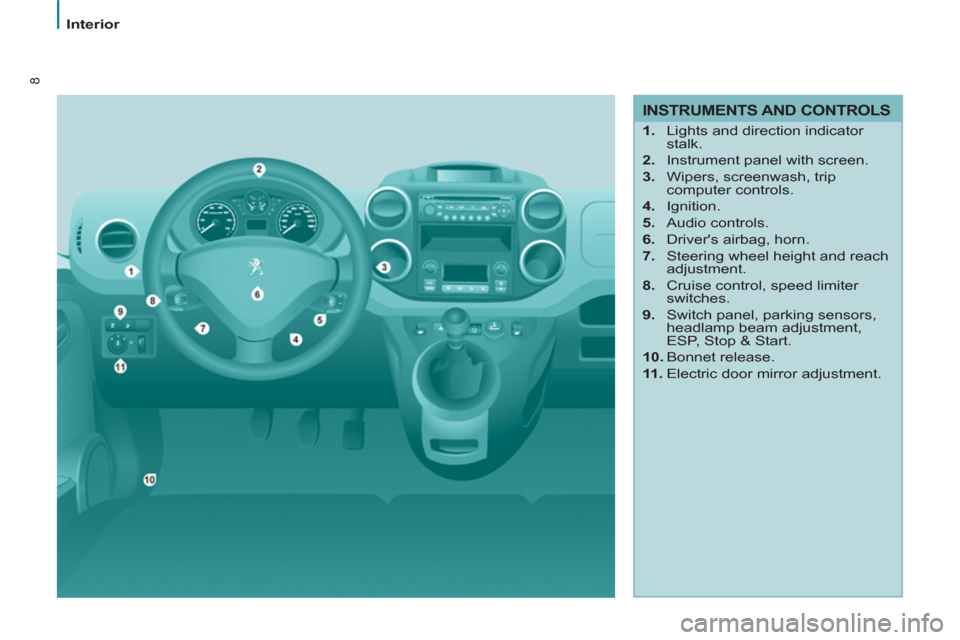
INSTRUMENTS AND CONTROLS
1.
Lights and direction indicator
stalk.
2.
Instrument panel with screen.
3.
Wipers, screenwash, trip
computer controls.
4.
Ignition.
5.
Audio controls.
6.
Driver's airbag, horn.
7.
Steering wheel height and reach
adjustment.
8.
Cruise control, speed limiter
switches.
9.
Switch panel, parking sensors,
headlamp beam adjustment,
ESP, Stop & Start.
10.
Bonnet release.
11 .
Electric door mirror adjustment.
Page 12 of 208
3
43
2
3
10
Interior
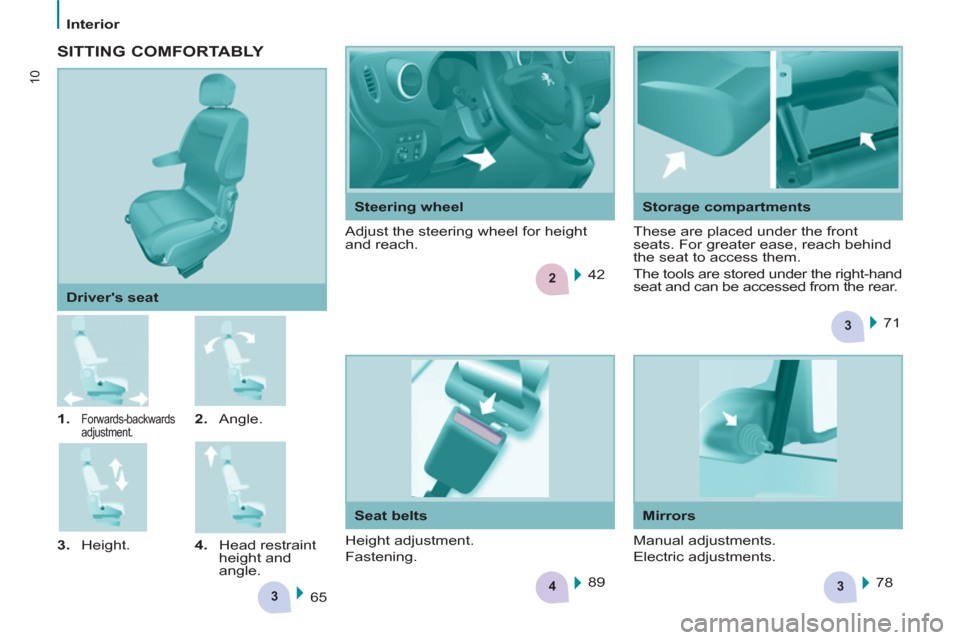
1.
Forwards-backwards
adjustment.
2.
Angle.
3.
Height.
4.
Head restraint
height and
angle.
Driver's seat
65 71
42
78 89
SITTING COMFORTABLY
Steering wheel
Adjust the steering wheel for height
and reach.
Storage compartments
These are placed under the front
seats. For greater ease, reach behind
the seat to access them.
The tools are stored under the right-hand
seat and can be accessed from the rear.
Seat belts
Height adjustment.
Fastening.
Mirrors
Manual adjustments.
Electric adjustments.
Page 18 of 208
16
Limit the causes of excess
consumption
Spread loads throughout the
vehicle; place the heaviest items in
the bottom of the boot, as close as
possible to the rear seats.
Limit the loads carried in the
vehicle and reduce wind resistance
(roof bars, roof rack, bicycle
carrier, trailer...). Use a roof box in
preference.
Remove roof bars and roof racks
after use.
At the end of winter, remove snow
tyres and refi t your summer tyres.
Observe the recommendations
on maintenance
Check the tyre pressures regularly,
when cold, referring to the label in the
door aperture, driver's side.
Carry out this check in particular:
- before a long journey,
- at each change of season,
- after a long period out of use.
Don't forget the spare wheel and the
tyres on any trailer or caravan.
Have your vehicle serviced regularly
(engine oil, oil fi lter, air fi lter...) and
observe the schedule of operations
recommended by the manufacturer.
When refuelling, do not continue after
the 3 rd cut-off of the nozzle to avoid
any overfl ow.
At the wheel of your new vehicle,
it is only after the fi rst 1 800 miles
(3 000 kilometres) that you will see
the fuel consumption settle down to a
consistent average.
Page 34 of 208
ABS
Instruments and controls
32
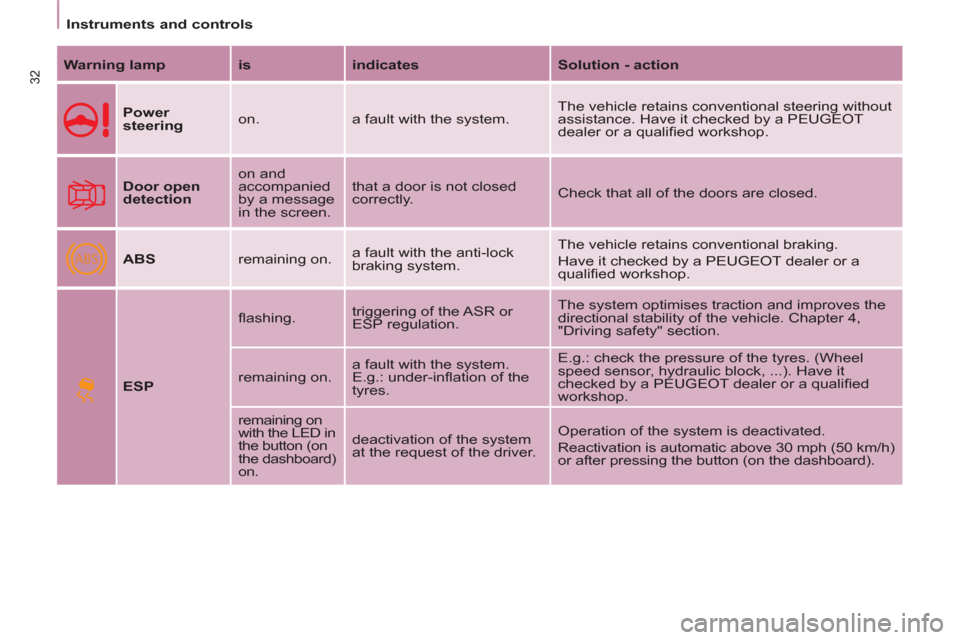
Warning lamp
is
indicates
Solution - action
Power
steering
on. a fault with the system. The vehicle retains conventional steering without
assistance. Have it checked by a PEUGEOT
dealer or a qualifi ed workshop.
Door open
detection
on and
accompanied
by a message
in the screen. that a door is not closed
correctly. Check that all of the doors are closed.
ABS
remaining on. a fault with the anti-lock
braking system. The vehicle retains conventional braking.
Have it checked by a PEUGEOT dealer or a
qualifi ed workshop.
ESP
fl ashing. triggering of the ASR or
ESP regulation. The system optimises traction and improves the
directional stability of the vehicle. Chapter 4,
"Driving safety" section.
remaining on. a fault with the system.
E.g.: under-infl ation of the
tyres. E.g.: check the pressure of the tyres. (Wheel
speed sensor, hydraulic block, ...). Have it
checked by a PEUGEOT dealer or a qualifi ed
workshop.
remaining on
with the LED in
the button (on
the dashboard)
on. deactivation of the system
at the request of the driver. Operation of the system is deactivated.
Reactivation is automatic above 30 mph (50 km/h)
or after pressing the button (on the dashboard).
Page 35 of 208
Instruments and controls
33
READY TO SET OFF
22
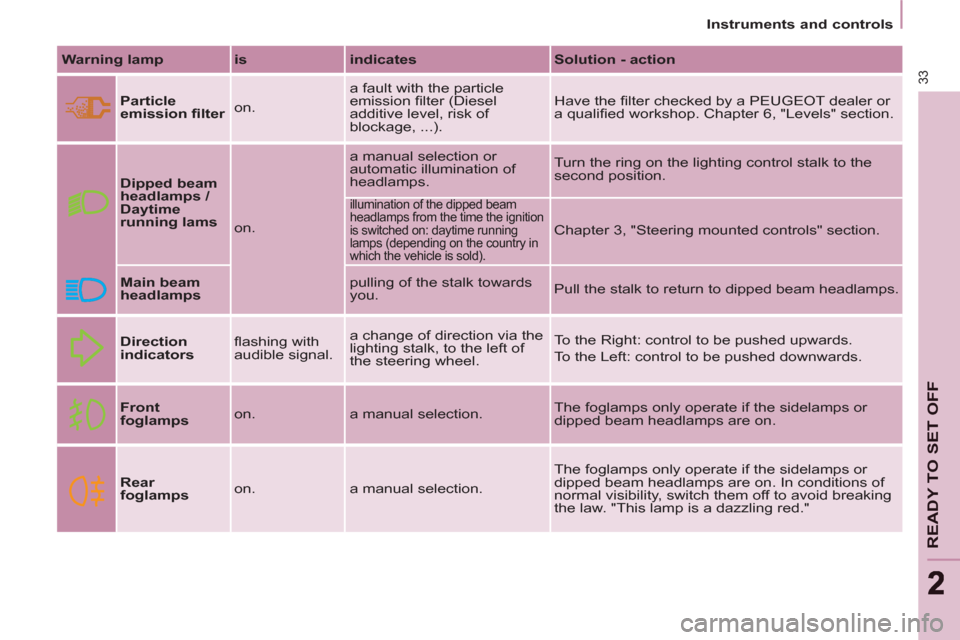
Warning lamp
is
indicates
Solution - action
Particle
emission fi lter
on. a fault with the particle
emission fi lter (Diesel
additive level, risk of
blockage, ...). Have the fi lter checked by a PEUGEOT dealer or
a qualifi ed workshop. Chapter 6, "Levels" section.
Dipped beam
headlamps /
Daytime
running lams
on. a manual selection or
automatic illumination of
headlamps. Turn the ring on the lighting control stalk to the
second position.
illumination of the dipped beam
headlamps from the time the ignition
is switched on: daytime running
lamps (depending on the country in
which the vehicle is sold).
Chapter 3, "Steering mounted controls" section.
Main beam
headlamps
pulling of the stalk towards
you. Pull the stalk to return to dipped beam headlamps.
Direction
indicators
fl ashing with
audible signal. a change of direction via the
lighting stalk, to the left of
the steering wheel. To the Right: control to be pushed upwards.
To the Left: control to be pushed downwards.
Front
foglamps
on. a manual selection. The foglamps only operate if the sidelamps or
dipped beam headlamps are on.
Rear
foglamps
on. a manual selection. The foglamps only operate if the sidelamps or
dipped beam headlamps are on. In conditions of
normal visibility, switch them off to avoid breaking
the law. "This lamp is a dazzling red."
Page 38 of 208
Instruments and controls
36
Puncture
The STOP warning lamp comes on.
Stop as soon as it is safe to do so,
avoiding any sudden movement of the
steering wheel and the brakes.
Make a temporary repair to the tyre
using the puncture repair kit or by
fi tting the spare wheel.
Change the damaged wheel, and have
the tyre pressures checked as soon as
possible.
Sensor(s) fault or not detected
The Service warning lamp comes on.
When changing a wheel or in the
event of a sensor fault, the tyre
pressure is no longer monitored.
Contact a PEUGEOT dealer or a
qualifi ed workshop to replace the faulty
sensor(s).
All repairs and changing of tyres on a
wheel fi tted with this system must be
carried out by a PEUGEOT dealer or a
qualifi ed workshop.
If when changing a tyre, you fi t a
wheel not detected by your vehicle
(for example: fi tting snow tyres), you
must have the system reinitialised
by a PEUGEOT dealer or a qualifi ed
workshop.
The tyre under-infl ation detection
system is a driving aid which does
not take the place of vigilance or the
responsibility of the driver.
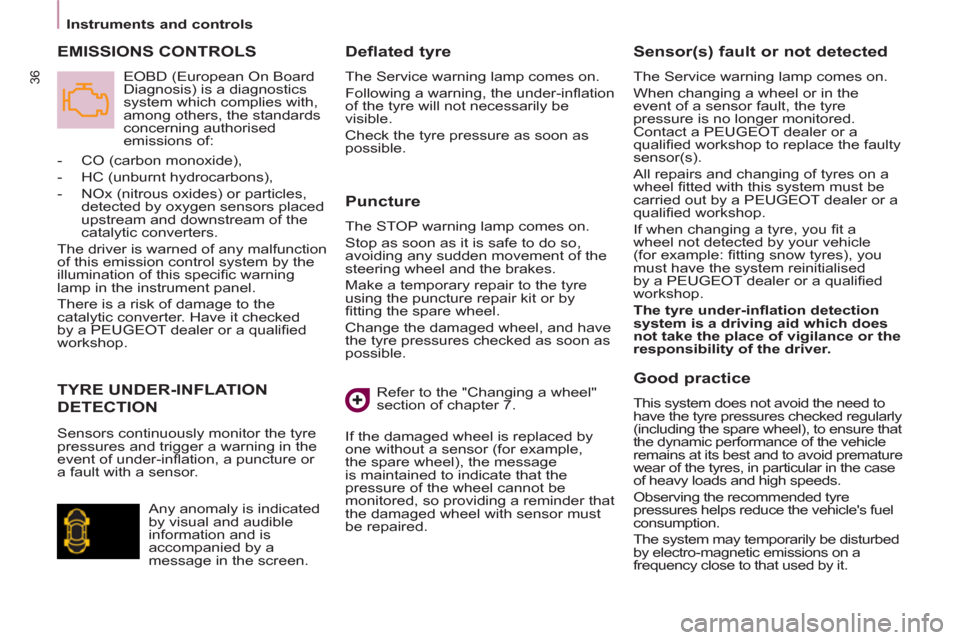
TYRE UNDER-INFLATION
DETECTION
- CO (carbon monoxide),
- HC (unburnt hydrocarbons),
- NOx (nitrous oxides) or particles,
detected by oxygen sensors placed
upstream and downstream of the
catalytic converters.
The driver is warned of any malfunction
of this emission control system by the
illumination of this specifi c warning
lamp in the instrument panel.
There is a risk of damage to the
catalytic converter. Have it checked
by a PEUGEOT dealer or a qualifi ed
workshop.
EMISSIONS CONTROLS
Deflated tyre
The Service warning lamp comes on.
Following a warning, the under-infl ation
of the tyre will not necessarily be
visible.
Check the tyre pressure as soon as
possible.
Refer to the "Changing a wheel"
section of chapter 7.
If the damaged wheel is replaced by
one without a sensor (for example,
the spare wheel), the message
is maintained to indicate that the
pressure of the wheel cannot be
monitored, so providing a reminder that
the damaged wheel with sensor must
be repaired. Sensors continuously monitor the tyre
pressures and trigger a warning in the
event of under-infl ation, a puncture or
a fault with a sensor.
EOBD (European On Board
Diagnosis) is a diagnostics
system which complies with,
among others, the standards
concerning authorised
emissions of:
Any anomaly is indicated
by visual and audible
information and is
accompanied by a
message in the screen.
Good practice
This system does not avoid the need to
have the tyre pressures checked regularly
(including the spare wheel), to ensure that
the dynamic performance of the vehicle
remains at its best and to avoid premature
wear of the tyres, in particular in the case
of heavy loads and high speeds.
Observing the recommended tyre
pressures helps reduce the vehicle's fuel
consumption.
The system may temporarily be disturbed
by electro-magnetic emissions on a
frequency close to that used by it.